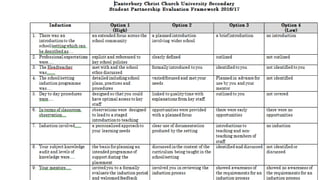
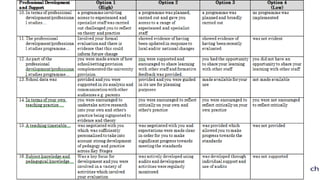
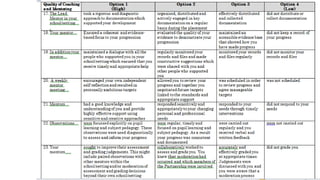
Mentor Development Session A: 21st
September 2017
New Mentor Training Day
21st September 2017
Subject & Professional Mentors
2017-18
 Keith Saunders
 Please sign the register
“Effective mentors are outstanding teachers
who are also skilled in deconstructing and
explaining their practice – outstanding
practitioners are not automatically outstanding
mentors”
Getting started…..
Carter Review, 2014
For discussion:
Objectives of this session:
 Identify your mentoring qualities
 Analyse student perceptions of outstanding
mentoring
 Explore strategies for supporting and developing
student resilience
“Deconstructing practice …”
• If you were asked to deconstruct your
practice, how would you do it? What
are the 3 best features of your own
teaching?
What makes an ‘outstanding’
mentor?
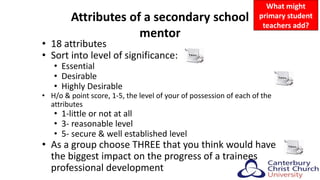
Attributes of a secondary school
mentor
• 18 attributes
• Sort into level of significance:
• Essential
• Desirable
• Highly Desirable
• H/o & point score, 1-5, the level of your of possession of each of the
attributes
• 1-little or not at all
• 3- reasonable level
• 5- secure & well established level
• As a group choose THREE that you think would have
the biggest impact on the progress of a trainees
professional development
What might
primary student
teachers add?
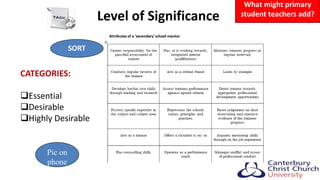
Level of Significance
CATEGORIES:
Essential
Desirable
Highly Desirable
SORT
Pic on
phone
What might primary
student teachers add?
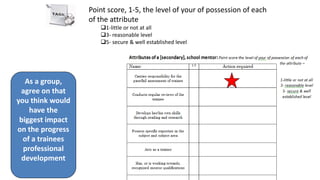
Point score, 1-5, the level of your of possession of each
of the attribute
1-little or not at all
3- reasonable level
5- secure & well established level
As a group,
agree on that
you think would
have the
biggest impact
on the progress
of a trainees
professional
development
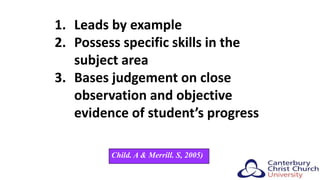
1. Leads by example
2. Possess specific skills in the
subject area
3. Bases judgement on close
observation and objective
evidence of student’s progress
Child. A & Merrill. S, 2005)
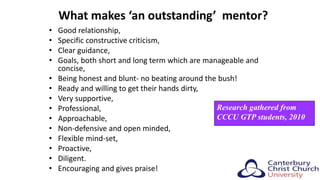
What makes ‘an outstanding’ mentor?
• Good relationship,
• Specific constructive criticism,
• Clear guidance,
• Goals, both short and long term which are manageable and
concise,
• Being honest and blunt- no beating around the bush!
• Ready and willing to get their hands dirty,
• Very supportive,
• Professional,
• Approachable,
• Non-defensive and open minded,
• Flexible mind-set,
• Proactive,
• Diligent.
• Encouraging and gives praise!
Research gathered from
CCCU GTP students, 2010
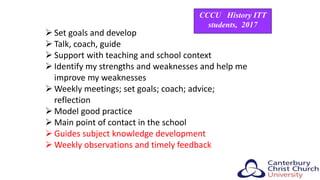
 Set goals and develop
 Talk, coach, guide
 Support with teaching and school context
 Identify my strengths and weaknesses and help me
improve my weaknesses
 Weekly meetings; set goals; coach; advice;
reflection
 Model good practice
 Main point of contact in the school
 Guides subject knowledge development
 Weekly observations and timely feedback
CCCU History ITT
students, 2017
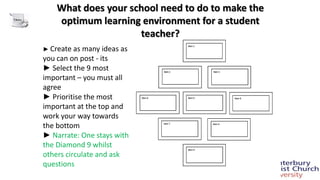
► Create as many ideas as
you can on post - its
► Select the 9 most
important – you must all
agree
► Prioritise the most
important at the top and
work your way towards
the bottom
► Narrate: One stays with
the Diamond 9 whilst
others circulate and ask
questions
What does your school need to do to make the
optimum learning environment for a student
teacher?
(Student) Teacher resilience
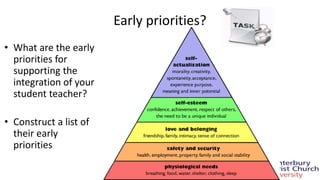
Early priorities?
• What are the early
priorities for
supporting the
integration of your
student teacher?
• Construct a list of
their early
priorities
Teacher resilience
• “teacher resilience is not primarily associated with the capacity
to ‘bounce back’ or recover from highly traumatic experiences
and events but, rather, the capacity to maintain equilibrium
and a sense of commitment and agency in the everyday worlds
in which teachers teach”.
“Teachers Matter”, OECD, 2005
19
20
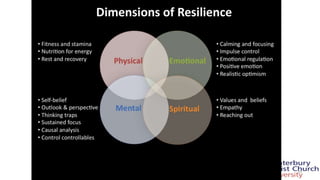
Look after all 4 areas:
“The more resilient ECTs (Early Career Teachers) in our study
were also those who understood the importance of their own
wellbeing in regard to their motivation, how well they coped
and their competence. They worked very hard at nurturing their
wellbeing and tried to establish a realistic work-life balance by
eating well, having family time, exercising, not taking work
home every night, making time for friends, playing sport, setting
aside “no work” time, debriefing, going to bed earlier, limiting
the time they worked at school and making time for
themselves.”
•Johnson et al 2010
21
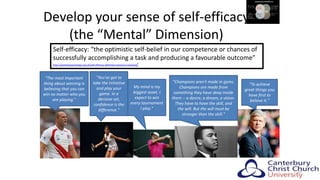
Develop your sense of self-efficacy
(the “Mental” Dimension)
22
Self-efficacy: “the optimistic self-belief in our competence or chances of
successfully accomplishing a task and producing a favourable outcome”
http://positivepsychology.org.uk/self-efficacy-definition-bandura-meaning/
My mind is my
biggest asset. I
expect to win
every tournament
I play."
"Champions aren't made in gyms.
Champions are made from
something they have deep inside
them -- a desire, a dream, a vision.
They have to have the skill, and
the will. But the will must be
stronger than the skill."
"To achieve
great things you
have first to
believe it."
"The most important
thing about winning is
believing that you can
win no matter who you
are playing."
"You've got to
take the initiative
and play your
game. In a
decisive set,
confidence is the
difference."
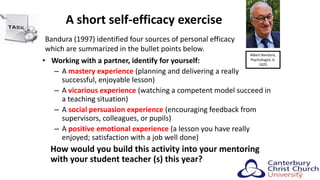
A short self-efficacy exercise
• Working with a partner, identify for yourself:
– A mastery experience (planning and delivering a really
successful, enjoyable lesson)
– A vicarious experience (watching a competent model succeed in
a teaching situation)
– A social persuasion experience (encouraging feedback from
supervisors, colleagues, or pupils)
– A positive emotional experience (a lesson you have really
enjoyed; satisfaction with a job well done)
How would you build this activity into your mentoring
with your student teacher (s) this year?
23
Bandura (1997) identified four sources of personal efficacy
which are summarized in the bullet points below.
Albert Bandura,
Psychologist, b.
1925
Help them maintain their own motivation
and sense of commitment (the “Spiritual”
dimension)
Help them to:
• Remember why they decided to enter the teaching profession
in the first place …..
• Hold on to what is important to them …
• Build their work as a teacher on what they think education is
for …
• Take time to reflect on what they enjoy as a teacher …
24
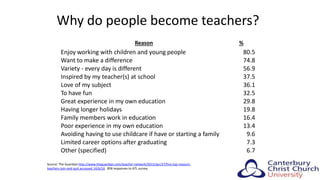
Why do people become teachers?
Reason %
Enjoy working with children and young people 80.5
Want to make a difference 74.8
Variety - every day is different 56.9
Inspired by my teacher(s) at school 37.5
Love of my subject 36.1
To have fun 32.5
Great experience in my own education 29.8
Having longer holidays 19.8
Family members work in education 16.4
Poor experience in my own education 13.4
Avoiding having to use childcare if have or starting a family 9.6
Limited career options after graduating 7.3
Other (specified) 6.7
25
Source: The Guardian http://www.theguardian.com/teacher-network/2015/jan/27/five-top-reasons-
teachers-join-and-quit accessed 14/6/16 858 responses to ATL survey
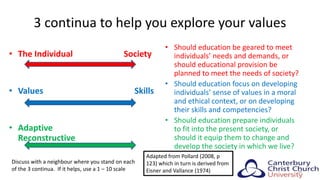
3 continua to help you explore your values
• The Individual Society
• Values Skills
• Adaptive
Reconstructive
• Should education be geared to meet
individuals’ needs and demands, or
should educational provision be
planned to meet the needs of society?
• Should education focus on developing
individuals’ sense of values in a moral
and ethical context, or on developing
their skills and competencies?
• Should education prepare individuals
to fit into the present society, or
should it equip them to change and
develop the society in which we live?
Adapted from Pollard (2008, p
123) which in turn is derived from
Eisner and Vallance (1974)
Discuss with a neighbour where you stand on each
of the 3 continua. If it helps, use a 1 – 10 scale 26
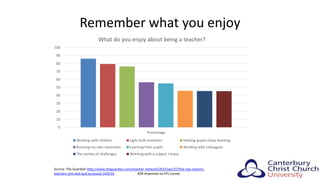
Remember what you enjoy
0
10
20
30
40
50
60
70
80
90
100
Percentage
What do you enjoy about being a teacher?
Working with children Light bulb moments Helping pupils enjoy learning
Running my own classroom Learning from pupils Working with colleagues
The variety of challenges Working with a subject I enjoy
Source: The Guardian http://www.theguardian.com/teacher-network/2015/jan/27/five-top-reasons-
teachers-join-and-quit accessed 14/6/16 858 responses to ATL survey 27
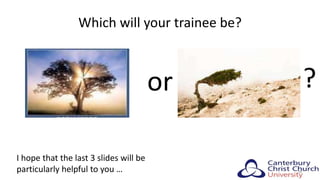
Which will your trainee be?
or ?
I hope that the last 3 slides will be
particularly helpful to you … 28
Sources of support
• Tutors and mentors
• Friends and family
• Teacher support network (now Education Support network):
https://www.educationsupportpartnership.org.uk/ )
• Canterbury Student support
www.canterbury.ac.uk/students/support-services/support-
services.aspx 01227 782675
• Join a union
29
Further reading
• Pollard, A et al (3rd Ed. 2008) Reflective Teaching. Continuum:
London (esp. Chapter 5: Values and identity. Who are we?)
• Muijs, D. and Reynolds, D (3rd Ed. 2011) Effective Teaching:
Evidence and Practice. Sage: London (esp. Chapter 6: Teacher
Beliefs, Values and Knowledge)
• Any of the articles mentioned in the preceding slides
30
Follow-up activities
• Carry out a self-efficacy activity regularly (e.g. each week or each
half-term), reflecting on what you have seen or done that has been
successful – use the Bandura framework on slide 11.
• Regularly reflect (e.g. in your Learning Journal) how your practice
or the practice around you matches your values
• Remember the 4th dimension: family, friends, ‘no work’ time,
exercise, good nutrition, sleep.
• Watch Julian Treasure’s TED talk on how to remain positive and
make the right impression, at
https://www.ted.com/talks/julian_treasure_how_to_speak_so_tha
t_people_want_to_listen?language=en
31
Mentor website
Please also make use of the Mentor website:
http://www.canterbury.ac.uk/education/ment
ors/
username – cccu-mentors
password – CCCUmentors

Mentor training 21 9-17

  • 1.
    Mentor Development SessionA: 21st September 2017
  • 2.
    New Mentor TrainingDay 21st September 2017 Subject & Professional Mentors 2017-18  Keith Saunders  Please sign the register
  • 3.
    “Effective mentors areoutstanding teachers who are also skilled in deconstructing and explaining their practice – outstanding practitioners are not automatically outstanding mentors” Getting started….. Carter Review, 2014 For discussion:
  • 4.
    Objectives of thissession:  Identify your mentoring qualities  Analyse student perceptions of outstanding mentoring  Explore strategies for supporting and developing student resilience
  • 5.
    “Deconstructing practice …” •If you were asked to deconstruct your practice, how would you do it? What are the 3 best features of your own teaching?
  • 6.
    What makes an‘outstanding’ mentor?
  • 7.
    Attributes of asecondary school mentor • 18 attributes • Sort into level of significance: • Essential • Desirable • Highly Desirable • H/o & point score, 1-5, the level of your of possession of each of the attributes • 1-little or not at all • 3- reasonable level • 5- secure & well established level • As a group choose THREE that you think would have the biggest impact on the progress of a trainees professional development What might primary student teachers add?
  • 8.
    Level of Significance CATEGORIES: Essential Desirable HighlyDesirable SORT Pic on phone What might primary student teachers add?
  • 9.
    Point score, 1-5,the level of your of possession of each of the attribute 1-little or not at all 3- reasonable level 5- secure & well established level As a group, agree on that you think would have the biggest impact on the progress of a trainees professional development
  • 10.
    1. Leads byexample 2. Possess specific skills in the subject area 3. Bases judgement on close observation and objective evidence of student’s progress Child. A & Merrill. S, 2005)
  • 11.
    What makes ‘anoutstanding’ mentor? • Good relationship, • Specific constructive criticism, • Clear guidance, • Goals, both short and long term which are manageable and concise, • Being honest and blunt- no beating around the bush! • Ready and willing to get their hands dirty, • Very supportive, • Professional, • Approachable, • Non-defensive and open minded, • Flexible mind-set, • Proactive, • Diligent. • Encouraging and gives praise! Research gathered from CCCU GTP students, 2010
  • 12.
     Set goalsand develop  Talk, coach, guide  Support with teaching and school context  Identify my strengths and weaknesses and help me improve my weaknesses  Weekly meetings; set goals; coach; advice; reflection  Model good practice  Main point of contact in the school  Guides subject knowledge development  Weekly observations and timely feedback CCCU History ITT students, 2017
  • 16.
    ► Create asmany ideas as you can on post - its ► Select the 9 most important – you must all agree ► Prioritise the most important at the top and work your way towards the bottom ► Narrate: One stays with the Diamond 9 whilst others circulate and ask questions What does your school need to do to make the optimum learning environment for a student teacher?
  • 17.
  • 18.
    Early priorities? • Whatare the early priorities for supporting the integration of your student teacher? • Construct a list of their early priorities
  • 19.
    Teacher resilience • “teacherresilience is not primarily associated with the capacity to ‘bounce back’ or recover from highly traumatic experiences and events but, rather, the capacity to maintain equilibrium and a sense of commitment and agency in the everyday worlds in which teachers teach”. “Teachers Matter”, OECD, 2005 19
  • 20.
  • 21.
    Look after all4 areas: “The more resilient ECTs (Early Career Teachers) in our study were also those who understood the importance of their own wellbeing in regard to their motivation, how well they coped and their competence. They worked very hard at nurturing their wellbeing and tried to establish a realistic work-life balance by eating well, having family time, exercising, not taking work home every night, making time for friends, playing sport, setting aside “no work” time, debriefing, going to bed earlier, limiting the time they worked at school and making time for themselves.” •Johnson et al 2010 21
  • 22.
    Develop your senseof self-efficacy (the “Mental” Dimension) 22 Self-efficacy: “the optimistic self-belief in our competence or chances of successfully accomplishing a task and producing a favourable outcome” http://positivepsychology.org.uk/self-efficacy-definition-bandura-meaning/ My mind is my biggest asset. I expect to win every tournament I play." "Champions aren't made in gyms. Champions are made from something they have deep inside them -- a desire, a dream, a vision. They have to have the skill, and the will. But the will must be stronger than the skill." "To achieve great things you have first to believe it." "The most important thing about winning is believing that you can win no matter who you are playing." "You've got to take the initiative and play your game. In a decisive set, confidence is the difference."
  • 23.
    A short self-efficacyexercise • Working with a partner, identify for yourself: – A mastery experience (planning and delivering a really successful, enjoyable lesson) – A vicarious experience (watching a competent model succeed in a teaching situation) – A social persuasion experience (encouraging feedback from supervisors, colleagues, or pupils) – A positive emotional experience (a lesson you have really enjoyed; satisfaction with a job well done) How would you build this activity into your mentoring with your student teacher (s) this year? 23 Bandura (1997) identified four sources of personal efficacy which are summarized in the bullet points below. Albert Bandura, Psychologist, b. 1925
  • 24.
    Help them maintaintheir own motivation and sense of commitment (the “Spiritual” dimension) Help them to: • Remember why they decided to enter the teaching profession in the first place ….. • Hold on to what is important to them … • Build their work as a teacher on what they think education is for … • Take time to reflect on what they enjoy as a teacher … 24
  • 25.
    Why do peoplebecome teachers? Reason % Enjoy working with children and young people 80.5 Want to make a difference 74.8 Variety - every day is different 56.9 Inspired by my teacher(s) at school 37.5 Love of my subject 36.1 To have fun 32.5 Great experience in my own education 29.8 Having longer holidays 19.8 Family members work in education 16.4 Poor experience in my own education 13.4 Avoiding having to use childcare if have or starting a family 9.6 Limited career options after graduating 7.3 Other (specified) 6.7 25 Source: The Guardian http://www.theguardian.com/teacher-network/2015/jan/27/five-top-reasons- teachers-join-and-quit accessed 14/6/16 858 responses to ATL survey
  • 26.
    3 continua tohelp you explore your values • The Individual Society • Values Skills • Adaptive Reconstructive • Should education be geared to meet individuals’ needs and demands, or should educational provision be planned to meet the needs of society? • Should education focus on developing individuals’ sense of values in a moral and ethical context, or on developing their skills and competencies? • Should education prepare individuals to fit into the present society, or should it equip them to change and develop the society in which we live? Adapted from Pollard (2008, p 123) which in turn is derived from Eisner and Vallance (1974) Discuss with a neighbour where you stand on each of the 3 continua. If it helps, use a 1 – 10 scale 26
  • 27.
    Remember what youenjoy 0 10 20 30 40 50 60 70 80 90 100 Percentage What do you enjoy about being a teacher? Working with children Light bulb moments Helping pupils enjoy learning Running my own classroom Learning from pupils Working with colleagues The variety of challenges Working with a subject I enjoy Source: The Guardian http://www.theguardian.com/teacher-network/2015/jan/27/five-top-reasons- teachers-join-and-quit accessed 14/6/16 858 responses to ATL survey 27
  • 28.
    Which will yourtrainee be? or ? I hope that the last 3 slides will be particularly helpful to you … 28
  • 29.
    Sources of support •Tutors and mentors • Friends and family • Teacher support network (now Education Support network): https://www.educationsupportpartnership.org.uk/ ) • Canterbury Student support www.canterbury.ac.uk/students/support-services/support- services.aspx 01227 782675 • Join a union 29
  • 30.
    Further reading • Pollard,A et al (3rd Ed. 2008) Reflective Teaching. Continuum: London (esp. Chapter 5: Values and identity. Who are we?) • Muijs, D. and Reynolds, D (3rd Ed. 2011) Effective Teaching: Evidence and Practice. Sage: London (esp. Chapter 6: Teacher Beliefs, Values and Knowledge) • Any of the articles mentioned in the preceding slides 30
  • 31.
    Follow-up activities • Carryout a self-efficacy activity regularly (e.g. each week or each half-term), reflecting on what you have seen or done that has been successful – use the Bandura framework on slide 11. • Regularly reflect (e.g. in your Learning Journal) how your practice or the practice around you matches your values • Remember the 4th dimension: family, friends, ‘no work’ time, exercise, good nutrition, sleep. • Watch Julian Treasure’s TED talk on how to remain positive and make the right impression, at https://www.ted.com/talks/julian_treasure_how_to_speak_so_tha t_people_want_to_listen?language=en 31
  • 32.
    Mentor website Please alsomake use of the Mentor website: http://www.canterbury.ac.uk/education/ment ors/ username – cccu-mentors password – CCCUmentors

Editor's Notes

  • #6 Mention the MDP sessions!
  • #14 Is there a correlation between the student teachers’ perception of a good mentor, and ours?
  • #19 GOAL: Prompt mentor so discuss on their table what they think these priorities (for themselves as mentors for their mentees) Construct a list of early priorities (term 1 and into term 2) – see also the section in the PEF on induction!!! KEY QUESTIONS: How ready and able are they to learn to begin with? If there are personal, social or economic concerns then who does this impact on their ability to make progress? PROMPTS: How are they coping with their living arrangements How are they connecting with the wider staff and facilities? Have they figured out how to drink enough water and still use the facilities during the day? Are they sleeping? Do they eat? Are they getting emotional feedback from you and your colleagues? How confident/competent are they feeling? SEGWAY: How do you learn what your student teacher is actually prioritising?
  • #22 Discuss in pairs how well they achieve this???