Epistemicinsight.com
LASAR@Canterbury.ac.uk
The Epistemic Insight Initiative
Dr Berry Billingsley, Professor of Science Education
Epistemicinsight.com
LASAR@Canterbury.ac.uk
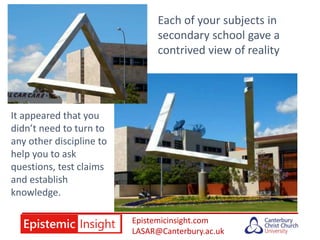
This is an “impossible
triangle” … but this
one is ‘real’ – it’s in
Perth!
Epistemicinsight.com
LASAR@Canterbury.ac.uk
Each of your subjects in
secondary school gave a
contrived view of reality
It appeared that you
didn’t need to turn to
any other discipline to
help you to ask
questions, test claims
and establish
knowledge.
Epistemicinsight.com
LASAR@Canterbury.ac.uk
Epistemic Insight
• Knowledge about knowledge –
particularly knowledge about disciplines
and how they interact
• ‘It’s not just cross-curricular’ – it means
going beyond topic work to recognise
the distinctive questions, methods and
norms of thought of different disciplines.
Epistemicinsight.com
LASAR@Canterbury.ac.uk
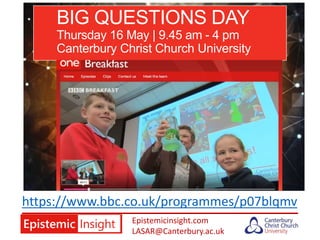
https://www.bbc.co.uk/programmes/p07blqmv
BIG QUESTIONS DAY
Thursday 16 May | 9.45 am - 4 pm
Canterbury Christ Church University
Epistemicinsight.com
LASAR@Canterbury.ac.uk
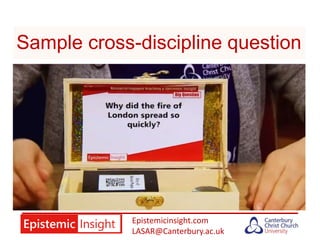
Sample cross-discipline question
Epistemicinsight.com
LASAR@Canterbury.ac.uk
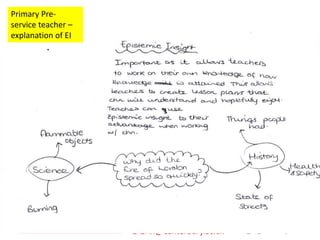
Primary Pre-
service teacher –
explanation of EI
Epistemicinsight.com
LASAR@Canterbury.ac.uk
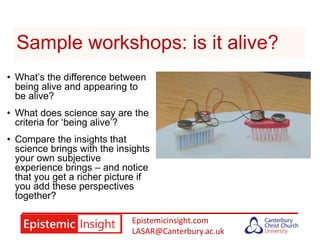
Sample workshops: is it alive?
• What’s the difference between
being alive and appearing to
be alive?
• What does science say are the
criteria for ‘being alive’?
• Compare the insights that
science brings with the insights
your own subjective
experience brings – and notice
that you get a richer picture if
you add these perspectives
together?
Epistemicinsight.com
LASAR@Canterbury.ac.uk
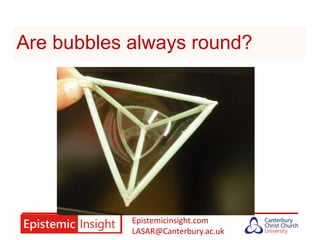
Are bubbles always round?
Epistemicinsight.com
LASAR@Canterbury.ac.uk
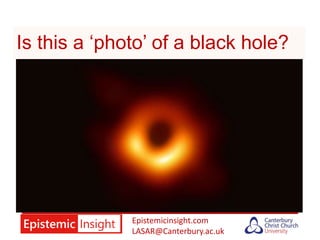
Is this a ‘photo’ of a black hole?
Epistemicinsight.com
LASAR@Canterbury.ac.uk
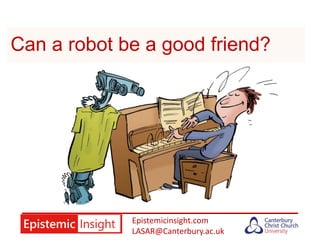
Can a robot be a good friend?
Epistemicinsight.com
LASAR@Canterbury.ac.uk
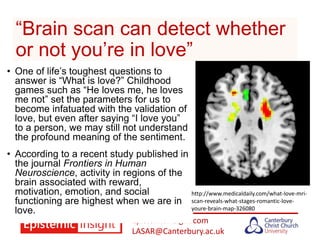
“Brain scan can detect whether
or not you’re in love”
• One of life’s toughest questions to
answer is “What is love?” Childhood
games such as “He loves me, he loves
me not” set the parameters for us to
become infatuated with the validation of
love, but even after saying “I love you”
to a person, we may still not understand
the profound meaning of the sentiment.
• According to a recent study published in
the journal Frontiers in Human
Neuroscience, activity in regions of the
brain associated with reward,
motivation, emotion, and social
functioning are highest when we are in
love.
http://www.medicaldaily.com/what-love-mri-
scan-reveals-what-stages-romantic-love-
youre-brain-map-326080
Epistemicinsight.com
LASAR@Canterbury.ac.uk
Epistemicinsight.com
LASAR@Canterbury.ac.uk
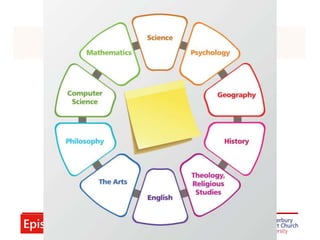
What is science?
What is a science question?
Epistemicinsight.com
LASAR@Canterbury.ac.uk 15
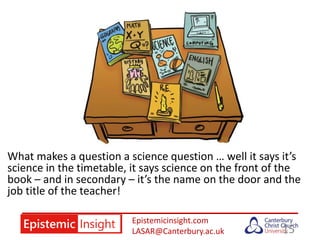
What makes a question a science question … well it says it’s
science in the timetable, it says science on the front of the
book – and in secondary – it’s the name on the door and the
job title of the teacher!
Epistemicinsight.com
LASAR@Canterbury.ac.uk
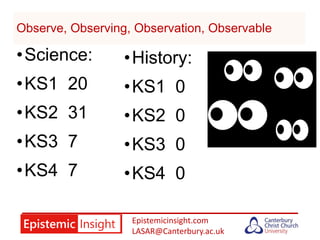
Observe, Observing, Observation, Observable
•History:
•KS1 0
•KS2 0
•KS3 0
•KS4 0
•Science:
•KS1 20
•KS2 31
•KS3 7
•KS4 7
Epistemicinsight.com
LASAR@Canterbury.ac.uk
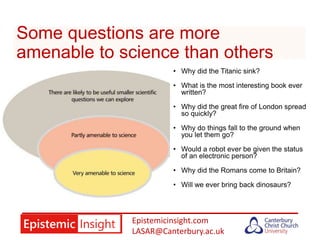
Some questions are more
amenable to science than others
• Why did the Titanic sink?
• What is the most interesting book ever
written?
• Why did the great fire of London spread
so quickly?
• Why do things fall to the ground when
you let them go?
• Would a robot ever be given the status
of an electronic person?
• Why did the Romans come to Britain?
• Will we ever bring back dinosaurs?
Epistemicinsight.com
LASAR@Canterbury.ac.uk
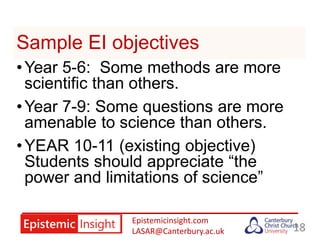
Sample EI objectives
•Year 5-6: Some methods are more
scientific than others.
•Year 7-9: Some questions are more
amenable to science than others.
•YEAR 10-11 (existing objective)
Students should appreciate “the
power and limitations of science”
18
Epistemicinsight.com
LASAR@Canterbury.ac.uk
Quotes and stats from our
previous research in
secondary schools. These
findings motivated our new
focus ….
Epistemicinsight.com
LASAR@Canterbury.ac.uk
Teachers
• Mr A (science): “we’ve had no cross-curricular
sessions here since I’ve been here – which is
(pause) 19 years. [laughs] I think they may be
useful, so that at least we know what [the] teacher
there is teaching.”
• Mr B (Science): “There is no relationship between
Religious Studies and science ... it is very hard for
pupils to actually see where those two can work
together.”
• Mr D (RE): “I’m not terribly familiar with the
science curriculum; I don’t think they’re terribly
familiar with mine.”
Epistemicinsight.com
LASAR@Canterbury.ac.uk
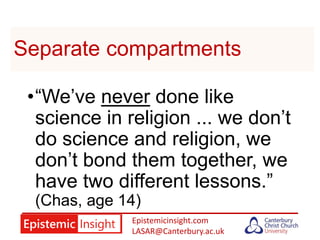
Separate compartments
•“We’ve never done like
science in religion ... we don’t
do science and religion, we
don’t bond them together, we
have two different lessons.”
(Chas, age 14)
Epistemicinsight.com
LASAR@Canterbury.ac.uk
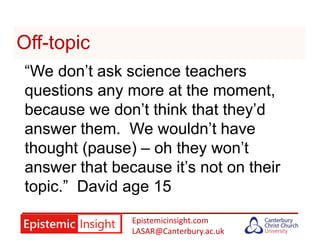
Off-topic
“We don’t ask science teachers
questions any more at the moment,
because we don’t think that they’d
answer them. We wouldn’t have
thought (pause) – oh they won’t
answer that because it’s not on their
topic.” David age 15
Epistemicinsight.com
LASAR@Canterbury.ac.uk
Science teachers avoid questions
“They’ve never put religion and
science together” and that “I
think like the science teachers
... do try and like avoid them
[questions].”
Epistemicinsight.com
LASAR@Canterbury.ac.uk
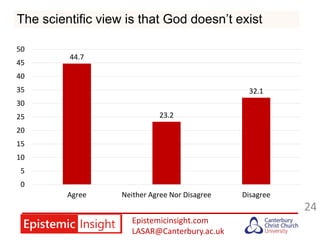
The scientific view is that God doesn’t exist
24
44.7
23.2
32.1
0
5
10
15
20
25
30
35
40
45
50
Agree Neither Agree Nor Disagree Disagree
Epistemicinsight.com
LASAR@Canterbury.ac.uk
www.epistemicinsight.com
25

Epistemic Insight

Editor's Notes

  • #5 Epistemic insight is both an intellectual virtue and a pedagogical approach. As a virtue it refers to students’ “knowledge about knowledge”, in particular their scholarly expertise and capacities to be wise about how knowledge is/can be formed and tested. It moves beyond topic work through recognising the distinctiveness of and interaction between the disciplines. So why are we arguing that epistemic insight is so important in the digital age?