
Mental Illness
The great misunderstanding
within society.
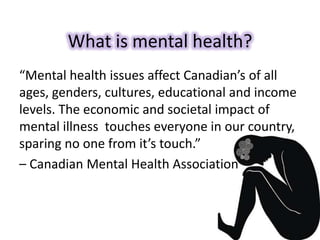
What is mental health?
“Mental health issues affect Canadian’s of all
ages, genders, cultures, educational and income
levels. The economic and societal impact of
mental illness touches everyone in our country,
sparing no one from it’s touch.”
– Canadian Mental Health Association
Mental Health:
• Alterations in thinking, mood or behaviour
• Impaired functioning over an extended period of
time.
• 1/5 Canadians under the age of 65 will suffer
from a mental health problem
• Most mental illnesses are chronic, in other words,
life-long. However, they are not always active.
• With treatment and support, the symptoms of
mental illness are treatable and the disease can
go into remission.
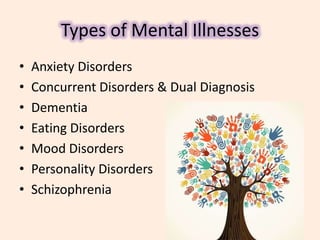
Types of Mental Illnesses
• Anxiety Disorders
• Concurrent Disorders & Dual Diagnosis
• Dementia
• Eating Disorders
• Mood Disorders
• Personality Disorders
• Schizophrenia
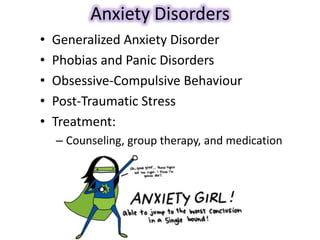
Anxiety Disorders
• Generalized Anxiety Disorder
• Phobias and Panic Disorders
• Obsessive-Compulsive Behaviour
• Post-Traumatic Stress
• Treatment:
– Counseling, group therapy, and medication
Concurrent Disorders & Dual Diagnosis
• Concurrent Disorders:
– Mental illness paired with a substance abuse of
drugs, alcohol, or gambling
– 1/3 of people with a mental illness also have a
substance use problem
– 1/3 of people with alcohol dependency also have
a psychiatric problem
• Dual Diagnosis:
– Someone coping with a developmental disability
as well as a mental illness
Dementia
• General decline in a person’s mental function
• Trouble with memory, language, simple
calculations, planning and judgment.
• Can be caused as a result of head injury, low
oxygen levels, cardiovascular conditions, or
drug/alcohol abuse medical conditions.
• Treatment:
– Rehabilitation and supportive care
Eating Disorders
• Anorexia Nervosa
– Extreme food reduction with severe weight loss
• Bulimia Nervosa
– A cycle of binge eating and purging of food by induced
vomiting or through use of laxatives and/or diuretics
• Binge Eating
– Cyclical bouts of compulsive eating followed by
chronic dieting
• Treatment:
– individual and group therapy has been beneficial
as well as family therapy
Mood Disorders
• Depression
– Sever and persistent feelings of worthlessness, self-
blame and sadness
– Treatment: medication and counseling
• Bipolar Disorder
– Manic depression
– Periods of serious depression, then periods of
extreme irritability and euphoric highs
– Treatment: medication and psychotherapy
• Seasonal Affective Disorder (SAD)
– Depression that appears to follow a seasonal pattern ,
typically experienced in the winter
– Treatment: light therapy, increased exposure sunlight,
exercise, antidepressants and counseling
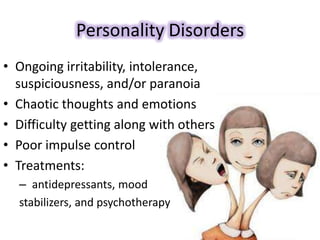
Personality Disorders
• Ongoing irritability, intolerance,
suspiciousness, and/or paranoia
• Chaotic thoughts and emotions
• Difficulty getting along with others
• Poor impulse control
• Treatments:
– antidepressants, mood
stabilizers, and psychotherapy
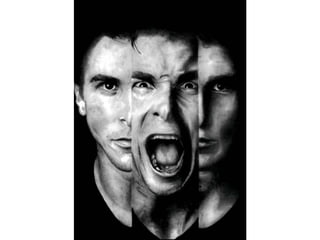
Schizophrenia
• A lifelong disease that impairs a person’s ability to
differentiate between what is real and what is not
• Symptoms usually include psychotic episodes
where the person suffers from hallucinations,
delusions, and paranoia
• Affects approximately 1% of the Canadian
population
• Treatment:
– Medication and counselling
– Can greatly reduce and possibly avoid psychotic
episodes
At A Glance: Schizophrenia
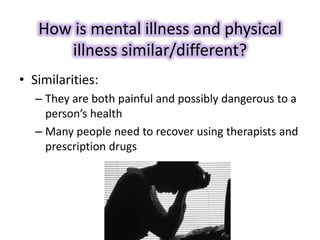
How is mental illness and physical
illness similar/different?
• Similarities:
– They are both painful and possibly dangerous to a
person’s health
– Many people need to recover using therapists and
prescription drugs
How is mental illness and physical
illness similar/different?
• Differences:
– Public Opinion; mental illness seems to be a
“hush hush” situation, people don’t want to
discuss going to therapists for depression but will
happily see a doctor for a broken arm.
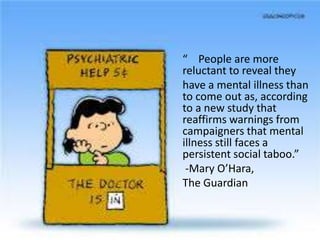
“ People are more
reluctant to reveal they
have a mental illness than
to come out as, according
to a new study that
reaffirms warnings from
campaigners that mental
illness still faces a
persistent social taboo.”
-Mary O’Hara,
The Guardian
Sociological Theories
Structural Functionalism:
• Recognizing mental illness means upholding values
of conforming behaviour
Symbolic Interactionalism:
• People with mental illness are treated irresponsibly
and are denied access to normal activities
• These people get socialized into mental patient
culture and therefore take on an identity of a
mental patient
Sociological Theories
Conflict Theory:
• Those who have the least resources in society
are more likely to have a mental illness
• People who have more resources are properly
cared for while those who are underprivileged
are less likely to receive proper treatment
Equality
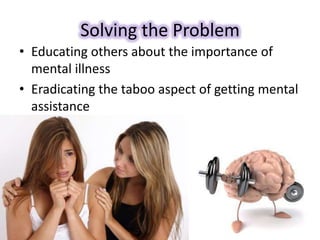
Solving the Problem
• Educating others about the importance of
mental illness
• Eradicating the taboo aspect of getting mental
assistance
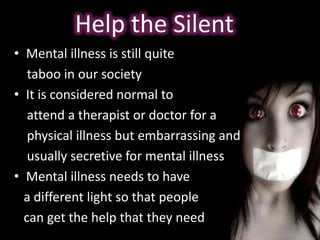
• Mental illness is still quite
taboo in our society
• It is considered normal to
attend a therapist or doctor for a
physical illness but embarrassing and
usually secretive for mental illness
• Mental illness needs to have
a different light so that people
can get the help that they need
Help the Silent
You don’t have to be alone; let
someone help you.
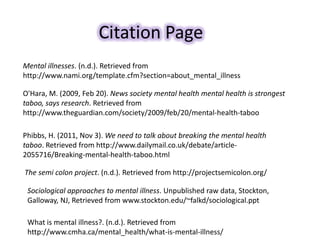
Citation Page
What is mental illness?. (n.d.). Retrieved from
http://www.cmha.ca/mental_health/what-is-mental-illness/
O'Hara, M. (2009, Feb 20). News society mental health mental health is strongest
taboo, says research. Retrieved from
http://www.theguardian.com/society/2009/feb/20/mental-health-taboo
The semi colon project. (n.d.). Retrieved from http://projectsemicolon.org/
Mental illnesses. (n.d.). Retrieved from
http://www.nami.org/template.cfm?section=about_mental_illness
Phibbs, H. (2011, Nov 3). We need to talk about breaking the mental health
taboo. Retrieved from http://www.dailymail.co.uk/debate/article-
2055716/Breaking-mental-health-taboo.html
Sociological approaches to mental illness. Unpublished raw data, Stockton,
Galloway, NJ, Retrieved from www.stockton.edu/~falkd/sociological.ppt
Presentation
• Student: Samantha Roughley
• Student #: 200267202
• Course: GNED2057

Mental Illness; A Misunderstanding Within Society

  • 1.
    Mental Illness The greatmisunderstanding within society.
  • 3.
    What is mentalhealth? “Mental health issues affect Canadian’s of all ages, genders, cultures, educational and income levels. The economic and societal impact of mental illness touches everyone in our country, sparing no one from it’s touch.” – Canadian Mental Health Association
  • 4.
    Mental Health: • Alterationsin thinking, mood or behaviour • Impaired functioning over an extended period of time. • 1/5 Canadians under the age of 65 will suffer from a mental health problem • Most mental illnesses are chronic, in other words, life-long. However, they are not always active. • With treatment and support, the symptoms of mental illness are treatable and the disease can go into remission.
  • 5.
    Types of MentalIllnesses • Anxiety Disorders • Concurrent Disorders & Dual Diagnosis • Dementia • Eating Disorders • Mood Disorders • Personality Disorders • Schizophrenia
  • 6.
    Anxiety Disorders • GeneralizedAnxiety Disorder • Phobias and Panic Disorders • Obsessive-Compulsive Behaviour • Post-Traumatic Stress • Treatment: – Counseling, group therapy, and medication
  • 7.
    Concurrent Disorders &Dual Diagnosis • Concurrent Disorders: – Mental illness paired with a substance abuse of drugs, alcohol, or gambling – 1/3 of people with a mental illness also have a substance use problem – 1/3 of people with alcohol dependency also have a psychiatric problem • Dual Diagnosis: – Someone coping with a developmental disability as well as a mental illness
  • 8.
    Dementia • General declinein a person’s mental function • Trouble with memory, language, simple calculations, planning and judgment. • Can be caused as a result of head injury, low oxygen levels, cardiovascular conditions, or drug/alcohol abuse medical conditions. • Treatment: – Rehabilitation and supportive care
  • 9.
    Eating Disorders • AnorexiaNervosa – Extreme food reduction with severe weight loss • Bulimia Nervosa – A cycle of binge eating and purging of food by induced vomiting or through use of laxatives and/or diuretics • Binge Eating – Cyclical bouts of compulsive eating followed by chronic dieting • Treatment: – individual and group therapy has been beneficial as well as family therapy
  • 10.
    Mood Disorders • Depression –Sever and persistent feelings of worthlessness, self- blame and sadness – Treatment: medication and counseling • Bipolar Disorder – Manic depression – Periods of serious depression, then periods of extreme irritability and euphoric highs – Treatment: medication and psychotherapy • Seasonal Affective Disorder (SAD) – Depression that appears to follow a seasonal pattern , typically experienced in the winter – Treatment: light therapy, increased exposure sunlight, exercise, antidepressants and counseling
  • 11.
    Personality Disorders • Ongoingirritability, intolerance, suspiciousness, and/or paranoia • Chaotic thoughts and emotions • Difficulty getting along with others • Poor impulse control • Treatments: – antidepressants, mood stabilizers, and psychotherapy
  • 12.
    Schizophrenia • A lifelongdisease that impairs a person’s ability to differentiate between what is real and what is not • Symptoms usually include psychotic episodes where the person suffers from hallucinations, delusions, and paranoia • Affects approximately 1% of the Canadian population • Treatment: – Medication and counselling – Can greatly reduce and possibly avoid psychotic episodes
  • 14.
    At A Glance:Schizophrenia
  • 15.
    How is mentalillness and physical illness similar/different? • Similarities: – They are both painful and possibly dangerous to a person’s health – Many people need to recover using therapists and prescription drugs
  • 16.
    How is mentalillness and physical illness similar/different? • Differences: – Public Opinion; mental illness seems to be a “hush hush” situation, people don’t want to discuss going to therapists for depression but will happily see a doctor for a broken arm.
  • 17.
    “ People aremore reluctant to reveal they have a mental illness than to come out as, according to a new study that reaffirms warnings from campaigners that mental illness still faces a persistent social taboo.” -Mary O’Hara, The Guardian
  • 18.
    Sociological Theories Structural Functionalism: •Recognizing mental illness means upholding values of conforming behaviour Symbolic Interactionalism: • People with mental illness are treated irresponsibly and are denied access to normal activities • These people get socialized into mental patient culture and therefore take on an identity of a mental patient
  • 19.
    Sociological Theories Conflict Theory: •Those who have the least resources in society are more likely to have a mental illness • People who have more resources are properly cared for while those who are underprivileged are less likely to receive proper treatment
  • 20.
  • 21.
    Solving the Problem •Educating others about the importance of mental illness • Eradicating the taboo aspect of getting mental assistance
  • 23.
    • Mental illnessis still quite taboo in our society • It is considered normal to attend a therapist or doctor for a physical illness but embarrassing and usually secretive for mental illness • Mental illness needs to have a different light so that people can get the help that they need Help the Silent
  • 24.
    You don’t haveto be alone; let someone help you.
  • 25.
    Citation Page What ismental illness?. (n.d.). Retrieved from http://www.cmha.ca/mental_health/what-is-mental-illness/ O'Hara, M. (2009, Feb 20). News society mental health mental health is strongest taboo, says research. Retrieved from http://www.theguardian.com/society/2009/feb/20/mental-health-taboo The semi colon project. (n.d.). Retrieved from http://projectsemicolon.org/ Mental illnesses. (n.d.). Retrieved from http://www.nami.org/template.cfm?section=about_mental_illness Phibbs, H. (2011, Nov 3). We need to talk about breaking the mental health taboo. Retrieved from http://www.dailymail.co.uk/debate/article- 2055716/Breaking-mental-health-taboo.html Sociological approaches to mental illness. Unpublished raw data, Stockton, Galloway, NJ, Retrieved from www.stockton.edu/~falkd/sociological.ppt
  • 26.
    Presentation • Student: SamanthaRoughley • Student #: 200267202 • Course: GNED2057