Mental Health
What’s the issue, what are we doing and what have we learned
Lindsay Rodgers
Breakdown
• What is mental health & illness
• The difference with mental health
and mental illness
• What are we doing to prevent it
• What we have learned in 5 steps
• The Stigma
• The conflict theory with mental
illness
The Impact
• What is mental health? a person’s condition with regard to their psychological
and emotional well-being.
• What is mental illness? Mental illness refers to a wide range of mental
health conditions —disorders that affect your mood, thinking and behavior.
Examples of mental illness include depression, anxiety disorders, schizophrenia,
eating disorders and addictive behaviors.
Mayo Foundation, 1998-2016
The Differences
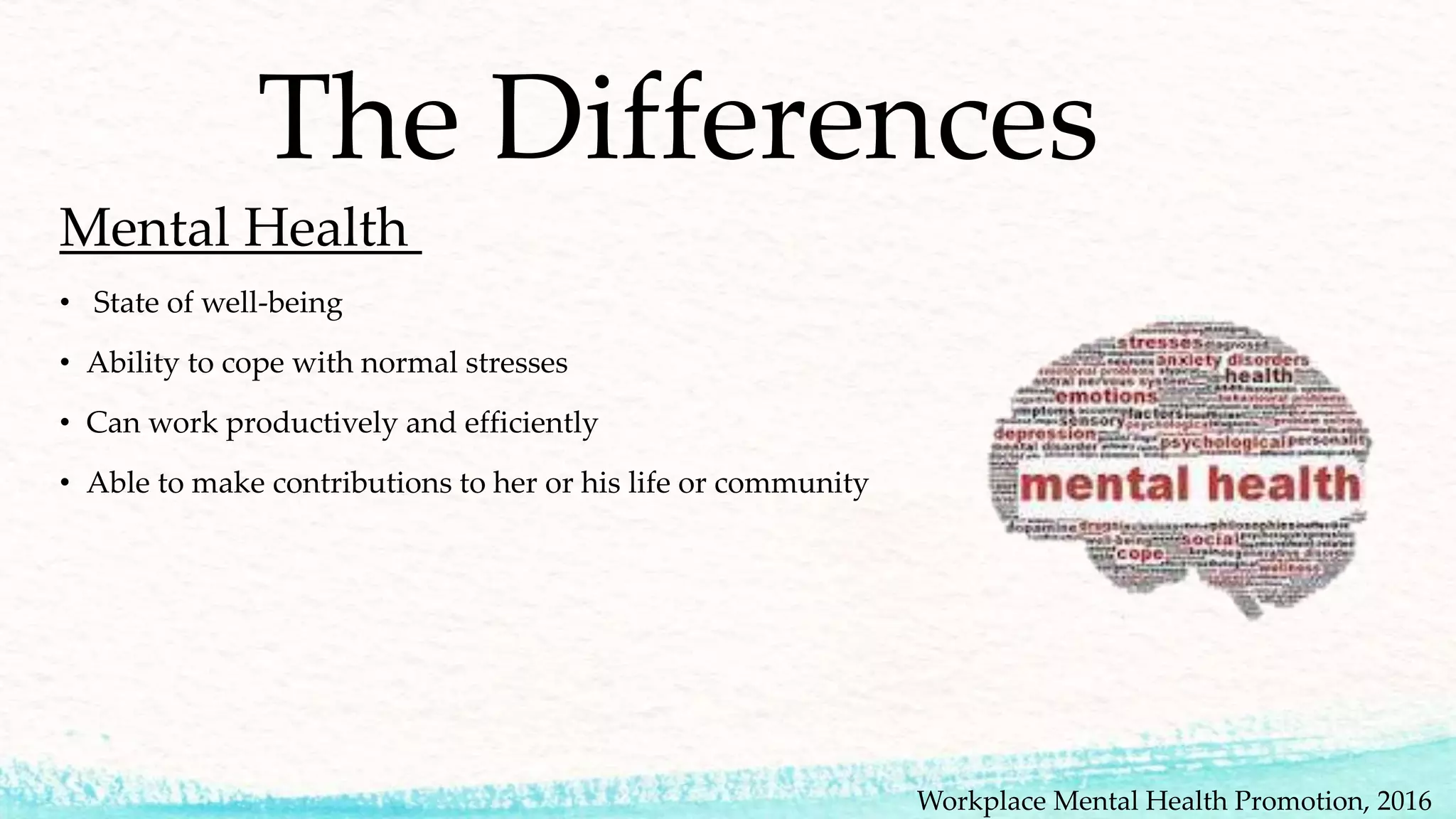
Mental Health
• State of well-being
• Ability to cope with normal stresses
• Can work productively and efficiently
• Able to make contributions to her or his life or community
Workplace Mental Health Promotion, 2016
The Differences
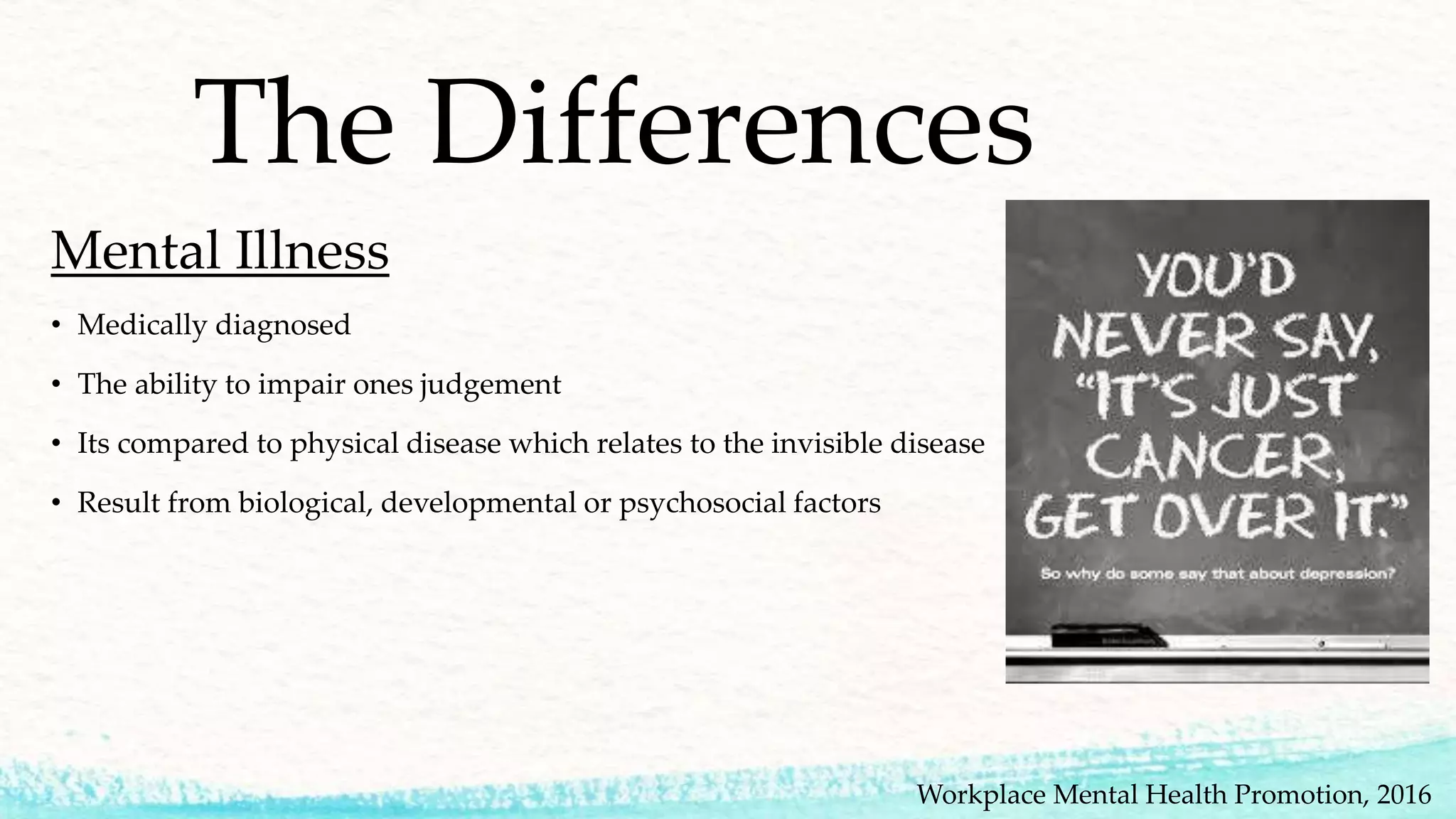
Mental Illness
• Medically diagnosed
• The ability to impair ones judgement
• Its compared to physical disease which relates to the invisible disease
• Result from biological, developmental or psychosocial factors
Workplace Mental Health Promotion, 2016
Mental Illness
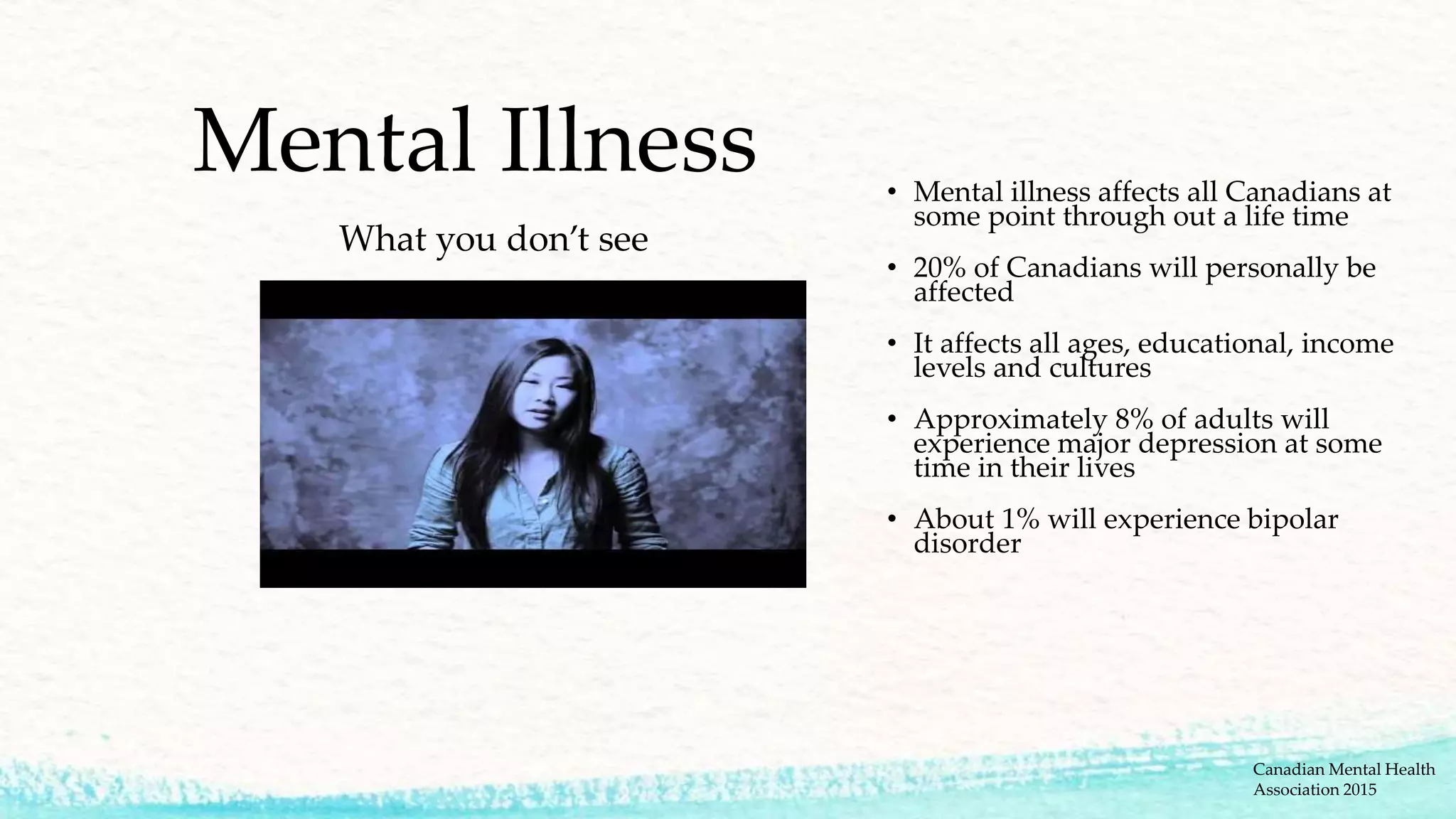
What you don’t see
• Mental illness affects all Canadians at
some point through out a life time
• 20% of Canadians will personally be
affected
• It affects all ages, educational, income
levels and cultures
• Approximately 8% of adults will
experience major depression at some
time in their lives
• About 1% will experience bipolar
disorder
Canadian Mental Health
Association 2015
More stats….
How common is it?
• Schizophrenia affects 1% of the Canadian
Population
• Anxiety disorders affect 5% of the household
population, causing mild to severe impairment
• Suicide accounts for 24%
of all deaths among 15-24
year olds
• 16% among 25-44 year olds
Suicide is one of the leading causes of death in both men and women from adolescence to middle
age.
The mortality rate due to suicide among men is four time the rate among women
Canadian Mental Health
Association 2015
What
causes
it?
genetic, biological, personality,
situational and environmental
factors
Financial
No satisfaction
with stress
towards financial
situation
Physical
Not being able
to recognize the
need for
physical activity,
diet, sleep, and
nutrtionSocial
No sense of
connecting or
not having a
support system.
Intellectual
Loosing interest
in finding ways
to become
creative
Emotional
Not being able to
cope with life or
create good
relationships
The Stigma..
What is it
really?
A negative
stereotype
Judgement
ShameNot Accepted
You don’t
even
have a
problem
Just
shake it
off
It’s all in your
head
Stop being
such a
psycho
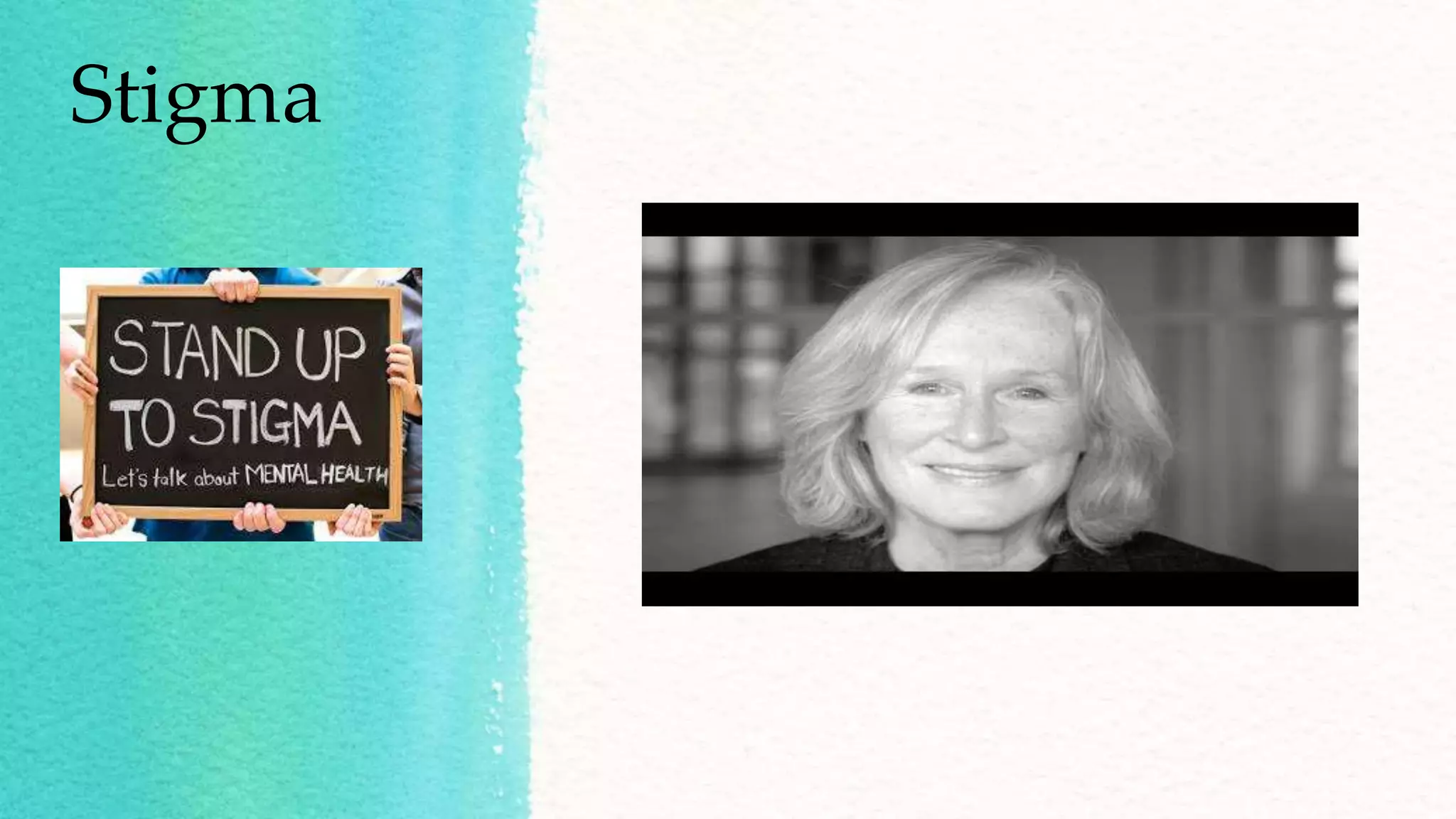
Stigma
5 Ways to Help
Reduce the
Stigma
Language Matters
Pay attention to what you say and the words you use, some can be
hurtful
Explain to friends and colleagues who use words like “nut” or
“psycho” they may hurt someone you know
Educate Yourself
Learn the facts and myths about mental illness. Be
knowledgeable and help fight stigma with facts
Understand early warning signs un yourself and
others
Know where to seek help
Bell Canada, 2016
Reducing Stigma Be Kind
Bell Canada, 2016
Small acts of kindness speaks volume
Don’t stand by someone if they are being bulled or labelled
Treat a person who has mental illness with the kindness
they deserve or with out treating them any different
Listen and Ask
Sometime all you can do is just listen
Ask questions on how you can help
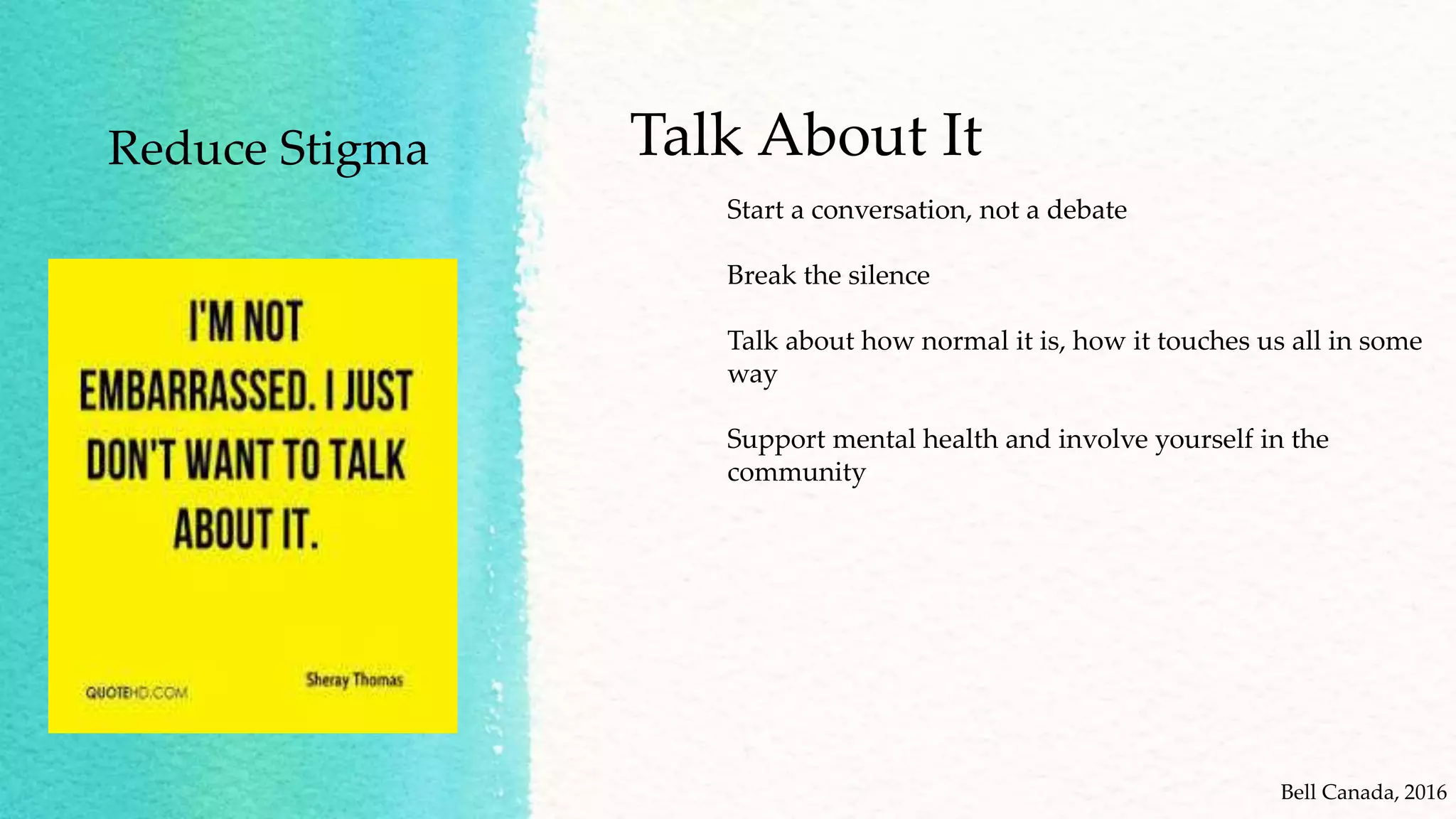
Reduce Stigma Talk About It
Bell Canada, 2016
Start a conversation, not a debate
Break the silence
Talk about how normal it is, how it touches us all in some
way
Support mental health and involve yourself in the
community
The Impact
The conflict theory
with stigma and
mental illness
Conflict Theory (Main)
• Refers to the labelling theory against people with
mental health issues, also knows as stigma
• Considered not normal
Functionalists (Secondary)
• People and social media believe that by
recognizing mental illness, society uphold values
about conforming behavior
Symbolic Interactionists (Third)
• See mentally ill people not as sick but more or less
as victims of societal reactions of their behavior
(Crossman, 2014).
Stop the Stigma!
https://m.facebook.com/st
ory.php?story_fbid=118895
9297811593&id=354522044
588660&_rdr
You wouldn’t treat
someone like this if they
had cancer, so why would
you if they had a mental
illness?
References
• Canadian Mental Health Association: Fast Facts about Mental Illness (Canadian Mental Health
Association, 2016). Retrieved February 22, 2016, from http://www.cmha.ca/media/fast-facts-
about-mental-illness/#.VsowXSgrLIU
• Canadian Mental Health Association: Stigma and Discrimination (Canadian Mental Health
Association, 2016). Retrieved February 22, 2016, from https://ontario.cmha.ca/mental-
health/mental-health-conditions/stigma-and-discrimination/
• Bell Let’s Talk: 5 simple ways to help end the stigma around mental illness (Bell Canada, 2016).
Retrieved February 22, 2016, from http://letstalk.bell.ca/en/end-the-stigma/
• Mayo Clinic: Mental Illness Definition (Mayo Foundation 1998-2016). Retrieved February 22,
2016, from, http://www.mayoclinic.org/diseases-conditions/mental-
illness/basics/definition/con-20033813
• About Education: Deviance and Mental Illness (Crossman, 2014). Retrieved February 22, 2016,
from http://sociology.about.com/od/Deviance/a/Deviance-And-Mental-Illness.htm
• Workplace Mental Health: A How-To Guide (Workplace Mental Health Promotion, 2016).
Retrieved February 22, 2016, from http://wmhp.cmhaontario.ca/workplace-mental-health-core-
concepts-issues/what-is-mental-health-and-mental-illness
• Youtube: Mental Illness: What you see/ What you don’t see (Neinstein & Associates, 2012,
December 14). Retrieved February 22, 2016, from
https://www.youtube.com/watch?v=54sDdNa9vek
• Youtube: Mental Health (Hasudugan., A. 2013, October 9). Retrieved February 22, 2016, from
https://www.youtube.com/watch?v=SQYNOXXjrxQ
• Youtube: What is Stigma? (BringChange2Mind, 2014, August 19). Retrieved February 22, 2016,
from https://www.youtube.com/watch?v=9vkUMXaJDM4

Week 11 mental health

  • 1.
    Mental Health What’s theissue, what are we doing and what have we learned Lindsay Rodgers
  • 2.
    Breakdown • What ismental health & illness • The difference with mental health and mental illness • What are we doing to prevent it • What we have learned in 5 steps • The Stigma • The conflict theory with mental illness
  • 3.
    The Impact • Whatis mental health? a person’s condition with regard to their psychological and emotional well-being. • What is mental illness? Mental illness refers to a wide range of mental health conditions —disorders that affect your mood, thinking and behavior. Examples of mental illness include depression, anxiety disorders, schizophrenia, eating disorders and addictive behaviors. Mayo Foundation, 1998-2016
  • 4.
    The Differences Mental Health •State of well-being • Ability to cope with normal stresses • Can work productively and efficiently • Able to make contributions to her or his life or community Workplace Mental Health Promotion, 2016
  • 5.
    The Differences Mental Illness •Medically diagnosed • The ability to impair ones judgement • Its compared to physical disease which relates to the invisible disease • Result from biological, developmental or psychosocial factors Workplace Mental Health Promotion, 2016
  • 6.
    Mental Illness What youdon’t see • Mental illness affects all Canadians at some point through out a life time • 20% of Canadians will personally be affected • It affects all ages, educational, income levels and cultures • Approximately 8% of adults will experience major depression at some time in their lives • About 1% will experience bipolar disorder Canadian Mental Health Association 2015
  • 7.
    More stats…. How commonis it? • Schizophrenia affects 1% of the Canadian Population • Anxiety disorders affect 5% of the household population, causing mild to severe impairment • Suicide accounts for 24% of all deaths among 15-24 year olds • 16% among 25-44 year olds Suicide is one of the leading causes of death in both men and women from adolescence to middle age. The mortality rate due to suicide among men is four time the rate among women Canadian Mental Health Association 2015
  • 8.
    What causes it? genetic, biological, personality, situationaland environmental factors Financial No satisfaction with stress towards financial situation Physical Not being able to recognize the need for physical activity, diet, sleep, and nutrtionSocial No sense of connecting or not having a support system. Intellectual Loosing interest in finding ways to become creative Emotional Not being able to cope with life or create good relationships
  • 9.
    The Stigma.. What isit really? A negative stereotype Judgement ShameNot Accepted You don’t even have a problem Just shake it off It’s all in your head Stop being such a psycho
  • 10.
  • 11.
    5 Ways toHelp Reduce the Stigma Language Matters Pay attention to what you say and the words you use, some can be hurtful Explain to friends and colleagues who use words like “nut” or “psycho” they may hurt someone you know Educate Yourself Learn the facts and myths about mental illness. Be knowledgeable and help fight stigma with facts Understand early warning signs un yourself and others Know where to seek help Bell Canada, 2016
  • 12.
    Reducing Stigma BeKind Bell Canada, 2016 Small acts of kindness speaks volume Don’t stand by someone if they are being bulled or labelled Treat a person who has mental illness with the kindness they deserve or with out treating them any different Listen and Ask Sometime all you can do is just listen Ask questions on how you can help
  • 13.
    Reduce Stigma TalkAbout It Bell Canada, 2016 Start a conversation, not a debate Break the silence Talk about how normal it is, how it touches us all in some way Support mental health and involve yourself in the community
  • 14.
    The Impact The conflicttheory with stigma and mental illness Conflict Theory (Main) • Refers to the labelling theory against people with mental health issues, also knows as stigma • Considered not normal Functionalists (Secondary) • People and social media believe that by recognizing mental illness, society uphold values about conforming behavior Symbolic Interactionists (Third) • See mentally ill people not as sick but more or less as victims of societal reactions of their behavior (Crossman, 2014).
  • 15.
    Stop the Stigma! https://m.facebook.com/st ory.php?story_fbid=118895 9297811593&id=354522044 588660&_rdr Youwouldn’t treat someone like this if they had cancer, so why would you if they had a mental illness?
  • 16.
    References • Canadian MentalHealth Association: Fast Facts about Mental Illness (Canadian Mental Health Association, 2016). Retrieved February 22, 2016, from http://www.cmha.ca/media/fast-facts- about-mental-illness/#.VsowXSgrLIU • Canadian Mental Health Association: Stigma and Discrimination (Canadian Mental Health Association, 2016). Retrieved February 22, 2016, from https://ontario.cmha.ca/mental- health/mental-health-conditions/stigma-and-discrimination/ • Bell Let’s Talk: 5 simple ways to help end the stigma around mental illness (Bell Canada, 2016). Retrieved February 22, 2016, from http://letstalk.bell.ca/en/end-the-stigma/ • Mayo Clinic: Mental Illness Definition (Mayo Foundation 1998-2016). Retrieved February 22, 2016, from, http://www.mayoclinic.org/diseases-conditions/mental- illness/basics/definition/con-20033813 • About Education: Deviance and Mental Illness (Crossman, 2014). Retrieved February 22, 2016, from http://sociology.about.com/od/Deviance/a/Deviance-And-Mental-Illness.htm • Workplace Mental Health: A How-To Guide (Workplace Mental Health Promotion, 2016). Retrieved February 22, 2016, from http://wmhp.cmhaontario.ca/workplace-mental-health-core- concepts-issues/what-is-mental-health-and-mental-illness • Youtube: Mental Illness: What you see/ What you don’t see (Neinstein & Associates, 2012, December 14). Retrieved February 22, 2016, from https://www.youtube.com/watch?v=54sDdNa9vek • Youtube: Mental Health (Hasudugan., A. 2013, October 9). Retrieved February 22, 2016, from https://www.youtube.com/watch?v=SQYNOXXjrxQ • Youtube: What is Stigma? (BringChange2Mind, 2014, August 19). Retrieved February 22, 2016, from https://www.youtube.com/watch?v=9vkUMXaJDM4

Editor's Notes

  • #7 http://www.cmha.ca/media/fast-facts-about-mental-illness/#.VsowXSgrLIU
  • #8 http://www.cmha.ca/media/fast-facts-about-mental-illness/#.VsowXSgrLIU
  • #12 http://letstalk.bell.ca/en/end-the-stigma/