Issues in Human Services
Adult Mental Health Issues
What is Mental Health?
• What is your understanding of mental health?
• Creating a safe place to talk about mental
health and mental health issues.
• Chances are some of us have experienced
mental illness ourselves or with someone
close to us.
Definition of Mental Health
• The definition of mental health is changing.
• Mental health seen from more holistic
approach- Body, Mind and Spirit
• Canadian Mental Health Association defines
mental health as:
• Ability to enjoy life, Resilience, Balance , Self
Actualization, Flexibility
Body/Mind/Spirit
• It is important to take care of our bodies.
Adequate nutrition, exercise and avoiding toxins
are seen as crucial to our well-being. Emotions
have an effect on the body.
• Our thoughts affect our mental health. Thoughts
supporting the person rather than self judgment
or judgments of others affirm mental health.
• Relatively new to mental health field is the
person’s spiritual dimension .
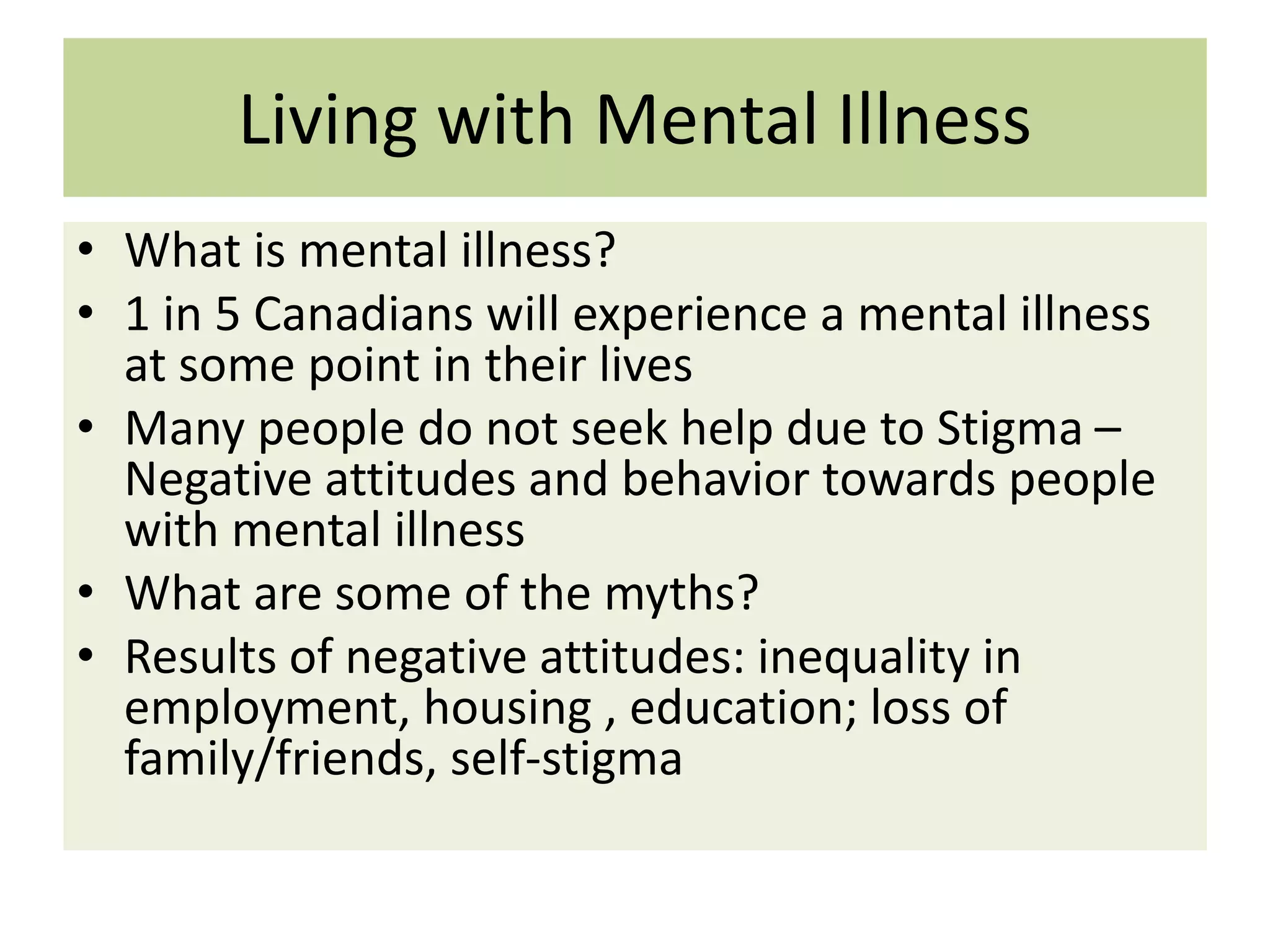
Living with Mental Illness
• What is mental illness?
• 1 in 5 Canadians will experience a mental illness
at some point in their lives
• Many people do not seek help due to Stigma –
Negative attitudes and behavior towards people
with mental illness
• What are some of the myths?
• Results of negative attitudes: inequality in
employment, housing , education; loss of
family/friends, self-stigma
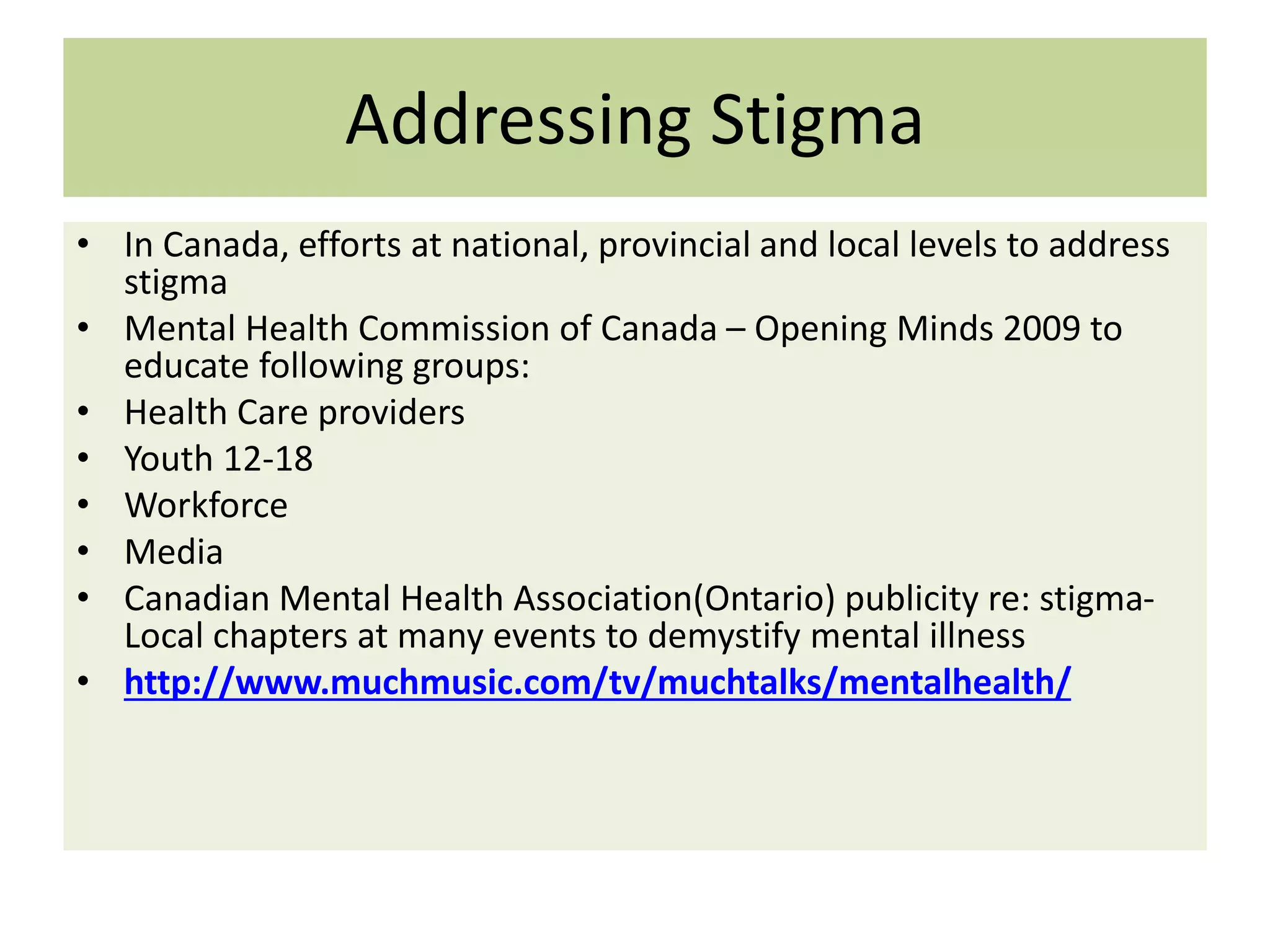
Addressing Stigma
• In Canada, efforts at national, provincial and local levels to address
stigma
• Mental Health Commission of Canada – Opening Minds 2009 to
educate following groups:
• Health Care providers
• Youth 12-18
• Workforce
• Media
• Canadian Mental Health Association(Ontario) publicity re: stigmaLocal chapters at many events to demystify mental illness
• http://www.muchmusic.com/tv/muchtalks/mentalhealth/
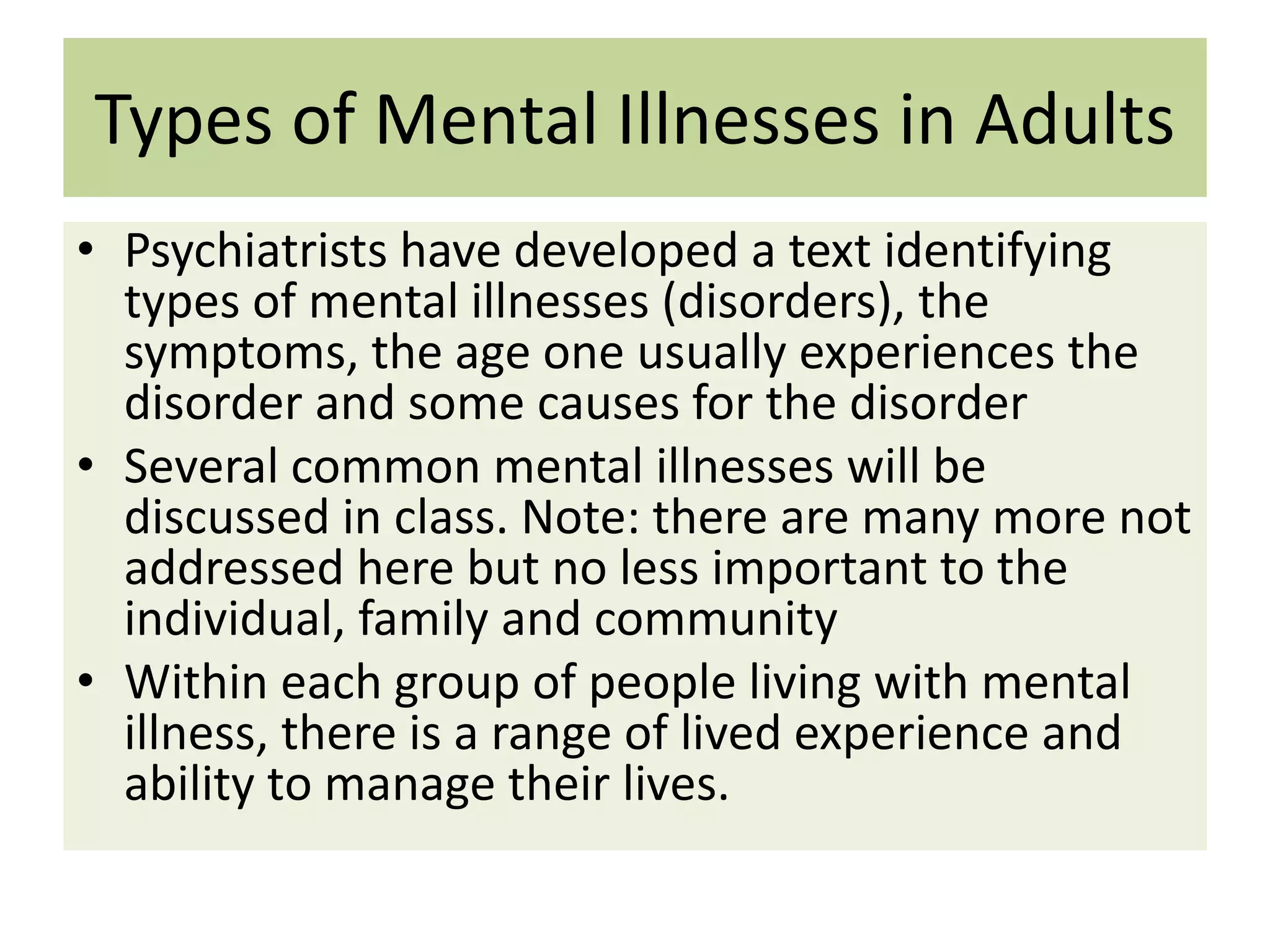
Types of Mental Illnesses in Adults
• Psychiatrists have developed a text identifying
types of mental illnesses (disorders), the
symptoms, the age one usually experiences the
disorder and some causes for the disorder
• Several common mental illnesses will be
discussed in class. Note: there are many more not
addressed here but no less important to the
individual, family and community
• Within each group of people living with mental
illness, there is a range of lived experience and
ability to manage their lives.
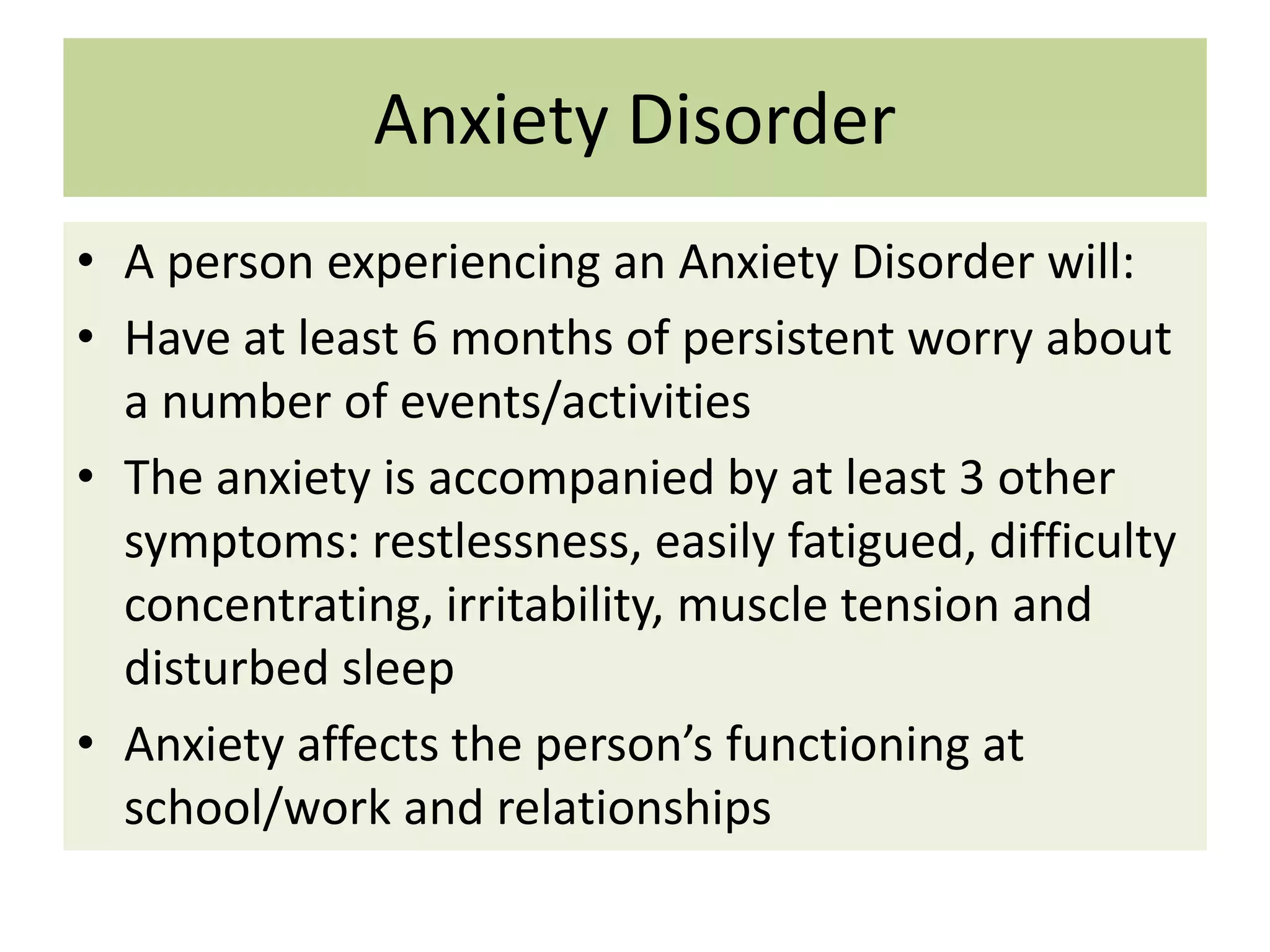
Anxiety Disorder
• A person experiencing an Anxiety Disorder will:
• Have at least 6 months of persistent worry about
a number of events/activities
• The anxiety is accompanied by at least 3 other
symptoms: restlessness, easily fatigued, difficulty
concentrating, irritability, muscle tension and
disturbed sleep
• Anxiety affects the person’s functioning at
school/work and relationships
Social Anxiety Disorder
• Many types of anxiety
• One type often overlooked is social anxiety
disorder
• Let one woman tell you her experience with
this disorder:
• http://www.youtube.com/watch?v=v0YCxZl3s
po
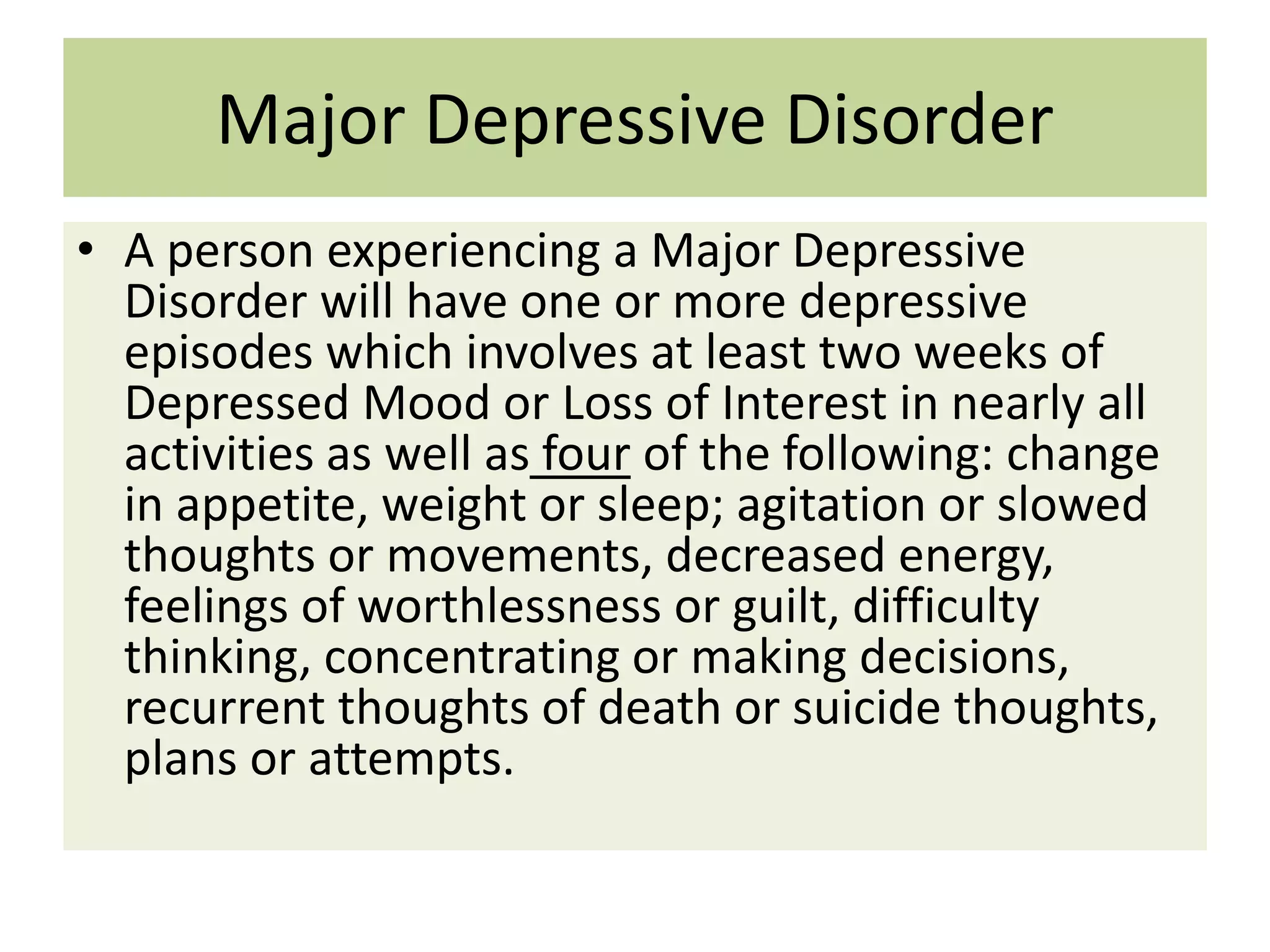
Major Depressive Disorder
• A person experiencing a Major Depressive
Disorder will have one or more depressive
episodes which involves at least two weeks of
Depressed Mood or Loss of Interest in nearly all
activities as well as four of the following: change
in appetite, weight or sleep; agitation or slowed
thoughts or movements, decreased energy,
feelings of worthlessness or guilt, difficulty
thinking, concentrating or making decisions,
recurrent thoughts of death or suicide thoughts,
plans or attempts.
One woman’s experience with
Depression and What helped her
 http://www.youtube.com/watch?v=rzXuZIUDI-s
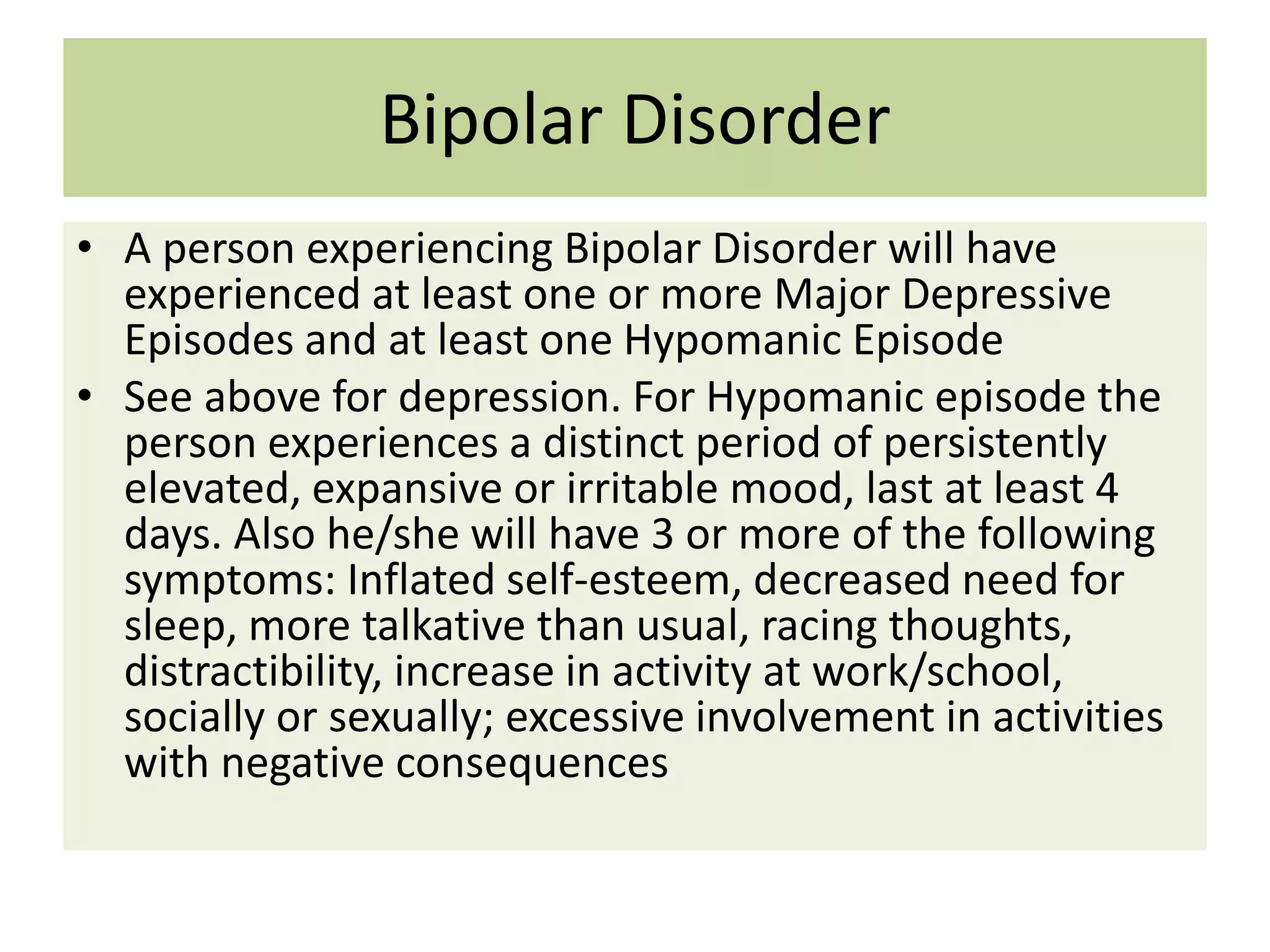
Bipolar Disorder
• A person experiencing Bipolar Disorder will have
experienced at least one or more Major Depressive
Episodes and at least one Hypomanic Episode
• See above for depression. For Hypomanic episode the
person experiences a distinct period of persistently
elevated, expansive or irritable mood, last at least 4
days. Also he/she will have 3 or more of the following
symptoms: Inflated self-esteem, decreased need for
sleep, more talkative than usual, racing thoughts,
distractibility, increase in activity at work/school,
socially or sexually; excessive involvement in activities
with negative consequences
To live with Bipolar Disorder
•
http://www.youtube.com/watch?v=gWguFrH
CzZM
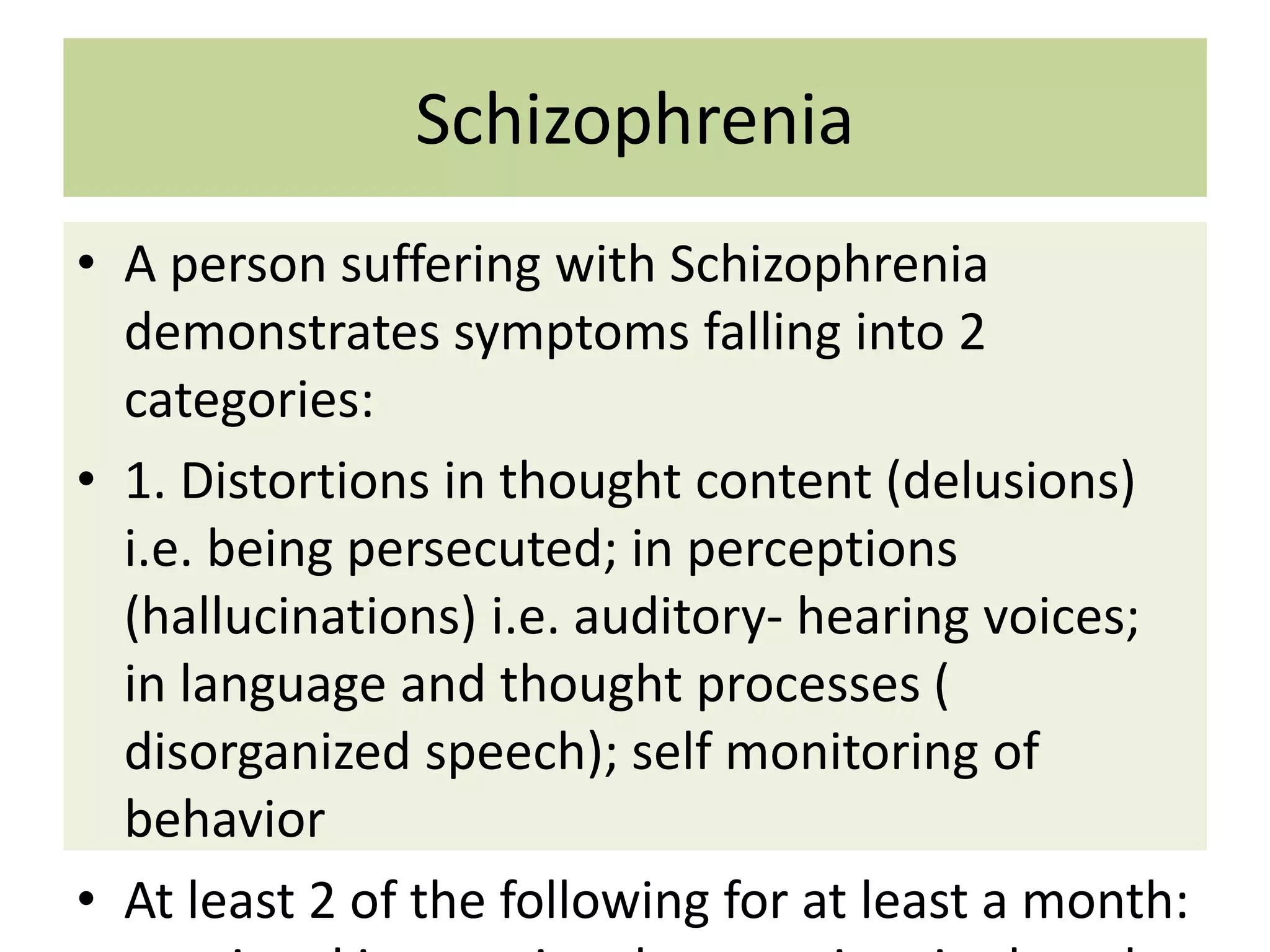
Schizophrenia
• A person suffering with Schizophrenia
demonstrates symptoms falling into 2
categories:
• 1. Distortions in thought content (delusions)
i.e. being persecuted; in perceptions
(hallucinations) i.e. auditory- hearing voices;
in language and thought processes (
disorganized speech); self monitoring of
behavior
• At least 2 of the following for at least a month:
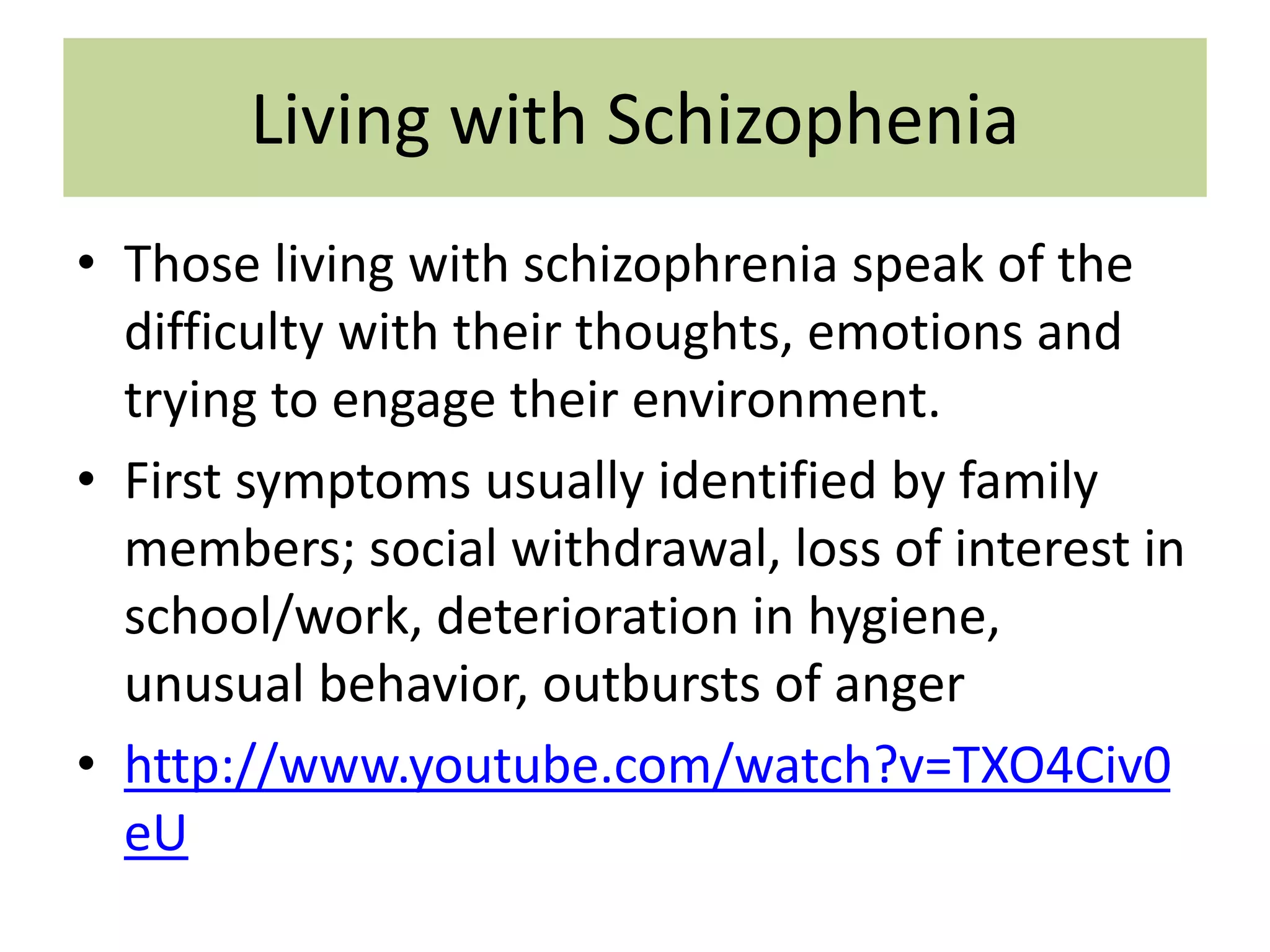
Living with Schizophenia
• Those living with schizophrenia speak of the
difficulty with their thoughts, emotions and
trying to engage their environment.
• First symptoms usually identified by family
members; social withdrawal, loss of interest in
school/work, deterioration in hygiene,
unusual behavior, outbursts of anger
• http://www.youtube.com/watch?v=TXO4Civ0
eU
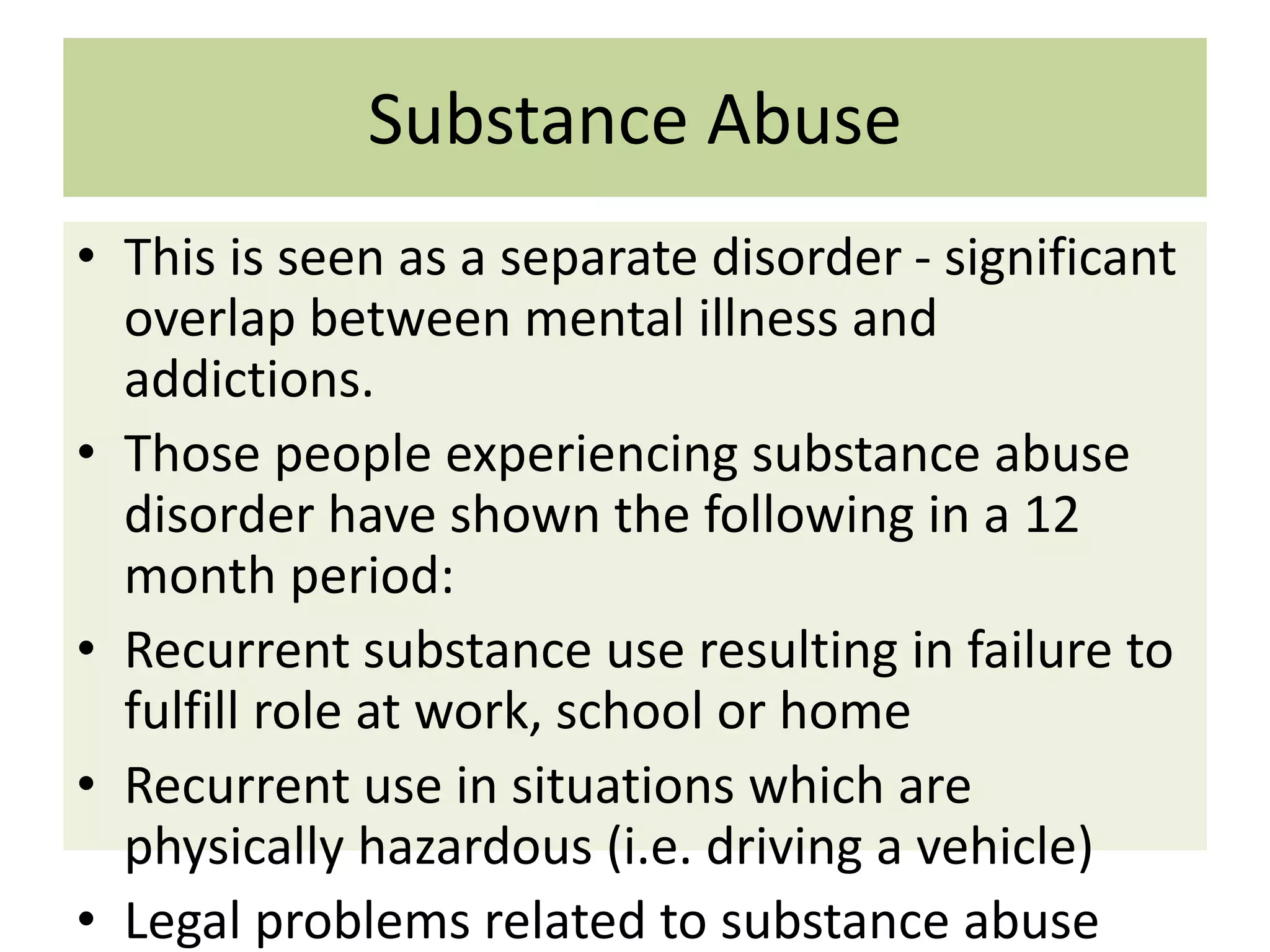
Substance Abuse
• This is seen as a separate disorder - significant
overlap between mental illness and
addictions.
• Those people experiencing substance abuse
disorder have shown the following in a 12
month period:
• Recurrent substance use resulting in failure to
fulfill role at work, school or home
• Recurrent use in situations which are
physically hazardous (i.e. driving a vehicle)
• Legal problems related to substance abuse
Living with Substance Abuse
• A man who has overcome his substance abuse
• http://www.youtube.com/watch?v=tyMzzVJC
Z-w
Mental Illness and Addictions
• Some people live with a psychiatric disorder and a
substance abuse disorder and/or gambling disorder.
Concurrent Disorder
• Having either one increases likelihood of having the
other
• Those people living with bipolar disorder and
schizophrenia especially vulnerable to substance abuse
• Centre for Addiction and Mental Health suggests the
following reasons the two coexist:
• People use substances to feel better i.e. self medicate
• The effects of substances look like mental illness
• Substances cause harm in his/her life leading to
anxiety/depression
• Biological disposition to both or have experienced
Consequences of Mental Illness
• The diagnosis of a mental illness can be very
difficult. Trying to understand what is
happening, what treatments to take and how
this will affect the person’s school/work and
relationships with family and friends.
• Treatment can take time. Uncertainty is a
common reaction. Will this treatment work?
Will I live with this for the rest of my life? Can I
return to my role as
student/worker/caregiver? Who am I with this
illness?
Suicide and Mental Illness
• Those people suffering from depression, bipolar
disorder and schizophrenia are at risk for suicide
especially if their illness is untreated or
undertreated.
• Depression- likely to become 2nd leading cause of
disability by 2020. Highly linked to suicide
• Bipolar disorder creates high risk for suicide, 15 %
higher than the general population
• Schizophrenia creates 4-10% lifetime risk for
suicide
• These illnesses combined with other factors
increase the suicidal risk.
• Protection against Suicide: Effective
Suicide Prevention
• More openness about suicide and mental
illness
• Community awareness through Suicide
Prevention programs
• Education about suicide and the warning signs
• If have any concern about someone thinking
about suicide, let her/him know that you will
accompany them to the nearest hospital
emergency
• Get support for yourself and take care of
Causes of Mental Illness
• The Centre for Addiction and Mental Health
cites that most mental illnesses are a
combination of biological factors,
psychological factors and stressful life
experiences.
• Genetic predisposition: inherited family genes
or altered genes at conception
• Childhood developmental issues
• Stressful or traumatic life events
• Alcohol, medications or illicit substances
Political/Sociological Factors
• Gender Differences: Women experience mental
illness differently than men-1.5 times more likely
to experience depression, more symptoms, more
physical symptoms and other mental health
issues than men
• Reasons? Biology – different brain chemistry and
hormonal cycles
• Social/Psychological – Women have been
socialized to value relationships and tend to
blame themselves . Taught to derive self esteem
from physical ideals. Internalize anger
• Trauma – women are more likely than men to
experience sexual abuse in childhood and rape in
Racial/Cultural Differences
• Aboriginals of Canada
• Important to understand the political,
economic and social context of the Aboriginal
people
• Compared to non-aboriginal people,
aboriginals experience higher rates of
experiences of discrimination/racism, major
depressive episodes and substance abuse with
suicide. Rates of suicide are 8 times higher for
females and 5 times higher for males than the
Aboriginals’ Experience
• Seven generations ago Aboriginal people lived
close to the land, to each other and in tune to the
rhythms of nature.
• British and French colonization – land taken with
the accompanying natural resources, domination
of the culture
Canadian Government defined Aboriginal Status
– disrupting families where the women could not
maintain their Status if married a non-Aboriginal
man
• Residential school system – separation of children
from their families, not permitted to speak their
Aboriginal Experience
• Understanding the aboriginal person
presenting with mental health issue means
understanding the way their history has
affected their opportunities for stable living
conditions, education, work and self worth.
• (Dr. Joanne McCarthy, BA(Hons), ND, Fall
2011)
Recovery from Mental Illness
• In the past people with mental illness often
hospitalized for long periods or indefinitely with
the main treatment being medications to control
behaviors.
• Today hospitalization is sometimes used to help
stabilize the illness and reintegrate the person
back to the community where they may continue
to see a psychiatrist or family doctor to monitor
medications and/or other mental health
professional for therapy/support. Some people
will not need hospital but the ongoing support of
Recovery Continued
• For many mental illnesses, psychiatric treatment
involves:
• 1. Education about the illness and treatment for
the individual and family/friend.
• 2. Psychiatric medication: finding the right
medications with the fewest side effects to
change brain function
• 3. Cognitive-Behavioral Therapy (CBT) Trying to
change thoughts which affect feelings of anxiety
or low mood
Future of Mental Health
• Anti stigma programs to allow a more
compassionate approach to people who live
with mental illness
• More research to understand how the brain
functions and what treatments can heal the
brain
• Early detection so effective treatments start
early in a person’s life
• Supporting families to raise mentally healthy
children
How you can help?
• Creating a non-judgmental attitude towards a
person with mental illness
• Listening to her/his story and understanding
the context of the illness
• Seeing the whole person
References
REFERENCES
1. www.cmhaontario.ca retrieved February 2012.
2. American Psychiatric Association: Diagnostic and Statistical Manual of Mental
Disorders. Fourth Edition, Text Revision, Washington, D.C., 2000.
3. www.mentalhealthcommission.ca retrieved February, 2012.
4. www.camh.net retrieved February 2012.
5. Mate, Gabor In the Realm of the Hungry Ghosts Vintage Canada, Random House,
Toronto, 2009.
6. McCarthy, Dr. Johanne, B.A. (Hons), ND. “The Context of Aboriginal Health in
Canada” CAND Vital Link, v. 18i3 Fall 2011, pp.35-43.
7. Pouther, Michael PhD and Hymie Anisman, PhD. How does your environment
affect your gene health and is there a link to suicidality? CASP News Volume 19
November 2010.

Hmns10085 mod8(1)

  • 1.
    Issues in HumanServices Adult Mental Health Issues
  • 2.
    What is MentalHealth? • What is your understanding of mental health? • Creating a safe place to talk about mental health and mental health issues. • Chances are some of us have experienced mental illness ourselves or with someone close to us.
  • 3.
    Definition of MentalHealth • The definition of mental health is changing. • Mental health seen from more holistic approach- Body, Mind and Spirit • Canadian Mental Health Association defines mental health as: • Ability to enjoy life, Resilience, Balance , Self Actualization, Flexibility
  • 4.
    Body/Mind/Spirit • It isimportant to take care of our bodies. Adequate nutrition, exercise and avoiding toxins are seen as crucial to our well-being. Emotions have an effect on the body. • Our thoughts affect our mental health. Thoughts supporting the person rather than self judgment or judgments of others affirm mental health. • Relatively new to mental health field is the person’s spiritual dimension .
  • 5.
    Living with MentalIllness • What is mental illness? • 1 in 5 Canadians will experience a mental illness at some point in their lives • Many people do not seek help due to Stigma – Negative attitudes and behavior towards people with mental illness • What are some of the myths? • Results of negative attitudes: inequality in employment, housing , education; loss of family/friends, self-stigma
  • 6.
    Addressing Stigma • InCanada, efforts at national, provincial and local levels to address stigma • Mental Health Commission of Canada – Opening Minds 2009 to educate following groups: • Health Care providers • Youth 12-18 • Workforce • Media • Canadian Mental Health Association(Ontario) publicity re: stigmaLocal chapters at many events to demystify mental illness • http://www.muchmusic.com/tv/muchtalks/mentalhealth/
  • 7.
    Types of MentalIllnesses in Adults • Psychiatrists have developed a text identifying types of mental illnesses (disorders), the symptoms, the age one usually experiences the disorder and some causes for the disorder • Several common mental illnesses will be discussed in class. Note: there are many more not addressed here but no less important to the individual, family and community • Within each group of people living with mental illness, there is a range of lived experience and ability to manage their lives.
  • 8.
    Anxiety Disorder • Aperson experiencing an Anxiety Disorder will: • Have at least 6 months of persistent worry about a number of events/activities • The anxiety is accompanied by at least 3 other symptoms: restlessness, easily fatigued, difficulty concentrating, irritability, muscle tension and disturbed sleep • Anxiety affects the person’s functioning at school/work and relationships
  • 9.
    Social Anxiety Disorder •Many types of anxiety • One type often overlooked is social anxiety disorder • Let one woman tell you her experience with this disorder: • http://www.youtube.com/watch?v=v0YCxZl3s po
  • 10.
    Major Depressive Disorder •A person experiencing a Major Depressive Disorder will have one or more depressive episodes which involves at least two weeks of Depressed Mood or Loss of Interest in nearly all activities as well as four of the following: change in appetite, weight or sleep; agitation or slowed thoughts or movements, decreased energy, feelings of worthlessness or guilt, difficulty thinking, concentrating or making decisions, recurrent thoughts of death or suicide thoughts, plans or attempts.
  • 11.
    One woman’s experiencewith Depression and What helped her  http://www.youtube.com/watch?v=rzXuZIUDI-s
  • 12.
    Bipolar Disorder • Aperson experiencing Bipolar Disorder will have experienced at least one or more Major Depressive Episodes and at least one Hypomanic Episode • See above for depression. For Hypomanic episode the person experiences a distinct period of persistently elevated, expansive or irritable mood, last at least 4 days. Also he/she will have 3 or more of the following symptoms: Inflated self-esteem, decreased need for sleep, more talkative than usual, racing thoughts, distractibility, increase in activity at work/school, socially or sexually; excessive involvement in activities with negative consequences
  • 13.
    To live withBipolar Disorder • http://www.youtube.com/watch?v=gWguFrH CzZM
  • 14.
    Schizophrenia • A personsuffering with Schizophrenia demonstrates symptoms falling into 2 categories: • 1. Distortions in thought content (delusions) i.e. being persecuted; in perceptions (hallucinations) i.e. auditory- hearing voices; in language and thought processes ( disorganized speech); self monitoring of behavior • At least 2 of the following for at least a month:
  • 15.
    Living with Schizophenia •Those living with schizophrenia speak of the difficulty with their thoughts, emotions and trying to engage their environment. • First symptoms usually identified by family members; social withdrawal, loss of interest in school/work, deterioration in hygiene, unusual behavior, outbursts of anger • http://www.youtube.com/watch?v=TXO4Civ0 eU
  • 16.
    Substance Abuse • Thisis seen as a separate disorder - significant overlap between mental illness and addictions. • Those people experiencing substance abuse disorder have shown the following in a 12 month period: • Recurrent substance use resulting in failure to fulfill role at work, school or home • Recurrent use in situations which are physically hazardous (i.e. driving a vehicle) • Legal problems related to substance abuse
  • 17.
    Living with SubstanceAbuse • A man who has overcome his substance abuse • http://www.youtube.com/watch?v=tyMzzVJC Z-w
  • 18.
    Mental Illness andAddictions • Some people live with a psychiatric disorder and a substance abuse disorder and/or gambling disorder. Concurrent Disorder • Having either one increases likelihood of having the other • Those people living with bipolar disorder and schizophrenia especially vulnerable to substance abuse • Centre for Addiction and Mental Health suggests the following reasons the two coexist: • People use substances to feel better i.e. self medicate • The effects of substances look like mental illness • Substances cause harm in his/her life leading to anxiety/depression • Biological disposition to both or have experienced
  • 19.
    Consequences of MentalIllness • The diagnosis of a mental illness can be very difficult. Trying to understand what is happening, what treatments to take and how this will affect the person’s school/work and relationships with family and friends. • Treatment can take time. Uncertainty is a common reaction. Will this treatment work? Will I live with this for the rest of my life? Can I return to my role as student/worker/caregiver? Who am I with this illness?
  • 20.
    Suicide and MentalIllness • Those people suffering from depression, bipolar disorder and schizophrenia are at risk for suicide especially if their illness is untreated or undertreated. • Depression- likely to become 2nd leading cause of disability by 2020. Highly linked to suicide • Bipolar disorder creates high risk for suicide, 15 % higher than the general population • Schizophrenia creates 4-10% lifetime risk for suicide • These illnesses combined with other factors increase the suicidal risk. • Protection against Suicide: Effective
  • 21.
    Suicide Prevention • Moreopenness about suicide and mental illness • Community awareness through Suicide Prevention programs • Education about suicide and the warning signs • If have any concern about someone thinking about suicide, let her/him know that you will accompany them to the nearest hospital emergency • Get support for yourself and take care of
  • 22.
    Causes of MentalIllness • The Centre for Addiction and Mental Health cites that most mental illnesses are a combination of biological factors, psychological factors and stressful life experiences. • Genetic predisposition: inherited family genes or altered genes at conception • Childhood developmental issues • Stressful or traumatic life events • Alcohol, medications or illicit substances
  • 23.
    Political/Sociological Factors • GenderDifferences: Women experience mental illness differently than men-1.5 times more likely to experience depression, more symptoms, more physical symptoms and other mental health issues than men • Reasons? Biology – different brain chemistry and hormonal cycles • Social/Psychological – Women have been socialized to value relationships and tend to blame themselves . Taught to derive self esteem from physical ideals. Internalize anger • Trauma – women are more likely than men to experience sexual abuse in childhood and rape in
  • 24.
    Racial/Cultural Differences • Aboriginalsof Canada • Important to understand the political, economic and social context of the Aboriginal people • Compared to non-aboriginal people, aboriginals experience higher rates of experiences of discrimination/racism, major depressive episodes and substance abuse with suicide. Rates of suicide are 8 times higher for females and 5 times higher for males than the
  • 25.
    Aboriginals’ Experience • Sevengenerations ago Aboriginal people lived close to the land, to each other and in tune to the rhythms of nature. • British and French colonization – land taken with the accompanying natural resources, domination of the culture Canadian Government defined Aboriginal Status – disrupting families where the women could not maintain their Status if married a non-Aboriginal man • Residential school system – separation of children from their families, not permitted to speak their
  • 26.
    Aboriginal Experience • Understandingthe aboriginal person presenting with mental health issue means understanding the way their history has affected their opportunities for stable living conditions, education, work and self worth. • (Dr. Joanne McCarthy, BA(Hons), ND, Fall 2011)
  • 27.
    Recovery from MentalIllness • In the past people with mental illness often hospitalized for long periods or indefinitely with the main treatment being medications to control behaviors. • Today hospitalization is sometimes used to help stabilize the illness and reintegrate the person back to the community where they may continue to see a psychiatrist or family doctor to monitor medications and/or other mental health professional for therapy/support. Some people will not need hospital but the ongoing support of
  • 28.
    Recovery Continued • Formany mental illnesses, psychiatric treatment involves: • 1. Education about the illness and treatment for the individual and family/friend. • 2. Psychiatric medication: finding the right medications with the fewest side effects to change brain function • 3. Cognitive-Behavioral Therapy (CBT) Trying to change thoughts which affect feelings of anxiety or low mood
  • 29.
    Future of MentalHealth • Anti stigma programs to allow a more compassionate approach to people who live with mental illness • More research to understand how the brain functions and what treatments can heal the brain • Early detection so effective treatments start early in a person’s life • Supporting families to raise mentally healthy children
  • 30.
    How you canhelp? • Creating a non-judgmental attitude towards a person with mental illness • Listening to her/his story and understanding the context of the illness • Seeing the whole person
  • 31.
    References REFERENCES 1. www.cmhaontario.ca retrievedFebruary 2012. 2. American Psychiatric Association: Diagnostic and Statistical Manual of Mental Disorders. Fourth Edition, Text Revision, Washington, D.C., 2000. 3. www.mentalhealthcommission.ca retrieved February, 2012. 4. www.camh.net retrieved February 2012. 5. Mate, Gabor In the Realm of the Hungry Ghosts Vintage Canada, Random House, Toronto, 2009. 6. McCarthy, Dr. Johanne, B.A. (Hons), ND. “The Context of Aboriginal Health in Canada” CAND Vital Link, v. 18i3 Fall 2011, pp.35-43. 7. Pouther, Michael PhD and Hymie Anisman, PhD. How does your environment affect your gene health and is there a link to suicidality? CASP News Volume 19 November 2010.