DELHI TEACHERS’ TRAINING
COLLEGE
DEENPUR, NAJAFGARH, NEW DELHI – 110043
(Affiliated to G.G.S.I.P. University, Delhi – 110075)
B.Ed. 2015 – 2017
Semester - II
Submitted By:-
Swati Ghansela
Enrollment No.- 05940202115
Sem.- II
Batch- 2015-17
MENSURATION
Multimedia Lesson Plan
Contents
Introduction
Important Terms
Figures
Measuring Plain Figures
Measuring Solid Figures
Review Of Formulae
Group Members
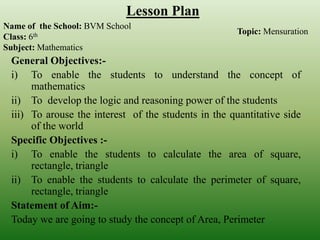
General Objectives:-
i) To enable the students to understand the concept of
mathematics
ii) To develop the logic and reasoning power of the students
iii) To arouse the interest of the students in the quantitative side
of the world
Specific Objectives :-
i) To enable the students to calculate the area of square,
rectangle, triangle
ii) To enable the students to calculate the perimeter of square,
rectangle, triangle
Statement of Aim:-
Today we are going to study the concept of Area, Perimeter
Name of the School: BVM School
Class: 6th
Subject: Mathematics
Lesson Plan
Topic: Mensuration
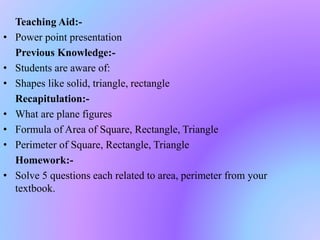
Teaching Aid:-
• Power point presentation
Previous Knowledge:-
• Students are aware of:
• Shapes like solid, triangle, rectangle
Recapitulation:-
• What are plane figures
• Formula of Area of Square, Rectangle, Triangle
• Perimeter of Square, Rectangle, Triangle
Homework:-
• Solve 5 questions each related to area, perimeter from your
textbook.
INTRODUCTION
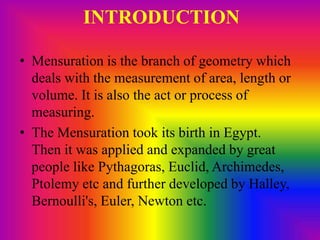
• Mensuration is the branch of geometry which
deals with the measurement of area, length or
volume. It is also the act or process of
measuring.
• The Mensuration took its birth in Egypt.
Then it was applied and expanded by great
people like Pythagoras, Euclid, Archimedes,
Ptolemy etc and further developed by Halley,
Bernoulli's, Euler, Newton etc.
Important Terms
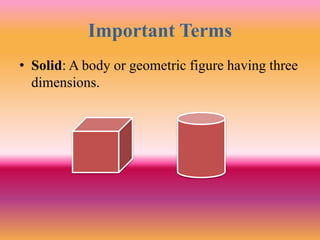
• Solid: A body or geometric figure having three
dimensions.
Important Terms
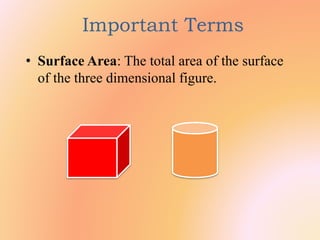
• Surface Area: The total area of the surface
of the three dimensional figure.
Important Terms
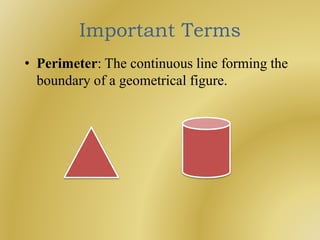
• Perimeter: The continuous line forming the
boundary of a geometrical figure.
Important Terms
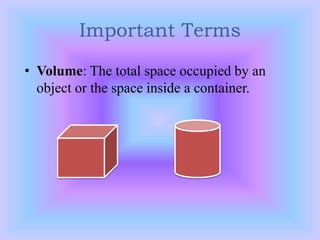
• Volume: The total space occupied by an
object or the space inside a container.
Figures
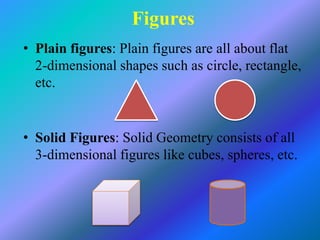
• Plain figures: Plain figures are all about flat
2-dimensional shapes such as circle, rectangle,
etc.
• Solid Figures: Solid Geometry consists of all
3-dimensional figures like cubes, spheres, etc.
Measuring Plain Figures
 SQUARE :-
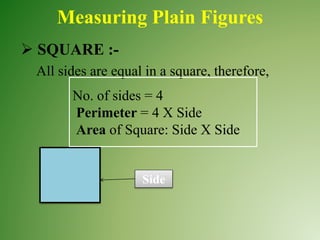
All sides are equal in a square, therefore,
No. of sides = 4
Perimeter = 4 X Side
Area of Square: Side X Side
Side
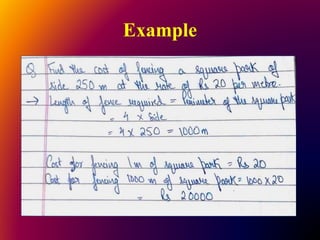
Example
Measuring Plain Figures
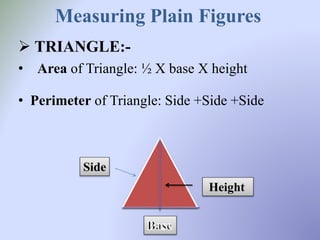
 TRIANGLE:-
• Area of Triangle: ½ X base X height
• Perimeter of Triangle: Side +Side +Side
Height
Side
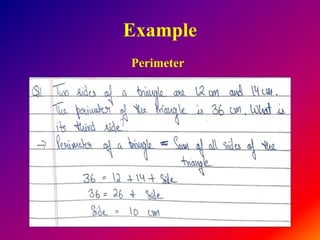
Example
Perimeter
Measuring Plain Figures
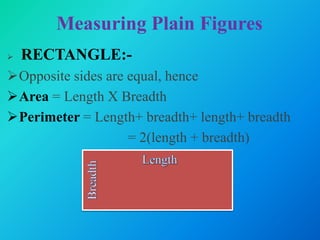
 RECTANGLE:-
Opposite sides are equal, hence
Area = Length X Breadth
Perimeter = Length+ breadth+ length+ breadth
= 2(length + breadth)
Video
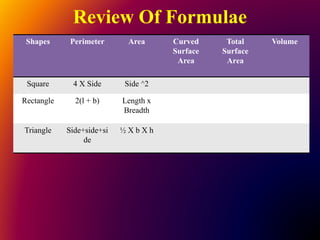
Review Of Formulae
Shapes Perimeter Area Curved
Surface
Area
Total
Surface
Area
Volume
Square 4 X Side Side ^2
Rectangle 2(l + b) Length x
Breadth
Triangle Side+side+si
de
½ X b X h
Maths Achievement Test
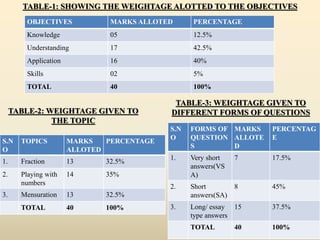
TABLE-1: SHOWING THE WEIGHTAGE ALOTTED TO THE OBJECTIVES
OBJECTIVES MARKS ALLOTED PERCENTAGE
Knowledge 05 12.5%
Understanding 17 42.5%
Application 16 40%
Skills 02 5%
TOTAL 40 100%
S.N
O
TOPICS MARKS
ALLOTED
PERCENTAGE
1. Fraction 13 32.5%
2. Playing with
numbers
14 35%
3. Mensuration 13 32.5%
TOTAL 40 100%
S.N
O
FORMS OF
QUESTION
S
MARKS
ALLOTE
D
PERCENTAG
E
1. Very short
answers(VS
A)
7 17.5%
2. Short
answers(SA)
8 45%
3. Long/ essay
type answers
15 37.5%
TOTAL 40 100%
TABLE-2: WEIGHTAGE GIVEN TO
THE TOPIC
TABLE-3: WEIGHTAGE GIVEN TO
DIFFERENT FORMS OF QUESTIONS
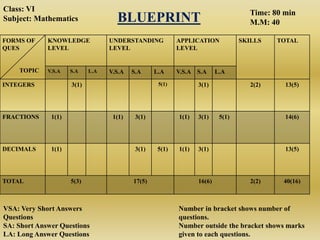
FORMS OF
QUES
TOPIC
KNOWLEDGE
LEVEL
UNDERSTANDING
LEVEL
APPLICATION
LEVEL
SKILLS TOTAL
V.S.A S.A L.A V.S.A S.A L.A V.S.A S.A L.A
INTEGERS 3(1) 5(1) 3(1) 2(2) 13(5)
FRACTIONS 1(1) 1(1) 3(1) 1(1) 3(1) 5(1) 14(6)
DECIMALS 1(1) 3(1) 5(1) 1(1) 3(1) 13(5)
TOTAL 5(3) 17(5) 16(6) 2(2) 40(16)
BLUEPRINT
Class: VI
Subject: Mathematics
Time: 80 min
M.M: 40
VSA: Very Short Answers
Questions
SA: Short Answer Questions
LA: Long Answer Questions
Number in bracket shows number of
questions.
Number outside the bracket shows marks
given to each questions.
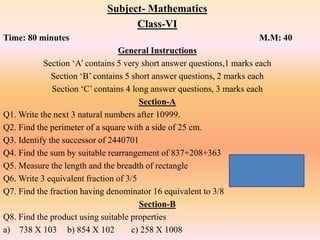
Subject- Mathematics
Class-VI
Time: 80 minutes M.M: 40
General Instructions
Section ‘A’ contains 5 very short answer questions,1 marks each
Section ‘B’ contains 5 short answer questions, 2 marks each
Section ‘C’ contains 4 long answer questions, 3 marks each
Section-A
Q1. Write the next 3 natural numbers after 10999.
Q2. Find the perimeter of a square with a side of 25 cm.
Q3. Identify the successor of 2440701
Q4. Find the sum by suitable rearrangement of 837+208+363
Q5. Measure the length and the breadth of rectangle
Q6. Write 3 equivalent fraction of 3/5
Q7. Find the fraction having denominator 16 equivalent to 3/8
Section-B
Q8. Find the product using suitable properties
a) 738 X 103 b) 854 X 102 c) 258 X 1008
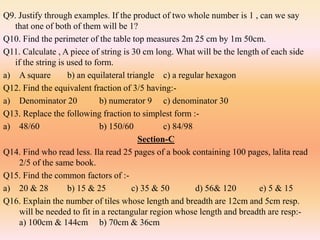
Q9. Justify through examples. If the product of two whole number is 1 , can we say
that one of both of them will be 1?
Q10. Find the perimeter of the table top measures 2m 25 cm by 1m 50cm.
Q11. Calculate , A piece of string is 30 cm long. What will be the length of each side
if the string is used to form.
a) A square b) an equilateral triangle c) a regular hexagon
Q12. Find the equivalent fraction of 3/5 having:-
a) Denominator 20 b) numerator 9 c) denominator 30
Q13. Replace the following fraction to simplest form :-
a) 48/60 b) 150/60 c) 84/98
Section-C
Q14. Find who read less. Ila read 25 pages of a book containing 100 pages, lalita read
2/5 of the same book.
Q15. Find the common factors of :-
a) 20 & 28 b) 15 & 25 c) 35 & 50 d) 56& 120 e) 5 & 15
Q16. Explain the number of tiles whose length and breadth are 12cm and 5cm resp.
will be needed to fit in a rectangular region whose length and breadth are resp:-
a) 100cm & 144cm b) 70cm & 36cm
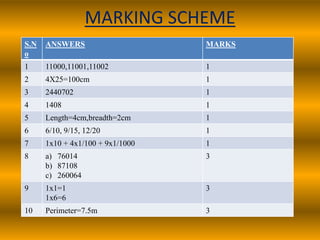
MARKING SCHEME
S.N
o
ANSWERS MARKS
1 11000,11001,11002 1
2 4X25=100cm 1
3 2440702 1
4 1408 1
5 Length=4cm,breadth=2cm 1
6 6/10, 9/15, 12/20 1
7 1x10 + 4x1/100 + 9x1/1000 1
8 a) 76014
b) 87108
c) 260064
3
9 1x1=1
1x6=6
3
10 Perimeter=7.5m 3
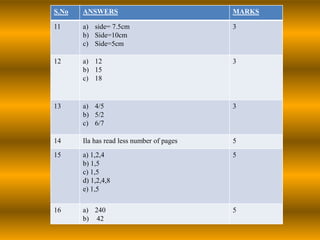
S.No ANSWERS MARKS
11 a) side= 7.5cm
b) Side=10cm
c) Side=5cm
3
12 a) 12
b) 15
c) 18
3
13 a) 4/5
b) 5/2
c) 6/7
3
14 Ila has read less number of pages 5
15 a) 1,2,4
b) 1,5
c) 1,5
d) 1,2,4,8
e) 1,5
5
16 a) 240
b) 42
5
Observation of student at
play (learning and
cognition)
B.Ed-102
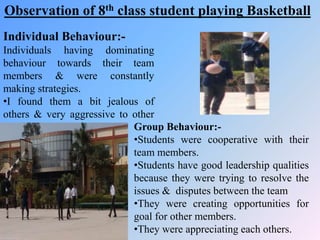
Individual Behaviour:-
Individuals having dominating
behaviour towards their team
members & were constantly
making strategies.
•I found them a bit jealous of
others & very aggressive to other
team members Group Behaviour:-
•Students were cooperative with their
team members.
•Students have good leadership qualities
because they were trying to resolve the
issues & disputes between the team
•They were creating opportunities for
goal for other members.
•They were appreciating each others.
Observation of 8th class student playing Basketball
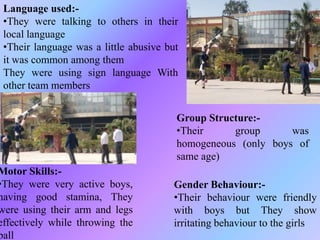
Language used:-
•They were talking to others in their
local language
•Their language was a little abusive but
it was common among them
They were using sign language With
other team members
Group Structure:-
•Their group was
homogeneous (only boys of
same age)
Gender Behaviour:-
•Their behaviour were friendly
with boys but They show
irritating behaviour to the girls
Motor Skills:-
•They were very active boys,
having good stamina, They
were using their arm and legs
effectively while throwing the
ball
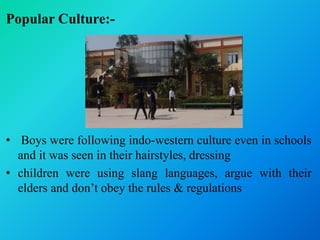
Popular Culture:-
• Boys were following indo-western culture even in schools
and it was seen in their hairstyles, dressing
• children were using slang languages, argue with their
elders and don’t obey the rules & regulations

MENSURATION

  • 1.
    DELHI TEACHERS’ TRAINING COLLEGE DEENPUR,NAJAFGARH, NEW DELHI – 110043 (Affiliated to G.G.S.I.P. University, Delhi – 110075) B.Ed. 2015 – 2017 Semester - II Submitted By:- Swati Ghansela Enrollment No.- 05940202115 Sem.- II Batch- 2015-17
  • 2.
  • 3.
    Contents Introduction Important Terms Figures Measuring PlainFigures Measuring Solid Figures Review Of Formulae Group Members
  • 4.
    General Objectives:- i) Toenable the students to understand the concept of mathematics ii) To develop the logic and reasoning power of the students iii) To arouse the interest of the students in the quantitative side of the world Specific Objectives :- i) To enable the students to calculate the area of square, rectangle, triangle ii) To enable the students to calculate the perimeter of square, rectangle, triangle Statement of Aim:- Today we are going to study the concept of Area, Perimeter Name of the School: BVM School Class: 6th Subject: Mathematics Lesson Plan Topic: Mensuration
  • 5.
    Teaching Aid:- • Powerpoint presentation Previous Knowledge:- • Students are aware of: • Shapes like solid, triangle, rectangle Recapitulation:- • What are plane figures • Formula of Area of Square, Rectangle, Triangle • Perimeter of Square, Rectangle, Triangle Homework:- • Solve 5 questions each related to area, perimeter from your textbook.
  • 6.
    INTRODUCTION • Mensuration isthe branch of geometry which deals with the measurement of area, length or volume. It is also the act or process of measuring. • The Mensuration took its birth in Egypt. Then it was applied and expanded by great people like Pythagoras, Euclid, Archimedes, Ptolemy etc and further developed by Halley, Bernoulli's, Euler, Newton etc.
  • 7.
    Important Terms • Solid:A body or geometric figure having three dimensions.
  • 8.
    Important Terms • SurfaceArea: The total area of the surface of the three dimensional figure.
  • 9.
    Important Terms • Perimeter:The continuous line forming the boundary of a geometrical figure.
  • 10.
    Important Terms • Volume:The total space occupied by an object or the space inside a container.
  • 11.
    Figures • Plain figures:Plain figures are all about flat 2-dimensional shapes such as circle, rectangle, etc. • Solid Figures: Solid Geometry consists of all 3-dimensional figures like cubes, spheres, etc.
  • 12.
    Measuring Plain Figures SQUARE :- All sides are equal in a square, therefore, No. of sides = 4 Perimeter = 4 X Side Area of Square: Side X Side Side
  • 13.
  • 14.
    Measuring Plain Figures TRIANGLE:- • Area of Triangle: ½ X base X height • Perimeter of Triangle: Side +Side +Side Height Side
  • 15.
  • 16.
    Measuring Plain Figures RECTANGLE:- Opposite sides are equal, hence Area = Length X Breadth Perimeter = Length+ breadth+ length+ breadth = 2(length + breadth)
  • 17.
  • 18.
    Review Of Formulae ShapesPerimeter Area Curved Surface Area Total Surface Area Volume Square 4 X Side Side ^2 Rectangle 2(l + b) Length x Breadth Triangle Side+side+si de ½ X b X h
  • 19.
  • 20.
    TABLE-1: SHOWING THEWEIGHTAGE ALOTTED TO THE OBJECTIVES OBJECTIVES MARKS ALLOTED PERCENTAGE Knowledge 05 12.5% Understanding 17 42.5% Application 16 40% Skills 02 5% TOTAL 40 100% S.N O TOPICS MARKS ALLOTED PERCENTAGE 1. Fraction 13 32.5% 2. Playing with numbers 14 35% 3. Mensuration 13 32.5% TOTAL 40 100% S.N O FORMS OF QUESTION S MARKS ALLOTE D PERCENTAG E 1. Very short answers(VS A) 7 17.5% 2. Short answers(SA) 8 45% 3. Long/ essay type answers 15 37.5% TOTAL 40 100% TABLE-2: WEIGHTAGE GIVEN TO THE TOPIC TABLE-3: WEIGHTAGE GIVEN TO DIFFERENT FORMS OF QUESTIONS
  • 21.
    FORMS OF QUES TOPIC KNOWLEDGE LEVEL UNDERSTANDING LEVEL APPLICATION LEVEL SKILLS TOTAL V.S.AS.A L.A V.S.A S.A L.A V.S.A S.A L.A INTEGERS 3(1) 5(1) 3(1) 2(2) 13(5) FRACTIONS 1(1) 1(1) 3(1) 1(1) 3(1) 5(1) 14(6) DECIMALS 1(1) 3(1) 5(1) 1(1) 3(1) 13(5) TOTAL 5(3) 17(5) 16(6) 2(2) 40(16) BLUEPRINT Class: VI Subject: Mathematics Time: 80 min M.M: 40 VSA: Very Short Answers Questions SA: Short Answer Questions LA: Long Answer Questions Number in bracket shows number of questions. Number outside the bracket shows marks given to each questions.
  • 22.
    Subject- Mathematics Class-VI Time: 80minutes M.M: 40 General Instructions Section ‘A’ contains 5 very short answer questions,1 marks each Section ‘B’ contains 5 short answer questions, 2 marks each Section ‘C’ contains 4 long answer questions, 3 marks each Section-A Q1. Write the next 3 natural numbers after 10999. Q2. Find the perimeter of a square with a side of 25 cm. Q3. Identify the successor of 2440701 Q4. Find the sum by suitable rearrangement of 837+208+363 Q5. Measure the length and the breadth of rectangle Q6. Write 3 equivalent fraction of 3/5 Q7. Find the fraction having denominator 16 equivalent to 3/8 Section-B Q8. Find the product using suitable properties a) 738 X 103 b) 854 X 102 c) 258 X 1008
  • 23.
    Q9. Justify throughexamples. If the product of two whole number is 1 , can we say that one of both of them will be 1? Q10. Find the perimeter of the table top measures 2m 25 cm by 1m 50cm. Q11. Calculate , A piece of string is 30 cm long. What will be the length of each side if the string is used to form. a) A square b) an equilateral triangle c) a regular hexagon Q12. Find the equivalent fraction of 3/5 having:- a) Denominator 20 b) numerator 9 c) denominator 30 Q13. Replace the following fraction to simplest form :- a) 48/60 b) 150/60 c) 84/98 Section-C Q14. Find who read less. Ila read 25 pages of a book containing 100 pages, lalita read 2/5 of the same book. Q15. Find the common factors of :- a) 20 & 28 b) 15 & 25 c) 35 & 50 d) 56& 120 e) 5 & 15 Q16. Explain the number of tiles whose length and breadth are 12cm and 5cm resp. will be needed to fit in a rectangular region whose length and breadth are resp:- a) 100cm & 144cm b) 70cm & 36cm
  • 24.
    MARKING SCHEME S.N o ANSWERS MARKS 111000,11001,11002 1 2 4X25=100cm 1 3 2440702 1 4 1408 1 5 Length=4cm,breadth=2cm 1 6 6/10, 9/15, 12/20 1 7 1x10 + 4x1/100 + 9x1/1000 1 8 a) 76014 b) 87108 c) 260064 3 9 1x1=1 1x6=6 3 10 Perimeter=7.5m 3
  • 25.
    S.No ANSWERS MARKS 11a) side= 7.5cm b) Side=10cm c) Side=5cm 3 12 a) 12 b) 15 c) 18 3 13 a) 4/5 b) 5/2 c) 6/7 3 14 Ila has read less number of pages 5 15 a) 1,2,4 b) 1,5 c) 1,5 d) 1,2,4,8 e) 1,5 5 16 a) 240 b) 42 5
  • 26.
    Observation of studentat play (learning and cognition) B.Ed-102
  • 27.
    Individual Behaviour:- Individuals havingdominating behaviour towards their team members & were constantly making strategies. •I found them a bit jealous of others & very aggressive to other team members Group Behaviour:- •Students were cooperative with their team members. •Students have good leadership qualities because they were trying to resolve the issues & disputes between the team •They were creating opportunities for goal for other members. •They were appreciating each others. Observation of 8th class student playing Basketball
  • 28.
    Language used:- •They weretalking to others in their local language •Their language was a little abusive but it was common among them They were using sign language With other team members Group Structure:- •Their group was homogeneous (only boys of same age) Gender Behaviour:- •Their behaviour were friendly with boys but They show irritating behaviour to the girls Motor Skills:- •They were very active boys, having good stamina, They were using their arm and legs effectively while throwing the ball
  • 29.
    Popular Culture:- • Boyswere following indo-western culture even in schools and it was seen in their hairstyles, dressing • children were using slang languages, argue with their elders and don’t obey the rules & regulations