Researchin Mathematics
Education
Need and
Importance
What you mean by
Mathematics Education?
In contemporary education, mathematics education is the
practice of teaching and learning mathematics, along with
the associated scholarly research.
RESEARCH
The systematic, rigorous investigation of a situation or problem
in order to generate new knowledge or validate existing
knowledge.
What is the meaning of Research in Mathematics Education?
Researches in Mathematics education primarily concerned with the tools, methods
and approaches that facilitate practice or the study of practice. Pedagogy of
Mathematics has developed into an extensive field of study, with its own concepts,
theories, methods, national and international organizations, conferences and
literature.
Objectives
 The teaching and learning of basic numeracy skills to all pupils.
 The teaching of practical mathematics (arithmetic, elementary algebra, plane and
solid geometry, trigonometry) to most pupils, to equip them a trade or craft.
 The teaching of abstract mathematical concepts (such as set and function) at an
early age.
 The teaching of selected areas of mathematics (such as Euclidean Geometry) as an
example of an axiomatic system and a model of deductive reasoning.
 The teaching of heuristic and other problem solving strategies to solve non-routine
problems.
Need and it’s Importance
 Continuing mathematics research is important because incredibly useful concepts like
cryptography, calculus, image and signal processing to continue to come from
mathematics and are helping people solve real-world problems.
 This “math as tool” is absolutely true and probably the easiest way to go about making
the case for math research.
 It’s a long-term project.
 We don’t know exactly what will come out next, or when, but if we follow the trend of
“useful tools” we trust that math will continue to produce for society.
 Mathematics is omnipresent in the exact science.
 Mathematics is basic stuff that has been known for decades or centuries.
 It is an art form, and more than that, an ancient and collaborative art form,
performed by an entire community.
 Our existence informs us on the most basic questions surrounding what it
means to be human.
 compare mathematics research directly with some other fields like philosophy
or even writing or music.
 Continuing math research is important because it trains people to think
abstractly and to have a skeptical mindset.
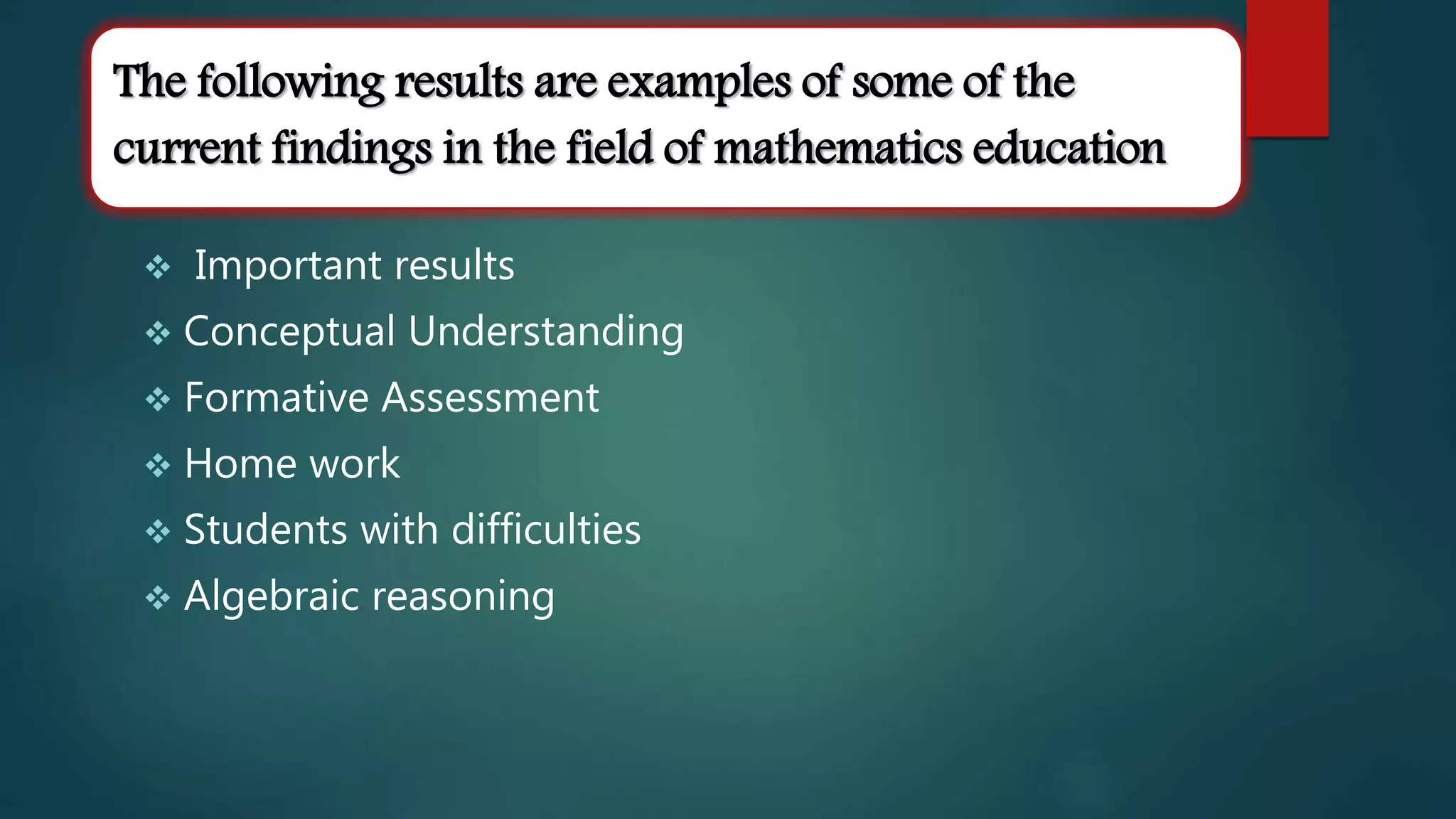
The following results are examples of some of the
current findings in the field of mathematics education
 Important results
 Conceptual Understanding
 Formative Assessment
 Home work
 Students with difficulties
 Algebraic reasoning
Conclusion
 At the current stage of research in mathematics education, its main contribution to practice
may be to raise teacher awareness and deepen teacher understanding of the complicated
nature of mathematical knowledge, knowing, and learning.
 Reading and discussing research articles, contributed to the teachers learning, in general, that
students construct their knowledge.
 The mini-study made this theoretical idea more specific, concrete and relevant for the teachers.
 They learned what the constructivist view might mean in a practical context.
Mathematics Research
Thrust areas in
 Contextualized Learning in Science and Mathematics –
Informal Learning sub-section (Research Thrusts 2013)
Thrust research aims:
The thrust will carry out research into societal and contextual issues that relate to mathematics,
science and technology. Such issues include indigenous knowledge systems, mathematical
informal learning, the nature of science, “practical work” and science engagement with the
Thrust development aims:
To develop teachers in order for them to use learning opportunities outside the classroom as
effectively as possible. In addition, science awareness in the general public are carried out.
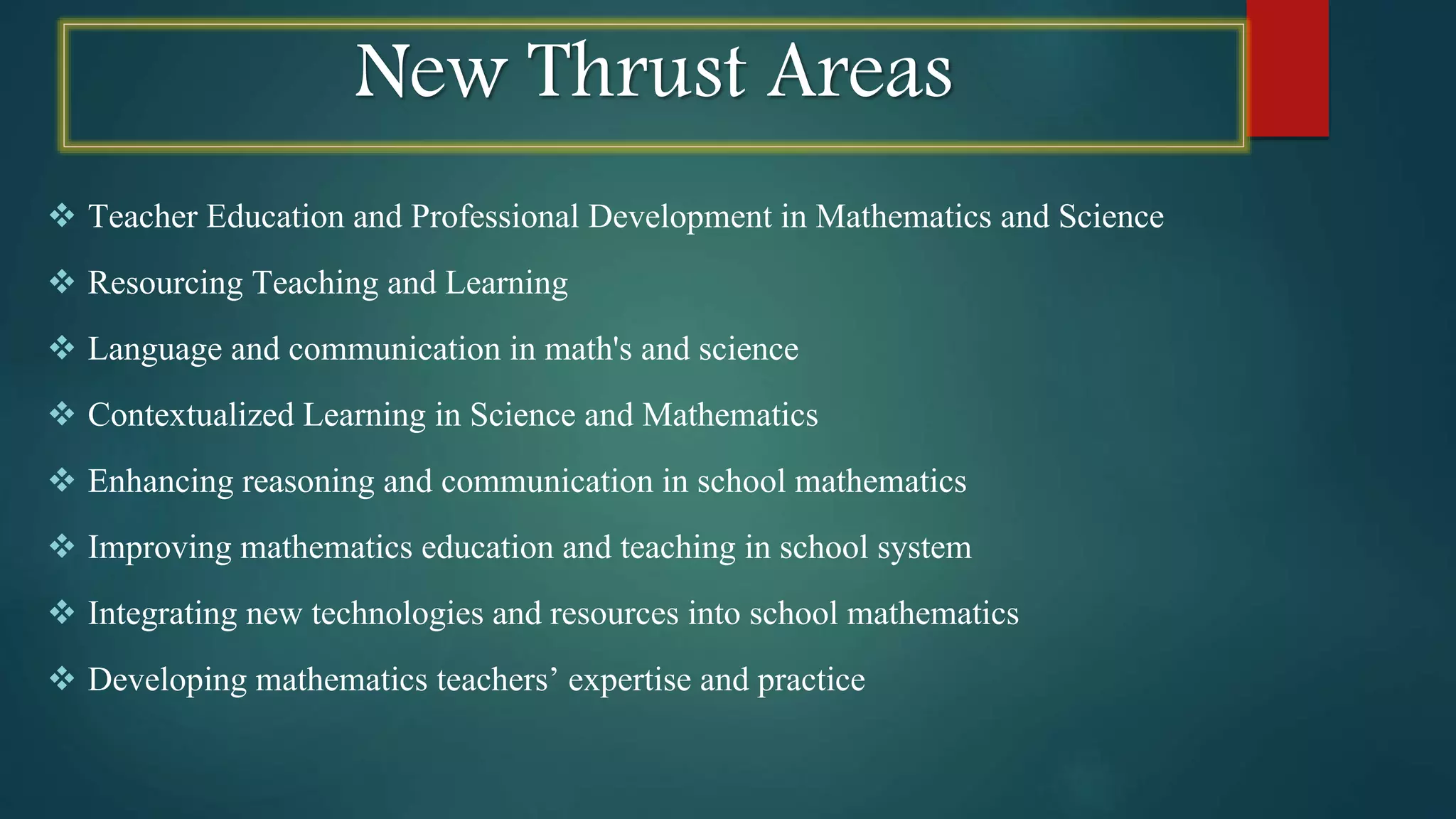
New Thrust Areas
 Teacher Education and Professional Development in Mathematics and Science
 Resourcing Teaching and Learning
 Language and communication in math's and science
 Contextualized Learning in Science and Mathematics
 Enhancing reasoning and communication in school mathematics
 Improving mathematics education and teaching in school system
 Integrating new technologies and resources into school mathematics
 Developing mathematics teachers’ expertise and practice

Research mathematics education new

  • 1.
  • 2.
    What you meanby Mathematics Education? In contemporary education, mathematics education is the practice of teaching and learning mathematics, along with the associated scholarly research.
  • 3.
    RESEARCH The systematic, rigorousinvestigation of a situation or problem in order to generate new knowledge or validate existing knowledge.
  • 4.
    What is themeaning of Research in Mathematics Education? Researches in Mathematics education primarily concerned with the tools, methods and approaches that facilitate practice or the study of practice. Pedagogy of Mathematics has developed into an extensive field of study, with its own concepts, theories, methods, national and international organizations, conferences and literature.
  • 5.
    Objectives  The teachingand learning of basic numeracy skills to all pupils.  The teaching of practical mathematics (arithmetic, elementary algebra, plane and solid geometry, trigonometry) to most pupils, to equip them a trade or craft.  The teaching of abstract mathematical concepts (such as set and function) at an early age.  The teaching of selected areas of mathematics (such as Euclidean Geometry) as an example of an axiomatic system and a model of deductive reasoning.  The teaching of heuristic and other problem solving strategies to solve non-routine problems.
  • 6.
    Need and it’sImportance  Continuing mathematics research is important because incredibly useful concepts like cryptography, calculus, image and signal processing to continue to come from mathematics and are helping people solve real-world problems.  This “math as tool” is absolutely true and probably the easiest way to go about making the case for math research.  It’s a long-term project.  We don’t know exactly what will come out next, or when, but if we follow the trend of “useful tools” we trust that math will continue to produce for society.  Mathematics is omnipresent in the exact science.  Mathematics is basic stuff that has been known for decades or centuries.
  • 7.
     It isan art form, and more than that, an ancient and collaborative art form, performed by an entire community.  Our existence informs us on the most basic questions surrounding what it means to be human.  compare mathematics research directly with some other fields like philosophy or even writing or music.  Continuing math research is important because it trains people to think abstractly and to have a skeptical mindset.
  • 8.
    The following resultsare examples of some of the current findings in the field of mathematics education  Important results  Conceptual Understanding  Formative Assessment  Home work  Students with difficulties  Algebraic reasoning
  • 9.
    Conclusion  At thecurrent stage of research in mathematics education, its main contribution to practice may be to raise teacher awareness and deepen teacher understanding of the complicated nature of mathematical knowledge, knowing, and learning.  Reading and discussing research articles, contributed to the teachers learning, in general, that students construct their knowledge.  The mini-study made this theoretical idea more specific, concrete and relevant for the teachers.  They learned what the constructivist view might mean in a practical context.
  • 10.
  • 11.
     Contextualized Learningin Science and Mathematics – Informal Learning sub-section (Research Thrusts 2013) Thrust research aims: The thrust will carry out research into societal and contextual issues that relate to mathematics, science and technology. Such issues include indigenous knowledge systems, mathematical informal learning, the nature of science, “practical work” and science engagement with the Thrust development aims: To develop teachers in order for them to use learning opportunities outside the classroom as effectively as possible. In addition, science awareness in the general public are carried out.
  • 12.
    New Thrust Areas Teacher Education and Professional Development in Mathematics and Science  Resourcing Teaching and Learning  Language and communication in math's and science  Contextualized Learning in Science and Mathematics  Enhancing reasoning and communication in school mathematics  Improving mathematics education and teaching in school system  Integrating new technologies and resources into school mathematics  Developing mathematics teachers’ expertise and practice