The anatomy of the vertebral
column
(thoracic & lumbar sections/segments of spinal
column
By
Dr. Soran M Kareem
Lecture outline
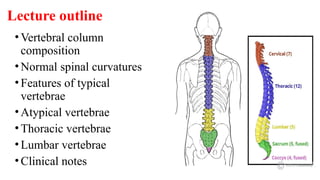
•Vertebral column
composition
•Normal spinal curvatures
•Features of typical
vertebrae
•Atypical vertebrae
•Thoracic vertebrae
•Lumbar vertebrae
•Clinical notes
Further readings!
•Anatomical basis of
dentistry ; by Bernard
Liebgott
• 3rd
edition chapters , 4
pages; 37, 54 & 87
•Figures; 2-2, 2-, 2-4 & 3-5
& 4-1
Functions
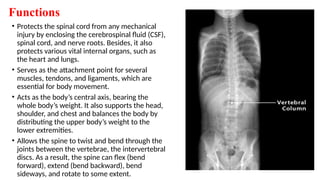
• Protects the spinal cord from any mechanical
injury by enclosing the cerebrospinal fluid (CSF),
spinal cord, and nerve roots. Besides, it also
protects various vital internal organs, such as
the heart and lungs.
• Serves as the attachment point for several
muscles, tendons, and ligaments, which are
essential for body movement.
• Acts as the body’s central axis, bearing the
whole body’s weight. It also supports the head,
shoulder, and chest and balances the body by
distributing the upper body’s weight to the
lower extremities.
• Allows the spine to twist and bend through the
joints between the vertebrae, the intervertebral
discs. As a result, the spine can flex (bend
forward), extend (bend backward), bend
sideways, and rotate to some extent.
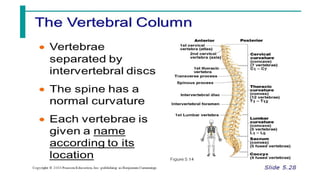
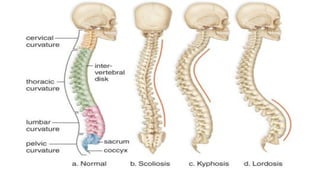
Spinal Curves
•The spine in adults has multiple natural curves.
•With the thoracic and sacrococcygeal curves being
the primary ones.
•There are two other minor curvatures,
the cervical, and lumbar curves, at the respective
regions of the spine.
•These curves provide extra strength to the spine to
support and distribute the body’s weight, absorb shock,
and allow the spine to bend and move in different
directions.
Articulations
• Intervertebral symphyses: All the vertebral bodies, except
C1-C2 and S2-S3, are joined via fibrocartilaginous joints by
intervertebral fibrocartilage in the form of intervertebral
discs.
• Zygapophyseal joints: Synovial joints formed between the
adjacent vertebral arches’ superior and inferior articular
facets.
• Atlanto-occipital joint: Another synovial joint found
between the atlas (C1) and the occipital bone.
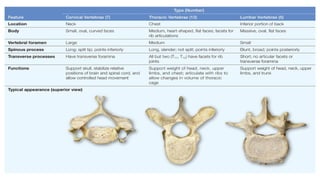
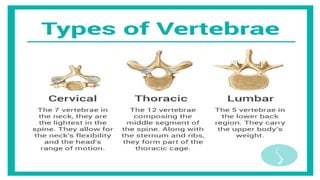
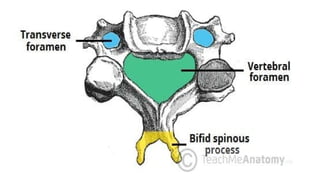
1. Cervical Vertebrae
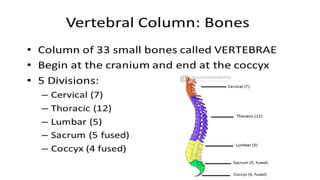
There are 7 cervical vertebrae named C1-C7, having thin intervertebral discs. The first two, C1 (atlas) and C2 (axis),
have unique anatomy and help in the rotation of the head. The other five vertebrae, C3-C7, share similar anatomical
features. They all have a bifid spinous process, transverse foramina, anterior and posterior tubercles, and a triangular
vertebral foramen.
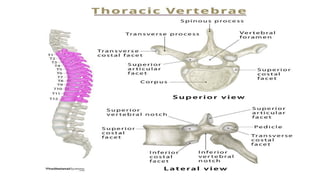
2. Thoracic Vertebrae
There are 12 medium-sized thoracic vertebrae (T1-T12) in the spine, with thicker intervertebral discs than cervical
ones. The size of the individual vertebra increases gradually down the spine. Their job is to articulate with the bony
ribs, forming the rib cage or thoracic cage.
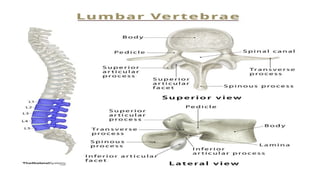
3. Lumbar Vertebrae
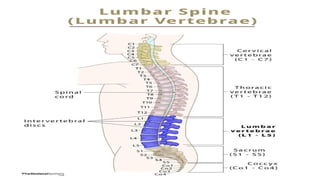
The spine has 5 lumbar vertebrae(L1-L5) supporting the body weight. They have large, kidney-shaped vertebral
bodies, triangular vertebral foramen, and short spinous processes. Among all the vertebrae, the L5 lumbar vertebra is
the largest.
4. Sacrum
It looks like a single bony component composed of 5 fused vertebrae (S1-S5). It looks like an inverted triangle, with
the apex pointing inferiorly.
5. Coccyx
It is another component of the vertebral column, formed by 4 fused vertebrae (Co1-Co4). It articulates with the apex
of the sacrum and is devoid of the vertebral canal.
Clinical Relevance: Abnormal Morphology of the Spine
There are several clinical syndromes resulting from an abnormal curvature
of the spine:
• Kyphosis – excessive thoracic curvature, causing a hunchback
deformity.
• Lordosis – excessive lumbar curvature, causing a swayback deformity.
• Scoliosis – lateral curvature of the spine, usually of unknown cause.
• Cervical spondylosis – decrease in the size of the intervertebral
foramina, usually due to degeneration of the joints of the spine. The
smaller size of the intervertebral foramina puts pressure on the exiting
nerves, causing pain.
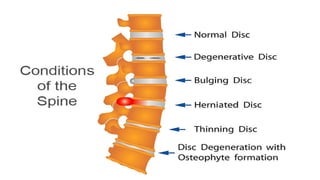
Clinical Relevance: Intervertebral Disc Herniation
• The intervertebral disc is a fibro-cartilaginous cylinder that lies between
the vertebrae, joining them together. They permit the flexibility of the
spine, and act as shock absorbers. In the lumbar and thoracic regions,
they are wedge–shaped – supporting the curvature of the spine.
• Each vertebral disc has two parts: the nucleus pulposus and annulus
fibrosus. The annulus fibrosus is tough and collagenous, and it surrounds
the jelly-like nucleus pulposus.
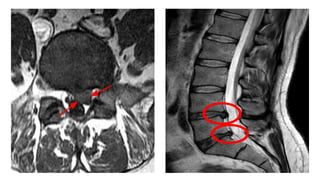
• Herniation of an intervertebral disc occurs when the nucleus
pulposus ruptures, breaking through the annulus fibrosus. The rupture
usually occurs in a posterior-lateral direction, after which the nucleus
pulposis can irritate nearby spinal nerves – resulting in a variety of
neurological and muscular symptoms.
clinically oriented anatomy of human spinal column

clinically oriented anatomy of human spinal column

  • 1.
    The anatomy ofthe vertebral column (thoracic & lumbar sections/segments of spinal column By Dr. Soran M Kareem
  • 2.
    Lecture outline •Vertebral column composition •Normalspinal curvatures •Features of typical vertebrae •Atypical vertebrae •Thoracic vertebrae •Lumbar vertebrae •Clinical notes
  • 3.
    Further readings! •Anatomical basisof dentistry ; by Bernard Liebgott • 3rd edition chapters , 4 pages; 37, 54 & 87 •Figures; 2-2, 2-, 2-4 & 3-5 & 4-1
  • 7.
    Functions • Protects thespinal cord from any mechanical injury by enclosing the cerebrospinal fluid (CSF), spinal cord, and nerve roots. Besides, it also protects various vital internal organs, such as the heart and lungs. • Serves as the attachment point for several muscles, tendons, and ligaments, which are essential for body movement. • Acts as the body’s central axis, bearing the whole body’s weight. It also supports the head, shoulder, and chest and balances the body by distributing the upper body’s weight to the lower extremities. • Allows the spine to twist and bend through the joints between the vertebrae, the intervertebral discs. As a result, the spine can flex (bend forward), extend (bend backward), bend sideways, and rotate to some extent.
  • 8.
    Spinal Curves •The spinein adults has multiple natural curves. •With the thoracic and sacrococcygeal curves being the primary ones. •There are two other minor curvatures, the cervical, and lumbar curves, at the respective regions of the spine. •These curves provide extra strength to the spine to support and distribute the body’s weight, absorb shock, and allow the spine to bend and move in different directions.
  • 9.
    Articulations • Intervertebral symphyses:All the vertebral bodies, except C1-C2 and S2-S3, are joined via fibrocartilaginous joints by intervertebral fibrocartilage in the form of intervertebral discs. • Zygapophyseal joints: Synovial joints formed between the adjacent vertebral arches’ superior and inferior articular facets. • Atlanto-occipital joint: Another synovial joint found between the atlas (C1) and the occipital bone.
  • 12.
    1. Cervical Vertebrae Thereare 7 cervical vertebrae named C1-C7, having thin intervertebral discs. The first two, C1 (atlas) and C2 (axis), have unique anatomy and help in the rotation of the head. The other five vertebrae, C3-C7, share similar anatomical features. They all have a bifid spinous process, transverse foramina, anterior and posterior tubercles, and a triangular vertebral foramen. 2. Thoracic Vertebrae There are 12 medium-sized thoracic vertebrae (T1-T12) in the spine, with thicker intervertebral discs than cervical ones. The size of the individual vertebra increases gradually down the spine. Their job is to articulate with the bony ribs, forming the rib cage or thoracic cage. 3. Lumbar Vertebrae The spine has 5 lumbar vertebrae(L1-L5) supporting the body weight. They have large, kidney-shaped vertebral bodies, triangular vertebral foramen, and short spinous processes. Among all the vertebrae, the L5 lumbar vertebra is the largest. 4. Sacrum It looks like a single bony component composed of 5 fused vertebrae (S1-S5). It looks like an inverted triangle, with the apex pointing inferiorly. 5. Coccyx It is another component of the vertebral column, formed by 4 fused vertebrae (Co1-Co4). It articulates with the apex of the sacrum and is devoid of the vertebral canal.
  • 23.
    Clinical Relevance: AbnormalMorphology of the Spine There are several clinical syndromes resulting from an abnormal curvature of the spine: • Kyphosis – excessive thoracic curvature, causing a hunchback deformity. • Lordosis – excessive lumbar curvature, causing a swayback deformity. • Scoliosis – lateral curvature of the spine, usually of unknown cause. • Cervical spondylosis – decrease in the size of the intervertebral foramina, usually due to degeneration of the joints of the spine. The smaller size of the intervertebral foramina puts pressure on the exiting nerves, causing pain.
  • 25.
    Clinical Relevance: IntervertebralDisc Herniation • The intervertebral disc is a fibro-cartilaginous cylinder that lies between the vertebrae, joining them together. They permit the flexibility of the spine, and act as shock absorbers. In the lumbar and thoracic regions, they are wedge–shaped – supporting the curvature of the spine. • Each vertebral disc has two parts: the nucleus pulposus and annulus fibrosus. The annulus fibrosus is tough and collagenous, and it surrounds the jelly-like nucleus pulposus. • Herniation of an intervertebral disc occurs when the nucleus pulposus ruptures, breaking through the annulus fibrosus. The rupture usually occurs in a posterior-lateral direction, after which the nucleus pulposis can irritate nearby spinal nerves – resulting in a variety of neurological and muscular symptoms.

Editor's Notes

  • #2 The vertebral column (spine) defines the animal subphylum Vertebra, or vertebrates, of the phylum Chordata. In humans, it is composed of 33 vertebrae that include 7 cervical, 12 thoracic, 5 lumbar, 5 sacral, and 4 coccygeal. Along with the skull, ribs, and sternum, these vertebrae make up the axial skeletal system.
  • #4 What is the Vertebral Column The vertebral column, commonly known as the spine, spinal column, or backbone, is a flexible hollow structure through which the spinal cord runs. It comprises 33 small bones called vertebrae, which remain separated by cartilaginous intervertebral discs. The vertebral column forms the axial skeleton, skull bones, ribs, and sternum. The vertebral column is a series of approximately 33 bones called vertebrae, which are separated by intervertebral discs. The column can be divided into five different regions, with each region characterised by a different vertebral structure. In this article, we shall look at the anatomy of the vertebral column – its function, structure, and clinical significance.
  • #7 The vertebral column has four main functions: Protection – encloses and protects the spinal cord within the spinal canal. Support – carries the weight of the body above the pelvis. Axis – forms the central axis of the body. Movement – has roles in both posture and movement.
  • #9 The vertebral column consists of several joints that permit various movements of the column. These joints are typically organized into the joints of the vertebral bodies, joints of the vertebral arches, craniovertebral joints, costovertebral joints, and the sacroiliac joints.
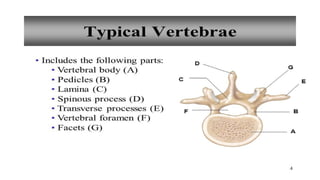
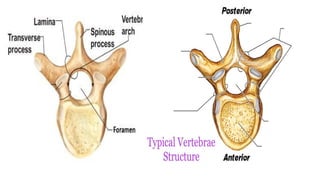
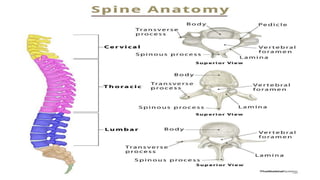
  • #10 Parts and Anatomy Though the anatomy of the 33 vertebrae may differ in some ways, most of them share a typical structure with the following parts: 1. Vertebral Body It is the large, cylindrical, weight-bearing component that forms the anterior part of all vertebrae. Its superior and inferior regions are covered by hyaline cartilage. A fibrocartilaginous intervertebral disc separates the adjacent vertebral bodies from each other. As we move down the vertebral column, the size of the vertebral body increases to better support the body’s weight. 2. Vertebral Arch It forms the lateral and posterior parts of each vertebra. The vertebral arch and vertebral body join to create an enclosed space called the vertebral foramen. These hole-like structures of all the adjacent vertebrae stack up on top of each other to form the continuous hollow space of the backbone, the vertebral canal. The spinal cord runs through this canal. The vertebral arch features the following bony projections, where the muscles and ligaments get attached. Spinous processes Transverse processes Pedicles Lamina Articular processes
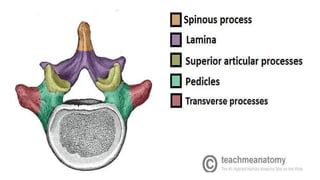
  • #11 Description. A typical vertebra consists of a body and a vertebral arch. The arch is formed by the paired pedicles and paired laminae. Arising from the vertebral arch are the transverse, spinous, superior articular, and inferior articular processes. The vertebral arch forms the lateral and posterior aspect of each vertebrae. In combination with the vertebral body, the vertebral arch forms an enclosed hole – the vertebral foramen. The foramina of all the vertebrae line up to form the vertebral canal, which encloses the spinal cord. The vertebral arches have several bony prominences, which act as attachment sites for muscles and ligaments: Spinous processes – each vertebra has a single spinous process, centred posteriorly at the point of the arch. Transverse processes – each vertebra has two transverse processes, which extend laterally and posteriorly from the vertebral body. In the thoracic vertebrae, the transverse processes articulate with the ribs. Pedicles – connect the vertebral body to the transverse processes. Lamina – connect the transverse and spinous processes. Articular processes – form joints between one vertebra and its superior and inferior counterparts. The articular processes are located at the intersection of the laminae and pedicles.  
  • #16 Cervical Vertebrae There are seven cervical vertebrae in the human body. They have three main distinguishing features: Bifid spinous process – the spinous process bifurcates at its distal end. Exceptions to this are C1 (no spinous process) and C7 (spinous process is longer than that of C2-C6 and may not bifurcate). Transverse foramina – an opening in each transverse process, through which the vertebral arteries travel to the brain. Triangular vertebral foramen Two cervical vertebrae that are unique. C1 and C2 (called the atlas and axis respectively), are specialised to allow for the movement of the head.
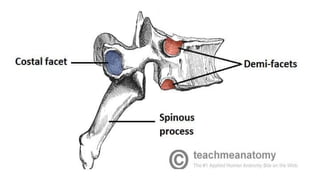
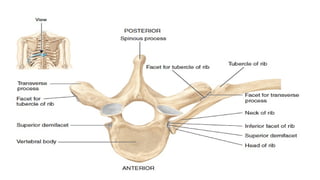
  • #17 Thoracic Vertebrae The twelve thoracic vertebrae are medium-sized, and increase in size from superior to inferior. Their specialised function is to articulate with ribs, producing the bony thorax. Each thoracic vertebra has two ‘demi facets,’ superiorly and inferiorly placed on either side of its vertebral body. The demi facets articulate with the heads of two different ribs. On the transverse processes of the thoracic vertebrae, there is a costal facet for articulation with the shaft of a single rib. For example, the head of Rib 2 articulates with the inferior demi facet of thoracic vertebra 1 (T1) and the superior demi facet of T2, while the shaft of Rib 2 articulates with the costal facets of T2. The spinous processes of thoracic vertebrae are oriented obliquely inferiorly and posteriorly. In contrast to the cervical vertebrae, the vertebral foramen of thoracic vertebrae is circular.
  • #18 Each rib articulates posteriorly with two thoracic vertebrae; by the costovertebral joint. An exception to this rule is that the first rib articulates with the first thoracic vertebra only.
  • #19 Lumbar Vertebrae There are five lumbar vertebrae in most humans, which are the largest in the vertebral column. They are structurally specialised to support the weight of the torso. Lumbar vertebrae have very large vertebral bodies, which are kidney shaped. They lack the characteristic features of other vertebrae, with no transverse foramina, costal facets, or bifid spinous processes. However, like the cervical vertebrae, they have a triangular-shaped vertebral foramen. Their spinous processes are shorter than those of thoracic vertebrae and do not extend inferiorly below the level of the vertebral body. Their size and orientation permits needle access to the spinal canal and spinal cord (which would not be possible between thoracic vertebrae). Examples include epidural anaesthesia administration and lumbar puncture.
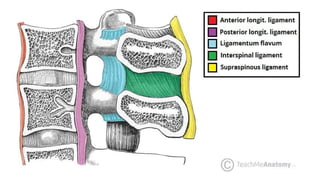
  • #20 Joints and Ligaments The mobile vertebrae articulate with each other via joints between their bodies and articular facets: Left and right superior articular facets articulate with the vertebra above. Left and right inferior articular facets articulate with the vertebra below. Vertebral bodies indirectly articulate with each other via the intervertebral discs. The vertebral body joints are cartilaginous joints, designed for weight-bearing. The articular surfaces are covered by hyaline cartilage, and are connected by the intervertebral disc. Two ligaments strengthen the vertebral body joints: the anterior and posterior longitudinal ligaments, which run the full length of the vertebral column. The anterior longitudinal ligament is thick and prevents hyperextension of the vertebral column. The posterior longitudinal ligament is weaker and prevents hyperflexion. The joints between the articular facets, called facet joints, allow for some gliding motions between the vertebrae. They are strengthened by several ligaments: Ligamentum flavum – extends between lamina of adjacent vertebrae. Interspinous and supraspinous – join the spinous processes of adjacent vertebrae. The interspinous ligaments attach between processes, and the supraspinous ligaments attach to the tips. Intertransverse ligaments – extends between transverse processes.
  • #21 Thoracic vertebrae have medium-sized and heart-shaped vertebral bodies, also known as corpus. Their primary role is to support body weight. As it approaches the lumbar vertebrae, the size of the vertebral bodies increases. On both sides of the vertebral body lie two concave cartilage-lined depressions, named superior and inferior costal facets, where the ribs get attached. Among the two facets, the superior one articulates with the head of the adjacent rib, and the inferior articulates with the head of the rib below. Pedicles are cylindrical bony protrusions projecting from the posterolateral surfaces of the vertebral bodies. Their superior and inferior surfaces are marked with several notches that combine to form the intervertebral foramina. The thoracic spinal nerves pass through this foramen. On the posterior side, the pedicles articulate with the laminae on both sides, forming the neural arch. This arch fuses with the posterior surface of the vertebral body, creating the vertebral foramen. The foramen of the adjacent thoracic vertebrae line up to form the vertebral canal, through which the spinal cord passes. These are long and thin wing-like structures projecting laterally from the junction between the pedicle from both sides of the vertebrae. The tubercle of the rib, along with several essential muscles and ligaments, attach here. Articular Processes Every thoracic vertebra features superior and inferior articular processes on both sides. Each of these processes has its corresponding articular facets, superior articular facet, and inferior articular facet. The former projects posteriorly and laterally, while the latter directs forward and medially.
  • #24 An abnormal curve in your spine, such as scoliosis or kyphosis, is known as a spinal deformity. It can affect your spine's ability to do its job, leading to pain, neurological problems, and mobility challenges.