Memory
Presenter: Dr Shashi Negi
PG1 Student, Psychiatry Department
IGGMC Nagpur
Outline (Focus on Psychological Aspects of Memory)
• Introduction
• Physiology of Memory
• Theories Of Memory
• Organisation of Long Term Memory
• Retrieval from Long Term Memory
• Forgetting
• Amnesia
Introduction
• Defined As: “Encoding, Storage, and retrieval of
what was learned earlier.”
• Study of Memory emphasises on cognitive, or
mental processes.
• Based upon synaptic plasticity.
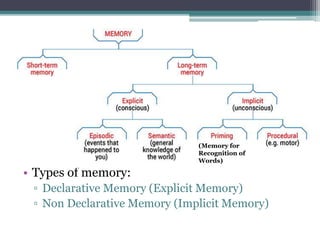
• Types of memory:
▫ Declarative Memory (Explicit Memory)
▫ Non Declarative Memory (Implicit Memory)
(Memory for
Recognition of
Words)
Physiology of Memory
▫ The basis of memory is synaptic plasticity
 Increase in response to repeated activity of the
synapse leads to sensitization and long term
potentiating
 Decrease in response to repeated activity of
synapse leads to Habituation and Long Term
Depression.
▫ Hippocampus which is important part for memory
 STM consolidation (Long term Potentiation) leads to
LTM
 CA1 Neurons of Hippocampus activated by different
pathway which helps in consolidation (Long Term
Potentiation).
 Sensory input pathway to hippocampus also called
preforant pathway.
Theories of Memory
• Theory of General Memory Functions
• Information Processing Theory
• Level of Processing theory
• Theory of General Memory Functions
▫ Most agreed theory
▫ Divided in three phases
 Encoding: Process of receiving sensory input
and transforming it into a form, or code, which
can be stored.
 Storage: Process of putting coded information
into memory.
 Retrieval: Process of gaining access to stored,
coded information when it is needed.
• Information Processing Theory
▫ By Richard Atkinson and Richard Shiffirin (1968)
▫ Sensory Register or Memory:
 Storage function of sensory channel
 Information that is given attention is sent to
Short term memory, rest is lost.
▫ Short term Memory:
 Information retained for up to 30 Sec, However
lengths of retention depends upon multiple
factors.
 Glanzer and Cunitz (1966) gave experiment to
demonstrate features of Short Term memory.
 They used the technique named “Free Recall”.
 Subjective Experiment; List of 15 noun
 Three Conditions:
▫ Zero Delay
▫ 10 Sec Delay
▫ 30 Sec Delay
▫ Delay interval filled with mental activity
(Counting)
 Recall Depends upon serial position of Noun
 Better recall in beginning called Primacy effect
 Better recall at end is called Recency effect
 Recency effect affected in Delay Interval due to
interference of transfer from short term to long
term memory due to Mental activity
▫ Rehearsal: Keeping items of information in the
centre of attention.
 Two Types
 Maintenance Rehearsal: Just going over and
over information to be remembered
 Elaborative Rehearsal: Giving Information/
material Organisation and meaning as it is
rehearsed.
• Level of processing Theory
▫ Given by Craik and Lockhart 1972, Elaborated by
Craik and Tulving
▫ Information can be worked at different Three
levels
 Perception: Immediate awareness of
environment.
 Structural Level: Structural features of the
Inputs are analyzed (sound, look, other details)
 Meaning Level: deeper Meaning of the input.
▫ Greater the elaboration of Information more likely
it is to be remembered.
Organisation of Long Term Memory
• Conscious Long Term memory is divided into
Semantic and Episodic Memory.
• Semantic
▫ “What words means, about the ways they are
related to one another, and about the rules for
using them in communication and thinking.”
▫ Stored in highly organised manner in two possible
ways
 Logical hierarchy from general category to specific
ones.
 Clusters of words with related meaning
• Episodic Memory
▫ Memory of specific things that happened to us at a
particular place and time.
▫ Less organised then semantic memory
▫ More Susceptible to be forgotten then semantic
memory.
• Encoding and Storing of Long Term Memory
▫ Encoding and storage are facilitated by organisation of
materials to be remembered.
▫ Organisation: can be Objective i.e. from Material/
Information to be remembered or Subjective i.e.
Imposed by us upon the information.
▫ Forming Images: during Encoding can also
helps in storage of Information.
▫ Constructive Process: Especially with complex
information or Life events details are often
modified or changed or inferences rather then
exact details are stored in memory.
Retrieval From Long Term Memory
• Retrieval Cues
▫ Finding information in the organised long term
memory is aided by retrieval cues
▫ More are cues for any encoded memory better are
chances of its retrieval.
▫ There can be state depended memory and cues
as well, e.g. Memory encoded during alcohol
intoxication may only be retrieved under alcohol
intoxication.
• Reconstructive Processes in retrieval Memory
▫ Unconscious modification of memory during
retrieval.
▫ Seen in persons with organic memory disorders
when gaps in memory are filled unconsciously by
false information
Forgetting
• Most of things we think are forgotten were never
actually encoded and stored in memory.
• Curve of Forgetting
▫ Curve of forgetting depends upon many factors
• Interferences
▫ Appears to play role in problems in forming new
memory
▫ Two types
 Retroactive interference: New information
interfere in memory retrieval of old information.
 Proactive interference: Old information interfere
in memory retrieval of new information.
▫ Exact mechanism of interference is still unclear
Amnesia
• Amnesia: “Profound Memory deficit due to either
loss of what has been stored or the inability to form
new memories”.
• Broad two Types:
▫ Psychological Amnesia: without any structural or
molecular brain malfunction
▫ Biological Amnesia: with structural or molecular
brain malfunction
• Psychological Amnesia
▫ Childhood Amnesia
 Poor early Childhood memory.
 Three Hypothesis
 Repression of forbidden (Sexual/ Aggressive)
memories that may cause anxiety or guilt if brought
into awareness, Freud 1938
 Difference in Encoding and storage of Information in
adults vs. Children; Adults encode memory using
language but children may encode memory using
unknown organisation making retrieval of information
difficult, Schachtel 1959
 Lack of maturation of brain structures responsible for
maturation in children so that memory is not stored properly
▫ Dream Amnesia
 Inability to remember all dreams had during sleep
 As per Freud due to repression of forbidden urges seen in
dreams just like childhood amnesia.
 May also be due to different organising of memory in dreams
in comparison to awake state. (State Dependent Memory)
▫ Defensive Amnesia
 Defensive repression of intense, intolerable life situations and
conflicts to prevent anxiety, guilt or other negative emotions.
• Biological Amnesia
▫ Transient Global Amnesia
 Profound memory problem with intact
consciousness
 Acute onset and usually short period condition
 Both anterograde as well as retrograde amnesia
 Due to temporary alteration in pattern of blood
flow in brain.
▫ Substance Use and Amnesia
 Cannabis can cause minor problems in encoding
and storage of memory.
 Alcohol
 Known to cause problems in encoding and
storage of memory, can lead to gap in memory
for period of heavy alcohol intoxication.
 Long term alcohol use can also cause difficult
to treat Korsakoff Syndrome due to Thiamine
deficiencies leading to anterograde amnesia.
▫ Senile Dementia
 Old age onset deficit in intellectual abilities like
memory, attention, judgement etc.
 Mostly anterograde amnesia
 Result of reduction of blood flow in brain.
▫ Alzheimer’s Dementia
 It is a type of Primary degenerative dementia
 Due to Acetylcholine deficiencies in brain areas
 Progressive mental deterioration from mild
anterograde to profound anterograde and retrograde
amnesia.
Thank You!

Memory.pptx

  • 1.
    Memory Presenter: Dr ShashiNegi PG1 Student, Psychiatry Department IGGMC Nagpur
  • 2.
    Outline (Focus onPsychological Aspects of Memory) • Introduction • Physiology of Memory • Theories Of Memory • Organisation of Long Term Memory • Retrieval from Long Term Memory • Forgetting • Amnesia
  • 3.
    Introduction • Defined As:“Encoding, Storage, and retrieval of what was learned earlier.” • Study of Memory emphasises on cognitive, or mental processes. • Based upon synaptic plasticity.
  • 4.
    • Types ofmemory: ▫ Declarative Memory (Explicit Memory) ▫ Non Declarative Memory (Implicit Memory) (Memory for Recognition of Words)
  • 5.
    Physiology of Memory ▫The basis of memory is synaptic plasticity  Increase in response to repeated activity of the synapse leads to sensitization and long term potentiating  Decrease in response to repeated activity of synapse leads to Habituation and Long Term Depression. ▫ Hippocampus which is important part for memory  STM consolidation (Long term Potentiation) leads to LTM
  • 6.
     CA1 Neuronsof Hippocampus activated by different pathway which helps in consolidation (Long Term Potentiation).  Sensory input pathway to hippocampus also called preforant pathway.
  • 7.
    Theories of Memory •Theory of General Memory Functions • Information Processing Theory • Level of Processing theory
  • 8.
    • Theory ofGeneral Memory Functions ▫ Most agreed theory ▫ Divided in three phases  Encoding: Process of receiving sensory input and transforming it into a form, or code, which can be stored.  Storage: Process of putting coded information into memory.  Retrieval: Process of gaining access to stored, coded information when it is needed.
  • 9.
    • Information ProcessingTheory ▫ By Richard Atkinson and Richard Shiffirin (1968)
  • 10.
    ▫ Sensory Registeror Memory:  Storage function of sensory channel  Information that is given attention is sent to Short term memory, rest is lost. ▫ Short term Memory:  Information retained for up to 30 Sec, However lengths of retention depends upon multiple factors.
  • 11.
     Glanzer andCunitz (1966) gave experiment to demonstrate features of Short Term memory.  They used the technique named “Free Recall”.  Subjective Experiment; List of 15 noun  Three Conditions: ▫ Zero Delay ▫ 10 Sec Delay ▫ 30 Sec Delay ▫ Delay interval filled with mental activity (Counting)
  • 12.
     Recall Dependsupon serial position of Noun  Better recall in beginning called Primacy effect  Better recall at end is called Recency effect  Recency effect affected in Delay Interval due to interference of transfer from short term to long term memory due to Mental activity
  • 13.
    ▫ Rehearsal: Keepingitems of information in the centre of attention.  Two Types  Maintenance Rehearsal: Just going over and over information to be remembered  Elaborative Rehearsal: Giving Information/ material Organisation and meaning as it is rehearsed.
  • 15.
    • Level ofprocessing Theory ▫ Given by Craik and Lockhart 1972, Elaborated by Craik and Tulving ▫ Information can be worked at different Three levels  Perception: Immediate awareness of environment.  Structural Level: Structural features of the Inputs are analyzed (sound, look, other details)  Meaning Level: deeper Meaning of the input.
  • 16.
    ▫ Greater theelaboration of Information more likely it is to be remembered.
  • 17.
    Organisation of LongTerm Memory • Conscious Long Term memory is divided into Semantic and Episodic Memory. • Semantic ▫ “What words means, about the ways they are related to one another, and about the rules for using them in communication and thinking.” ▫ Stored in highly organised manner in two possible ways  Logical hierarchy from general category to specific ones.  Clusters of words with related meaning
  • 18.
    • Episodic Memory ▫Memory of specific things that happened to us at a particular place and time. ▫ Less organised then semantic memory ▫ More Susceptible to be forgotten then semantic memory. • Encoding and Storing of Long Term Memory ▫ Encoding and storage are facilitated by organisation of materials to be remembered. ▫ Organisation: can be Objective i.e. from Material/ Information to be remembered or Subjective i.e. Imposed by us upon the information.
  • 19.
    ▫ Forming Images:during Encoding can also helps in storage of Information. ▫ Constructive Process: Especially with complex information or Life events details are often modified or changed or inferences rather then exact details are stored in memory.
  • 20.
    Retrieval From LongTerm Memory • Retrieval Cues ▫ Finding information in the organised long term memory is aided by retrieval cues ▫ More are cues for any encoded memory better are chances of its retrieval. ▫ There can be state depended memory and cues as well, e.g. Memory encoded during alcohol intoxication may only be retrieved under alcohol intoxication.
  • 21.
    • Reconstructive Processesin retrieval Memory ▫ Unconscious modification of memory during retrieval. ▫ Seen in persons with organic memory disorders when gaps in memory are filled unconsciously by false information
  • 22.
    Forgetting • Most ofthings we think are forgotten were never actually encoded and stored in memory. • Curve of Forgetting ▫ Curve of forgetting depends upon many factors
  • 23.
    • Interferences ▫ Appearsto play role in problems in forming new memory ▫ Two types  Retroactive interference: New information interfere in memory retrieval of old information.  Proactive interference: Old information interfere in memory retrieval of new information. ▫ Exact mechanism of interference is still unclear
  • 24.
    Amnesia • Amnesia: “ProfoundMemory deficit due to either loss of what has been stored or the inability to form new memories”. • Broad two Types: ▫ Psychological Amnesia: without any structural or molecular brain malfunction ▫ Biological Amnesia: with structural or molecular brain malfunction
  • 25.
    • Psychological Amnesia ▫Childhood Amnesia  Poor early Childhood memory.  Three Hypothesis  Repression of forbidden (Sexual/ Aggressive) memories that may cause anxiety or guilt if brought into awareness, Freud 1938  Difference in Encoding and storage of Information in adults vs. Children; Adults encode memory using language but children may encode memory using unknown organisation making retrieval of information difficult, Schachtel 1959
  • 26.
     Lack ofmaturation of brain structures responsible for maturation in children so that memory is not stored properly ▫ Dream Amnesia  Inability to remember all dreams had during sleep  As per Freud due to repression of forbidden urges seen in dreams just like childhood amnesia.  May also be due to different organising of memory in dreams in comparison to awake state. (State Dependent Memory) ▫ Defensive Amnesia  Defensive repression of intense, intolerable life situations and conflicts to prevent anxiety, guilt or other negative emotions.
  • 27.
    • Biological Amnesia ▫Transient Global Amnesia  Profound memory problem with intact consciousness  Acute onset and usually short period condition  Both anterograde as well as retrograde amnesia  Due to temporary alteration in pattern of blood flow in brain.
  • 28.
    ▫ Substance Useand Amnesia  Cannabis can cause minor problems in encoding and storage of memory.  Alcohol  Known to cause problems in encoding and storage of memory, can lead to gap in memory for period of heavy alcohol intoxication.  Long term alcohol use can also cause difficult to treat Korsakoff Syndrome due to Thiamine deficiencies leading to anterograde amnesia.
  • 29.
    ▫ Senile Dementia Old age onset deficit in intellectual abilities like memory, attention, judgement etc.  Mostly anterograde amnesia  Result of reduction of blood flow in brain. ▫ Alzheimer’s Dementia  It is a type of Primary degenerative dementia  Due to Acetylcholine deficiencies in brain areas  Progressive mental deterioration from mild anterograde to profound anterograde and retrograde amnesia.
  • 30.