
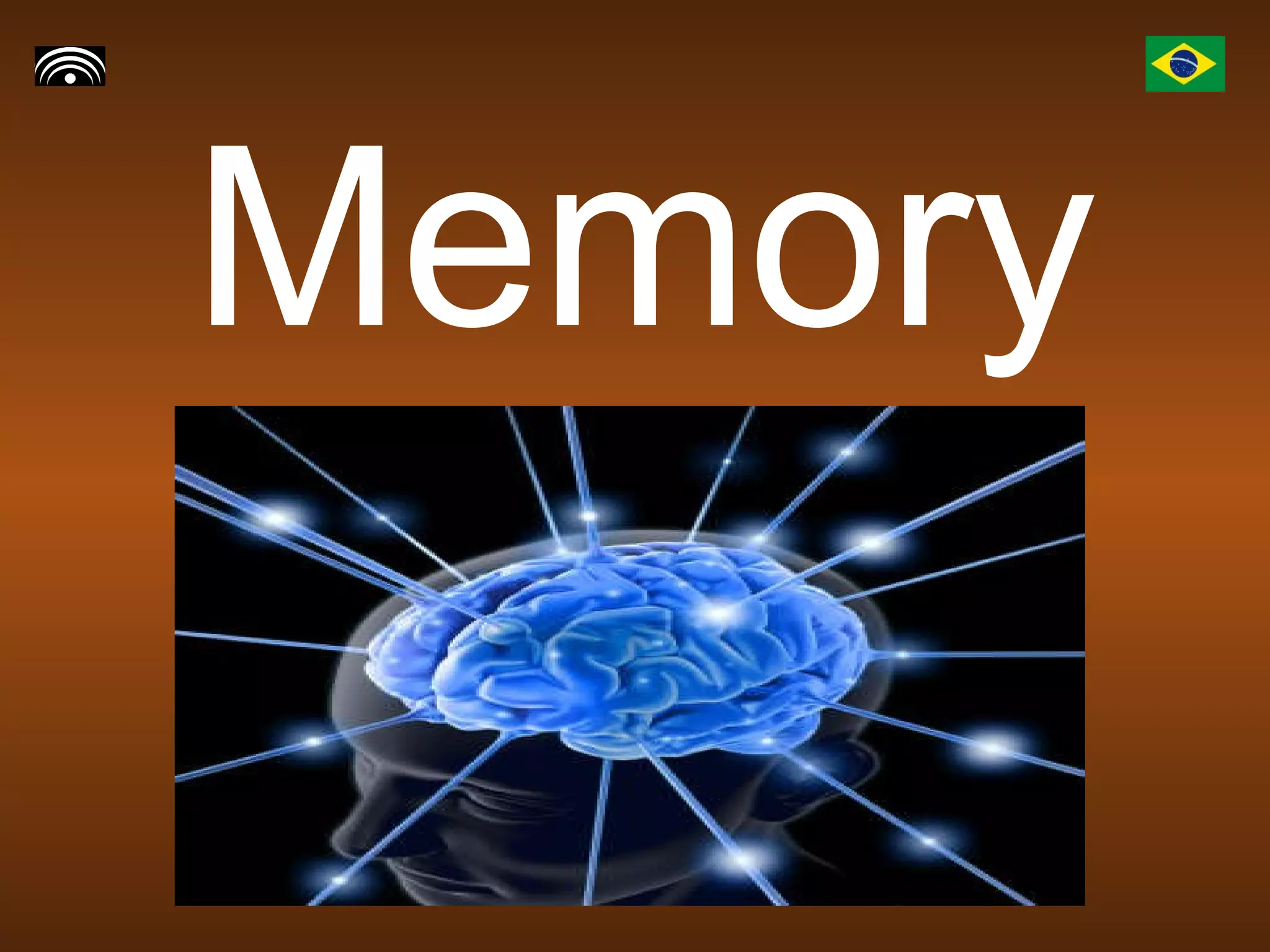


Memory
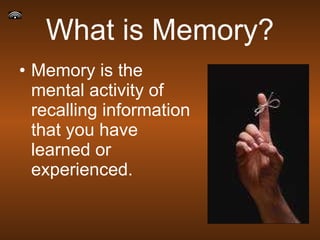
What is Memory? Memory is the mental activity of recalling information that you have learned or experienced.
Memory - Definition The ability to recover information about past events or knowledge.  The process of recovering information about past events or knowledge.
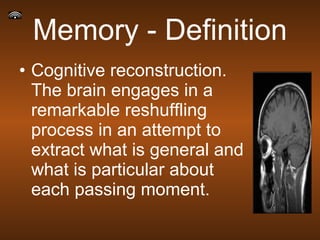
Memory - Definition Cognitive reconstruction. The brain engages in a remarkable reshuffling process in an attempt to extract what is general and what is particular about each passing moment.
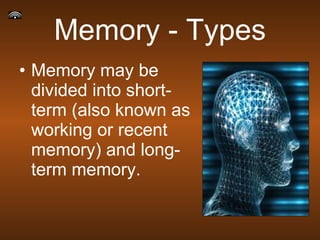
Memory - Types Memory may be divided into short-term (also known as working or recent memory) and long-term memory.
Short-term Memory Short-term memory recovers memories of recent events.
Long-term Memory Long-term memory is concerned with recalling the more distant past.
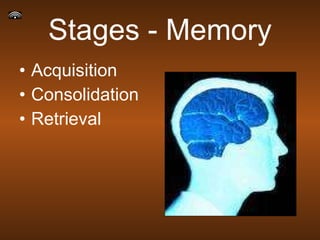
Stages - Memory Acquisition Consolidation Retrieval
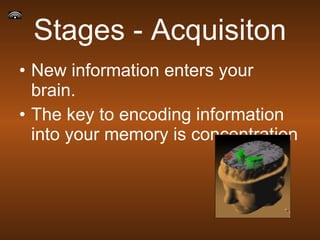
Stages - Acquisiton New information enters your brain. The key to encoding information into your memory is concentration
Stages - Acquisiton Unless you focus on information intently, it goes “in one ear and out the other.” This is why teachers are always nagging students to pay attention!
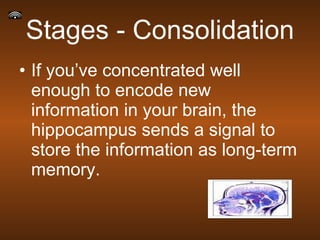
Stages - Consolidation If you’ve concentrated well enough to encode new information in your brain, the hippocampus sends a signal to store the information as long-term memory.
Stages - Retrieval When you need to recall information, your brain has to activate the same pattern of nerve cells it used to store it. The more frequently you need the information, the easier it is to retrieve it along healthy nerve cell connections.
Strategies Pay attention. Tailor information acquisition to your learning style. Involve as many senses as possible. Organize information.
Strategies Be motivated and keep a positive attitude. Rehearse information frequently and “overlearn.”
Lico Reis Consultoria  & Línguas P rof. Roberto Lico Reis www.licoreis.com [email_address] E-books: www.migre.me/oQ5 Linkedin: www.migre.me/1d9r Twitter: @licoreis

Memory - Main Aspects

  • 1.
  • 2.
    What is Memory?Memory is the mental activity of recalling information that you have learned or experienced.
  • 3.
    Memory - DefinitionThe ability to recover information about past events or knowledge. The process of recovering information about past events or knowledge.
  • 4.
    Memory - DefinitionCognitive reconstruction. The brain engages in a remarkable reshuffling process in an attempt to extract what is general and what is particular about each passing moment.
  • 5.
    Memory - TypesMemory may be divided into short-term (also known as working or recent memory) and long-term memory.
  • 6.
    Short-term Memory Short-termmemory recovers memories of recent events.
  • 7.
    Long-term Memory Long-termmemory is concerned with recalling the more distant past.
  • 8.
    Stages - MemoryAcquisition Consolidation Retrieval
  • 9.
    Stages - AcquisitonNew information enters your brain. The key to encoding information into your memory is concentration
  • 10.
    Stages - AcquisitonUnless you focus on information intently, it goes “in one ear and out the other.” This is why teachers are always nagging students to pay attention!
  • 11.
    Stages - ConsolidationIf you’ve concentrated well enough to encode new information in your brain, the hippocampus sends a signal to store the information as long-term memory.
  • 12.
    Stages - RetrievalWhen you need to recall information, your brain has to activate the same pattern of nerve cells it used to store it. The more frequently you need the information, the easier it is to retrieve it along healthy nerve cell connections.
  • 13.
    Strategies Pay attention.Tailor information acquisition to your learning style. Involve as many senses as possible. Organize information.
  • 14.
    Strategies Be motivatedand keep a positive attitude. Rehearse information frequently and “overlearn.”
  • 15.
    Lico Reis Consultoria & Línguas P rof. Roberto Lico Reis www.licoreis.com [email_address] E-books: www.migre.me/oQ5 Linkedin: www.migre.me/1d9r Twitter: @licoreis