Course Code Course Title Credit Hours
EDUC3112 Educational Psychology 3(3+0)
L # 5
5. The Cognitive Processing
5.1 The information processing Approaches
Information Processing Theory, a cognitive framework developed by American
psychologists George A. Miller and Richard Shiffrin in the 1960s, explains how the human mind
processes, stores, and retrieves information.
Information processing, as the name suggests, is about processing information in a manner that is
noticeable to an observer. It is a method that allows the gathering, recording, observing, displaying,
salvaging and spreading of valuable information.
The information processing concept is based on several assumptions like The available information
is processed by a series of processing units like short-term memory, perception, and attention It is
the function of the processing system to alter or transfer the collected information in a systematic
manner.
Information processing aims to offer details about the structure and processes that motivate
performance
Information processing in human beings to a great extent resembles that of computers
4 Steps of information processing by computers
In the context of computers, the information processing system has four different stages for instance
input, output, storage, and processing. The steps are described below
1. Input processing
2. Data processing
3. Output processing
4. Storage processing
Steps of information processing in psychology
Psychologists have been putting their onus on the fact that a human brain and a computer process
information and operate on a nearly comparable basis Comparisons have naturally been made to
identify the way information is received, stored and distributed in both the human mind and a
computer.
There are four steps of information processing. These are described below as
1. Attending
The first stage of information processing is attending, in this stage, a person pays close attention to
the information by putting all the focus on the words or data. This way it opens itself to receive the
valuable information
2. Encoding
The second stage of information processing in psychology is encoding. This is the stage where a
person processes the information it has gathered and encodes it for future usage
3. Storing
The third stage of information processing in psychology is storing. In this phase, the critical
information is stored in the memory banks so that it can easily be retrieved when required at a later
stage
4. Retrieving
The last and final step of information processing is retrieving. In this phase, the necessary data and
information can be easily retrieved from the memory banks and use it as per the need and
requirement.
Stages of memory for information processing
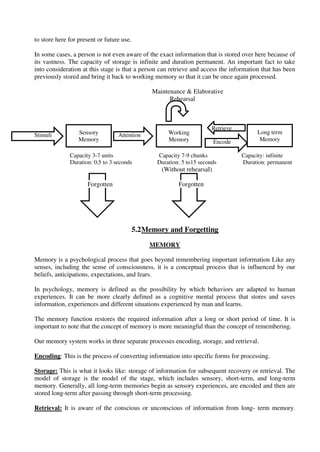
There are three main stages of memory that work together. These are:
1. Sensory memory
This is the initial stage where the senses pick up clues from the environment and bring it up in the
memory for screening and processing. The sensory memory perceives and deals with information
via its five senses or incoming stimuli.
The sensory memory deals with all the information and decides which information is important
enough to keep and which to discard Remember the capacity and duration of sensory memory is
minimal as it can handle only 3-7 units at a single time for just 1-3 seconds before the human brain
forgets it.
2. Short-term memory/working memory
This is the second stage of incoming information and holds a limited amount of information for a
specific period. It is often known as working memory and helps in planning certain aspects of life.
The information that is deemed necessary finds its way into the working memory, which offers a
temporary haven for storing and manipulating the information that needs to be processed.
Then the brain groups information so that it becomes easier to handle. The capacity and duration of
short-term or working memory are on an average of 7 chunks for 5-15 seconds before it is forgotten.
This is where the working memory starts its job via the process of rehearsal. It refers to the
manipulation of information in working memory. There are two types of rehearsal which one can
use for his benefit.
With the help of maintenance rehearsal, the idea should be repeated continuously to store it in the
working memory. The second is an elaborative rehearsal, where a definite meaning is attached to the
information and the storage now becomes more efficient.
3. Long-term memory
This is the long-term memory where the received information becomes implanted in the memory
banks. The best part is that there are no limitations on the type and amount of information you want
to store here for present or future use.
In some cases, a person is not even aware of the exact information that is stored over here because of
its vastness. The capacity of storage is infinite and duration permanent. An important fact to take
into consideration at this stage is that a person can retrieve and access the information that has been
previously stored and bring it back to working memory so that it can be once again processed.
Maintenance & Elaborative
Rehearsal
Retrieve
Stimuli Attention
Encode
Capacity 3-7 units Capacity 7-9 chunks Capacity: infinite
Duration: 0.5 to 3 seconds Duration: 5 to15 seconds Duration: permanent
(Without rehearsal)
Forgotten Forgotten
5.2Memory and Forgetting
MEMORY
Memory is a psychological process that goes beyond remembering important information Like any
senses, including the sense of consciousness, it is a conceptual process that is influenced by our
beliefs, anticipations, expectations, and fears.
In psychology, memory is defined as the possibility by which behaviors are adapted to human
experiences. It can be more clearly defined as a cognitive mental process that stores and saves
information, experiences and different situations experienced by man and learns.
The memory function restores the required information after a long or short period of time. It is
important to note that the concept of memory is more meaningful than the concept of remembering.
Our memory system works in three separate processes encoding, storage, and retrieval.
Encoding: This is the process of converting information into specific forms for processing.
Storage: This is what it looks like: storage of information for subsequent recovery or retrieval. The
model of storage is the model of the stage, which includes sensory, short-term, and long-term
memory. Generally, all long-term memories begin as sensory experiences, are encoded and then are
stored long-term after passing through short-term processing.
Retrieval: It is aware of the conscious or unconscious of information from long- term memory.
Sensory
Memory
Working
Memory
Long term
Memory
Consolidated information is stored in long-term memory registers, and then re-activated and
returned to short-term memory. This is achieved through the activation of the information's network
through the use of retrieval signals,
Forgetting
In simple words, forgetting is an inability to remember. Psychologists usually use the word
"forgetting" to encode before long-term memory and refer to the obvious loss of information stored.
Forgetfulness happens with people frequently in life, which may be normal with age. It can be an
indicator of health problems requiring medical intervention, and these health memory problems may
be associated with dementia.
Often forgetfulness, which leads to the disruption of human daily functions and professional and
social capabilities is one of the first indicators to identify and diagnose, unlike natural forgetfulness
and related to aging, which does not disrupt the daily functions of humans.
In the form of a disorder or in more severe cases, it can be described as amnesia The word "amnesia"
refers to the loss of memory. This is a kind of memory disorder that occurs from a loss of what has
already been stored.
Types of Forgetting in Psychology
There are basically two types of forgetting
1. Natural forgetting
2 Artificial forgetting
Natural or passive forgetting is unknown and happens over time. It is quite normal for people to
forget what was previously experienced. Painful memories push into the unconscious layers of the
brain and go there to forget. Artificial forgetting is the tendency of artificial neural networks to
completely and abruptly forget about the information previously learned on learning new artificial
information.
5.3 METHODS FOR IMPROVING MEMORY
The following research-proven strategies can effectively improve memory, enhance recall, and
increase retention of information
 Focus Your Attention
 Avoid Cramming
 Structure and Organize
 Utilize Mnemonic Devices
 Elaborate and Rehearse
 Visualize Concepts
 Relate New Information to Things You Already Know
 Read Out Loud
 Pay Extra Attention to Difficult Information
 Vary Your Study Routine
 Get Some Sleep
 Take care of your health
 Benefit from technology
 Reflect on your progress
 Develop Critical Thinking
 Read
 Dedicate time to creative activities
 Avoid multitasking
 Encourage internal motivation
5.4 Complex cognitive processes
Cognitive psychology is the scientific study of cognitive processes (mental processes) such as
"attention, language use, memory, perception, problem solving, creativity, and thinking"
COGNITIVE PROCESSES (Mental processes)
The main focus of cognitive psychologists is on the mental processes that affect behavior. Those
processes include, but are not limited to, the following three stages of memory:
1. Sensory memory storage: holds sensory information
2. Short term memory storage: holds information temporarily for analysis and retrieves
information from the Long term memory.
3. Long term memory: holds information over an extended period of time which receives
information from the short term memory.
1- Attention is the cognitive process of selectively concentrating on one aspect of the
environment while ignoring other things. Attention has also been referred to as the allocation
of processing resources.
The psychological definition of attention is a state of focused awareness on a subset of the available
perceptual information". A key function of attention is to identify irrelevant data and filter it out,
enabling significant data to be distributed to the other mental processes For example, the human
brain may simultaneously receive auditory, visual olfactory, taste, and tactile information.
2- Comprehension is the cognitive process of understanding the meaning of a communication.
This may be in terms of:
 Listening comprehension
 Number comprehension
 Reading comprehension
 Sentence comprehension
 Verbal comprehension
3- Decision making is the cognitive process leading to the selection of a course of action
among alternatives. Every decision making process produces a final choice. It can be an
action or an opinion. It begins when we need to do something but we do not know what.
Therefore, decision making is a reasoning process which can be rational or irrational, and can
be on explicit assumptions or tacit assumptions.
Common examples include shopping, deciding what to eat, when to sleep, and deciding whom or
what to vote for in an election or referendum.
Judgement can have a number of meanings in psychology
 Most commonly it is related to the decision-making process of forming an opinion on the
basis of the available evidence and is the term applied to the decision reached. Some sense of
the weighing of alternatives within a given set of values is implied.
 In older works it was assumed there was a faculty of judgement.
 In psychophysics a judgement applies to the decision made as to whether, for example, a
signal is present of not
Factors affecting judgement
Factors leading to judgement disturbances include:
 Bias
 Conformity
 Emotional immaturity
 Peer pressure
 Prejudice
 Uncertainty
4- Memory
There are several ways of classifying memories, based on duration, nature and retrieval of
information. From an information processing perspective there are three main stages in the
formation and retrieval of memory:
Encoding (processing and combining of received information)
Storage (creation of a permanent record of the encoded information)
Retrieval/Recall (calling back the stored information in response to some cue for use in some
process or activity)
Classification by duration
A basic and generally accepted classification of memory is based on the duration of memory
retention, and identifies three distinct types of memory sensory memory. Short-term memory, and
long-term memory.
The sensory memory corresponds approximately to the initial moment that an item is perceived.
Some of this information in the sensory area proceeds to the sensory store, which is referred to as
short-term memory. Sensory memory is characterized by the duration of memory retention from
milliseconds to seconds and short-term memory from seconds to minutes.
These stores are generally characterized as of strictly limited capacity and duration, whereas in
general stored information can be retrieved in a period of time which ranges from days to years, this
type of memory is called long-term memory.
It may be that short-term memory is supported by transient changes in neuronal communication,
whereas long-term memories are maintained by more stable and permanent changes in neural
structure that are dependent on protein synthesis. Some psychologists, however, argue that the
distinction between long and short-term memories is arbitrary, and is merely a reflection of differing
levels of activation within a single store.
If we are given a random seven-digit number, we may remember it only for a few seconds and then
forget (short-term memory). On the other hand, we can remember telephone numbers for many years
(assuming we use them often enough). Those long- lasting memories are said to be stored in long-
term memory.
5- Learning is one of the most important mental functions of humans, animals and artificial
cognitive systems. It relies on the acquisition of different types of knowledge supported by
perceived information. It leads to the development of new capacities, skills, values, understanding,
and preferences. Its goal is the increasing of individual and group experience. Learning functions
can be performed by different brain learning processes, which depend on the mental capacities of
learned subject, the type of knowledge which has to be acquitted, as well as on socio-cognitive and
environmental circumstances.
For example, in small children, non-conscious learning processes are as natural as breathing In fact,
there is evidence for behavioral learning prenatally, in which habituation has been observed as early
as 32 weeks into gestation, indicating that the central nervous system is sufficiently developed and
primed for learning and memory to occur very early on in development.
From the social perspective, learning should be the goal of teaching and education.
Conscious learning is a capacity requested by students, therefore is usually goal- oriented and
requires a motivation.
6- Perception involves both the physical senses (sight, smell, hearing, taste, touch and
proprioception) as well as the cognitive processes involved in interpreting those senses. Essentially,
it is how people come to understand the world around them through interpretation of stimuli.
Perception is the organization identification, and interpretation of sensory information in order to
represent and understand the environment. All perception involves signals in the nervous system,
which in turn result from physical stimulation of the sense organs. For example, vision involves
light striking the retinas of the eyes, smell is mediated by odor molecules and hearing involves
pressure waves Perception is not the passive receipt of these signals, but can be shaped by learning,
memory, and expectation. Perception involves these "top-down" effects as well as the "bottom- up
process of processing sensory input. The "bottom-up" processing is basically low-level information
that's used to build up higher-level information (e.g., shapes for object recognition). The top-down"
processing refers to a person's concept and expectations (knowledge) that influence perception.
Perception depends on complex functions of the nervous system, but subjectively seems mostly
effortless because this processing happens outside conscious awareness.
7- Reasoning is the mental (cognitive) process of looking for reasons for beliefs, conclusions,
actions or feelings. Humans have the ability to engage in reasoning about their own reasoning
using introspection. Different forms of such reflection on reasoning occur in different fields In
philosophy, the study of reasoning typically focuses on what makes reasoning efficient or
inefficient, appropriate or inappropriate, good or bad. Philosophers do this by either examining
the form or structure of the reasoning within arguments, or by considering the broader methods
used to reach particular goals of reasoning Psychologists and cognitive scientists, in contrast,
tend to study how people reason, which brain processes are engaged, and how the reasoning is
influenced by the structure of the brain. Specific forms of reasoning are also studied by
mathematicians and lawyers
8- Problem solving forms part of thinking Considered the most complex of all intellectual
functions, problem solving has been defined as higher-order cognitive process that requires the
modulation and control of more routine or fundamental skills (Goldstein & Levin, 1987). It
occurs if an organism or an artificial intelligence system does not know how to proceed from a
given state to a desired goal state. It is part of the larger problem process that includes problem
finding and problem shaping.
The nature of human problem solving methods has been studied by psychologists over the past
hundred years. There are several methods of studying problem solving, including: introspection,
behaviorism, simulation and computer modeling, and experiment.
9- Creativity is a mental and social process involving the generation of new ideas or concepts, or
new associations of the creative mind between existing ideas or concepts. An alternative
conception of creativeness is that it is simply the act of making something new. From a scientific
point of view, the products of creative thought (sometimes referred to as divergent thought) are
usually considered to have both originality and appropriateness.
Thought or thinking is a mental process which allows beings to model the world. and so to deal with
it effectively according to their goals, plans, ends and desires. Words referring to similar concepts
and processes include cognition, sentience, consciousness. idea, and imagination
Thinking involves the deeply cerebral manipulation of information, as when we form concepts,
engage in problem solving, reason and make decisions. Thinking is a higher cognitive function and
the analysis of thinking processes is part of cognitive psychology
10- Metacognition is the knowledge (ie, awareness) of one's cognitive processes (such as memory
and comprehension) and the efficient use of this self-awareness to self-regulate these cognitive
processes It is traditionally defined as the knowledge and experiences we have about our own
cognitive processes.
Component
Metacognition is classified into three components
1. Metacognitive knowledge (also called metacognitive awareness) is what individuals know
about themselves and others as cognitive processors.
2. Metacognitive regulation is the regulation of cognition and learning experiences through a set
of activities that help people control their learning
3. Metacognitive experiences are those experiences that have something to do with the current,
on going cognitive endeavor
10- Language Cognitive psychologists may study language acquisition, individual components of
language formation (like phonemes), how language use is involved in mood, or numerous other
related areas. Significant work has been done recently with regard to understanding the timing of
language acquisition and how it can be used to determine if a child has, or is at risk of
developing a learning disability. A study from 2012, showed that while this can be an effective
strategy, it is important that those making evaluations include all relevant information when
making their assessments Factors such as individual variability, socioeconomic status, short-term
and long-term memory capacity, and others must be included in order to make valid assessments.
5.5 Transfer of Learning
The word transfer is used to describe the effects of past learning upon present acquisition. In the
laboratory and in the outside world, how well and how rapidly we learn anything depends to a
large extent upon the kinds and amount of things we have learned previously.
In simple way transfer may be defined as "the partial or total application or carryover of
knowledge, skills, habits, attitudes from one situation to another situation".
Hence, carryover of skills of one learning to other learning is transfer of training or learning. Such
transfer occurs when learning of one set of material influences the learning of another set of material
later. For example, a person who knows to drive a moped can easily learn to drive a scooter
Types of Transfer of Learning:
There are three types of transfer of learning:
1. Positive transfer:
When learning in one situation facilitates learning in another situation, it is known as positive
transfer. For example, skills in playing violin facilitate learning to play piano. Knowledge of
mathematics facilitates to learn physics in a better way. Driving a scooter facilitates driving a
motorbike.
2. Negative transfer:
When learning of one task makes the learning of another task harder- it is known as negative transfer.
For example, speaking Telugu hindering the learning of Malayalam Left hand drive vehicles
hindering the leaming of right hand drive
3. Neutral transfer:
When learning of one activity neither facilitates not hinders the learning of another task, it is a case of
neutral transfer It is also called as zero transfer
For example, knowledge of history in no way affects learning of driving a car or a
Theories of Transfer of Learning:
There are two important theories which explain transfer of learning These are known as modem theories
Theory of identical elements:
This theory has been developed by EL. Thorndike. According to him most of transfer occurs from one
situation to another in which there are most similar or identical elements.
This theory explains that carrying over from one situation to another is roughly proportional to the
degree of resemblance in situation, in other words more the similarity, more the transfer
The degree of transfer increases as the similarity of elements increase. For example, learning to ride
moped is easy after learning to ride a bicycle. Here, transfer is very fast because of identical
elements in both vehicles.
Thorndike was convinced that the method used in guiding a pupil's learning activities had a great effect
upon the degree of transferability of his learning.
2. Theory of generalization of experience:
This theory was developed by Charles Judd. Theory of generalization assumes that what is learnt in task
"A" transfers to task 'B', because in studying 'A', the learner develops a general principle which
applies in part or completely in both 'A' and 'B'.
Experiences, habits, knowledge gained in one situation help us to the extent to which they can be
generalized and applied to another situation.
Generalization consists of perceiving and understanding what is common to a number of situations. The
ability of individuals to generalize knowledge varies with the degree of their intelligence.
Ways to Improve Transfer of Learning
Whether you're a student or working professional looking to keep your skills current, the importance of
being able to transfer what you learn in one context to an entirely new one cannot be overstated.
Of course, the goal of any learning or training is to eventually be able to apply it in real-world
situations.
 Focus on the relevance of what you're learning
 Take time to reflect and self-explain
 Use a variety of learning media
 Change things up as often as possible
 Identify any gaps in your knowledge
 Establish clear learning goals
 Practice generalizing
 Make your learning social
 Use analogies and metaphors
 Find daily opportunities to apply what you've learned

L # 5 Educational Psychology cognitive process.pdf

  • 1.
    Course Code CourseTitle Credit Hours EDUC3112 Educational Psychology 3(3+0) L # 5 5. The Cognitive Processing 5.1 The information processing Approaches Information Processing Theory, a cognitive framework developed by American psychologists George A. Miller and Richard Shiffrin in the 1960s, explains how the human mind processes, stores, and retrieves information. Information processing, as the name suggests, is about processing information in a manner that is noticeable to an observer. It is a method that allows the gathering, recording, observing, displaying, salvaging and spreading of valuable information. The information processing concept is based on several assumptions like The available information is processed by a series of processing units like short-term memory, perception, and attention It is the function of the processing system to alter or transfer the collected information in a systematic manner. Information processing aims to offer details about the structure and processes that motivate performance Information processing in human beings to a great extent resembles that of computers 4 Steps of information processing by computers In the context of computers, the information processing system has four different stages for instance input, output, storage, and processing. The steps are described below 1. Input processing 2. Data processing 3. Output processing 4. Storage processing Steps of information processing in psychology Psychologists have been putting their onus on the fact that a human brain and a computer process information and operate on a nearly comparable basis Comparisons have naturally been made to identify the way information is received, stored and distributed in both the human mind and a computer. There are four steps of information processing. These are described below as 1. Attending The first stage of information processing is attending, in this stage, a person pays close attention to the information by putting all the focus on the words or data. This way it opens itself to receive the valuable information 2. Encoding
  • 2.
    The second stageof information processing in psychology is encoding. This is the stage where a person processes the information it has gathered and encodes it for future usage 3. Storing The third stage of information processing in psychology is storing. In this phase, the critical information is stored in the memory banks so that it can easily be retrieved when required at a later stage 4. Retrieving The last and final step of information processing is retrieving. In this phase, the necessary data and information can be easily retrieved from the memory banks and use it as per the need and requirement. Stages of memory for information processing There are three main stages of memory that work together. These are: 1. Sensory memory This is the initial stage where the senses pick up clues from the environment and bring it up in the memory for screening and processing. The sensory memory perceives and deals with information via its five senses or incoming stimuli. The sensory memory deals with all the information and decides which information is important enough to keep and which to discard Remember the capacity and duration of sensory memory is minimal as it can handle only 3-7 units at a single time for just 1-3 seconds before the human brain forgets it. 2. Short-term memory/working memory This is the second stage of incoming information and holds a limited amount of information for a specific period. It is often known as working memory and helps in planning certain aspects of life. The information that is deemed necessary finds its way into the working memory, which offers a temporary haven for storing and manipulating the information that needs to be processed. Then the brain groups information so that it becomes easier to handle. The capacity and duration of short-term or working memory are on an average of 7 chunks for 5-15 seconds before it is forgotten. This is where the working memory starts its job via the process of rehearsal. It refers to the manipulation of information in working memory. There are two types of rehearsal which one can use for his benefit. With the help of maintenance rehearsal, the idea should be repeated continuously to store it in the working memory. The second is an elaborative rehearsal, where a definite meaning is attached to the information and the storage now becomes more efficient. 3. Long-term memory This is the long-term memory where the received information becomes implanted in the memory banks. The best part is that there are no limitations on the type and amount of information you want
  • 3.
    to store herefor present or future use. In some cases, a person is not even aware of the exact information that is stored over here because of its vastness. The capacity of storage is infinite and duration permanent. An important fact to take into consideration at this stage is that a person can retrieve and access the information that has been previously stored and bring it back to working memory so that it can be once again processed. Maintenance & Elaborative Rehearsal Retrieve Stimuli Attention Encode Capacity 3-7 units Capacity 7-9 chunks Capacity: infinite Duration: 0.5 to 3 seconds Duration: 5 to15 seconds Duration: permanent (Without rehearsal) Forgotten Forgotten 5.2Memory and Forgetting MEMORY Memory is a psychological process that goes beyond remembering important information Like any senses, including the sense of consciousness, it is a conceptual process that is influenced by our beliefs, anticipations, expectations, and fears. In psychology, memory is defined as the possibility by which behaviors are adapted to human experiences. It can be more clearly defined as a cognitive mental process that stores and saves information, experiences and different situations experienced by man and learns. The memory function restores the required information after a long or short period of time. It is important to note that the concept of memory is more meaningful than the concept of remembering. Our memory system works in three separate processes encoding, storage, and retrieval. Encoding: This is the process of converting information into specific forms for processing. Storage: This is what it looks like: storage of information for subsequent recovery or retrieval. The model of storage is the model of the stage, which includes sensory, short-term, and long-term memory. Generally, all long-term memories begin as sensory experiences, are encoded and then are stored long-term after passing through short-term processing. Retrieval: It is aware of the conscious or unconscious of information from long- term memory. Sensory Memory Working Memory Long term Memory
  • 4.
    Consolidated information isstored in long-term memory registers, and then re-activated and returned to short-term memory. This is achieved through the activation of the information's network through the use of retrieval signals, Forgetting In simple words, forgetting is an inability to remember. Psychologists usually use the word "forgetting" to encode before long-term memory and refer to the obvious loss of information stored. Forgetfulness happens with people frequently in life, which may be normal with age. It can be an indicator of health problems requiring medical intervention, and these health memory problems may be associated with dementia. Often forgetfulness, which leads to the disruption of human daily functions and professional and social capabilities is one of the first indicators to identify and diagnose, unlike natural forgetfulness and related to aging, which does not disrupt the daily functions of humans. In the form of a disorder or in more severe cases, it can be described as amnesia The word "amnesia" refers to the loss of memory. This is a kind of memory disorder that occurs from a loss of what has already been stored. Types of Forgetting in Psychology There are basically two types of forgetting 1. Natural forgetting 2 Artificial forgetting Natural or passive forgetting is unknown and happens over time. It is quite normal for people to forget what was previously experienced. Painful memories push into the unconscious layers of the brain and go there to forget. Artificial forgetting is the tendency of artificial neural networks to completely and abruptly forget about the information previously learned on learning new artificial information. 5.3 METHODS FOR IMPROVING MEMORY The following research-proven strategies can effectively improve memory, enhance recall, and increase retention of information  Focus Your Attention  Avoid Cramming  Structure and Organize  Utilize Mnemonic Devices  Elaborate and Rehearse  Visualize Concepts  Relate New Information to Things You Already Know  Read Out Loud  Pay Extra Attention to Difficult Information  Vary Your Study Routine  Get Some Sleep  Take care of your health  Benefit from technology  Reflect on your progress
  • 5.
     Develop CriticalThinking  Read  Dedicate time to creative activities  Avoid multitasking  Encourage internal motivation 5.4 Complex cognitive processes Cognitive psychology is the scientific study of cognitive processes (mental processes) such as "attention, language use, memory, perception, problem solving, creativity, and thinking" COGNITIVE PROCESSES (Mental processes) The main focus of cognitive psychologists is on the mental processes that affect behavior. Those processes include, but are not limited to, the following three stages of memory: 1. Sensory memory storage: holds sensory information 2. Short term memory storage: holds information temporarily for analysis and retrieves information from the Long term memory. 3. Long term memory: holds information over an extended period of time which receives information from the short term memory. 1- Attention is the cognitive process of selectively concentrating on one aspect of the environment while ignoring other things. Attention has also been referred to as the allocation of processing resources. The psychological definition of attention is a state of focused awareness on a subset of the available perceptual information". A key function of attention is to identify irrelevant data and filter it out, enabling significant data to be distributed to the other mental processes For example, the human brain may simultaneously receive auditory, visual olfactory, taste, and tactile information. 2- Comprehension is the cognitive process of understanding the meaning of a communication. This may be in terms of:  Listening comprehension  Number comprehension  Reading comprehension  Sentence comprehension  Verbal comprehension 3- Decision making is the cognitive process leading to the selection of a course of action among alternatives. Every decision making process produces a final choice. It can be an action or an opinion. It begins when we need to do something but we do not know what. Therefore, decision making is a reasoning process which can be rational or irrational, and can be on explicit assumptions or tacit assumptions.
  • 6.
    Common examples includeshopping, deciding what to eat, when to sleep, and deciding whom or what to vote for in an election or referendum. Judgement can have a number of meanings in psychology  Most commonly it is related to the decision-making process of forming an opinion on the basis of the available evidence and is the term applied to the decision reached. Some sense of the weighing of alternatives within a given set of values is implied.  In older works it was assumed there was a faculty of judgement.  In psychophysics a judgement applies to the decision made as to whether, for example, a signal is present of not Factors affecting judgement Factors leading to judgement disturbances include:  Bias  Conformity  Emotional immaturity  Peer pressure  Prejudice  Uncertainty 4- Memory There are several ways of classifying memories, based on duration, nature and retrieval of information. From an information processing perspective there are three main stages in the formation and retrieval of memory: Encoding (processing and combining of received information) Storage (creation of a permanent record of the encoded information) Retrieval/Recall (calling back the stored information in response to some cue for use in some process or activity) Classification by duration A basic and generally accepted classification of memory is based on the duration of memory retention, and identifies three distinct types of memory sensory memory. Short-term memory, and long-term memory. The sensory memory corresponds approximately to the initial moment that an item is perceived. Some of this information in the sensory area proceeds to the sensory store, which is referred to as short-term memory. Sensory memory is characterized by the duration of memory retention from milliseconds to seconds and short-term memory from seconds to minutes. These stores are generally characterized as of strictly limited capacity and duration, whereas in general stored information can be retrieved in a period of time which ranges from days to years, this type of memory is called long-term memory.
  • 7.
    It may bethat short-term memory is supported by transient changes in neuronal communication, whereas long-term memories are maintained by more stable and permanent changes in neural structure that are dependent on protein synthesis. Some psychologists, however, argue that the distinction between long and short-term memories is arbitrary, and is merely a reflection of differing levels of activation within a single store. If we are given a random seven-digit number, we may remember it only for a few seconds and then forget (short-term memory). On the other hand, we can remember telephone numbers for many years (assuming we use them often enough). Those long- lasting memories are said to be stored in long- term memory. 5- Learning is one of the most important mental functions of humans, animals and artificial cognitive systems. It relies on the acquisition of different types of knowledge supported by perceived information. It leads to the development of new capacities, skills, values, understanding, and preferences. Its goal is the increasing of individual and group experience. Learning functions can be performed by different brain learning processes, which depend on the mental capacities of learned subject, the type of knowledge which has to be acquitted, as well as on socio-cognitive and environmental circumstances. For example, in small children, non-conscious learning processes are as natural as breathing In fact, there is evidence for behavioral learning prenatally, in which habituation has been observed as early as 32 weeks into gestation, indicating that the central nervous system is sufficiently developed and primed for learning and memory to occur very early on in development. From the social perspective, learning should be the goal of teaching and education. Conscious learning is a capacity requested by students, therefore is usually goal- oriented and requires a motivation. 6- Perception involves both the physical senses (sight, smell, hearing, taste, touch and proprioception) as well as the cognitive processes involved in interpreting those senses. Essentially, it is how people come to understand the world around them through interpretation of stimuli. Perception is the organization identification, and interpretation of sensory information in order to represent and understand the environment. All perception involves signals in the nervous system, which in turn result from physical stimulation of the sense organs. For example, vision involves light striking the retinas of the eyes, smell is mediated by odor molecules and hearing involves pressure waves Perception is not the passive receipt of these signals, but can be shaped by learning, memory, and expectation. Perception involves these "top-down" effects as well as the "bottom- up process of processing sensory input. The "bottom-up" processing is basically low-level information that's used to build up higher-level information (e.g., shapes for object recognition). The top-down" processing refers to a person's concept and expectations (knowledge) that influence perception. Perception depends on complex functions of the nervous system, but subjectively seems mostly effortless because this processing happens outside conscious awareness. 7- Reasoning is the mental (cognitive) process of looking for reasons for beliefs, conclusions, actions or feelings. Humans have the ability to engage in reasoning about their own reasoning using introspection. Different forms of such reflection on reasoning occur in different fields In philosophy, the study of reasoning typically focuses on what makes reasoning efficient or inefficient, appropriate or inappropriate, good or bad. Philosophers do this by either examining the form or structure of the reasoning within arguments, or by considering the broader methods
  • 8.
    used to reachparticular goals of reasoning Psychologists and cognitive scientists, in contrast, tend to study how people reason, which brain processes are engaged, and how the reasoning is influenced by the structure of the brain. Specific forms of reasoning are also studied by mathematicians and lawyers 8- Problem solving forms part of thinking Considered the most complex of all intellectual functions, problem solving has been defined as higher-order cognitive process that requires the modulation and control of more routine or fundamental skills (Goldstein & Levin, 1987). It occurs if an organism or an artificial intelligence system does not know how to proceed from a given state to a desired goal state. It is part of the larger problem process that includes problem finding and problem shaping. The nature of human problem solving methods has been studied by psychologists over the past hundred years. There are several methods of studying problem solving, including: introspection, behaviorism, simulation and computer modeling, and experiment. 9- Creativity is a mental and social process involving the generation of new ideas or concepts, or new associations of the creative mind between existing ideas or concepts. An alternative conception of creativeness is that it is simply the act of making something new. From a scientific point of view, the products of creative thought (sometimes referred to as divergent thought) are usually considered to have both originality and appropriateness. Thought or thinking is a mental process which allows beings to model the world. and so to deal with it effectively according to their goals, plans, ends and desires. Words referring to similar concepts and processes include cognition, sentience, consciousness. idea, and imagination Thinking involves the deeply cerebral manipulation of information, as when we form concepts, engage in problem solving, reason and make decisions. Thinking is a higher cognitive function and the analysis of thinking processes is part of cognitive psychology 10- Metacognition is the knowledge (ie, awareness) of one's cognitive processes (such as memory and comprehension) and the efficient use of this self-awareness to self-regulate these cognitive processes It is traditionally defined as the knowledge and experiences we have about our own cognitive processes. Component Metacognition is classified into three components 1. Metacognitive knowledge (also called metacognitive awareness) is what individuals know about themselves and others as cognitive processors. 2. Metacognitive regulation is the regulation of cognition and learning experiences through a set of activities that help people control their learning 3. Metacognitive experiences are those experiences that have something to do with the current, on going cognitive endeavor 10- Language Cognitive psychologists may study language acquisition, individual components of language formation (like phonemes), how language use is involved in mood, or numerous other related areas. Significant work has been done recently with regard to understanding the timing of
  • 9.
    language acquisition andhow it can be used to determine if a child has, or is at risk of developing a learning disability. A study from 2012, showed that while this can be an effective strategy, it is important that those making evaluations include all relevant information when making their assessments Factors such as individual variability, socioeconomic status, short-term and long-term memory capacity, and others must be included in order to make valid assessments. 5.5 Transfer of Learning The word transfer is used to describe the effects of past learning upon present acquisition. In the laboratory and in the outside world, how well and how rapidly we learn anything depends to a large extent upon the kinds and amount of things we have learned previously. In simple way transfer may be defined as "the partial or total application or carryover of knowledge, skills, habits, attitudes from one situation to another situation". Hence, carryover of skills of one learning to other learning is transfer of training or learning. Such transfer occurs when learning of one set of material influences the learning of another set of material later. For example, a person who knows to drive a moped can easily learn to drive a scooter Types of Transfer of Learning: There are three types of transfer of learning: 1. Positive transfer: When learning in one situation facilitates learning in another situation, it is known as positive transfer. For example, skills in playing violin facilitate learning to play piano. Knowledge of mathematics facilitates to learn physics in a better way. Driving a scooter facilitates driving a motorbike. 2. Negative transfer: When learning of one task makes the learning of another task harder- it is known as negative transfer. For example, speaking Telugu hindering the learning of Malayalam Left hand drive vehicles hindering the leaming of right hand drive 3. Neutral transfer: When learning of one activity neither facilitates not hinders the learning of another task, it is a case of neutral transfer It is also called as zero transfer For example, knowledge of history in no way affects learning of driving a car or a Theories of Transfer of Learning: There are two important theories which explain transfer of learning These are known as modem theories Theory of identical elements: This theory has been developed by EL. Thorndike. According to him most of transfer occurs from one situation to another in which there are most similar or identical elements. This theory explains that carrying over from one situation to another is roughly proportional to the degree of resemblance in situation, in other words more the similarity, more the transfer
  • 10.
    The degree oftransfer increases as the similarity of elements increase. For example, learning to ride moped is easy after learning to ride a bicycle. Here, transfer is very fast because of identical elements in both vehicles. Thorndike was convinced that the method used in guiding a pupil's learning activities had a great effect upon the degree of transferability of his learning. 2. Theory of generalization of experience: This theory was developed by Charles Judd. Theory of generalization assumes that what is learnt in task "A" transfers to task 'B', because in studying 'A', the learner develops a general principle which applies in part or completely in both 'A' and 'B'. Experiences, habits, knowledge gained in one situation help us to the extent to which they can be generalized and applied to another situation. Generalization consists of perceiving and understanding what is common to a number of situations. The ability of individuals to generalize knowledge varies with the degree of their intelligence. Ways to Improve Transfer of Learning Whether you're a student or working professional looking to keep your skills current, the importance of being able to transfer what you learn in one context to an entirely new one cannot be overstated. Of course, the goal of any learning or training is to eventually be able to apply it in real-world situations.  Focus on the relevance of what you're learning  Take time to reflect and self-explain  Use a variety of learning media  Change things up as often as possible  Identify any gaps in your knowledge  Establish clear learning goals  Practice generalizing  Make your learning social  Use analogies and metaphors  Find daily opportunities to apply what you've learned