Hao Zhuang1, 2, Wenjian Yu1*, Gang Hu1, Zuochang Ye3 
1 Department of Computer Science and Technology, 3 Institute of Microelectronics, Tsinghua University, Beijing, China 
2 School of Electronics Engineering and Computer Science, 
Peking University, Beijing, China 
Speaker: Hao Zhuang 
Numerical Characterization of Multi-Dielectric Green’s Function for 3-D Capacitance Extraction with Floating Random Walk Algorithm
Outline 
Background 
3-D Floating Random Walk Algorithm for Capacitance Extraction 
Numerical characterization of multi-layer Green’s functions by FDM 
FDM & FRW’s Numerical Results 
Conclusions 
2
Background 
Field Solver on Capacitance Extraction based on 
Discretization-based method (like FastCap): 
fast and accurate 
not scalable to large structure due to 
the large demand of computational time or 
the bottleneck of memory usage. 
Discretization-free method 
like Floating Random Walk Algorithm (FRW) in this paper 
Advantages: 
lower memory usage 
more scalability for large structures and 
tunable accuracy 
FRW algorithm evolved to commercial capacitance solvers like QuickCap of Magma Inc. 
Recent advances for variation-aware capacitance extraction [ICCAD09] by MIT 
3
Backgrounds 
Challenges 
Little literature reveals the algorithm details of the 3-D FRW for multi-dielectric capacitance extraction. 
CAPEM is a FRW solver to deal with these problems, but not published and only binary code available. 
Recently, we’ve developed FRW to handle multi-dielectric structure, by sphere transition domain to go across dielectrics interface [another article in ASICON’12]. 
However, extraction of VLSI interconnects embedded in 5~10 layers of dielectrics, the efficiency would be largely lost. (see later in the talk) 
4
Outline 
Background 
3-D Floating Random Walk Algorithm for Capacitance Extraction 
Numerical characterization of multi-layer Green’s functions 
FDM & FRW’s Numerical Results 
Conclusions 
5
3-D FRW Algorithm for Capacitance Extraction 
Fundamental formula is potential calculation, 
is the electric potential on point r, S is a closed surface surrounding r. is called the Green’s function, 
Recursion to express 
Can be solved by Monte Carlo (MC) Integration 
6
3-D FRW Algorithm for Capacitance Extraction 
For capacitance problem, set master conductor with 1 volt, other with 0 volt, calculate the charge accumulated in conductors, 
Gi is the Gaussian surface containing only master conductor inside. D(r) is the field displacement in r, F(r) is dielectric constant at r, n(r) is normal vector at r from Gaussian surface 
Transform (3),obtain 
is weight function. 
7
3-D FRW Algorithm for Capacitance Extraction 
Fig. Transition domain’s PDF pre-computed 
Gi 
8
3-D FRW Algorithm for Capacitance Extraction 
It is a homogeneous case in last slide. To my best of knowledge, the analytical equation for transition domain with dielectrics is not available. 
Recently, The FRW we’ve developed handles multi-dielectric structure, by introducing sphere transition domain when hitting interface. (Algo1) 
Gaussian Surface 
Only equation we can use analytically 
9
3-D FRW Algorithm for Capacitance Extraction 
Lost efficiency in 5~10 layers of dielectrics 
Interface is really a problem 
Gaussian Surface 
walk stops frequently approaching dielectric interface 
increase hops! 
Only equation we can use analytically 
10 
It is a homogeneous case in last slide. To my best of knowledge, the analytical equation for transition domain with dielectrics is not available. 
Recently, The FRW we’ve developed handles multi-dielectric structure, by introducing sphere transition domain when hitting interface. (Algo1)
3-D FRW Algorithm for Capacitance Extraction 
11 
The modified FRW in this paper (Algo2) 
Pre-characterize the transition domain by Green’s Function (GF) to obtain transition probability 
and store them in GF Tables 
to aid random walk to cross the interface
3-D FRW Algorithm for Capacitance Extraction 
The modified FRW in this paper (Algo2) 
Pre-characterize the transition domain by Green’s Function (GF) to obtain transition probability 
and store them in GF Tables 
to aid random walk to cross the interface 
Finite Set V.S infinite online walk 
 Mismatch? 
Store them in GFTs 
Gaussian Surface 
12
3-D FRW Algorithm for Capacitance Extraction 
The modified FRW in this paper (Algo2) 
Pre-characterize the transition domain by Green’s Function (GF) to obtain transition probability 
and store them in GF Tables 
to aid random walk to cross the interface 
Mismatch? Shrink the size of domain 
Trade-off between memory & speed 
Store them in GFTs 
Gaussian Surface 
13
3-D FRW Algorithm for Capacitance Extraction 
The modified FRW in this paper (Algo2) 
Pre-characterize the transition domain by Green’s Function (GF) to obtain transition probability 
and store them in GF Tables 
to aid random walk to cross the interface 
Mismatch? Shrink the size of domain 
Trade-off between memory & speed 
Q 
Question: How can we get the probability for transition? 
Store them in GFTs 
Gaussian Surface 
14
Outline 
Background 
3-D Floating Random Walk Algorithm for Capacitance Extraction 
Numerical characterization of multi-layer Green’s functions 
FDM & FRW’s Numerical Results 
Conclusions 
15
Numerical characterization of multi-layer Green’s functions 
Problem Formulation 
Free charge space 
Interface with continuous condition 
Use Finite Difference method 
16
Numerical characterization of multi-layer Green’s functions 
Matrix Formulation 
Potential value at inner grids 
The k-th grid’s potential by multiple a vector with 1 in k-th position and 0 (otherwise) 
Eliminate the boundary condition vector, This is the transition probability we want! It describe the relation between center point and boundary points 
Inner grids 
Boundary points 
Points reside at interface grids 
Boundary condition 
17
Numerical characterization of multi-layer Green’s functions 
Coefficient of inner grids and continuous condition to avoid mismatch of numeric error order 
(a) use normal 7 point scheme 
(b) eq(12) 
(c) u0: eq(13) 
And the coefficient on interface 
18
Numerical characterization of multi-layer Green’s functions 
The situation when walk hits the interface requires interface in the middle layer of domain 
19
Outline 
Background 
3-D Floating Random Walk Algorithm for Capacitance Extraction 
Numerical characterization of multi-layer Green’s functions 
FDM & FRW’s Numerical Results 
Conclusions 
20
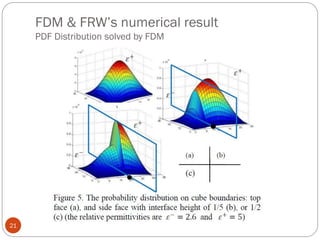
FDM & FRW’s numerical result PDF Distribution solved by FDM 
21
FDM & FRW Numerical Results The efficiency of FDM 
Comparison with the same solver utilized by CAPEM* 
* M. P. Desai, “The Capacitance Extraction Tool,” http://www.ee.iitb.ac.in/~microel/download. 
4X Speedups 
22
FDM & FRW’s Numerical Results FRW results Compared to Algo1 
The3 layers belongs to 5 layers without thin dielectrics 
2.1X Speedups 
h 
The3 layers belongs to 9 layers without thin dielectrics 
3.5X Speedups 
Increase only 6MB memory overhead 
41 wires in the 3 layers 
Placed in the brown zone 
23
Conclusions 
By using pre-computed 2-layer Green’s function for cube transition domain will accelerate FRW in multi-dielectric cases around 2X~4X 
Our generator is faster than CAPEM’s 
24
Thank you 
Q&A 
The END

RWCap ASCION2011

  • 1.
    Hao Zhuang1, 2,Wenjian Yu1*, Gang Hu1, Zuochang Ye3 1 Department of Computer Science and Technology, 3 Institute of Microelectronics, Tsinghua University, Beijing, China 2 School of Electronics Engineering and Computer Science, Peking University, Beijing, China Speaker: Hao Zhuang Numerical Characterization of Multi-Dielectric Green’s Function for 3-D Capacitance Extraction with Floating Random Walk Algorithm
  • 2.
    Outline Background 3-DFloating Random Walk Algorithm for Capacitance Extraction Numerical characterization of multi-layer Green’s functions by FDM FDM & FRW’s Numerical Results Conclusions 2
  • 3.
    Background Field Solveron Capacitance Extraction based on Discretization-based method (like FastCap): fast and accurate not scalable to large structure due to the large demand of computational time or the bottleneck of memory usage. Discretization-free method like Floating Random Walk Algorithm (FRW) in this paper Advantages: lower memory usage more scalability for large structures and tunable accuracy FRW algorithm evolved to commercial capacitance solvers like QuickCap of Magma Inc. Recent advances for variation-aware capacitance extraction [ICCAD09] by MIT 3
  • 4.
    Backgrounds Challenges Littleliterature reveals the algorithm details of the 3-D FRW for multi-dielectric capacitance extraction. CAPEM is a FRW solver to deal with these problems, but not published and only binary code available. Recently, we’ve developed FRW to handle multi-dielectric structure, by sphere transition domain to go across dielectrics interface [another article in ASICON’12]. However, extraction of VLSI interconnects embedded in 5~10 layers of dielectrics, the efficiency would be largely lost. (see later in the talk) 4
  • 5.
    Outline Background 3-DFloating Random Walk Algorithm for Capacitance Extraction Numerical characterization of multi-layer Green’s functions FDM & FRW’s Numerical Results Conclusions 5
  • 6.
    3-D FRW Algorithmfor Capacitance Extraction Fundamental formula is potential calculation, is the electric potential on point r, S is a closed surface surrounding r. is called the Green’s function, Recursion to express Can be solved by Monte Carlo (MC) Integration 6
  • 7.
    3-D FRW Algorithmfor Capacitance Extraction For capacitance problem, set master conductor with 1 volt, other with 0 volt, calculate the charge accumulated in conductors, Gi is the Gaussian surface containing only master conductor inside. D(r) is the field displacement in r, F(r) is dielectric constant at r, n(r) is normal vector at r from Gaussian surface Transform (3),obtain is weight function. 7
  • 8.
    3-D FRW Algorithmfor Capacitance Extraction Fig. Transition domain’s PDF pre-computed Gi 8
  • 9.
    3-D FRW Algorithmfor Capacitance Extraction It is a homogeneous case in last slide. To my best of knowledge, the analytical equation for transition domain with dielectrics is not available. Recently, The FRW we’ve developed handles multi-dielectric structure, by introducing sphere transition domain when hitting interface. (Algo1) Gaussian Surface Only equation we can use analytically 9
  • 10.
    3-D FRW Algorithmfor Capacitance Extraction Lost efficiency in 5~10 layers of dielectrics Interface is really a problem Gaussian Surface walk stops frequently approaching dielectric interface increase hops! Only equation we can use analytically 10 It is a homogeneous case in last slide. To my best of knowledge, the analytical equation for transition domain with dielectrics is not available. Recently, The FRW we’ve developed handles multi-dielectric structure, by introducing sphere transition domain when hitting interface. (Algo1)
  • 11.
    3-D FRW Algorithmfor Capacitance Extraction 11 The modified FRW in this paper (Algo2) Pre-characterize the transition domain by Green’s Function (GF) to obtain transition probability and store them in GF Tables to aid random walk to cross the interface
  • 12.
    3-D FRW Algorithmfor Capacitance Extraction The modified FRW in this paper (Algo2) Pre-characterize the transition domain by Green’s Function (GF) to obtain transition probability and store them in GF Tables to aid random walk to cross the interface Finite Set V.S infinite online walk  Mismatch? Store them in GFTs Gaussian Surface 12
  • 13.
    3-D FRW Algorithmfor Capacitance Extraction The modified FRW in this paper (Algo2) Pre-characterize the transition domain by Green’s Function (GF) to obtain transition probability and store them in GF Tables to aid random walk to cross the interface Mismatch? Shrink the size of domain Trade-off between memory & speed Store them in GFTs Gaussian Surface 13
  • 14.
    3-D FRW Algorithmfor Capacitance Extraction The modified FRW in this paper (Algo2) Pre-characterize the transition domain by Green’s Function (GF) to obtain transition probability and store them in GF Tables to aid random walk to cross the interface Mismatch? Shrink the size of domain Trade-off between memory & speed Q Question: How can we get the probability for transition? Store them in GFTs Gaussian Surface 14
  • 15.
    Outline Background 3-DFloating Random Walk Algorithm for Capacitance Extraction Numerical characterization of multi-layer Green’s functions FDM & FRW’s Numerical Results Conclusions 15
  • 16.
    Numerical characterization ofmulti-layer Green’s functions Problem Formulation Free charge space Interface with continuous condition Use Finite Difference method 16
  • 17.
    Numerical characterization ofmulti-layer Green’s functions Matrix Formulation Potential value at inner grids The k-th grid’s potential by multiple a vector with 1 in k-th position and 0 (otherwise) Eliminate the boundary condition vector, This is the transition probability we want! It describe the relation between center point and boundary points Inner grids Boundary points Points reside at interface grids Boundary condition 17
  • 18.
    Numerical characterization ofmulti-layer Green’s functions Coefficient of inner grids and continuous condition to avoid mismatch of numeric error order (a) use normal 7 point scheme (b) eq(12) (c) u0: eq(13) And the coefficient on interface 18
  • 19.
    Numerical characterization ofmulti-layer Green’s functions The situation when walk hits the interface requires interface in the middle layer of domain 19
  • 20.
    Outline Background 3-DFloating Random Walk Algorithm for Capacitance Extraction Numerical characterization of multi-layer Green’s functions FDM & FRW’s Numerical Results Conclusions 20
  • 21.
    FDM & FRW’snumerical result PDF Distribution solved by FDM 21
  • 22.
    FDM & FRWNumerical Results The efficiency of FDM Comparison with the same solver utilized by CAPEM* * M. P. Desai, “The Capacitance Extraction Tool,” http://www.ee.iitb.ac.in/~microel/download. 4X Speedups 22
  • 23.
    FDM & FRW’sNumerical Results FRW results Compared to Algo1 The3 layers belongs to 5 layers without thin dielectrics 2.1X Speedups h The3 layers belongs to 9 layers without thin dielectrics 3.5X Speedups Increase only 6MB memory overhead 41 wires in the 3 layers Placed in the brown zone 23
  • 24.
    Conclusions By usingpre-computed 2-layer Green’s function for cube transition domain will accelerate FRW in multi-dielectric cases around 2X~4X Our generator is faster than CAPEM’s 24
  • 25.
    Thank you Q&A The END