CIRCULATORYSYSTEMAND
LYMPHATICSYSTEM
 Overview of the circulatory system
 Function of the Circulatory system
Transportation
Regulation
Protection
 Major components of the circulatory
system
Cardiovascular system
Lymphatic system
 Blood Composition
 Structure of the Heart
 Blood Circulation
Pulmonary and Systemic circuit
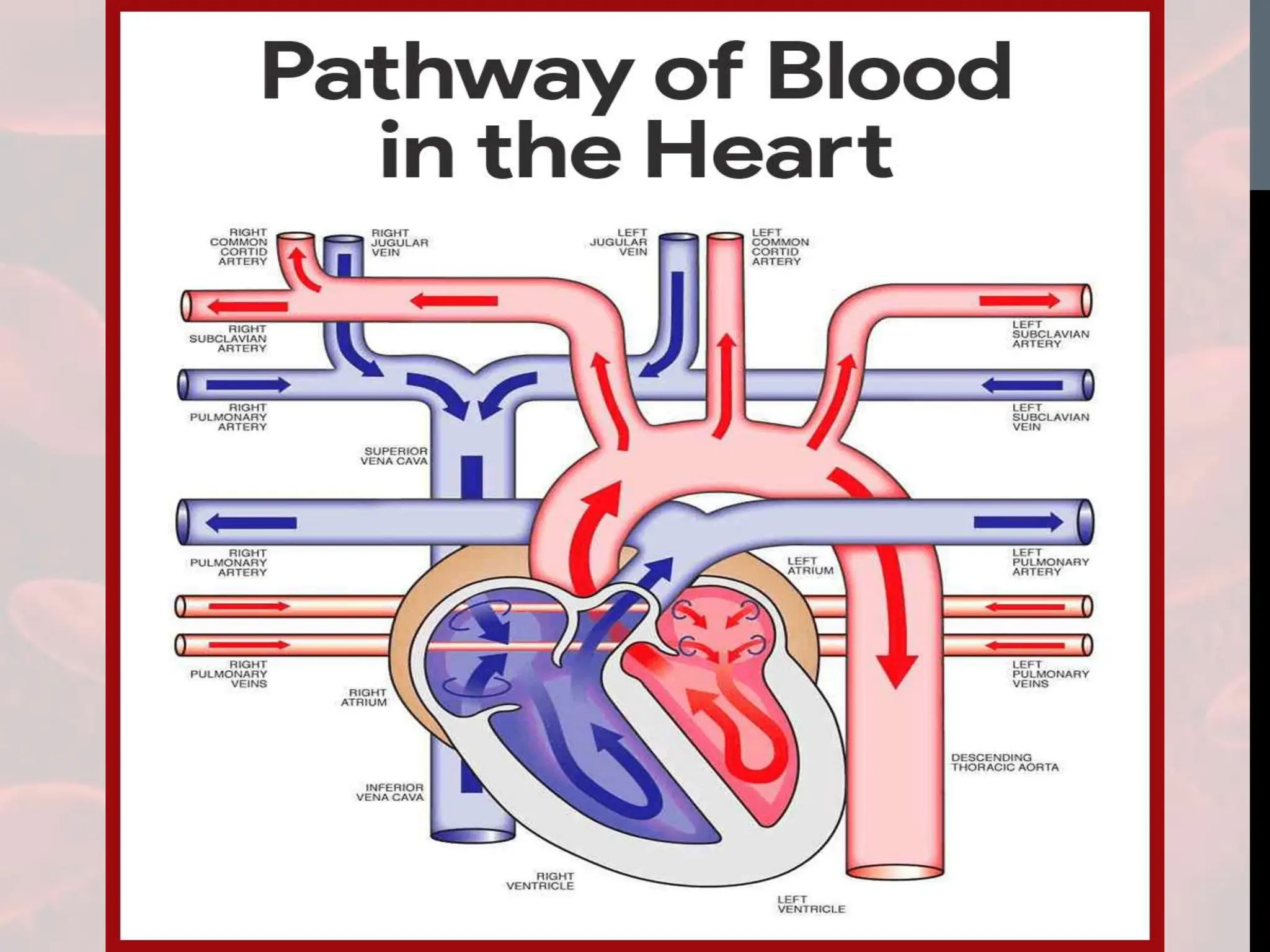
Valves of the Heart
Pathway of Blood flow through the heart
The cardiac cycle
Pressure changes during the cardiac
cycle: Systole & Diastole
Cardiac Output
Heart sounds
Cardiac Conduction System
Blood vessels
Arteries and Arterioles
Capillaries and Types
Veins and Venules
Lymphatic System
Conclusion
 The circulatory system consists of
• Blood
• Blood vessels
• The Heart
• Lymphatic vessels
 It works together with other systems
in maintaining Homeostasis
• Respiratory
• Urinary
• Digestive
• Endocrine
• Integumentary systems
Major Components of the
Circulatory System
The circulatory system is divided
into two major subdivisions:
The Cardiovascular system and the
Lymphatic system
Cardiovascular system consist of:
Heart
Blood vessels: Form a tubular
network that permits the flow of
blood
oArteries, arterioles, veins,
capillaries
CONT.
Lymphatic system consists of:
Lymphatic vessels
Lymphoid tissues
oFound in the spleen, thymus,
tonsil and lymph nodes
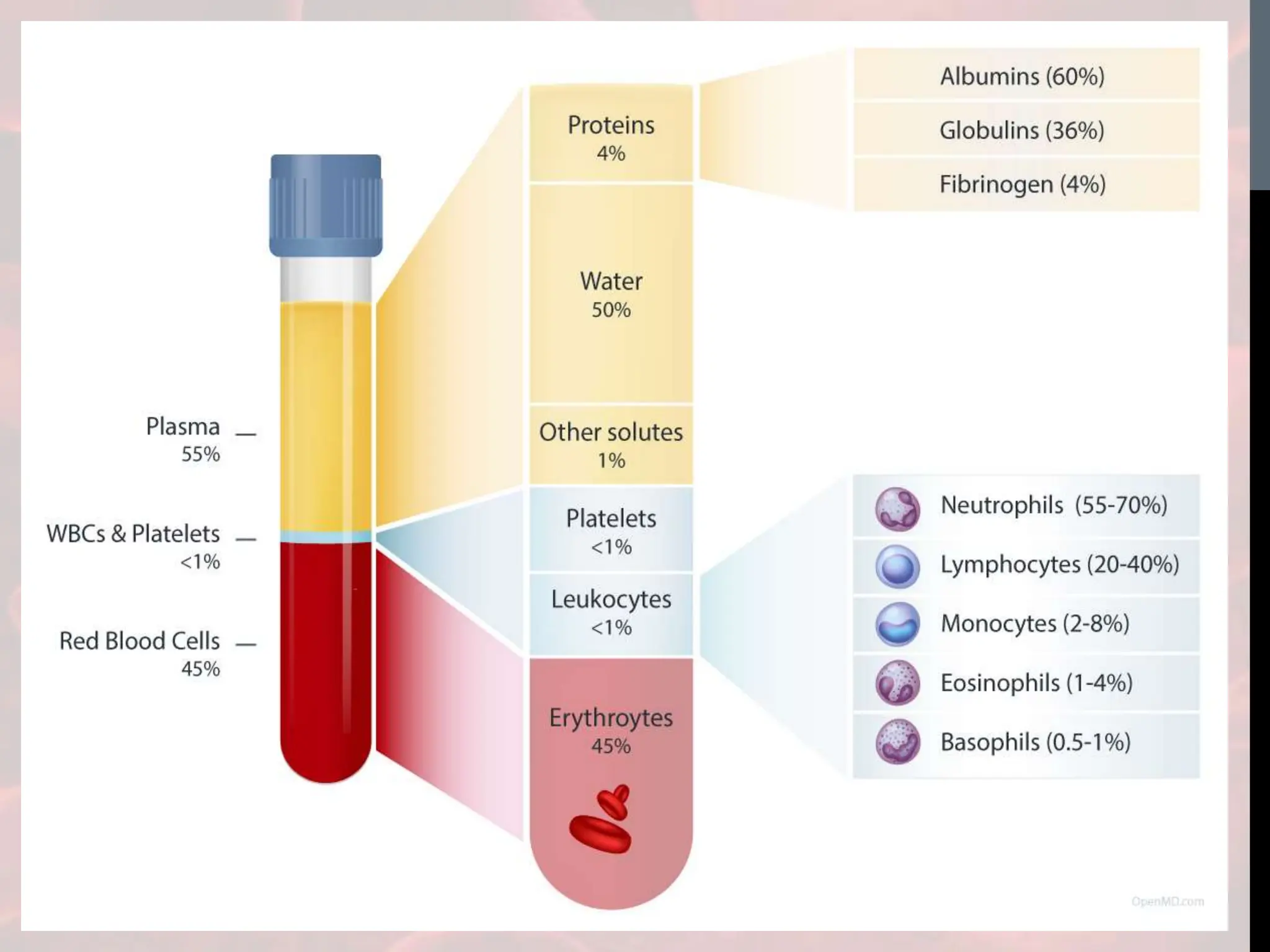
Composition of the Blood
•It consist of formed elements that are
suspended and carried in fluid know as
plasma.
•The formed element of the blood
consist of:
Erythrocyte (RBC)
Leukocyte (WBC)
Platelets
•Hematopoiesis is the formation of
blood cells
•Hematopoietic stem cells
THE CONSTITUENTS OF BLOOD
The constituents of blood. Blood cells
become packed at the bottom of the
test tube when whole blood is
centrifuged, leaving the fluid plasma
at the top of the tube.
BLOOD COMPOSITION CONT.
 Erythropoiesis refers to the
formation of erythrocytes
 Leukopoesis refers to the formation
of leukocytes
 These processes occur in two
classes of tissues after birth
 Myeloid and lymphoid
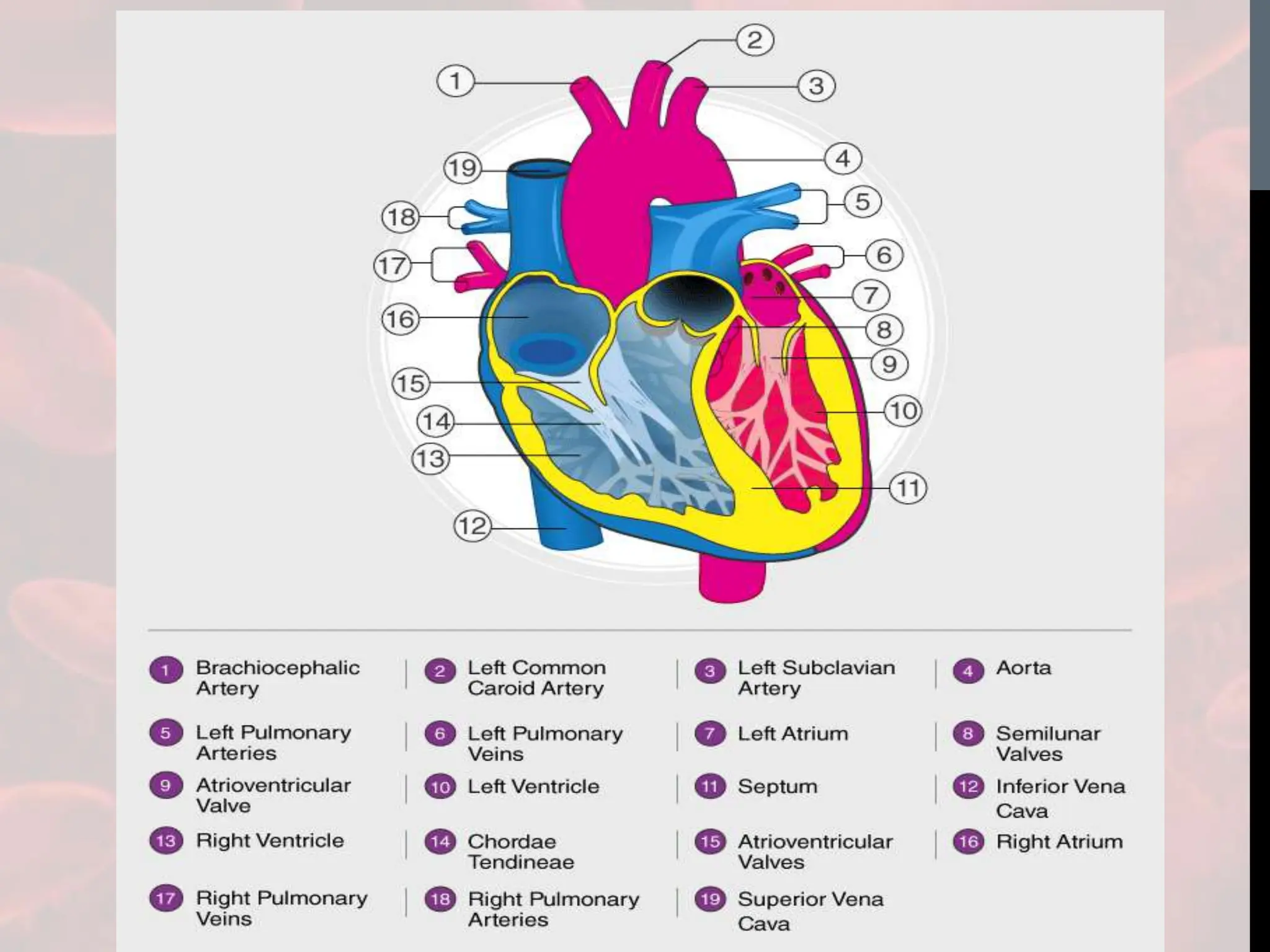
THE HEART STRUCTURE
• Located in the thoracic cavity in the
mediastinum, between the lungs
and deep to the sternum
• Contains four chamber
• Its about the size of a fist, the
hollow, cone-shaped
• There is a layer of dense connective
tissues b/t the atria and ventricle
BLOOD CIRCULATION
Movement of blood through the
vessels of the body that is induced by
the pumping action of the heart and
serves to distribute oxygen to and
remove wasted products from all
parts of the body.
Two types:
A. Pulmonary circulation
B. Systemic circulation
BLOOD CIRCULATION CONT.
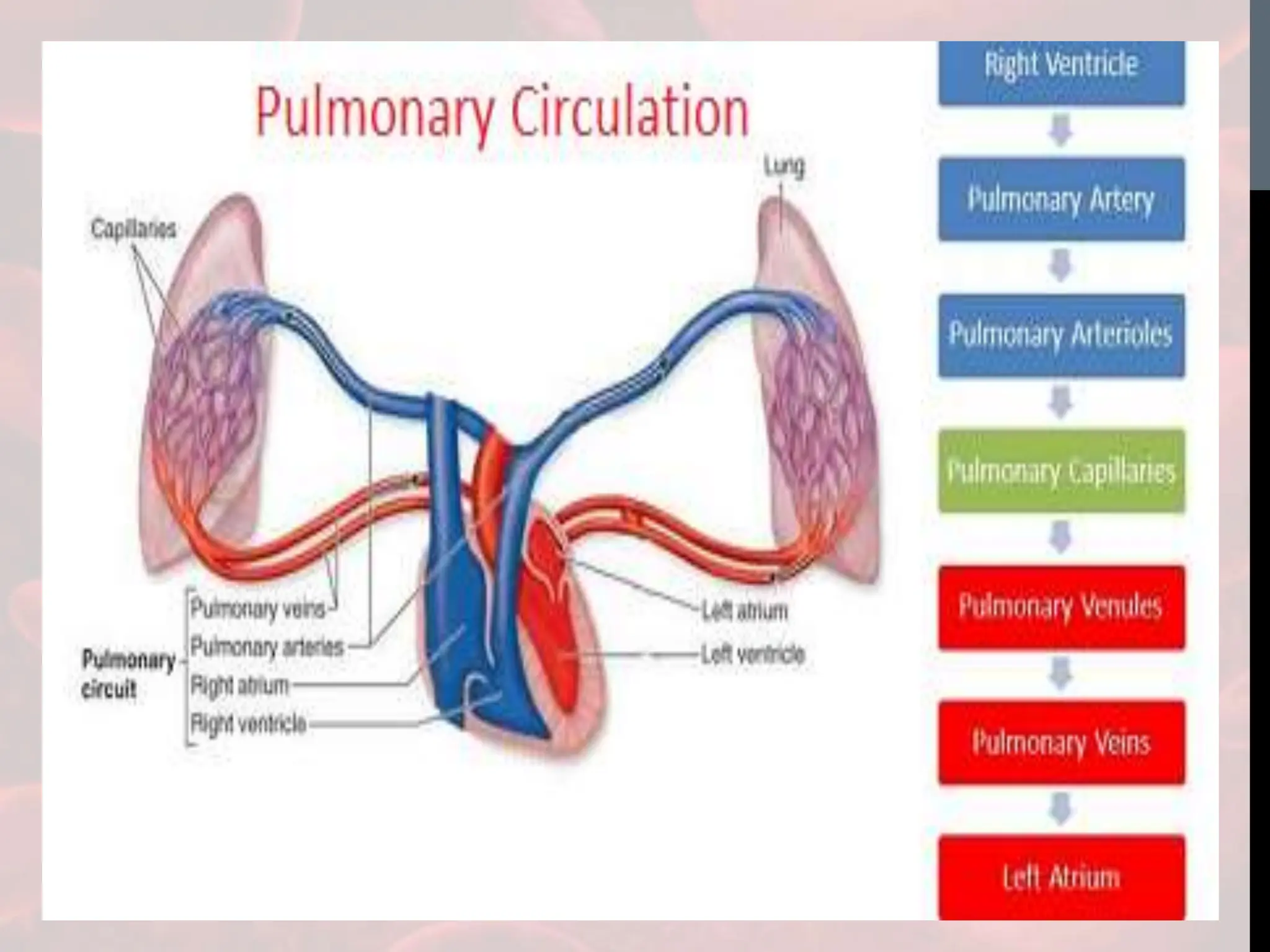
• Pulmonary circuit carries deoxygenated
blood away from the heart to the lungs
and returns oxygenated blood to the
heart.
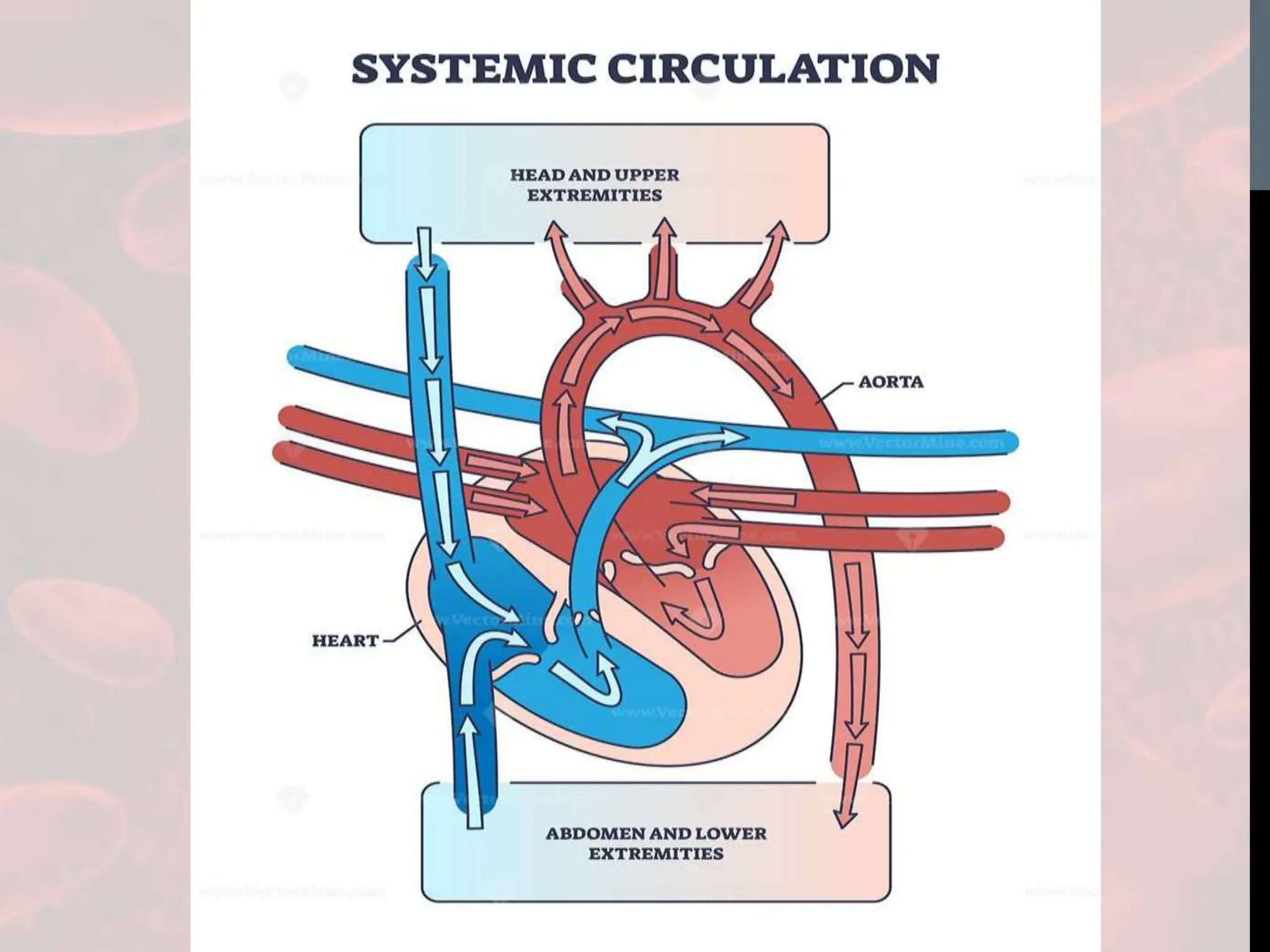
• Systemic circuit carries oxygenated blood
away from the heart to body system and
returns deoxygenated blood to the heart.
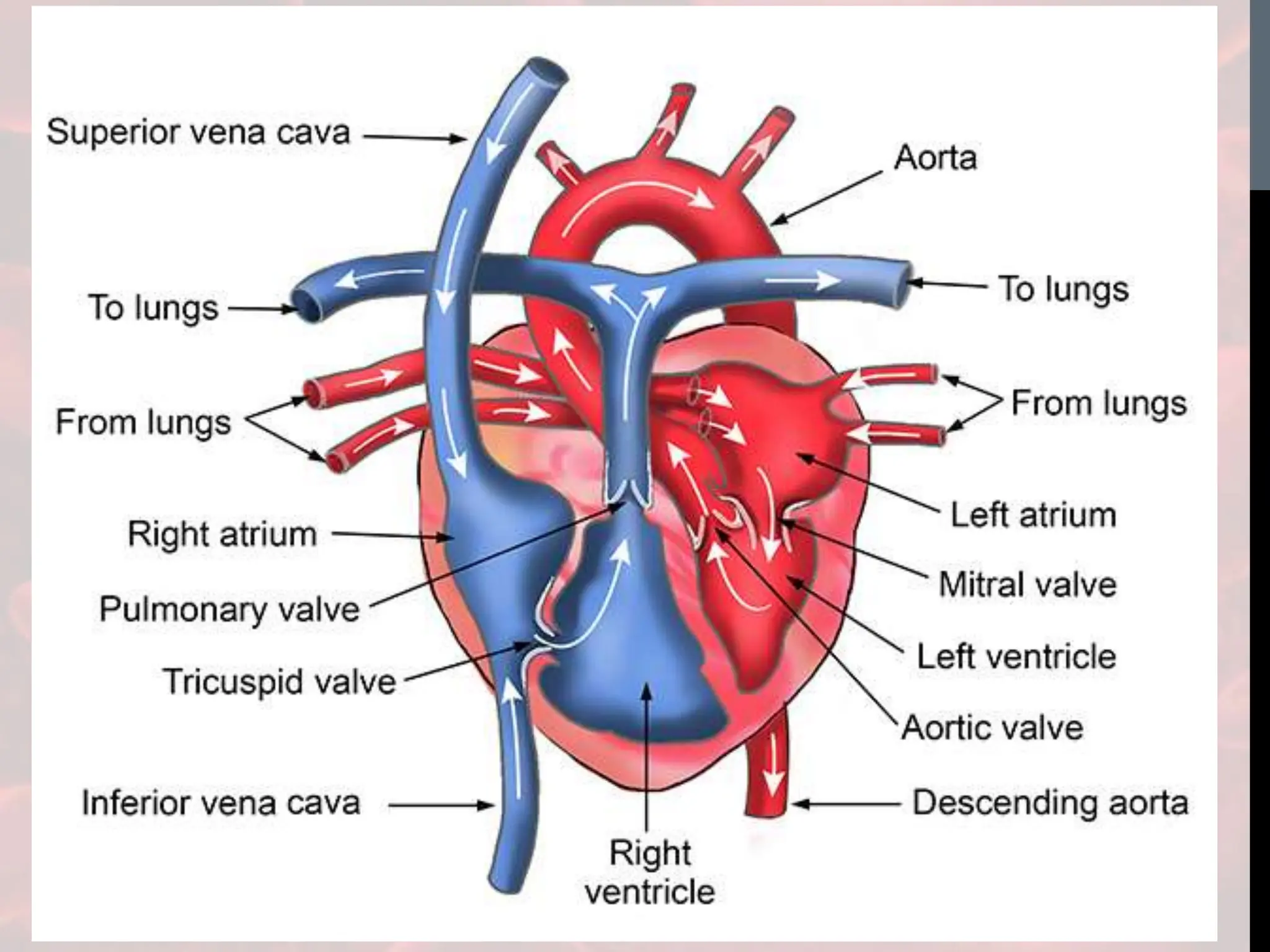
• Pulmonary circuit begins in the right
ventricle and ends in the left atrium
• Systemic circuit beings in the left
ventricle and ends in the right atrium
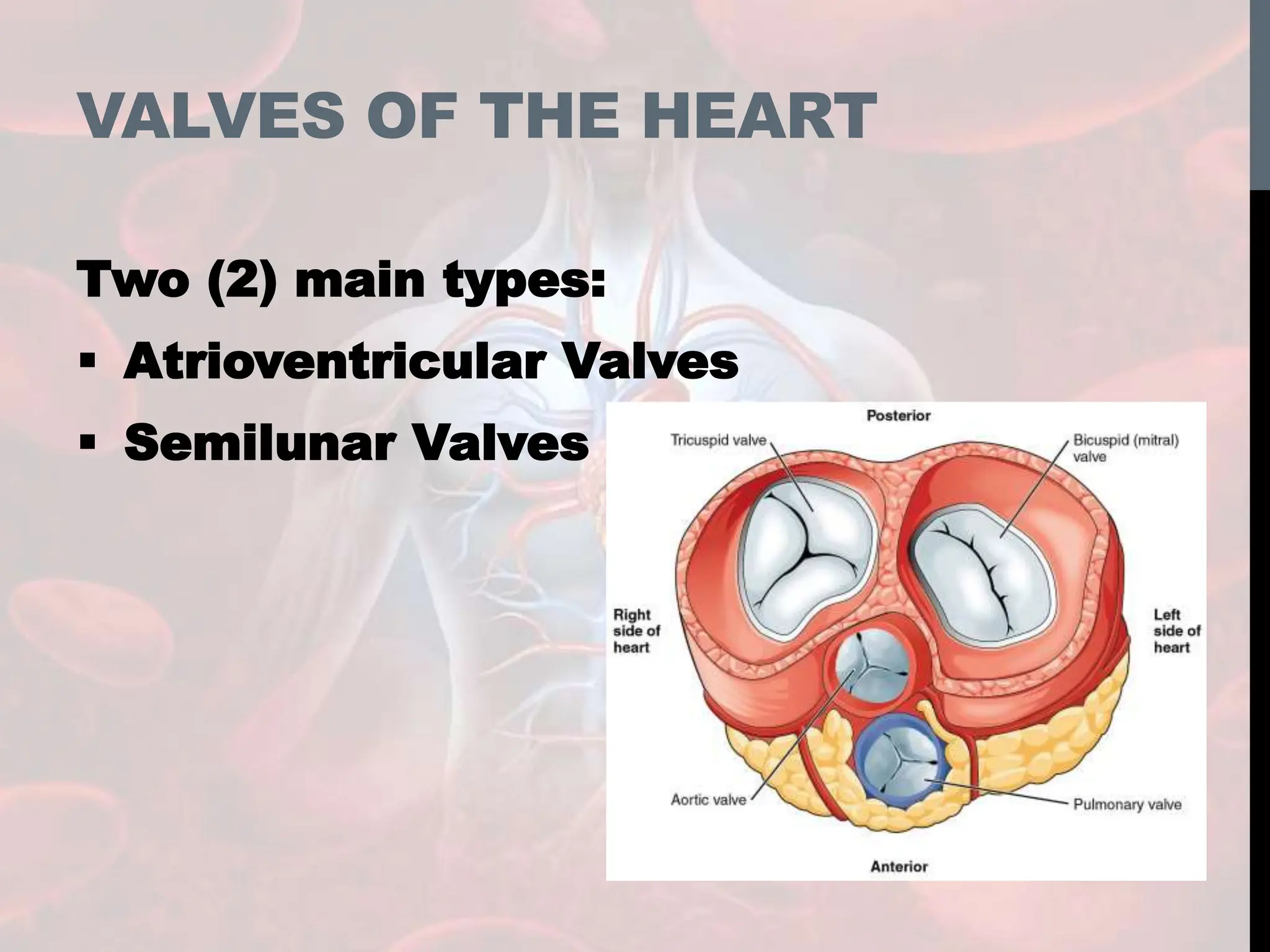
VALVES OF THE HEART
Two (2) main types:
 Atrioventricular Valves
 Semilunar Valves
ATRIOVENTRICULAR
VALVES
Found between the atria and
ventricles
Constitutes;
 Tricuspid valve
 Bicuspid valve
 Tricuspid valve: right AV valve that prevents
blood from flowing back into the right atrium
when the right ventricle contract. It has three
flaps of tissues.
 Bicuspid valves: left AV valve that prevents
blood from flowing back into the left atrium
when the left ventricle contract.
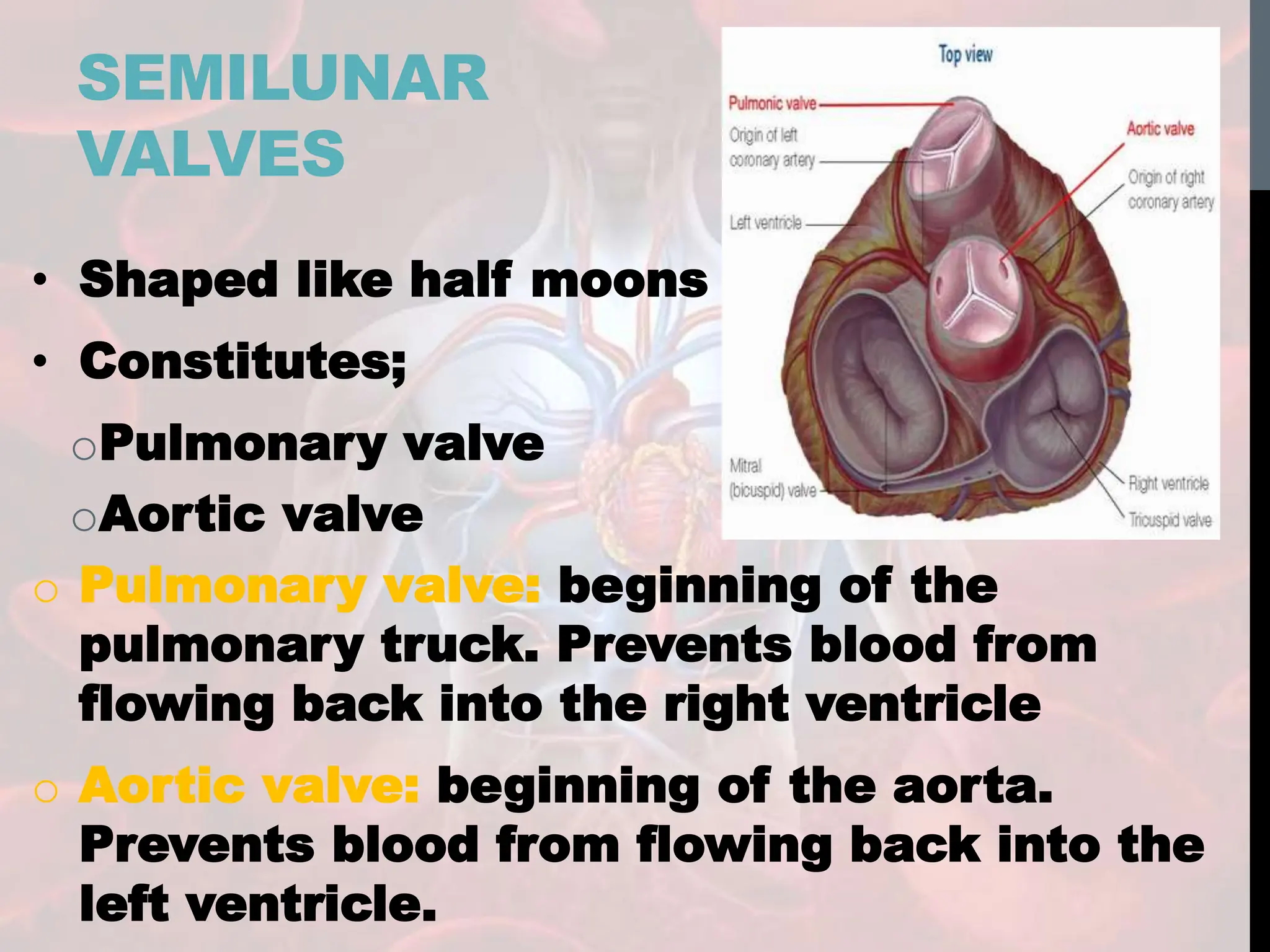
SEMILUNAR
VALVES
• Shaped like half moons
• Constitutes;
oPulmonary valve
oAortic valve
o Pulmonary valve: beginning of the
pulmonary truck. Prevents blood from
flowing back into the right ventricle
o Aortic valve: beginning of the aorta.
Prevents blood from flowing back into the
left ventricle.
Transportation- Transport substances
essential for cellular metabolism.
These substances can be categorized
as follows:
Respiratory- Oxygen (RBC), Carbon
dioxide (blood)
Nutritive- Absorbed products of
digestion (blood, lymphatics)
Excretory- Metabolic wastes (such as
urea), excess water and ions, etc.
(blood into kidneys = urine)
FUNCTION OF
THE CIRCULATORY SYSTEM
CONT.
Regulation- contributes to both
hormonal and temperature
regulation
Hormonal- hormones (blood)
Temperature- diversion of
blood from deeper to more
superficial cutaneous vessels
or vice versa
Protection- protects against blood loss
from injury and against pathogens,
including foreign microbes and toxins
introduced into the body.
These substances can be categorized
as follows:
Clotting- prevents blood loss when
blood vessels are damaged.
Immune function- protect against
many disease-causing agents
(pathogens). Performed by leukocytes
(white blood cells).
CONDUCTION
SYSTEM OF HEART
Conductive system of the heart is
formed by the modified cardiac
muscle fibers. These fibers are the
specialized cells, which conduct the
impulses rapidly from SA node of the
atrium. Conductive tissues of the
heart are also called junctional
tissues.
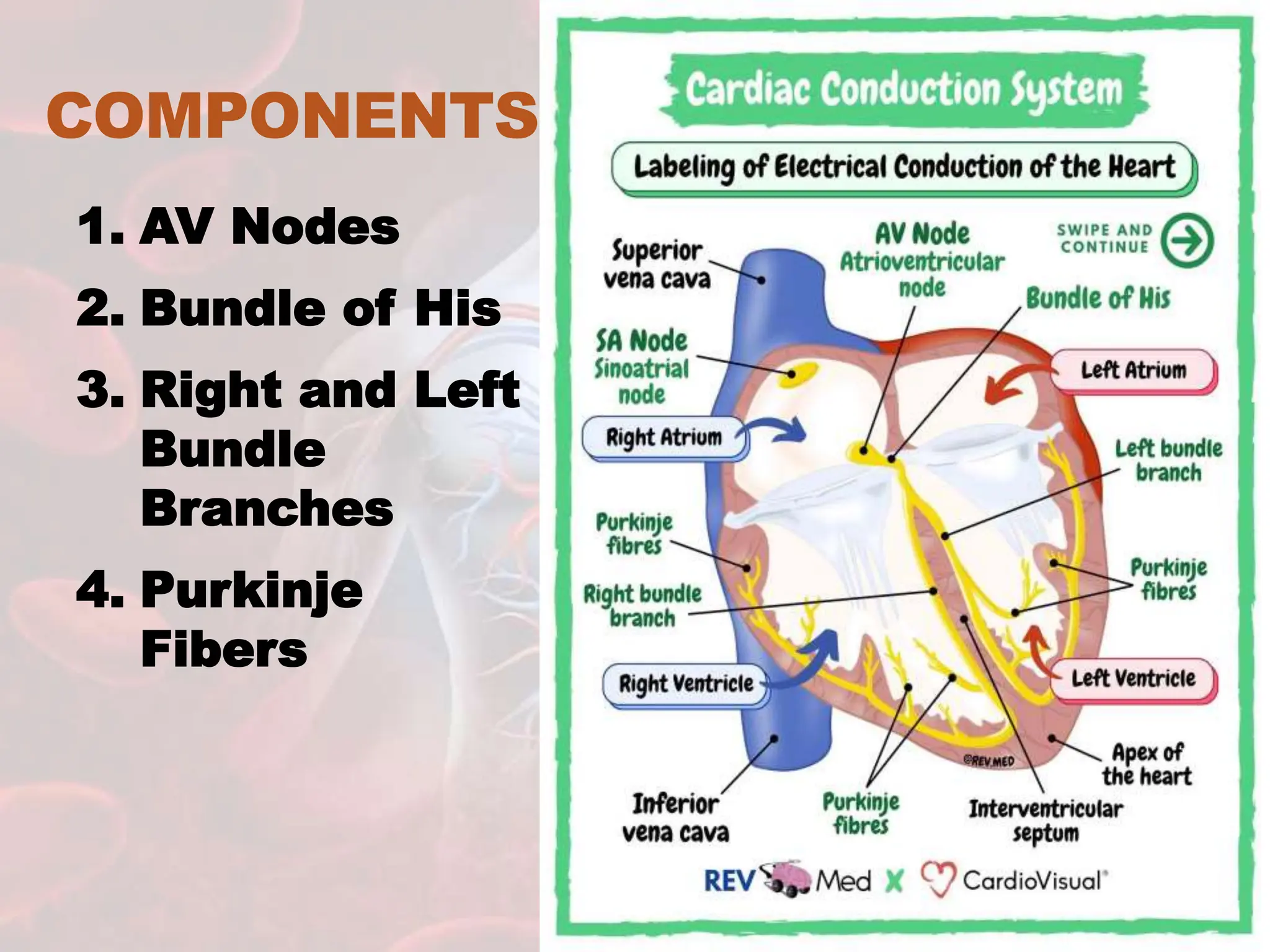
COMPONENTS
1. AV Nodes
2. Bundle of His
3. Right and Left
Bundle
Branches
4. Purkinje
Fibers
Impulses starts from SA node are
conducted through right and left atrium
and reaches the AV nodes via some
specialize fibers called internodal
fibers.
After this bundle of his arises and
devides into right and left branches.
From each branches of bundle of his
many Purkinje fibers that arises and
spread impulses all over the ventricular
myocardium.
CARDIAC CYCLE
DEFINITION
Cardiac cycle is defined as the
succession of (sequence of)
coordinated events taking place
in the heart during each beat.
Each heartbeat consists of two
major period called systole and
diastole.
 During systole heart contracts and
pump the blood through arteries.
 During diastole, heart relaxes and
blood is filled in the heart.
 All these changes are repeated during
every heartbeat, in a cyclic manner.
 When the heart beat at a normal rate
of 72/minute, duration of each cycle is
about 0.8 second.
CONT.
Events of cardiac cycle
1. Atrial events
Atrial systole
= 0.1 sec.
Atrial diastole
= 0.7 sec.
2. Ventricular events
Ventricular systole
= 0.3 sec
Ventricular diastole
= 0.5 sec.
ATRIAL SYSTOLE
Also known as last rapid filling phase
or presystole. It is also considered as
last phase or ventricular diastole.
In this period, only small amount of
blood is forced from atria into
ventricles.
ATRIAL DIASTOLE
After arterial systole, the atrial
diastole starts. Simultaneously,
ventricular systole also starts. Atrial
diastole lasts for 0.7 sec. which is
necessary that atrial filling takes
place.
VENTRICULAR EVENTS
1. Isovolumetric contraction– As the
ventricles begin their contraction,
the intraventricular pressure rises.
Closure of atrioventricular valves at
the beginning of this phase
produces first heart sound (LUB).
At this time, the ventricles are
neither being filled with blood
(because the AV valves are closed)
nor ejecting blood (because the
intraventricular pressure has not
risen sufficiently to open the
semilunar valves).
2. Ejection- Blood is pumped out of the
ventricles. When the pressure in the
left ventricle becomes greater than
the pressure in the aorta, the phase of
ejection begins as the semilunar
valves open.
3. Protodiastole- It is the first stage of
ventricular diastole. Due to the
ejection of blood, the pressure in
aorta and pulmonary artery increases
and pressure in ventricular drops. It
indicates end of systole and beginning
of diastole.
4. Isovolumetric relaxation– In this
period once again all the valves of
the heart are closed. Both ventricles
closed without change in volume and
length of muscle fibers.
Intraventricular pressure decreases
during this period. Closure of
semilunar valves during this phase
produces second heart sound(DUB).
5. Rapid filling– When the pressure in
the ventricles falls below the
pressure in the atria, the AV valves
open and a phase of rapid filling of
the ventricles occurs. About 70 % of
filling takes place during this phase.
6. Slow filling phase- After the sudden
rush of blood, the ventricular filling
become slow. Now it is called slow
filling. It is also called diastasis. About
20 % filling occurs in this phase and is
about 0.19 second.
7. Last Rapid Filling Phase- Last rapid
filling phase occurs because of atrial
systole. After slow filling period the
atria contracts and push a small
amount of blood into ventricles. About
10% of ventricular filling takes place
during this period. Flow of additional
amount of blood into ventricles due to
atrial systole is called atrial kick.
CARDIAC OUTPUT
Defined as the amount of blood pumped
from each ventricle per minute. It refers
to left ventricular output through aorta. It
is important factor that shows the rate of
blood.
Determined by:
1. Stroke volume
2. Minute volume
3. Cardiac index
 Stroke volume is the amount of blood pumped
out by each ventricle during each beat.
• Normal volume: 70 ml (60 to 80 ml) when the
heart rate is normal (72 beat/minute).
 Minute volume is the amount of blood pumped
out by eqch ventricle in one minute. It is the
product of stroke volume and heart rate:
Minute volume = stroke volume x heart rate
• Normal value: 5 L /ventricle/minute
 Cardiac index is defined as the amount of
blood pumped out per ventricle/minute/square
meter of the body surface area.
• Normal: 2.8 + 0.3 L/square meter of body
surface area/minute.
26. Heart Sounds • There are 4 heart sounds, 3 normal, 2 of
which are easily heard • The 4th heart sound may normally be
heard in a young child, but is abnormal in adults • The 1st
and 2nd heart sounds are associated with the closure of
valves
27. Heart Sound Cont’d… 1st Heart Sound (Lubb) • When
the ventricle contract, the tricuspid and bicuspid valves snap
shut 2nd Heart Sound (Dubb) • When the atria contract and
the pulmonary and aortic valves snap shut
28. Heart Sound Cont’d… 3rd Heart Sound • Produced
during diastole • Heard when the two inlet valves opens • Not
usually audible, may be heard in young child 4th Heart
Sound • Caused by contraction of both atria • It’s heard when
there is atrial hypertrophy • Thickening of the wall of the atria
29. The Heart: Cardiac Conduction System • Group of
structures that send electrical impulses through the heart •
Sinoatrial node (SA node) • Wall of right atrium • Generates
impulse • Natural pacemaker • Sends impulse to AV node •
Atrioventricular node (AV node) • Between atria just above
ventricles • Atria contract • Sends impulse to the bundle of
His • Bundle of His • Between ventricles • Two branches •
Sends impulse to Purkinje fibers • Purkinje fibers • Lateral
walls of ventricles • Ventricles contract
30. Cardiac Conduction System Figure 1.10 The conduction
system of the heart. The conduction system consists of
specialized myocardial cells that rapidly conduct the
impulses from the atria into the ventricles.
31. Blood Vessels • Blood vessels form a tubular network
throughout the body that permits blood to flow from the heart
to all the living cells of the body and then back to the heart •
Blood leaving the heart passes through vessels of
progressively smaller diameters, referred to as arteries,
arterioles, and capillaries • Blood returning to the heart from
the capillaries passes through vessels of progressively
larger diameters, called venules and veins.
32. Blood Vessels: Arteries and Arterioles • Strongest of the
blood vessels • Carry blood away from the heart • Under high
pressure • Vasoconstriction • Vasodilation • Arterioles • Small
branches of arteries • Aorta • Takes blood from the heart to
the body • Coronary arteries • Supply blood to heart muscle
THE
MICROCIRCULATION
The microcirculation. Metarterioles (arteriovenous
anastomoses) provide a path of least resistance between
arterioles and venules. Precapillary sphincter muscles
regulate the flow of blood through the capillaries.
BLOOD VESSELS
Capillaries
The arterial system branches extensively to deliver blood to
over 40 billion capillaries in the body.
The tiny capillaries provide a total surface area of 1,000
square miles for exchanges between blood and tissue fluid.
The amount of blood flowing through a particular capillary
bed depends primarily on the resistance to blood flow in the
small arteries and arterioles that supply blood to that
capillary bed.
Vasoconstriction in these vessels thus decreases blood flow
to the capillary bed, whereas vasodilation increases blood
flow
TYPES OF
CAPILLARIES
In terms of their endothelial lining, these capillary types include
those that are continuous, those that are fenestrated, and those
that are discontinuous.
Continuous capillaries are those in which adjacent endothelial
cells are closely joined together. These are found in muscles,
lungs, adipose tissue, and the central nervous system.
Fenestrated capillaries occur in the kidneys, endocrine glands,
and intestines. They are characterized by wide intercellular
pores that are covered by a layer of mucoprotein, which serves
as a basement membrane over the capillary endothelium
Discontinuous capillaries are found in the bone marrow, liver,
and spleen
Blood Vessels: Veins and Venules
Most of the total blood volume is contained in the venous
system.
Unlike arteries, which provide resistance to the flow of blood
from the heart, veins are able to expand as they accumulate
additional amounts of blood.
Average pressure in the veins is only 2mmHg compared to a
much higher arterial pressure of about 100mmHg
The low venous pressure is insufficient to return blood to the
heart, particularly from the lower limbs. Veins, however, pass
between skeletal muscle groups that provide a massaging
action as they contract.
The Action of The One-way Venous Valves Figure 1.13 The
action of the one-way venous valves. Contraction of skeletal
muscles helps to pump blood toward the heart, but the flow
of blood away from the heart is prevented by closure of the
venous valves.
Lymphatic System • Lymphatic vessels absorb excess interstitial fluid and
transport this fluid—now called lymph—to ducts that drain into veins. • The
lymphatic system has three basic functions: • It transports interstitial
(tissue) fluid, initially formed as a blood filtrate, back to the blood • It
transports absorbed fat from the small intestine to the blood • It cells—
called lymphocytes —help provide immunological defenses against
disease-causing agents
39. Lymphatic System Cont’d… • The smallest vessels of the lymphatic
system are the lymphatic capillaries. • Microscopic closed-ended tubes that
form vast networks in the intercellular spaces within most organs • Once
fluid enters the lymphatic capillaries, it is referred to as lymph. Figure 1.14
The relationship between blood capillaries and lymphatic capillaries
40. Lymphatic System Cont’d… • Before the lymph is returned to the
cardiovascular system, it is filtered through lymph nodes • Lymph nodes
contain phagocytic cells, which help remove pathogens, and germinal
centers, which are sites of lymphocyte production. Figure 1.15 The
relationship between the circulatory and lymphatic systems
41. Location of Lymph Node Along the Lymphatic Pathways Figure 1.16 The
location of lymph nodes along the lymphatic pathways. Lymph nodes are
small bean shaped bodies, enclosed within dense connective tissue
capsules.

circulatory system LYMPHATIC SYSTEM AND DETAILS

  • 1.
  • 2.
     Overview ofthe circulatory system  Function of the Circulatory system Transportation Regulation Protection  Major components of the circulatory system Cardiovascular system Lymphatic system  Blood Composition  Structure of the Heart  Blood Circulation Pulmonary and Systemic circuit
  • 3.
    Valves of theHeart Pathway of Blood flow through the heart The cardiac cycle Pressure changes during the cardiac cycle: Systole & Diastole Cardiac Output Heart sounds Cardiac Conduction System Blood vessels Arteries and Arterioles Capillaries and Types Veins and Venules Lymphatic System Conclusion
  • 4.
     The circulatorysystem consists of • Blood • Blood vessels • The Heart • Lymphatic vessels  It works together with other systems in maintaining Homeostasis • Respiratory • Urinary • Digestive • Endocrine • Integumentary systems
  • 5.
    Major Components ofthe Circulatory System The circulatory system is divided into two major subdivisions: The Cardiovascular system and the Lymphatic system Cardiovascular system consist of: Heart Blood vessels: Form a tubular network that permits the flow of blood oArteries, arterioles, veins, capillaries
  • 6.
    CONT. Lymphatic system consistsof: Lymphatic vessels Lymphoid tissues oFound in the spleen, thymus, tonsil and lymph nodes
  • 7.
    Composition of theBlood •It consist of formed elements that are suspended and carried in fluid know as plasma. •The formed element of the blood consist of: Erythrocyte (RBC) Leukocyte (WBC) Platelets •Hematopoiesis is the formation of blood cells •Hematopoietic stem cells
  • 8.
    THE CONSTITUENTS OFBLOOD The constituents of blood. Blood cells become packed at the bottom of the test tube when whole blood is centrifuged, leaving the fluid plasma at the top of the tube.
  • 10.
    BLOOD COMPOSITION CONT. Erythropoiesis refers to the formation of erythrocytes  Leukopoesis refers to the formation of leukocytes  These processes occur in two classes of tissues after birth  Myeloid and lymphoid
  • 11.
    THE HEART STRUCTURE •Located in the thoracic cavity in the mediastinum, between the lungs and deep to the sternum • Contains four chamber • Its about the size of a fist, the hollow, cone-shaped • There is a layer of dense connective tissues b/t the atria and ventricle
  • 14.
    BLOOD CIRCULATION Movement ofblood through the vessels of the body that is induced by the pumping action of the heart and serves to distribute oxygen to and remove wasted products from all parts of the body. Two types: A. Pulmonary circulation B. Systemic circulation
  • 15.
    BLOOD CIRCULATION CONT. •Pulmonary circuit carries deoxygenated blood away from the heart to the lungs and returns oxygenated blood to the heart. • Systemic circuit carries oxygenated blood away from the heart to body system and returns deoxygenated blood to the heart. • Pulmonary circuit begins in the right ventricle and ends in the left atrium • Systemic circuit beings in the left ventricle and ends in the right atrium
  • 18.
    VALVES OF THEHEART Two (2) main types:  Atrioventricular Valves  Semilunar Valves
  • 19.
    ATRIOVENTRICULAR VALVES Found between theatria and ventricles Constitutes;  Tricuspid valve  Bicuspid valve  Tricuspid valve: right AV valve that prevents blood from flowing back into the right atrium when the right ventricle contract. It has three flaps of tissues.  Bicuspid valves: left AV valve that prevents blood from flowing back into the left atrium when the left ventricle contract.
  • 20.
    SEMILUNAR VALVES • Shaped likehalf moons • Constitutes; oPulmonary valve oAortic valve o Pulmonary valve: beginning of the pulmonary truck. Prevents blood from flowing back into the right ventricle o Aortic valve: beginning of the aorta. Prevents blood from flowing back into the left ventricle.
  • 22.
    Transportation- Transport substances essentialfor cellular metabolism. These substances can be categorized as follows: Respiratory- Oxygen (RBC), Carbon dioxide (blood) Nutritive- Absorbed products of digestion (blood, lymphatics) Excretory- Metabolic wastes (such as urea), excess water and ions, etc. (blood into kidneys = urine) FUNCTION OF THE CIRCULATORY SYSTEM
  • 23.
    CONT. Regulation- contributes toboth hormonal and temperature regulation Hormonal- hormones (blood) Temperature- diversion of blood from deeper to more superficial cutaneous vessels or vice versa
  • 24.
    Protection- protects againstblood loss from injury and against pathogens, including foreign microbes and toxins introduced into the body. These substances can be categorized as follows: Clotting- prevents blood loss when blood vessels are damaged. Immune function- protect against many disease-causing agents (pathogens). Performed by leukocytes (white blood cells).
  • 25.
  • 26.
    Conductive system ofthe heart is formed by the modified cardiac muscle fibers. These fibers are the specialized cells, which conduct the impulses rapidly from SA node of the atrium. Conductive tissues of the heart are also called junctional tissues.
  • 27.
    COMPONENTS 1. AV Nodes 2.Bundle of His 3. Right and Left Bundle Branches 4. Purkinje Fibers
  • 29.
    Impulses starts fromSA node are conducted through right and left atrium and reaches the AV nodes via some specialize fibers called internodal fibers. After this bundle of his arises and devides into right and left branches. From each branches of bundle of his many Purkinje fibers that arises and spread impulses all over the ventricular myocardium.
  • 30.
  • 31.
    DEFINITION Cardiac cycle isdefined as the succession of (sequence of) coordinated events taking place in the heart during each beat. Each heartbeat consists of two major period called systole and diastole.
  • 32.
     During systoleheart contracts and pump the blood through arteries.  During diastole, heart relaxes and blood is filled in the heart.  All these changes are repeated during every heartbeat, in a cyclic manner.  When the heart beat at a normal rate of 72/minute, duration of each cycle is about 0.8 second.
  • 33.
    CONT. Events of cardiaccycle 1. Atrial events Atrial systole = 0.1 sec. Atrial diastole = 0.7 sec. 2. Ventricular events Ventricular systole = 0.3 sec Ventricular diastole = 0.5 sec.
  • 34.
    ATRIAL SYSTOLE Also knownas last rapid filling phase or presystole. It is also considered as last phase or ventricular diastole. In this period, only small amount of blood is forced from atria into ventricles.
  • 35.
    ATRIAL DIASTOLE After arterialsystole, the atrial diastole starts. Simultaneously, ventricular systole also starts. Atrial diastole lasts for 0.7 sec. which is necessary that atrial filling takes place.
  • 36.
    VENTRICULAR EVENTS 1. Isovolumetriccontraction– As the ventricles begin their contraction, the intraventricular pressure rises. Closure of atrioventricular valves at the beginning of this phase produces first heart sound (LUB). At this time, the ventricles are neither being filled with blood (because the AV valves are closed) nor ejecting blood (because the intraventricular pressure has not risen sufficiently to open the semilunar valves).
  • 37.
    2. Ejection- Bloodis pumped out of the ventricles. When the pressure in the left ventricle becomes greater than the pressure in the aorta, the phase of ejection begins as the semilunar valves open. 3. Protodiastole- It is the first stage of ventricular diastole. Due to the ejection of blood, the pressure in aorta and pulmonary artery increases and pressure in ventricular drops. It indicates end of systole and beginning of diastole.
  • 38.
    4. Isovolumetric relaxation–In this period once again all the valves of the heart are closed. Both ventricles closed without change in volume and length of muscle fibers. Intraventricular pressure decreases during this period. Closure of semilunar valves during this phase produces second heart sound(DUB). 5. Rapid filling– When the pressure in the ventricles falls below the pressure in the atria, the AV valves open and a phase of rapid filling of the ventricles occurs. About 70 % of filling takes place during this phase.
  • 39.
    6. Slow fillingphase- After the sudden rush of blood, the ventricular filling become slow. Now it is called slow filling. It is also called diastasis. About 20 % filling occurs in this phase and is about 0.19 second. 7. Last Rapid Filling Phase- Last rapid filling phase occurs because of atrial systole. After slow filling period the atria contracts and push a small amount of blood into ventricles. About 10% of ventricular filling takes place during this period. Flow of additional amount of blood into ventricles due to atrial systole is called atrial kick.
  • 40.
  • 41.
    Defined as theamount of blood pumped from each ventricle per minute. It refers to left ventricular output through aorta. It is important factor that shows the rate of blood. Determined by: 1. Stroke volume 2. Minute volume 3. Cardiac index
  • 42.
     Stroke volumeis the amount of blood pumped out by each ventricle during each beat. • Normal volume: 70 ml (60 to 80 ml) when the heart rate is normal (72 beat/minute).  Minute volume is the amount of blood pumped out by eqch ventricle in one minute. It is the product of stroke volume and heart rate: Minute volume = stroke volume x heart rate • Normal value: 5 L /ventricle/minute  Cardiac index is defined as the amount of blood pumped out per ventricle/minute/square meter of the body surface area. • Normal: 2.8 + 0.3 L/square meter of body surface area/minute.
  • 43.
    26. Heart Sounds• There are 4 heart sounds, 3 normal, 2 of which are easily heard • The 4th heart sound may normally be heard in a young child, but is abnormal in adults • The 1st and 2nd heart sounds are associated with the closure of valves
  • 44.
    27. Heart SoundCont’d… 1st Heart Sound (Lubb) • When the ventricle contract, the tricuspid and bicuspid valves snap shut 2nd Heart Sound (Dubb) • When the atria contract and the pulmonary and aortic valves snap shut
  • 45.
    28. Heart SoundCont’d… 3rd Heart Sound • Produced during diastole • Heard when the two inlet valves opens • Not usually audible, may be heard in young child 4th Heart Sound • Caused by contraction of both atria • It’s heard when there is atrial hypertrophy • Thickening of the wall of the atria
  • 46.
    29. The Heart:Cardiac Conduction System • Group of structures that send electrical impulses through the heart • Sinoatrial node (SA node) • Wall of right atrium • Generates impulse • Natural pacemaker • Sends impulse to AV node • Atrioventricular node (AV node) • Between atria just above ventricles • Atria contract • Sends impulse to the bundle of His • Bundle of His • Between ventricles • Two branches • Sends impulse to Purkinje fibers • Purkinje fibers • Lateral walls of ventricles • Ventricles contract
  • 47.
    30. Cardiac ConductionSystem Figure 1.10 The conduction system of the heart. The conduction system consists of specialized myocardial cells that rapidly conduct the impulses from the atria into the ventricles.
  • 48.
    31. Blood Vessels• Blood vessels form a tubular network throughout the body that permits blood to flow from the heart to all the living cells of the body and then back to the heart • Blood leaving the heart passes through vessels of progressively smaller diameters, referred to as arteries, arterioles, and capillaries • Blood returning to the heart from the capillaries passes through vessels of progressively larger diameters, called venules and veins.
  • 49.
    32. Blood Vessels:Arteries and Arterioles • Strongest of the blood vessels • Carry blood away from the heart • Under high pressure • Vasoconstriction • Vasodilation • Arterioles • Small branches of arteries • Aorta • Takes blood from the heart to the body • Coronary arteries • Supply blood to heart muscle
  • 50.
    THE MICROCIRCULATION The microcirculation. Metarterioles(arteriovenous anastomoses) provide a path of least resistance between arterioles and venules. Precapillary sphincter muscles regulate the flow of blood through the capillaries.
  • 51.
    BLOOD VESSELS Capillaries The arterialsystem branches extensively to deliver blood to over 40 billion capillaries in the body. The tiny capillaries provide a total surface area of 1,000 square miles for exchanges between blood and tissue fluid. The amount of blood flowing through a particular capillary bed depends primarily on the resistance to blood flow in the small arteries and arterioles that supply blood to that capillary bed. Vasoconstriction in these vessels thus decreases blood flow to the capillary bed, whereas vasodilation increases blood flow
  • 52.
    TYPES OF CAPILLARIES In termsof their endothelial lining, these capillary types include those that are continuous, those that are fenestrated, and those that are discontinuous. Continuous capillaries are those in which adjacent endothelial cells are closely joined together. These are found in muscles, lungs, adipose tissue, and the central nervous system. Fenestrated capillaries occur in the kidneys, endocrine glands, and intestines. They are characterized by wide intercellular pores that are covered by a layer of mucoprotein, which serves as a basement membrane over the capillary endothelium Discontinuous capillaries are found in the bone marrow, liver, and spleen
  • 53.
    Blood Vessels: Veinsand Venules Most of the total blood volume is contained in the venous system. Unlike arteries, which provide resistance to the flow of blood from the heart, veins are able to expand as they accumulate additional amounts of blood. Average pressure in the veins is only 2mmHg compared to a much higher arterial pressure of about 100mmHg The low venous pressure is insufficient to return blood to the heart, particularly from the lower limbs. Veins, however, pass between skeletal muscle groups that provide a massaging action as they contract.
  • 54.
    The Action ofThe One-way Venous Valves Figure 1.13 The action of the one-way venous valves. Contraction of skeletal muscles helps to pump blood toward the heart, but the flow of blood away from the heart is prevented by closure of the venous valves.
  • 55.
    Lymphatic System •Lymphatic vessels absorb excess interstitial fluid and transport this fluid—now called lymph—to ducts that drain into veins. • The lymphatic system has three basic functions: • It transports interstitial (tissue) fluid, initially formed as a blood filtrate, back to the blood • It transports absorbed fat from the small intestine to the blood • It cells— called lymphocytes —help provide immunological defenses against disease-causing agents 39. Lymphatic System Cont’d… • The smallest vessels of the lymphatic system are the lymphatic capillaries. • Microscopic closed-ended tubes that form vast networks in the intercellular spaces within most organs • Once fluid enters the lymphatic capillaries, it is referred to as lymph. Figure 1.14 The relationship between blood capillaries and lymphatic capillaries 40. Lymphatic System Cont’d… • Before the lymph is returned to the cardiovascular system, it is filtered through lymph nodes • Lymph nodes contain phagocytic cells, which help remove pathogens, and germinal centers, which are sites of lymphocyte production. Figure 1.15 The relationship between the circulatory and lymphatic systems 41. Location of Lymph Node Along the Lymphatic Pathways Figure 1.16 The location of lymph nodes along the lymphatic pathways. Lymph nodes are small bean shaped bodies, enclosed within dense connective tissue capsules.