3/27/2023
1
 SMALL INTESTINE AND LARGE INTESTINE-
DIGESTION AND ABSORPTION
SMALL INTESTINE
SECRETION
3/27/2023
2
 Mucus by Brunner’s glands in duodenum
 Stimuli: tactile, irritating, vagal, GI hormones
 Alkaline mucus: protection from gastric acid
 Inhibited by sympathetic stimulation…?duodenal
ulcers
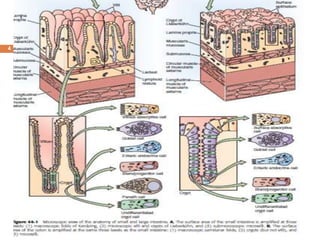
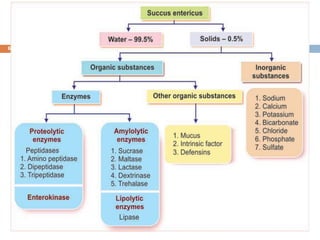
 Intestinal digestive juices by Crypts of
Lieberkuhn:
 Goblet cells (mucus) & enterocytes (water &
electrolytes)
 1800mls/d; pH 7.5-8.0; creates watery vehicle
for absorption
3/27/2023
3
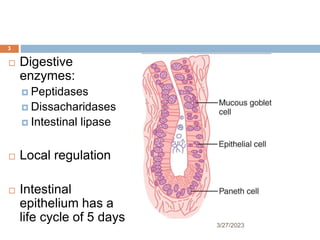
 Digestive
enzymes:
 Peptidases
 Dissacharidases
 Intestinal lipase
 Local regulation
 Intestinal
epithelium has a
life cycle of 5 days
3/27/2023
4
FUNCTION OF SMALL
INTESTINE
3/27/2023
5
 Secretion-
digestion,protection,activation,haemopeisis
 Hormonal
 Mechanical
 Absorption
3/27/2023
6
LARGE INTESTINE
SECRETION
3/27/2023
7
 Have crypts of Lieberkuhn that secrete only mucus and
a little HCO3
-
 Protects mucosa from: acids from bacterial activity and
physical excoriation.
 Mucus adheres feces together.
 Stimuli:
 Tactile by local reflexes
 Parasympathetic nervous system
3/27/2023
8
DIGESTION & ABSORPTION
3/27/2023
9
DIGESTION AND
ABSORPTION
3/27/2023
10
OBJECTIVES:
 To describe the site, digestive enzymes and
secretions involved in the digestion of:
 CHO’s, Proteins, Lipids
 To describe the absorbable units, transporters
involved and disorders in absorption of:
 CHO’s, Proteins, Lipids, Fluid & Electrolytes.
Introduction
3/27/2023
11
 Digestion and absorption is the ultimate
function of GIT.
 Digestion is the breakdown of ingested food
into absorbable particles.
 Absorption is movement of nutrients, water &
electrolytes from intestinal lumen into the
blood.
 Occurs through cellular or paracellular paths
The small intestine
3/27/2023
12
 Most of the absorption occurs here.
 The intestinal mucosa has longitudinal folds of
Kerckring, villi & microvilli.
 These increase absorptive surface area 600-1000
times.
 They contain epithelial cells interspersed with
goblet cells.
 Epithelial cells are shed every 3-6 days making
them vulnerable to irradiation and chemotherapy.
1. CARBOHYDRATES
3/27/2023
13
 Almost all ingested foods have >50% CHO’s
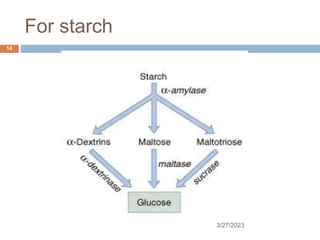
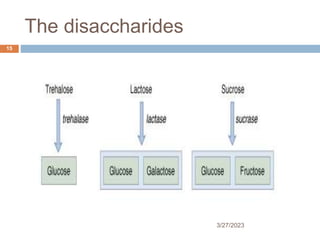
 Contains polysaccharides (starch),
disaccharides (trehalase, maltose, sucrose &
lactose) and monosaccharide (glucose &
fructose).
 Absorbed only as monosaccharide.
 Digestion begins in the mouth and is as
follows:
For starch
3/27/2023
14
The disaccharides
3/27/2023
15
Cho’s absorption
3/27/2023
16
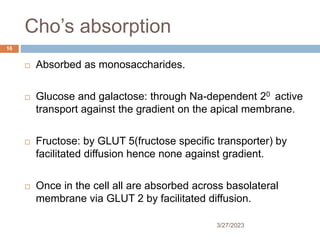
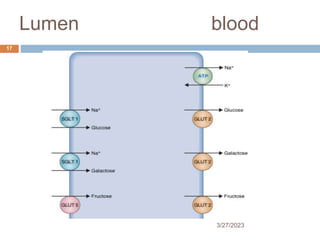
 Absorbed as monosaccharides.
 Glucose and galactose: through Na-dependent 20 active
transport against the gradient on the apical membrane.
 Fructose: by GLUT 5(fructose specific transporter) by
facilitated diffusion hence none against gradient.
 Once in the cell all are absorbed across basolateral
membrane via GLUT 2 by facilitated diffusion.
Lumen blood
3/27/2023
17
Lactose intolerance
3/27/2023
18
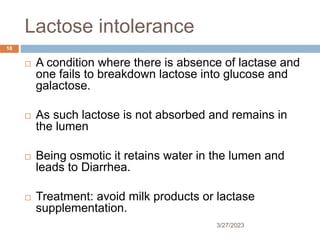
 A condition where there is absence of lactase and
one fails to breakdown lactose into glucose and
galactose.
 As such lactose is not absorbed and remains in
the lumen
 Being osmotic it retains water in the lumen and
leads to Diarrhea.
 Treatment: avoid milk products or lactase
supplementation.
2. PROTEINS
3/27/2023
19
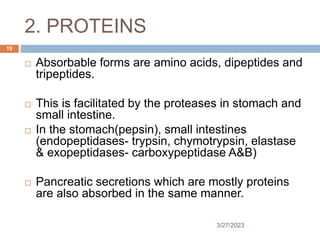
 Absorbable forms are amino acids, dipeptides and
tripeptides.
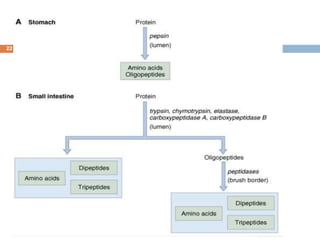
 This is facilitated by the proteases in stomach and
small intestine.
 In the stomach(pepsin), small intestines
(endopeptidases- trypsin, chymotrypsin, elastase
& exopeptidases- carboxypeptidase A&B)
 Pancreatic secretions which are mostly proteins
are also absorbed in the same manner.
Digestion
3/27/2023
20
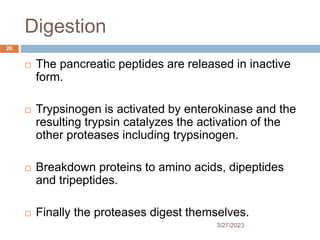
 The pancreatic peptides are released in inactive
form.
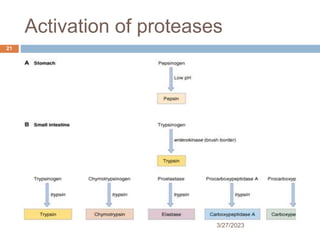
 Trypsinogen is activated by enterokinase and the
resulting trypsin catalyzes the activation of the
other proteases including trypsinogen.
 Breakdown proteins to amino acids, dipeptides
and tripeptides.
 Finally the proteases digest themselves.
Activation of proteases
3/27/2023
21
3/27/2023
22
Absorption
3/27/2023
23
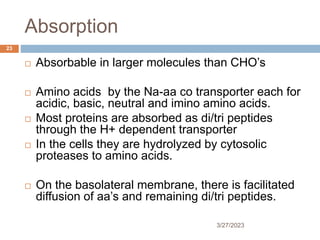
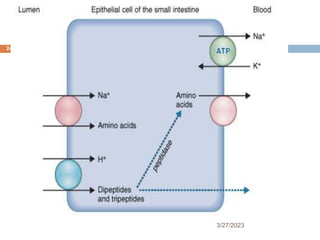
 Absorbable in larger molecules than CHO’s
 Amino acids by the Na-aa co transporter each for
acidic, basic, neutral and imino amino acids.
 Most proteins are absorbed as di/tri peptides
through the H+ dependent transporter
 In the cells they are hydrolyzed by cytosolic
proteases to amino acids.
 On the basolateral membrane, there is facilitated
diffusion of aa’s and remaining di/tri peptides.
Figure 8-30
3/27/2023
24
Disorders of protein digestion &
absorption
3/27/2023
25
 Chronic pancreatitis
 Cystic fibrosis of the pancreas
 The two lead to failure in production of pancreatic
proteases and failed protein digestion.
 Cystinuria: involves absence of Na-aa co
transporter of basic aa’s in the kidney and GIT
 Leads to loss in urine and feces of cysteine,
lysine, arginine and ornithine.
3. LIPIDS
3/27/2023
26
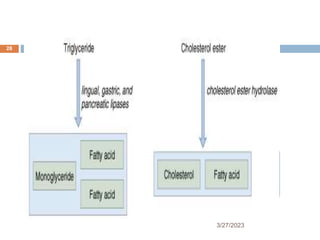
In the stomach:
 Lingual and gastric lipases
 Mixing and churning breakdown lipids further
 Dietary proteins emulsify lipids for lipases to
act
 Accounts for about 10% of all lipids.
 Delayed gastric emptying by CCK allows time
for duodenal digestion.
Small intestine
3/27/2023
27
 Bile salts: emulsify fats and help in micelles
formation
 Pancreatic lipase and colipase: breakdown
triglycerides
 Cholesterol ester hydroxylase: cholesterol esters
and triglycerides (glycerol)
 Phospholipase A2 : breaks phospholipids into
lysolecithin and fatty acids.
 Procollipase and prophospholipase A2 are
activated by trypsin.
3/27/2023
28
Disorders
3/27/2023
29
1) Pancreatic insufficiency (pancreatitis, fibrosis)
2) Duodenal acidity e.g. in ZE syndrome
3) Bile salts deficiency: resection of ileum
4) Bacterial overgrowth
5) Decreased intestinal cells e.g. tropical sprue
6) abetalipoproteinemia
4.VITAMINS
3/27/2023
30
 Required in small quantities as cofactors or
coenzymes in metabolism.
 Not synthesized in the body hence gotten from
GIT
 Fat soluble vitamins:
 ADEK
 Absorbed as lipids.
 Incorporated into micelles….taken to
chylomicrons…to lymphatics…general
circulation
3/27/2023
31
 Water soluble vitamins:
 Vitamins C and B complex
 Absorbed through Na-dependent co transport
except vitamin B12.
 Vitamin B12 is absorbed in the terminal ileum with
the help of intrinsic factor and transcobalamine
transporters.
 Lack of intrinsic factor leads to????????
 Pernicious anemia.
5.CALCIUM
3/27/2023
32
 1,25 dihydroxy cholecalciferol induces
synthesis of vitamin D-dependent Ca2+ binding
protein (Calbindin D-28K) in intestinal
epithelial cells.
 This mediates absorption of calcium
 Vitamin D deficiency impairs calcium
absorption and leads to deficiency.
 Causes rickets in children and osteomalacia in
adults.
6.IRON
3/27/2023
33
 Absorbed into intestinal epithelial cells as free iron
or as heme (bound to Hb or myoglobin).
 The heme iron is converted to free iron.
 The free iron is then transported out of the
intestinal epithelial cells into blood by apoferritin
as ferritin.
 In the blood iron is transported by transferrin (a
βglobulin) to the liver storage sites.
 From the liver to the bone marrow to make
Hemoglobin.
INTESTINAL FLUID AND
ELECTROLYTE
3/27/2023
34
 9 Liters of fluid in GIT every day. (2L from diet
and 7L from GI secretions)
 Almost all reabsorbed with 100-200mls in
feces.
 Intestinal epithelial cells also secrete into the
GIT which also needs to be reabsorbed.
 Absorption is through cellular and paracellular
path
 Tight junctions are leaky in SI and tight in
Intestinal absorption
3/27/2023
35
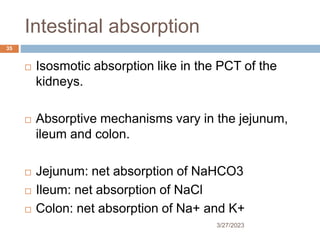
 Isosmotic absorption like in the PCT of the
kidneys.
 Absorptive mechanisms vary in the jejunum,
ileum and colon.
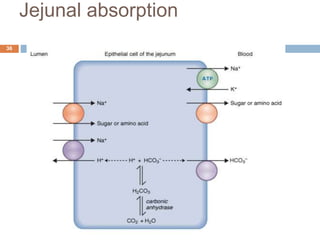
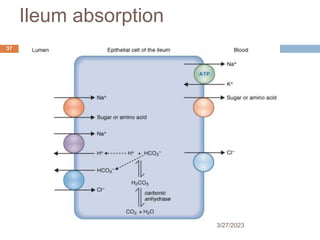
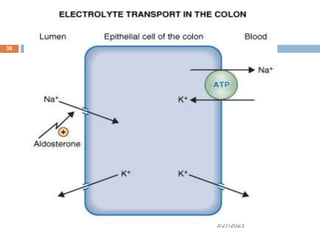
 Jejunum: net absorption of NaHCO3
 Ileum: net absorption of NaCl
 Colon: net absorption of Na+ and K+
Jejunal absorption
3/27/2023
36
Ileum absorption
3/27/2023
37
3/27/2023
38
Intestinal secretion
3/27/2023
39
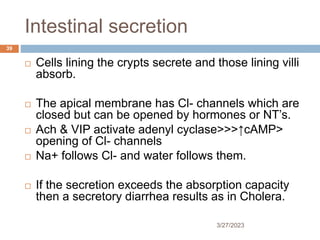
 Cells lining the crypts secrete and those lining villi
absorb.
 The apical membrane has Cl- channels which are
closed but can be opened by hormones or NT’s.
 Ach & VIP activate adenyl cyclase>>>↑cAMP>
opening of Cl- channels
 Na+ follows Cl- and water follows them.
 If the secretion exceeds the absorption capacity
then a secretory diarrhea results as in Cholera.
DIARRHOEA
3/27/2023
40
 “TO RUN THROUGH”
 Fluid loss>> ↓ECF>> ↓intracellular volume>>
↓arterial pressure>> Baroreceptors and RAAS try
to compensate and if they fail>> circulatory
collapse.
 K+ loss: flow rate dependent and leads to
hypokalemia
 HCO3- loss: GI secretions have a high HCO3-
level
Causes of diarrhea
3/27/2023
41
 Decreased absorptive surface area: infection
or inflammation of small intestine, sprue
 Osmotic diarrhea : lactose intolerance.
Bacteria can compound this diarrhea by further
breaking lactose into more osmotic
compounds.
 Secretory diarrhea: in Cholera and Escherichia
coli infection.
 How does Cholera cause Diarrhea?
FECES FORMATION
3/27/2023
42
 Bacterial action in the colon:
 Cellulose digestion
 Vit K, B12, B1, B2
 Gasses (flatus): Carbon dioxide, hydrogen,
methane.
 Feces composition:
 ¾ water
 ¼ solid matter
 Brown colour: stercobilin, urobilin
 Odour: indole, skatole, mercaptans, hydrogen
sulphide
Thank you.
3/27/2023
43

GIT SECRETIONS, DIGESTION & ABSORPTION.pptx

  • 1.
    3/27/2023 1  SMALL INTESTINEAND LARGE INTESTINE- DIGESTION AND ABSORPTION
  • 2.
    SMALL INTESTINE SECRETION 3/27/2023 2  Mucusby Brunner’s glands in duodenum  Stimuli: tactile, irritating, vagal, GI hormones  Alkaline mucus: protection from gastric acid  Inhibited by sympathetic stimulation…?duodenal ulcers  Intestinal digestive juices by Crypts of Lieberkuhn:  Goblet cells (mucus) & enterocytes (water & electrolytes)  1800mls/d; pH 7.5-8.0; creates watery vehicle for absorption
  • 3.
    3/27/2023 3  Digestive enzymes:  Peptidases Dissacharidases  Intestinal lipase  Local regulation  Intestinal epithelium has a life cycle of 5 days
  • 4.
  • 5.
    FUNCTION OF SMALL INTESTINE 3/27/2023 5 Secretion- digestion,protection,activation,haemopeisis  Hormonal  Mechanical  Absorption
  • 6.
  • 7.
    LARGE INTESTINE SECRETION 3/27/2023 7  Havecrypts of Lieberkuhn that secrete only mucus and a little HCO3 -  Protects mucosa from: acids from bacterial activity and physical excoriation.  Mucus adheres feces together.  Stimuli:  Tactile by local reflexes  Parasympathetic nervous system
  • 8.
  • 9.
  • 10.
    DIGESTION AND ABSORPTION 3/27/2023 10 OBJECTIVES:  Todescribe the site, digestive enzymes and secretions involved in the digestion of:  CHO’s, Proteins, Lipids  To describe the absorbable units, transporters involved and disorders in absorption of:  CHO’s, Proteins, Lipids, Fluid & Electrolytes.
  • 11.
    Introduction 3/27/2023 11  Digestion andabsorption is the ultimate function of GIT.  Digestion is the breakdown of ingested food into absorbable particles.  Absorption is movement of nutrients, water & electrolytes from intestinal lumen into the blood.  Occurs through cellular or paracellular paths
  • 12.
    The small intestine 3/27/2023 12 Most of the absorption occurs here.  The intestinal mucosa has longitudinal folds of Kerckring, villi & microvilli.  These increase absorptive surface area 600-1000 times.  They contain epithelial cells interspersed with goblet cells.  Epithelial cells are shed every 3-6 days making them vulnerable to irradiation and chemotherapy.
  • 13.
    1. CARBOHYDRATES 3/27/2023 13  Almostall ingested foods have >50% CHO’s  Contains polysaccharides (starch), disaccharides (trehalase, maltose, sucrose & lactose) and monosaccharide (glucose & fructose).  Absorbed only as monosaccharide.  Digestion begins in the mouth and is as follows:
  • 14.
  • 15.
  • 16.
    Cho’s absorption 3/27/2023 16  Absorbedas monosaccharides.  Glucose and galactose: through Na-dependent 20 active transport against the gradient on the apical membrane.  Fructose: by GLUT 5(fructose specific transporter) by facilitated diffusion hence none against gradient.  Once in the cell all are absorbed across basolateral membrane via GLUT 2 by facilitated diffusion.
  • 17.
  • 18.
    Lactose intolerance 3/27/2023 18  Acondition where there is absence of lactase and one fails to breakdown lactose into glucose and galactose.  As such lactose is not absorbed and remains in the lumen  Being osmotic it retains water in the lumen and leads to Diarrhea.  Treatment: avoid milk products or lactase supplementation.
  • 19.
    2. PROTEINS 3/27/2023 19  Absorbableforms are amino acids, dipeptides and tripeptides.  This is facilitated by the proteases in stomach and small intestine.  In the stomach(pepsin), small intestines (endopeptidases- trypsin, chymotrypsin, elastase & exopeptidases- carboxypeptidase A&B)  Pancreatic secretions which are mostly proteins are also absorbed in the same manner.
  • 20.
    Digestion 3/27/2023 20  The pancreaticpeptides are released in inactive form.  Trypsinogen is activated by enterokinase and the resulting trypsin catalyzes the activation of the other proteases including trypsinogen.  Breakdown proteins to amino acids, dipeptides and tripeptides.  Finally the proteases digest themselves.
  • 21.
  • 22.
  • 23.
    Absorption 3/27/2023 23  Absorbable inlarger molecules than CHO’s  Amino acids by the Na-aa co transporter each for acidic, basic, neutral and imino amino acids.  Most proteins are absorbed as di/tri peptides through the H+ dependent transporter  In the cells they are hydrolyzed by cytosolic proteases to amino acids.  On the basolateral membrane, there is facilitated diffusion of aa’s and remaining di/tri peptides.
  • 24.
  • 25.
    Disorders of proteindigestion & absorption 3/27/2023 25  Chronic pancreatitis  Cystic fibrosis of the pancreas  The two lead to failure in production of pancreatic proteases and failed protein digestion.  Cystinuria: involves absence of Na-aa co transporter of basic aa’s in the kidney and GIT  Leads to loss in urine and feces of cysteine, lysine, arginine and ornithine.
  • 26.
    3. LIPIDS 3/27/2023 26 In thestomach:  Lingual and gastric lipases  Mixing and churning breakdown lipids further  Dietary proteins emulsify lipids for lipases to act  Accounts for about 10% of all lipids.  Delayed gastric emptying by CCK allows time for duodenal digestion.
  • 27.
    Small intestine 3/27/2023 27  Bilesalts: emulsify fats and help in micelles formation  Pancreatic lipase and colipase: breakdown triglycerides  Cholesterol ester hydroxylase: cholesterol esters and triglycerides (glycerol)  Phospholipase A2 : breaks phospholipids into lysolecithin and fatty acids.  Procollipase and prophospholipase A2 are activated by trypsin.
  • 28.
  • 29.
    Disorders 3/27/2023 29 1) Pancreatic insufficiency(pancreatitis, fibrosis) 2) Duodenal acidity e.g. in ZE syndrome 3) Bile salts deficiency: resection of ileum 4) Bacterial overgrowth 5) Decreased intestinal cells e.g. tropical sprue 6) abetalipoproteinemia
  • 30.
    4.VITAMINS 3/27/2023 30  Required insmall quantities as cofactors or coenzymes in metabolism.  Not synthesized in the body hence gotten from GIT  Fat soluble vitamins:  ADEK  Absorbed as lipids.  Incorporated into micelles….taken to chylomicrons…to lymphatics…general circulation
  • 31.
    3/27/2023 31  Water solublevitamins:  Vitamins C and B complex  Absorbed through Na-dependent co transport except vitamin B12.  Vitamin B12 is absorbed in the terminal ileum with the help of intrinsic factor and transcobalamine transporters.  Lack of intrinsic factor leads to????????  Pernicious anemia.
  • 32.
    5.CALCIUM 3/27/2023 32  1,25 dihydroxycholecalciferol induces synthesis of vitamin D-dependent Ca2+ binding protein (Calbindin D-28K) in intestinal epithelial cells.  This mediates absorption of calcium  Vitamin D deficiency impairs calcium absorption and leads to deficiency.  Causes rickets in children and osteomalacia in adults.
  • 33.
    6.IRON 3/27/2023 33  Absorbed intointestinal epithelial cells as free iron or as heme (bound to Hb or myoglobin).  The heme iron is converted to free iron.  The free iron is then transported out of the intestinal epithelial cells into blood by apoferritin as ferritin.  In the blood iron is transported by transferrin (a βglobulin) to the liver storage sites.  From the liver to the bone marrow to make Hemoglobin.
  • 34.
    INTESTINAL FLUID AND ELECTROLYTE 3/27/2023 34 9 Liters of fluid in GIT every day. (2L from diet and 7L from GI secretions)  Almost all reabsorbed with 100-200mls in feces.  Intestinal epithelial cells also secrete into the GIT which also needs to be reabsorbed.  Absorption is through cellular and paracellular path  Tight junctions are leaky in SI and tight in
  • 35.
    Intestinal absorption 3/27/2023 35  Isosmoticabsorption like in the PCT of the kidneys.  Absorptive mechanisms vary in the jejunum, ileum and colon.  Jejunum: net absorption of NaHCO3  Ileum: net absorption of NaCl  Colon: net absorption of Na+ and K+
  • 36.
  • 37.
  • 38.
  • 39.
    Intestinal secretion 3/27/2023 39  Cellslining the crypts secrete and those lining villi absorb.  The apical membrane has Cl- channels which are closed but can be opened by hormones or NT’s.  Ach & VIP activate adenyl cyclase>>>↑cAMP> opening of Cl- channels  Na+ follows Cl- and water follows them.  If the secretion exceeds the absorption capacity then a secretory diarrhea results as in Cholera.
  • 40.
    DIARRHOEA 3/27/2023 40  “TO RUNTHROUGH”  Fluid loss>> ↓ECF>> ↓intracellular volume>> ↓arterial pressure>> Baroreceptors and RAAS try to compensate and if they fail>> circulatory collapse.  K+ loss: flow rate dependent and leads to hypokalemia  HCO3- loss: GI secretions have a high HCO3- level
  • 41.
    Causes of diarrhea 3/27/2023 41 Decreased absorptive surface area: infection or inflammation of small intestine, sprue  Osmotic diarrhea : lactose intolerance. Bacteria can compound this diarrhea by further breaking lactose into more osmotic compounds.  Secretory diarrhea: in Cholera and Escherichia coli infection.  How does Cholera cause Diarrhea?
  • 42.
    FECES FORMATION 3/27/2023 42  Bacterialaction in the colon:  Cellulose digestion  Vit K, B12, B1, B2  Gasses (flatus): Carbon dioxide, hydrogen, methane.  Feces composition:  ¾ water  ¼ solid matter  Brown colour: stercobilin, urobilin  Odour: indole, skatole, mercaptans, hydrogen sulphide
  • 43.

Editor's Notes

  • #9 THESE IS KISUMU 2019 IF NASA COMES TO POWER THIS AUGUST