Alkaline Phosphatase
- Alex Thomas
Basics
Do you know?
• Why the name alkaline phosphatase?
• Why Blood levels of alkaline phosphatase increase two to four times
during pregnancy?
• Relation between ALP and the scoring method?
• What are the Alkaline phosphatase isozymes in Humans?
• During childhood the majority of alkaline phosphatase are of skeletal
origin
• ALP is heat stable
2
Behind the name
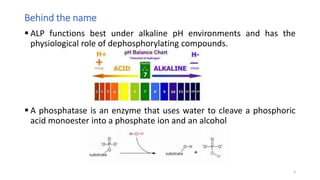
 ALP functions best under alkaline pH environments and has the
physiological role of dephosphorylating compounds.
 A phosphatase is an enzyme that uses water to cleave a phosphoric
acid monoester into a phosphate ion and an alcohol
3
Why Blood levels of alkaline phosphatase increase two to four
times during pregnancy?
 Additional alkaline phosphatase produced by the placenta
4
Alkaline phosphatase isozymes in Humans?
Humans and most other mammals contain the following alkaline
phosphatase isozymes:
 ALPI – intestinal (molecular weight of 150 kDa)
 ALPL – tissue-nonspecific (expressed mainly in liver/bone/kidney)
 ALPP – placental (Regan isozyme)
 GCAP – germ cell
5
Source
 In humans, alkaline phosphatase is present in all tissues throughout
the entire body, but is particularly concentrated in the
 Liver
 Bile Duct
 Kidney
 Bone
 Intestinal Mucosa
 Placenta
6
Elevated levels
 Biliary obstruction
 Bone conditions
 Osteoblastic bone tumors
 Osteomalacia
 Osteoporosis
 Hepatitis
 Cirrhosis
 Myelofibrosis
 Leukemoid reaction
 Lymphoma
 Paget's disease
 Sarcoidosis
 Hyperthyroidism
 Hyperparathyroidism
 Myocardial infarction
 Pregnancy
7
Lowered level
 Hypophosphatasia, an autosomal recessive disease
 Postmenopausal women receiving estrogen therapy because of aging
 Men with recent heart surgery, malnutrition, magnesium deficiency, hypothyroidism, or
severe anemia
 Children with achondroplasia and cretinism
 Children after a severe episode of enteritis
 Pernicious anemia
 Aplastic anemia
 Chronic myelogenous leukemia
 Wilson's disease
 Hypothyroidism
 Pernicious anaem
8
Thank you
9

Alkaline phosphatase- Basics

  • 1.
  • 2.
    Do you know? •Why the name alkaline phosphatase? • Why Blood levels of alkaline phosphatase increase two to four times during pregnancy? • Relation between ALP and the scoring method? • What are the Alkaline phosphatase isozymes in Humans? • During childhood the majority of alkaline phosphatase are of skeletal origin • ALP is heat stable 2
  • 3.
    Behind the name ALP functions best under alkaline pH environments and has the physiological role of dephosphorylating compounds.  A phosphatase is an enzyme that uses water to cleave a phosphoric acid monoester into a phosphate ion and an alcohol 3
  • 4.
    Why Blood levelsof alkaline phosphatase increase two to four times during pregnancy?  Additional alkaline phosphatase produced by the placenta 4
  • 5.
    Alkaline phosphatase isozymesin Humans? Humans and most other mammals contain the following alkaline phosphatase isozymes:  ALPI – intestinal (molecular weight of 150 kDa)  ALPL – tissue-nonspecific (expressed mainly in liver/bone/kidney)  ALPP – placental (Regan isozyme)  GCAP – germ cell 5
  • 6.
    Source  In humans,alkaline phosphatase is present in all tissues throughout the entire body, but is particularly concentrated in the  Liver  Bile Duct  Kidney  Bone  Intestinal Mucosa  Placenta 6
  • 7.
    Elevated levels  Biliaryobstruction  Bone conditions  Osteoblastic bone tumors  Osteomalacia  Osteoporosis  Hepatitis  Cirrhosis  Myelofibrosis  Leukemoid reaction  Lymphoma  Paget's disease  Sarcoidosis  Hyperthyroidism  Hyperparathyroidism  Myocardial infarction  Pregnancy 7
  • 8.
    Lowered level  Hypophosphatasia,an autosomal recessive disease  Postmenopausal women receiving estrogen therapy because of aging  Men with recent heart surgery, malnutrition, magnesium deficiency, hypothyroidism, or severe anemia  Children with achondroplasia and cretinism  Children after a severe episode of enteritis  Pernicious anemia  Aplastic anemia  Chronic myelogenous leukemia  Wilson's disease  Hypothyroidism  Pernicious anaem 8
  • 9.