MANAGEMENT INFORMATION SYSTEM Data; Facts or observation about physical phenomena or business tractions. More specifically, data are objective measurements of the attributes of  entities such as people, place, things & events. Information; Information is data placed in a meaningful and useful context for  an end user. Information Technology; Hardware, software, telecommunications, DB management, & other  information processing technologies used in computer-based IS
System; System is a set of interrelated components, with a clearly defined  boundary, working together to achieve a common  set of objectives.  Information systems; A set of people, procedures, & resources that collects, transforms,  and disseminates information in an organization. A system that accepts data resources as input and processes them into information products as output. Computer based IS; An IS that uses computer H/W & S/W to perform its information processing activities. IS can be any organized combination of People, Hardware, Software, Comm. networks, & data recourses that stores & retrieves, transforms,  & disseminates information in an organization.
Information Technology in Business IT includes internet base IS, are playing a vital & expanding role in business.  IT can help in all kinds of business, to improve the efficiency  & effectiveness of their business processes, managerial  decision Making, & workgroup collaboration, thus  strengthening their competitive positions in a rapidly changing market place.
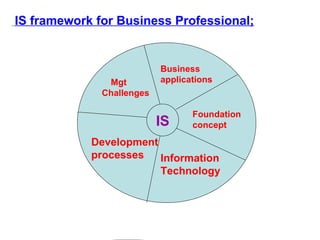
IS framework for Business Professional; IS Information Technology Development processes Foundation  concept Business applications Mgt Challenges
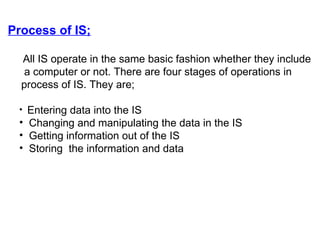
Process of IS; All IS operate in the same basic fashion whether they include  a computer or not. There are four stages of operations in  process of IS. They are; Entering data into the IS Changing and manipulating the data in the IS Getting information out of the IS Storing  the information and data
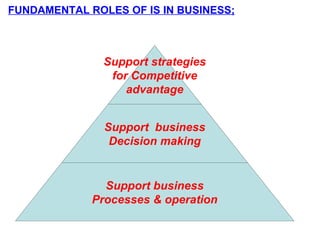
FUNDAMENTAL ROLES OF IS IN BUSINESS; Support strategies for Competitive  advantage Support  business Decision making Support business Processes & operation
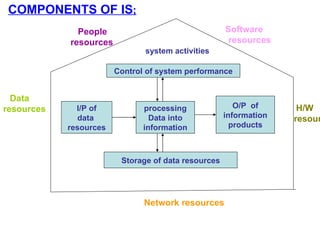
COMPONENTS OF IS ; I/P of data  resources processing Data into information O/P  of information products  Control of system performance Storage of data resources system activities People  resources Software  resources H/W resources Network resources Data  resources
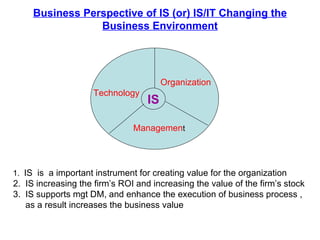
Business Perspective of IS (or) IS/IT Changing the Business Environment IS Technology Organization Managemen t 1.  IS  is  a important instrument for creating value for the organization 2.  IS increasing the firm’s ROI and increasing the value of the firm’s stock 3.  IS supports mgt DM, and enhance the execution of business process ,  as a result increases the business value
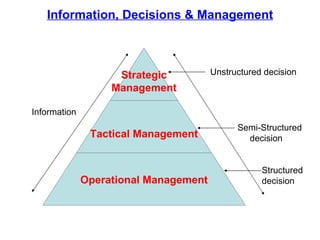
Information, Decisions & Management Information Unstructured decision Semi-Structured  decision Structured  decision Strategic Management Tactical Management Operational Management
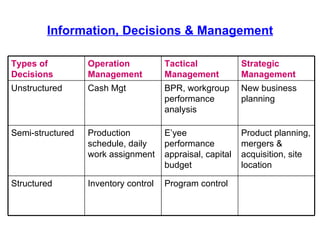
Information, Decisions & Management Program control Inventory control Structured Product planning, mergers & acquisition, site location E’yee performance appraisal, capital budget Production schedule, daily work assignment Semi-structured New business planning BPR, workgroup performance analysis Cash Mgt Unstructured Strategic Management Tactical Management Operation Management Types of Decisions
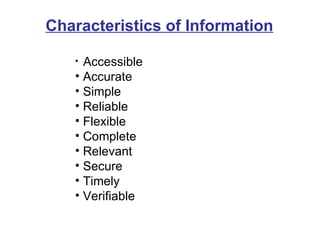
Characteristics of Information Accessible Accurate Simple Reliable Flexible Complete Relevant Secure Timely Verifiable
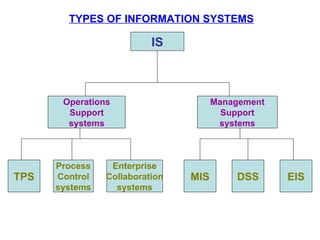
TYPES OF INFORMATION SYSTEMS TPS Process Control systems Enterprise Collaboration systems MIS DSS EIS Operations Support systems Management Support systems IS
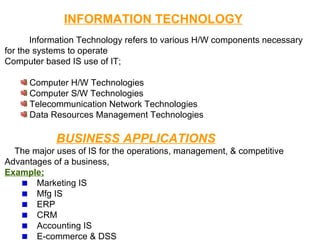
INFORMATION TECHNOLOGY Information Technology refers to various H/W components necessary  for the systems to operate Computer based IS use of IT; Computer H/W Technologies Computer S/W Technologies Telecommunication Network Technologies Data Resources Management Technologies BUSINESS APPLICATIONS The major uses of IS for the operations, management, & competitive  Advantages of a business, Example; Marketing IS Mfg IS ERP CRM Accounting IS E-commerce & DSS
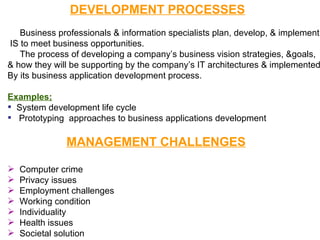
DEVELOPMENT PROCESSES Business professionals & information specialists plan, develop, & implement IS to meet business opportunities. The process of developing a company’s business vision strategies, &goals,  & how they will be supporting by the company’s IT architectures & implemented  By its business application development process. Examples; System development life cycle Prototyping  approaches to business applications development MANAGEMENT CHALLENGES Computer crime Privacy issues Employment challenges Working condition Individuality Health issues Societal solution

MELJUNManagement information system

  • 1.
    MANAGEMENT INFORMATION SYSTEMData; Facts or observation about physical phenomena or business tractions. More specifically, data are objective measurements of the attributes of entities such as people, place, things & events. Information; Information is data placed in a meaningful and useful context for an end user. Information Technology; Hardware, software, telecommunications, DB management, & other information processing technologies used in computer-based IS
  • 2.
    System; System isa set of interrelated components, with a clearly defined boundary, working together to achieve a common set of objectives. Information systems; A set of people, procedures, & resources that collects, transforms, and disseminates information in an organization. A system that accepts data resources as input and processes them into information products as output. Computer based IS; An IS that uses computer H/W & S/W to perform its information processing activities. IS can be any organized combination of People, Hardware, Software, Comm. networks, & data recourses that stores & retrieves, transforms, & disseminates information in an organization.
  • 3.
    Information Technology inBusiness IT includes internet base IS, are playing a vital & expanding role in business. IT can help in all kinds of business, to improve the efficiency & effectiveness of their business processes, managerial decision Making, & workgroup collaboration, thus strengthening their competitive positions in a rapidly changing market place.
  • 4.
    IS framework forBusiness Professional; IS Information Technology Development processes Foundation concept Business applications Mgt Challenges
  • 5.
    Process of IS;All IS operate in the same basic fashion whether they include a computer or not. There are four stages of operations in process of IS. They are; Entering data into the IS Changing and manipulating the data in the IS Getting information out of the IS Storing the information and data
  • 6.
    FUNDAMENTAL ROLES OFIS IN BUSINESS; Support strategies for Competitive advantage Support business Decision making Support business Processes & operation
  • 7.
    COMPONENTS OF IS; I/P of data resources processing Data into information O/P of information products Control of system performance Storage of data resources system activities People resources Software resources H/W resources Network resources Data resources
  • 8.
    Business Perspective ofIS (or) IS/IT Changing the Business Environment IS Technology Organization Managemen t 1. IS is a important instrument for creating value for the organization 2. IS increasing the firm’s ROI and increasing the value of the firm’s stock 3. IS supports mgt DM, and enhance the execution of business process , as a result increases the business value
  • 9.
    Information, Decisions &Management Information Unstructured decision Semi-Structured decision Structured decision Strategic Management Tactical Management Operational Management
  • 10.
    Information, Decisions &Management Program control Inventory control Structured Product planning, mergers & acquisition, site location E’yee performance appraisal, capital budget Production schedule, daily work assignment Semi-structured New business planning BPR, workgroup performance analysis Cash Mgt Unstructured Strategic Management Tactical Management Operation Management Types of Decisions
  • 11.
    Characteristics of InformationAccessible Accurate Simple Reliable Flexible Complete Relevant Secure Timely Verifiable
  • 12.
    TYPES OF INFORMATIONSYSTEMS TPS Process Control systems Enterprise Collaboration systems MIS DSS EIS Operations Support systems Management Support systems IS
  • 13.
    INFORMATION TECHNOLOGY InformationTechnology refers to various H/W components necessary for the systems to operate Computer based IS use of IT; Computer H/W Technologies Computer S/W Technologies Telecommunication Network Technologies Data Resources Management Technologies BUSINESS APPLICATIONS The major uses of IS for the operations, management, & competitive Advantages of a business, Example; Marketing IS Mfg IS ERP CRM Accounting IS E-commerce & DSS
  • 14.
    DEVELOPMENT PROCESSES Businessprofessionals & information specialists plan, develop, & implement IS to meet business opportunities. The process of developing a company’s business vision strategies, &goals, & how they will be supporting by the company’s IT architectures & implemented By its business application development process. Examples; System development life cycle Prototyping approaches to business applications development MANAGEMENT CHALLENGES Computer crime Privacy issues Employment challenges Working condition Individuality Health issues Societal solution