Personalised Access to Cultural
Heritage Spaces using Pathways

         Mark Stevenson
       University of Sheffield
Overview


•  Information access in cultural heritage

•  PATHS project
Information access in cultural heritage

•  Significant amounts of Cultural Heritage material
   available online
   –  Web portals, digital libraries, Wikipedia …


•  Users find it difficult to navigate and interpret the
   wealth of information
   –  users are normally not subject experts
   –  systems offer limited support for knowledge exploration and
      discovery
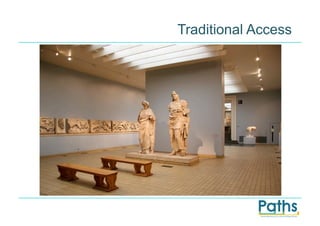
Traditional Access
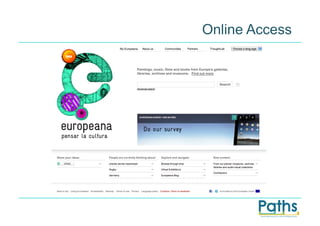
Online Access
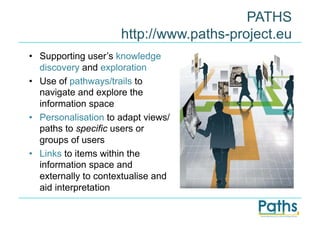
PATHS
                      http://www.paths-project.eu
•  Supporting user’s knowledge
   discovery and exploration
•  Use of pathways/trails to
   navigate and explore the
   information space
•  Personalisation to adapt views/
   paths to specific users or
   groups of users
•  Links to items within the
   information space and
   externally to contextualise and
   aid interpretation
PATHS: Basic facts

•  STREP funded under the European Commission's
   Seventh Framework Programme
•  36 months
   –  1st January 2011 to 31st December 2013
•  6 partners in 5 countries
   –    Sheffield University (co-ordinator)
   –    Universidad del Pais Vasco
   –    i-sieve technologies Ltd
   –    Asplan Viak Internet Ltd
   –    MDR Partners
   –    Alinari 24 Ore Spa
Project objectives
•  Analysis of users’ requirements for discovering knowledge in
   Cultural Heritage collections and construction of pathways/trails
•  Automated organisation and enrichment of Cultural Heritage content
   for use within a navigation system
•  Implementation of a system for navigating Cultural Heritage
   resources
•  Techniques for providing personalised access to Cultural Heritage
   content (e.g. recommender systems)
•  Porting the navigation system for use on mobile devices and
   Facebook
•  Evaluation with user groups and in field trials
Research areas
•  Information Access
   –  user-driven navigation through collections
   –  knowledge of users’ requirements for access to cultural heritage
      collections
   –  modeling of user preferences and context
•  Educational Informatics
   –  adapting to individual learners in relation to being directed and
      being allowed the freedom to explore autonomously
•  Content Interpretation and Enrichment
   –  representation and sharing of information about items in Digital
      Libraries
   –  identifying background information related to the items in cultural
      heritage collections (e.g. links to Wikipedia pages)
Pathways for navigation
•  Navigation through a collection via metaphor of “pathways”

•  A path is a ‘route’ through an information space
   –  defined as collections of cultural heritage resources
   –  consists of items, links connecting them and narrative


 Presentation at Glasgow University, 14th March 2011
Guided and user generated paths
•  Users can follow pre-defined “guided paths”
   –  created by domain experts, such as scholars or teachers
•  Provide an easily accessible entry point to the collection
   –  can be followed in their entirety or left at any point
•  Users can also create and share their own paths

•  Paths can be based around any theme
   –    artist and media (“paintings by Picasso”)
   –    historic periods (“the Cold War”)
   –    places (“Venice”)
   –    famous people (“Muhammed Ali”)
   –    or any other topic (e.g. “Europe”, “food”)
Paths and trails have been studied in many fields

•  Trails (Memex, 1945)
   –  Associative trails explicitly created by users forming links
      between stored materials to help others navigate
•  Destinations (search engines and web analytics)
   –  Origin/landing page (from query), intermediate pages and
      destination page
•  Search strategies (information seeking)
   –  Users moving between information sources, perhaps due to
      changes in their information needs
•  Guided tours (hypertext)
   –  authors create sequence of pages useful to others (manual)
   –  automatically generated trails to assist with web navigation
   –  used in educational informatics and cultural heritage
Learning and knowledge discovery
•  A particular area of focus in PATHS
   –  Aims to help people to learn and discover new knowledge as
      they use cultural heritage resources
•  People learn and solve problems differently
   –  some people require a lot of guiding; others are self-directed
   –  some people welcome irrelevant material; others are intolerant
   –  some people creatively explore and come up with new ideas;
      others want to answer a set problem
•  Users may perform information seeking
   –  must navigate through information spaces
   –  different people may require different levels of assistance
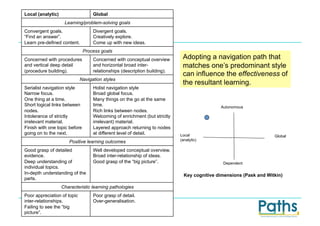
Local (analytic)                   Global
                    Learning/problem-solving goals
Convergent goals.                  Divergent goals.
“Find an answer”.                  Creatively explore.
Learn pre-defined content.         Come up with new ideas.
                               Process goals
Concerned with procedures          Concerned with conceptual overview       Adopting a navigation path that
and vertical deep detail           and horizontal broad inter-              matches one’s predominant style
(procedure building).              relationships (description building).
                                                                            can influence the effectiveness of
                             Navigation styles
                                                                            the resultant learning.
Serialist navigation style         Holist navigation style
Narrow focus.                      Broad global focus.
One thing at a time.               Many things on the go at the same
Short logical links between        time.                                                    Autonomous
nodes.                             Rich links between nodes.
Intolerance of strictly            Welcoming of enrichment (but strictly
irrelevant material.               irrelevant) material.
Finish with one topic before       Layered approach returning to nodes
going on to the next.              at different level of detail.           Local                                   Global
                                                                           (analytic)
                      Positive learning outcomes
Good grasp of detailed             Well developed conceptual overview.
evidence.                          Broad inter-relationship of ideas.
Deep understanding of              Good grasp of the “big picture”.                          Dependent
individual topics.
In-depth understanding of the                                                Key cognitive dimensions (Pask and Witkin)
parts.
                   Characteristic learning pathologies
Poor appreciation of topic         Poor grasp of detail.
inter-relationships.               Over-generalisation.
Failing to see the “big
picture”.
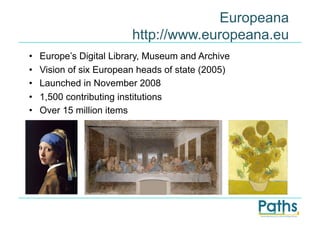
Europeana
                                               http://www.europeana.eu
•    Europe’s Digital Library, Museum and Archive
•    Vision of six European heads of state (2005)
•    Launched in November 2008
•    1,500 contributing institutions
•    Over 15 million items


     6/22/11   © The University of Sheffield
Europeana data
<record>
  <dc:creator>Davies, J O</dc:creator>
  <dc:date>[2001]</dc:date>
  <dc:title>Stembridge Windmill, High Ham, Somerset</dc:title>
  <dc:description>This is a random-coursed blue lias stone tower mill, with a unique thatched cap. Built 1822 to replace an earlier mill
     which was sited a few hundred metres to the north east. It ceased work in 1908 and was willed to the National Trust in 1969, since
     when quite extensive repairs have been carried out.</dc:description>
  <dc:identifier>http://viewfinder.english-heritage.org.uk/search/detail.asp?calledFrom=oai&amp;imageUID=8</dc:identifier>
  <dc:language>en</dc:language>
  <dc:rights>Copyright English Heritage.NMR</dc:rights>
  <dc:subject>Agriculture</dc:subject>
  <dc:subject>Windmill</dc:subject>
  <dc:subject>Tower Mill</dc:subject>
  <dc:type>Image</dc:type>
  <dcterms:isPartOf>English Heritage</dcterms:isPartOf>
  <europeana:country>uk</europeana:country>
  <europeana:dataProvider>English Heritage - Viewfinder</europeana:dataProvider>
  <europeana:isShownAt>http://viewfinder.english-heritage.org.uk/search/detail.asp?calledFrom=oai&amp;imageUID=8</
     europeana:isShownAt>
  <europeana:language>en</europeana:language>
  <europeana:object>http://www.culturegrid.org.uk/dpp/resource/1512084/stream/thumbnail_image_jpeg</europeana:object>
  <europeana:provider>CultureGrid</europeana:provider>
  <europeana:rights>http://www.europeana.eu/rights/rr-f/</europeana:rights>
  <europeana:type>IMAGE</europeana:type>
  <europeana:uri>http://www.europeana.eu/resolve/record/09405o/AC721E03934115003DEA60494AC9C88441A255ED</
     europeana:uri>
  <europeana:year>2001</europeana:year>
</record>
Europeana data
•  Positives
  –  Consistent format

•  Negatives
  –  Field values not standardised
     •  Different vocabularies
     •  Different levels of detail

  –  Very frequent field values

  –  URIs are not stable!
Conclusions

•  Aim to improve access to large Cultural Heritage
   collections


•  Research areas:
   –  Information Access
   –  Educational Informatics
   –  Content Processing and Enrichment
Contact

    Any questions?

   info@paths-project.eu
 http://www.paths-project.eu/


m.stevenson@dcs.shef.ac.uk

PATHS at the Language Technology Group, Computer Science and Software Engineering Department, Melbourne University

  • 1.
    Personalised Access toCultural Heritage Spaces using Pathways Mark Stevenson University of Sheffield
  • 2.
    Overview •  Information accessin cultural heritage •  PATHS project
  • 3.
    Information access incultural heritage •  Significant amounts of Cultural Heritage material available online –  Web portals, digital libraries, Wikipedia … •  Users find it difficult to navigate and interpret the wealth of information –  users are normally not subject experts –  systems offer limited support for knowledge exploration and discovery
  • 4.
  • 5.
  • 6.
    PATHS http://www.paths-project.eu •  Supporting user’s knowledge discovery and exploration •  Use of pathways/trails to navigate and explore the information space •  Personalisation to adapt views/ paths to specific users or groups of users •  Links to items within the information space and externally to contextualise and aid interpretation
  • 7.
    PATHS: Basic facts • STREP funded under the European Commission's Seventh Framework Programme •  36 months –  1st January 2011 to 31st December 2013 •  6 partners in 5 countries –  Sheffield University (co-ordinator) –  Universidad del Pais Vasco –  i-sieve technologies Ltd –  Asplan Viak Internet Ltd –  MDR Partners –  Alinari 24 Ore Spa
  • 8.
    Project objectives •  Analysisof users’ requirements for discovering knowledge in Cultural Heritage collections and construction of pathways/trails •  Automated organisation and enrichment of Cultural Heritage content for use within a navigation system •  Implementation of a system for navigating Cultural Heritage resources •  Techniques for providing personalised access to Cultural Heritage content (e.g. recommender systems) •  Porting the navigation system for use on mobile devices and Facebook •  Evaluation with user groups and in field trials
  • 9.
    Research areas •  InformationAccess –  user-driven navigation through collections –  knowledge of users’ requirements for access to cultural heritage collections –  modeling of user preferences and context •  Educational Informatics –  adapting to individual learners in relation to being directed and being allowed the freedom to explore autonomously •  Content Interpretation and Enrichment –  representation and sharing of information about items in Digital Libraries –  identifying background information related to the items in cultural heritage collections (e.g. links to Wikipedia pages)
  • 10.
    Pathways for navigation • Navigation through a collection via metaphor of “pathways” •  A path is a ‘route’ through an information space –  defined as collections of cultural heritage resources –  consists of items, links connecting them and narrative Presentation at Glasgow University, 14th March 2011
  • 11.
    Guided and usergenerated paths •  Users can follow pre-defined “guided paths” –  created by domain experts, such as scholars or teachers •  Provide an easily accessible entry point to the collection –  can be followed in their entirety or left at any point •  Users can also create and share their own paths •  Paths can be based around any theme –  artist and media (“paintings by Picasso”) –  historic periods (“the Cold War”) –  places (“Venice”) –  famous people (“Muhammed Ali”) –  or any other topic (e.g. “Europe”, “food”)
  • 12.
    Paths and trailshave been studied in many fields •  Trails (Memex, 1945) –  Associative trails explicitly created by users forming links between stored materials to help others navigate •  Destinations (search engines and web analytics) –  Origin/landing page (from query), intermediate pages and destination page •  Search strategies (information seeking) –  Users moving between information sources, perhaps due to changes in their information needs •  Guided tours (hypertext) –  authors create sequence of pages useful to others (manual) –  automatically generated trails to assist with web navigation –  used in educational informatics and cultural heritage
  • 13.
    Learning and knowledgediscovery •  A particular area of focus in PATHS –  Aims to help people to learn and discover new knowledge as they use cultural heritage resources •  People learn and solve problems differently –  some people require a lot of guiding; others are self-directed –  some people welcome irrelevant material; others are intolerant –  some people creatively explore and come up with new ideas; others want to answer a set problem •  Users may perform information seeking –  must navigate through information spaces –  different people may require different levels of assistance
  • 14.
    Local (analytic) Global Learning/problem-solving goals Convergent goals. Divergent goals. “Find an answer”. Creatively explore. Learn pre-defined content. Come up with new ideas. Process goals Concerned with procedures Concerned with conceptual overview Adopting a navigation path that and vertical deep detail and horizontal broad inter- matches one’s predominant style (procedure building). relationships (description building). can influence the effectiveness of Navigation styles the resultant learning. Serialist navigation style Holist navigation style Narrow focus. Broad global focus. One thing at a time. Many things on the go at the same Short logical links between time. Autonomous nodes. Rich links between nodes. Intolerance of strictly Welcoming of enrichment (but strictly irrelevant material. irrelevant) material. Finish with one topic before Layered approach returning to nodes going on to the next. at different level of detail. Local Global (analytic) Positive learning outcomes Good grasp of detailed Well developed conceptual overview. evidence. Broad inter-relationship of ideas. Deep understanding of Good grasp of the “big picture”. Dependent individual topics. In-depth understanding of the Key cognitive dimensions (Pask and Witkin) parts. Characteristic learning pathologies Poor appreciation of topic Poor grasp of detail. inter-relationships. Over-generalisation. Failing to see the “big picture”.
  • 15.
    Europeana http://www.europeana.eu •  Europe’s Digital Library, Museum and Archive •  Vision of six European heads of state (2005) •  Launched in November 2008 •  1,500 contributing institutions •  Over 15 million items 6/22/11 © The University of Sheffield
  • 16.
    Europeana data <record> <dc:creator>Davies, J O</dc:creator> <dc:date>[2001]</dc:date> <dc:title>Stembridge Windmill, High Ham, Somerset</dc:title> <dc:description>This is a random-coursed blue lias stone tower mill, with a unique thatched cap. Built 1822 to replace an earlier mill which was sited a few hundred metres to the north east. It ceased work in 1908 and was willed to the National Trust in 1969, since when quite extensive repairs have been carried out.</dc:description> <dc:identifier>http://viewfinder.english-heritage.org.uk/search/detail.asp?calledFrom=oai&amp;imageUID=8</dc:identifier> <dc:language>en</dc:language> <dc:rights>Copyright English Heritage.NMR</dc:rights> <dc:subject>Agriculture</dc:subject> <dc:subject>Windmill</dc:subject> <dc:subject>Tower Mill</dc:subject> <dc:type>Image</dc:type> <dcterms:isPartOf>English Heritage</dcterms:isPartOf> <europeana:country>uk</europeana:country> <europeana:dataProvider>English Heritage - Viewfinder</europeana:dataProvider> <europeana:isShownAt>http://viewfinder.english-heritage.org.uk/search/detail.asp?calledFrom=oai&amp;imageUID=8</ europeana:isShownAt> <europeana:language>en</europeana:language> <europeana:object>http://www.culturegrid.org.uk/dpp/resource/1512084/stream/thumbnail_image_jpeg</europeana:object> <europeana:provider>CultureGrid</europeana:provider> <europeana:rights>http://www.europeana.eu/rights/rr-f/</europeana:rights> <europeana:type>IMAGE</europeana:type> <europeana:uri>http://www.europeana.eu/resolve/record/09405o/AC721E03934115003DEA60494AC9C88441A255ED</ europeana:uri> <europeana:year>2001</europeana:year> </record>
  • 17.
    Europeana data •  Positives –  Consistent format •  Negatives –  Field values not standardised •  Different vocabularies •  Different levels of detail –  Very frequent field values –  URIs are not stable!
  • 18.
    Conclusions •  Aim toimprove access to large Cultural Heritage collections •  Research areas: –  Information Access –  Educational Informatics –  Content Processing and Enrichment
  • 19.
    Contact Any questions? info@paths-project.eu http://www.paths-project.eu/ m.stevenson@dcs.shef.ac.uk