Semantic Technologies for
                        Cultural Heritage
                        Vladimir Alexiev, PhD, PMP
                      vladimir.alexiev@ontotext.com


Seoul, 19 May 2011             KR Global Smart SOC Initiative 2011   1
Outline
• Semantic Web
      – Linked Open Data
      – Ontotext Corp
• Cultural Heritage
      – Applicability of Semantic Web
      – Data Standards
      – Europeana Data Model
• Related Projects
      – EU Projects
      – EU Projects with BG Participation
      – BG Projects
• ITCC Project

Seoul, 19 May 2011         KR Global Smart SOC Initiative 2011   2
SEMANTIC WEB, LOD, ONTOTEXT


Seoul, 19 May 2011   KR Global Smart SOC Initiative 2011   3
Semantic Web
• What is the semantic web?
      – "Artificial Intelligence meets the web": Recasting of AI
        developments, but with realistic goals and at global web scale
      – Proposed around 1998 by T.Berners-Lee (same person who
        proposed the WWW)
      – Standardized by the WWW Consortium (W3C)
      – If Web 1.0 is a giant hyperlinked document, then Web 3.0 is a giant
        linked database
• Emerged as the best Data Integration approach
      – Many professional fields have a data fusion problem
      – Semantic web becomes the "Rosetta Stone" linking various types of
        independent data sources, using a unified, globalized and abstracted
        representation (RDF, RDFS, OWL2, RIF)
      – Schema info (metadata) is represented the same way as data
• Intro videos (from the TED series)
      – Tim Berners-Lee: The next Web of open, linked data
      – Tim Berners-Lee: The year open data went worldwide
      – Hans Rosling: No more boring data
Seoul, 19 May 2011             KR Global Smart SOC Initiative 2011            4
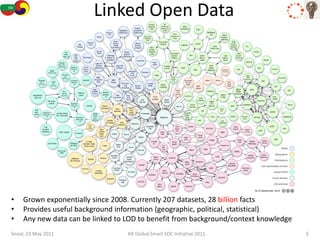
Linked Open Data


•    Grown exponentially since 2008. Currently 207 datasets, 28 billion facts
•    Provides useful background information (geographic, political, statistical)
•    Any new data can be linked to LOD to benefit from background/context knowledge
Seoul, 19 May 2011                 KR Global Smart SOC Initiative 2011                5
Ontotext Corp
• Who is Ontotext?
      – The leading semtech company in Eastern Europe and one of
        the leaders world-wide
      – 55 people: Bulgaria (Sofia, Varna), Austria, USA
      – Worked in this area since 2000
      – Venture funding and commercial clients since 2008
      – Bulgaria's most successful participant in EU FP5,6,7 research
      – www.ontotext.com
• 360-degree semantic technology:
      – Semantic Repository (OWLIM), ETL
      – Text Mining, Semantic Annotation and Search (KIM,
        U.Sheffield GATE, Teamware, MIMIR)
      – Web Mining and Crawling
      – Ontology Engineering and Exploitation
      – Master Data and Linked Data Management

Seoul, 19 May 2011           KR Global Smart SOC Initiative 2011        6
Ontotext Clients (selected)
• British Broadcasting Corporation (BBC)
      – Runs its World Cup 2010 sites on top of OWLIM
      – Next is BBC Sports (2011) and the 2012 Olympics
• The National Archives (UK)
      – The UK Government’s official archive contracted Ontotext to implement
        semantic search for the Government Web Archive
• AstraZeneca
      – Analysis and retrieval of clinical trial reports
      – Integration of biomedical databases for drug target identification
• KT
      – Applications of OWLIM in Interactive TV and IPTV
• All these clients need to:
      – integrate massive amounts of heterogeneous data
      – provide efficient search and navigation

Seoul, 19 May 2011                KR Global Smart SOC Initiative 2011           7
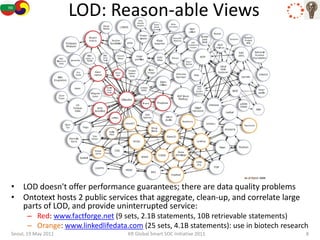
LOD: Reason-able Views


• LOD doesn't offer performance guarantees; there are data quality problems
• Ontotext hosts 2 public services that aggregate, clean-up, and correlate large
  parts of LOD, and provide uninterrupted service:
      – Red: www.factforge.net (9 sets, 2.1B statements, 10B retrievable statements)
      – Orange: www.linkedlifedata.com (25 sets, 4.1B statements): use in biotech research
Seoul, 19 May 2011                  KR Global Smart SOC Initiative 2011                  8
SemWeb Tipping Point
• Richard McManus (founder of ReadWriteWeb):
      – “…the tipping point for the Semantic Web may be when
        one can … deliver –using Linked Data– a comprehensive
        list of locations of original Modigliani art works …”
• Query http://factforge.net/sparql: uses data from 3
  independent datasets (DBpedia, FreeBase, UMBEL)
     SELECT DISTINCT
       ?painting_l ?owner_l ?city_fb_con ?city_db_loc ?city_db_cit
     WHERE {
       ?p fb:visual_art.artwork.artist dbpedia:Amedeo_Modigliani ;
          fb:visual_art.artwork.owners [
            fb:visual_art.artwork_owner_relationship.owner ?ow ] ;
          ff:preferredLabel ?painting_l.
        ?ow ff:preferredLabel ?owner_l .
         OPTIONAL { ?ow fb:location.location.containedby [
                        ff:preferredLabel ?city_fb_con ] } .
         OPTIONAL { ?ow dbp-prop:location ?loc.
                     ?loc rdf:type umbel-sc:City ;
                         ff:preferredLabel ?city_db_loc }
         OPTIONAL { ?ow dbp-ont:city [ ff:preferredLabel ?city_db_cit ] }
     }


Seoul, 19 May 2011                   KR Global Smart SOC Initiative 2011    9
Modigliani Test: FactForge Results


• Reaching the tipping point of the semantic web
• Interestingly, with an application to cultural heritage
Seoul, 19 May 2011          KR Global Smart SOC Initiative 2011   10
CULTURAL HERITAGE
       AND DATA STANDARDS

Seoul, 19 May 2011   KR Global Smart SOC Initiative 2011   11
Cultural Heritage
• Cultural Heritage (C.H.) represents
      – artifacts: historical, archeological, written, art, etc
      – institutions: museums, galleries, archives, audiovisual
        collections, libraries, trusts, universities, research
        institutes, …
      – activities: preservation, scientific research, cataloging,
        dissemination, digitalization, …
      – fields: artistic, scientific, industrial, bibliographic,
        ethnographic, nature …
      – A large, heterogeneous, cross-disciplinary field
• Social importance
      – The EU agenda includes multiculturalism and cultural
        preservation
      – Both BG and KR have rich history and heritage
Seoul, 19 May 2011          KR Global Smart SOC Initiative 2011      12
C.H. Data Standards
• Dublin Core (DC)
      – Simple resource descriptions: author, date created, etc
      – ISO 15836
• Conceptual Reference Model (CRM)
      – By International Committee on Documentation (CIDOC) of the International Council
        of Museums (ICOM), an organization devoted to conserve and communicate to
        society the world's natural and cultural heritage
      – Core upper-level concepts common across c.h. documentation
      – ISO 21127 (2006) "Information and documentation — A reference ontology for the
        interchange of cultural heritage information"
• Functional Requirements for Bibliographic Records (FRBR)
      – by International Federation of Library Associations and Institutions (IFLA)
      – Conceptual entity-relationship model
• Europeana Data Model (EDM)
      –   Structuring the data that Europeana is ingesting, managing and publishing
      –   Refined until the end of 2010, will be implemented during 2011
      –   Open, cross-domain framework, adheres to semweb modeling principles
      –   Intended to accommodate specific community standards such as LIDO, EAD, METS
      –   Probably in the future will incorporate CRM

Seoul, 19 May 2011                   KR Global Smart SOC Initiative 2011              13
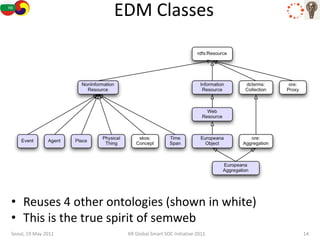
EDM Classes


• Reuses 4 other ontologies (shown in white)
• This is the true spirit of semweb
Seoul, 19 May 2011    KR Global Smart SOC Initiative 2011   14
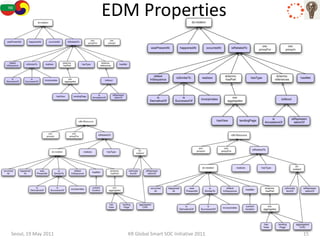
EDM Properties


Seoul, 19 May 2011     KR Global Smart SOC Initiative 2011   15
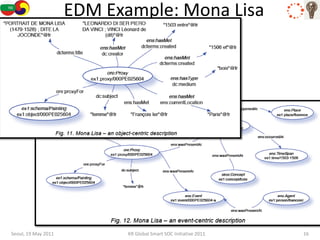
EDM Example: Mona Lisa


Seoul, 19 May 2011          KR Global Smart SOC Initiative 2011   16
Why Semweb for C.H.?
• Many C.H. institutions have a data integration problem, since data
  about the same artifacts is scattered in separate silos:
      –   cataloging data
      –   acquisition data
      –   conservation data
      –   scientific data, …
• Cross-institution and cross-country research is stuttered
      – Which BG archeological sites exhibit the same style as MK sites? Who knows…
• British Museum hosted a Cultural Heritage & SemWeb day (13.1.2011)
      – Examined use of the emerging web of data by c.h. and humanities
        organizations. See this interesting blog
      – Looked at practical applications of semweb technology relevant to the sector
      – Out of 8 presenters:
             • John Sheridan (Ontotext client): Government and National Archive initiatives (the 2nd most
               used web archive in the world is being converted to a Semantic Knowledge Base with 50M
               documents)
             • Atanas Kiryakov (Ontotext CEO ): FactForge – the Fast Track to the Centre of the Data Web


Seoul, 19 May 2011                         KR Global Smart SOC Initiative 2011                              17
PROJECTS RELATED TO
       CULTURAL HERITAGE & SEMTECH

Seoul, 19 May 2011   KR Global Smart SOC Initiative 2011   18
Related Projects
• Numerous related projects are sponsored by the EU,
  in line with its multiculturalism agenda
      – Europeana
      – EU FP7 and DigiCult projects
• Some EU projects with BG participation
      –   MOLTO
      –   CULTURA
      –   IMPACT
      –   Linked Heritage
• BG Projects
      – SUdigital
      – Romulus, Theseus, Thelamon
      – Collaborative Portal
Seoul, 19 May 2011            KR Global Smart SOC Initiative 2011   19
Europeana
• http://europeana.eu
• Pan-European Digital Museum
• People can explore the digital resources of
  Europe's museums, libraries, archives, audio-
  visual collections
      • And be inspired by the rich diversity of Europe's
        cultural and scientific heritage
• Promotes discovery and networking
  opportunities in a multilingual space
• Around 1500 institutions contributed
      – Includes over 15 M items
      – Still none from BG, but that will change soon
Seoul, 19 May 2011        KR Global Smart SOC Initiative 2011   20
Europeana and semweb
•    Europeana adopts semtech for all future development
      – EDM is based on semweb, which makes it easily extensible
      – Current holdings will be converted to semweb format
•    Europeana's first White Paper Knowledge = Information in Context looks at the key
     role LOD will play in Europeana's development
      – "Linked data gives machines the ability to make associations and put search terms into
        context. Without linked data, Europeana could be seen as a simple collection of digital
        objects. With linked data, the potential is far greater"
•    LOD Experiment in Europeana Thought Lab:
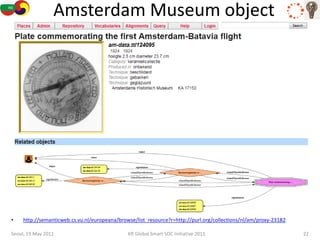
      – Data and metadata from the Amsterdam Museum (AM)
             •   70k cultural heritage objects related to the city
      – Retrieved from an XML API of the museum's collection (database by AdLib UK)
      – Converted to LOD compliant with EDM by Vrije Universiteit (VU): 5M facts
             •   Conversion software is available as open source
      – Linked to existing datasets
             •   Dutch Art and Architecture Thesaurus (AATNed)
             •   Getty's Union List of Artists Names (ULAN)
             •   DBpedia (data version of Wikipedia)
             •   GeoNames (structured geographical data)
      – Published to the Comprehensive Knowledge Archives Network (CKAN)
      – Prime example the type of LOD that Europeana will be producing

Seoul, 19 May 2011                                    KR Global Smart SOC Initiative 2011         21
Amsterdam Museum object


•    http://semanticweb.cs.vu.nl/europeana/browse/list_resource?r=http://purl.org/collections/nl/am/proxy-23182

Seoul, 19 May 2011                             KR Global Smart SOC Initiative 2011                                22
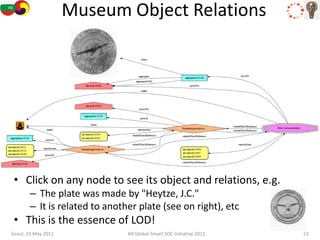
Museum Object Relations


 • Click on any node to see its object and relations, e.g.
       – The plate was made by "Heytze, J.C."
       – It is related to another plate (see on right), etc
 • This is the essence of LOD!
Seoul, 19 May 2011             KR Global Smart SOC Initiative 2011   23
EU FP7 and DigiCult
• DigiCult and TeLearn
      – DigiCult (Cultural Heritage): leading-edge ICT for accessing, experiencing and
        preserving cultural and scientific resources
      – TeLearn (Technology Enhanced Learning): how ICT can make learning more
        efficient
• FP6 Projects
      – 25 research projects were executed to mid 2010
• FP7 projects and calls:
      – 11 projects from the first two calls, started between Nov 2007 and Feb 2009
      – 15 projects from the latest call, started between Dec 2010 and Apr 2011
      – ICT SME DCL: open till Apr 2011, Digital Content and Languages, targets SMEs
             • Ontotext submitted a proposal with VU Amsterdam and AdLib (UK) similar to the Europeana pilot
      – ICT call 9: open Jan-Jul 2012, targets Digitization
• Budget (specifically for DigiCult and TeLearn, other calls are also be applicable)
      – WP 2007-2008: 102 MEUR DigiCult and TeLearn (Calls 1 and 3)
      – WP 2009-2010: 69 MEUR for "Digital Libraries and Digital Preservation"
      – WP 2011-2012: 110 MEUR (Call 9, Challenges 4 and 8) for "Digital Preservation"
        and "ICT for access to cultural resources"
Seoul, 19 May 2011                          KR Global Smart SOC Initiative 2011                                24
DigiCult Semtech Projects
• Digital cultural experiences: exploration of leading edge
  technologies (e.g. knowledge management systems, semantic
  tools, graphics, interfaces, novel displays)
      – Empower applications that improve the meaningful use of cultural resources and
        the experiences users get from visits of museums and sites
       3D-COFORM, ARtSENSE, AXES, CHESS, CINeSPACE, CULTURA, DECIPHER, EPOCH,
        ISAAC, iTACITUS, MOSAICA, PATHS, P2P-FUSION, QVIZ, V-City, …
• Information retrieval and use: application areas such as digital
  libraries and archives, exploring methods and tools for
  (semi)automatic indexing, semantic annotation of non-textual
  objects (music, speech, images).
      – Aim at enhancing information and knowledge retrieval through efficient search
        engines able to deliver results from complex multimedia resources, from
        distributed collections, across languages.
       CONTRAPUNCTUS, EASAIER, ethnoArc, IMAGINATION, MEMORIES, MultiMATCH,
        PAPYRUS, QVIZ, Treble-CLEF, …


Seoul, 19 May 2011                 KR Global Smart SOC Initiative 2011                   25
EU PROJECTS WITH
       BG PARTICIPATION

Seoul, 19 May 2011   KR Global Smart SOC Initiative 2011   26
MOLTO
• Multilingual Online Translation (MOLTO), www.molto-project.eu
      – develops knowledge infrastructure, provides interoperability between
        natural language and structured queries
• BG partner: Ontotext
• Objectives:
      – tool for creating domain-specific translation systems;
      – set of tools for translators and the general public to translate documents;
      – three extensive case studies: mathematical exercises, biomedical patents,
        museum objects
• Ontotext is in charge the Representation Infrastructure, including
  interoperability between NL P and SPARQL and case study 3
      – Goal: provide access to museum information, allow querying for museum
        items, discover information related to them from other sources
      – Data comes from Gothenburg City Museum
      – Uses LOD and Reason-able views to publish museum data
      – Integrates standard museum-specific ontologies (CRM) with upper-level
        ontologies, to permit linking museum data to existing LOD (e.g. from
        DBpedia)
      – Integrates c.h.-specific systems such as the Swedish K-search system

Seoul, 19 May 2011                KR Global Smart SOC Initiative 2011                 27
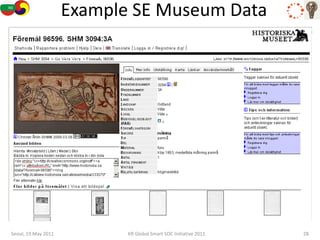
Example SE Museum Data


Seoul, 19 May 2011          KR Global Smart SOC Initiative 2011   28
CULTURA
• CULTivating Understanding and Research through Adaptivity (CULTURA),
  www.cultura-strep.eu
– BG partners: Sofia University, ComMetric (BG branch of US company)
• Development of adaptive systems, new forms of multi-dimensional adaptivity:
      – personalized information retrieval and presentation: user and contextual intent
        models
      – community-aware adaptivity: responds to community activity, interest,
        contribution and experience
      – content-aware adaptivity: responds to entities and relationships automatically
        identified within the artifacts and across collections
      – personalized dynamic storylines: generated across individual artifacts and entire
        collections
• Advances and integrates:
      – Natural language processing: normalizes ambiguities in noisy historical texts
      – Entity and relationship extraction: highlights the key individuals, events, dates and
        other entities and relationships within unstructured text
      – Social network analysis of entities and relationships within the content, and also of
        the individuals and broader community of users engaging with the content
      – Multi-model adaptivity to support dynamic reconciliation of multiple dimensions of
        personalization


Seoul, 19 May 2011                   KR Global Smart SOC Initiative 2011                    29
IMPACT
• Improving Access to Text (IMPACT), www.impact-project.eu
• Goal: improve access to historical texts
• Innovate OCR technology
      – explore challenges using different approaches, rather than just one sided
        approaches
      – develop cutting edge approaches such as collaborative correction
• Innovative language technologies to remove the historical language
  barrier
• Create center for access to digitized materials of all participating
  institutions
• Remove constraints to mass digitization by providing Best Practice
  guidance
• In 2010 the project was extended to include more countries and
  languages, totaling 25 beneficiaries all over Europe.
• BG participants: Bulgarian Academy of Sciences (ICT Institute), National
  Library
      – Digitize 2000 pages and create a dictionary of 10k old BG words

Seoul, 19 May 2011               KR Global Smart SOC Initiative 2011                30
Linked Heritage
•    Coordination of Standards and Technologies for the enrichment of Europeana,
     www.linkedheritage.org
•    Consortium includes key stakeholder groups from 20 EU countries, Israel and Russia
      –   Several partners participate in related Europeana ecosystem projects; guarantees alignment with
          Europeana’s evolution
      –   Organizations which have not in the past been involved will contribute for the first time to Europeana
•    BG participant: Bulgarian Academy of Sciences (Central Library)
•    Мain objectives:
      –   Contribute large quantities of new content to Europeana (from both public and private sectors).
          3 M new items will be delivered to Europeana, covering a wide spectrum of types of cultural content
      –   Demonstrate enhancement of quality of content, in terms of metadata richness, re-use potential and
          uniqueness
      –   Enable improved search, retrieval and use of Europeana content
•    Facilitate and deliver large-scale, long-term enhancement of Europeana and its services.
     Address problems associated with:
      –   Non-standard descriptive terminologies
      –   Preservation of complex metadata models within the Europeana metadata schema


Seoul, 19 May 2011                            KR Global Smart SOC Initiative 2011                                  31
BG PROJECTS


Seoul, 19 May 2011   KR Global Smart SOC Initiative 2011   32
SUDigital
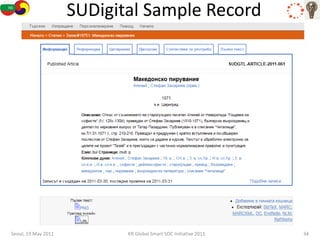
• Digital Library of Sofia University (sudigital.org)
• A common platform and presentation portal for digitization
  initiatives at SU (e.g. see next 3 such initiatives)
• Cross-disciplinary effort. Current participants:
      –   University Library,
      –   Faculty of History,
      –   Faculty of Theology,
      –   Faculty of Journalism,
      –   Faculty of Philology (Slavic, Western, Eastern, Ancient languages)
• Built using the CDS Invenio digital repository by CERN (CH),
  currently 1k items
• Extensible variety of document types
      – Currently extended to epigraphics (stone inscriptions).
      – A universal system for describing and indexing c.h. items that is
        unique for BG
      – Adheres to the spirit of Europeana and hopefully will soon
        contribute to Europeana
Seoul, 19 May 2011               KR Global Smart SOC Initiative 2011           33
SUDigital Sample Record


Seoul, 19 May 2011          KR Global Smart SOC Initiative 2011   34
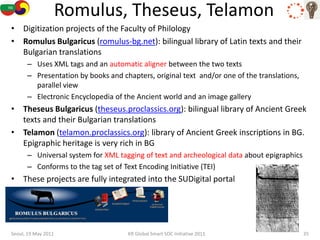
Romulus, Theseus, Telamon
• Digitization projects of the Faculty of Philology
• Romulus Bulgaricus (romulus-bg.net): bilingual library of Latin texts and their
  Bulgarian translations
      – Uses XML tags and an automatic aligner between the two texts
      – Presentation by books and chapters, original text and/or one of the translations,
        parallel view
      – Electronic Encyclopedia of the Ancient world and an image gallery
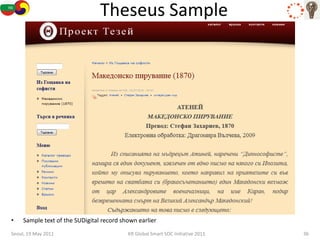
• Theseus Bulgaricus (theseus.proclassics.org): bilingual library of Ancient Greek
  texts and their Bulgarian translations
• Telamon (telamon.proclassics.org): library of Ancient Greek inscriptions in BG.
  Epigraphic heritage is very rich in BG
      – Universal system for XML tagging of text and archeological data about epigraphics
      – Conforms to the tag set of Text Encoding Initiative (TEI)
• These projects are fully integrated into the SUDigital portal


Seoul, 19 May 2011                  KR Global Smart SOC Initiative 2011                     35
Theseus Sample


•    Sample text of the SUDigital record shown earlier
Seoul, 19 May 2011                         KR Global Smart SOC Initiative 2011   36
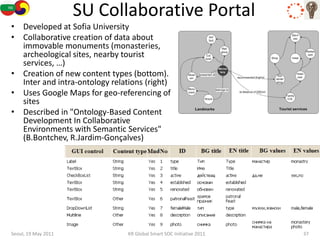
SU Collaborative Portal
• Developed at Sofia University
• Collaborative creation of data about
  immovable monuments (monasteries,
  archeological sites, nearby tourist
  services, …)
• Creation of new content types (bottom).
  Inter and intra-ontology relations (right)
• Uses Google Maps for geo-referencing of
  sites
• Described in "Ontology-Based Content
  Development In Collaborative
  Environments with Semantic Services"
  (B.Bontchev, R.Jardim-Gonçalves)


Seoul, 19 May 2011              KR Global Smart SOC Initiative 2011   37
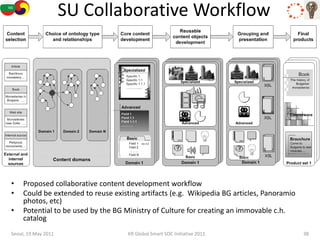
SU Collaborative Workflow


•    Proposed collaborative content development workflow
•    Could be extended to reuse existing artifacts (e.g. Wikipedia BG articles, Panoramio
     photos, etc)
•    Potential to be used by the BG Ministry of Culture for creating an immovable c.h.
     catalog
Seoul, 19 May 2011                   KR Global Smart SOC Initiative 2011                    38
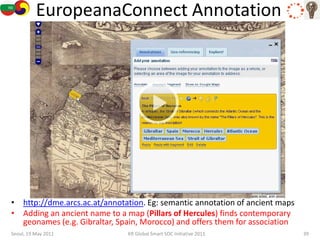
EuropeanaConnect Annotation


• http://dme.arcs.ac.at/annotation. Eg: semantic annotation of ancient maps
• Adding an ancient name to a map (Pillars of Hercules) finds contemporary
  geonames (e.g. Gibraltar, Spain, Morocco) and offers them for association
Seoul, 19 May 2011            KR Global Smart SOC Initiative 2011             39
ITCC-SPONSORED PROJECT


Seoul, 19 May 2011   KR Global Smart SOC Initiative 2011   40
Project Partners
• Sponsor: BG-KR ITCC (www.itcc-bg.com)
• BG Partners
      – Ontotext Corp
      – Sofia University
             • Faculty of Mathematics and Informatics
             • Faculty of History
             • Faculty of Classical and New Philology
• KR Potential Partners
      – Saltlux
      – Wonkwang University


Seoul, 19 May 2011             KR Global Smart SOC Initiative 2011   41
Project Goals
• Semweb publishing for SUDigital
      – Map SUDigital content models to EDM (ontology
        mapping)
      – (optional) Enrich SUDigital with more item relations
      – Convert SUDigital holdings to LOD
      – Put the RDF data to a semantic repository
      – Publish the RDF data to Europeana
      – Use content negotiation to serve human-readable
        content to browser agents
             • Similar to Europeana pilot (Amsterdam Musem) and MOLTO
               (Gothenburg City Museum)
      – Streamline a semweb publishing pipeline for c.h.
        institutions
      – (optional) Contribute semweb publishing to Invenio by
        CERN (inventor of the web)

Seoul, 19 May 2011              KR Global Smart SOC Initiative 2011     42
Project Goals (cont)
• Semweb publishing of data about immovable
  monuments
      – Map the Collaborative Portal data models to EDM
      – Enrich the Collaborative Portal with a semweb publishing
        pipeline
      – Publish data about immovable monuments to Europeana
• (optional) Extend and integrate
      – Integrate the Collaborative Portal to SUDigital to allow
        description of immovable monuments
      – Create in-depth Archeological ontology, in particular
        about Tombs and rich graves in Thracia and the
        Mediterranean area during Classical and Hellenistic ages

Seoul, 19 May 2011         KR Global Smart SOC Initiative 2011     43

Semantic Technologies for Cultural Heritage

  • 1.
    Semantic Technologies for Cultural Heritage Vladimir Alexiev, PhD, PMP vladimir.alexiev@ontotext.com Seoul, 19 May 2011 KR Global Smart SOC Initiative 2011 1
  • 2.
    Outline • Semantic Web – Linked Open Data – Ontotext Corp • Cultural Heritage – Applicability of Semantic Web – Data Standards – Europeana Data Model • Related Projects – EU Projects – EU Projects with BG Participation – BG Projects • ITCC Project Seoul, 19 May 2011 KR Global Smart SOC Initiative 2011 2
  • 3.
    SEMANTIC WEB, LOD,ONTOTEXT Seoul, 19 May 2011 KR Global Smart SOC Initiative 2011 3
  • 4.
    Semantic Web • Whatis the semantic web? – "Artificial Intelligence meets the web": Recasting of AI developments, but with realistic goals and at global web scale – Proposed around 1998 by T.Berners-Lee (same person who proposed the WWW) – Standardized by the WWW Consortium (W3C) – If Web 1.0 is a giant hyperlinked document, then Web 3.0 is a giant linked database • Emerged as the best Data Integration approach – Many professional fields have a data fusion problem – Semantic web becomes the "Rosetta Stone" linking various types of independent data sources, using a unified, globalized and abstracted representation (RDF, RDFS, OWL2, RIF) – Schema info (metadata) is represented the same way as data • Intro videos (from the TED series) – Tim Berners-Lee: The next Web of open, linked data – Tim Berners-Lee: The year open data went worldwide – Hans Rosling: No more boring data Seoul, 19 May 2011 KR Global Smart SOC Initiative 2011 4
  • 5.
    Linked Open Data • Grown exponentially since 2008. Currently 207 datasets, 28 billion facts • Provides useful background information (geographic, political, statistical) • Any new data can be linked to LOD to benefit from background/context knowledge Seoul, 19 May 2011 KR Global Smart SOC Initiative 2011 5
  • 6.
    Ontotext Corp • Whois Ontotext? – The leading semtech company in Eastern Europe and one of the leaders world-wide – 55 people: Bulgaria (Sofia, Varna), Austria, USA – Worked in this area since 2000 – Venture funding and commercial clients since 2008 – Bulgaria's most successful participant in EU FP5,6,7 research – www.ontotext.com • 360-degree semantic technology: – Semantic Repository (OWLIM), ETL – Text Mining, Semantic Annotation and Search (KIM, U.Sheffield GATE, Teamware, MIMIR) – Web Mining and Crawling – Ontology Engineering and Exploitation – Master Data and Linked Data Management Seoul, 19 May 2011 KR Global Smart SOC Initiative 2011 6
  • 7.
    Ontotext Clients (selected) •British Broadcasting Corporation (BBC) – Runs its World Cup 2010 sites on top of OWLIM – Next is BBC Sports (2011) and the 2012 Olympics • The National Archives (UK) – The UK Government’s official archive contracted Ontotext to implement semantic search for the Government Web Archive • AstraZeneca – Analysis and retrieval of clinical trial reports – Integration of biomedical databases for drug target identification • KT – Applications of OWLIM in Interactive TV and IPTV • All these clients need to: – integrate massive amounts of heterogeneous data – provide efficient search and navigation Seoul, 19 May 2011 KR Global Smart SOC Initiative 2011 7
  • 8.
    LOD: Reason-able Views •LOD doesn't offer performance guarantees; there are data quality problems • Ontotext hosts 2 public services that aggregate, clean-up, and correlate large parts of LOD, and provide uninterrupted service: – Red: www.factforge.net (9 sets, 2.1B statements, 10B retrievable statements) – Orange: www.linkedlifedata.com (25 sets, 4.1B statements): use in biotech research Seoul, 19 May 2011 KR Global Smart SOC Initiative 2011 8
  • 9.
    SemWeb Tipping Point •Richard McManus (founder of ReadWriteWeb): – “…the tipping point for the Semantic Web may be when one can … deliver –using Linked Data– a comprehensive list of locations of original Modigliani art works …” • Query http://factforge.net/sparql: uses data from 3 independent datasets (DBpedia, FreeBase, UMBEL) SELECT DISTINCT ?painting_l ?owner_l ?city_fb_con ?city_db_loc ?city_db_cit WHERE { ?p fb:visual_art.artwork.artist dbpedia:Amedeo_Modigliani ; fb:visual_art.artwork.owners [ fb:visual_art.artwork_owner_relationship.owner ?ow ] ; ff:preferredLabel ?painting_l. ?ow ff:preferredLabel ?owner_l . OPTIONAL { ?ow fb:location.location.containedby [ ff:preferredLabel ?city_fb_con ] } . OPTIONAL { ?ow dbp-prop:location ?loc. ?loc rdf:type umbel-sc:City ; ff:preferredLabel ?city_db_loc } OPTIONAL { ?ow dbp-ont:city [ ff:preferredLabel ?city_db_cit ] } } Seoul, 19 May 2011 KR Global Smart SOC Initiative 2011 9
  • 10.
    Modigliani Test: FactForgeResults • Reaching the tipping point of the semantic web • Interestingly, with an application to cultural heritage Seoul, 19 May 2011 KR Global Smart SOC Initiative 2011 10
  • 11.
    CULTURAL HERITAGE AND DATA STANDARDS Seoul, 19 May 2011 KR Global Smart SOC Initiative 2011 11
  • 12.
    Cultural Heritage • CulturalHeritage (C.H.) represents – artifacts: historical, archeological, written, art, etc – institutions: museums, galleries, archives, audiovisual collections, libraries, trusts, universities, research institutes, … – activities: preservation, scientific research, cataloging, dissemination, digitalization, … – fields: artistic, scientific, industrial, bibliographic, ethnographic, nature … – A large, heterogeneous, cross-disciplinary field • Social importance – The EU agenda includes multiculturalism and cultural preservation – Both BG and KR have rich history and heritage Seoul, 19 May 2011 KR Global Smart SOC Initiative 2011 12
  • 13.
    C.H. Data Standards •Dublin Core (DC) – Simple resource descriptions: author, date created, etc – ISO 15836 • Conceptual Reference Model (CRM) – By International Committee on Documentation (CIDOC) of the International Council of Museums (ICOM), an organization devoted to conserve and communicate to society the world's natural and cultural heritage – Core upper-level concepts common across c.h. documentation – ISO 21127 (2006) "Information and documentation — A reference ontology for the interchange of cultural heritage information" • Functional Requirements for Bibliographic Records (FRBR) – by International Federation of Library Associations and Institutions (IFLA) – Conceptual entity-relationship model • Europeana Data Model (EDM) – Structuring the data that Europeana is ingesting, managing and publishing – Refined until the end of 2010, will be implemented during 2011 – Open, cross-domain framework, adheres to semweb modeling principles – Intended to accommodate specific community standards such as LIDO, EAD, METS – Probably in the future will incorporate CRM Seoul, 19 May 2011 KR Global Smart SOC Initiative 2011 13
  • 14.
    EDM Classes • Reuses4 other ontologies (shown in white) • This is the true spirit of semweb Seoul, 19 May 2011 KR Global Smart SOC Initiative 2011 14
  • 15.
    EDM Properties Seoul, 19May 2011 KR Global Smart SOC Initiative 2011 15
  • 16.
    EDM Example: MonaLisa Seoul, 19 May 2011 KR Global Smart SOC Initiative 2011 16
  • 17.
    Why Semweb forC.H.? • Many C.H. institutions have a data integration problem, since data about the same artifacts is scattered in separate silos: – cataloging data – acquisition data – conservation data – scientific data, … • Cross-institution and cross-country research is stuttered – Which BG archeological sites exhibit the same style as MK sites? Who knows… • British Museum hosted a Cultural Heritage & SemWeb day (13.1.2011) – Examined use of the emerging web of data by c.h. and humanities organizations. See this interesting blog – Looked at practical applications of semweb technology relevant to the sector – Out of 8 presenters: • John Sheridan (Ontotext client): Government and National Archive initiatives (the 2nd most used web archive in the world is being converted to a Semantic Knowledge Base with 50M documents) • Atanas Kiryakov (Ontotext CEO ): FactForge – the Fast Track to the Centre of the Data Web Seoul, 19 May 2011 KR Global Smart SOC Initiative 2011 17
  • 18.
    PROJECTS RELATED TO CULTURAL HERITAGE & SEMTECH Seoul, 19 May 2011 KR Global Smart SOC Initiative 2011 18
  • 19.
    Related Projects • Numerousrelated projects are sponsored by the EU, in line with its multiculturalism agenda – Europeana – EU FP7 and DigiCult projects • Some EU projects with BG participation – MOLTO – CULTURA – IMPACT – Linked Heritage • BG Projects – SUdigital – Romulus, Theseus, Thelamon – Collaborative Portal Seoul, 19 May 2011 KR Global Smart SOC Initiative 2011 19
  • 20.
    Europeana • http://europeana.eu • Pan-EuropeanDigital Museum • People can explore the digital resources of Europe's museums, libraries, archives, audio- visual collections • And be inspired by the rich diversity of Europe's cultural and scientific heritage • Promotes discovery and networking opportunities in a multilingual space • Around 1500 institutions contributed – Includes over 15 M items – Still none from BG, but that will change soon Seoul, 19 May 2011 KR Global Smart SOC Initiative 2011 20
  • 21.
    Europeana and semweb • Europeana adopts semtech for all future development – EDM is based on semweb, which makes it easily extensible – Current holdings will be converted to semweb format • Europeana's first White Paper Knowledge = Information in Context looks at the key role LOD will play in Europeana's development – "Linked data gives machines the ability to make associations and put search terms into context. Without linked data, Europeana could be seen as a simple collection of digital objects. With linked data, the potential is far greater" • LOD Experiment in Europeana Thought Lab: – Data and metadata from the Amsterdam Museum (AM) • 70k cultural heritage objects related to the city – Retrieved from an XML API of the museum's collection (database by AdLib UK) – Converted to LOD compliant with EDM by Vrije Universiteit (VU): 5M facts • Conversion software is available as open source – Linked to existing datasets • Dutch Art and Architecture Thesaurus (AATNed) • Getty's Union List of Artists Names (ULAN) • DBpedia (data version of Wikipedia) • GeoNames (structured geographical data) – Published to the Comprehensive Knowledge Archives Network (CKAN) – Prime example the type of LOD that Europeana will be producing Seoul, 19 May 2011 KR Global Smart SOC Initiative 2011 21
  • 22.
    Amsterdam Museum object • http://semanticweb.cs.vu.nl/europeana/browse/list_resource?r=http://purl.org/collections/nl/am/proxy-23182 Seoul, 19 May 2011 KR Global Smart SOC Initiative 2011 22
  • 23.
    Museum Object Relations • Click on any node to see its object and relations, e.g. – The plate was made by "Heytze, J.C." – It is related to another plate (see on right), etc • This is the essence of LOD! Seoul, 19 May 2011 KR Global Smart SOC Initiative 2011 23
  • 24.
    EU FP7 andDigiCult • DigiCult and TeLearn – DigiCult (Cultural Heritage): leading-edge ICT for accessing, experiencing and preserving cultural and scientific resources – TeLearn (Technology Enhanced Learning): how ICT can make learning more efficient • FP6 Projects – 25 research projects were executed to mid 2010 • FP7 projects and calls: – 11 projects from the first two calls, started between Nov 2007 and Feb 2009 – 15 projects from the latest call, started between Dec 2010 and Apr 2011 – ICT SME DCL: open till Apr 2011, Digital Content and Languages, targets SMEs • Ontotext submitted a proposal with VU Amsterdam and AdLib (UK) similar to the Europeana pilot – ICT call 9: open Jan-Jul 2012, targets Digitization • Budget (specifically for DigiCult and TeLearn, other calls are also be applicable) – WP 2007-2008: 102 MEUR DigiCult and TeLearn (Calls 1 and 3) – WP 2009-2010: 69 MEUR for "Digital Libraries and Digital Preservation" – WP 2011-2012: 110 MEUR (Call 9, Challenges 4 and 8) for "Digital Preservation" and "ICT for access to cultural resources" Seoul, 19 May 2011 KR Global Smart SOC Initiative 2011 24
  • 25.
    DigiCult Semtech Projects •Digital cultural experiences: exploration of leading edge technologies (e.g. knowledge management systems, semantic tools, graphics, interfaces, novel displays) – Empower applications that improve the meaningful use of cultural resources and the experiences users get from visits of museums and sites  3D-COFORM, ARtSENSE, AXES, CHESS, CINeSPACE, CULTURA, DECIPHER, EPOCH, ISAAC, iTACITUS, MOSAICA, PATHS, P2P-FUSION, QVIZ, V-City, … • Information retrieval and use: application areas such as digital libraries and archives, exploring methods and tools for (semi)automatic indexing, semantic annotation of non-textual objects (music, speech, images). – Aim at enhancing information and knowledge retrieval through efficient search engines able to deliver results from complex multimedia resources, from distributed collections, across languages.  CONTRAPUNCTUS, EASAIER, ethnoArc, IMAGINATION, MEMORIES, MultiMATCH, PAPYRUS, QVIZ, Treble-CLEF, … Seoul, 19 May 2011 KR Global Smart SOC Initiative 2011 25
  • 26.
    EU PROJECTS WITH BG PARTICIPATION Seoul, 19 May 2011 KR Global Smart SOC Initiative 2011 26
  • 27.
    MOLTO • Multilingual OnlineTranslation (MOLTO), www.molto-project.eu – develops knowledge infrastructure, provides interoperability between natural language and structured queries • BG partner: Ontotext • Objectives: – tool for creating domain-specific translation systems; – set of tools for translators and the general public to translate documents; – three extensive case studies: mathematical exercises, biomedical patents, museum objects • Ontotext is in charge the Representation Infrastructure, including interoperability between NL P and SPARQL and case study 3 – Goal: provide access to museum information, allow querying for museum items, discover information related to them from other sources – Data comes from Gothenburg City Museum – Uses LOD and Reason-able views to publish museum data – Integrates standard museum-specific ontologies (CRM) with upper-level ontologies, to permit linking museum data to existing LOD (e.g. from DBpedia) – Integrates c.h.-specific systems such as the Swedish K-search system Seoul, 19 May 2011 KR Global Smart SOC Initiative 2011 27
  • 28.
    Example SE MuseumData Seoul, 19 May 2011 KR Global Smart SOC Initiative 2011 28
  • 29.
    CULTURA • CULTivating Understandingand Research through Adaptivity (CULTURA), www.cultura-strep.eu – BG partners: Sofia University, ComMetric (BG branch of US company) • Development of adaptive systems, new forms of multi-dimensional adaptivity: – personalized information retrieval and presentation: user and contextual intent models – community-aware adaptivity: responds to community activity, interest, contribution and experience – content-aware adaptivity: responds to entities and relationships automatically identified within the artifacts and across collections – personalized dynamic storylines: generated across individual artifacts and entire collections • Advances and integrates: – Natural language processing: normalizes ambiguities in noisy historical texts – Entity and relationship extraction: highlights the key individuals, events, dates and other entities and relationships within unstructured text – Social network analysis of entities and relationships within the content, and also of the individuals and broader community of users engaging with the content – Multi-model adaptivity to support dynamic reconciliation of multiple dimensions of personalization Seoul, 19 May 2011 KR Global Smart SOC Initiative 2011 29
  • 30.
    IMPACT • Improving Accessto Text (IMPACT), www.impact-project.eu • Goal: improve access to historical texts • Innovate OCR technology – explore challenges using different approaches, rather than just one sided approaches – develop cutting edge approaches such as collaborative correction • Innovative language technologies to remove the historical language barrier • Create center for access to digitized materials of all participating institutions • Remove constraints to mass digitization by providing Best Practice guidance • In 2010 the project was extended to include more countries and languages, totaling 25 beneficiaries all over Europe. • BG participants: Bulgarian Academy of Sciences (ICT Institute), National Library – Digitize 2000 pages and create a dictionary of 10k old BG words Seoul, 19 May 2011 KR Global Smart SOC Initiative 2011 30
  • 31.
    Linked Heritage • Coordination of Standards and Technologies for the enrichment of Europeana, www.linkedheritage.org • Consortium includes key stakeholder groups from 20 EU countries, Israel and Russia – Several partners participate in related Europeana ecosystem projects; guarantees alignment with Europeana’s evolution – Organizations which have not in the past been involved will contribute for the first time to Europeana • BG participant: Bulgarian Academy of Sciences (Central Library) • Мain objectives: – Contribute large quantities of new content to Europeana (from both public and private sectors). 3 M new items will be delivered to Europeana, covering a wide spectrum of types of cultural content – Demonstrate enhancement of quality of content, in terms of metadata richness, re-use potential and uniqueness – Enable improved search, retrieval and use of Europeana content • Facilitate and deliver large-scale, long-term enhancement of Europeana and its services. Address problems associated with: – Non-standard descriptive terminologies – Preservation of complex metadata models within the Europeana metadata schema Seoul, 19 May 2011 KR Global Smart SOC Initiative 2011 31
  • 32.
    BG PROJECTS Seoul, 19May 2011 KR Global Smart SOC Initiative 2011 32
  • 33.
    SUDigital • Digital Libraryof Sofia University (sudigital.org) • A common platform and presentation portal for digitization initiatives at SU (e.g. see next 3 such initiatives) • Cross-disciplinary effort. Current participants: – University Library, – Faculty of History, – Faculty of Theology, – Faculty of Journalism, – Faculty of Philology (Slavic, Western, Eastern, Ancient languages) • Built using the CDS Invenio digital repository by CERN (CH), currently 1k items • Extensible variety of document types – Currently extended to epigraphics (stone inscriptions). – A universal system for describing and indexing c.h. items that is unique for BG – Adheres to the spirit of Europeana and hopefully will soon contribute to Europeana Seoul, 19 May 2011 KR Global Smart SOC Initiative 2011 33
  • 34.
    SUDigital Sample Record Seoul,19 May 2011 KR Global Smart SOC Initiative 2011 34
  • 35.
    Romulus, Theseus, Telamon •Digitization projects of the Faculty of Philology • Romulus Bulgaricus (romulus-bg.net): bilingual library of Latin texts and their Bulgarian translations – Uses XML tags and an automatic aligner between the two texts – Presentation by books and chapters, original text and/or one of the translations, parallel view – Electronic Encyclopedia of the Ancient world and an image gallery • Theseus Bulgaricus (theseus.proclassics.org): bilingual library of Ancient Greek texts and their Bulgarian translations • Telamon (telamon.proclassics.org): library of Ancient Greek inscriptions in BG. Epigraphic heritage is very rich in BG – Universal system for XML tagging of text and archeological data about epigraphics – Conforms to the tag set of Text Encoding Initiative (TEI) • These projects are fully integrated into the SUDigital portal Seoul, 19 May 2011 KR Global Smart SOC Initiative 2011 35
  • 36.
    Theseus Sample • Sample text of the SUDigital record shown earlier Seoul, 19 May 2011 KR Global Smart SOC Initiative 2011 36
  • 37.
    SU Collaborative Portal •Developed at Sofia University • Collaborative creation of data about immovable monuments (monasteries, archeological sites, nearby tourist services, …) • Creation of new content types (bottom). Inter and intra-ontology relations (right) • Uses Google Maps for geo-referencing of sites • Described in "Ontology-Based Content Development In Collaborative Environments with Semantic Services" (B.Bontchev, R.Jardim-Gonçalves) Seoul, 19 May 2011 KR Global Smart SOC Initiative 2011 37
  • 38.
    SU Collaborative Workflow • Proposed collaborative content development workflow • Could be extended to reuse existing artifacts (e.g. Wikipedia BG articles, Panoramio photos, etc) • Potential to be used by the BG Ministry of Culture for creating an immovable c.h. catalog Seoul, 19 May 2011 KR Global Smart SOC Initiative 2011 38
  • 39.
    EuropeanaConnect Annotation • http://dme.arcs.ac.at/annotation.Eg: semantic annotation of ancient maps • Adding an ancient name to a map (Pillars of Hercules) finds contemporary geonames (e.g. Gibraltar, Spain, Morocco) and offers them for association Seoul, 19 May 2011 KR Global Smart SOC Initiative 2011 39
  • 40.
    ITCC-SPONSORED PROJECT Seoul, 19May 2011 KR Global Smart SOC Initiative 2011 40
  • 41.
    Project Partners • Sponsor:BG-KR ITCC (www.itcc-bg.com) • BG Partners – Ontotext Corp – Sofia University • Faculty of Mathematics and Informatics • Faculty of History • Faculty of Classical and New Philology • KR Potential Partners – Saltlux – Wonkwang University Seoul, 19 May 2011 KR Global Smart SOC Initiative 2011 41
  • 42.
    Project Goals • Semwebpublishing for SUDigital – Map SUDigital content models to EDM (ontology mapping) – (optional) Enrich SUDigital with more item relations – Convert SUDigital holdings to LOD – Put the RDF data to a semantic repository – Publish the RDF data to Europeana – Use content negotiation to serve human-readable content to browser agents • Similar to Europeana pilot (Amsterdam Musem) and MOLTO (Gothenburg City Museum) – Streamline a semweb publishing pipeline for c.h. institutions – (optional) Contribute semweb publishing to Invenio by CERN (inventor of the web) Seoul, 19 May 2011 KR Global Smart SOC Initiative 2011 42
  • 43.
    Project Goals (cont) •Semweb publishing of data about immovable monuments – Map the Collaborative Portal data models to EDM – Enrich the Collaborative Portal with a semweb publishing pipeline – Publish data about immovable monuments to Europeana • (optional) Extend and integrate – Integrate the Collaborative Portal to SUDigital to allow description of immovable monuments – Create in-depth Archeological ontology, in particular about Tombs and rich graves in Thracia and the Mediterranean area during Classical and Hellenistic ages Seoul, 19 May 2011 KR Global Smart SOC Initiative 2011 43