Melanesian Morphosyntax The complexity of Melanesian possession
Proper nouns and pronouns  -vi Common nouns   -va What about the rai  i/rai  a examples e aa rai  a o Jone ‘Jone saw it.’ It appears that 3 rd  singular objects need not be represented in the sentence BUT they pattern with common nouns. The shape of these suffix,  like Maaori passive – -   a/  i -ka/ki, -ta/ti –va/vi –na/ni = Ca/Ci  analyse these as 2 morphemes  C= transitive suffix - marks verb as having Object -i/-a tells you what kind of object.
Possession Possession is the grammatical construction of ownership. English has possessive pronouns  my her his our  etc For nouns, 2 strategies  -’s and –s’ attaches to the POSS’R which must appear before the POSS’D noun John’s car, the cat’s tail  [most likely used with animate possessors] Possessive Preposition ‘of’ The top of the stairs The Islands of Tahiti
Possession in Melanesia (and Micronesia!) Semantics play an important role in possession in Oc. Mel BUT SEMANTICS OF THE POSSD not the possessor. The semantic division is usually referred to as the  ALIENABLE versus INALIENABLE distinction INALIENABLE POSSESSION for POSS’D elements that cannot be given away Kinship terms, body parts Inalienable possession is classified as SIMPLEX or DIRECT because there are only two elements involved in the construction
Inalienable construction Only the POSS’D and POSS’R involved POSS’D appears as a noun POSS’R appears as a suffix attached to the noun. Father hand tem-eq  my father var-iq  my hand tem-em  your (sg) father var-im  your hand tem-en  his/her father var-na  his/her hand tem-dara father-1dl.incl var-dara hand-1dl.incl With nouns: temen a Lewi  varna a Lewi
Alienable Possession Alienable possession is often called COMPLEX or INDIRECT because there are THREE ELEMENTS to the construction. The POSS’D appears as a noun THe POSS’R appears as one of the same series of suffix that appears in the inalienable construction BUT it is not attached directly to the POSS”R noun it is attached to a POSSESSION CLASSIFIER nema tah-eq house poss-1sg  my house nelib  tah-en knife poss-3sg  her house nogod tah-dara  basket poss-1dl.incl  our (two)’s basket
Why classifier? Most languages have more than one morpheme that receives the POSS’R suffix The different classifiers tell us something about the POSS’D. nave nah-en water poss.edible-3sg his water  buaq nah-dara  taro  poss.ed-1dl.incl  our (2)’s taro ready for eating Aulua has only two possession classifiers general possession  tah-  and edible possession  nah- Other langs have many more up to 60, average 6-10
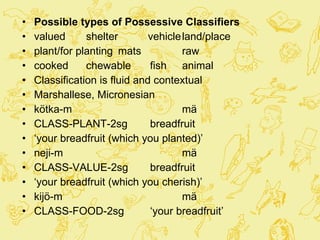
Possible types of Possessive Classifiers valued shelter  vehicle land/place plant/for planting mats raw cooked chewable fish animal Classification is fluid and contextual Marshallese, Micronesian kötka-m mä CLASS-PLANT-2sg breadfruit ‘ your breadfruit (which you planted)’ neji-m mä CLASS-VALUE-2sg breadfruit ‘ your breadfruit (which you cherish)’ kijö-m mä CLASS-FOOD-2sg ‘your breadfruit’
Possession strategies  POSSESSED NOUN Can I give it away? No attach POSS’R affix to N Yes What characteristic do I emphasize? Choose classifier attach POSS’R affix to Classifier Inalienable Alienable edible shelter vehicle

Melanesian Possession

  • 1.
    Melanesian Morphosyntax Thecomplexity of Melanesian possession
  • 2.
    Proper nouns andpronouns -vi Common nouns -va What about the rai  i/rai  a examples e aa rai  a o Jone ‘Jone saw it.’ It appears that 3 rd singular objects need not be represented in the sentence BUT they pattern with common nouns. The shape of these suffix, like Maaori passive – -  a/  i -ka/ki, -ta/ti –va/vi –na/ni = Ca/Ci analyse these as 2 morphemes C= transitive suffix - marks verb as having Object -i/-a tells you what kind of object.
  • 3.
    Possession Possession isthe grammatical construction of ownership. English has possessive pronouns my her his our etc For nouns, 2 strategies -’s and –s’ attaches to the POSS’R which must appear before the POSS’D noun John’s car, the cat’s tail [most likely used with animate possessors] Possessive Preposition ‘of’ The top of the stairs The Islands of Tahiti
  • 4.
    Possession in Melanesia(and Micronesia!) Semantics play an important role in possession in Oc. Mel BUT SEMANTICS OF THE POSSD not the possessor. The semantic division is usually referred to as the ALIENABLE versus INALIENABLE distinction INALIENABLE POSSESSION for POSS’D elements that cannot be given away Kinship terms, body parts Inalienable possession is classified as SIMPLEX or DIRECT because there are only two elements involved in the construction
  • 5.
    Inalienable construction Onlythe POSS’D and POSS’R involved POSS’D appears as a noun POSS’R appears as a suffix attached to the noun. Father hand tem-eq my father var-iq my hand tem-em your (sg) father var-im your hand tem-en his/her father var-na his/her hand tem-dara father-1dl.incl var-dara hand-1dl.incl With nouns: temen a Lewi varna a Lewi
  • 6.
    Alienable Possession Alienablepossession is often called COMPLEX or INDIRECT because there are THREE ELEMENTS to the construction. The POSS’D appears as a noun THe POSS’R appears as one of the same series of suffix that appears in the inalienable construction BUT it is not attached directly to the POSS”R noun it is attached to a POSSESSION CLASSIFIER nema tah-eq house poss-1sg my house nelib tah-en knife poss-3sg her house nogod tah-dara basket poss-1dl.incl our (two)’s basket
  • 7.
    Why classifier? Mostlanguages have more than one morpheme that receives the POSS’R suffix The different classifiers tell us something about the POSS’D. nave nah-en water poss.edible-3sg his water buaq nah-dara taro poss.ed-1dl.incl our (2)’s taro ready for eating Aulua has only two possession classifiers general possession tah- and edible possession nah- Other langs have many more up to 60, average 6-10
  • 8.
    Possible types ofPossessive Classifiers valued shelter vehicle land/place plant/for planting mats raw cooked chewable fish animal Classification is fluid and contextual Marshallese, Micronesian kötka-m mä CLASS-PLANT-2sg breadfruit ‘ your breadfruit (which you planted)’ neji-m mä CLASS-VALUE-2sg breadfruit ‘ your breadfruit (which you cherish)’ kijö-m mä CLASS-FOOD-2sg ‘your breadfruit’
  • 9.
    Possession strategies POSSESSED NOUN Can I give it away? No attach POSS’R affix to N Yes What characteristic do I emphasize? Choose classifier attach POSS’R affix to Classifier Inalienable Alienable edible shelter vehicle