Uladzimir Kalashnikau
Performance challenges and
victories we got at open source
ecommerce
How EPAM was engaged by Magento
History:
Magento was looking to outsource some product development work to extend
internal team capacity. EPAM’s “Developer’s Developer” reputation, and our
experience in product development for other eCommerce platforms helped
Magento to recognize us as partners.
Benefits for Magento:
• Outsource part of functionality to extend internal team capacity
• Deliver more new features with Merchant Beta and GA releases
Benefits for EPAM:
• Improve our knowledge of Magento 2.0
• Align development approaches and best practices with Magento core team
Goals of project
• Improve import-export functionalities for products/customers
• Implement new functionality to import/export prices
• Change obsolete file format for import/export purposes
• Optimize import/export performance
• Improve error processing for import/export operations
• All functionality should be covered with the tests and correspond to Magento
coding standards
Acceptance criteria
Import procedure should be a linear process for Magento framework and number of
records in a single file should not exponentially increase process time until the
bottleneck is a MySQL server itself:
Run #1 100k 30 min
simple_products = 60000
configurable_products = 20000 (each configurable
has 3 simple products as options)
bundle_products = 10000 (each bundle product
has 3 simple products as options)
grouped_products = 10000 (each grouped product
has 3 simple products as options)
categories = 1000
categories_nesting_level = 3
Each product has 2 images attached using local
storage only.
Number of product attribute sets = 100
Number of attributes per product = 10
Total Number of attributes = 1000
Run #2 200k 1 hour
simple_products = 120000
configurable_products = 40000 (each configurable has
3 simple products as options)
bundle_products = 20000 (each bundle product has 3
simple products as options)
grouped_products = 20000 (each grouped product has
3 simple products as options)
categories = 1000
categories_nesting_level = 3
Each product has 2 images attached using local
storage only.
Number of product attribute sets (product templates) =
100
Number of attributes per product = 10
Total Number of attributes = 1000
Import process shouldn’t affect frontend load time more than 20% of average
page load, metered by JMeter
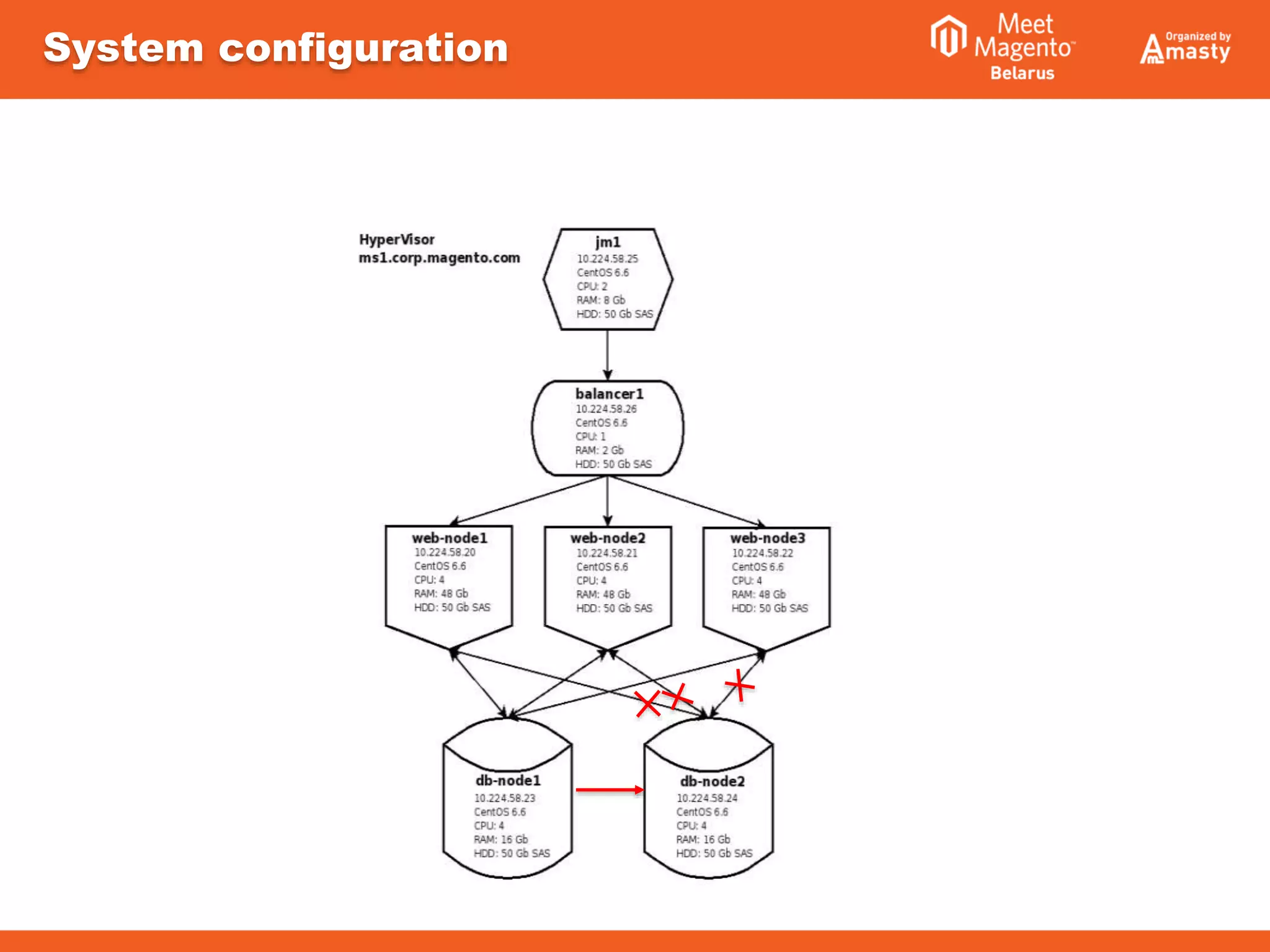
System configuration
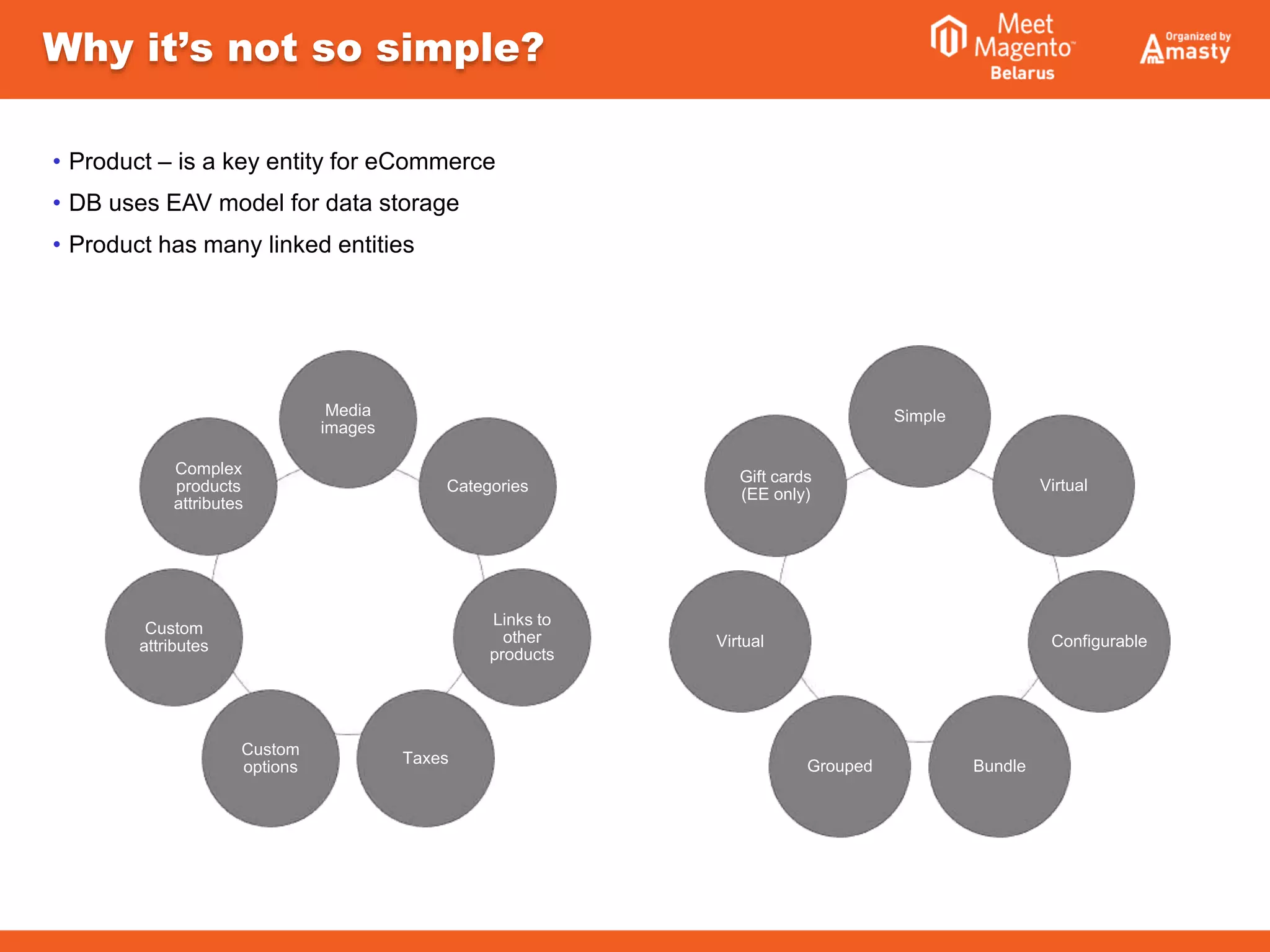
Why it’s not so simple?
Product
Media
images
Categories
Links to
other
products
Taxes
Custom
options
Custom
attributes
Complex
products
attributes
• Product – is a key entity for eCommerce
• DB uses EAV model for data storage
• Product has many linked entities
Product
types
Simple
Virtual
Configurable
BundleGrouped
Virtual
Gift cards
(EE only)
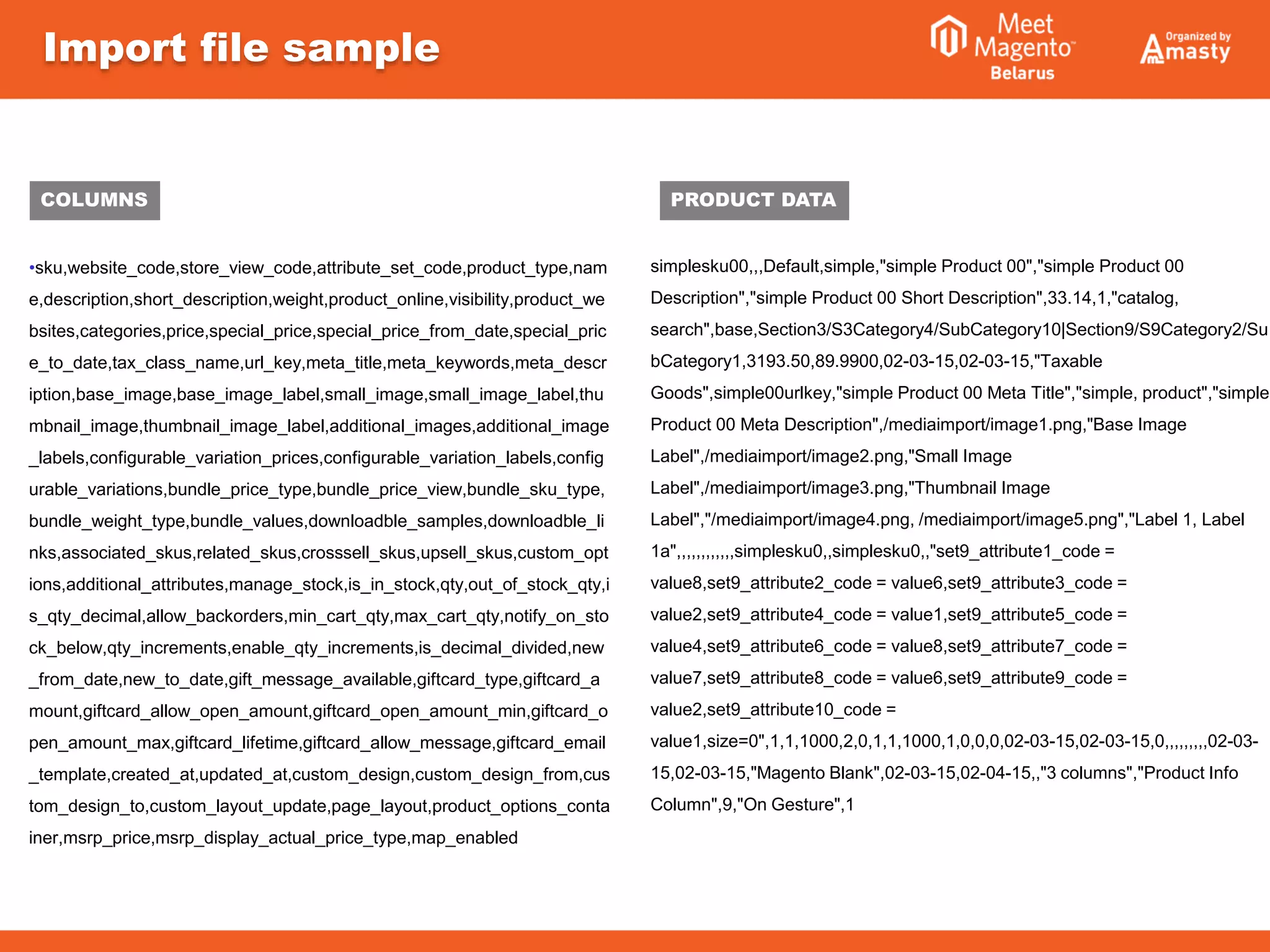
•sku,website_code,store_view_code,attribute_set_code,product_type,nam
e,description,short_description,weight,product_online,visibility,product_we
bsites,categories,price,special_price,special_price_from_date,special_pric
e_to_date,tax_class_name,url_key,meta_title,meta_keywords,meta_descr
iption,base_image,base_image_label,small_image,small_image_label,thu
mbnail_image,thumbnail_image_label,additional_images,additional_image
_labels,configurable_variation_prices,configurable_variation_labels,config
urable_variations,bundle_price_type,bundle_price_view,bundle_sku_type,
bundle_weight_type,bundle_values,downloadble_samples,downloadble_li
nks,associated_skus,related_skus,crosssell_skus,upsell_skus,custom_opt
ions,additional_attributes,manage_stock,is_in_stock,qty,out_of_stock_qty,i
s_qty_decimal,allow_backorders,min_cart_qty,max_cart_qty,notify_on_sto
ck_below,qty_increments,enable_qty_increments,is_decimal_divided,new
_from_date,new_to_date,gift_message_available,giftcard_type,giftcard_a
mount,giftcard_allow_open_amount,giftcard_open_amount_min,giftcard_o
pen_amount_max,giftcard_lifetime,giftcard_allow_message,giftcard_email
_template,created_at,updated_at,custom_design,custom_design_from,cus
tom_design_to,custom_layout_update,page_layout,product_options_conta
iner,msrp_price,msrp_display_actual_price_type,map_enabled
Import file sample
COLUMNS
simplesku00,,,Default,simple,"simple Product 00","simple Product 00
Description","simple Product 00 Short Description",33.14,1,"catalog,
search",base,Section3/S3Category4/SubCategory10|Section9/S9Category2/Su
bCategory1,3193.50,89.9900,02-03-15,02-03-15,"Taxable
Goods",simple00urlkey,"simple Product 00 Meta Title","simple, product","simple
Product 00 Meta Description",/mediaimport/image1.png,"Base Image
Label",/mediaimport/image2.png,"Small Image
Label",/mediaimport/image3.png,"Thumbnail Image
Label","/mediaimport/image4.png, /mediaimport/image5.png","Label 1, Label
1a",,,,,,,,,,,,simplesku0,,simplesku0,,"set9_attribute1_code =
value8,set9_attribute2_code = value6,set9_attribute3_code =
value2,set9_attribute4_code = value1,set9_attribute5_code =
value4,set9_attribute6_code = value8,set9_attribute7_code =
value7,set9_attribute8_code = value6,set9_attribute9_code =
value2,set9_attribute10_code =
value1,size=0",1,1,1000,2,0,1,1,1000,1,0,0,0,02-03-15,02-03-15,0,,,,,,,,,02-03-
15,02-03-15,"Magento Blank",02-03-15,02-04-15,,"3 columns","Product Info
Column",9,"On Gesture",1
PRODUCT DATA
One of the concepts for import
optimization
Append data to
model
Prepare data for
insert
Query to DB
Get imported data
Retrieve data ready
to insert
Create multi-insert
query
Standard saving process
Multi-insert process
How it’s actually working
Standard saving process
Multi-insert process
Append data to
model
Prepare data for
insert
Query to DB
Get imported data
Create multi-insert
query
Prepare data for
insert
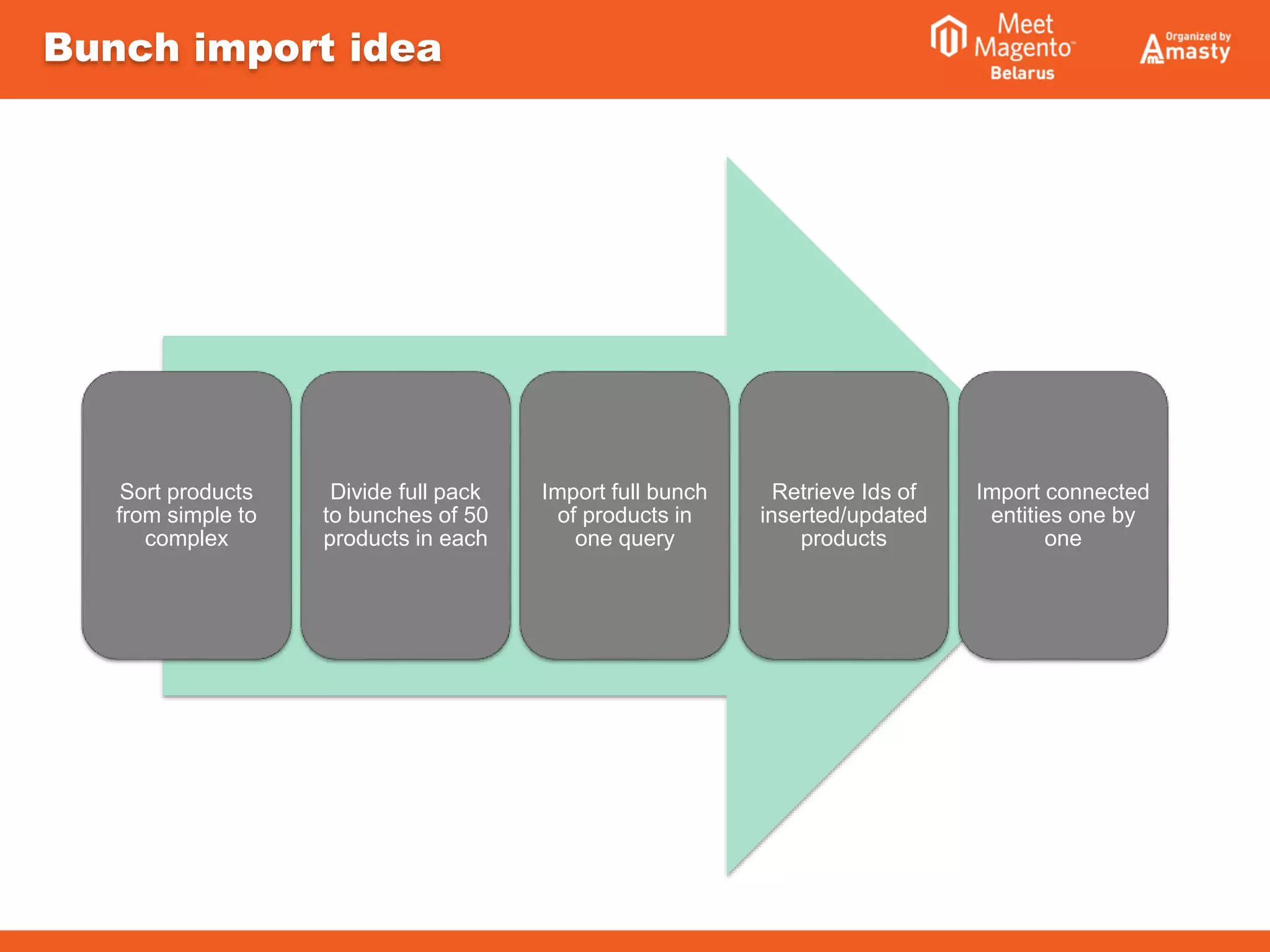
Sort products
from simple to
complex
Divide full pack
to bunches of 50
products in each
Import full bunch
of products in
one query
Retrieve Ids of
inserted/updated
products
Import connected
entities one by
one
Bunch import idea
• Importing of 500k products on cluster – nearly 4-5h
• Creating URL rewrites for them – nearly 12h
• Total time: 17h
• Need to be less that 2.5h
Before optimizations takes a place
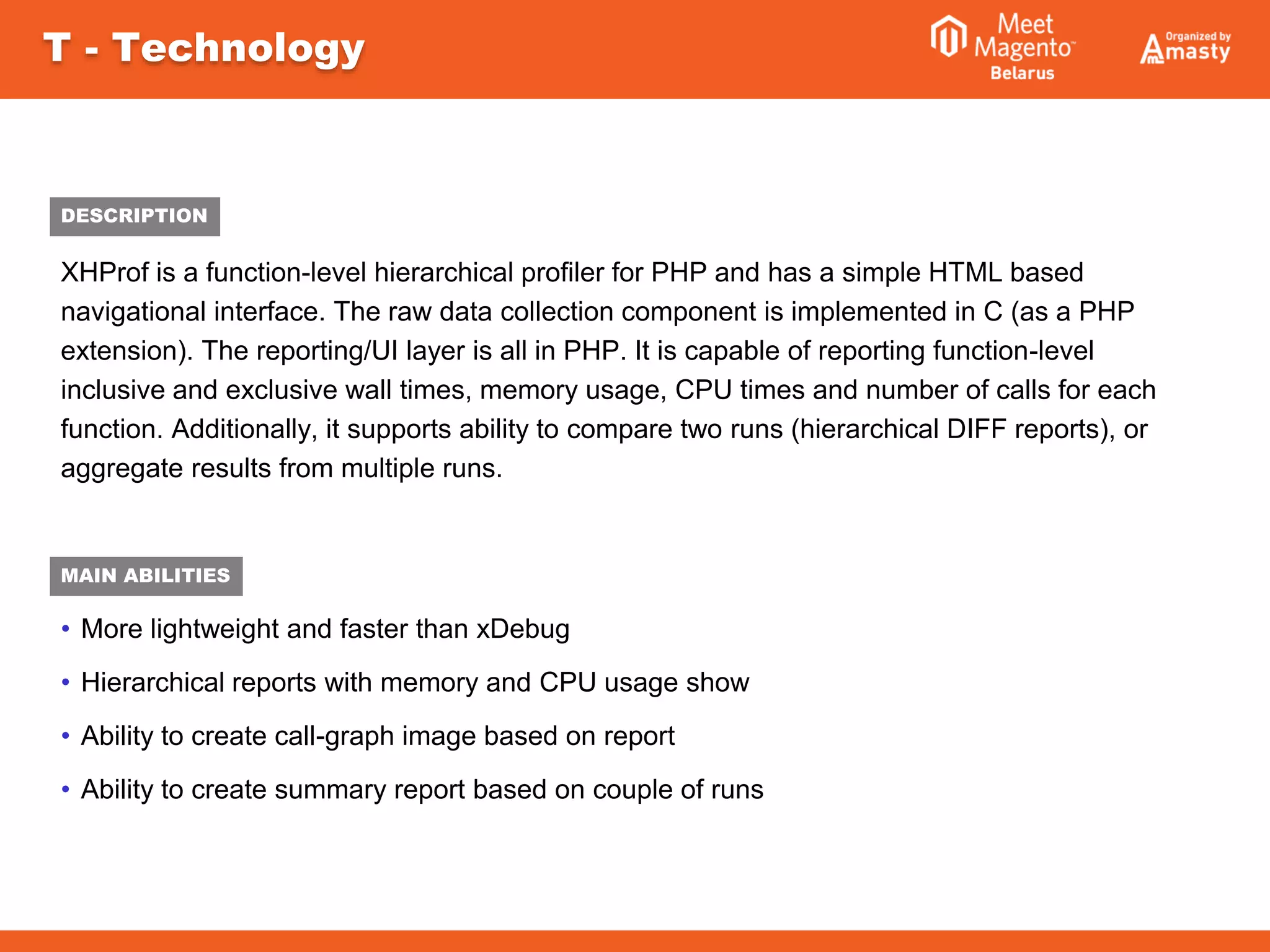
XHProf is a function-level hierarchical profiler for PHP and has a simple HTML based
navigational interface. The raw data collection component is implemented in C (as a PHP
extension). The reporting/UI layer is all in PHP. It is capable of reporting function-level
inclusive and exclusive wall times, memory usage, CPU times and number of calls for each
function. Additionally, it supports ability to compare two runs (hierarchical DIFF reports), or
aggregate results from multiple runs.
• More lightweight and faster than xDebug
• Hierarchical reports with memory and CPU usage show
• Ability to create call-graph image based on report
• Ability to create summary report based on couple of runs
T - Technology
MAIN ABILITIES
DESCRIPTION
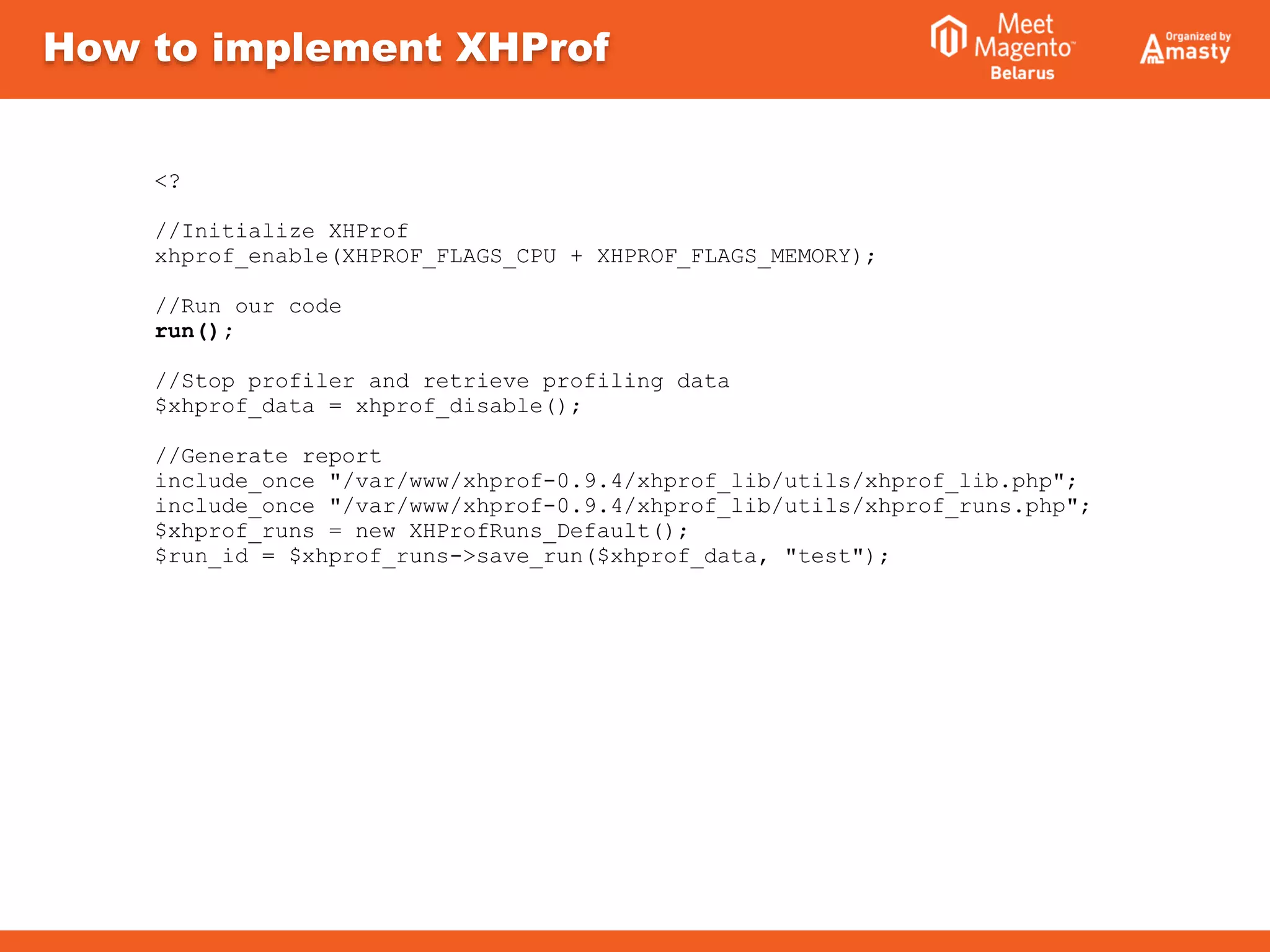
How to implement XHProf
<?
//Initialize XHProf
xhprof_enable(XHPROF_FLAGS_CPU + XHPROF_FLAGS_MEMORY);
//Run our code
run();
//Stop profiler and retrieve profiling data
$xhprof_data = xhprof_disable();
//Generate report
include_once "/var/www/xhprof-0.9.4/xhprof_lib/utils/xhprof_lib.php";
include_once "/var/www/xhprof-0.9.4/xhprof_lib/utils/xhprof_runs.php";
$xhprof_runs = new XHProfRuns_Default();
$run_id = $xhprof_runs->save_run($xhprof_data, "test");
How reports look like
Call-graph visualization
Very bad
Not so bad
Seems normal, but…
How it looks like in Magento
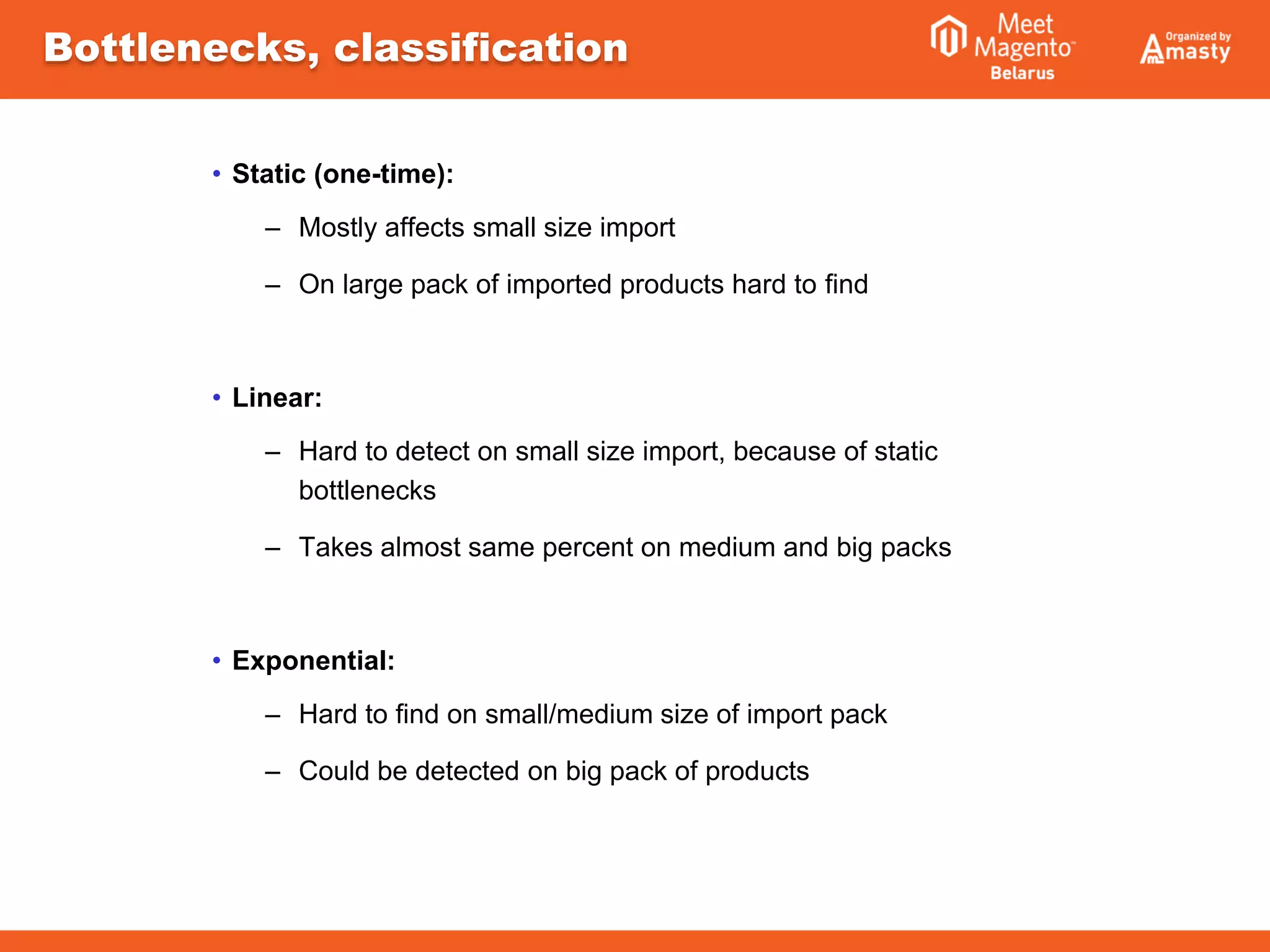
• Static (one-time):
– Mostly affects small size import
– On large pack of imported products hard to find
• Linear:
– Hard to detect on small size import, because of static
bottlenecks
– Takes almost same percent on medium and big packs
• Exponential:
– Hard to find on small/medium size of import pack
– Could be detected on big pack of products
Bottlenecks, classification
― Generate queue
― Create number of workers
― Pray that it won’t affect frontend loading time
Pros:
• We could use several processor cores to increase data
process speed
Cons:
• Troubles with disabled thread/system functions due to
security reasons
• Potential risks to frontend loading time tests
• Quite complex mechanism to implement
• Potential risks of rows/tables lock lags due to parallel read-
write to single DB
Approaches to optimization
Implement multi-processing
― Change attribute load process
― Change URL Rewrites save process
― Implement effective plugin cache
― Other small optimizations
Pros:
• We could deliver by iterations
• Less shit-code
Cons:
• We don’t know capability of such fixes to deliver
performance increase
• These changes could affect tests and core processes
Find and fix bottle-necks
• Time, quality - what should we prefer on really dirty code?
• Import/export functionality is a part of MTF (Magento testing framework) so changing it
brakes tests
• Results are affected by the size of import file
• Results varies on different DB data and we didn’t have etalon DB
• Long time to get report
• To detect exponential bottlenecks we should compare reports on different import files
• How to import related entities if we haven’t got an unique key?
• Memory usage vs. queries to DB
• How to compare elephant and fly if we don’t know real server configuration?
• XHProf lies, we cannot be sure in results and should use it only as a guideline
Difficulties in optimization
It’s a lie!
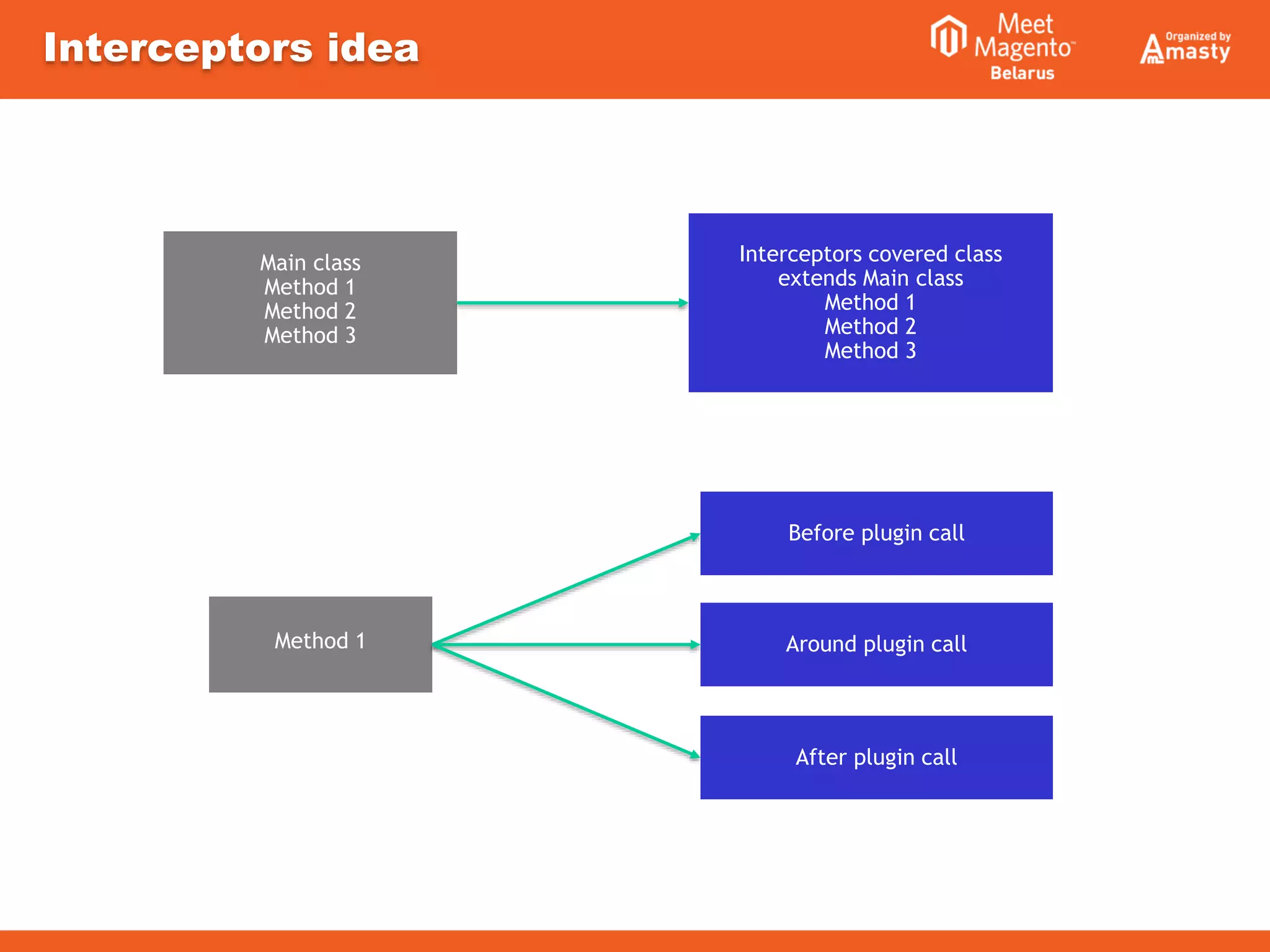
Interceptors idea
Main class
Method 1
Method 2
Method 3
Interceptors covered class
extends Main class
Method 1
Method 2
Method 3
Method 1
Before plugin call
Around plugin call
After plugin call
Interceptors benchmark results
Before optimizations takes
place
Plugin system performance
issue
Interceptors benchmark results
After plugin system
optimization
Instead of old
calls
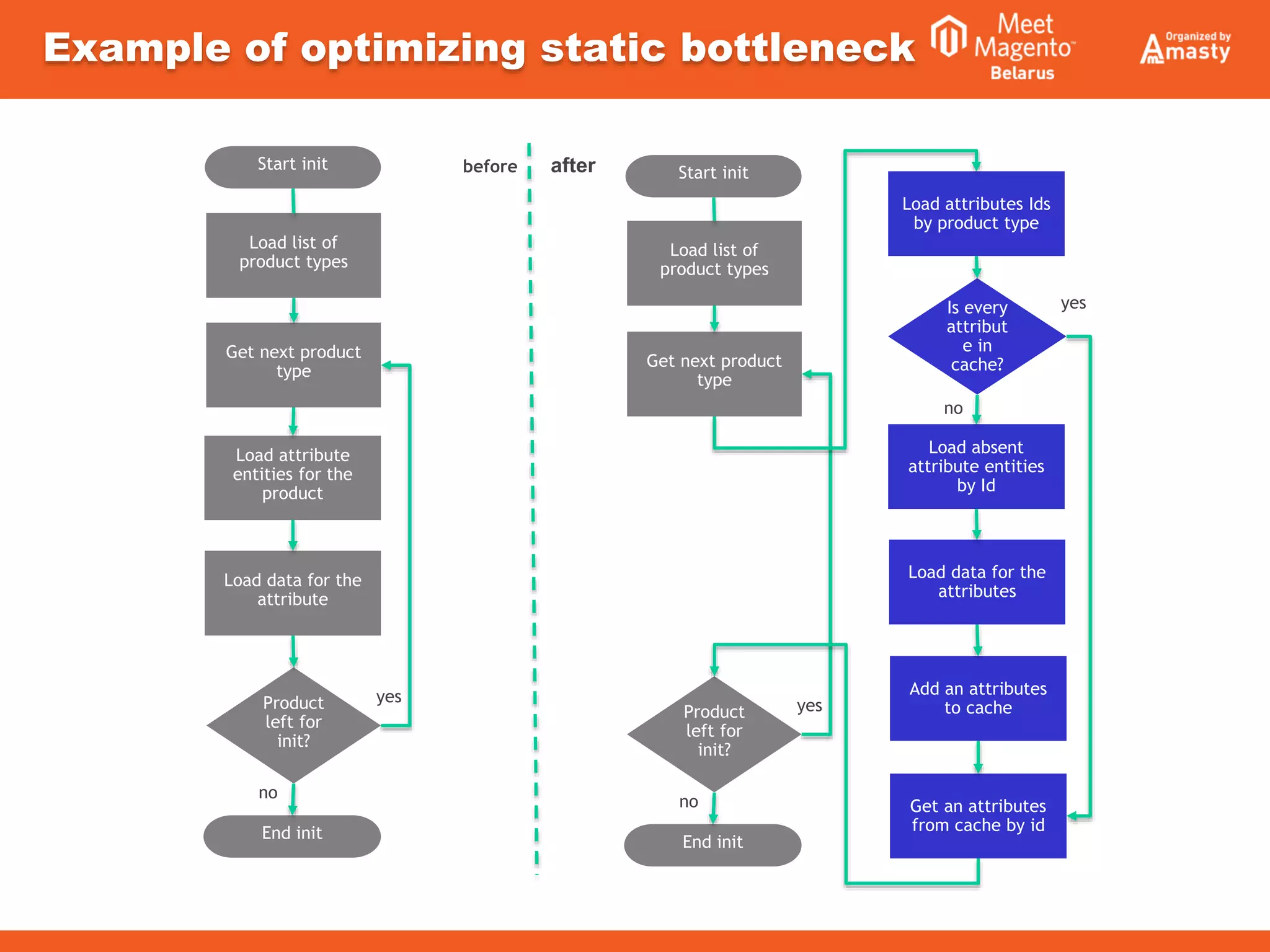
Example of optimizing static bottleneck
Load list of
product types
Product
left for
init?
Load attribute
entities for the
product
Load data for the
attribute
Start init
End init
Get next product
type
yes
no
Load list of
product types
Product
left for
init?
Load absent
attribute entities
by Id
Load data for the
attributes
Start init
End init
Get next product
type
yes
no
Load attributes Ids
by product type
Is every
attribut
e in
cache?
Add an attributes
to cache
Get an attributes
from cache by id
no
yes
before after
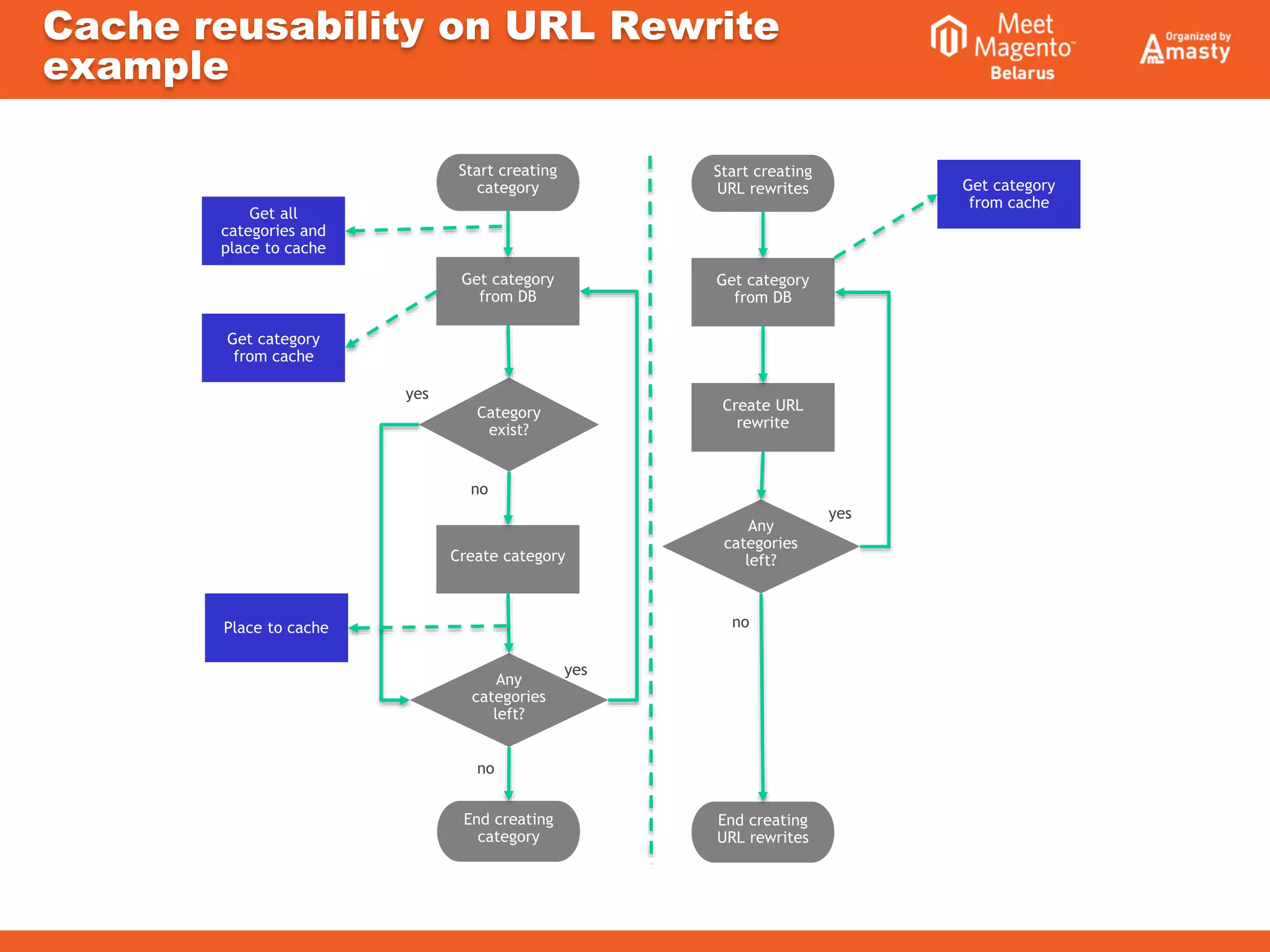
Cache reusability on URL Rewrite
example
Get category
from DB
Category
exist?
Create category
Start creating
category
Any
categories
left?
End creating
category
yes
yes
no
no
Start creating
URL rewrites
Get category
from DB
Create URL
rewrite
Any
categories
left?
yes
End creating
URL rewrites
no
Get category
from cache
Place to cache
Get category
from cache
Get all
categories and
place to cache
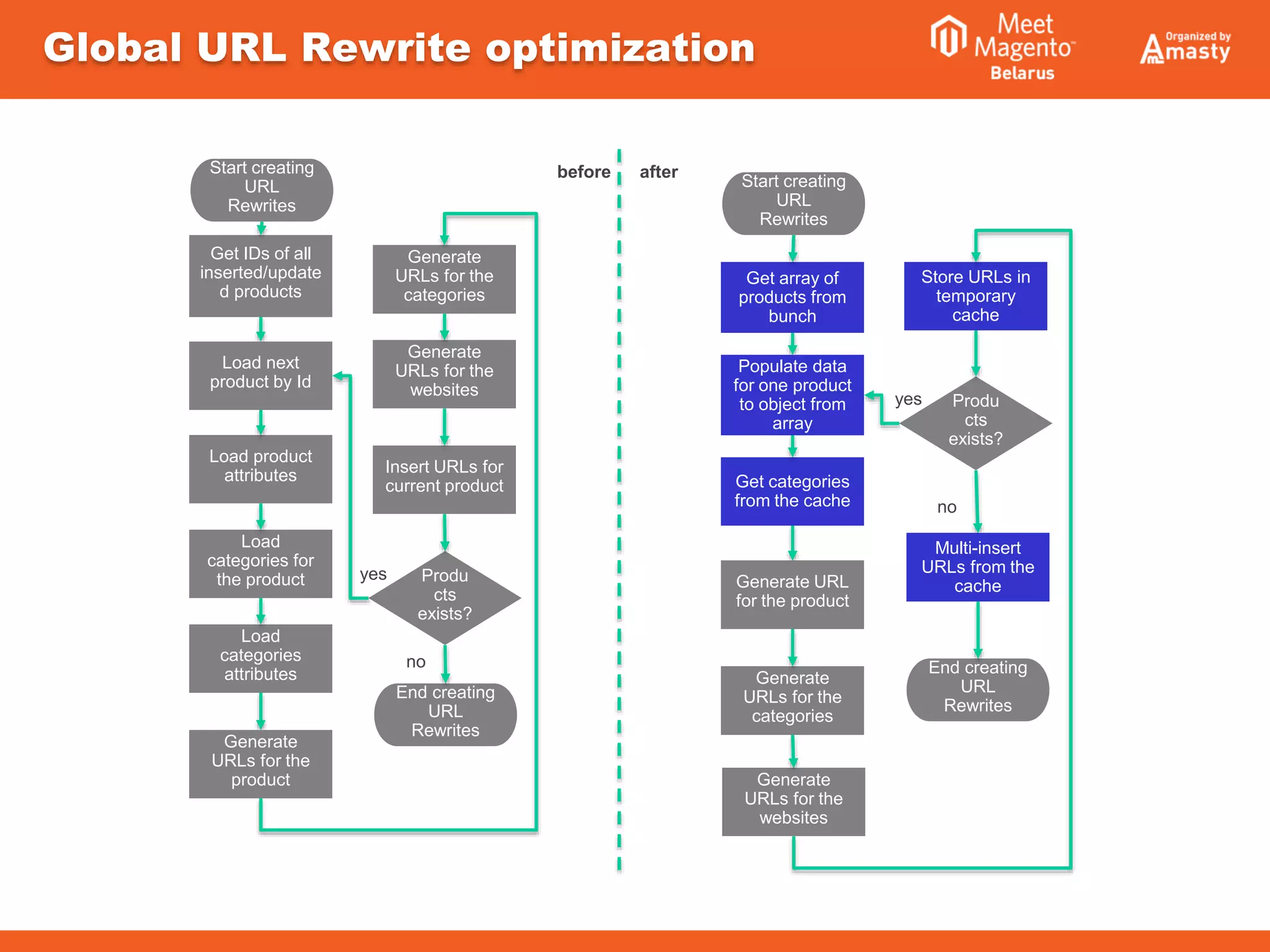
Global URL Rewrite optimization
Get IDs of all
inserted/update
d products
Produ
cts
exists?
Start creating
URL
Rewrites
Load
categories for
the product
Load product
attributes
Load
categories
attributes
Load next
product by Id
End creating
URL
Rewrites
Generate
URLs for the
product
Generate
URLs for the
categories
Generate
URLs for the
websites
Insert URLs for
current product
yes
no
Get array of
products from
bunch
Produ
cts
exists?
Start creating
URL
Rewrites
Get categories
from the cache
Populate data
for one product
to object from
array
End creating
URL
Rewrites
Generate URL
for the product
Generate
URLs for the
categories
Generate
URLs for the
websites
Store URLs in
temporary
cache
yes
no
Multi-insert
URLs from the
cache
before after
• CPU 4 physical cores 3.5GHz (2 for VM)
• L2 cache 1 Mb
• L3 cache 6 Mb
• RAM 16GB
• SATA3 HDD (64 Mb buffer)
How to compare performance?
First config
• CPU 2 physical cores with Hyper-Thread 3.2GHz (2 for VM)
• L2 cache 512 Kb
• L3 cache 4 Mb
• RAM 8GB
• SATA1 HDD (16 Mb buffer)
Total time: ~50mTotal time: ~16.5m
Second config
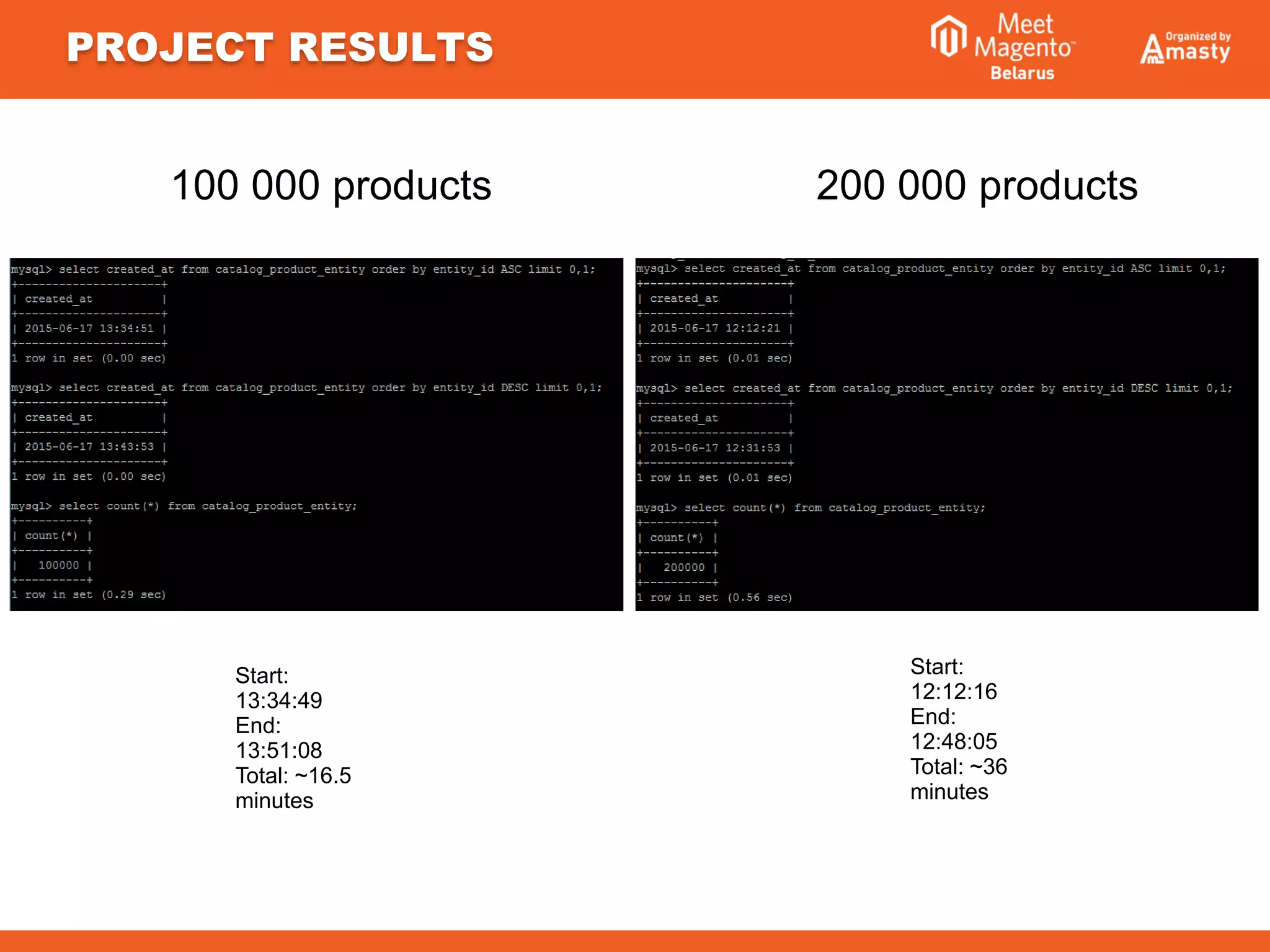
PROJECT RESULTS
200 000 products
Start:
12:12:16
End:
12:48:05
Total: ~36
minutes
Start:
13:34:49
End:
13:51:08
Total: ~16.5
minutes
100 000 products
Magento 2 Merchant Beta Release
We are tremendously excited to announce that today we reached another significant development
milestone with the release of the Magento 2 Merchant Beta. This release brings us to the last stage
before the general availability (GA) of Magento 2 in Q4 2015.
…
• The Enterprise Edition module includes updates to merchant features like import/export
functionality, configurable swatches, transactional emails and more.
• It demonstrates significant performance improvements for both the Magento Community
Edition and Enterprise Edition with holistic updates to both server-side and client-side architecture.
Server-side updates include out of box Varnish 4, full page caching, and support for HHVM3.6.
Client-side updates include static content caching in browser, image compression, use of jQuery,
and RequireJS for better management of JavaScript and bundling to reduce file download counts.
News link: http://magento.com/blog/technical/magento-2-merchant-beta-release
Our changes goes in release!

Meet Magento Belarus 2015: Uladzimir Kalashnikau

  • 1.
    Uladzimir Kalashnikau Performance challengesand victories we got at open source ecommerce
  • 2.
    How EPAM wasengaged by Magento History: Magento was looking to outsource some product development work to extend internal team capacity. EPAM’s “Developer’s Developer” reputation, and our experience in product development for other eCommerce platforms helped Magento to recognize us as partners. Benefits for Magento: • Outsource part of functionality to extend internal team capacity • Deliver more new features with Merchant Beta and GA releases Benefits for EPAM: • Improve our knowledge of Magento 2.0 • Align development approaches and best practices with Magento core team
  • 3.
    Goals of project •Improve import-export functionalities for products/customers • Implement new functionality to import/export prices • Change obsolete file format for import/export purposes • Optimize import/export performance • Improve error processing for import/export operations • All functionality should be covered with the tests and correspond to Magento coding standards
  • 4.
    Acceptance criteria Import procedureshould be a linear process for Magento framework and number of records in a single file should not exponentially increase process time until the bottleneck is a MySQL server itself: Run #1 100k 30 min simple_products = 60000 configurable_products = 20000 (each configurable has 3 simple products as options) bundle_products = 10000 (each bundle product has 3 simple products as options) grouped_products = 10000 (each grouped product has 3 simple products as options) categories = 1000 categories_nesting_level = 3 Each product has 2 images attached using local storage only. Number of product attribute sets = 100 Number of attributes per product = 10 Total Number of attributes = 1000 Run #2 200k 1 hour simple_products = 120000 configurable_products = 40000 (each configurable has 3 simple products as options) bundle_products = 20000 (each bundle product has 3 simple products as options) grouped_products = 20000 (each grouped product has 3 simple products as options) categories = 1000 categories_nesting_level = 3 Each product has 2 images attached using local storage only. Number of product attribute sets (product templates) = 100 Number of attributes per product = 10 Total Number of attributes = 1000 Import process shouldn’t affect frontend load time more than 20% of average page load, metered by JMeter
  • 5.
  • 6.
    Why it’s notso simple? Product Media images Categories Links to other products Taxes Custom options Custom attributes Complex products attributes • Product – is a key entity for eCommerce • DB uses EAV model for data storage • Product has many linked entities Product types Simple Virtual Configurable BundleGrouped Virtual Gift cards (EE only)
  • 7.
    •sku,website_code,store_view_code,attribute_set_code,product_type,nam e,description,short_description,weight,product_online,visibility,product_we bsites,categories,price,special_price,special_price_from_date,special_pric e_to_date,tax_class_name,url_key,meta_title,meta_keywords,meta_descr iption,base_image,base_image_label,small_image,small_image_label,thu mbnail_image,thumbnail_image_label,additional_images,additional_image _labels,configurable_variation_prices,configurable_variation_labels,config urable_variations,bundle_price_type,bundle_price_view,bundle_sku_type, bundle_weight_type,bundle_values,downloadble_samples,downloadble_li nks,associated_skus,related_skus,crosssell_skus,upsell_skus,custom_opt ions,additional_attributes,manage_stock,is_in_stock,qty,out_of_stock_qty,i s_qty_decimal,allow_backorders,min_cart_qty,max_cart_qty,notify_on_sto ck_below,qty_increments,enable_qty_increments,is_decimal_divided,new _from_date,new_to_date,gift_message_available,giftcard_type,giftcard_a mount,giftcard_allow_open_amount,giftcard_open_amount_min,giftcard_o pen_amount_max,giftcard_lifetime,giftcard_allow_message,giftcard_email _template,created_at,updated_at,custom_design,custom_design_from,cus tom_design_to,custom_layout_update,page_layout,product_options_conta iner,msrp_price,msrp_display_actual_price_type,map_enabled Import file sample COLUMNS simplesku00,,,Default,simple,"simpleProduct 00","simple Product 00 Description","simple Product 00 Short Description",33.14,1,"catalog, search",base,Section3/S3Category4/SubCategory10|Section9/S9Category2/Su bCategory1,3193.50,89.9900,02-03-15,02-03-15,"Taxable Goods",simple00urlkey,"simple Product 00 Meta Title","simple, product","simple Product 00 Meta Description",/mediaimport/image1.png,"Base Image Label",/mediaimport/image2.png,"Small Image Label",/mediaimport/image3.png,"Thumbnail Image Label","/mediaimport/image4.png, /mediaimport/image5.png","Label 1, Label 1a",,,,,,,,,,,,simplesku0,,simplesku0,,"set9_attribute1_code = value8,set9_attribute2_code = value6,set9_attribute3_code = value2,set9_attribute4_code = value1,set9_attribute5_code = value4,set9_attribute6_code = value8,set9_attribute7_code = value7,set9_attribute8_code = value6,set9_attribute9_code = value2,set9_attribute10_code = value1,size=0",1,1,1000,2,0,1,1,1000,1,0,0,0,02-03-15,02-03-15,0,,,,,,,,,02-03- 15,02-03-15,"Magento Blank",02-03-15,02-04-15,,"3 columns","Product Info Column",9,"On Gesture",1 PRODUCT DATA
  • 8.
    One of theconcepts for import optimization Append data to model Prepare data for insert Query to DB Get imported data Retrieve data ready to insert Create multi-insert query Standard saving process Multi-insert process
  • 9.
    How it’s actuallyworking Standard saving process Multi-insert process Append data to model Prepare data for insert Query to DB Get imported data Create multi-insert query Prepare data for insert
  • 10.
    Sort products from simpleto complex Divide full pack to bunches of 50 products in each Import full bunch of products in one query Retrieve Ids of inserted/updated products Import connected entities one by one Bunch import idea
  • 11.
    • Importing of500k products on cluster – nearly 4-5h • Creating URL rewrites for them – nearly 12h • Total time: 17h • Need to be less that 2.5h Before optimizations takes a place
  • 12.
    XHProf is afunction-level hierarchical profiler for PHP and has a simple HTML based navigational interface. The raw data collection component is implemented in C (as a PHP extension). The reporting/UI layer is all in PHP. It is capable of reporting function-level inclusive and exclusive wall times, memory usage, CPU times and number of calls for each function. Additionally, it supports ability to compare two runs (hierarchical DIFF reports), or aggregate results from multiple runs. • More lightweight and faster than xDebug • Hierarchical reports with memory and CPU usage show • Ability to create call-graph image based on report • Ability to create summary report based on couple of runs T - Technology MAIN ABILITIES DESCRIPTION
  • 13.
    How to implementXHProf <? //Initialize XHProf xhprof_enable(XHPROF_FLAGS_CPU + XHPROF_FLAGS_MEMORY); //Run our code run(); //Stop profiler and retrieve profiling data $xhprof_data = xhprof_disable(); //Generate report include_once "/var/www/xhprof-0.9.4/xhprof_lib/utils/xhprof_lib.php"; include_once "/var/www/xhprof-0.9.4/xhprof_lib/utils/xhprof_runs.php"; $xhprof_runs = new XHProfRuns_Default(); $run_id = $xhprof_runs->save_run($xhprof_data, "test");
  • 14.
  • 15.
    Call-graph visualization Very bad Notso bad Seems normal, but…
  • 16.
    How it lookslike in Magento
  • 17.
    • Static (one-time): –Mostly affects small size import – On large pack of imported products hard to find • Linear: – Hard to detect on small size import, because of static bottlenecks – Takes almost same percent on medium and big packs • Exponential: – Hard to find on small/medium size of import pack – Could be detected on big pack of products Bottlenecks, classification
  • 18.
    ― Generate queue ―Create number of workers ― Pray that it won’t affect frontend loading time Pros: • We could use several processor cores to increase data process speed Cons: • Troubles with disabled thread/system functions due to security reasons • Potential risks to frontend loading time tests • Quite complex mechanism to implement • Potential risks of rows/tables lock lags due to parallel read- write to single DB Approaches to optimization Implement multi-processing ― Change attribute load process ― Change URL Rewrites save process ― Implement effective plugin cache ― Other small optimizations Pros: • We could deliver by iterations • Less shit-code Cons: • We don’t know capability of such fixes to deliver performance increase • These changes could affect tests and core processes Find and fix bottle-necks
  • 19.
    • Time, quality- what should we prefer on really dirty code? • Import/export functionality is a part of MTF (Magento testing framework) so changing it brakes tests • Results are affected by the size of import file • Results varies on different DB data and we didn’t have etalon DB • Long time to get report • To detect exponential bottlenecks we should compare reports on different import files • How to import related entities if we haven’t got an unique key? • Memory usage vs. queries to DB • How to compare elephant and fly if we don’t know real server configuration? • XHProf lies, we cannot be sure in results and should use it only as a guideline Difficulties in optimization
  • 20.
  • 21.
    Interceptors idea Main class Method1 Method 2 Method 3 Interceptors covered class extends Main class Method 1 Method 2 Method 3 Method 1 Before plugin call Around plugin call After plugin call
  • 22.
    Interceptors benchmark results Beforeoptimizations takes place Plugin system performance issue
  • 23.
    Interceptors benchmark results Afterplugin system optimization Instead of old calls
  • 24.
    Example of optimizingstatic bottleneck Load list of product types Product left for init? Load attribute entities for the product Load data for the attribute Start init End init Get next product type yes no Load list of product types Product left for init? Load absent attribute entities by Id Load data for the attributes Start init End init Get next product type yes no Load attributes Ids by product type Is every attribut e in cache? Add an attributes to cache Get an attributes from cache by id no yes before after
  • 25.
    Cache reusability onURL Rewrite example Get category from DB Category exist? Create category Start creating category Any categories left? End creating category yes yes no no Start creating URL rewrites Get category from DB Create URL rewrite Any categories left? yes End creating URL rewrites no Get category from cache Place to cache Get category from cache Get all categories and place to cache
  • 26.
    Global URL Rewriteoptimization Get IDs of all inserted/update d products Produ cts exists? Start creating URL Rewrites Load categories for the product Load product attributes Load categories attributes Load next product by Id End creating URL Rewrites Generate URLs for the product Generate URLs for the categories Generate URLs for the websites Insert URLs for current product yes no Get array of products from bunch Produ cts exists? Start creating URL Rewrites Get categories from the cache Populate data for one product to object from array End creating URL Rewrites Generate URL for the product Generate URLs for the categories Generate URLs for the websites Store URLs in temporary cache yes no Multi-insert URLs from the cache before after
  • 27.
    • CPU 4physical cores 3.5GHz (2 for VM) • L2 cache 1 Mb • L3 cache 6 Mb • RAM 16GB • SATA3 HDD (64 Mb buffer) How to compare performance? First config • CPU 2 physical cores with Hyper-Thread 3.2GHz (2 for VM) • L2 cache 512 Kb • L3 cache 4 Mb • RAM 8GB • SATA1 HDD (16 Mb buffer) Total time: ~50mTotal time: ~16.5m Second config
  • 28.
    PROJECT RESULTS 200 000products Start: 12:12:16 End: 12:48:05 Total: ~36 minutes Start: 13:34:49 End: 13:51:08 Total: ~16.5 minutes 100 000 products
  • 29.
    Magento 2 MerchantBeta Release We are tremendously excited to announce that today we reached another significant development milestone with the release of the Magento 2 Merchant Beta. This release brings us to the last stage before the general availability (GA) of Magento 2 in Q4 2015. … • The Enterprise Edition module includes updates to merchant features like import/export functionality, configurable swatches, transactional emails and more. • It demonstrates significant performance improvements for both the Magento Community Edition and Enterprise Edition with holistic updates to both server-side and client-side architecture. Server-side updates include out of box Varnish 4, full page caching, and support for HHVM3.6. Client-side updates include static content caching in browser, image compression, use of jQuery, and RequireJS for better management of JavaScript and bundling to reduce file download counts. News link: http://magento.com/blog/technical/magento-2-merchant-beta-release Our changes goes in release!