MOTHER TONGUE-BASED MULTILINGUAL EDUCATION: 
IMPLICATIONS FOR EDUCATION POLICY 
Susan Malone, SIL International 
Presented at the Seminar on Education Policy and the Right to Education: Towards 
More Equitable Outcomes for South Asia’s Children 
Kathmandu, 17-20 September 2007 
Defining Mother Tongue-based Multilingual Education (MT-Based MLE) 
Discussions relating to MT-Based MLE in Asia tend to use the term in one of two ways. In 
some contexts, MT-based MLE refers to the use of students’ mother tongue and two or 
more additional languages as Languages of Instruction (LoI) in school. In other contexts, the 
term is used to describe bilingual education across multiple language communities—each 
community using their own mother tongue plus the official school language for instruction. 
In the non-dominant language communities of South Asia, multilingual education usually 
follows the first definition: learning and using multiple languages in school. In some South 
Asian countries, MT-based MLE includes four languages—the students’ mother tongue or 
first language, a regional language, the national language and an international language. 
Rationale for MT-Based MLE: The current situation 
“The choice of the language…is a recurrent chal enge in the development 
of quality education... Speakers of mother tongues, which are not the same 
as the national…language, are often at a considerable disadvantage in the 
educational system…” (UNESCO, 2003). 
By the time children begin school, they have begun gaining confidence in their ability to 
communicate meaningfully in their mother tongue. They have built a foundation of 
knowledge and experience through observing and interacting with peers and adults in their 
community. The language, knowledge and experience that children bring to school form an 
important foundation for their learning in the classroom. 
The educational problem faced by many children from ethnolinguistic communities is two-fold. 
In the first place, some have no access to education at all. Those who do have access 
to school but do not speak the official language when they enter the education system find 
that their knowledge, experience and language—rather than serving as a foundation for 
learning—are treated as a disadvantage. Their language skills do not serve them because 
their language has no place in the classroom. Instead, textbooks and teaching are in a 
language they neither speak nor understand. Their learning and problem-solving 
experiences and their knowledge of “how things work” in their own culture and social 
setting do not serve them because the culture of the classroom, the teachers, and the 
textbooks is that of the dominant society. The consequences for many students are 
predictable and have been described in numerous studies, as noted in the quotations that 
follow. 
Loss of confidence in themselves as learners 
…when students’ language, culture and experiences are ignored or excluded in 
classroom interactions, students are immediately starting from a disadvantage. 
Everything they have learned about life and the world up to this point is being 
dismissed as irrelevant to school learning; there are few points of connection to 
Paper on multilingual education in South Asia 
1 
Susan Malone, Kathmandu, 2007
curriculum materials or instruction and so students are expected to learn in an 
experiential vacuum (Cummins, 2001). 
Inability to learn the official school language well 
My children are very good at copying from the blackboard. By the time they 
reach Grade 5, they can copy al the answers and memorize them. But only 
two of the Grade 5 students can actual y speak Hindi (Grade 5 teacher in 
India, in Jinghran, 2005, page 1). 
High repetition and drop-out rates 
Fifty percent of the world’s out-of-school children live in communities where 
the language of schooling is rarely, if ever, used at home. This underscores 
the biggest chal enge to achieving Education for Al (EFA): a legacy of non-productive 
practices that lead to low levels of learning and high levels of 
dropout and repetition. (World Bank, 2005). 
Alienation from heritage language and culture, from parents and community 
The children who go to the primary schools are often teased by other students 
for using their MT in the classroom when they talk to their counterparts. 
Teachers advise them to use L2 instead of their MT. Parents are asked not to 
use MT at home in order to make the children fluent in the L2. Al these 
things have led to a negative attitude towards their language in the minds of 
the parents and children… (Educator in minority language community in 
India. 2006. Personal communication). 
In addition to the damage they do to students who do not speak the dominant language 
when they begin school, dominant language-only education policies and programs have 
negative consequences for the language communities, for nations, and indeed, for the world 
in general. These include… 
Further disempowerment of girls 
Gender considerations cross cut…situations of educational risk, for girls and women 
may be in a particularly disadvantaged position. In most traditional societies, it is the 
girls and women who tend to be monolingual, being less exposed either through 
schooling, salaried labour, or migration to the national language, than their sons, 
brothers or husbands (UNESCO, 2003). 
Lack of access to social, political, economic and physical development processes 
Existing policies and supports have failed to reduce discrimination towards 
indigenous communities in vital areas related to employment, religion, language, 
ownership, possession or use of lands and natural resources…and access to 
education, health services and different institutions (Research and Development 
Col ective, 2003, Page 17, in Paulson, 2004). 
For many ethnolinguistic minority groups. .promises of…economic and social 
mobility are…poor compensation for cultural subordination and language shift. 
…Linguistic minority groups are driven to further poverty—cultural y and 
economical y—because their languages, as a resource for educational 
achievement and…for equal access to economic and other benefits in a 
competitive society, are rendered powerless (Mohanty, 1990, p. 54). 
Paper on multilingual education in South Asia 
2 
Susan Malone, Kathmandu, 2007
Underutilization of human resources 
Children whose first language is not used at school … experience lower levels 
of learning and are much less likely to be able to contribute to a country’s 
economic and intel ectual development (World Bank, 2006, page 4). 
Loss of languages, cultures and of knowledge systems. 
More broadly, the loss of language is part of the loss of whole cultures 
and knowledge systems, including philosophical systems, oral literary 
and music traditions, environmental knowledge systems, medical 
knowledge, and important cultural practices and artistic skills. The 
world stands to lose an important part of the sum of human knowledge 
whenever a language stops being used. Just as the human species is 
putting itself in danger through the destruction of species diversity, so might 
we be in danger from the destruction of the diversity of knowledge systems 
(Hinton, 2001. page 5.) 
Ineffective and inefficient use of human resources 
We have a few hundred years of evidence that submersion in the L2 is "highly 
inefficient," if not downright wasteful and discriminatory, since such school 
systems are characterized by low intake, high repetition and dropout, and low 
completion rates… The overal costs to the society… are clearly astronomical, 
and must be seen as at least partial y to blame for the lack of inclusive, 
participatory governing in post-colonial countries (Benson, 2001, page 7). 
These quotations—and there are many more like them—indicate the concerns that are 
being raised in Asia and Africa, about the negative consequences of exclusionary language 
and education policies. The next section of this paper focuses on strong Mother Tongue- 
Based MLE programs as the best means for ensuring quality education for the ethnolinguistic 
communities who speak non-dominant languages. 
MT-Based MLE: Using students’ mother tongue as the foundation for life-long learning 
MT-Based MLE programs enable students from non-dominant language communities to build 
a strong educational foundation in the language they know best—their MT or first language 
(L1)—and a good bridge to the official language—the school L2—and other languages of 
learning (L3, L4, etc.) and then encourage them to use both / all their languages for life-long 
learning. 
Strong and well-planned MT-Based MLE programs help students to build a strong educational 
foundation when they… 
1) Enable and encourage students to develop oral fluency in their L1;1 
2) Introduce reading and writing in the L1; help students to become fluent and 
confident in L1 literacy2; and 
1 That is, children are encouraged to describe, explain, analyze, ask questions, exchange ideas—to talk 
rather than sit passively while the teacher talks at them. In strong programs, this “L1 time” is kept in the 
schedule throughout primary school. 
2 This, of course, requires a library of graded reading materials, which requires a core of L1 authors. At 
least in the first years of the program, L1 reading materials produced at local “writers’ workshops” are 
usually printed in black-and-white with stiff paper covers—inexpensive to produce and, because they 
relate to the students’ own lives, fun for the students, and their parents, to read. 
Paper on multilingual education in South Asia 
3 
Susan Malone, Kathmandu, 2007
3) Build their capacity to use the L1 for everyday communication and for learning in 
school. 
MT-Based MLE programs help learners build a “good bridge” when they… 
1. Introduce oral L2 through meaningful, non-threatening activities; 
2. Introduce reading and writing in the L2 by building on what the children have learned 
about the oral L2 and their foundation in L1 literacy;3 
3. Build fluency and confidence in using oral and written L2 for everyday 
communication and for academic learning. 
MT-Based MLE programs ensure that students achieve educational competencies or 
standards established by education officials for each grade when they… 
1. Use the L1 only for teaching in the early grades, as students are learning basic 
communication skills in the L2; 
2. Use the L1 with the L2 for teaching in later grades, as students gain fluency and 
confidence in using the school language for learning academic concepts.4 
Planning a “strong foundation” and “good bridge”: From the theorists and researchers 
Regarding the focus on building a strong educational foundation in the L1: 
The most powerful factor in predicting educational success for minority learners is 
the amount of formal schooling their received in their L1… Only those language 
minority students who had 5-6 years of strong cognitive and academic development 
in their L1—as wel as through [L2]—did wel in Grade 11 assessments (Thomas 
and Col ier, 2001). 
Knowledge gained in one language transfers to other languages that we learn 
(Cummins: http://esl.fis.edu/teachers/support/cummins.htm) 
Regarding the focus on introducing the L2 through listening and responding (no speaking at 
first): 
The best [language learning] methods are…those that supply “comprehensible 
input” in low anxiety situations, containing messages that students real y want to 
hear. These messages do not force early production in the L2 but al ow students to 
produce when they are ‘ready’, recognizing that improvement comes from supplying 
communicative and comprehensible input, and not from forcing and correcting 
production (Krashen, 1981, in Wilson, 2001. 
Regarding the focus on building a basic level of oral fluency in L2 before introducing reading 
and writing in that language: 
...oral proficiency in the target language [is] of critical importance for the 
development…of reading comprehension among third and fourth-grade students… 
(Droop and Verhoeven, 2003. Pages 101). 
Children should be helped to build up oral skil s in the second language before 
reading instruction in that language is started. Minority children’s knowledge of L2 
3 Because reading is like riding a bicycle—we only need to learn once. 
4 Most researchers and practitioners agree that it takes 2-3 years to build basic communication skills and 
5-7 years to develop cognitive and academic proficiency in a new language (Cummins, 2000; Thomas and 
Collier, 2001) 
Paper on multilingual education in South Asia 
4 
Susan Malone, Kathmandu, 2007
vocabulary determines their comprehension of oral text much more than mother 
tongue L2 speakers. (Droop & Verhoeven, 2003, page101). 
Regarding the continued development of oral and written L1 and L2 (that is, both taught as 
subjects), at least through primary school: 
When children continue to develop their abilities in two or more languages 
throughout their primary school years, they gain a deeper understanding of 
language and how to use it effectively. They have more practice in processing 
language, especial y when they develop literacy in both, and they are able to 
compare and contrast the ways in which their two languages organize reality (Jim 
Cummins, citing Baker and Skutnabb-Kangas. 
http://www.iteachilearn.com/cummins/ 
Finally, in strong MT-Based MLE programs, both languages are used for teaching throughout 
primary school. Following is an example of a progression plan for teaching and using 
languages in a 3-language MT-Based MLE program: 
K1 
K2 
Grade 1 Grade 2 Grade 3 Grade 4 Grade 5 Grade 6 
Build 
fluency 
in oral L1 
L1 for 
teaching 
Continue 
oral L1 
Begin 
written 
L1 
Begin 
oral L2 
(late in 
the year) 
L1 for 
teaching 
Continue 
oral & 
written L1, 
oral L2 
Begin 
written 
L2 (late 
in the 
year) 
L1 for 
teaching 
Continue 
oral & 
written L1, 
L2 
L1 for 
teaching 
Continue 
oral & 
written L1, 
L2 
Begin 
oral L3 
L1-L2-L1 
for 
teaching 
Continue 
oral & 
written L1, 
L2, oral L3 
Begin 
written 
L3 
L1-L2-L1 
for 
teaching 
Continue 
oral & 
written L1, 
L2, L3 
L1-L2-L1 
for 
teaching 
Continue 
oral & 
written L1, 
L2,L3 
L2-L1 for 
teaching 
Language and education policies for strong and sustained MT-Based MLE 
Successful MT-Based MLE programs (that is, that are sustained and enable students from 
non-dominant language communities to achieve their educational goals) can be described as 
“top-down and bottom-up”. They are part of an established education system and so enable 
children to achieve learning competencies developed at the “top” and they incorporate the 
knowledge, skills, stories, songs, and culture from the communities into the curriculum. 
Success and sustainability depend on cooperation among a variety of stakeholders, with local 
communities working in partnership with the MOE or other implementing agency. They also 
require good policies. 
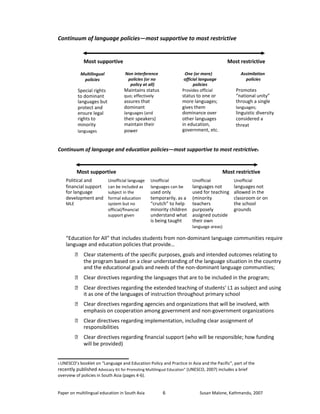
A study of language and/or language-and-education policies in Asia reveals a continuum of 
policies, from those that support and affirm linguistic and cultural diversity as a national 
resource to those that promote assimilation and “national unity” based on the language and 
culture of the most dominant group(s). 
Paper on multilingual education in South Asia 
5 
Susan Malone, Kathmandu, 2007
Continuum of language policies—most supportive to most restrictive 
Most supportive 
Most restrictive 
Multilingual 
policies 
Special rights 
to dominant 
languages but 
protect and 
ensure legal 
rights to 
minority 
languages 
Non interference 
policies (or no 
policy at all) 
Maintains status 
quo; effectively 
assures that 
dominant 
languages (and 
their speakers) 
maintain their 
power 
One (or more) 
official language 
policies 
Provides official 
status to one or 
more languages; 
gives them 
dominance over 
other languages 
in education, 
government, etc. 
Assimilation 
policies 
Promotes 
“national unity” 
through a single 
languages; 
linguistic diversity 
considered a 
threat 
Continuum of language and education policies—most supportive to most restrictive5 
Most supportive 
Most restrictive 
Political and 
financial support 
for language 
development and 
MLE 
Unofficial language 
can be included as 
subject in the 
formal education 
system but no 
official/financial 
support given 
Unofficial 
languages can be 
used only 
temporarily, as a 
“crutch” to help 
minority children 
understand what 
is being taught 
Unofficial 
languages not 
used for teaching 
(minority 
teachers 
purposely 
assigned outside 
their own 
language areas) 
Unofficial 
languages not 
allowed in the 
classroom or on 
the school 
grounds 
“Education for All” that includes students from non-dominant language communities require 
language and education policies that provide… 
 Clear statements of the specific purposes, goals and intended outcomes relating to 
the program based on a clear understanding of the language situation in the country 
and the educational goals and needs of the non-dominant language communities; 
 Clear directives regarding the languages that are to be included in the program; 
 Clear directives regarding the extended teaching of students’ L1 as subject and using 
it as one of the languages of instruction throughout primary school 
 Clear directives regarding agencies and organizations that will be involved, with 
emphasis on cooperation among government and non-government organizations 
 Clear directives regarding implementation, including clear assignment of 
responsibilities 
 Clear directives regarding financial support (who will be responsible; how funding 
will be provided) 
5 UNESCO’s booklet on “Language and Education Policy and Practice in Asia and the Pacific”, part of the 
recently published Advocacy Kit for Promoting Multilingual Education” (UNESCO, 2007) includes a brief 
overview of policies in South Asia (pages 4-6). 
Paper on multilingual education in South Asia 
6 
Susan Malone, Kathmandu, 2007
 Clear directives for incorporating the program into the existing education system 
and for providing funding for all components and personnel 
Conclusion 
Planning, implementing and sustaining MT-Based MLE programs in multiple language 
communities is certainly challenging, especially in multi-lingual countries lacking extensive 
financial resources. But is it worth the effort? Perhaps the best people to answer that 
question are the members of the ethnic minority communities themselves. 
When our children go to school, they go to an alien place. They leave their parents, 
they leave their gardens, they leave everything that is their way of life. They sit in a 
classroom and they learn things that have nothing to do with their own place. Later, 
because they have learned only other things, they reject their own. 
They don’t want to dig sweet potatoes, they say it’s dirty; they don’t want to help their 
mother fetch water. They look down on those things. There are big changes in the 
children now. They don’t obey their parents; they become rascals. And this is because 
they have gone to school and left the things that are ours. 
Now my child is in Tok Ples school. He is not leaving his place. He is learning in school 
about his customs, his way of life. Now he can write anything he wants to in tok ples. 
Not just the things he can see, but things he thinks about, too. And he writes about his 
place. He writes about helping his mother carry water, about digging kaukau, about 
going to the garden. 
When he writes these things they become important to him. He is not only reading and 
writing about things outside, but learning through reading and writing to be proud of our 
way of life. When he is big, he wil not reject us. It is important to teach our children to 
read and write, but it is more important to teach them to be proud of themselves, and 
of us. 
(Parent, Laitrao Vil age Tok Ples School, Buin, North Solomons Province, 
in Delpit and Kemelfield, 1985, p. 29-30) 
References 
Benson, Carol. 2001. Real and potential benefits of bilingual programs in developing countries. Paper 
presented at the Third Annual Symposium on Bilingual Education, Bristol England, 20 April, 
2001. 
Cummins, Jim. 2000. BICS and CALP. http://www.iteachilearn.com/cummins/bicscalp.html 
Cummins, Jim. 2001. Negotiating Identities: Education for Empowerment in a Diverse Society. Los 
Angeles: California Association for Bilingual Education. 
Delpit, L. D. and Kemelfield, G. 1985. An Evaluation of the Viles Tok Ples Skul Scheme in the North 
Solomons Province. ERU Report No. 51. Waigani, Papua New Guinea, University of Papua New 
Guinea. 
Department for International Development. 2006. DFID’s Girls’ education strategy. Girls’ 
education: towards a better future for al . First progress report. December 2006. UK: DFID. 
Droop, Mienke & Ludo Verhoeven. (2003). “Language proficiency and reading ability in first- and 
second-language learners”. Reading Research Quarterly, 38(1), 78-103. 
Paper on multilingual education in South Asia 
7 
Susan Malone, Kathmandu, 2007
Farrah, Iffat. 1998. “Sabaq. The context of learning literacy for girls in rural Pakistan”. In 
Durgunolu, Aydin and Ludo Verhoeven (Eds), Literacy development in a multilingual context. 
London: Lawrence Erlbaum Associates, Publishers. Pages 249-266. 
Guardian Weekly. 2005. Development's language barrier. Friday, November 18 2005. 
EducationGuardian.co.uk. Guardian Newspapers Limited 2005. 
Hinton, Leanne. "Language Revitalization: An Overview", pp. 3-18, in Hinton, L. & Hale, Ken 
(Eds.). (2001). The green book of language revitalization in practice. San Diego: Academic Press 
Human Development Network, The World Bank. 2006. Language of learning, language of 
instruction. Implications for achieving Education for Al . New York: The World Bank 
Jinghran, D. 2005. Language Disadvantage. The Learning Challenge in Primary Education. New 
Delhi: A. P. H. Publishing. 
Malone, Susan. 2005. Education in ethnic minority communities. Questions to consider, 
problems to solve. In UNESCO. Promoting Literacy in Multilingual Situations. Bangkok: UNESCO. 
Chapter 2. 
Mohanty, A. K. (1990). “Psychological consequences of mother tongue maintenance and 
multilingualism in India.” In D. P. Pattanayak (Ed.), Multilingualism in India (pp. 54-66). Clevedon: 
Multilingual Matters 
Research and Development Collective. 2003. “A Journey to indigenous society: The inert tone.” 
In Natalie Poulson. 2004. Many peoples, many voices. Unpublished report to BRAC, Bangladesh 
Thomas, Wayne P. and Virginia P. Collier. 2001. A National Study of School Effectiveness for 
Language Minority Students' Long-Term Academic Achievement Final Report: Project 1.1. National 
Clearinghouse on Bilingual Education. The George Washington University, Center for the Study 
of Language and Education, Washington, DC. 
http://www.ncela.gwu.edu/ncbepubs/resource/effectiveness/ 
UNESCO. 2003. Education in a Multilingual World. Paris, UNESCO. 
http://unesdoc.unesco.org/images/0012/001297/129728e.pdf 
UNESCO. 2007. Advocacy kit for promoting multilingual education: Including the excluded. Bangkok: 
UNESCO Asia and the Pacific Regional Bureau for Education. 
Verhoeven, Ludo. 1990. Acquisition of reading in a second-language. Reading Research Quarterly, 
25(2), 90-112. 
Wilson, Reid. (ND). A summary of Stephen Krashan’s “Principles and Practices in Second Language 
Acquisition. http://www.languageimpact.com/articles/rw/krashenbk.htm 
World Bank. 2005. In their Own Language: Education for Al . New York: World Bank 
Wurm, Stephen. 1991. “Language death and disappearance. Causes and circumstances”. In R. 
Robins E Whelenbeck (Eds.). Endangered languages. Oxford: Oxford University Press. 
Paper on multilingual education in South Asia 
8 
Susan Malone, Kathmandu, 2007

Mtbmle implications for_policy

  • 1.
    MOTHER TONGUE-BASED MULTILINGUALEDUCATION: IMPLICATIONS FOR EDUCATION POLICY Susan Malone, SIL International Presented at the Seminar on Education Policy and the Right to Education: Towards More Equitable Outcomes for South Asia’s Children Kathmandu, 17-20 September 2007 Defining Mother Tongue-based Multilingual Education (MT-Based MLE) Discussions relating to MT-Based MLE in Asia tend to use the term in one of two ways. In some contexts, MT-based MLE refers to the use of students’ mother tongue and two or more additional languages as Languages of Instruction (LoI) in school. In other contexts, the term is used to describe bilingual education across multiple language communities—each community using their own mother tongue plus the official school language for instruction. In the non-dominant language communities of South Asia, multilingual education usually follows the first definition: learning and using multiple languages in school. In some South Asian countries, MT-based MLE includes four languages—the students’ mother tongue or first language, a regional language, the national language and an international language. Rationale for MT-Based MLE: The current situation “The choice of the language…is a recurrent chal enge in the development of quality education... Speakers of mother tongues, which are not the same as the national…language, are often at a considerable disadvantage in the educational system…” (UNESCO, 2003). By the time children begin school, they have begun gaining confidence in their ability to communicate meaningfully in their mother tongue. They have built a foundation of knowledge and experience through observing and interacting with peers and adults in their community. The language, knowledge and experience that children bring to school form an important foundation for their learning in the classroom. The educational problem faced by many children from ethnolinguistic communities is two-fold. In the first place, some have no access to education at all. Those who do have access to school but do not speak the official language when they enter the education system find that their knowledge, experience and language—rather than serving as a foundation for learning—are treated as a disadvantage. Their language skills do not serve them because their language has no place in the classroom. Instead, textbooks and teaching are in a language they neither speak nor understand. Their learning and problem-solving experiences and their knowledge of “how things work” in their own culture and social setting do not serve them because the culture of the classroom, the teachers, and the textbooks is that of the dominant society. The consequences for many students are predictable and have been described in numerous studies, as noted in the quotations that follow. Loss of confidence in themselves as learners …when students’ language, culture and experiences are ignored or excluded in classroom interactions, students are immediately starting from a disadvantage. Everything they have learned about life and the world up to this point is being dismissed as irrelevant to school learning; there are few points of connection to Paper on multilingual education in South Asia 1 Susan Malone, Kathmandu, 2007
  • 2.
    curriculum materials orinstruction and so students are expected to learn in an experiential vacuum (Cummins, 2001). Inability to learn the official school language well My children are very good at copying from the blackboard. By the time they reach Grade 5, they can copy al the answers and memorize them. But only two of the Grade 5 students can actual y speak Hindi (Grade 5 teacher in India, in Jinghran, 2005, page 1). High repetition and drop-out rates Fifty percent of the world’s out-of-school children live in communities where the language of schooling is rarely, if ever, used at home. This underscores the biggest chal enge to achieving Education for Al (EFA): a legacy of non-productive practices that lead to low levels of learning and high levels of dropout and repetition. (World Bank, 2005). Alienation from heritage language and culture, from parents and community The children who go to the primary schools are often teased by other students for using their MT in the classroom when they talk to their counterparts. Teachers advise them to use L2 instead of their MT. Parents are asked not to use MT at home in order to make the children fluent in the L2. Al these things have led to a negative attitude towards their language in the minds of the parents and children… (Educator in minority language community in India. 2006. Personal communication). In addition to the damage they do to students who do not speak the dominant language when they begin school, dominant language-only education policies and programs have negative consequences for the language communities, for nations, and indeed, for the world in general. These include… Further disempowerment of girls Gender considerations cross cut…situations of educational risk, for girls and women may be in a particularly disadvantaged position. In most traditional societies, it is the girls and women who tend to be monolingual, being less exposed either through schooling, salaried labour, or migration to the national language, than their sons, brothers or husbands (UNESCO, 2003). Lack of access to social, political, economic and physical development processes Existing policies and supports have failed to reduce discrimination towards indigenous communities in vital areas related to employment, religion, language, ownership, possession or use of lands and natural resources…and access to education, health services and different institutions (Research and Development Col ective, 2003, Page 17, in Paulson, 2004). For many ethnolinguistic minority groups. .promises of…economic and social mobility are…poor compensation for cultural subordination and language shift. …Linguistic minority groups are driven to further poverty—cultural y and economical y—because their languages, as a resource for educational achievement and…for equal access to economic and other benefits in a competitive society, are rendered powerless (Mohanty, 1990, p. 54). Paper on multilingual education in South Asia 2 Susan Malone, Kathmandu, 2007
  • 3.
    Underutilization of humanresources Children whose first language is not used at school … experience lower levels of learning and are much less likely to be able to contribute to a country’s economic and intel ectual development (World Bank, 2006, page 4). Loss of languages, cultures and of knowledge systems. More broadly, the loss of language is part of the loss of whole cultures and knowledge systems, including philosophical systems, oral literary and music traditions, environmental knowledge systems, medical knowledge, and important cultural practices and artistic skills. The world stands to lose an important part of the sum of human knowledge whenever a language stops being used. Just as the human species is putting itself in danger through the destruction of species diversity, so might we be in danger from the destruction of the diversity of knowledge systems (Hinton, 2001. page 5.) Ineffective and inefficient use of human resources We have a few hundred years of evidence that submersion in the L2 is "highly inefficient," if not downright wasteful and discriminatory, since such school systems are characterized by low intake, high repetition and dropout, and low completion rates… The overal costs to the society… are clearly astronomical, and must be seen as at least partial y to blame for the lack of inclusive, participatory governing in post-colonial countries (Benson, 2001, page 7). These quotations—and there are many more like them—indicate the concerns that are being raised in Asia and Africa, about the negative consequences of exclusionary language and education policies. The next section of this paper focuses on strong Mother Tongue- Based MLE programs as the best means for ensuring quality education for the ethnolinguistic communities who speak non-dominant languages. MT-Based MLE: Using students’ mother tongue as the foundation for life-long learning MT-Based MLE programs enable students from non-dominant language communities to build a strong educational foundation in the language they know best—their MT or first language (L1)—and a good bridge to the official language—the school L2—and other languages of learning (L3, L4, etc.) and then encourage them to use both / all their languages for life-long learning. Strong and well-planned MT-Based MLE programs help students to build a strong educational foundation when they… 1) Enable and encourage students to develop oral fluency in their L1;1 2) Introduce reading and writing in the L1; help students to become fluent and confident in L1 literacy2; and 1 That is, children are encouraged to describe, explain, analyze, ask questions, exchange ideas—to talk rather than sit passively while the teacher talks at them. In strong programs, this “L1 time” is kept in the schedule throughout primary school. 2 This, of course, requires a library of graded reading materials, which requires a core of L1 authors. At least in the first years of the program, L1 reading materials produced at local “writers’ workshops” are usually printed in black-and-white with stiff paper covers—inexpensive to produce and, because they relate to the students’ own lives, fun for the students, and their parents, to read. Paper on multilingual education in South Asia 3 Susan Malone, Kathmandu, 2007
  • 4.
    3) Build theircapacity to use the L1 for everyday communication and for learning in school. MT-Based MLE programs help learners build a “good bridge” when they… 1. Introduce oral L2 through meaningful, non-threatening activities; 2. Introduce reading and writing in the L2 by building on what the children have learned about the oral L2 and their foundation in L1 literacy;3 3. Build fluency and confidence in using oral and written L2 for everyday communication and for academic learning. MT-Based MLE programs ensure that students achieve educational competencies or standards established by education officials for each grade when they… 1. Use the L1 only for teaching in the early grades, as students are learning basic communication skills in the L2; 2. Use the L1 with the L2 for teaching in later grades, as students gain fluency and confidence in using the school language for learning academic concepts.4 Planning a “strong foundation” and “good bridge”: From the theorists and researchers Regarding the focus on building a strong educational foundation in the L1: The most powerful factor in predicting educational success for minority learners is the amount of formal schooling their received in their L1… Only those language minority students who had 5-6 years of strong cognitive and academic development in their L1—as wel as through [L2]—did wel in Grade 11 assessments (Thomas and Col ier, 2001). Knowledge gained in one language transfers to other languages that we learn (Cummins: http://esl.fis.edu/teachers/support/cummins.htm) Regarding the focus on introducing the L2 through listening and responding (no speaking at first): The best [language learning] methods are…those that supply “comprehensible input” in low anxiety situations, containing messages that students real y want to hear. These messages do not force early production in the L2 but al ow students to produce when they are ‘ready’, recognizing that improvement comes from supplying communicative and comprehensible input, and not from forcing and correcting production (Krashen, 1981, in Wilson, 2001. Regarding the focus on building a basic level of oral fluency in L2 before introducing reading and writing in that language: ...oral proficiency in the target language [is] of critical importance for the development…of reading comprehension among third and fourth-grade students… (Droop and Verhoeven, 2003. Pages 101). Children should be helped to build up oral skil s in the second language before reading instruction in that language is started. Minority children’s knowledge of L2 3 Because reading is like riding a bicycle—we only need to learn once. 4 Most researchers and practitioners agree that it takes 2-3 years to build basic communication skills and 5-7 years to develop cognitive and academic proficiency in a new language (Cummins, 2000; Thomas and Collier, 2001) Paper on multilingual education in South Asia 4 Susan Malone, Kathmandu, 2007
  • 5.
    vocabulary determines theircomprehension of oral text much more than mother tongue L2 speakers. (Droop & Verhoeven, 2003, page101). Regarding the continued development of oral and written L1 and L2 (that is, both taught as subjects), at least through primary school: When children continue to develop their abilities in two or more languages throughout their primary school years, they gain a deeper understanding of language and how to use it effectively. They have more practice in processing language, especial y when they develop literacy in both, and they are able to compare and contrast the ways in which their two languages organize reality (Jim Cummins, citing Baker and Skutnabb-Kangas. http://www.iteachilearn.com/cummins/ Finally, in strong MT-Based MLE programs, both languages are used for teaching throughout primary school. Following is an example of a progression plan for teaching and using languages in a 3-language MT-Based MLE program: K1 K2 Grade 1 Grade 2 Grade 3 Grade 4 Grade 5 Grade 6 Build fluency in oral L1 L1 for teaching Continue oral L1 Begin written L1 Begin oral L2 (late in the year) L1 for teaching Continue oral & written L1, oral L2 Begin written L2 (late in the year) L1 for teaching Continue oral & written L1, L2 L1 for teaching Continue oral & written L1, L2 Begin oral L3 L1-L2-L1 for teaching Continue oral & written L1, L2, oral L3 Begin written L3 L1-L2-L1 for teaching Continue oral & written L1, L2, L3 L1-L2-L1 for teaching Continue oral & written L1, L2,L3 L2-L1 for teaching Language and education policies for strong and sustained MT-Based MLE Successful MT-Based MLE programs (that is, that are sustained and enable students from non-dominant language communities to achieve their educational goals) can be described as “top-down and bottom-up”. They are part of an established education system and so enable children to achieve learning competencies developed at the “top” and they incorporate the knowledge, skills, stories, songs, and culture from the communities into the curriculum. Success and sustainability depend on cooperation among a variety of stakeholders, with local communities working in partnership with the MOE or other implementing agency. They also require good policies. A study of language and/or language-and-education policies in Asia reveals a continuum of policies, from those that support and affirm linguistic and cultural diversity as a national resource to those that promote assimilation and “national unity” based on the language and culture of the most dominant group(s). Paper on multilingual education in South Asia 5 Susan Malone, Kathmandu, 2007
  • 6.
    Continuum of languagepolicies—most supportive to most restrictive Most supportive Most restrictive Multilingual policies Special rights to dominant languages but protect and ensure legal rights to minority languages Non interference policies (or no policy at all) Maintains status quo; effectively assures that dominant languages (and their speakers) maintain their power One (or more) official language policies Provides official status to one or more languages; gives them dominance over other languages in education, government, etc. Assimilation policies Promotes “national unity” through a single languages; linguistic diversity considered a threat Continuum of language and education policies—most supportive to most restrictive5 Most supportive Most restrictive Political and financial support for language development and MLE Unofficial language can be included as subject in the formal education system but no official/financial support given Unofficial languages can be used only temporarily, as a “crutch” to help minority children understand what is being taught Unofficial languages not used for teaching (minority teachers purposely assigned outside their own language areas) Unofficial languages not allowed in the classroom or on the school grounds “Education for All” that includes students from non-dominant language communities require language and education policies that provide…  Clear statements of the specific purposes, goals and intended outcomes relating to the program based on a clear understanding of the language situation in the country and the educational goals and needs of the non-dominant language communities;  Clear directives regarding the languages that are to be included in the program;  Clear directives regarding the extended teaching of students’ L1 as subject and using it as one of the languages of instruction throughout primary school  Clear directives regarding agencies and organizations that will be involved, with emphasis on cooperation among government and non-government organizations  Clear directives regarding implementation, including clear assignment of responsibilities  Clear directives regarding financial support (who will be responsible; how funding will be provided) 5 UNESCO’s booklet on “Language and Education Policy and Practice in Asia and the Pacific”, part of the recently published Advocacy Kit for Promoting Multilingual Education” (UNESCO, 2007) includes a brief overview of policies in South Asia (pages 4-6). Paper on multilingual education in South Asia 6 Susan Malone, Kathmandu, 2007
  • 7.
     Clear directivesfor incorporating the program into the existing education system and for providing funding for all components and personnel Conclusion Planning, implementing and sustaining MT-Based MLE programs in multiple language communities is certainly challenging, especially in multi-lingual countries lacking extensive financial resources. But is it worth the effort? Perhaps the best people to answer that question are the members of the ethnic minority communities themselves. When our children go to school, they go to an alien place. They leave their parents, they leave their gardens, they leave everything that is their way of life. They sit in a classroom and they learn things that have nothing to do with their own place. Later, because they have learned only other things, they reject their own. They don’t want to dig sweet potatoes, they say it’s dirty; they don’t want to help their mother fetch water. They look down on those things. There are big changes in the children now. They don’t obey their parents; they become rascals. And this is because they have gone to school and left the things that are ours. Now my child is in Tok Ples school. He is not leaving his place. He is learning in school about his customs, his way of life. Now he can write anything he wants to in tok ples. Not just the things he can see, but things he thinks about, too. And he writes about his place. He writes about helping his mother carry water, about digging kaukau, about going to the garden. When he writes these things they become important to him. He is not only reading and writing about things outside, but learning through reading and writing to be proud of our way of life. When he is big, he wil not reject us. It is important to teach our children to read and write, but it is more important to teach them to be proud of themselves, and of us. (Parent, Laitrao Vil age Tok Ples School, Buin, North Solomons Province, in Delpit and Kemelfield, 1985, p. 29-30) References Benson, Carol. 2001. Real and potential benefits of bilingual programs in developing countries. Paper presented at the Third Annual Symposium on Bilingual Education, Bristol England, 20 April, 2001. Cummins, Jim. 2000. BICS and CALP. http://www.iteachilearn.com/cummins/bicscalp.html Cummins, Jim. 2001. Negotiating Identities: Education for Empowerment in a Diverse Society. Los Angeles: California Association for Bilingual Education. Delpit, L. D. and Kemelfield, G. 1985. An Evaluation of the Viles Tok Ples Skul Scheme in the North Solomons Province. ERU Report No. 51. Waigani, Papua New Guinea, University of Papua New Guinea. Department for International Development. 2006. DFID’s Girls’ education strategy. Girls’ education: towards a better future for al . First progress report. December 2006. UK: DFID. Droop, Mienke & Ludo Verhoeven. (2003). “Language proficiency and reading ability in first- and second-language learners”. Reading Research Quarterly, 38(1), 78-103. Paper on multilingual education in South Asia 7 Susan Malone, Kathmandu, 2007
  • 8.
    Farrah, Iffat. 1998.“Sabaq. The context of learning literacy for girls in rural Pakistan”. In Durgunolu, Aydin and Ludo Verhoeven (Eds), Literacy development in a multilingual context. London: Lawrence Erlbaum Associates, Publishers. Pages 249-266. Guardian Weekly. 2005. Development's language barrier. Friday, November 18 2005. EducationGuardian.co.uk. Guardian Newspapers Limited 2005. Hinton, Leanne. "Language Revitalization: An Overview", pp. 3-18, in Hinton, L. & Hale, Ken (Eds.). (2001). The green book of language revitalization in practice. San Diego: Academic Press Human Development Network, The World Bank. 2006. Language of learning, language of instruction. Implications for achieving Education for Al . New York: The World Bank Jinghran, D. 2005. Language Disadvantage. The Learning Challenge in Primary Education. New Delhi: A. P. H. Publishing. Malone, Susan. 2005. Education in ethnic minority communities. Questions to consider, problems to solve. In UNESCO. Promoting Literacy in Multilingual Situations. Bangkok: UNESCO. Chapter 2. Mohanty, A. K. (1990). “Psychological consequences of mother tongue maintenance and multilingualism in India.” In D. P. Pattanayak (Ed.), Multilingualism in India (pp. 54-66). Clevedon: Multilingual Matters Research and Development Collective. 2003. “A Journey to indigenous society: The inert tone.” In Natalie Poulson. 2004. Many peoples, many voices. Unpublished report to BRAC, Bangladesh Thomas, Wayne P. and Virginia P. Collier. 2001. A National Study of School Effectiveness for Language Minority Students' Long-Term Academic Achievement Final Report: Project 1.1. National Clearinghouse on Bilingual Education. The George Washington University, Center for the Study of Language and Education, Washington, DC. http://www.ncela.gwu.edu/ncbepubs/resource/effectiveness/ UNESCO. 2003. Education in a Multilingual World. Paris, UNESCO. http://unesdoc.unesco.org/images/0012/001297/129728e.pdf UNESCO. 2007. Advocacy kit for promoting multilingual education: Including the excluded. Bangkok: UNESCO Asia and the Pacific Regional Bureau for Education. Verhoeven, Ludo. 1990. Acquisition of reading in a second-language. Reading Research Quarterly, 25(2), 90-112. Wilson, Reid. (ND). A summary of Stephen Krashan’s “Principles and Practices in Second Language Acquisition. http://www.languageimpact.com/articles/rw/krashenbk.htm World Bank. 2005. In their Own Language: Education for Al . New York: World Bank Wurm, Stephen. 1991. “Language death and disappearance. Causes and circumstances”. In R. Robins E Whelenbeck (Eds.). Endangered languages. Oxford: Oxford University Press. Paper on multilingual education in South Asia 8 Susan Malone, Kathmandu, 2007