Settings:-
In general, Medieval Romances begin with the words—“Once upon a time or Long ago
there lived a king/prince in a far off land ” , and traditionally end with the words---- “And they
lived happily thereafter” creating a magical atmosphere .
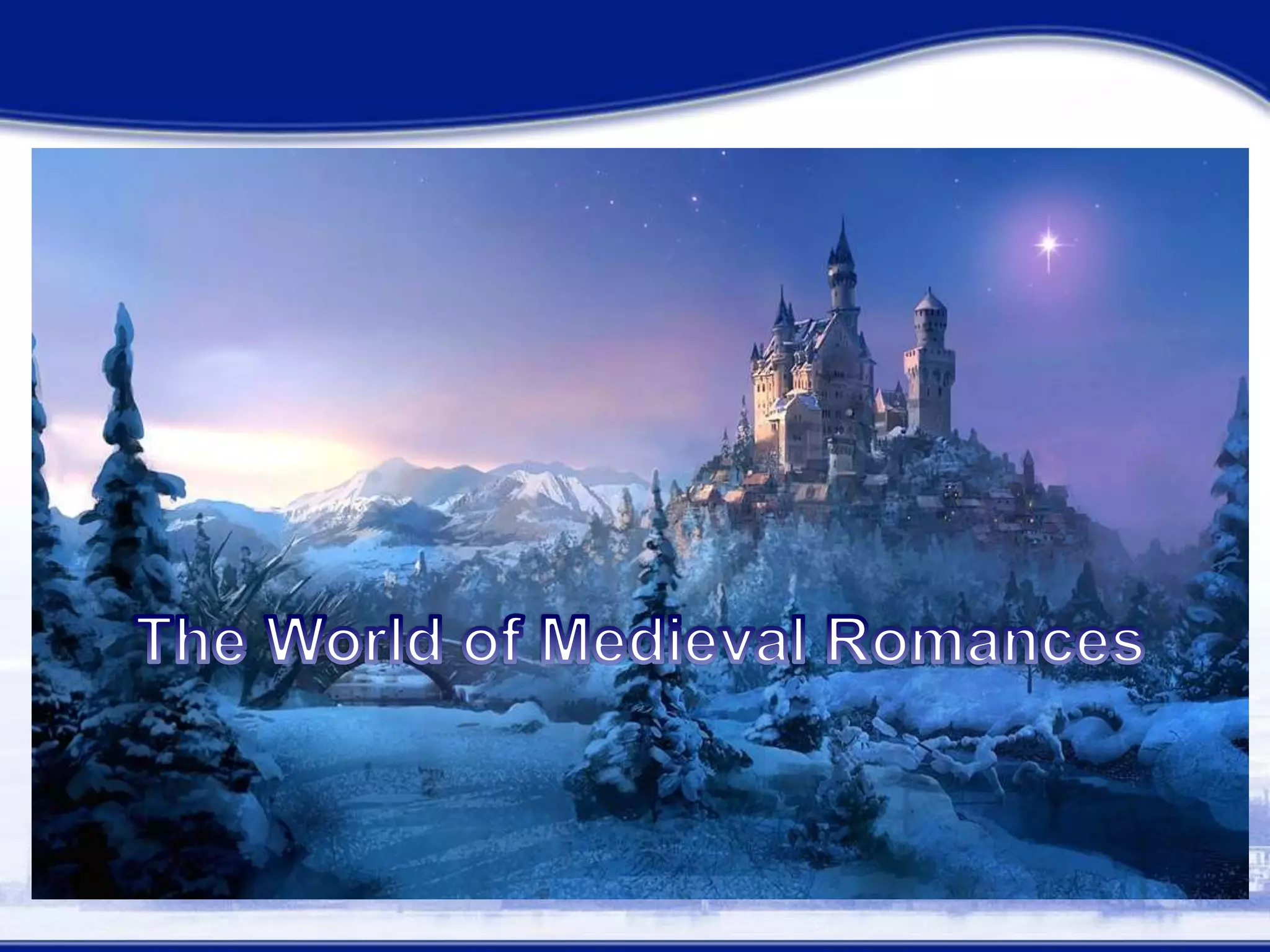
Medieval Romances
• What is meant by ‘Medieval’?
• Medieval or Mediaeval means ‘Of Middle Ages’. It’s an adjective of Middle
Ages.
• The Roman Empire started declining towards the AD 300's and its crumbling
gave rise to the Medieval Ages, or Middle Ages. This period lasted from AD
500 to 1500 and is referred as "middle" because it was the time when the
European nations began to form. Since the borders of present-day European
nations were being set, the Middle Ages was a period of great warfare.
• Officially the period between 1066AD(Norman Conquest) and 1453AD(The
Fall of Constantinople) is called The Medieval Period.
• The coinage of the generic title ‘Medieval’ was made by the 19th century
scholars.
The initial lack of strong government
divided the people into feudal states.
Because of the constant warfare between
these states, the concept of the knight
came into being. A knight is simply a
mounted warrior. Young men were
taught to wear heavy armor, ride a war-
horse, and fight with sword and lance .
With the rise of the knight came the rise
of chivalry, the knightly code of
behavior. The chivalrous knight was
supposed to be loyal to his feudal state,
virtuous, brave, selfless, and protector
the weak..
Medieval Romances
• Oral literature of the entire Middle ages in Europe
comprised of Medieval Romances.
• The publication of the two volumes of ‘Don Quixote’ by
Miguel de Cervantes in 1605 and 1615 respectively brought
the end of Medieval Romances.
• Because Cervantes very bitterly satirized the absurdity and
untruth of the Medieval concepts of Chivalry and valour.
• The contemporary concept of ‘Magic Realism’ was
inherent in the Medieval Romances.
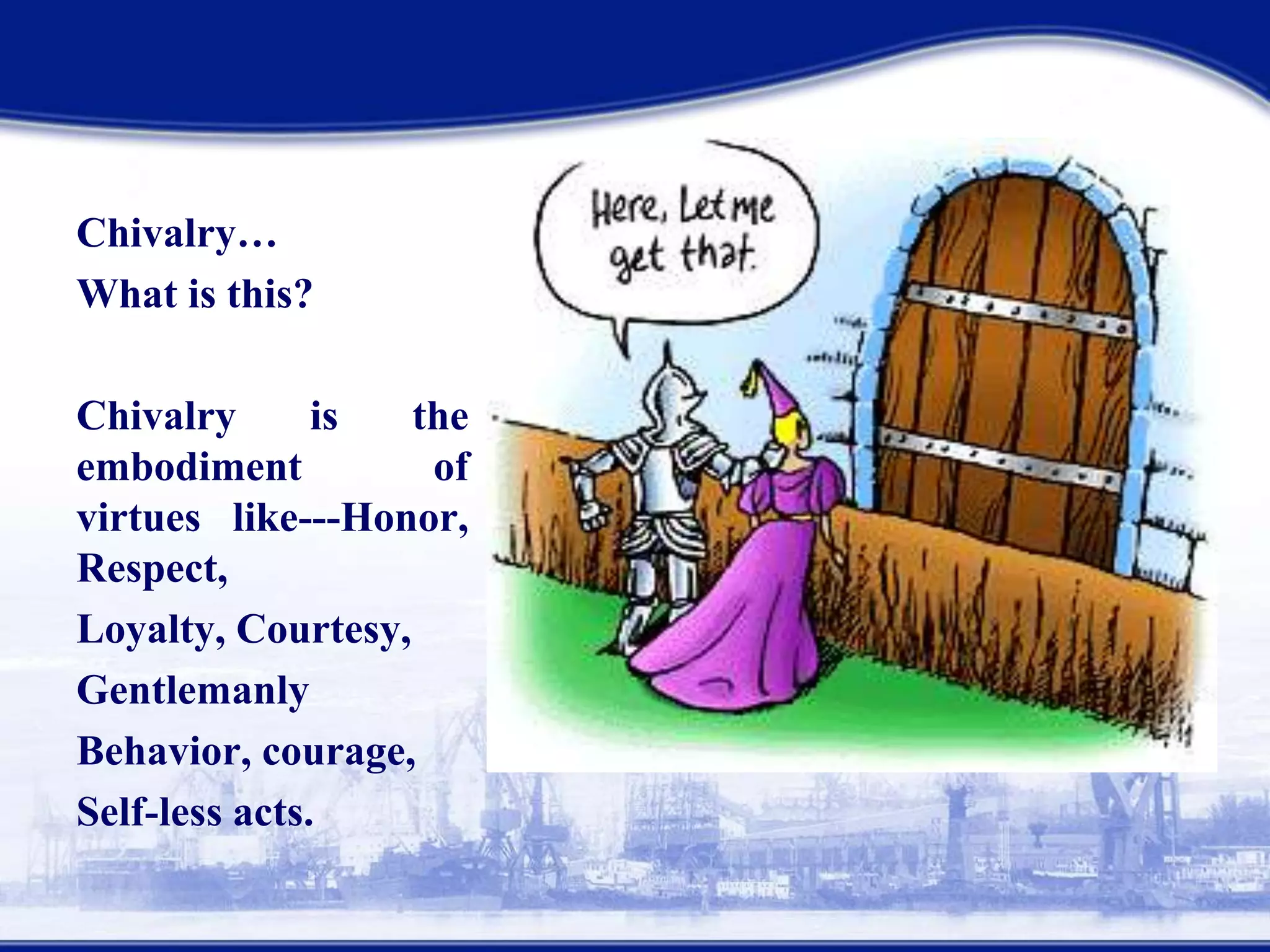
Chivalry…!
What is this?
Chivalry is the
embodiment of virtues
like---Honor, Respect,
Loyalty, Courtesy,
Gentlemanly
behavior,courage,
Self-less acts.
• Medieval romances are stories of adventure in which the chief parts are played by
knights, famous kings, or distressed ladies, acting most often under the impulse of
love, religious faith, or, in many, mere desire for adventure. The stories were first
told in verse, but when, later, prose versions were made, they were also called
romances. In length the verse romances vary from a few hundred lines to tens of
thousands. . .”
• A popular example of Medieval Romance is ‘Sir Gawain and the Green Knight’
• Gawain poet or poets also known as Pearl poets were supposed to be the author of
‘Sir Gawain and The Green Knight’.
• Recently one Mr. John Massey of Cotton has been identified as the Gawain Poet or
the Pearl Poet.
• ‘Sir Gawain and the Green Knight’ contains 2,530 lines and 101 stanzas. It was
written in ‘Alliterative Revival’ style in ‘Bob and Wheel’ stanza, typically popular
in the 14th Century.
Medieval Romances
• Characteristics of Medieval Romance:-
1.A Medieval romance usually idealizes chivalry
2. It idealizes the hero-knight and his noble deeds
3. It narrates the knight's love for his lady.
4. The settings of a medieval romance tend to be imaginary and
vague.
5. Medieval romance derives mystery and suspense from supernatural
elements.
6. It uses concealed or disguised identity.
7. Repetition of the mystical number "3" or its multiples is employed
to convey mystical nature of the tale.
Medieval Romances
• Qualities of the hero-knight of a Medieval Romance:-
• 1. His birth is shrouded in mystery
2. He is reared away from his true home in ignorance of his real
parents.
3.For a time his true identity is unknown
4. After meeting an extraordinary challenge, he claims his right
5. His triumph benefits his nation or group.
• Gist: Medieval romance is characterized by chivalry, disguised
identity, love, unreal locations and suspense.
• Medieval age refers to the middle ages where warfare was
dominant.
• Youngmen (knights) were taught to fight, with knights came the
rise of chivalry.
• Who was Jean Bodel?
• Jean Bodel was a twelfth century French poet and the
author of the Chanson des Saisnes (Song of the Saxons),He
compiled and classified the Medieval Romances.
• Historically, Romance tales of antiquity came to England
from Normandy (present Day Germany) along with the
Norman Conquest.
• The style of these Romances was called ‘Alliterative
Revival’ style.
Medieval Romances
• Jean Bodel’s Division of Medieval Romances:-
• Jean Bodel divided medieval romances into three groups or
topics, based on the geographic location and characters in
the plot which he termed as ‘Matter’. These were:-
• i. Matter of France;
• ii. Matter of Rome and
• iii. Matter of Britain.
Medieval Romances
Matter of France
Matter of France was also known as
the Carolingian cycle. It was a body
of legendary history that sprang from
the Old French Medieval Literature
of the Chansons de gesta. Its tales
were first developed in these epics,
but the stories they told lived on even
after the medieval epics themselves
were no longer widely read.
The stories developed around
Charlemagne and his court.
King Chalemagne
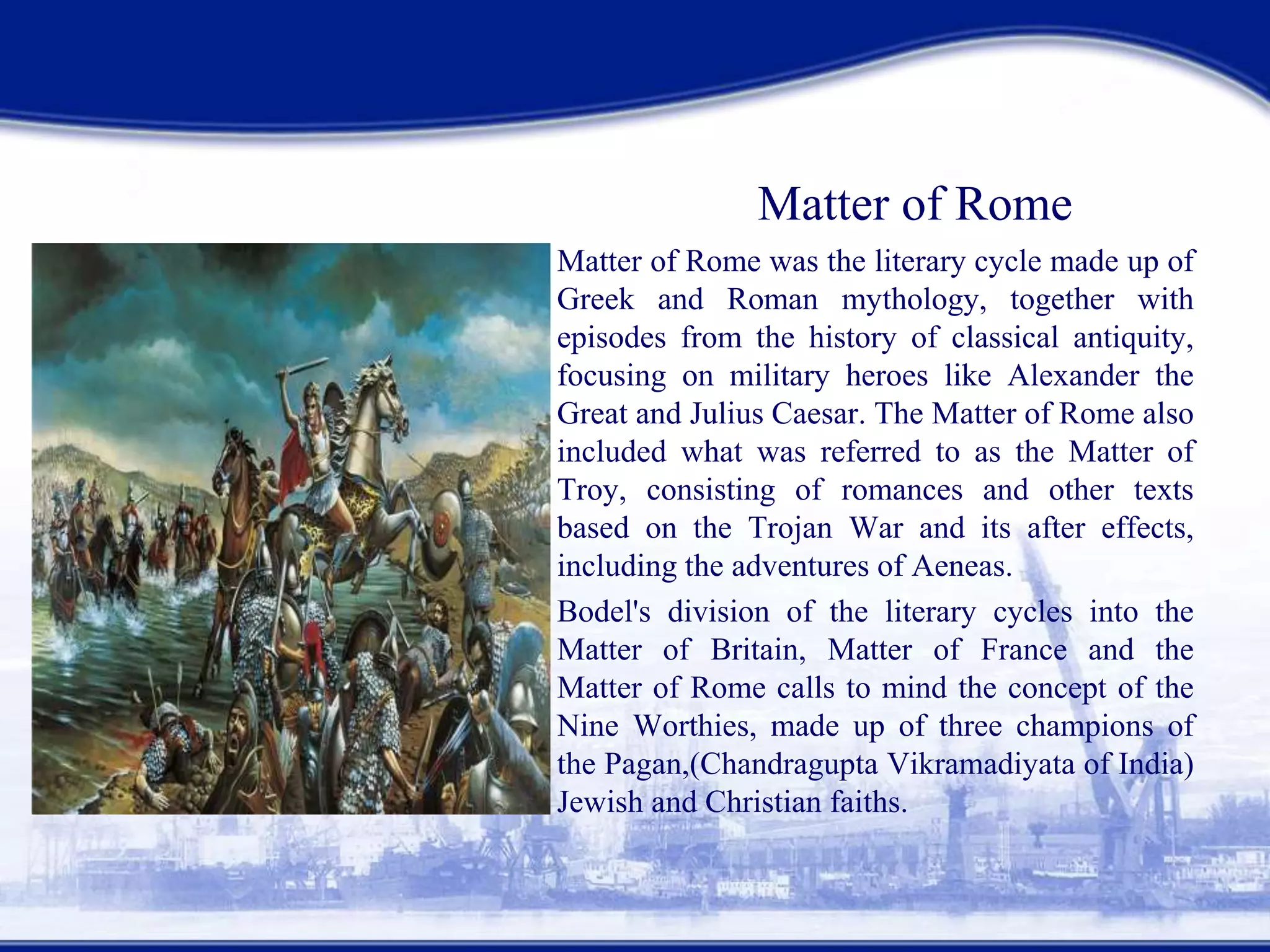
Matter of Rome
• Matter of Rome was the literary cycle made up of
Greek and Roman mythology, together with
episodes from the history of classical antiquity,
focusing on military heroes like Alexander the
Great and Julius Caesar. The Matter of Rome also
included what was referred to as the Matter of
Troy, consisting of romances and other texts
based on the Trojan War and its after effects,
including the adventures of Aeneas.
• Bodel's division of the literary cycles into the
Matter of Britain, Matter of France and the
Matter of Rome calls to mind the concept of the
Nine Worthies, made up of three champions of
the Pagan,(Chandragupta Vikramadiyata of India)
Jewish and Christian faiths.
Matter of Britain
• The Arthurian legend or the Matter of Britain
was the name given collectively to the legends
that concerned the Celtic and legendary
history of the British Isles, especially those
focused on King Arthur and the knights of the
Round Table.
[Legend has it that Arthur received the Round
Table as a marital gift from his father –in law
and surprisingly the scholars have found out
the table last year.]
• The name distinguishes and relates the Matter
of Britain from the mythological themes taken
from classical antiquity While Arthur was the
chief subject of the Matter of Britain, other
lesser-known legendary history of the British
Isles, including the stories of Brutus of
britain,Old king Cole, King Lear and
Gogmagog was also included in the subjects
covered by the Matter of Britain.
King Arthur in his Court
King Arthur and his Knights in the Round Table
Matter of England
A fourth Group of Romances have been
compiled by the latter researchers
which has been called ‘Matter of
England’.
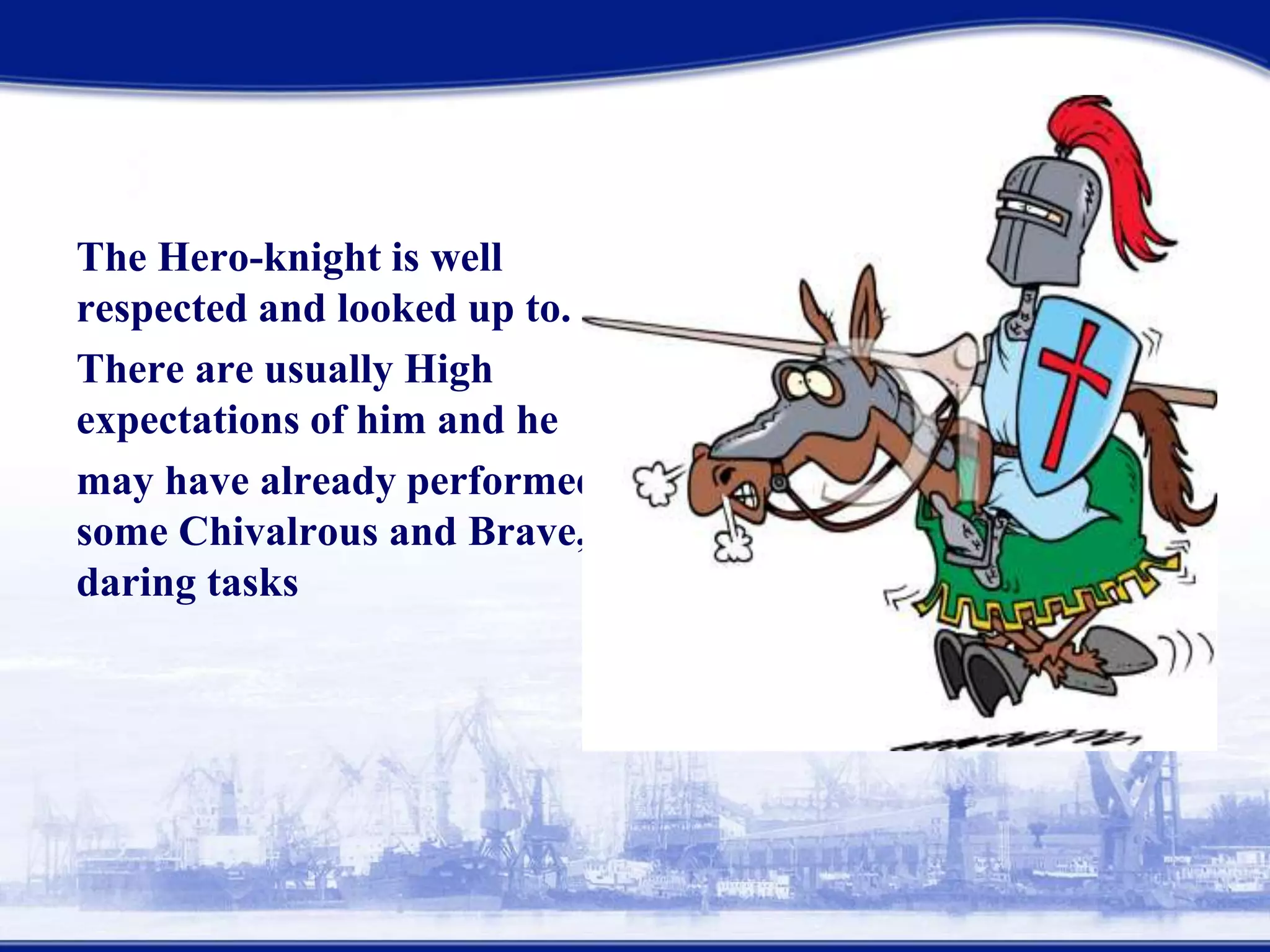
The Hero-knight is well
respected and looked up to.
There are usually High
expectations of him and he
may have already performed
some Chivalrous and Brave,
daring tasks
Concealed or Disguised identity Magic or Supernatural elements
Medieval
romances have a
simple, predictable
plot with some
inevitable or
unavoidable
events.
Thanks -i.s

Medieval romances

  • 3.
    Settings:- In general, MedievalRomances begin with the words—“Once upon a time or Long ago there lived a king/prince in a far off land ” , and traditionally end with the words---- “And they lived happily thereafter” creating a magical atmosphere .
  • 5.
    Medieval Romances • Whatis meant by ‘Medieval’? • Medieval or Mediaeval means ‘Of Middle Ages’. It’s an adjective of Middle Ages. • The Roman Empire started declining towards the AD 300's and its crumbling gave rise to the Medieval Ages, or Middle Ages. This period lasted from AD 500 to 1500 and is referred as "middle" because it was the time when the European nations began to form. Since the borders of present-day European nations were being set, the Middle Ages was a period of great warfare. • Officially the period between 1066AD(Norman Conquest) and 1453AD(The Fall of Constantinople) is called The Medieval Period. • The coinage of the generic title ‘Medieval’ was made by the 19th century scholars.
  • 6.
    The initial lackof strong government divided the people into feudal states. Because of the constant warfare between these states, the concept of the knight came into being. A knight is simply a mounted warrior. Young men were taught to wear heavy armor, ride a war- horse, and fight with sword and lance . With the rise of the knight came the rise of chivalry, the knightly code of behavior. The chivalrous knight was supposed to be loyal to his feudal state, virtuous, brave, selfless, and protector the weak..
  • 7.
    Medieval Romances • Oralliterature of the entire Middle ages in Europe comprised of Medieval Romances. • The publication of the two volumes of ‘Don Quixote’ by Miguel de Cervantes in 1605 and 1615 respectively brought the end of Medieval Romances. • Because Cervantes very bitterly satirized the absurdity and untruth of the Medieval concepts of Chivalry and valour. • The contemporary concept of ‘Magic Realism’ was inherent in the Medieval Romances.
  • 8.
    Chivalry…! What is this? Chivalryis the embodiment of virtues like---Honor, Respect, Loyalty, Courtesy, Gentlemanly behavior,courage, Self-less acts.
  • 9.
    • Medieval romancesare stories of adventure in which the chief parts are played by knights, famous kings, or distressed ladies, acting most often under the impulse of love, religious faith, or, in many, mere desire for adventure. The stories were first told in verse, but when, later, prose versions were made, they were also called romances. In length the verse romances vary from a few hundred lines to tens of thousands. . .” • A popular example of Medieval Romance is ‘Sir Gawain and the Green Knight’ • Gawain poet or poets also known as Pearl poets were supposed to be the author of ‘Sir Gawain and The Green Knight’. • Recently one Mr. John Massey of Cotton has been identified as the Gawain Poet or the Pearl Poet. • ‘Sir Gawain and the Green Knight’ contains 2,530 lines and 101 stanzas. It was written in ‘Alliterative Revival’ style in ‘Bob and Wheel’ stanza, typically popular in the 14th Century.
  • 10.
    Medieval Romances • Characteristicsof Medieval Romance:- 1.A Medieval romance usually idealizes chivalry 2. It idealizes the hero-knight and his noble deeds 3. It narrates the knight's love for his lady. 4. The settings of a medieval romance tend to be imaginary and vague. 5. Medieval romance derives mystery and suspense from supernatural elements. 6. It uses concealed or disguised identity. 7. Repetition of the mystical number "3" or its multiples is employed to convey mystical nature of the tale.
  • 11.
    Medieval Romances • Qualitiesof the hero-knight of a Medieval Romance:- • 1. His birth is shrouded in mystery 2. He is reared away from his true home in ignorance of his real parents. 3.For a time his true identity is unknown 4. After meeting an extraordinary challenge, he claims his right 5. His triumph benefits his nation or group. • Gist: Medieval romance is characterized by chivalry, disguised identity, love, unreal locations and suspense. • Medieval age refers to the middle ages where warfare was dominant. • Youngmen (knights) were taught to fight, with knights came the rise of chivalry.
  • 12.
    • Who wasJean Bodel? • Jean Bodel was a twelfth century French poet and the author of the Chanson des Saisnes (Song of the Saxons),He compiled and classified the Medieval Romances. • Historically, Romance tales of antiquity came to England from Normandy (present Day Germany) along with the Norman Conquest. • The style of these Romances was called ‘Alliterative Revival’ style. Medieval Romances
  • 13.
    • Jean Bodel’sDivision of Medieval Romances:- • Jean Bodel divided medieval romances into three groups or topics, based on the geographic location and characters in the plot which he termed as ‘Matter’. These were:- • i. Matter of France; • ii. Matter of Rome and • iii. Matter of Britain.
  • 14.
    Medieval Romances Matter ofFrance Matter of France was also known as the Carolingian cycle. It was a body of legendary history that sprang from the Old French Medieval Literature of the Chansons de gesta. Its tales were first developed in these epics, but the stories they told lived on even after the medieval epics themselves were no longer widely read. The stories developed around Charlemagne and his court. King Chalemagne
  • 15.
    Matter of Rome •Matter of Rome was the literary cycle made up of Greek and Roman mythology, together with episodes from the history of classical antiquity, focusing on military heroes like Alexander the Great and Julius Caesar. The Matter of Rome also included what was referred to as the Matter of Troy, consisting of romances and other texts based on the Trojan War and its after effects, including the adventures of Aeneas. • Bodel's division of the literary cycles into the Matter of Britain, Matter of France and the Matter of Rome calls to mind the concept of the Nine Worthies, made up of three champions of the Pagan,(Chandragupta Vikramadiyata of India) Jewish and Christian faiths.
  • 16.
    Matter of Britain •The Arthurian legend or the Matter of Britain was the name given collectively to the legends that concerned the Celtic and legendary history of the British Isles, especially those focused on King Arthur and the knights of the Round Table. [Legend has it that Arthur received the Round Table as a marital gift from his father –in law and surprisingly the scholars have found out the table last year.] • The name distinguishes and relates the Matter of Britain from the mythological themes taken from classical antiquity While Arthur was the chief subject of the Matter of Britain, other lesser-known legendary history of the British Isles, including the stories of Brutus of britain,Old king Cole, King Lear and Gogmagog was also included in the subjects covered by the Matter of Britain. King Arthur in his Court King Arthur and his Knights in the Round Table
  • 17.
    Matter of England Afourth Group of Romances have been compiled by the latter researchers which has been called ‘Matter of England’.
  • 18.
    The Hero-knight iswell respected and looked up to. There are usually High expectations of him and he may have already performed some Chivalrous and Brave, daring tasks
  • 19.
    Concealed or Disguisedidentity Magic or Supernatural elements
  • 21.
    Medieval romances have a simple,predictable plot with some inevitable or unavoidable events.
  • 22.