Created byCreated by Irma Nydia VillanuevaIrma Nydia Villanueva
Spanish Teacher, Puerto Rico Department of EducationSpanish Teacher, Puerto Rico Department of Education
spanishteacherpr@yahoo.comspanishteacherpr@yahoo.com
http://irmavillanuevarivera.wordpress.comhttp://irmavillanuevarivera.wordpress.com
http://lenguajelenguayhabla.blogspot.comhttp://lenguajelenguayhabla.blogspot.com








 A period of European history from the
fall of Western Roman Empire in 476
until the fall of Constantinople in 1453.
Followed by the Renaissance. Marked
by constant warfare and the feudal
system, the Crusades, the Black Death,
Christian-orientated art and works.
Middle Ages

 Early Middle Ages 476-1000 CE
 Once called the “Dark Ages” (which
roughly covered the time from the fall of
the Roman Empire, c. 400 CE, to the reign
of Charlemagne, c. 800 CE), this term is
seldom used now, as we become better
informed about the accomplishments of
this period.

 High Middle Ages1000-1300 CE
 Late Middle Ages1300-1400 CE
The Middle Ages end at about the
time of the conquest of
Constantinople by the Turks in
1453.


The map below depicts the general boundaries of the
various nations of Europe in the Middle Ages.
Europe in the
Middle Ages

 WESTERN and CENTRAL EUROPE
Latin- the language of the catholic Church
-the common language of writings
-education language
 EASTERN
Greek and Old Slavonic
 VERNACULARS Old English (Beowulf), German
(Nibelungelied), Greek (Digenis Acritas), Slavic (Tale of
Igor’s Campaing), Old French (Chanson de Roland),
Castilian (Mio Cid).
Languages

 In the southern part of England,
people in medieval times spoke a
language called Anglo-Saxon. This
language is also called Old English.
Old English

 In fact, it looks something like this:
oðþæt him æghwylc
þær ymbsittendra ofer
hronrade hyran scolde
(Beowulf, Old English).
Old English

 Anglo-Saxon uses only some of the
same letters we use in our alphabet
today. Plus, it uses three letters that
we no longer use - þ ð æ

 In medieval times, most people did not
read or write. Perhaps that is why it is
sometimes easier to hear and
understand Old English than it is to
read it.
 Still, there are many words in Old
English that we do not use today. Here
are some examples:
Spoken Old English

durst – Dare; to have the necessary
boldness or courage for something
whence - From where, e.g., "Whence
comest thou?" means "Where do you come
from?"
whither - To where, e.g., "Whither thou
goest, I'll go." means "Where you go, I will
go."

English Language Timeline

 Medieval Period was based on feudalism
 Feudalism was a hierarchy based on the least
powerful swearing allegiance and loyalty to
the person in power above him. It began with
the serfs and ended with the king and the
Pope.
Medieval Life




 The bubonic plague created a labor
shortage that contributed to the
end of feudalism and to the
passing of the Middle Ages.

Theocentrism




The medieval “entreteiners”

Books

Themes of Medieval Literature
 Themes of Medieval Literature fall into
several major categories which seem to reflect
the concerns/focus of life for people in that
time period.
 The Seven Deadly Sins (what to avoid)
 The Seven Heavenly Virtues (what to do)
 Physiognomy and “The Humours”
 Values of “courtly love”
 The Code of Chivalry

The Seven Deadly Sins are:
 Lust
 Gluttony
 Avarice (greed)
 Sloth
 Wrath
 Envy
 Pride
The Seven Virtues are:
 Chastity
 Temperance
 Charity
 Diligence
 Forgiveness
 Kindness
 Humility

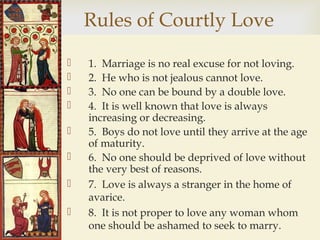
Rules of Courtly Love
 1. Marriage is no real excuse for not loving.
 2. He who is not jealous cannot love.
 3. No one can be bound by a double love.
 4. It is well known that love is always
increasing or decreasing.
 5. Boys do not love until they arrive at the age
of maturity.
 6. No one should be deprived of love without
the very best of reasons.
 7. Love is always a stranger in the home of
avarice.
 8. It is not proper to love any woman whom
one should be ashamed to seek to marry.

 9. A true lover does not desire to embrace in love
anyone except his beloved.
 10. When made public, love rarely endures.
 11. The easy attainment of love makes it of little
value; difficulty of attainment makes it prized.
 12. Every lover regularly turns pale in the presence
of his beloved.
 13. When a lover suddenly catches sight of his
beloved, his heart palpitates.
 14. A new love puts to flight an old one.
 15. Good character alone makes any man worthy of
love.
 16. A man in love is always apprehensive.
 17. Real jealousy always increases the feeling of
love.

 18. Jealousy, and therefore love, are increased when one
suspects his beloved.
 19. He whom the thought of love vexes, eats and sleeps
very little.
 20. Every act of a lover ends in the thought of his
beloved.
 21. A true lover considers nothing good except what he
thinks will please his beloved.
 22. A lover can never have enough of the solaces of his
beloved.
 23. A man who is vexed by too much passion usually
does not love.
 24. A true lover is constantly and without intermission
possessed by the thought of his beloved.
 25. Nothing forbids one woman being loved by two men
or one man by two women.

Chivalry
 Chivalry is a system of discipline and
social interaction that is derived from the
warrior class of medieval
times, especially and
primarily the class of
trained warriors who
participated in the
Crusades (12th
– 14th
centuries).

 Chivalry was a code of conduct based on the
process of becoming a knight.
 Adherence to oaths of allegiance and rules
governing fighting were basic to its precepts.
 The ideals and behavior codes governed both
knight and gentlewoman
 adhere to the oath of loyalty to one’s overlord
 acceptance of certain rules of warfare
 adoration of a particular lady for purposes of self-
improvement

 Chivalry has a discipline because those
ancient soldiers trained themselves daily
through learning and practicing the arts of
attack and self defense.
 These arts gave rise to the idea of control of
body, mind, and speech in the Knight.

 From this idea of engaging only other
Knights developed the idea of treating
enemies and friends fairly and equally.
 Later, as the honor of being a Knight grew,
both Monarchy and the Church (Eastern
Orthodox as well as Roman Catholic) began
to participate in the selection and creation of
Knights.

A Knight should be known for:
 Prowess
 Justice
 Loyalty
 Defense
 Courage
 Faith
 Humility
 Largesse
 Nobility
 Franchise

 A morality play to teach a lesson to its viewers. It’s
about a character named Everyman who confronts
Death and has to find which of his friends will go
with him.
Everyman


Epic Poetry
The beginnings of English Literature
Unknown author; possibly one
Christian author in Anglo-Saxon
England
Unknown date of composition
(roughly 8th
-11th
Century CE)
Beowulf

 Canterbury Tales was written in Middle
English by Geoffrey Chaucer who is often
called the father of English poetry. He is
credited with making English respectable.
Until Chaucer most literature and
documents of importance were done in
Latin.
Canterbury Tales (written 1387)

 A tale about Arthur’s knights and
the Round Table, Sir Gawain
accepts the Green Knights
challenge to exchange blows. The
story might really be about
redemption and sin.
Sir Gawain and the Green Knight

 King Arthur is a legendary British leader
who, according to medieval histories and
romances, led the defense of Britain
against the Saxon invaders in the early
6th century. The details of Arthur's story
are mainly composed of folklore
and literary invention, and his
historical existence is debated
and disputed by modern historians.
King
Arthur

 The Alliterative Morte Arthure is a
4346-line Middle English alliterative
poem, retelling the latter part of the
legend of King Arthur.
 The romances in this volume are two of
the best and most important of our
surviving Middle English romances.
Alliterative Morte Arthure


Attend and listen gentlemen
that be of freeborn blood
I shall tell you of a good yeman
His name was Robyn Hode"
opening lines of "A Gest of Robyn Hode"

El Cantar del Mio Cid, 1140

 Arabic Conquest of the Peninsula 711
 Muslims and Christians battles
 Born of the “Lenguas romances”: castellano, italiano,
portugués, francés, occitano…
 El Cantar del Mio Cid, the beginning of the Hispanic
Literature
 Castilian as the Kingdom language
The Spain of the Middle Ages

 Fernando and Isabel marriage
 Conquest of the Peninsula by the Christians 1492 and
Muslims and Jewish expulsion
 1492 -Cristobal Colón (and the Castilian
language) arrives to the “New World”
-First Spanish Grammar by Nebrija
The Spain of the Middle Ages

Created byCreated by Irma Nydia VillanuevaIrma Nydia Villanueva
Spanish Teacher, Puerto Rico Department of EducationSpanish Teacher, Puerto Rico Department of Education
spanishteacherpr@yahoo.comspanishteacherpr@yahoo.com
http://irmavillanuevarivera.wordpress.comhttp://irmavillanuevarivera.wordpress.com
http://lenguajelenguayhabla.blogspot.comhttp://lenguajelenguayhabla.blogspot.com

Medieval Literature/ Literatura Medieval

  • 1.
    Created byCreated byIrma Nydia VillanuevaIrma Nydia Villanueva Spanish Teacher, Puerto Rico Department of EducationSpanish Teacher, Puerto Rico Department of Education spanishteacherpr@yahoo.comspanishteacherpr@yahoo.com http://irmavillanuevarivera.wordpress.comhttp://irmavillanuevarivera.wordpress.com http://lenguajelenguayhabla.blogspot.comhttp://lenguajelenguayhabla.blogspot.com
  • 2.
  • 3.
  • 4.
  • 5.
  • 6.
  • 7.
  • 8.
  • 9.
      A periodof European history from the fall of Western Roman Empire in 476 until the fall of Constantinople in 1453. Followed by the Renaissance. Marked by constant warfare and the feudal system, the Crusades, the Black Death, Christian-orientated art and works. Middle Ages
  • 10.
      Early MiddleAges 476-1000 CE  Once called the “Dark Ages” (which roughly covered the time from the fall of the Roman Empire, c. 400 CE, to the reign of Charlemagne, c. 800 CE), this term is seldom used now, as we become better informed about the accomplishments of this period.
  • 11.
      High MiddleAges1000-1300 CE  Late Middle Ages1300-1400 CE The Middle Ages end at about the time of the conquest of Constantinople by the Turks in 1453.
  • 12.
  • 13.
     The map belowdepicts the general boundaries of the various nations of Europe in the Middle Ages. Europe in the Middle Ages
  • 14.
      WESTERN andCENTRAL EUROPE Latin- the language of the catholic Church -the common language of writings -education language  EASTERN Greek and Old Slavonic  VERNACULARS Old English (Beowulf), German (Nibelungelied), Greek (Digenis Acritas), Slavic (Tale of Igor’s Campaing), Old French (Chanson de Roland), Castilian (Mio Cid). Languages
  • 15.
      In thesouthern part of England, people in medieval times spoke a language called Anglo-Saxon. This language is also called Old English. Old English
  • 16.
      In fact,it looks something like this: oðþæt him æghwylc þær ymbsittendra ofer hronrade hyran scolde (Beowulf, Old English). Old English
  • 17.
      Anglo-Saxon usesonly some of the same letters we use in our alphabet today. Plus, it uses three letters that we no longer use - þ ð æ
  • 18.
      In medievaltimes, most people did not read or write. Perhaps that is why it is sometimes easier to hear and understand Old English than it is to read it.  Still, there are many words in Old English that we do not use today. Here are some examples: Spoken Old English
  • 19.
     durst – Dare;to have the necessary boldness or courage for something whence - From where, e.g., "Whence comest thou?" means "Where do you come from?" whither - To where, e.g., "Whither thou goest, I'll go." means "Where you go, I will go."
  • 20.
  • 21.
      Medieval Periodwas based on feudalism  Feudalism was a hierarchy based on the least powerful swearing allegiance and loyalty to the person in power above him. It began with the serfs and ended with the king and the Pope. Medieval Life
  • 22.
  • 23.
  • 24.
  • 25.
      The bubonicplague created a labor shortage that contributed to the end of feudalism and to the passing of the Middle Ages.
  • 26.
  • 27.
  • 28.
  • 29.
  • 30.
  • 31.
  • 32.
     Themes of MedievalLiterature  Themes of Medieval Literature fall into several major categories which seem to reflect the concerns/focus of life for people in that time period.  The Seven Deadly Sins (what to avoid)  The Seven Heavenly Virtues (what to do)  Physiognomy and “The Humours”  Values of “courtly love”  The Code of Chivalry
  • 33.
     The Seven DeadlySins are:  Lust  Gluttony  Avarice (greed)  Sloth  Wrath  Envy  Pride The Seven Virtues are:  Chastity  Temperance  Charity  Diligence  Forgiveness  Kindness  Humility
  • 34.
     Rules of CourtlyLove  1. Marriage is no real excuse for not loving.  2. He who is not jealous cannot love.  3. No one can be bound by a double love.  4. It is well known that love is always increasing or decreasing.  5. Boys do not love until they arrive at the age of maturity.  6. No one should be deprived of love without the very best of reasons.  7. Love is always a stranger in the home of avarice.  8. It is not proper to love any woman whom one should be ashamed to seek to marry.
  • 35.
      9. Atrue lover does not desire to embrace in love anyone except his beloved.  10. When made public, love rarely endures.  11. The easy attainment of love makes it of little value; difficulty of attainment makes it prized.  12. Every lover regularly turns pale in the presence of his beloved.  13. When a lover suddenly catches sight of his beloved, his heart palpitates.  14. A new love puts to flight an old one.  15. Good character alone makes any man worthy of love.  16. A man in love is always apprehensive.  17. Real jealousy always increases the feeling of love.
  • 36.
      18. Jealousy,and therefore love, are increased when one suspects his beloved.  19. He whom the thought of love vexes, eats and sleeps very little.  20. Every act of a lover ends in the thought of his beloved.  21. A true lover considers nothing good except what he thinks will please his beloved.  22. A lover can never have enough of the solaces of his beloved.  23. A man who is vexed by too much passion usually does not love.  24. A true lover is constantly and without intermission possessed by the thought of his beloved.  25. Nothing forbids one woman being loved by two men or one man by two women.
  • 37.
     Chivalry  Chivalry isa system of discipline and social interaction that is derived from the warrior class of medieval times, especially and primarily the class of trained warriors who participated in the Crusades (12th – 14th centuries).
  • 38.
      Chivalry wasa code of conduct based on the process of becoming a knight.  Adherence to oaths of allegiance and rules governing fighting were basic to its precepts.  The ideals and behavior codes governed both knight and gentlewoman  adhere to the oath of loyalty to one’s overlord  acceptance of certain rules of warfare  adoration of a particular lady for purposes of self- improvement
  • 39.
      Chivalry hasa discipline because those ancient soldiers trained themselves daily through learning and practicing the arts of attack and self defense.  These arts gave rise to the idea of control of body, mind, and speech in the Knight.
  • 40.
      From thisidea of engaging only other Knights developed the idea of treating enemies and friends fairly and equally.  Later, as the honor of being a Knight grew, both Monarchy and the Church (Eastern Orthodox as well as Roman Catholic) began to participate in the selection and creation of Knights.
  • 41.
     A Knight shouldbe known for:  Prowess  Justice  Loyalty  Defense  Courage  Faith  Humility  Largesse  Nobility  Franchise
  • 42.
      A moralityplay to teach a lesson to its viewers. It’s about a character named Everyman who confronts Death and has to find which of his friends will go with him. Everyman
  • 43.
  • 44.
     Epic Poetry The beginningsof English Literature Unknown author; possibly one Christian author in Anglo-Saxon England Unknown date of composition (roughly 8th -11th Century CE) Beowulf
  • 45.
      Canterbury Taleswas written in Middle English by Geoffrey Chaucer who is often called the father of English poetry. He is credited with making English respectable. Until Chaucer most literature and documents of importance were done in Latin. Canterbury Tales (written 1387)
  • 46.
      A taleabout Arthur’s knights and the Round Table, Sir Gawain accepts the Green Knights challenge to exchange blows. The story might really be about redemption and sin. Sir Gawain and the Green Knight
  • 47.
      King Arthuris a legendary British leader who, according to medieval histories and romances, led the defense of Britain against the Saxon invaders in the early 6th century. The details of Arthur's story are mainly composed of folklore and literary invention, and his historical existence is debated and disputed by modern historians. King Arthur
  • 48.
      The AlliterativeMorte Arthure is a 4346-line Middle English alliterative poem, retelling the latter part of the legend of King Arthur.  The romances in this volume are two of the best and most important of our surviving Middle English romances. Alliterative Morte Arthure
  • 49.
  • 50.
     Attend and listengentlemen that be of freeborn blood I shall tell you of a good yeman His name was Robyn Hode" opening lines of "A Gest of Robyn Hode"
  • 51.
     El Cantar delMio Cid, 1140
  • 52.
      Arabic Conquestof the Peninsula 711  Muslims and Christians battles  Born of the “Lenguas romances”: castellano, italiano, portugués, francés, occitano…  El Cantar del Mio Cid, the beginning of the Hispanic Literature  Castilian as the Kingdom language The Spain of the Middle Ages
  • 53.
      Fernando andIsabel marriage  Conquest of the Peninsula by the Christians 1492 and Muslims and Jewish expulsion  1492 -Cristobal Colón (and the Castilian language) arrives to the “New World” -First Spanish Grammar by Nebrija The Spain of the Middle Ages
  • 54.
  • 55.
    Created byCreated byIrma Nydia VillanuevaIrma Nydia Villanueva Spanish Teacher, Puerto Rico Department of EducationSpanish Teacher, Puerto Rico Department of Education spanishteacherpr@yahoo.comspanishteacherpr@yahoo.com http://irmavillanuevarivera.wordpress.comhttp://irmavillanuevarivera.wordpress.com http://lenguajelenguayhabla.blogspot.comhttp://lenguajelenguayhabla.blogspot.com