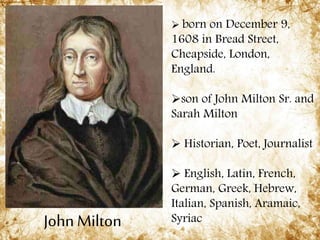
John Milton
 born on December 9,
1608 in Bread Street,
Cheapside, London,
England.
son of John Milton Sr. and
Sarah Milton
 Historian, Poet, Journalist
 English, Latin, French,
German, Greek, Hebrew,
Italian, Spanish, Aramaic,
Syriac
EDUCATION
 St. Paul's School
 In 1625, at the age of sixteen, Milton started
his studies at Christ's College, Cambridge.
Christ's College, Cambridge, where Milton studied from 1625 -`32
In 1632, Milton took his M.A. at Cambridge, after
which he retired to the family homes in London and
Horton, Buckinghamshire, for years of private study
and literary composition. His poem, "On Shakespeare",
was published in the same year in the Second Folio.
From this period hail also his "L'Allegro" and "Il
Penseroso." Milton's Comus, a masque, was performed
at Ludlow Castle in 1634, to be first published
anonymously in 1637.
MARRIAGE
Mary Powell (4 Children) 1642
Katherine Woodcock (1 child) 1656
Elizabeth Minshull 1663
WORKS
Paradise Lost
- chronicles Satan’s temptation of Adam and Eve and their
expulsion from Eden, is widely regarded as his masterpiece
and one of the greatest epic poems in world literature.
Since its first publication, the work has continually elicited
debate regarding its theological themes, political
commentary, and its depiction of the fallen angel Satan
who is often viewed as the protagonist of the work.
Milton(44) dictated the poem to a series of aides in his employ
Milton's poetry and prose
reflect deep personal
convictions, a passion for
freedom and self-
determination, and the urgent
issues and political turbulence
of his day. Writing in English,
Latin, Greek, and Italian, he
achieved international renown
within his lifetime, and his
celebrated Areopagitica (1644)
—written in condemnation of
pre-publication censorship—is
among history's most
influential and impassioned
defences of free speech and
freedom of the press.
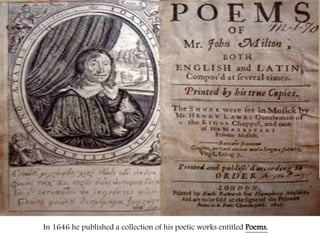
In 1646 he published a collection of his poetic works entitled Poems.
Poetry and Drama
1631: L'Allegro
1631: Il Penseroso
1634: A Mask Presented at Ludlow Castle,
1634 commonly known as Comus (a masque)
1638: Lycidas
1645: Poems of Mr John Milton, Both English and Latin
1655: On the Late Massacre in Piedmont
1667: Paradise Lost
1671: Paradise Regained
1671: Samson Agonistes
1673: Poems, &c, Upon Several Occasions
Prose
Of Reformation (1641)
Of Prelatical Episcopacy (1641)
Animadversions (1641)
The Reason of Church-Government Urged against
Prelaty (1642)
Apology for Smectymnuus (1642)
Doctrine and Discipline of Divorce (1643)
Judgement of Martin Bucer Concerning Divorce (1644)
Of Education (1644)
Areopagitica (1644)
Tetrachordon (1645)
Colasterion (1645)
The Tenure of Kings and Magistrates (1649)
Eikonoklastes (1649)
Defensio pro Populo Anglicano [First Defence] (1651)
Defensio Secunda [Second Defence] (1654)
A Treatise of Civil Power (1659)
The Likeliest Means to Remove Hirelings from the
Church (1659)
The Ready and Easy Way to Establish a Free
Commonwealth (1660)
Brief Notes Upon a Late Sermon (1660)
Accedence Commenced Grammar (1669)
History of Britain (1670)
Artis logicae plenior institutio [Art of Logic] (1672)
Of True Religion (1673)
Epistolae Familiaries (1674)
Prolusiones (1674)
A brief History of Moscovia, and other less known
Countries lying Eastward of Russia as far as Cathay,
gathered from the writings of several Eye-
witnesses (1682)[114]
De Doctrina Christiana (1823)
Milton died at the age 65 on the 9th of November 1674, and was buried at St Giles, Cripplegate.
Milton's cottage at Chalfont St. Giles, where Paradise Lost was completed.

John milton

  • 1.
    John Milton  bornon December 9, 1608 in Bread Street, Cheapside, London, England. son of John Milton Sr. and Sarah Milton  Historian, Poet, Journalist  English, Latin, French, German, Greek, Hebrew, Italian, Spanish, Aramaic, Syriac
  • 2.
    EDUCATION  St. Paul'sSchool  In 1625, at the age of sixteen, Milton started his studies at Christ's College, Cambridge.
  • 3.
    Christ's College, Cambridge,where Milton studied from 1625 -`32
  • 4.
    In 1632, Miltontook his M.A. at Cambridge, after which he retired to the family homes in London and Horton, Buckinghamshire, for years of private study and literary composition. His poem, "On Shakespeare", was published in the same year in the Second Folio. From this period hail also his "L'Allegro" and "Il Penseroso." Milton's Comus, a masque, was performed at Ludlow Castle in 1634, to be first published anonymously in 1637.
  • 5.
    MARRIAGE Mary Powell (4Children) 1642 Katherine Woodcock (1 child) 1656 Elizabeth Minshull 1663
  • 6.
    WORKS Paradise Lost - chroniclesSatan’s temptation of Adam and Eve and their expulsion from Eden, is widely regarded as his masterpiece and one of the greatest epic poems in world literature. Since its first publication, the work has continually elicited debate regarding its theological themes, political commentary, and its depiction of the fallen angel Satan who is often viewed as the protagonist of the work.
  • 7.
    Milton(44) dictated thepoem to a series of aides in his employ
  • 8.
    Milton's poetry andprose reflect deep personal convictions, a passion for freedom and self- determination, and the urgent issues and political turbulence of his day. Writing in English, Latin, Greek, and Italian, he achieved international renown within his lifetime, and his celebrated Areopagitica (1644) —written in condemnation of pre-publication censorship—is among history's most influential and impassioned defences of free speech and freedom of the press.
  • 9.
    In 1646 hepublished a collection of his poetic works entitled Poems.
  • 10.
    Poetry and Drama 1631:L'Allegro 1631: Il Penseroso 1634: A Mask Presented at Ludlow Castle, 1634 commonly known as Comus (a masque) 1638: Lycidas 1645: Poems of Mr John Milton, Both English and Latin 1655: On the Late Massacre in Piedmont 1667: Paradise Lost 1671: Paradise Regained
  • 11.
    1671: Samson Agonistes 1673:Poems, &c, Upon Several Occasions Prose Of Reformation (1641) Of Prelatical Episcopacy (1641) Animadversions (1641) The Reason of Church-Government Urged against Prelaty (1642) Apology for Smectymnuus (1642) Doctrine and Discipline of Divorce (1643) Judgement of Martin Bucer Concerning Divorce (1644) Of Education (1644)
  • 12.
    Areopagitica (1644) Tetrachordon (1645) Colasterion(1645) The Tenure of Kings and Magistrates (1649) Eikonoklastes (1649) Defensio pro Populo Anglicano [First Defence] (1651) Defensio Secunda [Second Defence] (1654) A Treatise of Civil Power (1659) The Likeliest Means to Remove Hirelings from the Church (1659) The Ready and Easy Way to Establish a Free Commonwealth (1660)
  • 13.
    Brief Notes Upona Late Sermon (1660) Accedence Commenced Grammar (1669) History of Britain (1670) Artis logicae plenior institutio [Art of Logic] (1672) Of True Religion (1673) Epistolae Familiaries (1674) Prolusiones (1674) A brief History of Moscovia, and other less known Countries lying Eastward of Russia as far as Cathay, gathered from the writings of several Eye- witnesses (1682)[114] De Doctrina Christiana (1823)
  • 14.
    Milton died atthe age 65 on the 9th of November 1674, and was buried at St Giles, Cripplegate.
  • 15.
    Milton's cottage atChalfont St. Giles, where Paradise Lost was completed.