An Introduction to
Solfege
What’s Solfege?
● A method of naming pitches
● For example: the C major scale can be named
do-re-mi-fa-so-la-ti-do, with C corresponding to do, D
to re, etc.
● These syllables are easier to sing than the actual note
names, and give the melody a more memorable
“song-like” quality.
● There are two solfege systems: movable “do” and
fixed “do”
Learn more: http://musl.ink/a31
The Origins of Solfege
● Solfege originated nearly a thousand years ago.
● An Italian monk named Guido d’Arezzo noticed that the
beginning of each phrase in the Latin hymn “Ut Queant Laxis”
began on each successive step of the scale.
● He developed a six-note ascending scale based on the first
pitch of each phrase.
● The first syllable of the original (“ut”) was eventually changed to
“do”.
● With this system, one could sing the hymn using these
syllables, instead of the note names.
Learn more: http://musl.ink/a31
What Information Does Solfege Give You?
● Suppose you hear two notes, and can
recognize them as “so” going up to “do”.
Here’s what this tells you:
● The pitch movement is from scale degree 5 to
1 (dominant to tonic)
● This implies harmonic (chord) motion of V-I /
V-I
● The interval is a perfect fourth
Learn more: http://musl.ink/a31
Two Solfege Systems: Movable “Do”
and Fixed “Do”
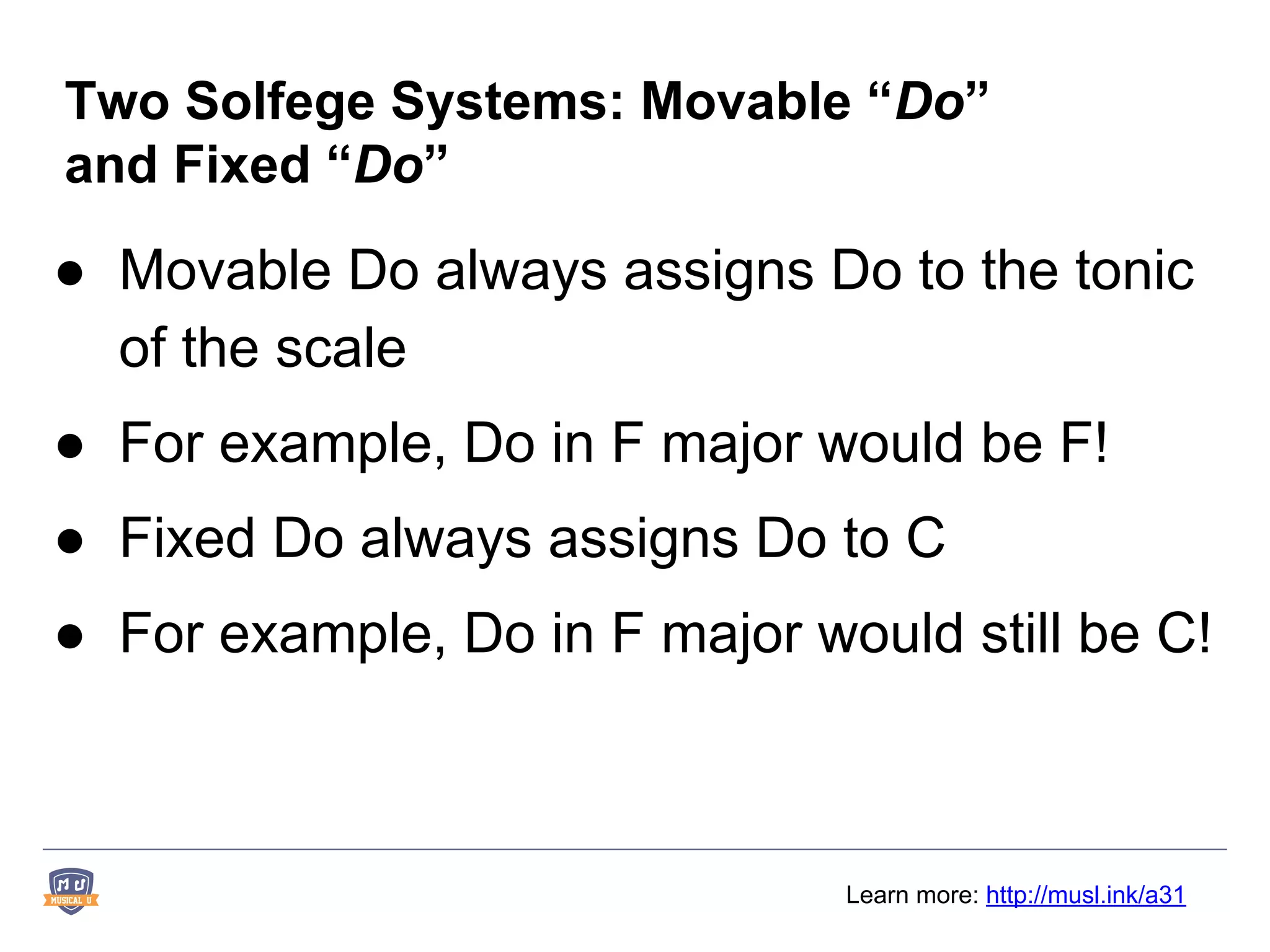
● Movable Do always assigns Do to the tonic
of the scale
● For example, Do in F major would be F!
● Fixed Do always assigns Do to C
● For example, Do in F major would still be C!
Learn more: http://musl.ink/a31
Advantages of Movable “Do”
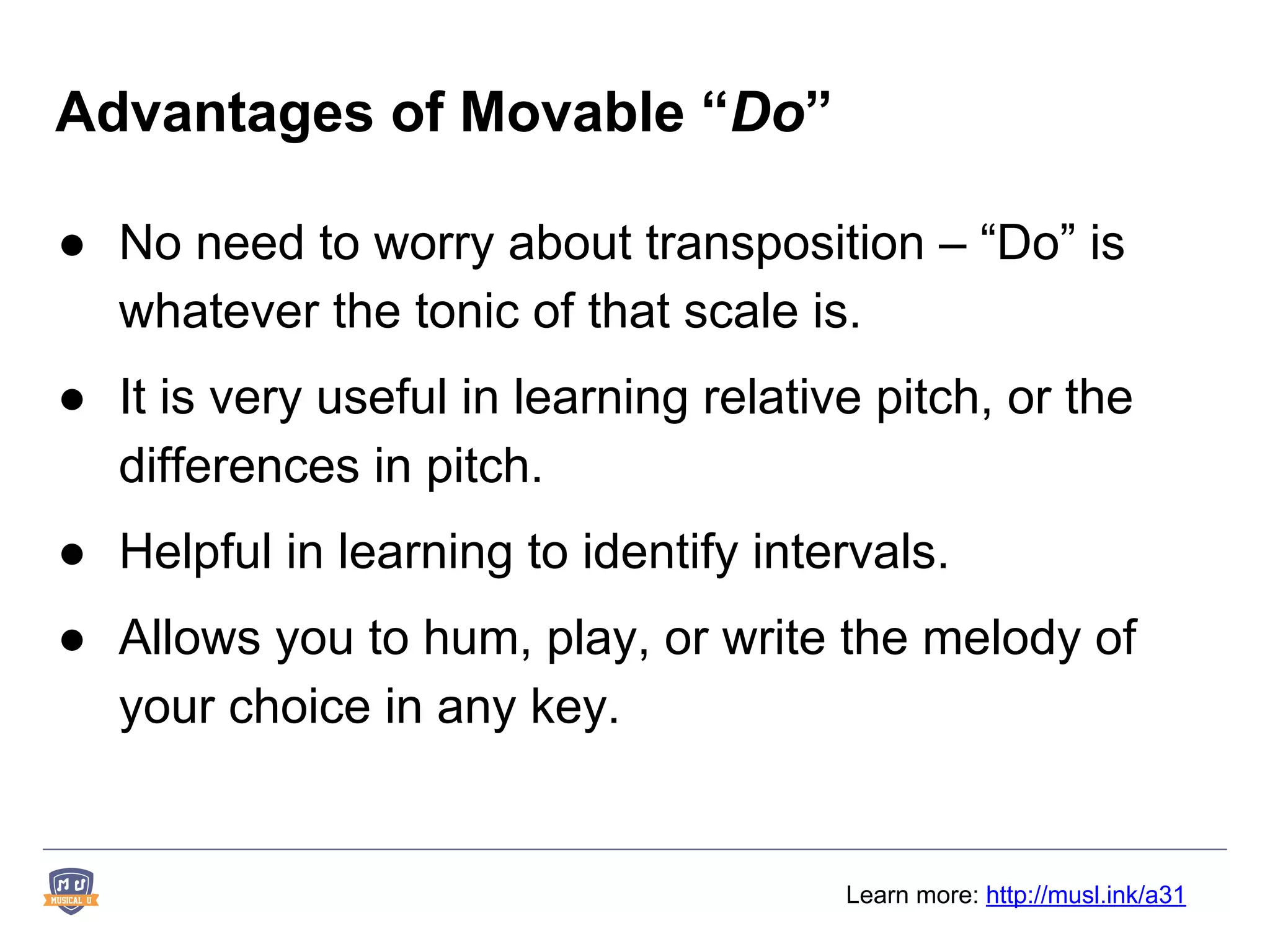
● No need to worry about transposition – “Do” is
whatever the tonic of that scale is.
● It is very useful in learning relative pitch, or the
differences in pitch.
● Helpful in learning to identify intervals.
● Allows you to hum, play, or write the melody of
your choice in any key.
Learn more: http://musl.ink/a31
Solfege in Minor Keys
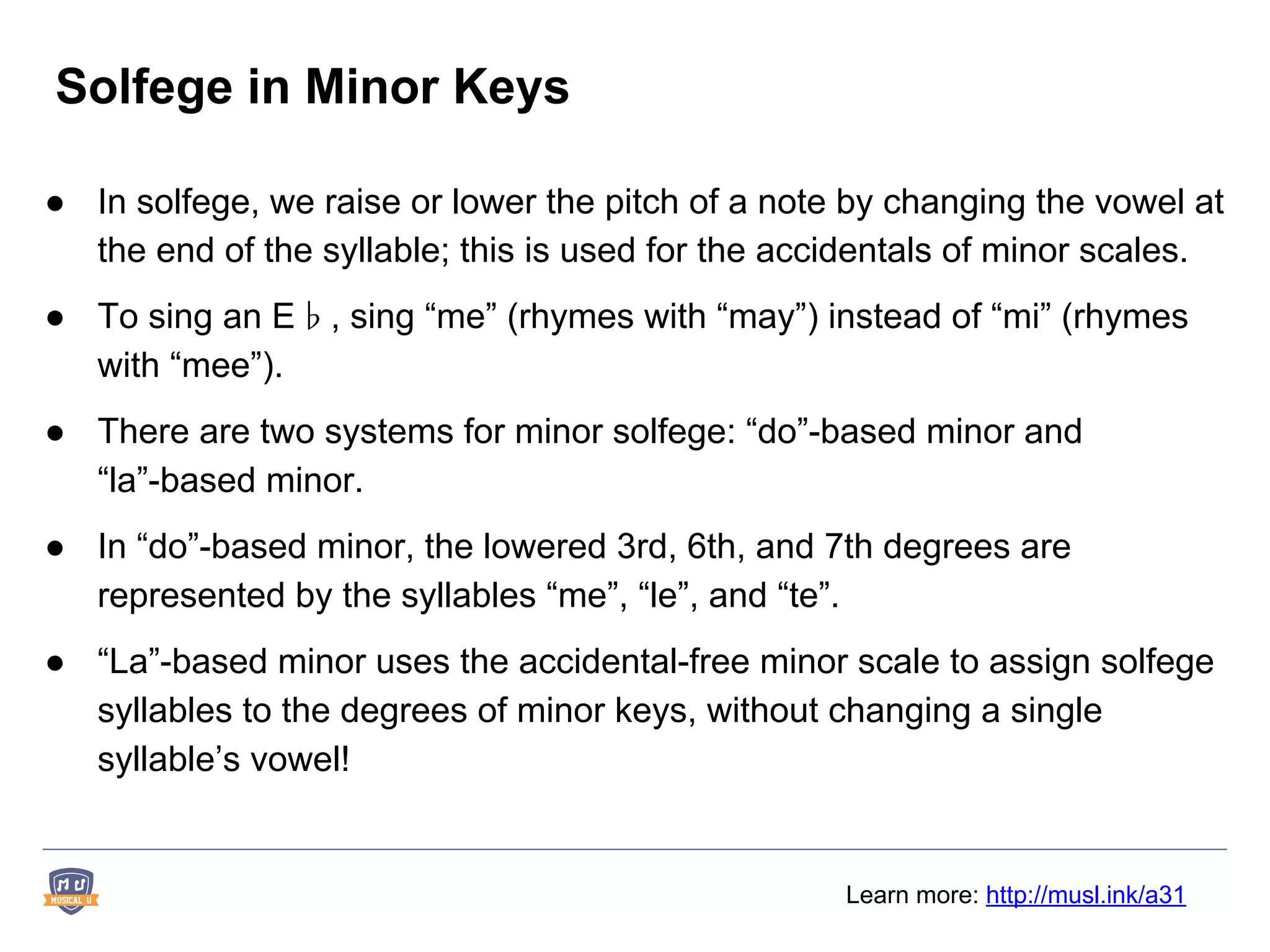
● In solfege, we raise or lower the pitch of a note by changing the vowel at
the end of the syllable; this is used for the accidentals of minor scales.
● To sing an E♭, sing “me” (rhymes with “may”) instead of “mi” (rhymes
with “mee”).
● There are two systems for minor solfege: “do”-based minor and
“la”-based minor.
● In “do”-based minor, the lowered 3rd, 6th, and 7th degrees are
represented by the syllables “me”, “le”, and “te”.
● “La”-based minor uses the accidental-free minor scale to assign solfege
syllables to the degrees of minor keys, without changing a single
syllable’s vowel!
Learn more: http://musl.ink/a31
6 Great Reasons to Learn Solfege
● Recognize patterns in music
● Improve your sight-singing skills
● Transcribe music
● Learn relative pitch
● Recall melodies at will
● Improve your composing
Learn more: http://musl.ink/a31
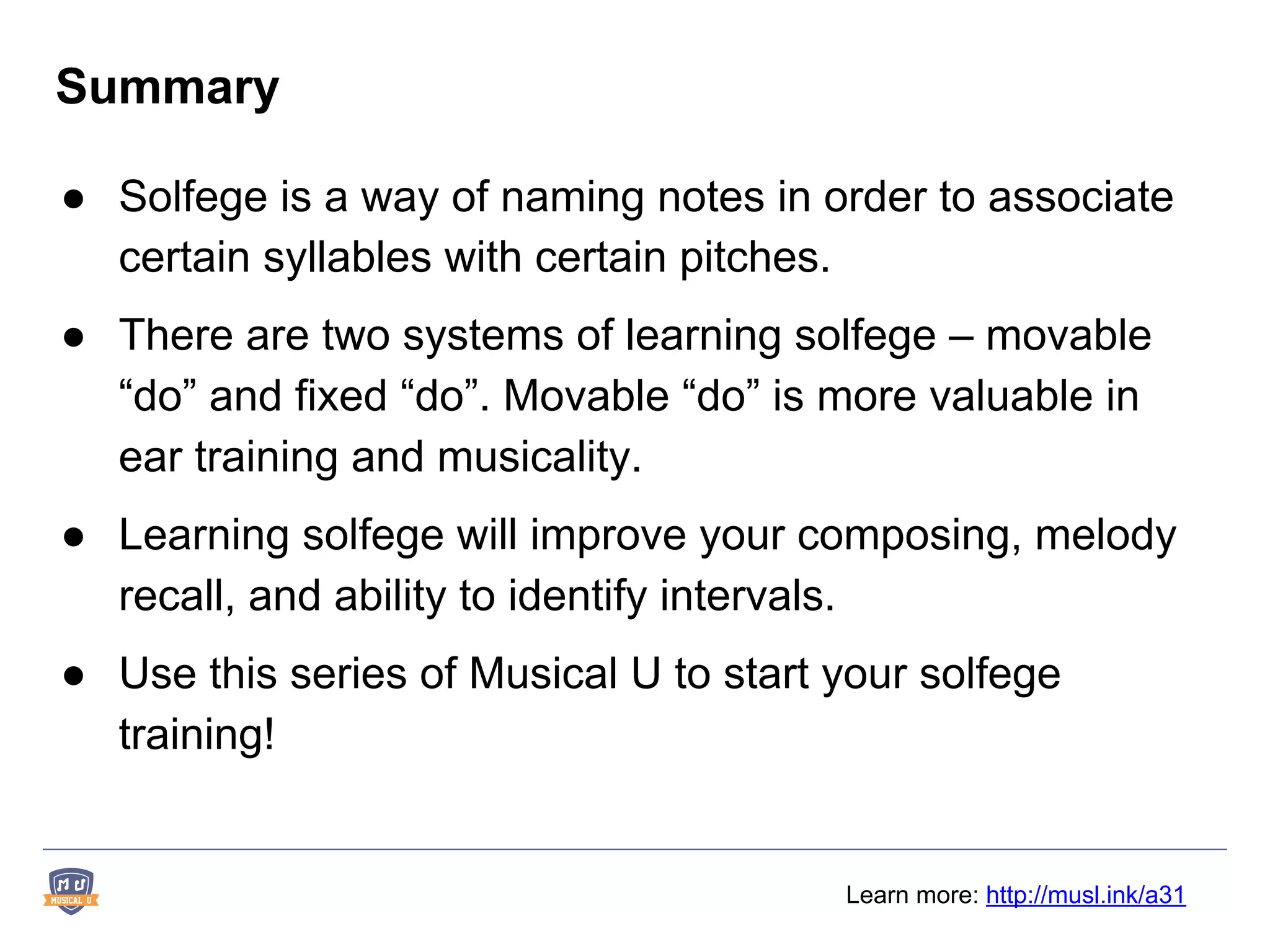
Summary
● Solfege is a way of naming notes in order to associate
certain syllables with certain pitches.
● There are two systems of learning solfege – movable
“do” and fixed “do”. Movable “do” is more valuable in
ear training and musicality.
● Learning solfege will improve your composing, melody
recall, and ability to identify intervals.
● Use this series of Musical U to start your solfege
training!
Learn more: http://musl.ink/a31
Learn More

Introduction to Solfege

  • 1.
  • 2.
    What’s Solfege? ● Amethod of naming pitches ● For example: the C major scale can be named do-re-mi-fa-so-la-ti-do, with C corresponding to do, D to re, etc. ● These syllables are easier to sing than the actual note names, and give the melody a more memorable “song-like” quality. ● There are two solfege systems: movable “do” and fixed “do” Learn more: http://musl.ink/a31
  • 3.
    The Origins ofSolfege ● Solfege originated nearly a thousand years ago. ● An Italian monk named Guido d’Arezzo noticed that the beginning of each phrase in the Latin hymn “Ut Queant Laxis” began on each successive step of the scale. ● He developed a six-note ascending scale based on the first pitch of each phrase. ● The first syllable of the original (“ut”) was eventually changed to “do”. ● With this system, one could sing the hymn using these syllables, instead of the note names. Learn more: http://musl.ink/a31
  • 4.
    What Information DoesSolfege Give You? ● Suppose you hear two notes, and can recognize them as “so” going up to “do”. Here’s what this tells you: ● The pitch movement is from scale degree 5 to 1 (dominant to tonic) ● This implies harmonic (chord) motion of V-I / V-I ● The interval is a perfect fourth Learn more: http://musl.ink/a31
  • 5.
    Two Solfege Systems:Movable “Do” and Fixed “Do” ● Movable Do always assigns Do to the tonic of the scale ● For example, Do in F major would be F! ● Fixed Do always assigns Do to C ● For example, Do in F major would still be C! Learn more: http://musl.ink/a31
  • 6.
    Advantages of Movable“Do” ● No need to worry about transposition – “Do” is whatever the tonic of that scale is. ● It is very useful in learning relative pitch, or the differences in pitch. ● Helpful in learning to identify intervals. ● Allows you to hum, play, or write the melody of your choice in any key. Learn more: http://musl.ink/a31
  • 7.
    Solfege in MinorKeys ● In solfege, we raise or lower the pitch of a note by changing the vowel at the end of the syllable; this is used for the accidentals of minor scales. ● To sing an E♭, sing “me” (rhymes with “may”) instead of “mi” (rhymes with “mee”). ● There are two systems for minor solfege: “do”-based minor and “la”-based minor. ● In “do”-based minor, the lowered 3rd, 6th, and 7th degrees are represented by the syllables “me”, “le”, and “te”. ● “La”-based minor uses the accidental-free minor scale to assign solfege syllables to the degrees of minor keys, without changing a single syllable’s vowel! Learn more: http://musl.ink/a31
  • 8.
    6 Great Reasonsto Learn Solfege ● Recognize patterns in music ● Improve your sight-singing skills ● Transcribe music ● Learn relative pitch ● Recall melodies at will ● Improve your composing Learn more: http://musl.ink/a31
  • 9.
    Summary ● Solfege isa way of naming notes in order to associate certain syllables with certain pitches. ● There are two systems of learning solfege – movable “do” and fixed “do”. Movable “do” is more valuable in ear training and musicality. ● Learning solfege will improve your composing, melody recall, and ability to identify intervals. ● Use this series of Musical U to start your solfege training! Learn more: http://musl.ink/a31
  • 10.