Music GCSE Edexcel
LENA STEINBERG
AREA OF STUDY 1
WESTERN CLASSICAL MUSIC
And the Glory of the Lord (from
‘Messiah’) – Handel
Musical Features:
◦ Imitation
◦ Sequences
◦ Syllabic and Melismatic word setting
And the Glory of the Lord (from
‘Messiah’) – Handel
Melody:
◦ 4 Melodies:
◦ Melody 1 – Based on triad of A major – Syllabic – Sung by all parts, started by the Altos
◦ Melody 2 – Descending sequences – Melismattic - Sung by all parts, started by the Altos
◦ Melody 3 – Repetition, featuring sequences – Syllabic and Melismattic - Sung by all parts, started by the
Altos
◦ Melody 4 – Pedal note – repeated – syllabic – mainly sung by tenors and basses
And the Glory of the Lord (from
‘Messiah’) – Handel
Rhythm:
◦ Driving regular beat on crothcht rhythms – matches stately mood
◦ Use of HEMIOLA – notes grouped in 2 beats, instead of the 3 beats of the time signature
And the Glory of the Lord (from
‘Messiah’) – Handel
Structure:
◦ Based on four contrasting melodies (See melody slide)
And the Glory of the Lord (from
‘Messiah’) – Handel
Instrumentation:
◦ Written for four voices – Soprano, Alto, Tenor and Bass
◦ Featuring String orchestra (Violins, Violas and Cellos)
◦ Also Featuring Basso continuo (Harpsichord or Organ)
And the Glory of the Lord (from
‘Messiah’) – Handel
Dynamics:
◦ No dynamics are printed on the score
◦ However, terraced dynamics are achieved by adding and taking away parts and instruments
And the Glory of the Lord (from
‘Messiah’) – Handel
Harmony:
◦ Clear A major harmonies – minor is avoided
◦ Perfect cadences during the piece (V-I)
◦ Plagal cadence at end of piece (IV-I)
And the Glory of the Lord (from
‘Messiah’) – Handel
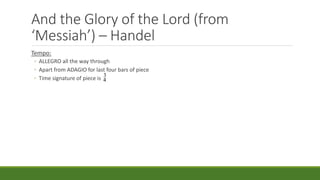
Tempo:
◦ ALLEGRO all the way through
◦ Apart from ADAGIO for last four bars of piece
◦ Time signature of piece is
And the Glory of the Lord (from
‘Messiah’) – Handel
Texture:
◦ Alternating homophonic and polyphonic sections
◦ Ends with all part playing together - Homophonic
Symphony No.40 in G minor - Mozart
Musical Features:
◦ Pedal Notes are used in the development
Symphony No.40 in G minor - Mozart
Melody:
◦ Two subjects
◦ Sonata Form (see structure slide)
Symphony No.40 in G minor - Mozart
Rhythm:
◦ Scale passages and rising sequences
◦ 1st subject – crochet and quaver rhythms
◦ 2nd subject – Slower, legato rhythms
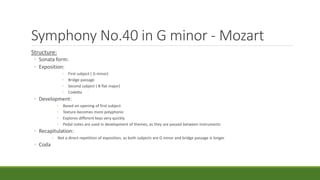
Symphony No.40 in G minor - Mozart
Structure:
◦ Sonata form:
◦ Exposition:
◦ First subject ( G minor)
◦ Bridge passage
◦ Second subject ( B flat major)
◦ Codetta
◦ Development:
◦ Based on opening of first subject
◦ Texture becomes more polyphonic
◦ Explores different keys very quickly
◦ Pedal notes are used in development of themes, as they are passed between instruments
◦ Recapitulation:
◦ Not a direct repetition of exposition, as both subjects are G minor and bridge passage is longer
◦ Coda
Symphony No.40 in G minor - Mozart
Instrumentation:
◦ Normal orchestra
◦ Only 1 Flute
◦ No trumpets
◦ No Timps
Symphony No.40 in G minor - Mozart
Dynamics:
◦ Starts off p
◦ Lots of dynamic contrast
◦ Use of sfz and accents
Symphony No.40 in G minor - Mozart
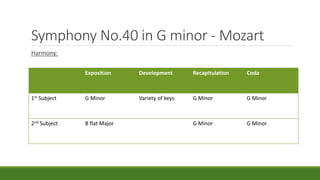
Harmony:
Exposition Development Recapitulation Coda
1st Subject G Minor Variety of keys G Minor G Minor
2nd Subject B flat Major G Minor G Minor
Symphony No.40 in G minor - Mozart
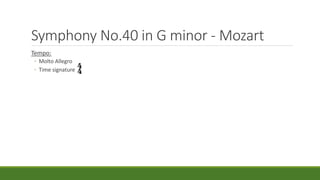
Tempo:
◦ Molto Allegro
◦ Time signature
Symphony No.40 in G minor - Mozart
Texture:
◦ Mainly Melody with accompaniment
◦ Some homophonic sections
◦ Polyphonic in development
Prelude No.15 in D flat Major
Musical Features:
◦ Careful expressive use od pedals, particularly in the sustaining pedal
◦ SOSTENUTO – sustained
◦ ACCIACATURA – “Crushing note” – melodic decoration
◦ PEDAL NOTE – A flat in the piece
Prelude No.15 in D flat Major
Melody:
◦ A section
◦ Falling motif to represent the sadness
◦ Elegiac melody in right hand
◦ B section
◦ Mood is dark and stormy
◦ Melody in left hand
◦ Equally balanced 4 bar phrases
◦ Falling phrases which represent rain (nicknamed “Raindrop Prelude”)
Prelude No.15 in D flat Major
Rhythm:
◦ Repeated quavers
◦ Sustained tempo
◦ 4 beats in a bar which always stays the same
◦ Dotted rhythms in the A section
◦ Crochet Rhythms in the B section
◦ Septuplets are used
◦ Rubarto
Prelude No.15 in D flat Major
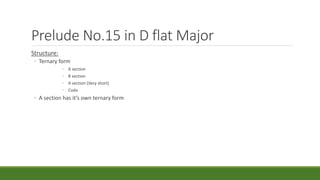
Structure:
◦ Ternary form
◦ A section
◦ B section
◦ A section (Very short)
◦ Coda
◦ A section has it’s own ternary form
Prelude No.15 in D flat Major
Instrumentation:
◦ Solo piano
Prelude No.15 in D flat Major
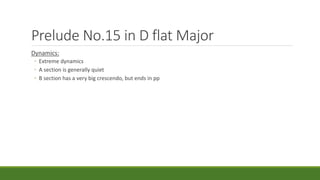
Dynamics:
◦ Extreme dynamics
◦ A section is generally quiet
◦ B section has a very big crescendo, but ends in pp
Prelude No.15 in D flat Major
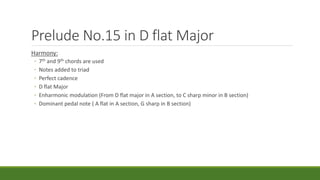
Harmony:
◦ 7th and 9th chords are used
◦ Notes added to triad
◦ Perfect cadence
◦ D flat Major
◦ Enharmonic modulation (From D flat major in A section, to C sharp minor in B section)
◦ Dominant pedal note ( A flat in A section, G sharp in B section)
Prelude No.15 in D flat Major
Tempo
◦ Use of rubarto
◦ Time signature is
Prelude No.15 in D flat Major
Texture:
◦ Melody dominated homophony
◦ Homophonic
◦ Melody with accompaniment
◦ Monophonic bar in second A section
Area of Study 2
MUSIC IN THE 20TH CENTURY
Peripetie - Schoenberg
Melody:
◦ Use of hexachords
◦ Klangfarben melodie – Melody moves between parts
◦ Word painting
◦ Canon
Peripetie - Schoenberg
Rhythm:
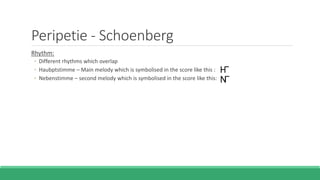
◦ Different rhythms which overlap
◦ Haubptstimme – Main melody which is symbolised in the score like this :
◦ Nebenstimme – second melody which is symbolised in the score like this:
Peripetie - Schoenberg
Structure:
◦ Free rondo
◦ A
◦ B
◦ A1
◦ C
◦ A2
Peripetie - Schoenberg
Instrumentation:
◦ Written for a very large orchestra
◦ Unusual instrumentation
◦ 3 flutes
◦ Cor anglais
◦ 3 bassoons
◦ Piccolos
◦ Instruments played at extremes of their registers
◦ Schoenberg is very specific with his tones and timbre
◦ Hi-hat played with cello bow
◦ Muted but playing ff
◦ Glissando
◦ Tremolo
Peripetie - Schoenberg
Dynamics:
◦ Extremes
◦ Sudden changes (e.g. from fff to pp)
Peripetie - Schoenberg
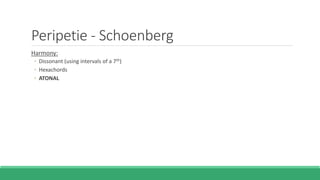
Harmony:
◦ Dissonant (using intervals of a 7th)
◦ Hexachords
◦ ATONAL
Peripetie - Schoenberg
Tempo:
◦ Changes throughout the piece
◦ Sehr rash (very quick)
◦ Etwas rhuiger (a little slower)
◦ Heftig (Quick)
Peripetie - Schoenberg
Texture:
◦ Homophonic and solo sections
◦ Polyphonic sections
Something’s coming - Bernstein
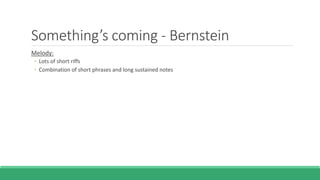
Melody:
◦ Lots of short riffs
◦ Combination of short phrases and long sustained notes
Something’s coming - Bernstein
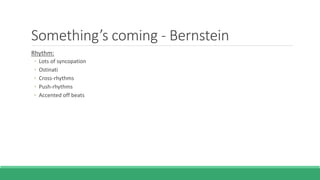
Rhythm:
◦ Lots of syncopation
◦ Ostinati
◦ Cross-rhythms
◦ Push-rhythms
◦ Accented off beats
Something’s coming - Bernstein
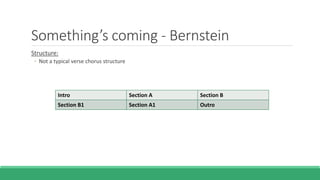
Structure:
◦ Not a typical verse chorus structure
Intro Section A Section B
Section B1 Section A1 Outro
Something’s coming - Bernstein
Instrumentation:
◦ Solo male singer (tenor)
◦ Large orchestra (however this is hidden from the score)
Something’s coming - Bernstein
Dynamics:
◦ Tony starts singing pp
◦ Gradually gets louder
◦ Fades out at end
Something’s coming - Bernstein
Harmony:
◦ D major
◦ Use of tritone – augmented 4th
◦ Jazz harmony – added blues notes
Something’s coming - Bernstein
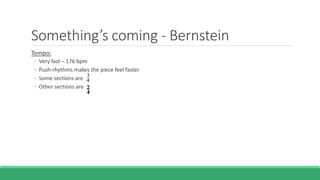
Tempo:
◦ Very fast – 176 bpm
◦ Push-rhythms makes the piece feel faster
◦ Some sections are
◦ Other sections are
Something’s coming - Bernstein
Texture:
◦ Melody with accompaniment
Electric Counterpoint - Reich
Melody:
◦ Repeated melodies (motifs)
◦ Resultant melodies
◦ Guitar 3 uses additive melody
◦ Two or three notes are added each bar, until the whole riff can be heard
Electric Counterpoint - Reich
Rhythm:
◦ Layered ostinato
◦ Phase shifted
◦ Displaced
◦ Minimalist
◦ Interviewing rhythms
Electric Counterpoint - Reich
Structure:
◦ Divided into two main sections with a coda
◦ These two sections are further divided into four smaller sections
◦ Each of which is defined by a change in texture or key
Electric Counterpoint - Reich
Instrumentation:
◦ 10 guitars all together
◦ 1 live guitar
◦ 7 electric guitars
◦ 2 bass guitars
◦ Each guitar enters one after each other (cannon)
Electric Counterpoint - Reich
Dynamics:
◦ Not many dynamics printed
◦ Dynamics achieved by layering instruments
Electric Counterpoint - Reich
Harmony:
◦ Diatonic harmonies
◦ Tonal ambiguity
◦ Bass guitar confirms the key is E minor
◦ AEOLIAN MODE
◦ Changes to C minor in second section
◦ Finishes with a E5 chord (No third)
Electric Counterpoint - Reich
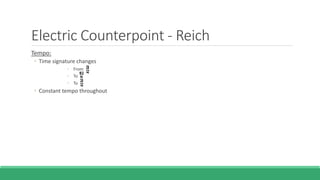
Tempo:
◦ Time signature changes
◦ From
◦ To
◦ To
◦ Constant tempo throughout
Electric Counterpoint - Reich
Texture:
◦ Multi-layered texture is achieved by each track being multi-tracked
◦ Made of short motifs that are repeated
◦ Counter point (polyphonic)
◦ Panning is used
AREA OF STUDY 3
POPULAR MUSIC IN CONTEXT
All Blues - Davis
Melody:
◦ The main melody (HEAD) and the solos are all played over the 12-bar-blues chord sequence (see
harmony slide)
◦ Based on the notes of the Mixolydian mode on G
◦ The improvisations are ornamented and combine riffs
All Blues - Davis
Rhythm:
◦ The rhythms section provides the harmony and rhythmic background
◦ The rhythmic section provides the COMPING playing the background chords and rhythms
All Blues - Davis
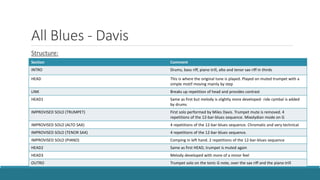
Structure:
Section Comment
INTRO Drums, bass riff, piano trill, alto and tenor sax riff in thirds
HEAD This is where the original tune is played. Played on muted trumpet with a
simple motif moving mainly by step
LINK Breaks up repetition of head and provides contrast
HEAD1 Same as first but melody is slightly more developed- ride cymbal is added
by drums
IMPROVISED SOLO (TRUMPET) First solo performed by Miles Davis. Trumpet mute is removed. 4
repetitions of the 12-bar-blues sequence. Mixolydian mode on G
IMPROVISED SOLO (ALTO SAX) 4 repetitions of the 12-bar-blues sequence. Chromatic and very technical
IMPROVISED SOLO (TENOR SAX) 4 repetitions of the 12-bar-blues sequence.
IMPROVISED SOLO (PIANO) Comping in left hand. 2 repetitions of the 12-bar-blues sequence
HEAD2 Same as first HEAD, trumpet is muted again
HEAD3 Melody developed with more of a minor feel
OUTRO Trumpet solo on the tonic G note, over the sax riff and the piano trill
All Blues - Davis
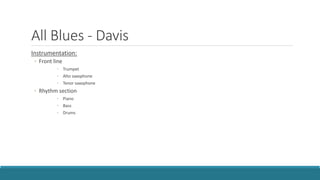
Instrumentation:
◦ Front line
◦ Trumpet
◦ Alto saxophone
◦ Tenor saxophone
◦ Rhythm section
◦ Piano
◦ Bass
◦ Drums
All Blues - Davis
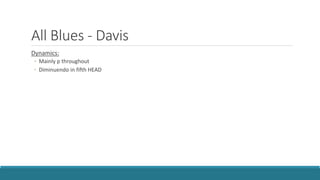
Dynamics:
◦ Mainly p throughout
◦ Diminuendo in fifth HEAD
All Blues - Davis
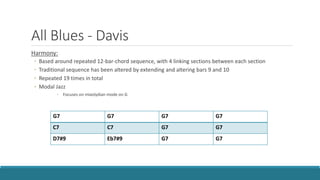
Harmony:
◦ Based around repeated 12-bar-chord sequence, with 4 linking sections between each section
◦ Traditional sequence has been altered by extending and altering bars 9 and 10
◦ Repeated 19 times in total
◦ Modal Jazz
◦ Focuses on mixolydian mode on G
G7 G7 G7 G7
C7 C7 G7 G7
D7#9 Eb7#9 G7 G7
All Blues - Davis
Tempo:
◦ 156 bpm
◦ Feels like dotted rhythm
◦ Jazz waltz
◦ Time signature is
All Blues - Davis
Texture:
◦ Made up of riffs
◦ 3 riffs are used
◦ 1st – G D ED F DED – played by double bass
◦ 2nd – D/B E/C F/D E/C – played by alto and tenor saxophones in thirds
Grace – Jeff Buckley
Melody:
◦ Vocal melody in the verse has a limited pitch range, becoming higher in the pre chorus
◦ A “whispering” backing vocal adds variety to the melody in the chorus
◦ The telephone EQ effect added to the vocal melody in the middle 8 gives a harsh and distant effect
◦ Verse 3 sees the pitch of the vocal melody becoming higher
◦ Extremely high pitched vocal (FALSETTO) improvisation in the outro including melisma
Grace – Jeff Buckley
Rhythm:
◦ Rhythm of the intro is highlighted by the acoustic guitar and hi-hat cymbals, which “drive” the song
forward
◦ During the verse, more emphasis is placed on the toms of the drum kit
◦ A drum roll leads into the middle 8 section
◦ Cymbals used more prominently in verse 3
◦ The unifying rhythm of the song is a solid rock beat
Grace – Jeff Buckley
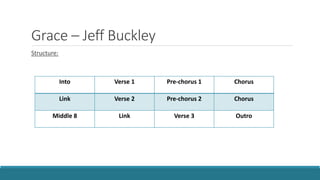
Structure:
Into Verse 1 Pre-chorus 1 Chorus
Link Verse 2 Pre-chorus 2 Chorus
Middle 8 Link Verse 3 Outro
Grace – Jeff Buckley
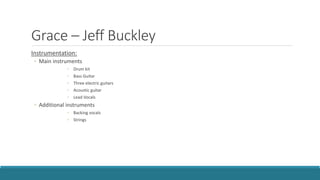
Instrumentation:
◦ Main instruments
◦ Drum kit
◦ Bass Guitar
◦ Three electric guitars
◦ Acoustic guitar
◦ Lead Vocals
◦ Additional instruments
◦ Backing vocals
◦ Strings
Grace – Jeff Buckley
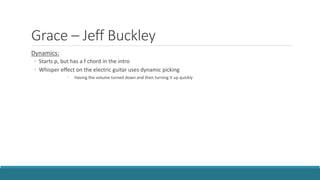
Dynamics:
◦ Starts p, but has a f chord in the intro
◦ Whisper effect on the electric guitar uses dynamic picking
◦ Having the volume turned down and then turning it up quickly
Grace – Jeff Buckley
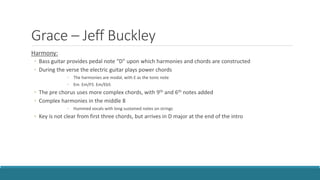
Harmony:
◦ Bass guitar provides pedal note “D” upon which harmonies and chords are constructed
◦ During the verse the electric guitar plays power chords
◦ The harmonies are modal, with E as the tonic note
◦ Em Em/F5 Em/Eb5
◦ The pre chorus uses more complex chords, with 9th and 6th notes added
◦ Complex harmonies in the middle 8
◦ Hummed vocals with long sustained notes on strings
◦ Key is not clear from first three chords, but arrives in D major at the end of the intro
Grace – Jeff Buckley
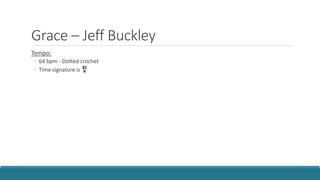
Tempo:
◦ 64 bpm - Dotted crochet
◦ Time signature is
Grace – Jeff Buckley
Texture:
◦ Textural contrast is created when parts drop out
◦ Texture in verse is thinner
◦ Thick polyphonic texture in middle 8
Why does my heart feel so bad? - Moby
Melody:
◦ Piano provides an accompaniment to the vocal sample with a synthesiser pad doubling some of the
piano notes, but also takes on the role of the melody in places
◦ There are elements of call and response between the piano and vocal sample
Why does my heart feel so bad? - Moby
Rhythm:
◦ Hip-hop drum loop used throughout, also called a back beat
◦ Piano accompaniment changes to syncopated rhythm in verse 1
Why does my heart feel so bad? - Moby
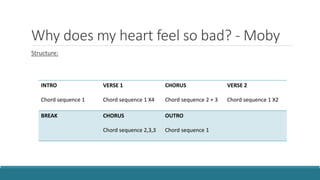
Structure:
INTRO
Chord sequence 1
VERSE 1
Chord sequence 1 X4
CHORUS
Chord sequence 2 + 3
VERSE 2
Chord sequence 1 X2
BREAK CHORUS
Chord sequence 2,3,3
OUTRO
Chord sequence 1
Why does my heart feel so bad? - Moby
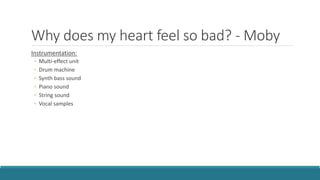
Instrumentation:
◦ Multi-effect unit
◦ Drum machine
◦ Synth bass sound
◦ Piano sound
◦ String sound
◦ Vocal samples
Why does my heart feel so bad? - Moby
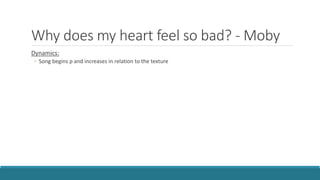
Dynamics:
◦ Song begins p and increases in relation to the texture
Why does my heart feel so bad? - Moby
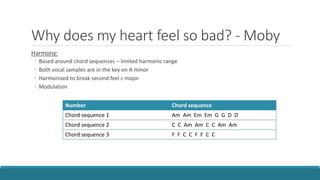
Harmony:
◦ Based around chord sequences – limited harmonic range
◦ Both vocal samples are in the key on A minor
◦ Harmonised to break second feel c major
◦ Modulation
Number Chord sequence
Chord sequence 1 Am Am Em Em G G D D
Chord sequence 2 C C Am Am C C Am Am
Chord sequence 3 F F C C F F C C
Why does my heart feel so bad? - Moby
Tempo:
◦ Constant throughout at 98 bpm
◦ Time signature is
Why does my heart feel so bad? - Moby
Texture:
◦ Instruments come in and drop out for textual contrast
◦ Sustained chords
◦ Static chords
◦ Telephone EQ effect
◦ Break
◦ Delay effect
◦ EQ
◦ Reverb
AREA OF STUDY 4
WORLD MUSIC
Skye Waulking song - Capercaillie
Melody:
◦ Melodic lines are played in the folk style
◦ Instruments improvise around melody
◦ Typical features of a walking song are used:
◦ Vocables
◦ Repetition of each line of the verse
◦ Slow rhythm
Skye Waulking song - Capercaillie
Rhythm:
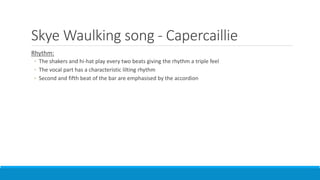
◦ The shakers and hi-hat play every two beats giving the rhythm a triple feel
◦ The vocal part has a characteristic lilting rhythm
◦ Second and fifth beat of the bar are emphasised by the accordion
Skye Waulking song - Capercaillie
Structure:
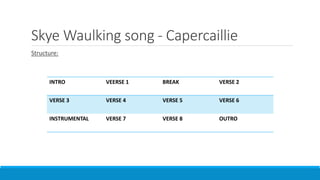
INTRO VEERSE 1 BREAK VERSE 2
VERSE 3 VERSE 4 VERSE 5 VERSE 6
INSTRUMENTAL VERSE 7 VERSE 8 OUTRO
Skye Waulking song - Capercaillie
Instrumentation:
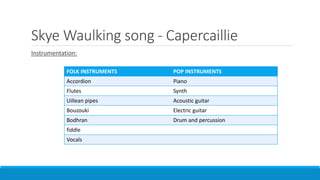
FOLK INSTRUMENTS POP INSTRUMENTS
Accordion Piano
Flutes Synth
Uillean pipes Acoustic guitar
Bouzouki Electric guitar
Bodhran Drum and percussion
fiddle
Vocals
Skye Waulking song - Capercaillie
Dynamics:
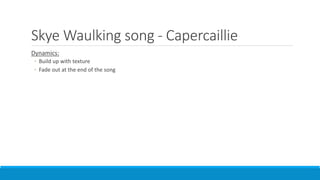
◦ Build up with texture
◦ Fade out at the end of the song
Skye Waulking song - Capercaillie
Harmony:
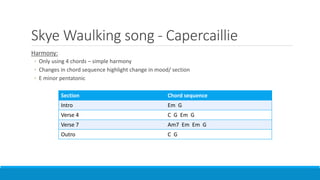
◦ Only using 4 chords – simple harmony
◦ Changes in chord sequence highlight change in mood/ section
◦ E minor pentatonic
Section Chord sequence
Intro Em G
Verse 4 C G Em G
Verse 7 Am7 Em Em G
Outro C G
Skye Waulking song - Capercaillie
Tempo:
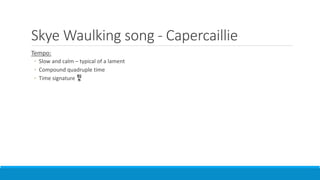
◦ Slow and calm – typical of a lament
◦ Compound quadruple time
◦ Time signature
Skye Waulking song - Capercaillie
Texture:
◦ Heterophonic – in instruments
◦ Improvised counterpoint around melody
◦ Monophonic bar before verse
◦ Counter melody
Rag Desh – Version 1 - Anoushka Shankar
Instruments:
◦ Sitar
◦ Tabla
Rag Desh – Version 1 - Anoushka Shankar
ALAP:
◦ Slow and unmetered
◦ Unaccompanied sitar explores the first notes of the raga
◦ Free rhythms sound improvised, due to a lack of a regular pulse
◦ Some decoration to melody
Rag Desh – Version 1 - Anoushka Shankar
GAT 1:
◦ Sitar plays fixed composition rather than improvisation, but decorates melody with flourishes and
ornaments
◦ Medium tempo
◦ Tabla enters playing 10 beat JHAPTAL tala with decoration
◦ There is dialogue between sitar and tabla
Rag Desh – Version 1 - Anoushka Shankar
GAT 2:
◦ Faster tempo
◦ Tabla now switches to TIN TAL tala
Rag Desh – Version 1 - Anoushka Shankar
JHALLA:
◦ Drone strings are used on the sitar which are strummed providing a rhythmic effect
◦ Piece ends with a TIHAI
◦ Phrase which is played three times across the beat ending on the first beat of the cycle
Rag Desh – Version 2 – Chiranji Lal
Tanwar
Instruments:
◦ Voice
◦ Sarangi
◦ Sarod
◦ Pakhawaj
◦ Cymbals
◦ Tabla
Rag Desh – Version 2 – Chiranji Lal
Tanwar
ALAP:
◦ Short introduction as the saraod player, then the singer, vocalise the melody, based ont eh notes of the
raga
◦ Free time
◦ A version of the chorus from the song
Rag Desh – Version 2 – Chiranji Lal
Tanwar
BHAJAN:
◦ A fixed composition
◦ Song in verse form, with the first lines used as a refrain
◦ Tabla plays KEHERWA table
◦ Sarod and sarangi play solo passages between verses
◦ Dynamics and tempo increase
◦ Music becomes faster and more exiting, as the cymbals play more frequently
Rag Desh – Version 3 – Wertheimer &
Gorn
Instruments:
◦ Bansuri
◦ Esraj
◦ Tambura
◦ Tabla
Rag Desh – Version 3 – Wertheimer &
Gorn
ALAP:
◦ Slow and unmetered
◦ Drone is established by tambura
◦ Bansuri enters exploring the notes of the raga
Rag Desh – Version 3 – Wertheimer &
Gorn
GAT 1:
◦ Slow tempo
◦ Bansuri plays lyrical, unaccompanied melody
◦ The tabla enters playing RUPAK tala
◦ Bansuri and tabla players embellish and improvise upon their original patters, instruments then swap;
Bansuri improvises, table accompanies
Rag Desh – Version 3 – Wertheimer &
Gorn
GAT 2:
◦ Fast tempo
◦ Tabla now uses EKTAL tala
◦ Bansuri plays an elaborate melody with wide ranging pitch, fast scale passages (tans) and slides
◦ Several THIAIs bring music to a close
◦ Drone continues shortly after melody ends
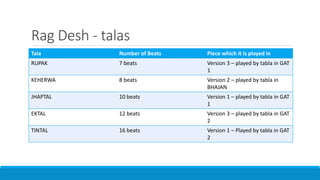
Rag Desh - talas
Tala Number of Beats Piece which it is played in
RUPAK 7 beats Version 3 – played by tabla in GAT
1
KEHERWA 8 beats Version 2 – played by tabla in
BHAJAN
JHAPTAL 10 beats Version 1 – played by tabla in GAT
1
EKTAL 12 beats Version 3 – played by tabla in GAT
2
TINTAL 16 beats Version 1 – Played by tabla in GAT
2
Yiri
Melody:
◦ The opening solo balaphone melody is high pitched and is a simple repetitive idea, using “rolls” on each
note
◦ When the second balaphone enters the melody becomes more syncopated
◦ The vocal melody is short, simple and repetitive
◦ Melodies are often varied by different instruments
◦ Contrasting melody in call and response section, long held notes and short punctuated notes on “Yiri”
Yiri
Rhythm:
◦ The balaphone ostinato in combination produces a complex polyphonic texture
◦ The drum ostinato perform a relentless one bar starting in the intro, performed by the talking drum,
small talking drum and djembe
◦ The drum ostinati are decorated with occasional rhythmic fills
◦ The balaphone performes cross-rhythms in the call and response section, which become syncopated
during the coda
Yiri
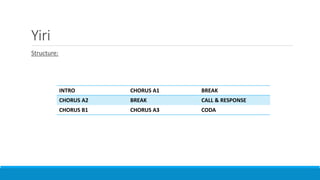
Structure:
INTRO CHORUS A1 BREAK
CHORUS A2 BREAK CALL & RESPONSE
CHORUS B1 CHORUS A3 CODA
Yiri
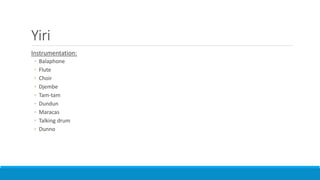
Instrumentation:
◦ Balaphone
◦ Flute
◦ Choir
◦ Djembe
◦ Tam-tam
◦ Dundun
◦ Maracas
◦ Talking drum
◦ Dunno
Yiri
Dynamics:
◦ Soft dynamics which are increased as instruments are added
◦ No dynamics printed on score
Yiri
Harmony:
◦ Harmony remains close to the tonic Gb major throughout, making frequent use of the dominant Db
note
◦ When the voice enters in chorus A1 they sound in unison
Yiri
Tempo:
◦ Piece starts off in free tempo but continues in moderate tampo
Yiri
Texture:
◦ Stars off with a monophonic texture with a solo balaphone
◦ When second balaphone joins in they play in octaves
◦ Heterophonic texture
◦ Call and response

Music GCSE edexcel

  • 1.
  • 2.
    AREA OF STUDY1 WESTERN CLASSICAL MUSIC
  • 3.
    And the Gloryof the Lord (from ‘Messiah’) – Handel Musical Features: ◦ Imitation ◦ Sequences ◦ Syllabic and Melismatic word setting
  • 4.
    And the Gloryof the Lord (from ‘Messiah’) – Handel Melody: ◦ 4 Melodies: ◦ Melody 1 – Based on triad of A major – Syllabic – Sung by all parts, started by the Altos ◦ Melody 2 – Descending sequences – Melismattic - Sung by all parts, started by the Altos ◦ Melody 3 – Repetition, featuring sequences – Syllabic and Melismattic - Sung by all parts, started by the Altos ◦ Melody 4 – Pedal note – repeated – syllabic – mainly sung by tenors and basses
  • 5.
    And the Gloryof the Lord (from ‘Messiah’) – Handel Rhythm: ◦ Driving regular beat on crothcht rhythms – matches stately mood ◦ Use of HEMIOLA – notes grouped in 2 beats, instead of the 3 beats of the time signature
  • 6.
    And the Gloryof the Lord (from ‘Messiah’) – Handel Structure: ◦ Based on four contrasting melodies (See melody slide)
  • 7.
    And the Gloryof the Lord (from ‘Messiah’) – Handel Instrumentation: ◦ Written for four voices – Soprano, Alto, Tenor and Bass ◦ Featuring String orchestra (Violins, Violas and Cellos) ◦ Also Featuring Basso continuo (Harpsichord or Organ)
  • 8.
    And the Gloryof the Lord (from ‘Messiah’) – Handel Dynamics: ◦ No dynamics are printed on the score ◦ However, terraced dynamics are achieved by adding and taking away parts and instruments
  • 9.
    And the Gloryof the Lord (from ‘Messiah’) – Handel Harmony: ◦ Clear A major harmonies – minor is avoided ◦ Perfect cadences during the piece (V-I) ◦ Plagal cadence at end of piece (IV-I)
  • 10.
    And the Gloryof the Lord (from ‘Messiah’) – Handel Tempo: ◦ ALLEGRO all the way through ◦ Apart from ADAGIO for last four bars of piece ◦ Time signature of piece is
  • 11.
    And the Gloryof the Lord (from ‘Messiah’) – Handel Texture: ◦ Alternating homophonic and polyphonic sections ◦ Ends with all part playing together - Homophonic
  • 12.
    Symphony No.40 inG minor - Mozart Musical Features: ◦ Pedal Notes are used in the development
  • 13.
    Symphony No.40 inG minor - Mozart Melody: ◦ Two subjects ◦ Sonata Form (see structure slide)
  • 14.
    Symphony No.40 inG minor - Mozart Rhythm: ◦ Scale passages and rising sequences ◦ 1st subject – crochet and quaver rhythms ◦ 2nd subject – Slower, legato rhythms
  • 15.
    Symphony No.40 inG minor - Mozart Structure: ◦ Sonata form: ◦ Exposition: ◦ First subject ( G minor) ◦ Bridge passage ◦ Second subject ( B flat major) ◦ Codetta ◦ Development: ◦ Based on opening of first subject ◦ Texture becomes more polyphonic ◦ Explores different keys very quickly ◦ Pedal notes are used in development of themes, as they are passed between instruments ◦ Recapitulation: ◦ Not a direct repetition of exposition, as both subjects are G minor and bridge passage is longer ◦ Coda
  • 16.
    Symphony No.40 inG minor - Mozart Instrumentation: ◦ Normal orchestra ◦ Only 1 Flute ◦ No trumpets ◦ No Timps
  • 17.
    Symphony No.40 inG minor - Mozart Dynamics: ◦ Starts off p ◦ Lots of dynamic contrast ◦ Use of sfz and accents
  • 18.
    Symphony No.40 inG minor - Mozart Harmony: Exposition Development Recapitulation Coda 1st Subject G Minor Variety of keys G Minor G Minor 2nd Subject B flat Major G Minor G Minor
  • 19.
    Symphony No.40 inG minor - Mozart Tempo: ◦ Molto Allegro ◦ Time signature
  • 20.
    Symphony No.40 inG minor - Mozart Texture: ◦ Mainly Melody with accompaniment ◦ Some homophonic sections ◦ Polyphonic in development
  • 21.
    Prelude No.15 inD flat Major Musical Features: ◦ Careful expressive use od pedals, particularly in the sustaining pedal ◦ SOSTENUTO – sustained ◦ ACCIACATURA – “Crushing note” – melodic decoration ◦ PEDAL NOTE – A flat in the piece
  • 22.
    Prelude No.15 inD flat Major Melody: ◦ A section ◦ Falling motif to represent the sadness ◦ Elegiac melody in right hand ◦ B section ◦ Mood is dark and stormy ◦ Melody in left hand ◦ Equally balanced 4 bar phrases ◦ Falling phrases which represent rain (nicknamed “Raindrop Prelude”)
  • 23.
    Prelude No.15 inD flat Major Rhythm: ◦ Repeated quavers ◦ Sustained tempo ◦ 4 beats in a bar which always stays the same ◦ Dotted rhythms in the A section ◦ Crochet Rhythms in the B section ◦ Septuplets are used ◦ Rubarto
  • 24.
    Prelude No.15 inD flat Major Structure: ◦ Ternary form ◦ A section ◦ B section ◦ A section (Very short) ◦ Coda ◦ A section has it’s own ternary form
  • 25.
    Prelude No.15 inD flat Major Instrumentation: ◦ Solo piano
  • 26.
    Prelude No.15 inD flat Major Dynamics: ◦ Extreme dynamics ◦ A section is generally quiet ◦ B section has a very big crescendo, but ends in pp
  • 27.
    Prelude No.15 inD flat Major Harmony: ◦ 7th and 9th chords are used ◦ Notes added to triad ◦ Perfect cadence ◦ D flat Major ◦ Enharmonic modulation (From D flat major in A section, to C sharp minor in B section) ◦ Dominant pedal note ( A flat in A section, G sharp in B section)
  • 28.
    Prelude No.15 inD flat Major Tempo ◦ Use of rubarto ◦ Time signature is
  • 29.
    Prelude No.15 inD flat Major Texture: ◦ Melody dominated homophony ◦ Homophonic ◦ Melody with accompaniment ◦ Monophonic bar in second A section
  • 30.
    Area of Study2 MUSIC IN THE 20TH CENTURY
  • 31.
    Peripetie - Schoenberg Melody: ◦Use of hexachords ◦ Klangfarben melodie – Melody moves between parts ◦ Word painting ◦ Canon
  • 32.
    Peripetie - Schoenberg Rhythm: ◦Different rhythms which overlap ◦ Haubptstimme – Main melody which is symbolised in the score like this : ◦ Nebenstimme – second melody which is symbolised in the score like this:
  • 33.
    Peripetie - Schoenberg Structure: ◦Free rondo ◦ A ◦ B ◦ A1 ◦ C ◦ A2
  • 34.
    Peripetie - Schoenberg Instrumentation: ◦Written for a very large orchestra ◦ Unusual instrumentation ◦ 3 flutes ◦ Cor anglais ◦ 3 bassoons ◦ Piccolos ◦ Instruments played at extremes of their registers ◦ Schoenberg is very specific with his tones and timbre ◦ Hi-hat played with cello bow ◦ Muted but playing ff ◦ Glissando ◦ Tremolo
  • 35.
    Peripetie - Schoenberg Dynamics: ◦Extremes ◦ Sudden changes (e.g. from fff to pp)
  • 36.
    Peripetie - Schoenberg Harmony: ◦Dissonant (using intervals of a 7th) ◦ Hexachords ◦ ATONAL
  • 37.
    Peripetie - Schoenberg Tempo: ◦Changes throughout the piece ◦ Sehr rash (very quick) ◦ Etwas rhuiger (a little slower) ◦ Heftig (Quick)
  • 38.
    Peripetie - Schoenberg Texture: ◦Homophonic and solo sections ◦ Polyphonic sections
  • 39.
    Something’s coming -Bernstein Melody: ◦ Lots of short riffs ◦ Combination of short phrases and long sustained notes
  • 40.
    Something’s coming -Bernstein Rhythm: ◦ Lots of syncopation ◦ Ostinati ◦ Cross-rhythms ◦ Push-rhythms ◦ Accented off beats
  • 41.
    Something’s coming -Bernstein Structure: ◦ Not a typical verse chorus structure Intro Section A Section B Section B1 Section A1 Outro
  • 42.
    Something’s coming -Bernstein Instrumentation: ◦ Solo male singer (tenor) ◦ Large orchestra (however this is hidden from the score)
  • 43.
    Something’s coming -Bernstein Dynamics: ◦ Tony starts singing pp ◦ Gradually gets louder ◦ Fades out at end
  • 44.
    Something’s coming -Bernstein Harmony: ◦ D major ◦ Use of tritone – augmented 4th ◦ Jazz harmony – added blues notes
  • 45.
    Something’s coming -Bernstein Tempo: ◦ Very fast – 176 bpm ◦ Push-rhythms makes the piece feel faster ◦ Some sections are ◦ Other sections are
  • 46.
    Something’s coming -Bernstein Texture: ◦ Melody with accompaniment
  • 47.
    Electric Counterpoint -Reich Melody: ◦ Repeated melodies (motifs) ◦ Resultant melodies ◦ Guitar 3 uses additive melody ◦ Two or three notes are added each bar, until the whole riff can be heard
  • 48.
    Electric Counterpoint -Reich Rhythm: ◦ Layered ostinato ◦ Phase shifted ◦ Displaced ◦ Minimalist ◦ Interviewing rhythms
  • 49.
    Electric Counterpoint -Reich Structure: ◦ Divided into two main sections with a coda ◦ These two sections are further divided into four smaller sections ◦ Each of which is defined by a change in texture or key
  • 50.
    Electric Counterpoint -Reich Instrumentation: ◦ 10 guitars all together ◦ 1 live guitar ◦ 7 electric guitars ◦ 2 bass guitars ◦ Each guitar enters one after each other (cannon)
  • 51.
    Electric Counterpoint -Reich Dynamics: ◦ Not many dynamics printed ◦ Dynamics achieved by layering instruments
  • 52.
    Electric Counterpoint -Reich Harmony: ◦ Diatonic harmonies ◦ Tonal ambiguity ◦ Bass guitar confirms the key is E minor ◦ AEOLIAN MODE ◦ Changes to C minor in second section ◦ Finishes with a E5 chord (No third)
  • 53.
    Electric Counterpoint -Reich Tempo: ◦ Time signature changes ◦ From ◦ To ◦ To ◦ Constant tempo throughout
  • 54.
    Electric Counterpoint -Reich Texture: ◦ Multi-layered texture is achieved by each track being multi-tracked ◦ Made of short motifs that are repeated ◦ Counter point (polyphonic) ◦ Panning is used
  • 55.
    AREA OF STUDY3 POPULAR MUSIC IN CONTEXT
  • 56.
    All Blues -Davis Melody: ◦ The main melody (HEAD) and the solos are all played over the 12-bar-blues chord sequence (see harmony slide) ◦ Based on the notes of the Mixolydian mode on G ◦ The improvisations are ornamented and combine riffs
  • 57.
    All Blues -Davis Rhythm: ◦ The rhythms section provides the harmony and rhythmic background ◦ The rhythmic section provides the COMPING playing the background chords and rhythms
  • 58.
    All Blues -Davis Structure: Section Comment INTRO Drums, bass riff, piano trill, alto and tenor sax riff in thirds HEAD This is where the original tune is played. Played on muted trumpet with a simple motif moving mainly by step LINK Breaks up repetition of head and provides contrast HEAD1 Same as first but melody is slightly more developed- ride cymbal is added by drums IMPROVISED SOLO (TRUMPET) First solo performed by Miles Davis. Trumpet mute is removed. 4 repetitions of the 12-bar-blues sequence. Mixolydian mode on G IMPROVISED SOLO (ALTO SAX) 4 repetitions of the 12-bar-blues sequence. Chromatic and very technical IMPROVISED SOLO (TENOR SAX) 4 repetitions of the 12-bar-blues sequence. IMPROVISED SOLO (PIANO) Comping in left hand. 2 repetitions of the 12-bar-blues sequence HEAD2 Same as first HEAD, trumpet is muted again HEAD3 Melody developed with more of a minor feel OUTRO Trumpet solo on the tonic G note, over the sax riff and the piano trill
  • 59.
    All Blues -Davis Instrumentation: ◦ Front line ◦ Trumpet ◦ Alto saxophone ◦ Tenor saxophone ◦ Rhythm section ◦ Piano ◦ Bass ◦ Drums
  • 60.
    All Blues -Davis Dynamics: ◦ Mainly p throughout ◦ Diminuendo in fifth HEAD
  • 61.
    All Blues -Davis Harmony: ◦ Based around repeated 12-bar-chord sequence, with 4 linking sections between each section ◦ Traditional sequence has been altered by extending and altering bars 9 and 10 ◦ Repeated 19 times in total ◦ Modal Jazz ◦ Focuses on mixolydian mode on G G7 G7 G7 G7 C7 C7 G7 G7 D7#9 Eb7#9 G7 G7
  • 62.
    All Blues -Davis Tempo: ◦ 156 bpm ◦ Feels like dotted rhythm ◦ Jazz waltz ◦ Time signature is
  • 63.
    All Blues -Davis Texture: ◦ Made up of riffs ◦ 3 riffs are used ◦ 1st – G D ED F DED – played by double bass ◦ 2nd – D/B E/C F/D E/C – played by alto and tenor saxophones in thirds
  • 64.
    Grace – JeffBuckley Melody: ◦ Vocal melody in the verse has a limited pitch range, becoming higher in the pre chorus ◦ A “whispering” backing vocal adds variety to the melody in the chorus ◦ The telephone EQ effect added to the vocal melody in the middle 8 gives a harsh and distant effect ◦ Verse 3 sees the pitch of the vocal melody becoming higher ◦ Extremely high pitched vocal (FALSETTO) improvisation in the outro including melisma
  • 65.
    Grace – JeffBuckley Rhythm: ◦ Rhythm of the intro is highlighted by the acoustic guitar and hi-hat cymbals, which “drive” the song forward ◦ During the verse, more emphasis is placed on the toms of the drum kit ◦ A drum roll leads into the middle 8 section ◦ Cymbals used more prominently in verse 3 ◦ The unifying rhythm of the song is a solid rock beat
  • 66.
    Grace – JeffBuckley Structure: Into Verse 1 Pre-chorus 1 Chorus Link Verse 2 Pre-chorus 2 Chorus Middle 8 Link Verse 3 Outro
  • 67.
    Grace – JeffBuckley Instrumentation: ◦ Main instruments ◦ Drum kit ◦ Bass Guitar ◦ Three electric guitars ◦ Acoustic guitar ◦ Lead Vocals ◦ Additional instruments ◦ Backing vocals ◦ Strings
  • 68.
    Grace – JeffBuckley Dynamics: ◦ Starts p, but has a f chord in the intro ◦ Whisper effect on the electric guitar uses dynamic picking ◦ Having the volume turned down and then turning it up quickly
  • 69.
    Grace – JeffBuckley Harmony: ◦ Bass guitar provides pedal note “D” upon which harmonies and chords are constructed ◦ During the verse the electric guitar plays power chords ◦ The harmonies are modal, with E as the tonic note ◦ Em Em/F5 Em/Eb5 ◦ The pre chorus uses more complex chords, with 9th and 6th notes added ◦ Complex harmonies in the middle 8 ◦ Hummed vocals with long sustained notes on strings ◦ Key is not clear from first three chords, but arrives in D major at the end of the intro
  • 70.
    Grace – JeffBuckley Tempo: ◦ 64 bpm - Dotted crochet ◦ Time signature is
  • 71.
    Grace – JeffBuckley Texture: ◦ Textural contrast is created when parts drop out ◦ Texture in verse is thinner ◦ Thick polyphonic texture in middle 8
  • 72.
    Why does myheart feel so bad? - Moby Melody: ◦ Piano provides an accompaniment to the vocal sample with a synthesiser pad doubling some of the piano notes, but also takes on the role of the melody in places ◦ There are elements of call and response between the piano and vocal sample
  • 73.
    Why does myheart feel so bad? - Moby Rhythm: ◦ Hip-hop drum loop used throughout, also called a back beat ◦ Piano accompaniment changes to syncopated rhythm in verse 1
  • 74.
    Why does myheart feel so bad? - Moby Structure: INTRO Chord sequence 1 VERSE 1 Chord sequence 1 X4 CHORUS Chord sequence 2 + 3 VERSE 2 Chord sequence 1 X2 BREAK CHORUS Chord sequence 2,3,3 OUTRO Chord sequence 1
  • 75.
    Why does myheart feel so bad? - Moby Instrumentation: ◦ Multi-effect unit ◦ Drum machine ◦ Synth bass sound ◦ Piano sound ◦ String sound ◦ Vocal samples
  • 76.
    Why does myheart feel so bad? - Moby Dynamics: ◦ Song begins p and increases in relation to the texture
  • 77.
    Why does myheart feel so bad? - Moby Harmony: ◦ Based around chord sequences – limited harmonic range ◦ Both vocal samples are in the key on A minor ◦ Harmonised to break second feel c major ◦ Modulation Number Chord sequence Chord sequence 1 Am Am Em Em G G D D Chord sequence 2 C C Am Am C C Am Am Chord sequence 3 F F C C F F C C
  • 78.
    Why does myheart feel so bad? - Moby Tempo: ◦ Constant throughout at 98 bpm ◦ Time signature is
  • 79.
    Why does myheart feel so bad? - Moby Texture: ◦ Instruments come in and drop out for textual contrast ◦ Sustained chords ◦ Static chords ◦ Telephone EQ effect ◦ Break ◦ Delay effect ◦ EQ ◦ Reverb
  • 80.
    AREA OF STUDY4 WORLD MUSIC
  • 81.
    Skye Waulking song- Capercaillie Melody: ◦ Melodic lines are played in the folk style ◦ Instruments improvise around melody ◦ Typical features of a walking song are used: ◦ Vocables ◦ Repetition of each line of the verse ◦ Slow rhythm
  • 82.
    Skye Waulking song- Capercaillie Rhythm: ◦ The shakers and hi-hat play every two beats giving the rhythm a triple feel ◦ The vocal part has a characteristic lilting rhythm ◦ Second and fifth beat of the bar are emphasised by the accordion
  • 83.
    Skye Waulking song- Capercaillie Structure: INTRO VEERSE 1 BREAK VERSE 2 VERSE 3 VERSE 4 VERSE 5 VERSE 6 INSTRUMENTAL VERSE 7 VERSE 8 OUTRO
  • 84.
    Skye Waulking song- Capercaillie Instrumentation: FOLK INSTRUMENTS POP INSTRUMENTS Accordion Piano Flutes Synth Uillean pipes Acoustic guitar Bouzouki Electric guitar Bodhran Drum and percussion fiddle Vocals
  • 85.
    Skye Waulking song- Capercaillie Dynamics: ◦ Build up with texture ◦ Fade out at the end of the song
  • 86.
    Skye Waulking song- Capercaillie Harmony: ◦ Only using 4 chords – simple harmony ◦ Changes in chord sequence highlight change in mood/ section ◦ E minor pentatonic Section Chord sequence Intro Em G Verse 4 C G Em G Verse 7 Am7 Em Em G Outro C G
  • 87.
    Skye Waulking song- Capercaillie Tempo: ◦ Slow and calm – typical of a lament ◦ Compound quadruple time ◦ Time signature
  • 88.
    Skye Waulking song- Capercaillie Texture: ◦ Heterophonic – in instruments ◦ Improvised counterpoint around melody ◦ Monophonic bar before verse ◦ Counter melody
  • 89.
    Rag Desh –Version 1 - Anoushka Shankar Instruments: ◦ Sitar ◦ Tabla
  • 90.
    Rag Desh –Version 1 - Anoushka Shankar ALAP: ◦ Slow and unmetered ◦ Unaccompanied sitar explores the first notes of the raga ◦ Free rhythms sound improvised, due to a lack of a regular pulse ◦ Some decoration to melody
  • 91.
    Rag Desh –Version 1 - Anoushka Shankar GAT 1: ◦ Sitar plays fixed composition rather than improvisation, but decorates melody with flourishes and ornaments ◦ Medium tempo ◦ Tabla enters playing 10 beat JHAPTAL tala with decoration ◦ There is dialogue between sitar and tabla
  • 92.
    Rag Desh –Version 1 - Anoushka Shankar GAT 2: ◦ Faster tempo ◦ Tabla now switches to TIN TAL tala
  • 93.
    Rag Desh –Version 1 - Anoushka Shankar JHALLA: ◦ Drone strings are used on the sitar which are strummed providing a rhythmic effect ◦ Piece ends with a TIHAI ◦ Phrase which is played three times across the beat ending on the first beat of the cycle
  • 94.
    Rag Desh –Version 2 – Chiranji Lal Tanwar Instruments: ◦ Voice ◦ Sarangi ◦ Sarod ◦ Pakhawaj ◦ Cymbals ◦ Tabla
  • 95.
    Rag Desh –Version 2 – Chiranji Lal Tanwar ALAP: ◦ Short introduction as the saraod player, then the singer, vocalise the melody, based ont eh notes of the raga ◦ Free time ◦ A version of the chorus from the song
  • 96.
    Rag Desh –Version 2 – Chiranji Lal Tanwar BHAJAN: ◦ A fixed composition ◦ Song in verse form, with the first lines used as a refrain ◦ Tabla plays KEHERWA table ◦ Sarod and sarangi play solo passages between verses ◦ Dynamics and tempo increase ◦ Music becomes faster and more exiting, as the cymbals play more frequently
  • 97.
    Rag Desh –Version 3 – Wertheimer & Gorn Instruments: ◦ Bansuri ◦ Esraj ◦ Tambura ◦ Tabla
  • 98.
    Rag Desh –Version 3 – Wertheimer & Gorn ALAP: ◦ Slow and unmetered ◦ Drone is established by tambura ◦ Bansuri enters exploring the notes of the raga
  • 99.
    Rag Desh –Version 3 – Wertheimer & Gorn GAT 1: ◦ Slow tempo ◦ Bansuri plays lyrical, unaccompanied melody ◦ The tabla enters playing RUPAK tala ◦ Bansuri and tabla players embellish and improvise upon their original patters, instruments then swap; Bansuri improvises, table accompanies
  • 100.
    Rag Desh –Version 3 – Wertheimer & Gorn GAT 2: ◦ Fast tempo ◦ Tabla now uses EKTAL tala ◦ Bansuri plays an elaborate melody with wide ranging pitch, fast scale passages (tans) and slides ◦ Several THIAIs bring music to a close ◦ Drone continues shortly after melody ends
  • 101.
    Rag Desh -talas Tala Number of Beats Piece which it is played in RUPAK 7 beats Version 3 – played by tabla in GAT 1 KEHERWA 8 beats Version 2 – played by tabla in BHAJAN JHAPTAL 10 beats Version 1 – played by tabla in GAT 1 EKTAL 12 beats Version 3 – played by tabla in GAT 2 TINTAL 16 beats Version 1 – Played by tabla in GAT 2
  • 102.
    Yiri Melody: ◦ The openingsolo balaphone melody is high pitched and is a simple repetitive idea, using “rolls” on each note ◦ When the second balaphone enters the melody becomes more syncopated ◦ The vocal melody is short, simple and repetitive ◦ Melodies are often varied by different instruments ◦ Contrasting melody in call and response section, long held notes and short punctuated notes on “Yiri”
  • 103.
    Yiri Rhythm: ◦ The balaphoneostinato in combination produces a complex polyphonic texture ◦ The drum ostinato perform a relentless one bar starting in the intro, performed by the talking drum, small talking drum and djembe ◦ The drum ostinati are decorated with occasional rhythmic fills ◦ The balaphone performes cross-rhythms in the call and response section, which become syncopated during the coda
  • 104.
    Yiri Structure: INTRO CHORUS A1BREAK CHORUS A2 BREAK CALL & RESPONSE CHORUS B1 CHORUS A3 CODA
  • 105.
    Yiri Instrumentation: ◦ Balaphone ◦ Flute ◦Choir ◦ Djembe ◦ Tam-tam ◦ Dundun ◦ Maracas ◦ Talking drum ◦ Dunno
  • 106.
    Yiri Dynamics: ◦ Soft dynamicswhich are increased as instruments are added ◦ No dynamics printed on score
  • 107.
    Yiri Harmony: ◦ Harmony remainsclose to the tonic Gb major throughout, making frequent use of the dominant Db note ◦ When the voice enters in chorus A1 they sound in unison
  • 108.
    Yiri Tempo: ◦ Piece startsoff in free tempo but continues in moderate tampo
  • 109.
    Yiri Texture: ◦ Stars offwith a monophonic texture with a solo balaphone ◦ When second balaphone joins in they play in octaves ◦ Heterophonic texture ◦ Call and response