Chapter Four
Medieval Music, 476-1450
http://www.youtube.com/watch?v=cPkLhSVtPS4&list=PLzQS4HL6t8zxfAUG4-
gPb9dkTMATGMFtG
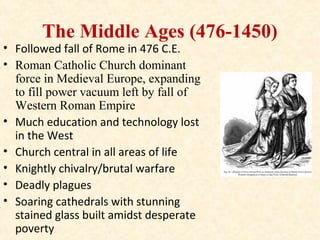
The Middle Ages (476-1450)
• Followed fall of Rome in 476 C.E.
• Roman Catholic Church dominant
force in Medieval Europe, expanding
to fill power vacuum left by fall of
Western Roman Empire
• Much education and technology lost
in the West
• Church central in all areas of life
• Knightly chivalry/brutal warfare
• Deadly plagues
• Soaring cathedrals with stunning
stained glass built amidst desperate
poverty
Music in the Monastery
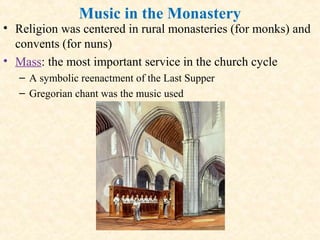
• Religion was centered in rural monasteries (for monks) and
convents (for nuns)
• Mass: the most important service in the church cycle
– A symbolic reenactment of the Last Supper
– Gregorian chant was the music used
Music in the Monastery
• Gregorian Chant: A unique collection of thousands of
religious songs that carry the theological message of the
Church
– Sung in Latin
– Composed for fifteen centuries
• Musical notation- Between 700 and 1000, church musicians started
putting notes on a grid of lines and spaces that were identified by note
names. Before this, chant was passed down by rote.
http://www.youtube.com/watch?v=XnnYjnlHIgk
• Rhythm
– Gregorian chant (also called plainsong) and early
secular songs
• Pitches did not indicate rhythm
• Secular songs learned by rote
– Polyphonic compositions (after 1180)
• Triple meter (reflecting the trinity)
• Repeated rhythmic patterns
Style of Medieval Music
• Harmony
–Monophonic texture of pure chant is not
harmonized
–Polyphonic compositions
• Dissonant chords within phrases
• Phrases end with open, pure, hollow-
sounding chords
Style of Medieval Music
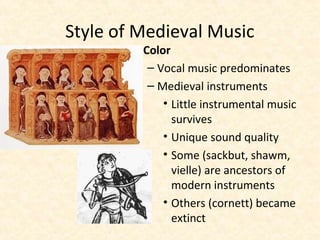
• Color
– Vocal music predominates
– Medieval instruments
• Little instrumental music
survives
• Unique sound quality
• Some (sackbut, shawm,
vielle) are ancestors of
modern instruments
• Others (cornett) became
extinct
Style of Medieval Music
• Named in honor of Pope Gregory (540 – 604),
who decreed that certain chants would be sung
for specific days in the liturgical church year
– Pope Gregory wrote little music himself, was
mainly an administrator
– Actual composers of chant generally unknown,
music was created to glorify God, not individuals
Gregorian Chant
https://www.youtube.com/watch?v=kK5AohCMX0U
Click this link to hear some chant
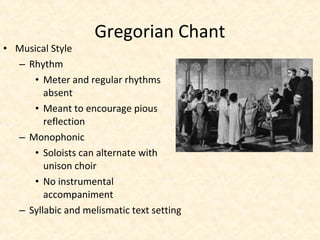
• Musical Style
– Rhythm
• Meter and regular rhythms
absent
• Meant to encourage pious
reflection
– Monophonic
• Soloists can alternate with
unison choir
• No instrumental
accompaniment
– Syllabic and melismatic text setting
Gregorian Chant
• Extraordinary intellect and imagination
• 10th
child of noble family, “given” to the church as a
tithe (1/10th
of possessions)
• Advised popes and kings
• Renaissance woman
• Naturalist, linguist, artist and pharmacologist
• Wrote scientific books, poetry, and a play
• Composer, philosopher, visionary
Founded a convent
Hildegard von Bingen (1098-1179)
Germany
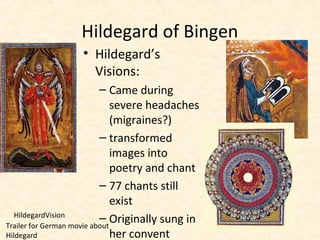
• Hildegard’s
Visions:
– Came during
severe headaches
(migraines?)
– transformed
images into
poetry and chant
– 77 chants still
exist
– Originally sung in
her convent
Hildegard of Bingen
HildegardVision
Trailer for German movie about
Hildegard
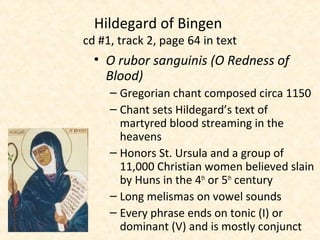
• O rubor sanguinis (O Redness of
Blood)
– Gregorian chant composed circa 1150
– Chant sets Hildegard’s text of
martyred blood streaming in the
heavens
– Honors St. Ursula and a group of
11,000 Christian women believed slain
by Huns in the 4th
or 5th
century
– Long melismas on vowel sounds
– Every phrase ends on tonic (I) or
dominant (V) and is mostly conjunct
Hildegard of Bingen
cd #1, track 2, page 64 in text
Music in the Cathedral
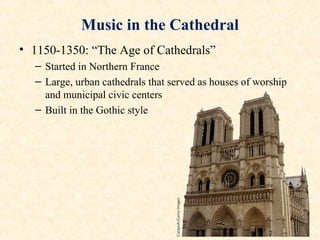
• 1150-1350: “The Age of Cathedrals”
– Started in Northern France
– Large, urban cathedrals that served as houses of worship
and municipal civic centers
– Built in the Gothic style
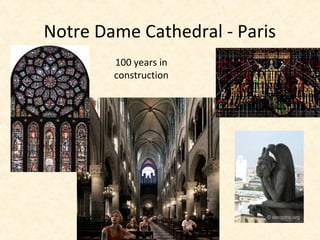
Notre Dame Cathedral - Paris
100 years in
construction
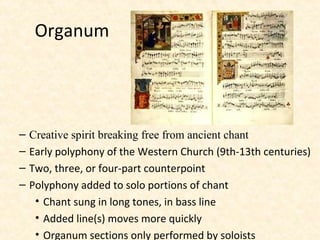
– Creative spirit breaking free from ancient chant
– Early polyphony of the Western Church (9th-13th centuries)
– Two, three, or four-part counterpoint
– Polyphony added to solo portions of chant
• Chant sung in long tones, in bass line
• Added line(s) moves more quickly
• Organum sections only performed by soloists
Organum
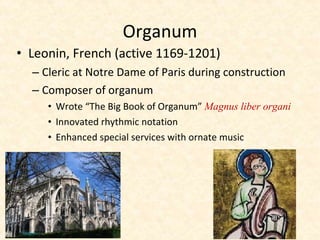
• Leonin, French (active 1169-1201)
– Cleric at Notre Dame of Paris during construction
– Composer of organum
• Wrote “The Big Book of Organum” Magnus liber organi
• Innovated rhythmic notation
• Enhanced special services with ornate music
Organum
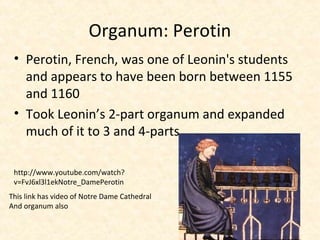
• Perotin, French, was one of Leonin's students
and appears to have been born between 1155
and 1160
• Took Leonin’s 2-part organum and expanded
much of it to 3 and 4-parts
Organum: Perotin
http://www.youtube.com/watch?
v=FvJ6xl3l1ekNotre_DamePerotin
This link has video of Notre Dame Cathedral
And organum also
Perotin: Organum Viderunt omnes
(All the Ends of the Earth) p. 65 L.Guide
• Four voice organum
• Performed during the Mass for Christmas Day
• Tenor: Sustaining line of the borrowed chant
– From Latin tenore meaning “to hold”, actually is in the
bass line of the music
• Mensural notation: “Measured notation”
to specify musical rhythm as well as pitch
– Began in the 13th
and 14th
centuries
– Leonin and Perotin credited with
devising rhythmic notation
Notre Dame of Reims (Rance)
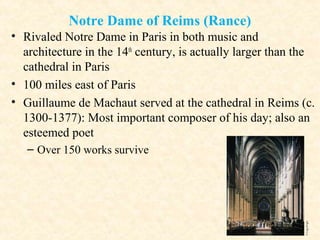
• Rivaled Notre Dame in Paris in both music and
architecture in the 14th
century, is actually larger than the
cathedral in Paris
• 100 miles east of Paris
• Guillaume de Machaut served at the cathedral in Reims (c.
1300-1377): Most important composer of his day; also an
esteemed poet
– Over 150 works survive
• Author, composer, courtier, cleric
• Most important composer of the 14th
century, both
sacred and love songs
– Secular songs for court entertainment
– Sacred music for cathedral at Reims
Guillaume de Machaut, French (ca. 1300-1377)
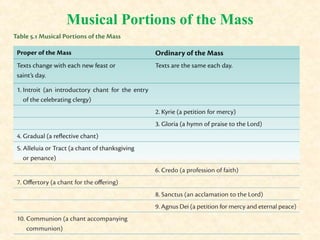
Musical Portions of the Mass
Machaut: Messe de Nostre Dame
(Mass of Our Lady - c. 1360)
• Most famous medieval composition
– Kyrie
• Alternation between chant and polyphony
• Disparity between rhythm and harmony
• Interplay between dissonant and consonant chords
• First composer to use nearly the full vocal range of a chorus
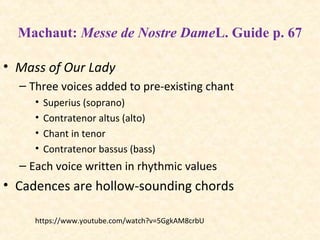
Machaut: Messe de Nostre DameL. Guide p. 67
• Mass of Our Lady
– Three voices added to pre-existing chant
• Superius (soprano)
• Contratenor altus (alto)
• Chant in tenor
• Contratenor bassus (bass)
– Each voice written in rhythmic values
• Cadences are hollow-sounding chords
https://www.youtube.com/watch?v=5GgkAM8crbU
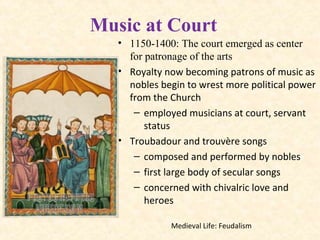
Music at Court
• 1150-1400: The court emerged as center
for patronage of the arts
• Royalty now becoming patrons of music as
nobles begin to wrest more political power
from the Church
– employed musicians at court, servant
status
• Troubadour and trouvère songs
– composed and performed by nobles
– first large body of secular songs
– concerned with chivalric love and
heroes
Medieval Life: Feudalism
Troubadours and Trouvères
• Poet-musicians of France, Performers from all social
classes, females also
• Name from French trouver – “to find”
– “Finders” or inventors of the chanson
• Chanson: “song;” new genre of vocal expression
– Several thousand chansons were created
– Mostly monophonic love songs,
ordinary language used for lyrics
– Ideals of faith and devotion
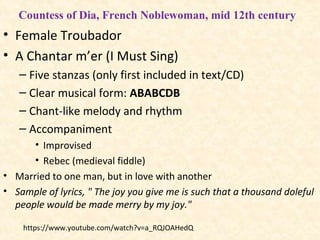
• Female Troubador
• A Chantar m’er (I Must Sing)
– Five stanzas (only first included in text/CD)
– Clear musical form: ABABCDB
– Chant-like melody and rhythm
– Accompaniment
• Improvised
• Rebec (medieval fiddle)
• Married to one man, but in love with another
• Sample of lyrics, " The joy you give me is such that a thousand doleful
people would be made merry by my joy."
Countess of Dia, French Noblewoman, mid 12th century
https://www.youtube.com/watch?v=a_RQJOAHedQ
Battle of Agincourt
• Henry V (1386-1422): Most illustrious English
king in the late Middle Ages
• Hundred Years’ War: Took place between the
French and the English on French soil
• Battle of Agincourt (October 25, 1415):
Henry’s greatest victory celebrated in song
http://www.youtube.com/watch?v=zMtb1aYNBvU
History of the battle of Agincourt
A Battle Carol for the English Court, p.69-71
• Genre: Carol
• Form: Strophic
– Carol: song in the local (vernacular) language
language; usually in strophic form
http://www.youtube.com/watch?v=f9VJzKNhp0s
Medieval Musical Instruments
• Pipe organ: principal instrument of the monastery and
cathedral
– Was the only instrument admitted by church authorities
• More variety of instruments at court
– Hauts: Loud instruments; often used for dance music
• Sackbut, shawm, cornetto
– Bas: Soft instruments
• Flute (recorder), fiddle (vielle), harp, lute
• Vielle: Distant ancestor of the modern violin

4listening medievalonline

  • 1.
    Chapter Four Medieval Music,476-1450 http://www.youtube.com/watch?v=cPkLhSVtPS4&list=PLzQS4HL6t8zxfAUG4- gPb9dkTMATGMFtG
  • 2.
    The Middle Ages(476-1450) • Followed fall of Rome in 476 C.E. • Roman Catholic Church dominant force in Medieval Europe, expanding to fill power vacuum left by fall of Western Roman Empire • Much education and technology lost in the West • Church central in all areas of life • Knightly chivalry/brutal warfare • Deadly plagues • Soaring cathedrals with stunning stained glass built amidst desperate poverty
  • 3.
    Music in theMonastery • Religion was centered in rural monasteries (for monks) and convents (for nuns) • Mass: the most important service in the church cycle – A symbolic reenactment of the Last Supper – Gregorian chant was the music used
  • 4.
    Music in theMonastery • Gregorian Chant: A unique collection of thousands of religious songs that carry the theological message of the Church – Sung in Latin – Composed for fifteen centuries • Musical notation- Between 700 and 1000, church musicians started putting notes on a grid of lines and spaces that were identified by note names. Before this, chant was passed down by rote. http://www.youtube.com/watch?v=XnnYjnlHIgk
  • 5.
    • Rhythm – Gregorianchant (also called plainsong) and early secular songs • Pitches did not indicate rhythm • Secular songs learned by rote – Polyphonic compositions (after 1180) • Triple meter (reflecting the trinity) • Repeated rhythmic patterns Style of Medieval Music
  • 6.
    • Harmony –Monophonic textureof pure chant is not harmonized –Polyphonic compositions • Dissonant chords within phrases • Phrases end with open, pure, hollow- sounding chords Style of Medieval Music
  • 7.
    • Color – Vocalmusic predominates – Medieval instruments • Little instrumental music survives • Unique sound quality • Some (sackbut, shawm, vielle) are ancestors of modern instruments • Others (cornett) became extinct Style of Medieval Music
  • 8.
    • Named inhonor of Pope Gregory (540 – 604), who decreed that certain chants would be sung for specific days in the liturgical church year – Pope Gregory wrote little music himself, was mainly an administrator – Actual composers of chant generally unknown, music was created to glorify God, not individuals Gregorian Chant https://www.youtube.com/watch?v=kK5AohCMX0U Click this link to hear some chant
  • 9.
    • Musical Style –Rhythm • Meter and regular rhythms absent • Meant to encourage pious reflection – Monophonic • Soloists can alternate with unison choir • No instrumental accompaniment – Syllabic and melismatic text setting Gregorian Chant
  • 10.
    • Extraordinary intellectand imagination • 10th child of noble family, “given” to the church as a tithe (1/10th of possessions) • Advised popes and kings • Renaissance woman • Naturalist, linguist, artist and pharmacologist • Wrote scientific books, poetry, and a play • Composer, philosopher, visionary Founded a convent Hildegard von Bingen (1098-1179) Germany
  • 11.
    • Hildegard’s Visions: – Cameduring severe headaches (migraines?) – transformed images into poetry and chant – 77 chants still exist – Originally sung in her convent Hildegard of Bingen HildegardVision Trailer for German movie about Hildegard
  • 12.
    • O ruborsanguinis (O Redness of Blood) – Gregorian chant composed circa 1150 – Chant sets Hildegard’s text of martyred blood streaming in the heavens – Honors St. Ursula and a group of 11,000 Christian women believed slain by Huns in the 4th or 5th century – Long melismas on vowel sounds – Every phrase ends on tonic (I) or dominant (V) and is mostly conjunct Hildegard of Bingen cd #1, track 2, page 64 in text
  • 13.
    Music in theCathedral • 1150-1350: “The Age of Cathedrals” – Started in Northern France – Large, urban cathedrals that served as houses of worship and municipal civic centers – Built in the Gothic style
  • 14.
    Notre Dame Cathedral- Paris 100 years in construction
  • 15.
    – Creative spiritbreaking free from ancient chant – Early polyphony of the Western Church (9th-13th centuries) – Two, three, or four-part counterpoint – Polyphony added to solo portions of chant • Chant sung in long tones, in bass line • Added line(s) moves more quickly • Organum sections only performed by soloists Organum
  • 16.
    • Leonin, French(active 1169-1201) – Cleric at Notre Dame of Paris during construction – Composer of organum • Wrote “The Big Book of Organum” Magnus liber organi • Innovated rhythmic notation • Enhanced special services with ornate music Organum
  • 17.
    • Perotin, French,was one of Leonin's students and appears to have been born between 1155 and 1160 • Took Leonin’s 2-part organum and expanded much of it to 3 and 4-parts Organum: Perotin http://www.youtube.com/watch? v=FvJ6xl3l1ekNotre_DamePerotin This link has video of Notre Dame Cathedral And organum also
  • 18.
    Perotin: Organum Videruntomnes (All the Ends of the Earth) p. 65 L.Guide • Four voice organum • Performed during the Mass for Christmas Day • Tenor: Sustaining line of the borrowed chant – From Latin tenore meaning “to hold”, actually is in the bass line of the music • Mensural notation: “Measured notation” to specify musical rhythm as well as pitch – Began in the 13th and 14th centuries – Leonin and Perotin credited with devising rhythmic notation
  • 19.
    Notre Dame ofReims (Rance) • Rivaled Notre Dame in Paris in both music and architecture in the 14th century, is actually larger than the cathedral in Paris • 100 miles east of Paris • Guillaume de Machaut served at the cathedral in Reims (c. 1300-1377): Most important composer of his day; also an esteemed poet – Over 150 works survive
  • 20.
    • Author, composer,courtier, cleric • Most important composer of the 14th century, both sacred and love songs – Secular songs for court entertainment – Sacred music for cathedral at Reims Guillaume de Machaut, French (ca. 1300-1377)
  • 21.
  • 22.
    Machaut: Messe deNostre Dame (Mass of Our Lady - c. 1360) • Most famous medieval composition – Kyrie • Alternation between chant and polyphony • Disparity between rhythm and harmony • Interplay between dissonant and consonant chords • First composer to use nearly the full vocal range of a chorus
  • 23.
    Machaut: Messe deNostre DameL. Guide p. 67 • Mass of Our Lady – Three voices added to pre-existing chant • Superius (soprano) • Contratenor altus (alto) • Chant in tenor • Contratenor bassus (bass) – Each voice written in rhythmic values • Cadences are hollow-sounding chords https://www.youtube.com/watch?v=5GgkAM8crbU
  • 24.
    Music at Court •1150-1400: The court emerged as center for patronage of the arts • Royalty now becoming patrons of music as nobles begin to wrest more political power from the Church – employed musicians at court, servant status • Troubadour and trouvère songs – composed and performed by nobles – first large body of secular songs – concerned with chivalric love and heroes Medieval Life: Feudalism
  • 25.
    Troubadours and Trouvères •Poet-musicians of France, Performers from all social classes, females also • Name from French trouver – “to find” – “Finders” or inventors of the chanson • Chanson: “song;” new genre of vocal expression – Several thousand chansons were created – Mostly monophonic love songs, ordinary language used for lyrics – Ideals of faith and devotion
  • 26.
    • Female Troubador •A Chantar m’er (I Must Sing) – Five stanzas (only first included in text/CD) – Clear musical form: ABABCDB – Chant-like melody and rhythm – Accompaniment • Improvised • Rebec (medieval fiddle) • Married to one man, but in love with another • Sample of lyrics, " The joy you give me is such that a thousand doleful people would be made merry by my joy." Countess of Dia, French Noblewoman, mid 12th century https://www.youtube.com/watch?v=a_RQJOAHedQ
  • 27.
    Battle of Agincourt •Henry V (1386-1422): Most illustrious English king in the late Middle Ages • Hundred Years’ War: Took place between the French and the English on French soil • Battle of Agincourt (October 25, 1415): Henry’s greatest victory celebrated in song http://www.youtube.com/watch?v=zMtb1aYNBvU History of the battle of Agincourt
  • 28.
    A Battle Carolfor the English Court, p.69-71 • Genre: Carol • Form: Strophic – Carol: song in the local (vernacular) language language; usually in strophic form http://www.youtube.com/watch?v=f9VJzKNhp0s
  • 29.
    Medieval Musical Instruments •Pipe organ: principal instrument of the monastery and cathedral – Was the only instrument admitted by church authorities • More variety of instruments at court – Hauts: Loud instruments; often used for dance music • Sackbut, shawm, cornetto – Bas: Soft instruments • Flute (recorder), fiddle (vielle), harp, lute • Vielle: Distant ancestor of the modern violin

Editor's Notes

  • #8 Watch first 2 minutes or so. Then skip to 5’10” – Hurdy gurdy
  • #14 Figure 5.3 The cathedral of Notre Dame of Paris, begun c. 1160, was one of the first to be built in the new Gothic style of architecture. Organum was composed there as the building was being constructed
  • #19 Figure 5.4 Perotinus’s four-voice Viderunt omnes for Christmas Day. Note how the chant in the tenor voice (staffs 4, 8, and 12) provides a long-note foundation for the three voices above.
  • #20 Figure 5.5 Interior of the cathedral of Reims, looking from floor to ceiling. The pillars carry the eye up to the ribbed vaults of the roof, creating a feeling of great upward movement, just as the Mass of Machaut, with four superimposed voices, has a new sense of verticality.
  • #21 Machaut not only epitomized the chivalric world, he also captured for all time the yearnings and pleasures of romance. His dozens of love songs, in all the poetic/musical forms of the day, are flowery and formulaic in language but delightful in their musical settings.
  • #23 Appropriate for any Mass honoring the Virgin Mary
  • #24 Begin at 6 minutes 19”
  • #26 Figure 5.6 Beatriz, Countess of Dia, who flourished during the mid-twelfth century, as depicted in a manuscript of troubadour and trouvère poetry.
  • #27 She is only known as the Comtessa de Dia ("Countess of Diá") in contemporary documents, but was almost certainly named Beatriz and likely the daughter of Count Isoard II of Diá (a town northeast of Montelimar in southern France).[3] According to her vida, she was married to Guillem or Guilhem de Poitiers, Count of Viennois, but was in love with and sang about Raimbaut of Orange (1146-1173).[4][edit]WorksA chantar m'er in modern notation, first verse onlyBeatrice's poems were often set to the music of a flute. Five of her works survive, including 4 cansos and 1 tenson.[2][5] Scholars have debated whether or not C
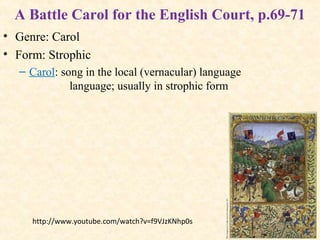
  • #29 Figure 5.7 A remarkably accurate depiction of the Battle of Agincourt, showing the English archers on the left cutting down the French cavalry on the right. The artist clearly shows the English flag, with lions rampant (left), and the French one, with fleurs de lis (right).
  • #30 Figure 5.8 Hans Memling (c. 1430–1491), musical angels painted for the walls of a hospital in Bruges, Belgium. The depiction of the instruments is remarkably detailed.