Music in the Middle AgesMelody vs Polyphony
The Middle Ages450-1450
Life was tough…20% of women died during childbirth20% of children died during birth or infancyMen and women would marry as young as 12-14 years old….typically, though, women were 17-18 years old and men were in their late 20s or 30s
People were superstitious…
Different times…EntertainmentGames and sports, hunting, banquets, jousts and tournamentsFeast days were very important
Feast Days in just the month of February:   1st    St Brigid and St Ignatius 2nd     Candlemas4th      St Gilbert 5th      St Agatha 9th      Purification of St Mary 11th   St Frideswide14th   St Valentine 16th   St Juliana 23rd   St Milburga24th   St Mathias 28th   St Oswald
So what does all this mean for music?The Catholic Church was the center of musical lifeMainly  vocalThe Church frowned on instruments because of their earlier role in pagan rites.“To what purpose, I pray you, is that terrible blowing of bellows, expressing rather the cracks of thunder than the sweetness of a Voyce.” –St. AethelredOrgans were played on special occaisions…people sometimes complained that the noise was a distraction to worshipers
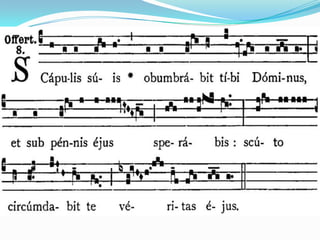
Gregorian Chant!The official music of the Roman Catholic Church for over 1,000 yearsSingle line of music without accompaniment Represents the voice of the Church, rather than any single individualFlexible rhythm with little sense of beat
3 kinds of Gregorian chantSyllabicOne syllable for every noteMary Had a Little LambMelismaticFew syllables over many notesAngels We Have Heard on High “Gloria”NeumaticIn between: one syllable over a few notesAmazing Grace
Pope Gregory IAKA: St. Gregory the GreatReorganized the Catholic liturgyAlthough Gregorian chant gets its name from this pope, he is not the sole creator of Gregorian chant
How did they learn music?In the early middle ages, music was all passed on by oral tradition.Write down what I say…Is this the most accurate way of doing things?
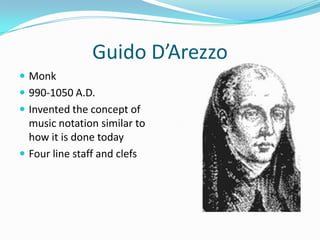
Guido D’ArezzoMonk990-1050 A.D.Invented the concept of music notation similar to how it is done todayFour line staff and clefs
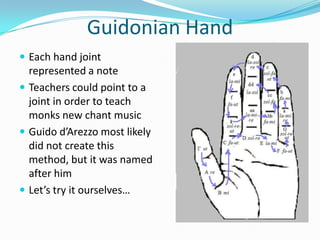
Guidonian HandEach hand joint represented a noteTeachers could point to a joint in order to teach monks new chant musicGuido d’Arezzo most likely did not create this method, but it was named after himLet’s try it ourselves…
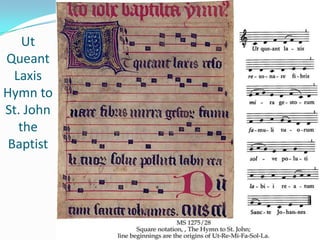
Well that works, but let’s think of something better.Imagine, for a moment, that we never had written music before. How would you create it?Guido came up with the basic music notation systemUt, Re, Mi, Fa, So, LaDoes that look familiar?
UtQueantLaxisHymn to St. John the Baptist
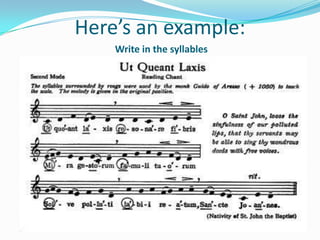
Here’s an example:Write in the syllables
MonophonyWhat does all of this chant have in common?Let’s have a brave volunteer…
Congratulations!You’ve just sung monophony!Monophony=Single line of music.Any voice singing or any instrument playing by itself is considered monophonic musicHowever: more than one voice or instrument can perform in unison and still be considered monophonic (Gregorian Chant)Monophony was the main form of music in the early part of the middle ages
My favorite piece of monophonic music:

4 middle ages, monophony

  • 1.
    Music in theMiddle AgesMelody vs Polyphony
  • 2.
  • 3.
    Life was tough…20%of women died during childbirth20% of children died during birth or infancyMen and women would marry as young as 12-14 years old….typically, though, women were 17-18 years old and men were in their late 20s or 30s
  • 4.
  • 6.
    Different times…EntertainmentGames andsports, hunting, banquets, jousts and tournamentsFeast days were very important
  • 7.
    Feast Days injust the month of February: 1st St Brigid and St Ignatius 2nd Candlemas4th St Gilbert 5th St Agatha 9th Purification of St Mary 11th St Frideswide14th St Valentine 16th St Juliana 23rd St Milburga24th St Mathias 28th St Oswald
  • 8.
    So what doesall this mean for music?The Catholic Church was the center of musical lifeMainly vocalThe Church frowned on instruments because of their earlier role in pagan rites.“To what purpose, I pray you, is that terrible blowing of bellows, expressing rather the cracks of thunder than the sweetness of a Voyce.” –St. AethelredOrgans were played on special occaisions…people sometimes complained that the noise was a distraction to worshipers
  • 9.
    Gregorian Chant!The officialmusic of the Roman Catholic Church for over 1,000 yearsSingle line of music without accompaniment Represents the voice of the Church, rather than any single individualFlexible rhythm with little sense of beat
  • 11.
    3 kinds ofGregorian chantSyllabicOne syllable for every noteMary Had a Little LambMelismaticFew syllables over many notesAngels We Have Heard on High “Gloria”NeumaticIn between: one syllable over a few notesAmazing Grace
  • 12.
    Pope Gregory IAKA:St. Gregory the GreatReorganized the Catholic liturgyAlthough Gregorian chant gets its name from this pope, he is not the sole creator of Gregorian chant
  • 13.
    How did theylearn music?In the early middle ages, music was all passed on by oral tradition.Write down what I say…Is this the most accurate way of doing things?
  • 15.
    Guido D’ArezzoMonk990-1050 A.D.Inventedthe concept of music notation similar to how it is done todayFour line staff and clefs
  • 17.
    Guidonian HandEach handjoint represented a noteTeachers could point to a joint in order to teach monks new chant musicGuido d’Arezzo most likely did not create this method, but it was named after himLet’s try it ourselves…
  • 18.
    Well that works,but let’s think of something better.Imagine, for a moment, that we never had written music before. How would you create it?Guido came up with the basic music notation systemUt, Re, Mi, Fa, So, LaDoes that look familiar?
  • 19.
    UtQueantLaxisHymn to St.John the Baptist
  • 20.
  • 22.
    MonophonyWhat does allof this chant have in common?Let’s have a brave volunteer…
  • 23.
    Congratulations!You’ve just sungmonophony!Monophony=Single line of music.Any voice singing or any instrument playing by itself is considered monophonic musicHowever: more than one voice or instrument can perform in unison and still be considered monophonic (Gregorian Chant)Monophony was the main form of music in the early part of the middle ages
  • 24.
    My favorite pieceof monophonic music:

Editor's Notes

  • #5 http://www.youtube.com/watch?v=yp_l5ntikaU
  • #6 http://www.youtube.com/watch?v=yp_l5ntikaUMonty Python witch
  • #11 http://www.youtube.com/watch?v=2HEKhr002Ts&feature=related
  • #15 http://www.youtube.com/watch?v=wLIlkPNnxUITelephone game
  • #17 Guido d’Arezzo
  • #25 Bach Cello Suite No 1 YoYo Mahttp://www.youtube.com/watch?v=dZn_VBgkPNY