The Black Death
0 A punishment from God
0 Religion was a central part of daily lives
0 Christian Church shaped worldview
0 People believed they needed the Christian Church to
 help then get into heaven.
Finish this sentence:

In Canada today, ______________ is a
central part of people’s daily lives.
Finish this sentence:

In Canada today, ______________ is a
central part of people’s daily lives.

  What does this suggest about worldviews in our
                     society?
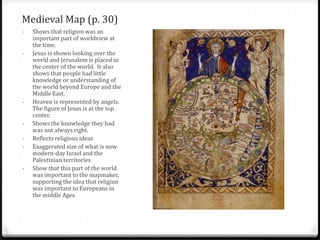
Medieval Map (p. 30)
-   Shows that religion was an
    important part of worldview at
    the time.
-   Jesus is shown looking over the
    world and Jerusalem is placed in
    the center of the world. It also
    shows that people had little
    knowledge or understanding of
    the world beyond Europe and the
    Middle East.
-   Heaven is represented by angels.
    The figure of Jesus is at the top
    center.
-   Shows the knowledge they had
    was not always right.
-   Reflects religious ideas
-   Exaggerated size of what is now
    modern-day Israel and the
    Palestinian territories
-   Show that this part of the world
    was important to the mapmaker,
    supporting the idea that religion
    was important to Europeans in
    the middle Ages
Roles of the Church
     Continuity               Change

0 To what extent did   0 To what extent did
 the roles of the       the roles of the
 Church stay the        Church change?
 same?
Changing Hierarchy
   (Social Structure)
Feudalism         Church
Responsibilities


                   Right to
                   Right to
Cathedrals

-   Built more than 1500 churches
    from 900-1000 A.D in France.
-   Built more all over Europe
-   Pride and competition to build
    the tallest and most beautiful
    buildings
-   People put money and labour
    into building
-   Involved hundreds of masons,
    sculptors, carpenters,
    blacksmiths, and workers
-   Heavy work was done by serfs
    and peasants.
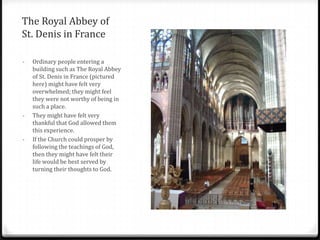
The Royal Abbey of
St. Denis in France

-   Ordinary people entering a
    building such as The Royal Abbey
    of St. Denis in France (pictured
    here) might have felt very
    overwhelmed; they might feel
    they were not worthy of being in
    such a place.
-   They might have felt very
    thankful that God allowed them
    this experience.
-   If the Church could prosper by
    following the teachings of God,
    then they might have felt their
    life would be best served by
    turning their thoughts to God.
The Monastic Life
0 Deeply religious people during the medieval and
  Renaissance times joined a religious order
0 Men became monks and entered monasteries
0 Women became nuns and entered covenants
0 They spent their lives studying religious texts,
  praying, and working.
0 They grew and prepared food for the order, taught
  children, cared for the sick and the poor, and fed the
  hungry.
Learning and the Church
0 Monks and nuns were well educated
0 Some monasteries became great centres of learning during medieval
    times
0   Religious scholars copied Christian religious texts as well as
    manuscripts from ancient times written in Latin and Greek
0   These manuscripts and the ideas they contained contributed to a
    revival of learning during the Renaissance.
0   Universities evolved from religious schools
0   Subjects such as grammar, geometry, astronomy, and music were
    taught
0   Training in religion, law, and medicine was also offered
0   By the end of the 1400s there were more than 80 universities in
    Western Europe.
0   Women were allowed to attend some universities by the late 1800s
Changing Attitudes Toward
        Religion
0 Some people questioned their faith due to the Black
  Death
0 Became critical of the church
  0 Wealthy
  0 Owned 1/3 of the land in Europe
  0 Earned a large about of money from rent
  0 Collected money in tithes
  0 Received money from the estates of wealthy members
  0 Some members of the clergy enjoyed the wealth
A New Age
0 Towns were emerging
0 A merchant class was developing
0 Less rigid social structure
0 Material possessions were becoming more important
0 1855 – French historian Jules Michelet came up with
 the term “Renaissance” to describe the period that
 was beginning (creativity in the arts and sciences) in
 Italy.
Abraham Ortelius Map
                                    (circa. 1612)
Changing Worldviews:
- Drawn toward the end of the
   Renaissance
- Abraham Ortelius was a
   Renaissance map-maker and
   geographer
- Ortelius is believed to have
   created the first modern atlas
   that was sold to the public
- Prior to the invention of the
   printing press, maps were only
   available to the rich and
   powerful
Changing Worldviews
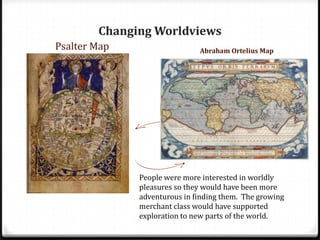
Psalter Map                    Abraham Ortelius Map


              Ortelius’ map shows a more accurate
              understanding of the world. It includes North
              and South America and a better understanding
              of the oceans. It does not have symbols
              representing religion or legendary figures.
Changing Worldviews
Psalter Map                   Abraham Ortelius Map


              People were more interested in worldly
              pleasures so they would have been more
              adventurous in finding them. The growing
              merchant class would have supported
              exploration to new parts of the world.
Renaissance
   Personalities


   Christine de Pisan
    (1364 – 1430)
 French poet, philosopher, historian.
  Educated in ancient languages and
literature. Wrote that women should
 be allowed to participate more fully
              in society.
Renaissance
   Personalities


     Vasco da Gama
      c. 1460-1524
Portuguese explorer. First person to
  sail directly from Europe to India.
 Started “Age of Exploration” during
  which Europeans began to settle
     different parts of the world.
Renaissance
   Personalities


  Francois 1, King of
       France
     1494-1547
   Supported the construction of
buildings using the new Renaissance
architecture (e.g., the Louvre in Paris
  and the Chateau de Chambord).
Renaissance
   Personalities


      Martin Luther
       1483-1546
German religious thinker. Translated
  the Bible into German. A leading
  protester and religious reformer
against the corruption of the Church.
Renaissance
   Personalities


 Nicolaus Copernicus
     1473-1543
       Polish astronomer and
mathematician. Published his theory
that the sun is near the center of the
universe, not the Earth. Considered
the father of modern astronomy and
               science.
Renaissance
   Personalities


   Leonardo da Vinci
      1452-1519
Architect, inventor, engineer, painter,
musician. Painted one of the world’s
  most famous paintings, the Mona
Lisa. One of the great geniuses of all
                time.

Medieval ages

  • 2.
    The Black Death 0A punishment from God 0 Religion was a central part of daily lives 0 Christian Church shaped worldview 0 People believed they needed the Christian Church to help then get into heaven.
  • 3.
    Finish this sentence: InCanada today, ______________ is a central part of people’s daily lives.
  • 4.
    Finish this sentence: InCanada today, ______________ is a central part of people’s daily lives. What does this suggest about worldviews in our society?
  • 5.
    Medieval Map (p.30) - Shows that religion was an important part of worldview at the time. - Jesus is shown looking over the world and Jerusalem is placed in the center of the world. It also shows that people had little knowledge or understanding of the world beyond Europe and the Middle East. - Heaven is represented by angels. The figure of Jesus is at the top center. - Shows the knowledge they had was not always right. - Reflects religious ideas - Exaggerated size of what is now modern-day Israel and the Palestinian territories - Show that this part of the world was important to the mapmaker, supporting the idea that religion was important to Europeans in the middle Ages
  • 6.
    Roles of theChurch Continuity Change 0 To what extent did 0 To what extent did the roles of the the roles of the Church stay the Church change? same?
  • 7.
    Changing Hierarchy (Social Structure) Feudalism Church
  • 8.
    Responsibilities Right to Right to
  • 9.
    Cathedrals - Built more than 1500 churches from 900-1000 A.D in France. - Built more all over Europe - Pride and competition to build the tallest and most beautiful buildings - People put money and labour into building - Involved hundreds of masons, sculptors, carpenters, blacksmiths, and workers - Heavy work was done by serfs and peasants.
  • 10.
    The Royal Abbeyof St. Denis in France - Ordinary people entering a building such as The Royal Abbey of St. Denis in France (pictured here) might have felt very overwhelmed; they might feel they were not worthy of being in such a place. - They might have felt very thankful that God allowed them this experience. - If the Church could prosper by following the teachings of God, then they might have felt their life would be best served by turning their thoughts to God.
  • 11.
    The Monastic Life 0Deeply religious people during the medieval and Renaissance times joined a religious order 0 Men became monks and entered monasteries 0 Women became nuns and entered covenants 0 They spent their lives studying religious texts, praying, and working. 0 They grew and prepared food for the order, taught children, cared for the sick and the poor, and fed the hungry.
  • 12.
    Learning and theChurch 0 Monks and nuns were well educated 0 Some monasteries became great centres of learning during medieval times 0 Religious scholars copied Christian religious texts as well as manuscripts from ancient times written in Latin and Greek 0 These manuscripts and the ideas they contained contributed to a revival of learning during the Renaissance. 0 Universities evolved from religious schools 0 Subjects such as grammar, geometry, astronomy, and music were taught 0 Training in religion, law, and medicine was also offered 0 By the end of the 1400s there were more than 80 universities in Western Europe. 0 Women were allowed to attend some universities by the late 1800s
  • 13.
    Changing Attitudes Toward Religion 0 Some people questioned their faith due to the Black Death 0 Became critical of the church 0 Wealthy 0 Owned 1/3 of the land in Europe 0 Earned a large about of money from rent 0 Collected money in tithes 0 Received money from the estates of wealthy members 0 Some members of the clergy enjoyed the wealth
  • 14.
    A New Age 0Towns were emerging 0 A merchant class was developing 0 Less rigid social structure 0 Material possessions were becoming more important 0 1855 – French historian Jules Michelet came up with the term “Renaissance” to describe the period that was beginning (creativity in the arts and sciences) in Italy.
  • 15.
    Abraham Ortelius Map (circa. 1612) Changing Worldviews: - Drawn toward the end of the Renaissance - Abraham Ortelius was a Renaissance map-maker and geographer - Ortelius is believed to have created the first modern atlas that was sold to the public - Prior to the invention of the printing press, maps were only available to the rich and powerful
  • 16.
    Changing Worldviews Psalter Map Abraham Ortelius Map Ortelius’ map shows a more accurate understanding of the world. It includes North and South America and a better understanding of the oceans. It does not have symbols representing religion or legendary figures.
  • 17.
    Changing Worldviews Psalter Map Abraham Ortelius Map People were more interested in worldly pleasures so they would have been more adventurous in finding them. The growing merchant class would have supported exploration to new parts of the world.
  • 18.
    Renaissance Personalities Christine de Pisan (1364 – 1430) French poet, philosopher, historian. Educated in ancient languages and literature. Wrote that women should be allowed to participate more fully in society.
  • 19.
    Renaissance Personalities Vasco da Gama c. 1460-1524 Portuguese explorer. First person to sail directly from Europe to India. Started “Age of Exploration” during which Europeans began to settle different parts of the world.
  • 20.
    Renaissance Personalities Francois 1, King of France 1494-1547 Supported the construction of buildings using the new Renaissance architecture (e.g., the Louvre in Paris and the Chateau de Chambord).
  • 21.
    Renaissance Personalities Martin Luther 1483-1546 German religious thinker. Translated the Bible into German. A leading protester and religious reformer against the corruption of the Church.
  • 22.
    Renaissance Personalities Nicolaus Copernicus 1473-1543 Polish astronomer and mathematician. Published his theory that the sun is near the center of the universe, not the Earth. Considered the father of modern astronomy and science.
  • 23.
    Renaissance Personalities Leonardo da Vinci 1452-1519 Architect, inventor, engineer, painter, musician. Painted one of the world’s most famous paintings, the Mona Lisa. One of the great geniuses of all time.

Editor's Notes

  • #8 They were both a hierarchy in which people at the top had more power and rights than those at the bottom.