Bible Translation


             Further Turning Points (20th Century)
                    Decisive Moments in the History of Christianity
Brian M. Sandifer                                                     1
Turning Points
                 in Christian History
1.   Fall of Jerusalem (70)       8.    English Act of Supremacy
2.   Council of Nicaea (325)            (1534)
3.   Council of Chalcedon (451)   9.    Founding of Jesuits (1540)
4.   Benedict’s Rule (530)        10.   Conversion of Wesleys
5.   Coronation of Charlemagne          (1738)
     (800)                        11.   French Revolution (1789)
6.   Great Schism (1054)          12.   Edinburgh Missionary
                                        Conference (1910)
7.   Diet of Worms (1521)
                                  13.   Further Turning Points
                                        (1900s)
                                                 2
Historically Significant
                         Bible Translations
   In the 20th century there have been 6 major English
    translations published (and ~88 minor translations!)
       ASV (1901); RSV (1952); NASB (1971); NIV (1978); NKJV
        (1982); NRSV (1990)
   But English-speaking Christians already had many
    Bibles in their language for centuries
       GNV (1599); KJV (1611); YLT (1862); DBY (1884); ERV (1885);
        DRA (1899)
   Many (most?) cultures did not have access to the Bible
    in their vernacular tongue
   Based on this fact, from a worldwide perspective of
    God’s Kingdom, the publication of the first Bible
    translation in a language is therefore historically
    significant compared to a new translation for a language
    “already covered”.                           3
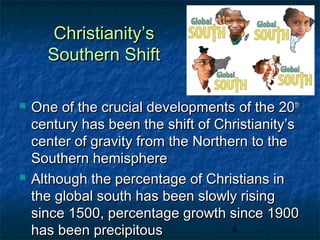
Christianity’s
      Southern Shift

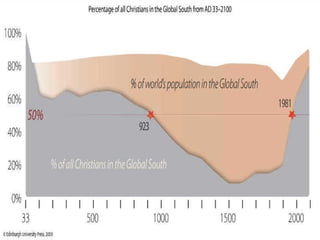
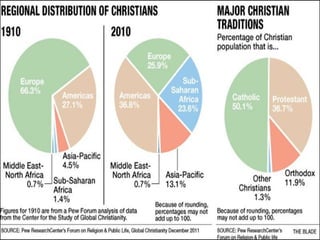
   One of the crucial developments of the 20 th
    century has been the shift of Christianity’s
    center of gravity from the Northern to the
    Southern hemisphere
   Although the percentage of Christians in
    the global south has been slowly rising
    since 1500, percentage growth since 1900
    has been precipitous             4
5
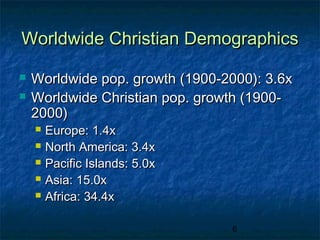
Worldwide Christian Demographics

   Worldwide pop. growth (1900-2000): 3.6x
   Worldwide Christian pop. growth (1900-
    2000)
       Europe: 1.4x
       North America: 3.4x
       Pacific Islands: 5.0x
       Asia: 15.0x
       Africa: 34.4x

                                 6
7
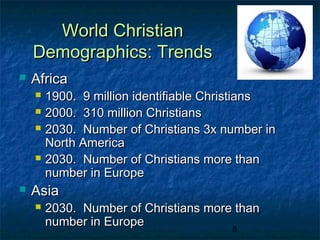
World Christian
    Demographics: Trends
   Africa
       1900. 9 million identifiable Christians
       2000. 310 million Christians
       2030. Number of Christians 3x number in
        North America
       2030. Number of Christians more than
        number in Europe
   Asia
       2030. Number of Christians more than
        number in Europe
                                       8
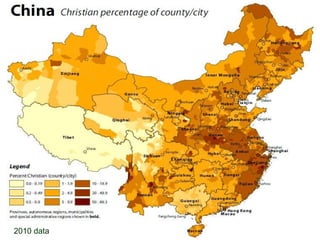
2010 data   9
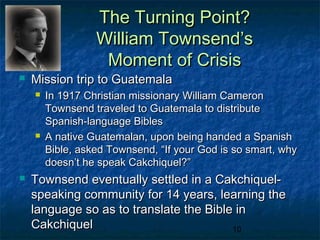
The Turning Point?
                  William Townsend’s
                   Moment of Crisis
   Mission trip to Guatemala
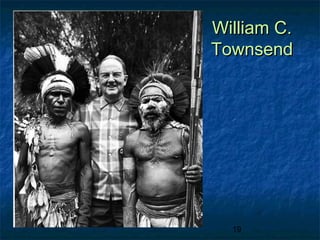
       In 1917 Christian missionary William Cameron
        Townsend traveled to Guatemala to distribute
        Spanish-language Bibles
       A native Guatemalan, upon being handed a Spanish
        Bible, asked Townsend, “If your God is so smart, why
        doesn’t he speak Cakchiquel?”
   Townsend eventually settled in a Cakchiquel-
    speaking community for 14 years, learning the
    language so as to translate the Bible in
    Cakchiquel                           10
Symbolic Turning Point: Spread
              of Bible Translations
   1934. Founding of Wycliffe Bible
    Translators (WBT)
       Founded by William Townsend (1896-1982)
        after he returned to USA from Guatemala
       WBT is the most vigorous promoter of foreign
        Bible translation and distribution
       Draws most of its workers from North
        American & Europe

                                        11
Significance of a Vernacular
     Bible for a Culture

    Western Europe
        Jerome’s Bible translation into Latin immensely
         impacted the Middle Ages
        Luther’s Bible translation shaped German language
         and literature
        KJV and other English Bible translations shaped the
         faith and life of Britain in its colonies
    Vernacular Bible translations in other European
     countries significantly shaped the culture
                                               12
What Does the Future Hold?
   In the 20th century, the Bible has been
    translated into the vernacular for these
    language groups (among others):
       isiZulu (Africa)
       Hausa (Africa)
       KingyaRwanda (Africa)
       Tibetan (Asia)
       Vietnamese (Asia)
       Tagalog (Philippines)
       Various languages (China)    13
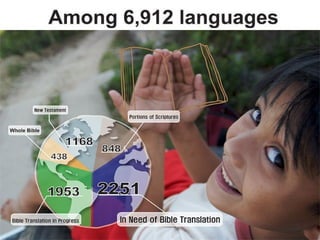
Magnitude of Translation Efforts
   Full vernacular translations of the Bible
       As of 1989. There were 289 separate languages with
        a version. Of these, 170 (59%) were published in the
        20th century.
   Partial vernacular translations of the Bible
       1900. Portions of the Bible were available in
        approximately 537 different languages.
       1980. Portions of the Bible were available in
        approximately 1811 different languages.
   Far more individual language groups, and the
    cultures that these languages define, have
    received the Bible during the 20th century than in
    the preceding 1900 years of church history!
                                          14
15
Implications of Massive
                    Bible Translation Efforts
   The message of Christ (the gospel) that
    missionaries brought is eclipsed by the message
    they left (the vernacular Bible)
   The drama of Pentecost and Church History
    continues
       As at Pentecost, people are hearing the message of
        the Bible in their own tongues
       The gospel message of the universality of salvation
        becomes more real when it arises from within a
        culture rather than outside a culture
   The possession of the Bible in the vernacular
    language often begins to effect a process of
    Christianization of the culture      16
Importance of Vernacular
                  Scriptures
There is a radical pluralism implied in
 vernacular translation wherein all
 languages and cultures are, in principle,
 equal in expressing the word of God…Two
 general ideas stem from this analysis.
 First is the inclusive principle whereby no
 culture is excluded from the Christian
 dispensation or even judged solely or
 ultimately by Western cultural criteria.
 (cont’d)
                                 17
Importance of Vernacular
                        Scriptures
Second is the ethical principle of change as
 a check to cultural self-absolutization.
 Both of these ideas are rooted in what
 missionaries understood by God’s
 universal truth as this was revealed in
 Jesus Christ, with the need and duty to
 work out this fact in the vernacular
 medium rather than in the uniform
 framework of cultural homogeneity.
* Gambian mission historian Lamin Sanneh   18
William C.
Townsend


  19
Questions for Discussion
   What factors would contribute to worldwide
    distribution of vernacular Bible translations
    becoming a significant turning point in church
    history? What factors would be hindrances?
   The USA is increasingly becoming less culturally
    homogeneous due (among other things) to
    immigration of non-English speakers. How
    might vernacular Bible versions foster unity in
    America? How might they encourage
    multicultural fragmentation?
                                        20
Application for Today’s
                       Church
   How ought the church use vernacular
    Bible versions in ministry to speakers of
    other languages?
   Discuss some inherent dangers in the
    process of translating and distributing the
    Bible into vernacular languages.
   Discuss strategies to overcome these
    dangers.
                                     21
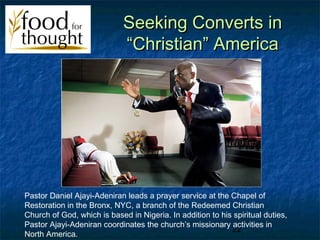
Seeking Converts in
                             “Christian” America


Pastor Daniel Ajayi-Adeniran leads a prayer service at the Chapel of
Restoration in the Bronx, NYC, a branch of the Redeemed Christian
Church of God, which is based in Nigeria. In addition to his spiritual duties,
Pastor Ajayi-Adeniran coordinates the church’s missionary activities in
                                                            22
North America.

Turning Points, Chapter 13, Bible Translation

  • 1.
    Bible Translation Further Turning Points (20th Century) Decisive Moments in the History of Christianity Brian M. Sandifer 1
  • 2.
    Turning Points in Christian History 1. Fall of Jerusalem (70) 8. English Act of Supremacy 2. Council of Nicaea (325) (1534) 3. Council of Chalcedon (451) 9. Founding of Jesuits (1540) 4. Benedict’s Rule (530) 10. Conversion of Wesleys 5. Coronation of Charlemagne (1738) (800) 11. French Revolution (1789) 6. Great Schism (1054) 12. Edinburgh Missionary Conference (1910) 7. Diet of Worms (1521) 13. Further Turning Points (1900s) 2
  • 3.
    Historically Significant Bible Translations  In the 20th century there have been 6 major English translations published (and ~88 minor translations!)  ASV (1901); RSV (1952); NASB (1971); NIV (1978); NKJV (1982); NRSV (1990)  But English-speaking Christians already had many Bibles in their language for centuries  GNV (1599); KJV (1611); YLT (1862); DBY (1884); ERV (1885); DRA (1899)  Many (most?) cultures did not have access to the Bible in their vernacular tongue  Based on this fact, from a worldwide perspective of God’s Kingdom, the publication of the first Bible translation in a language is therefore historically significant compared to a new translation for a language “already covered”. 3
  • 4.
    Christianity’s Southern Shift  One of the crucial developments of the 20 th century has been the shift of Christianity’s center of gravity from the Northern to the Southern hemisphere  Although the percentage of Christians in the global south has been slowly rising since 1500, percentage growth since 1900 has been precipitous 4
  • 5.
  • 6.
    Worldwide Christian Demographics  Worldwide pop. growth (1900-2000): 3.6x  Worldwide Christian pop. growth (1900- 2000)  Europe: 1.4x  North America: 3.4x  Pacific Islands: 5.0x  Asia: 15.0x  Africa: 34.4x 6
  • 7.
  • 8.
    World Christian Demographics: Trends  Africa  1900. 9 million identifiable Christians  2000. 310 million Christians  2030. Number of Christians 3x number in North America  2030. Number of Christians more than number in Europe  Asia  2030. Number of Christians more than number in Europe 8
  • 9.
  • 10.
    The Turning Point? William Townsend’s Moment of Crisis  Mission trip to Guatemala  In 1917 Christian missionary William Cameron Townsend traveled to Guatemala to distribute Spanish-language Bibles  A native Guatemalan, upon being handed a Spanish Bible, asked Townsend, “If your God is so smart, why doesn’t he speak Cakchiquel?”  Townsend eventually settled in a Cakchiquel- speaking community for 14 years, learning the language so as to translate the Bible in Cakchiquel 10
  • 11.
    Symbolic Turning Point:Spread of Bible Translations  1934. Founding of Wycliffe Bible Translators (WBT)  Founded by William Townsend (1896-1982) after he returned to USA from Guatemala  WBT is the most vigorous promoter of foreign Bible translation and distribution  Draws most of its workers from North American & Europe 11
  • 12.
    Significance of aVernacular Bible for a Culture  Western Europe  Jerome’s Bible translation into Latin immensely impacted the Middle Ages  Luther’s Bible translation shaped German language and literature  KJV and other English Bible translations shaped the faith and life of Britain in its colonies  Vernacular Bible translations in other European countries significantly shaped the culture 12
  • 13.
    What Does theFuture Hold?  In the 20th century, the Bible has been translated into the vernacular for these language groups (among others):  isiZulu (Africa)  Hausa (Africa)  KingyaRwanda (Africa)  Tibetan (Asia)  Vietnamese (Asia)  Tagalog (Philippines)  Various languages (China) 13
  • 14.
    Magnitude of TranslationEfforts  Full vernacular translations of the Bible  As of 1989. There were 289 separate languages with a version. Of these, 170 (59%) were published in the 20th century.  Partial vernacular translations of the Bible  1900. Portions of the Bible were available in approximately 537 different languages.  1980. Portions of the Bible were available in approximately 1811 different languages.  Far more individual language groups, and the cultures that these languages define, have received the Bible during the 20th century than in the preceding 1900 years of church history! 14
  • 15.
  • 16.
    Implications of Massive Bible Translation Efforts  The message of Christ (the gospel) that missionaries brought is eclipsed by the message they left (the vernacular Bible)  The drama of Pentecost and Church History continues  As at Pentecost, people are hearing the message of the Bible in their own tongues  The gospel message of the universality of salvation becomes more real when it arises from within a culture rather than outside a culture  The possession of the Bible in the vernacular language often begins to effect a process of Christianization of the culture 16
  • 17.
    Importance of Vernacular Scriptures There is a radical pluralism implied in vernacular translation wherein all languages and cultures are, in principle, equal in expressing the word of God…Two general ideas stem from this analysis. First is the inclusive principle whereby no culture is excluded from the Christian dispensation or even judged solely or ultimately by Western cultural criteria. (cont’d) 17
  • 18.
    Importance of Vernacular Scriptures Second is the ethical principle of change as a check to cultural self-absolutization. Both of these ideas are rooted in what missionaries understood by God’s universal truth as this was revealed in Jesus Christ, with the need and duty to work out this fact in the vernacular medium rather than in the uniform framework of cultural homogeneity. * Gambian mission historian Lamin Sanneh 18
  • 19.
  • 20.
    Questions for Discussion  What factors would contribute to worldwide distribution of vernacular Bible translations becoming a significant turning point in church history? What factors would be hindrances?  The USA is increasingly becoming less culturally homogeneous due (among other things) to immigration of non-English speakers. How might vernacular Bible versions foster unity in America? How might they encourage multicultural fragmentation? 20
  • 21.
    Application for Today’s Church  How ought the church use vernacular Bible versions in ministry to speakers of other languages?  Discuss some inherent dangers in the process of translating and distributing the Bible into vernacular languages.  Discuss strategies to overcome these dangers. 21
  • 22.
    Seeking Converts in “Christian” America Pastor Daniel Ajayi-Adeniran leads a prayer service at the Chapel of Restoration in the Bronx, NYC, a branch of the Redeemed Christian Church of God, which is based in Nigeria. In addition to his spiritual duties, Pastor Ajayi-Adeniran coordinates the church’s missionary activities in 22 North America.