PATIENT RECORD SYSTEM
DEFINITION
A patient record system is a clinical information system that
collects, stores, and makes available clinical data to help
deliver patient care.
Or
According to National institute of health “A patient record
is the repository of information about a single patient. This
information is generated by health care professionals as a
direct result of interaction with a patient or with individuals
who have personal knowledge of the patient (or with both)”.
CLASSIFICATION:
• Paper based documentation system
• Electronic documentation
PAPER BASED DOCUMENTATION TYPE:
1. Source oriented method (eg.admission record):
Source-oriented (SO) charting is a narrative recording by each
member (source) of the health care team charts on separate records.
ADVANTAGES :
1. Seeing a Patient’s Progress According to Each Care Specialty.
2. Visualizing Notes in the Order They Were Written.
3. Tracking Progress Across the Multidisciplinary Team for
Coordinated Discharge.
4. Ease of Use for Individual Disciplines.
5. Detailed Documentation.
Disadvantages
• 1. Difficulty Finding Up-to-date Information in
Complex Cases.
• 2. Fragmented Data Among Treating Providers.
• 3. Limited Cross-Referencing and Silo-Writing.
• 4. Inconsistency in Documentation Styles.
• 5. Increased Risk of Errors.
• 6. Time-Consuming Data Compilation.
2. Problem oriented method (p.o.m.) (eg.list
of client problems):
• Problem-oriented documentation (POMR) is a
method of note-taking that helps with clinical
thought processes and is used to manage and
communicate patient information in a medical office.
The Four (4) Basic Components
1. Database.
2. Problem List.
3. Plan of Care
4. Progress Notes
Advantages
• Enhance communication between members of
the medical team
• Increase the quality of care
• Reduce the chances of making serious
mistakes
• Help healthcare practitioners identify patterns
• Improve coordination of care
• Improve patient outcomes
Disadvantages
1. Varied Ability to Use the Charting Format.
2. Constant Vigilance Required
3. Inefficiency Due to Repetition
4. Time-Consuming
5. Learning Curve.
3. PIE (Problems, Interventions, and Evaluation)
• Problems (P). Identifies and lists the patient’s
health issues or nursing diagnoses.
• Interventions (I). Records the specific actions
taken to address the identified problems.
• Evaluation (E). Documents the patient’s
response to the interventions and the
effectiveness of the care provided.
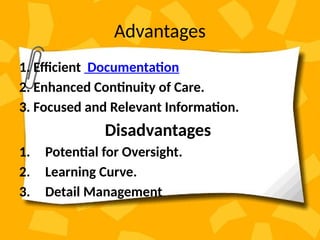
Advantages
1. Efficient Documentation
2. Enhanced Continuity of Care.
3. Focused and Relevant Information.
Disadvantages
1. Potential for Oversight.
2. Learning Curve.
3. Detail Management
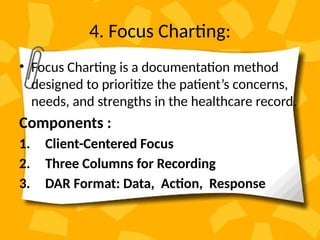
4. Focus Charting:
• Focus Charting is a documentation method
designed to prioritize the patient’s concerns,
needs, and strengths in the healthcare record.
Components :
1. Client-Centered Focus
2. Three Columns for Recording
3. DAR Format: Data, Action, Response
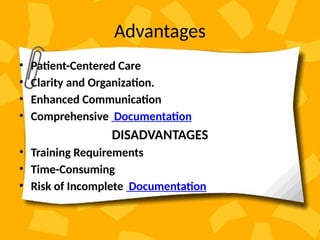
Advantages
• Patient-Centered Care
• Clarity and Organization.
• Enhanced Communication
• Comprehensive Documentation
DISADVANTAGES
• Training Requirements
• Time-Consuming
• Risk of Incomplete Documentation
5. Charting by Exception
• Charting by Exception (CBE) is a documentation
system that focuses on recording only abnormal or
significant findings, or exceptions to established
norms.
• Components :
1. Flow Sheets
2. Standards of Nursing Care
3. Bedside Access to Chart Forms
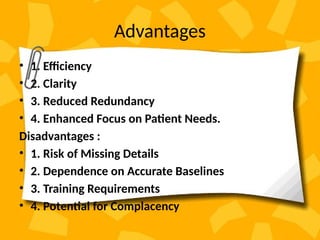
Advantages
• 1. Efficiency
• 2. Clarity
• 3. Reduced Redundancy
• 4. Enhanced Focus on Patient Needs.
Disadvantages :
• 1. Risk of Missing Details
• 2. Dependence on Accurate Baselines
• 3. Training Requirements
• 4. Potential for Complacency
Computerized Documentation
• Computerized documentation systems have
been developed to manage the vast amount
of information required in modern healthcare.
These systems leverage technology to
facilitate the documentation process, enhance
accuracy, and improve access to patient
information.
Benefits
1. Managing Large Volumes of Information
2. Functions for Nurses:
• Storing Client Databases
• Adding New Data
• Creating and Revising Care Plans
• Documenting Client Progress
3. Elimination of Multiple Flow Sheets
Advantages
1. Efficiency
2. Accuracy and Consistency.
3. Accessibility
4. Enhanced Communication
5. Data Security and Privacy
Disadvantages
1. Cost and Implementation
2. Technical Issues
3. Data Entry Burden.
4. Learning Curve
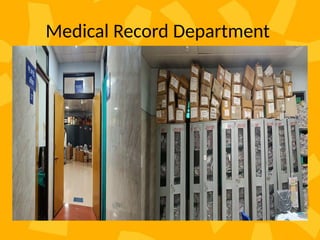
Medical Record Department
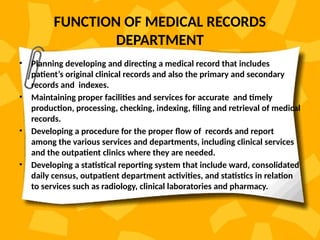
FUNCTION OF MEDICAL RECORDS
DEPARTMENT
• Planning developing and directing a medical record that includes
patient’s original clinical records and also the primary and secondary
records and indexes.
• Maintaining proper facilities and services for accurate and timely
production, processing, checking, indexing, filing and retrieval of medical
records.
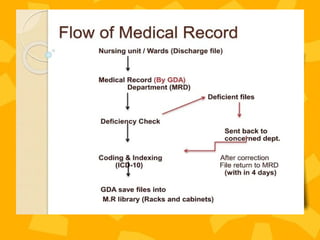
• Developing a procedure for the proper flow of records and report
among the various services and departments, including clinical services
and the outpatient clinics where they are needed.
• Developing a statistical reporting system that include ward, consolidated
daily census, outpatient department activities, and statistics in relation
to services such as radiology, clinical laboratories and pharmacy.
Continue…
• Coding all diagnoses and operational according to
international classification of disease for statistical purpose.
• Safeguarding the information in the medical records against
theft, loss, defacement, tampering or use by unauthorized
persons.
• Determining in coordination with medical staff and
administrating the action to be taken in medico-legal cases
relating to the released of medical records in a variety of
situations and determining the legality and ethical
appropriateness of such action of conformity with the laws
of the land.
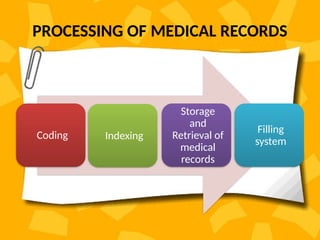
PROCESSING OF MEDICAL RECORDS
Coding Indexing
Storage
and
Retrieval of
medical
records
Filling
system
CODING
• Coding of the disease is done as per the
international classification of the disease; for
making nation and international comparisons.
This is to bring uniformity in classification of
the disease.
INDEXING:
• Alphabetical Indexing- Patients name sequenced in
alphabetical order.
• Disease index- The medical records, are of patient having
the same diagnosis is placed at one place.
• Unit indexing- unit wise indexing of medical records are
done like cardiology, nephrology or unit I or unit II of surgery
department.
• Physicians index- all patients treated by a particular
physician are indexed.
• Operation index- details of patients, who have undergone
surgery, are indexed.
STORAGE AND RETRIEVAL OF MEDICAL
RECORDS:
• Compactness
• Easy accessibility
• Simplicity for understanding
• Elasticity for expansion
• Economical
• Easily retrievable
• Safety from fire, moth, insects and dampness.
• Controllability
FILLING SYSTEM
• Centralized system- All the medical records
whether OPD or IPD are filed in medical
records department of the hospital.
• Decentralized- In this system the OPD save
their own records department. If a patients is
transferred from one department to another
department, the file is transferred on loan
basis.
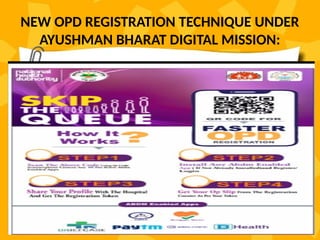
NEW OPD REGISTRATION TECHNIQUE UNDER
AYUSHMAN BHARAT DIGITAL MISSION:
CONCLUSION
• A patient record system is a type of clinical
information system, which is dedicated to
collecting, storing, manipulating, and
making available clinical information
important to the delivery of patient care.
The central focus of such systems is clinical
data and not financial or billing information.
BIBLIOGRAPHY
• Jogindra vati; principles and practice of nursing management and
administration jaypee publications;648-655
• Deepak. k et al; A comprehensive textbook on nursing management
emmess publications;2013;555-559
• Basavanthappa B T;. Nursing administration. Ist edn. New Delhi:
Jaypee brothers;2000.
• Alamellu; Newer trends in management of nursing services and
education. health science publishers first edition 2017;
Net reference
• Electronic patient records and innovation in health care
services PB ELBERG - International journal of medical
informatics, 2001 – Elsevier
• www. pubmed.com
• www.wikepedia.com
• https://www.ausmed.com/cpd/articles/record-keeping-
documentation
patient record system is a method to stored

patient record system is a method to stored

  • 2.
  • 3.
    DEFINITION A patient recordsystem is a clinical information system that collects, stores, and makes available clinical data to help deliver patient care. Or According to National institute of health “A patient record is the repository of information about a single patient. This information is generated by health care professionals as a direct result of interaction with a patient or with individuals who have personal knowledge of the patient (or with both)”.
  • 4.
    CLASSIFICATION: • Paper baseddocumentation system • Electronic documentation
  • 5.
    PAPER BASED DOCUMENTATIONTYPE: 1. Source oriented method (eg.admission record): Source-oriented (SO) charting is a narrative recording by each member (source) of the health care team charts on separate records. ADVANTAGES : 1. Seeing a Patient’s Progress According to Each Care Specialty. 2. Visualizing Notes in the Order They Were Written. 3. Tracking Progress Across the Multidisciplinary Team for Coordinated Discharge. 4. Ease of Use for Individual Disciplines. 5. Detailed Documentation.
  • 7.
    Disadvantages • 1. DifficultyFinding Up-to-date Information in Complex Cases. • 2. Fragmented Data Among Treating Providers. • 3. Limited Cross-Referencing and Silo-Writing. • 4. Inconsistency in Documentation Styles. • 5. Increased Risk of Errors. • 6. Time-Consuming Data Compilation.
  • 8.
    2. Problem orientedmethod (p.o.m.) (eg.list of client problems): • Problem-oriented documentation (POMR) is a method of note-taking that helps with clinical thought processes and is used to manage and communicate patient information in a medical office. The Four (4) Basic Components 1. Database. 2. Problem List. 3. Plan of Care 4. Progress Notes
  • 9.
    Advantages • Enhance communicationbetween members of the medical team • Increase the quality of care • Reduce the chances of making serious mistakes • Help healthcare practitioners identify patterns • Improve coordination of care • Improve patient outcomes
  • 10.
    Disadvantages 1. Varied Abilityto Use the Charting Format. 2. Constant Vigilance Required 3. Inefficiency Due to Repetition 4. Time-Consuming 5. Learning Curve.
  • 11.
    3. PIE (Problems,Interventions, and Evaluation) • Problems (P). Identifies and lists the patient’s health issues or nursing diagnoses. • Interventions (I). Records the specific actions taken to address the identified problems. • Evaluation (E). Documents the patient’s response to the interventions and the effectiveness of the care provided.
  • 12.
    Advantages 1. Efficient Documentation 2.Enhanced Continuity of Care. 3. Focused and Relevant Information. Disadvantages 1. Potential for Oversight. 2. Learning Curve. 3. Detail Management
  • 13.
    4. Focus Charting: •Focus Charting is a documentation method designed to prioritize the patient’s concerns, needs, and strengths in the healthcare record. Components : 1. Client-Centered Focus 2. Three Columns for Recording 3. DAR Format: Data, Action, Response
  • 14.
    Advantages • Patient-Centered Care •Clarity and Organization. • Enhanced Communication • Comprehensive Documentation DISADVANTAGES • Training Requirements • Time-Consuming • Risk of Incomplete Documentation
  • 15.
    5. Charting byException • Charting by Exception (CBE) is a documentation system that focuses on recording only abnormal or significant findings, or exceptions to established norms. • Components : 1. Flow Sheets 2. Standards of Nursing Care 3. Bedside Access to Chart Forms
  • 16.
    Advantages • 1. Efficiency •2. Clarity • 3. Reduced Redundancy • 4. Enhanced Focus on Patient Needs. Disadvantages : • 1. Risk of Missing Details • 2. Dependence on Accurate Baselines • 3. Training Requirements • 4. Potential for Complacency
  • 17.
    Computerized Documentation • Computerizeddocumentation systems have been developed to manage the vast amount of information required in modern healthcare. These systems leverage technology to facilitate the documentation process, enhance accuracy, and improve access to patient information.
  • 18.
    Benefits 1. Managing LargeVolumes of Information 2. Functions for Nurses: • Storing Client Databases • Adding New Data • Creating and Revising Care Plans • Documenting Client Progress 3. Elimination of Multiple Flow Sheets
  • 19.
    Advantages 1. Efficiency 2. Accuracyand Consistency. 3. Accessibility 4. Enhanced Communication 5. Data Security and Privacy
  • 20.
    Disadvantages 1. Cost andImplementation 2. Technical Issues 3. Data Entry Burden. 4. Learning Curve
  • 21.
  • 23.
    FUNCTION OF MEDICALRECORDS DEPARTMENT • Planning developing and directing a medical record that includes patient’s original clinical records and also the primary and secondary records and indexes. • Maintaining proper facilities and services for accurate and timely production, processing, checking, indexing, filing and retrieval of medical records. • Developing a procedure for the proper flow of records and report among the various services and departments, including clinical services and the outpatient clinics where they are needed. • Developing a statistical reporting system that include ward, consolidated daily census, outpatient department activities, and statistics in relation to services such as radiology, clinical laboratories and pharmacy.
  • 24.
    Continue… • Coding alldiagnoses and operational according to international classification of disease for statistical purpose. • Safeguarding the information in the medical records against theft, loss, defacement, tampering or use by unauthorized persons. • Determining in coordination with medical staff and administrating the action to be taken in medico-legal cases relating to the released of medical records in a variety of situations and determining the legality and ethical appropriateness of such action of conformity with the laws of the land.
  • 25.
    PROCESSING OF MEDICALRECORDS Coding Indexing Storage and Retrieval of medical records Filling system
  • 26.
    CODING • Coding ofthe disease is done as per the international classification of the disease; for making nation and international comparisons. This is to bring uniformity in classification of the disease.
  • 27.
    INDEXING: • Alphabetical Indexing-Patients name sequenced in alphabetical order. • Disease index- The medical records, are of patient having the same diagnosis is placed at one place. • Unit indexing- unit wise indexing of medical records are done like cardiology, nephrology or unit I or unit II of surgery department. • Physicians index- all patients treated by a particular physician are indexed. • Operation index- details of patients, who have undergone surgery, are indexed.
  • 28.
    STORAGE AND RETRIEVALOF MEDICAL RECORDS: • Compactness • Easy accessibility • Simplicity for understanding • Elasticity for expansion • Economical • Easily retrievable • Safety from fire, moth, insects and dampness. • Controllability
  • 29.
    FILLING SYSTEM • Centralizedsystem- All the medical records whether OPD or IPD are filed in medical records department of the hospital. • Decentralized- In this system the OPD save their own records department. If a patients is transferred from one department to another department, the file is transferred on loan basis.
  • 30.
    NEW OPD REGISTRATIONTECHNIQUE UNDER AYUSHMAN BHARAT DIGITAL MISSION:
  • 31.
    CONCLUSION • A patientrecord system is a type of clinical information system, which is dedicated to collecting, storing, manipulating, and making available clinical information important to the delivery of patient care. The central focus of such systems is clinical data and not financial or billing information.
  • 32.
    BIBLIOGRAPHY • Jogindra vati;principles and practice of nursing management and administration jaypee publications;648-655 • Deepak. k et al; A comprehensive textbook on nursing management emmess publications;2013;555-559 • Basavanthappa B T;. Nursing administration. Ist edn. New Delhi: Jaypee brothers;2000. • Alamellu; Newer trends in management of nursing services and education. health science publishers first edition 2017;
  • 33.
    Net reference • Electronicpatient records and innovation in health care services PB ELBERG - International journal of medical informatics, 2001 – Elsevier • www. pubmed.com • www.wikepedia.com • https://www.ausmed.com/cpd/articles/record-keeping- documentation