tps://www.sigmabiomedical.com
Medical Devices I
Basic Principles
tps://www.sigmabiomedical.com
Description
This presentation serves as an introduction to the principles of medical device
development. It is mainly intended for those beginning in the biomedical engineering
career or are new to the field.
Medical Devices Principles
tps://www.sigmabiomedical.com
Presentation Contents
Medical Devices Principles
 Medical Device Definition
 Product Development Process
 Biomedical Engineering Overview
 Medical Device Regulations
 Bioethics in Product Development
 Biomedical Instrumentation
tps://www.sigmabiomedical.com
What is a Medical Device?
Medical Devices Principles
It is an instrument, apparatus, implement,
machine, implant, in vitro reagent, a
component part, or accessory which is:
Intended for use in the diagnosis of disease
or other conditions, or in the cure,
mitigation, treatment, or prevention of
disease or
which does not achieve any of its primary
intended purposes through chemical action
Diagnose
Disease
Diagnose
Disease
Treat
Disease
Treat
Disease
Manage
Disease
Manage
Disease
Prevent
Disease
Prevent
Disease
Medical
Device
Medical
Device
tps://www.sigmabiomedical.com
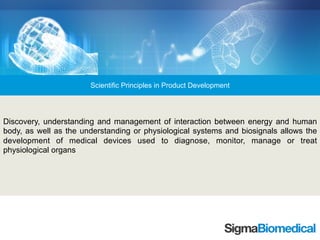
Discovery, understanding and management of interaction between energy and human body, as
well as the understanding or physiological systems and biosignals allows the development of
medical devices used to diagnose, monitor, manage or treat physiological organs
Medical Devices Principles
Scientific Principles in Product Development
tps://www.sigmabiomedical.com
Development Phases
tps://www.sigmabiomedical.com
Biomedical Industry Overview
Engineering technology is the part of the
technological field that requires the application of
scientific and engineering knowledge and methods
combined with technical skills in support of
engineering activities
ENGINEERING applies knowledge of the natural
sciences gained by study, experience, and practice
to develop ways to utilize the materials and forces of
nature for the benefit of mankind.
Medical Devices Principles
tps://www.sigmabiomedical.com
Medical Device Industry Overview
Engineering disciplines related include
•Electrical engineering
•Mechanical engineering
•Biomedical engineering
•Chemical engineering
•Computer engineering
A Biomedical engineer applies electronic, mechanical, and other engineering
principles to design, develop, maintain, repair or upgrade medical
equipment.
Most biomedical engineering graduates are employed by medical device
manufacturers, research labs, hospital, clinics, and service organizations
Medical Devices Principles
tps://www.sigmabiomedical.com
Biomedical Industry Overview
Scientific fields applied
•Medicine, Healthcare
•Physics, Chemistry, Math, Biology
•Engineering Disciplines
•Manufacturing technologies
•Medical Device Regulations
•Compliance Engineering
Areas of product development:
• Biomedical instrumentation
• Medical Devices
• Medical Imaging
• Biomechanics and rehabilitation engineering
• Bioinformatics and telemedicine
• Clinical Engineering
Medical Devices Principles
tps://www.sigmabiomedical.com
Medical Devices Principles
Medical Device Regulations
• Devices can benefit patients
• Devices can harm patients
• Balance between risk and benefit
Products need to be regulated
• To ensure patient safety
• To ensure maximum benefit
• To ensure proper use
tps://www.sigmabiomedical.com
Product Approval Requires
•Patient Safety
•Demonstrated Effectiveness
•Validated Intended Use
•Labeling Compliance
•Risk Management
•Quality in Manufacturing
Medical Devices Principles
Medical Device Regulations
Patients depend on an increasing array of medical devices for
the diagnosis and management of disease conditions. Most
countries have a regulatory body that regulates the safe and
effective development manufacturing, distribution and use of
such devices.
FDA
In the United States, the Food and Drug Administration (FDA)
regulates the medical device industry. The FDA was allowed to
regulate medical devices starting in 1976. This year was
significant because the conflict of interest between a medical
device company and its investors was brought to the forefront
with a device (the Dalkon Shield) that compromised the safety
of its users.
Product review
Medical devices are reviewed for safety, effectiveness and
labeling compliance within the FDA Center for Devices and
Radiological Health (CDRH)
tps://www.sigmabiomedical.com
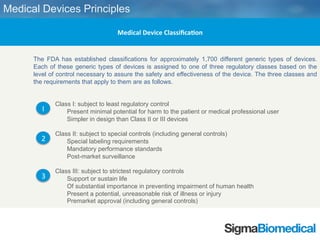
The FDA has established classifications for approximately 1,700 different generic types of devices. Each of these
generic types of devices is assigned to one of three regulatory classes based on the level of control necessary to
assure the safety and effectiveness of the device. The three classes and the requirements that apply to them are as
follows.
Class I: subject to least regulatory control
Present minimal potential for harm to the patient or medical professional user
Simpler in design than Class II or III devices
Class II: subject to special controls (including general controls)
Special labeling requirements
Mandatory performance standards
Post-market surveillance
Class III: subject to strictest regulatory controls
Support or sustain life
Of substantial importance in preventing impairment of human health
Present a potential, unreasonable risk of illness or injury
Premarket approval (including general controls)
Medical Devices Principles
Medical Device Classification
II
22
33
tps://www.sigmabiomedical.com
25 MeV Radiotherapy Machine – X-rays & Electrons
200 rad (e) or 25000 rad (x)
Error on selection, Software bug, Beam not reset
Patient received 25000 MeV, “malfunction 54
displayed”
Technician fired 2 more times
4 months later patient died
Medical Devices Principles
Patient Safety – Case Example
tps://www.sigmabiomedical.com
Biomedical Industry Overview
As per the Biomedical Engineering Society, biomedical engineering is a learned profession
that combines expertise and responsibilities in engineering, science, technology, and
medicine. Because public health and welfare are paramount considerations in each of
these areas, biomedical engineering professionals must uphold those principles of ethical
conduct when involved in professional practice, research, patient care, and training.
Biomedical engineering professionals in the fulfillment of their professional duties shall use
their knowledge, skills, and abilities to enhance the safety, health, and welfare of the
public; and strive by action, example, and influence to increase the competence, prestige,
and honor of the biomedical engineering profession.
Biomedical engineering professionals involved in healthcare activities shall regard
responsibility toward and rights of patients, including those of confidentiality and privacy,
as their primary concern; and consider the larger consequences of their work in regard to
cost, availability, and delivery of healthcare.
Medical Devices Principles
Bioethics Within the Field of Biomedical Engineering
tps://www.sigmabiomedical.com
Biomedical engineering professionals must follow principles of
ethical conduct when involved in professional practice, research,
patient care, and training. Biomedical engineering professionals in
the fulfillment of their professional duties shall
•Use their knowledge, skills, and abilities to enhance the safety,
health, and welfare of the public
•Regard responsibility toward and rights of patients, including
those of confidentiality and privacy, as their primary concern; and
•Consider the larger consequences of their work in regard to cost,
availability, and delivery of healthcare.
Medical Devices Principles
Bioethics Within the Field of Biomedical Engineering
tps://www.sigmabiomedical.com
Diagnostic Medical Devices generally
capture signals from the human body or
signals as a result of interaction of
energy sources with the body, and
convert these signals into useful
information to diagnose or treat disease
conditions
Medical Devices Principles
Biomedical Instrumentation in Medical Devices
tps://www.sigmabiomedical.com
Biomedical signals contain important information about the
health, as well as anatomical or physiological condition of
human beings. The signals are measured to assess the
presence of abnormal events, commonly associated with
diseases or abnormal conditions. Biomedical signals can
be obtained:
•Capturing signals produced by physiological processes in
the human body. Interfaces are developed with sensors to
capture signals and convert them to appropriate electrical
or mechanical signals
•Capturing signals produced by energy sources after they
have interacted with the human body. Signals include
attenuation signals, radiated heat profiles, etc.
Medical Devices Principles
Biomedical Instrumentation - Signals
tps://www.sigmabiomedical.com
Biomedical instrumentation systems in medical devices deal with the measurement and conditioning of the
body's current and voltage signals for further analysis. Most of these systems measure currents very small in
magnitude and require several stages of signal conditioning and processing in order to convert them into signals
that can analyzed by humans with the use of computer systems. The block diagram below depicts the basic
components of a biomedical instrumentation system.
Medical Devices Principles
Biomedical Instrumentation
SubjectSubject
Applied energyApplied energy
SensorSensor
Calibration SignalCalibration Signal
Signal
conditioning
Signal
conditioning
Analog to DigitalAnalog to Digital Data acquisitionData acquisition
Signal ProcessingSignal Processing
Control & FeedbackControl & Feedback
Output DisplayOutput Display
Data
Transmission
Data
Transmission
tps://www.sigmabiomedical.com
Measurand—what is being measured or analyzed
(i.e., ECG, EEG, EMG, temperature, blood
pressure).
Sensor—The physical element that senses the
signals and converts them to an electrical signal.
Signal conditioning—The signal is prepared and
improved for interpretation, either through
amplification or filtering.
Output display—The physiological signal or its
transformed signal is displayed for the end user’s
interpretation.
Medical Devices Principles
Definitions
tps://www.sigmabiomedical.com
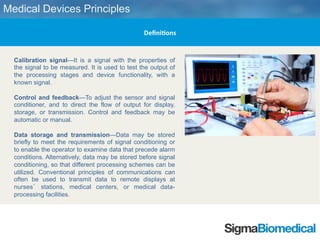
Calibration signal—It is a signal with the properties of the signal
to be measured. It is used to test the output of the processing
stages and device functionality, with a known signal.
Control and feedback—To adjust the sensor and signal
conditioner, and to direct the flow of output for display, storage, or
transmission. Control and feedback may be automatic or manual.
Data storage and transmission—Data may be stored briefly to
meet the requirements of signal conditioning or to enable the
operator to examine data that precede alarm conditions.
Alternatively, data may be stored before signal conditioning, so
that different processing schemes can be utilized. Conventional
principles of communications can often be used to transmit data to
remote displays at nurses’ stations, medical centers, or medical
data-processing facilities.
Medical Devices Principles
Definitions
tps://www.sigmabiomedical.com
Validity
How well an instrument measures the signal it is supposed to measure
Reliability
Consistency in the measurement results on multiple trials
Repeatability
Ability of an instrument to return to the same value when repeatedly
exposed to the same signal
Accuracy
Having minimal error with respect to the true value.
Precision
Relating to the ‘exactness’ of findings from multiple trials.
Resolution
The smallest to be distinguished magnitude from the measured value
Medical Devices Principles
Measurement Factors
tps://www.sigmabiomedical.com
Medical Devices Principles
Factors in Making Measurements
tps://www.sigmabiomedical.com
Medical Devices Principles
Factors in Making Measurements
For more information, contact
SigmaBiomedical
http://www.sigmabiomedical.com

Medical devices introduction

  • 1.
  • 2.
    tps://www.sigmabiomedical.com Description This presentation servesas an introduction to the principles of medical device development. It is mainly intended for those beginning in the biomedical engineering career or are new to the field. Medical Devices Principles
  • 3.
    tps://www.sigmabiomedical.com Presentation Contents Medical DevicesPrinciples  Medical Device Definition  Product Development Process  Biomedical Engineering Overview  Medical Device Regulations  Bioethics in Product Development  Biomedical Instrumentation
  • 4.
    tps://www.sigmabiomedical.com What is aMedical Device? Medical Devices Principles It is an instrument, apparatus, implement, machine, implant, in vitro reagent, a component part, or accessory which is: Intended for use in the diagnosis of disease or other conditions, or in the cure, mitigation, treatment, or prevention of disease or which does not achieve any of its primary intended purposes through chemical action Diagnose Disease Diagnose Disease Treat Disease Treat Disease Manage Disease Manage Disease Prevent Disease Prevent Disease Medical Device Medical Device
  • 5.
    tps://www.sigmabiomedical.com Discovery, understanding andmanagement of interaction between energy and human body, as well as the understanding or physiological systems and biosignals allows the development of medical devices used to diagnose, monitor, manage or treat physiological organs Medical Devices Principles Scientific Principles in Product Development
  • 6.
  • 7.
    tps://www.sigmabiomedical.com Biomedical Industry Overview Engineeringtechnology is the part of the technological field that requires the application of scientific and engineering knowledge and methods combined with technical skills in support of engineering activities ENGINEERING applies knowledge of the natural sciences gained by study, experience, and practice to develop ways to utilize the materials and forces of nature for the benefit of mankind. Medical Devices Principles
  • 8.
    tps://www.sigmabiomedical.com Medical Device IndustryOverview Engineering disciplines related include •Electrical engineering •Mechanical engineering •Biomedical engineering •Chemical engineering •Computer engineering A Biomedical engineer applies electronic, mechanical, and other engineering principles to design, develop, maintain, repair or upgrade medical equipment. Most biomedical engineering graduates are employed by medical device manufacturers, research labs, hospital, clinics, and service organizations Medical Devices Principles
  • 9.
    tps://www.sigmabiomedical.com Biomedical Industry Overview Scientificfields applied •Medicine, Healthcare •Physics, Chemistry, Math, Biology •Engineering Disciplines •Manufacturing technologies •Medical Device Regulations •Compliance Engineering Areas of product development: • Biomedical instrumentation • Medical Devices • Medical Imaging • Biomechanics and rehabilitation engineering • Bioinformatics and telemedicine • Clinical Engineering Medical Devices Principles
  • 10.
    tps://www.sigmabiomedical.com Medical Devices Principles MedicalDevice Regulations • Devices can benefit patients • Devices can harm patients • Balance between risk and benefit Products need to be regulated • To ensure patient safety • To ensure maximum benefit • To ensure proper use
  • 11.
    tps://www.sigmabiomedical.com Product Approval Requires •PatientSafety •Demonstrated Effectiveness •Validated Intended Use •Labeling Compliance •Risk Management •Quality in Manufacturing Medical Devices Principles Medical Device Regulations Patients depend on an increasing array of medical devices for the diagnosis and management of disease conditions. Most countries have a regulatory body that regulates the safe and effective development manufacturing, distribution and use of such devices. FDA In the United States, the Food and Drug Administration (FDA) regulates the medical device industry. The FDA was allowed to regulate medical devices starting in 1976. This year was significant because the conflict of interest between a medical device company and its investors was brought to the forefront with a device (the Dalkon Shield) that compromised the safety of its users. Product review Medical devices are reviewed for safety, effectiveness and labeling compliance within the FDA Center for Devices and Radiological Health (CDRH)
  • 12.
    tps://www.sigmabiomedical.com The FDA hasestablished classifications for approximately 1,700 different generic types of devices. Each of these generic types of devices is assigned to one of three regulatory classes based on the level of control necessary to assure the safety and effectiveness of the device. The three classes and the requirements that apply to them are as follows. Class I: subject to least regulatory control Present minimal potential for harm to the patient or medical professional user Simpler in design than Class II or III devices Class II: subject to special controls (including general controls) Special labeling requirements Mandatory performance standards Post-market surveillance Class III: subject to strictest regulatory controls Support or sustain life Of substantial importance in preventing impairment of human health Present a potential, unreasonable risk of illness or injury Premarket approval (including general controls) Medical Devices Principles Medical Device Classification II 22 33
  • 13.
    tps://www.sigmabiomedical.com 25 MeV RadiotherapyMachine – X-rays & Electrons 200 rad (e) or 25000 rad (x) Error on selection, Software bug, Beam not reset Patient received 25000 MeV, “malfunction 54 displayed” Technician fired 2 more times 4 months later patient died Medical Devices Principles Patient Safety – Case Example
  • 14.
    tps://www.sigmabiomedical.com Biomedical Industry Overview Asper the Biomedical Engineering Society, biomedical engineering is a learned profession that combines expertise and responsibilities in engineering, science, technology, and medicine. Because public health and welfare are paramount considerations in each of these areas, biomedical engineering professionals must uphold those principles of ethical conduct when involved in professional practice, research, patient care, and training. Biomedical engineering professionals in the fulfillment of their professional duties shall use their knowledge, skills, and abilities to enhance the safety, health, and welfare of the public; and strive by action, example, and influence to increase the competence, prestige, and honor of the biomedical engineering profession. Biomedical engineering professionals involved in healthcare activities shall regard responsibility toward and rights of patients, including those of confidentiality and privacy, as their primary concern; and consider the larger consequences of their work in regard to cost, availability, and delivery of healthcare. Medical Devices Principles Bioethics Within the Field of Biomedical Engineering
  • 15.
    tps://www.sigmabiomedical.com Biomedical engineering professionalsmust follow principles of ethical conduct when involved in professional practice, research, patient care, and training. Biomedical engineering professionals in the fulfillment of their professional duties shall •Use their knowledge, skills, and abilities to enhance the safety, health, and welfare of the public •Regard responsibility toward and rights of patients, including those of confidentiality and privacy, as their primary concern; and •Consider the larger consequences of their work in regard to cost, availability, and delivery of healthcare. Medical Devices Principles Bioethics Within the Field of Biomedical Engineering
  • 16.
    tps://www.sigmabiomedical.com Diagnostic Medical Devicesgenerally capture signals from the human body or signals as a result of interaction of energy sources with the body, and convert these signals into useful information to diagnose or treat disease conditions Medical Devices Principles Biomedical Instrumentation in Medical Devices
  • 17.
    tps://www.sigmabiomedical.com Biomedical signals containimportant information about the health, as well as anatomical or physiological condition of human beings. The signals are measured to assess the presence of abnormal events, commonly associated with diseases or abnormal conditions. Biomedical signals can be obtained: •Capturing signals produced by physiological processes in the human body. Interfaces are developed with sensors to capture signals and convert them to appropriate electrical or mechanical signals •Capturing signals produced by energy sources after they have interacted with the human body. Signals include attenuation signals, radiated heat profiles, etc. Medical Devices Principles Biomedical Instrumentation - Signals
  • 18.
    tps://www.sigmabiomedical.com Biomedical instrumentation systemsin medical devices deal with the measurement and conditioning of the body's current and voltage signals for further analysis. Most of these systems measure currents very small in magnitude and require several stages of signal conditioning and processing in order to convert them into signals that can analyzed by humans with the use of computer systems. The block diagram below depicts the basic components of a biomedical instrumentation system. Medical Devices Principles Biomedical Instrumentation SubjectSubject Applied energyApplied energy SensorSensor Calibration SignalCalibration Signal Signal conditioning Signal conditioning Analog to DigitalAnalog to Digital Data acquisitionData acquisition Signal ProcessingSignal Processing Control & FeedbackControl & Feedback Output DisplayOutput Display Data Transmission Data Transmission
  • 19.
    tps://www.sigmabiomedical.com Measurand—what is beingmeasured or analyzed (i.e., ECG, EEG, EMG, temperature, blood pressure). Sensor—The physical element that senses the signals and converts them to an electrical signal. Signal conditioning—The signal is prepared and improved for interpretation, either through amplification or filtering. Output display—The physiological signal or its transformed signal is displayed for the end user’s interpretation. Medical Devices Principles Definitions
  • 20.
    tps://www.sigmabiomedical.com Calibration signal—It isa signal with the properties of the signal to be measured. It is used to test the output of the processing stages and device functionality, with a known signal. Control and feedback—To adjust the sensor and signal conditioner, and to direct the flow of output for display, storage, or transmission. Control and feedback may be automatic or manual. Data storage and transmission—Data may be stored briefly to meet the requirements of signal conditioning or to enable the operator to examine data that precede alarm conditions. Alternatively, data may be stored before signal conditioning, so that different processing schemes can be utilized. Conventional principles of communications can often be used to transmit data to remote displays at nurses’ stations, medical centers, or medical data-processing facilities. Medical Devices Principles Definitions
  • 21.
    tps://www.sigmabiomedical.com Validity How well aninstrument measures the signal it is supposed to measure Reliability Consistency in the measurement results on multiple trials Repeatability Ability of an instrument to return to the same value when repeatedly exposed to the same signal Accuracy Having minimal error with respect to the true value. Precision Relating to the ‘exactness’ of findings from multiple trials. Resolution The smallest to be distinguished magnitude from the measured value Medical Devices Principles Measurement Factors
  • 22.
  • 23.
    tps://www.sigmabiomedical.com Medical Devices Principles Factorsin Making Measurements For more information, contact SigmaBiomedical http://www.sigmabiomedical.com