Design Requirement for
Medical Devices
What is a Medical Device?
‘medical device’ means any instrument, apparatus, appliance, software, implant, reagent,
material or other article intended by the manufacturer to be used, alone or in combination,
for human beings for one or more of the following specific medical purposes:
• diagnosis, prevention, monitoring, prediction, prognosis, treatment or alleviation of
disease,
• diagnosis, monitoring, treatment, alleviation of, or compensation for, an injury or
disability,
• investigation, replacement or modification of the anatomy or of a physiological or
pathological process or state,
• providing information by means of in vitro examination of specimens derived from the
human body, including organ, blood and tissue donations,
• and which does not achieve its principal intended action by pharmacological,
immunological or metabolic means, in or on the human body, but which may be assisted
in its function by such means.
• The following products shall also be deemed to be medical devices:
• devices for the control or support of conception;
• products specifically intended for the cleaning, disinfection or sterilization of devices as
referred to in Article 1(4) and of those referred to in the first paragraph of this point.
• Product for human use which has a medical purpose.
• Any product that act on diseases, Injuries, Disabilities, Anatomy, Physiological or
pathological state or provide information through in-vitro combination.
• Should not be a drug.
• Including this products :- Contact lenses, Aestatic implants, Botox etc..
What is a Medical Device?
(Simplified)
Classification of Medical Devices :-
o Class I – Device posing least harm to the user or patient.
o Class II - Device posing moderate harm to user or patient.
o Class III - Device which cause highest potential risk.
Medical Devices
Prefilled syringe
Glasses
PPE Kit
NO No
Yes
Medical Device Design and
development
An effective medical
device design
addresses healthcare
regulatory compliance,
solution specifications,
and deliver
functionalities that
satisfy end users’
needs
How to design and develop medical
devices
• It takes a significant amount of
effort to deliver the right
healthcare solution that meets
customer demand
• Strong scope definition from
end user’s need.
• collaborative efforts across the
team.
• adherence to specification and
requirements.
• mitigating risks.
• best possible quality.
Steps to be followed while
designing
Product Ideation and conceptualization
Design control regulation
Testing –Verification and Validation
Risk management
Addressing Regulation and Compliance need
Product Ideation and
Conceptualization
Let us understand what are Vitamins and Pain Killers in terms of product
development:
• It’s not obvious that a device must address a particular problem, a device
might also be a solution that aids convenience on a routine lifestyle or
situation.
• Identification of need
• Device classification
• Transition to Discovery Phase
Design control Regulations
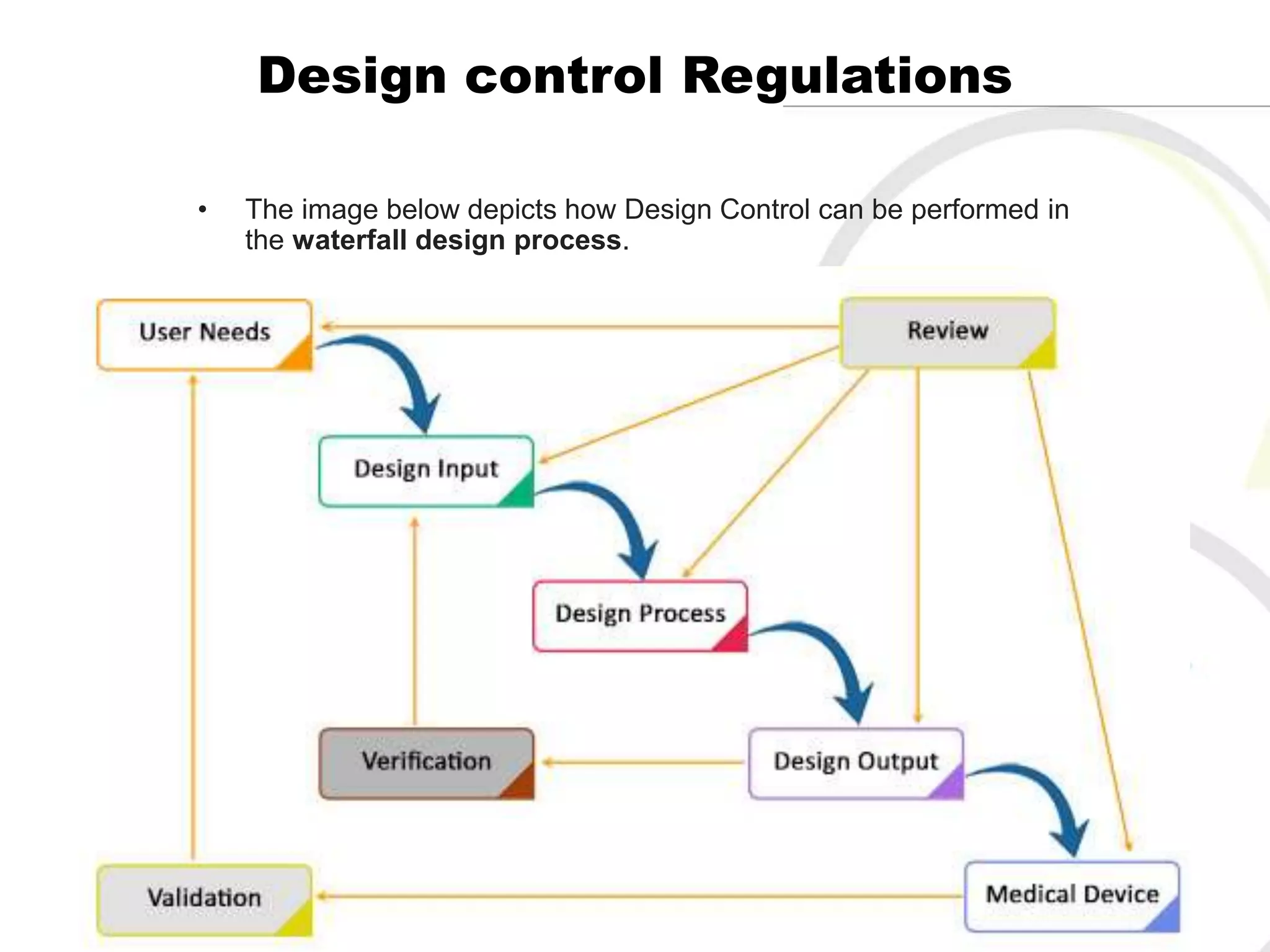
• The image below depicts how Design Control can be performed in
the waterfall design process.
Testing – Verification and Validation
• Verification is internal to internal process, which evaluates whether a
design output meets the specified requirements, specification or
regulation defined in the design input. Whereas validation is internal to
an external process, which evaluates if your product delivers benefits,
according to the need of targeted users or not.
Example of Verification and
validation
Risk Management
• Risk :- Combination of the probability of occurrence of harm or severity
of that harm.
• Considering the complexity of medical device design, focused risk
management practices help ensure usability, safety, and regulatory
compliance. It is a process of identifying, controlling and preventing
the failure that may cause hazards to user
Addressing Regulation and Compliance
Need
 ISO 10993-1:2018 for material.
 ISO 13485:2012, Medical devices — Quality management
systems — Requirements for regulatory purposes
 ISO 14971:2012, Medical devices — Application of risk
management to medical devices.
 International Electrotechnical Commission (IEC) 60601-1.

Medical device design guidlines

  • 1.
  • 2.
    What is aMedical Device? ‘medical device’ means any instrument, apparatus, appliance, software, implant, reagent, material or other article intended by the manufacturer to be used, alone or in combination, for human beings for one or more of the following specific medical purposes: • diagnosis, prevention, monitoring, prediction, prognosis, treatment or alleviation of disease, • diagnosis, monitoring, treatment, alleviation of, or compensation for, an injury or disability, • investigation, replacement or modification of the anatomy or of a physiological or pathological process or state, • providing information by means of in vitro examination of specimens derived from the human body, including organ, blood and tissue donations, • and which does not achieve its principal intended action by pharmacological, immunological or metabolic means, in or on the human body, but which may be assisted in its function by such means. • The following products shall also be deemed to be medical devices: • devices for the control or support of conception; • products specifically intended for the cleaning, disinfection or sterilization of devices as referred to in Article 1(4) and of those referred to in the first paragraph of this point.
  • 3.
    • Product forhuman use which has a medical purpose. • Any product that act on diseases, Injuries, Disabilities, Anatomy, Physiological or pathological state or provide information through in-vitro combination. • Should not be a drug. • Including this products :- Contact lenses, Aestatic implants, Botox etc.. What is a Medical Device? (Simplified) Classification of Medical Devices :- o Class I – Device posing least harm to the user or patient. o Class II - Device posing moderate harm to user or patient. o Class III - Device which cause highest potential risk.
  • 4.
  • 5.
    Medical Device Designand development An effective medical device design addresses healthcare regulatory compliance, solution specifications, and deliver functionalities that satisfy end users’ needs
  • 6.
    How to designand develop medical devices • It takes a significant amount of effort to deliver the right healthcare solution that meets customer demand • Strong scope definition from end user’s need. • collaborative efforts across the team. • adherence to specification and requirements. • mitigating risks. • best possible quality.
  • 7.
    Steps to befollowed while designing Product Ideation and conceptualization Design control regulation Testing –Verification and Validation Risk management Addressing Regulation and Compliance need
  • 9.
    Product Ideation and Conceptualization Letus understand what are Vitamins and Pain Killers in terms of product development: • It’s not obvious that a device must address a particular problem, a device might also be a solution that aids convenience on a routine lifestyle or situation. • Identification of need • Device classification • Transition to Discovery Phase
  • 10.
    Design control Regulations •The image below depicts how Design Control can be performed in the waterfall design process.
  • 11.
    Testing – Verificationand Validation • Verification is internal to internal process, which evaluates whether a design output meets the specified requirements, specification or regulation defined in the design input. Whereas validation is internal to an external process, which evaluates if your product delivers benefits, according to the need of targeted users or not.
  • 12.
  • 13.
    Risk Management • Risk:- Combination of the probability of occurrence of harm or severity of that harm. • Considering the complexity of medical device design, focused risk management practices help ensure usability, safety, and regulatory compliance. It is a process of identifying, controlling and preventing the failure that may cause hazards to user
  • 14.
    Addressing Regulation andCompliance Need  ISO 10993-1:2018 for material.  ISO 13485:2012, Medical devices — Quality management systems — Requirements for regulatory purposes  ISO 14971:2012, Medical devices — Application of risk management to medical devices.  International Electrotechnical Commission (IEC) 60601-1.