REGULATION FOR
MEDICAL DEVICES
BY: BHAGYALAXMI RANAWAT
SUBMITTED TO: TOSHA MA’AM
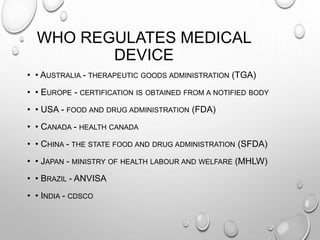
WHO REGULATES MEDICAL
DEVICE
• • AUSTRALIA - THERAPEUTIC GOODS ADMINISTRATION (TGA)
• • EUROPE - CERTIFICATION IS OBTAINED FROM A NOTIFIED BODY
• • USA - FOOD AND DRUG ADMINISTRATION (FDA)
• • CANADA - HEALTH CANADA
• • CHINA - THE STATE FOOD AND DRUG ADMINISTRATION (SFDA)
• • JAPAN - MINISTRY OF HEALTH LABOUR AND WELFARE (MHLW)
• • BRAZIL - ANVISA
• • INDIA - CDSCO
FDA
• The food and drug administration (FDA or USFDA) is a
federal agency of the united states department of health and
human service.
MEDICAL DEVICES
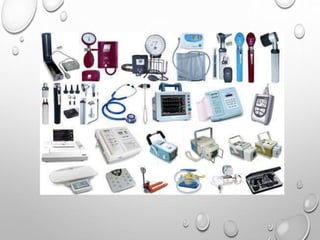
• The term “medical devices” includes everything from highly
sophisticated computerized medical equipment down to simple
wooden tongue depressors .
• An instrument, apparatus, implement, machine, implant, in vitro
reagent, or other similar or related article, including a component part,
or accessory which comes under the pharmacopeia.
• COMPUTERIZED MEDICAL EQUIPMENT -- x-ray machine,
ECG machine, pacemaker etc.
CLASSIFICATION OF MEDICAL
DEVICES
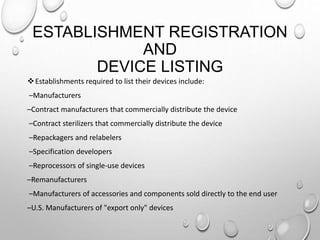
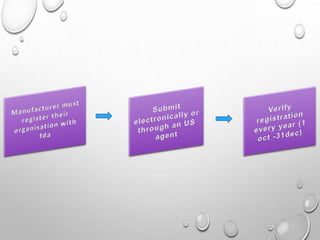
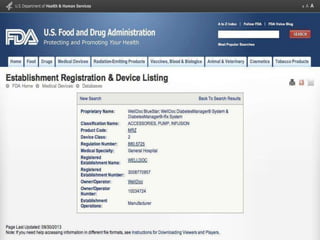
ESTABLISHMENT REGISTRATION
AND
DEVICE LISTING
Establishments required to list their devices include:
–Manufacturers
–Contract manufacturers that commercially distribute the device
–Contract sterilizers that commercially distribute the device
–Repackagers and relabelers
–Specification developers
–Reprocessors of single-use devices
–Remanufacturers
–Manufacturers of accessories and components sold directly to the end user
–U.S. Manufacturers of "export only" devices
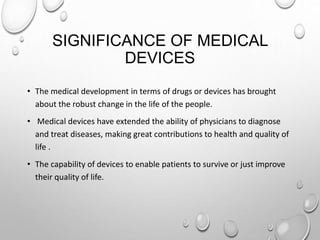
SIGNIFICANCE OF MEDICAL
DEVICES
• The medical development in terms of drugs or devices has brought
about the robust change in the life of the people.
• Medical devices have extended the ability of physicians to diagnose
and treat diseases, making great contributions to health and quality of
life .
• The capability of devices to enable patients to survive or just improve
their quality of life.
• Medical devices in India are regulated under the medical device rules
• Published on 31st january 2017
• Effective from 1st january 2018.
• The Indian medical regulatory system has become more complicated in
recent years. In the past, medical devices did not need to be approved
at all, but that is not the case today. In India, there are about 30 device
“families” that outline which specific medical devices need to be
registered.
REGULATION IN INDIA
• In India medical devices are governed by cdsco(central drugs standard
control organization) which is regulated by directorate general of
health services , ministry of health and family welfare , government of
India.
• CDSCO is the only government body which regulate the medical
devices
No medical device regulations existed in india prior to 2005.
• However, today there are registration procedures for certain types of
medical devices regulated under the medical device rules.
• The new rules are based on global harmonization task force .
• In India, the manufacturing, import, sale, and distribution of medical
devices are regulated under India’s drugs & cosmetic act and rules
(1945) .
• 22 medical devices are currently notified under the drugs and
cosmetics act.
• Controls and inspections are carried out by the CDSCO, state drug
controllers and central/state laboratories
PREMARKETED NOTIFICATION
INTRODUCTION
• All medical devices must submit premarketed notification, except:-
1.Device for which PMA application is required
2.Device exempted from 510(K) notification FDA (most class I ).
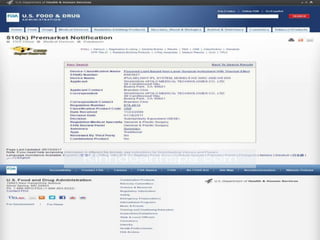
• For device with 510(K) submission manufacturer must receive a
clearance order before commercial distribution.
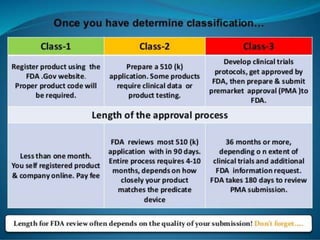
• It takes 90 days to receive clearance or longer typically 130 days
( depends on the information submitted by manufacturer)
• It should demonstrate that the device to be marketed is as safe and
effective as predicate.
• • After 510(k) approval the manufacturer can manufacture the device
without waiting for fda quality system inspection, but submitter must be
ready for inspection.
• Submitter must compare his medical device with similar legally marketed
Device AND PROVE SUBSTANTIAL EQIVALANCE
• Submitter submits 510(K) to FDA before marketing and prove substantial
equivalence
• Submitter receives an order in form of letter from FDA, which proves that
the device is substantially equivalent.
SUBSTANTIAL EQUIVALENT
• A device is substantially equivalent only if
1.Same use as predicate and same technological characteristic as
predicate.
2.Same use as predicate but different technological characteristic as
predicate.
• If FDA determines that the device is not substantially equivalent, the
applicant may:-
Resubmit another 510(K)
Request class I and class II designation through de novo process
File reclarification submission
Submit a PMA application
• It confirms that safety and effectiveness are adversely effected by new
technological characteristics.
WHEN IS 510(K)
REQUIRED
• When a device is marketed for
the 1st time, medical device that
was not marketed before may
28,1976 for these devices 510(K)
is required.
• Propose different use from that
of the predicate.
• Change or modification in
predicate medical device that
affects the safety and
effectiveness
WHEN IS 510(K) NOT
REQUIRED
• If unfinished product or
components of devices are sold
• If distribute another firms device
• If device is marketed before may
28,1976
• If device is from outside US and
the exporter already submitted
510(k),then the importer need
not submit the 510(K).
DE NOVO CLASSIFICATION
• Also known as automatic class III designation
• • For “low risk” devices with no predicate that are found to be NSE
through the 510(k) process
• • Submitter must request de novo classification within 30 days of
receipt of NSE
• • The de novo process has a 60 day review period.
• • If fda grants request the device is permitted to enter commercial
distribution in same manner as 510(k) clearance
• • Device in DE novo can be used as a predicate in future 510(k)
submission.
PRE MARKETED APPROVAL
INTRODUCTION
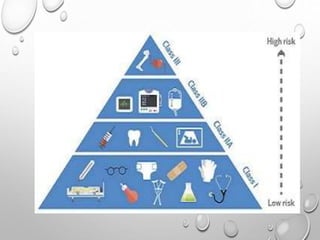
• Mainly applicable for class III devices ( high risk)
• Applicable for class II if device is not substantially equivalent.
• Most stringent type of device marketing application
• FDA confirms pre marketed approval only when it confirms the
scientific evidence to assure that the device is safe
• FDA requires 180 days to review or longer
• PMA- private license permitting the applicant to market the device
• FDA notifies applicant that PMA is approved or denied, the notice is
published on internet also.
CONTENT OF PREMARKETED
APPROVAL
• Device description and principle of operation
• Preclinical and clinical studies
• Bibliography of known information
• Manufacturing information
• Professional and patient labelling
POST MARKETING REQUIREMENT
QUALITY SYSTEM
REGULATION/GMP
INTRODUCTION
QUALITY SYSTEM SPECIFIES THE REQIREMENT OF METHOD,
FACILITIES AND CONTROL FOR MEDICAL DEVICE LIFE CYCLE
MANUFACTURER MUST FOLLOW QUALITY SYSTEM TO ENSURE THAT
THEIR PRODUCT HAS ALL THE REQUIREMENT AND SPECIFICATION
QUALITY SYSTEM FOR FDA ARE ALSO KNOWN AS CURRENT GMPS
Regulation for medical devices

Regulation for medical devices

  • 1.
    REGULATION FOR MEDICAL DEVICES BY:BHAGYALAXMI RANAWAT SUBMITTED TO: TOSHA MA’AM
  • 2.
    WHO REGULATES MEDICAL DEVICE •• AUSTRALIA - THERAPEUTIC GOODS ADMINISTRATION (TGA) • • EUROPE - CERTIFICATION IS OBTAINED FROM A NOTIFIED BODY • • USA - FOOD AND DRUG ADMINISTRATION (FDA) • • CANADA - HEALTH CANADA • • CHINA - THE STATE FOOD AND DRUG ADMINISTRATION (SFDA) • • JAPAN - MINISTRY OF HEALTH LABOUR AND WELFARE (MHLW) • • BRAZIL - ANVISA • • INDIA - CDSCO
  • 3.
    FDA • The foodand drug administration (FDA or USFDA) is a federal agency of the united states department of health and human service.
  • 4.
    MEDICAL DEVICES • Theterm “medical devices” includes everything from highly sophisticated computerized medical equipment down to simple wooden tongue depressors . • An instrument, apparatus, implement, machine, implant, in vitro reagent, or other similar or related article, including a component part, or accessory which comes under the pharmacopeia. • COMPUTERIZED MEDICAL EQUIPMENT -- x-ray machine, ECG machine, pacemaker etc.
  • 6.
  • 10.
    ESTABLISHMENT REGISTRATION AND DEVICE LISTING Establishmentsrequired to list their devices include: –Manufacturers –Contract manufacturers that commercially distribute the device –Contract sterilizers that commercially distribute the device –Repackagers and relabelers –Specification developers –Reprocessors of single-use devices –Remanufacturers –Manufacturers of accessories and components sold directly to the end user –U.S. Manufacturers of "export only" devices
  • 13.
    SIGNIFICANCE OF MEDICAL DEVICES •The medical development in terms of drugs or devices has brought about the robust change in the life of the people. • Medical devices have extended the ability of physicians to diagnose and treat diseases, making great contributions to health and quality of life . • The capability of devices to enable patients to survive or just improve their quality of life.
  • 14.
    • Medical devicesin India are regulated under the medical device rules • Published on 31st january 2017 • Effective from 1st january 2018. • The Indian medical regulatory system has become more complicated in recent years. In the past, medical devices did not need to be approved at all, but that is not the case today. In India, there are about 30 device “families” that outline which specific medical devices need to be registered.
  • 15.
    REGULATION IN INDIA •In India medical devices are governed by cdsco(central drugs standard control organization) which is regulated by directorate general of health services , ministry of health and family welfare , government of India. • CDSCO is the only government body which regulate the medical devices
  • 16.
    No medical deviceregulations existed in india prior to 2005. • However, today there are registration procedures for certain types of medical devices regulated under the medical device rules. • The new rules are based on global harmonization task force . • In India, the manufacturing, import, sale, and distribution of medical devices are regulated under India’s drugs & cosmetic act and rules (1945) . • 22 medical devices are currently notified under the drugs and cosmetics act. • Controls and inspections are carried out by the CDSCO, state drug controllers and central/state laboratories
  • 18.
    PREMARKETED NOTIFICATION INTRODUCTION • Allmedical devices must submit premarketed notification, except:- 1.Device for which PMA application is required 2.Device exempted from 510(K) notification FDA (most class I ). • For device with 510(K) submission manufacturer must receive a clearance order before commercial distribution. • It takes 90 days to receive clearance or longer typically 130 days ( depends on the information submitted by manufacturer)
  • 19.
    • It shoulddemonstrate that the device to be marketed is as safe and effective as predicate. • • After 510(k) approval the manufacturer can manufacture the device without waiting for fda quality system inspection, but submitter must be ready for inspection. • Submitter must compare his medical device with similar legally marketed Device AND PROVE SUBSTANTIAL EQIVALANCE • Submitter submits 510(K) to FDA before marketing and prove substantial equivalence • Submitter receives an order in form of letter from FDA, which proves that the device is substantially equivalent.
  • 20.
    SUBSTANTIAL EQUIVALENT • Adevice is substantially equivalent only if 1.Same use as predicate and same technological characteristic as predicate. 2.Same use as predicate but different technological characteristic as predicate.
  • 21.
    • If FDAdetermines that the device is not substantially equivalent, the applicant may:- Resubmit another 510(K) Request class I and class II designation through de novo process File reclarification submission Submit a PMA application • It confirms that safety and effectiveness are adversely effected by new technological characteristics.
  • 22.
    WHEN IS 510(K) REQUIRED •When a device is marketed for the 1st time, medical device that was not marketed before may 28,1976 for these devices 510(K) is required. • Propose different use from that of the predicate. • Change or modification in predicate medical device that affects the safety and effectiveness WHEN IS 510(K) NOT REQUIRED • If unfinished product or components of devices are sold • If distribute another firms device • If device is marketed before may 28,1976 • If device is from outside US and the exporter already submitted 510(k),then the importer need not submit the 510(K).
  • 24.
    DE NOVO CLASSIFICATION •Also known as automatic class III designation • • For “low risk” devices with no predicate that are found to be NSE through the 510(k) process • • Submitter must request de novo classification within 30 days of receipt of NSE • • The de novo process has a 60 day review period. • • If fda grants request the device is permitted to enter commercial distribution in same manner as 510(k) clearance • • Device in DE novo can be used as a predicate in future 510(k) submission.
  • 25.
    PRE MARKETED APPROVAL INTRODUCTION •Mainly applicable for class III devices ( high risk) • Applicable for class II if device is not substantially equivalent. • Most stringent type of device marketing application • FDA confirms pre marketed approval only when it confirms the scientific evidence to assure that the device is safe • FDA requires 180 days to review or longer • PMA- private license permitting the applicant to market the device • FDA notifies applicant that PMA is approved or denied, the notice is published on internet also.
  • 26.
    CONTENT OF PREMARKETED APPROVAL •Device description and principle of operation • Preclinical and clinical studies • Bibliography of known information • Manufacturing information • Professional and patient labelling
  • 27.
    POST MARKETING REQUIREMENT QUALITYSYSTEM REGULATION/GMP INTRODUCTION QUALITY SYSTEM SPECIFIES THE REQIREMENT OF METHOD, FACILITIES AND CONTROL FOR MEDICAL DEVICE LIFE CYCLE MANUFACTURER MUST FOLLOW QUALITY SYSTEM TO ENSURE THAT THEIR PRODUCT HAS ALL THE REQUIREMENT AND SPECIFICATION QUALITY SYSTEM FOR FDA ARE ALSO KNOWN AS CURRENT GMPS