1
About the Author
Beth A. Rich, B.S., CPC-H
• 12 years as a post-secondary coding instructor – 8+ years with
Pittsburgh Technical Institute (pti.edu) – MOA degree, MA
degree, Coding certificate – recent high school grads, adult
learners
• 8 previous years training others and as project manager
• 8 years as a manager of patient registration, patient financial
services, medical coding, chart auditing, and customer service
• Experienced writer, instructional designer
• Healthcare consulting experience
• Experience in acute care, skilled nursing, rehabilitation,
pharmacy, mental health, dental, primary care
• Additional teaching – medical office management; revenue
2
cycle; EHR; professionalism; patient relations; job readiness
Today’s Presentation
•
•
•
•
•
•
•

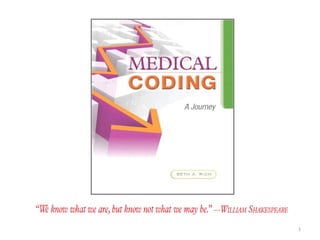
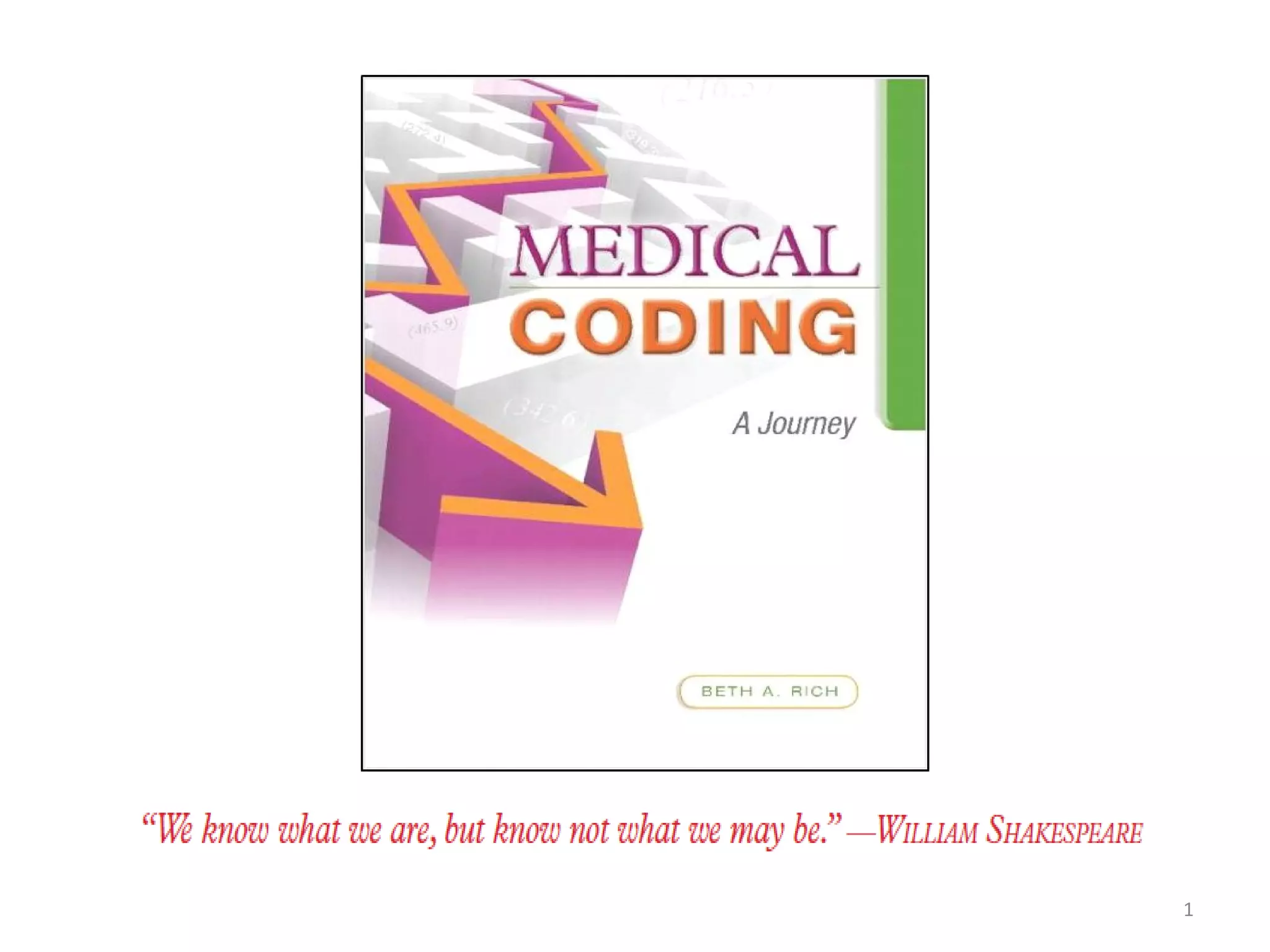
Why did I write this textbook?
Thousands of coding opportunities
Contents of the textbook
What makes this textbook different?
Additional Features
Instructor Manual Features
MyHealthProfessionsLab Features
3
Why Did I Write This Textbook?
1. To appeal to beginners and keep students
engaged in learning a difficult
subject
 Relevant for everyone
 Incorporated students’ questions

2. To write in a way that is easy for students to
read and understand
 Speaks directly to students in a classroom
 Not copied from the coding manuals
 Walk-through examples
 Tables, including bulleted and numbered points
 Did not sacrifice content

4
Why Did I Write This Textbook? (cont.)
3. To allow instructors to teach coding without
being “the constant liaison”





Homework can be assigned without fear
Students can understand the basics by reading
Works with instructors, not against them
Saves instructors’ time

4. To incorporate all the tools for success
 Anatomy and physiology texts or medical dictionary not
mandatory
 Medical terminology text not mandatory
 Internet searches not mandatory
5
Why Did I Write This Textbook? (cont.)
5. To provide constant support and
encouragement to students
 Cheers students on through content and exercises
and continues to “talk them through” difficult and
challenging concepts, posing questions, providing
examples

6
Thousands of Coding
Opportunities
• 2,119 practice exercises in textbook- 664 more
than Step-by-Step Medical Coding textbook
(1,455)
• Plus 2,554 practice exercises in
MyHealthProfessionsLab
• Total of 4,673 practice exercises (text and lab)

7
Medical Coding - A Journey
Contents

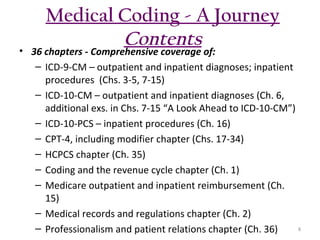
• 36 chapters - Comprehensive coverage of:
– ICD-9-CM – outpatient and inpatient diagnoses; inpatient
procedures (Chs. 3-5, 7-15)
– ICD-10-CM – outpatient and inpatient diagnoses (Ch. 6,
additional exs. in Chs. 7-15 “A Look Ahead to ICD-10-CM”)
– ICD-10-PCS – inpatient procedures (Ch. 16)
– CPT-4, including modifier chapter (Chs. 17-34)
– HCPCS chapter (Ch. 35)
– Coding and the revenue cycle chapter (Ch. 1)
– Medicare outpatient and inpatient reimbursement (Ch.
15)
– Medical records and regulations chapter (Ch. 2)
8
– Professionalism and patient relations chapter (Ch. 36)
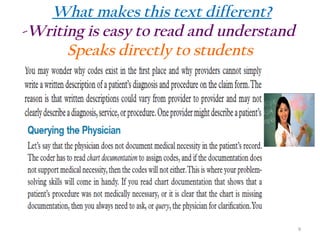
What makes this text different?
-Writing is easy to read and understand
Speaks directly to students

9
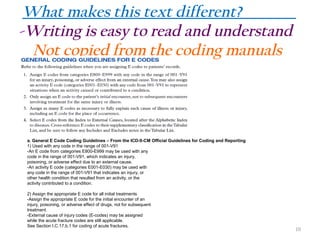
What makes this text different?
-Writing is easy to read and understand
Not copied from the coding manuals

a. General E Code Coding Guidelines – From the ICD-9-CM Official Guidelines for Coding and Reporting
1) Used with any code in the range of 001-V91
-An E code from categories E800-E999 may be used with any
code in the range of 001-V91, which indicates an injury,
poisoning, or adverse effect due to an external cause.
-An activity E code (categories E001-E030) may be used with
any code in the range of 001-V91 that indicates an injury, or
other health condition that resulted from an activity, or the
activity contributed to a condition.
2) Assign the appropriate E code for all initial treatments
-Assign the appropriate E code for the initial encounter of an
injury, poisoning, or adverse effect of drugs, not for subsequent
treatment.
-External cause of injury codes (E-codes) may be assigned
while the acute fracture codes are still applicable.
See Section I.C.17.b.1 for coding of acute fractures.

10
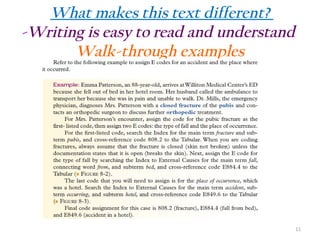
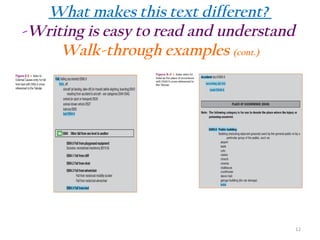
What makes this text different?
-Writing is easy to read and understand
Walk-through examples

11
What makes this text different?
-Writing is easy to read and understand
Walk-through examples (cont.)

12
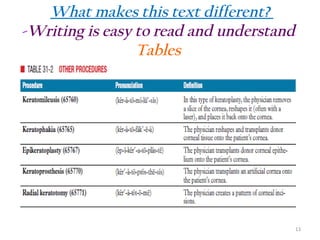
What makes this text different?
-Writing is easy to read and understand
Tables

13
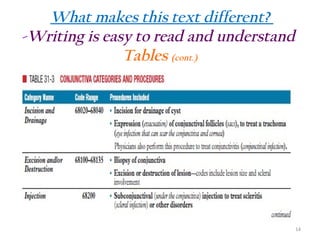
What makes this text different?
-Writing is easy to read and understand
Tables (cont.)

14
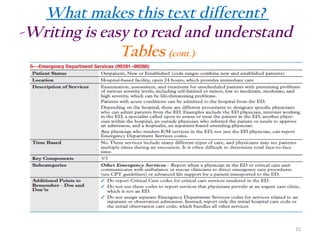
What makes this text different?
-Writing is easy to read and understand
Tables (cont.)

15
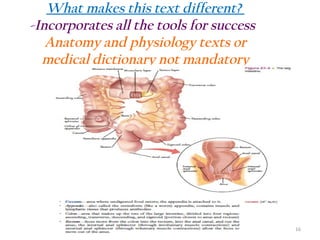
What makes this text different?
-Incorporates all the tools for success
Anatomy and physiology texts or
medical dictionary not mandatory

16
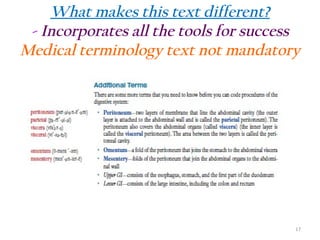
What makes this text different?
- Incorporates all the tools for success
Medical terminology text not mandatory

17
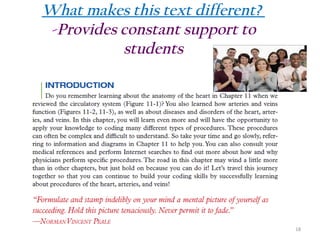
What makes this text different?
-Provides constant support to
students

18
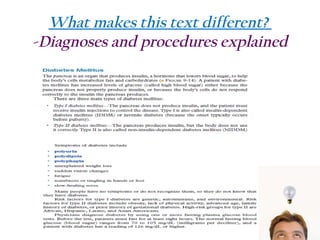
What makes this text different?
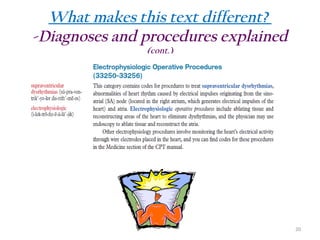
-Diagnoses and procedures explained

19
What makes this text different?
-Diagnoses and procedures explained
(cont.)

20
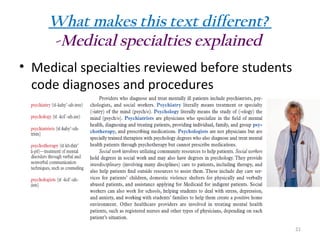
What makes this text different?
-Medical specialties explained
• Medical specialties reviewed before students
code diagnoses and procedures

21
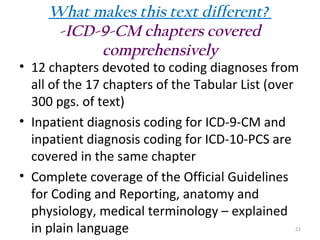
What makes this text different?
-ICD-9-CM chapters covered
comprehensively

• 12 chapters devoted to coding diagnoses from
all of the 17 chapters of the Tabular List (over
300 pgs. of text)
• Inpatient diagnosis coding for ICD-9-CM and
inpatient diagnosis coding for ICD-10-PCS are
covered in the same chapter
• Complete coverage of the Official Guidelines
for Coding and Reporting, anatomy and
physiology, medical terminology – explained
in plain language

22
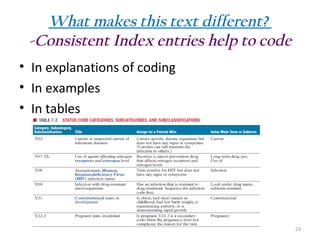
What makes this text different?
-Consistent Index entries help to code
• In explanations of coding
• In examples
• In tables

23
What makes this text different?
-Exercises and examples are realistic
• Outline real-world scenarios, not one-line
documentation
• Include physicians’ names and specialties,
patients’ names, conditions, ages, and
procedures performed
24
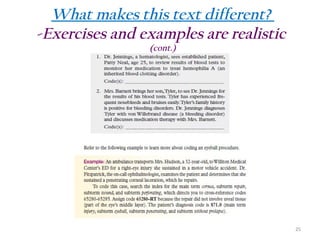
What makes this text different?
-Exercises and examples are realistic
(cont.)

25
What makes this text different?
- 2,119 coding exercises in “Take a Break” strategically placed
• Provide encouragement
• Throughout chapter at various intervals
• Includes theory and coding practice
• CPT exercises include optional diagnosis
coding

26
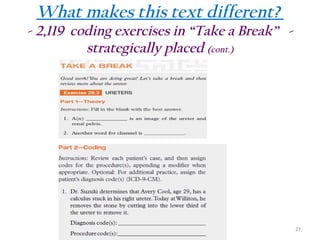
What makes this text different?

- 2,119 coding exercises in “Take a Break” strategically placed (cont.)

27
What makes this text different?
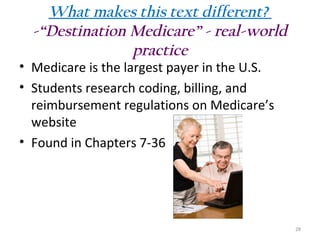
-“Destination Medicare” - real-world
practice

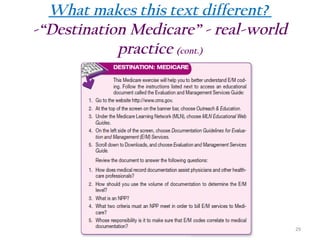
• Medicare is the largest payer in the U.S.
• Students research coding, billing, and
reimbursement regulations on Medicare’s
website
• Found in Chapters 7-36

28
What makes this text different?
-“Destination Medicare” - real-world
practice (cont.)

29
What makes this text different?
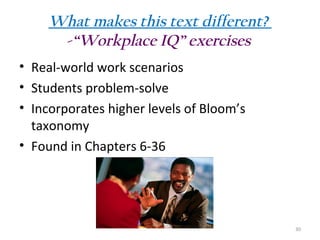
-“Workplace IQ” exercises
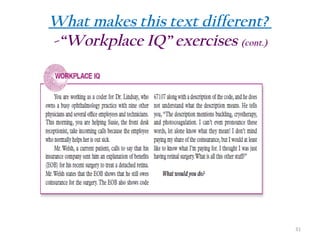
• Real-world work scenarios
• Students problem-solve
• Incorporates higher levels of Bloom’s
taxonomy
• Found in Chapters 6-36

30
What makes this text different?
-“Workplace IQ” exercises (cont.)

31
What makes this text different?
-“Interesting Facts” break up content
• Learn more about a given topic in each
chapter; more facts in the Instructor’s Manual
• Opportunity to break and review new and
interesting information

32
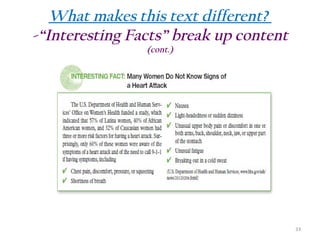
What makes this text different?
-“Interesting Facts” break up content
(cont.)

33
What makes this text different?
-“Pointers from the Pros” interviews
• Interviews with healthcare professionals who
hold a variety of positions – interview
questions and answers provided to students
• Offers real-world advice for handling many
types of workplace situations
• Found in Chapters 6-36

34
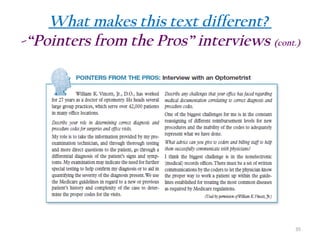
What makes this text different?
-“Pointers from the Pros” interviews (cont.)

35
What makes this text different?
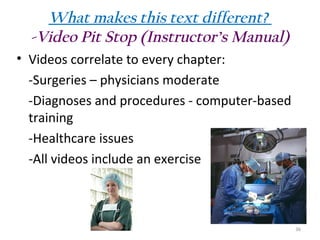
-Video Pit Stop (Instructor’s Manual)
• Videos correlate to every chapter:
-Surgeries – physicians moderate
-Diagnoses and procedures - computer-based
training
-Healthcare issues
-All videos include an exercise

36
What makes this text different?
-Medical Record Interpretation and
Chart Audit (MyHealthProfessionsLab)
• Students read a medical record and interpret
its content using hints provided
• Students then review codes assigned to
determine their accuracy
• Correlate to Chapters 7-35

37
What makes this text different?
-Current Medicare regulations
• Up-to-date coding, billing, and
reimbursement guidelines discussed from:
-National coverage determinations (NCDs)
-NCD Manual
-Local coverage determinations (LCDs)
-Medicare Claims Processing Manual
-Medicare Benefit Policy Manual
38
Additional Features
Chapter Review exercises
comprehensive

• Incorporates elements in chapter to test for
understanding
• Part theory – multiple choice
• Part coding
• CPT chapters include option to code diagnoses

39
Additional Features
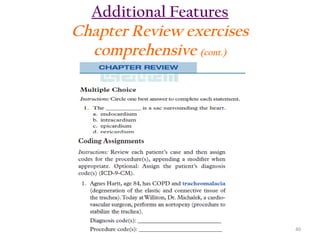
Chapter Review exercises
comprehensive (cont.)

40
Additional Features
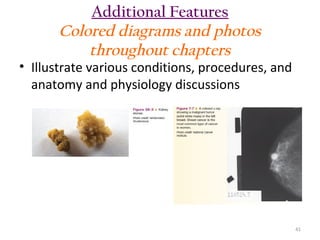
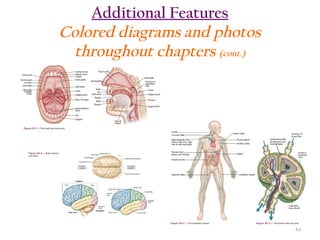
Colored diagrams and photos
throughout chapters

• Illustrate various conditions, procedures, and
anatomy and physiology discussions

41
Additional Features
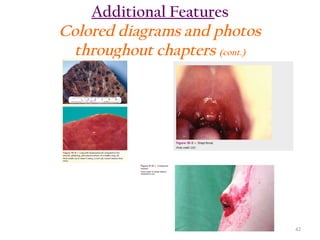
Colored diagrams and photos
throughout chapters (cont.)

42
Additional Features
Colored diagrams and photos
throughout chapters (cont.)

43
Instructor’s Manual (online)
Features
•
•
•
•
•
•
•
•

PowerPoint presentations
Learning objectives and outlines
Detailed lesson plans
In-class activities
Teaching notes and tips
Additional Interesting Facts
Video Pit Stop
Answer key for chapter exercises and chapter
review
• Test bank

44
MyHealthProfessionsLab
Features
•
•
•
•
•
•

Pre-test to assess skills learned per chapter
Results show practice target areas
Opportunities to practice per chapter
Post-test to assess improvement
2,554 total practice exercises
Medical Record Interpretation and Chart Audit

45
Thank you for your time!
Do you have any questions?

46

Medical Coding textbook for beginners

  • 1.
  • 2.
    About the Author BethA. Rich, B.S., CPC-H • 12 years as a post-secondary coding instructor – 8+ years with Pittsburgh Technical Institute (pti.edu) – MOA degree, MA degree, Coding certificate – recent high school grads, adult learners • 8 previous years training others and as project manager • 8 years as a manager of patient registration, patient financial services, medical coding, chart auditing, and customer service • Experienced writer, instructional designer • Healthcare consulting experience • Experience in acute care, skilled nursing, rehabilitation, pharmacy, mental health, dental, primary care • Additional teaching – medical office management; revenue 2 cycle; EHR; professionalism; patient relations; job readiness
  • 3.
    Today’s Presentation • • • • • • • Why didI write this textbook? Thousands of coding opportunities Contents of the textbook What makes this textbook different? Additional Features Instructor Manual Features MyHealthProfessionsLab Features 3
  • 4.
    Why Did IWrite This Textbook? 1. To appeal to beginners and keep students engaged in learning a difficult subject  Relevant for everyone  Incorporated students’ questions 2. To write in a way that is easy for students to read and understand  Speaks directly to students in a classroom  Not copied from the coding manuals  Walk-through examples  Tables, including bulleted and numbered points  Did not sacrifice content 4
  • 5.
    Why Did IWrite This Textbook? (cont.) 3. To allow instructors to teach coding without being “the constant liaison”     Homework can be assigned without fear Students can understand the basics by reading Works with instructors, not against them Saves instructors’ time 4. To incorporate all the tools for success  Anatomy and physiology texts or medical dictionary not mandatory  Medical terminology text not mandatory  Internet searches not mandatory 5
  • 6.
    Why Did IWrite This Textbook? (cont.) 5. To provide constant support and encouragement to students  Cheers students on through content and exercises and continues to “talk them through” difficult and challenging concepts, posing questions, providing examples 6
  • 7.
    Thousands of Coding Opportunities •2,119 practice exercises in textbook- 664 more than Step-by-Step Medical Coding textbook (1,455) • Plus 2,554 practice exercises in MyHealthProfessionsLab • Total of 4,673 practice exercises (text and lab) 7
  • 8.
    Medical Coding -A Journey Contents • 36 chapters - Comprehensive coverage of: – ICD-9-CM – outpatient and inpatient diagnoses; inpatient procedures (Chs. 3-5, 7-15) – ICD-10-CM – outpatient and inpatient diagnoses (Ch. 6, additional exs. in Chs. 7-15 “A Look Ahead to ICD-10-CM”) – ICD-10-PCS – inpatient procedures (Ch. 16) – CPT-4, including modifier chapter (Chs. 17-34) – HCPCS chapter (Ch. 35) – Coding and the revenue cycle chapter (Ch. 1) – Medicare outpatient and inpatient reimbursement (Ch. 15) – Medical records and regulations chapter (Ch. 2) 8 – Professionalism and patient relations chapter (Ch. 36)
  • 9.
    What makes thistext different? -Writing is easy to read and understand Speaks directly to students 9
  • 10.
    What makes thistext different? -Writing is easy to read and understand Not copied from the coding manuals a. General E Code Coding Guidelines – From the ICD-9-CM Official Guidelines for Coding and Reporting 1) Used with any code in the range of 001-V91 -An E code from categories E800-E999 may be used with any code in the range of 001-V91, which indicates an injury, poisoning, or adverse effect due to an external cause. -An activity E code (categories E001-E030) may be used with any code in the range of 001-V91 that indicates an injury, or other health condition that resulted from an activity, or the activity contributed to a condition. 2) Assign the appropriate E code for all initial treatments -Assign the appropriate E code for the initial encounter of an injury, poisoning, or adverse effect of drugs, not for subsequent treatment. -External cause of injury codes (E-codes) may be assigned while the acute fracture codes are still applicable. See Section I.C.17.b.1 for coding of acute fractures. 10
  • 11.
    What makes thistext different? -Writing is easy to read and understand Walk-through examples 11
  • 12.
    What makes thistext different? -Writing is easy to read and understand Walk-through examples (cont.) 12
  • 13.
    What makes thistext different? -Writing is easy to read and understand Tables 13
  • 14.
    What makes thistext different? -Writing is easy to read and understand Tables (cont.) 14
  • 15.
    What makes thistext different? -Writing is easy to read and understand Tables (cont.) 15
  • 16.
    What makes thistext different? -Incorporates all the tools for success Anatomy and physiology texts or medical dictionary not mandatory 16
  • 17.
    What makes thistext different? - Incorporates all the tools for success Medical terminology text not mandatory 17
  • 18.
    What makes thistext different? -Provides constant support to students 18
  • 19.
    What makes thistext different? -Diagnoses and procedures explained 19
  • 20.
    What makes thistext different? -Diagnoses and procedures explained (cont.) 20
  • 21.
    What makes thistext different? -Medical specialties explained • Medical specialties reviewed before students code diagnoses and procedures 21
  • 22.
    What makes thistext different? -ICD-9-CM chapters covered comprehensively • 12 chapters devoted to coding diagnoses from all of the 17 chapters of the Tabular List (over 300 pgs. of text) • Inpatient diagnosis coding for ICD-9-CM and inpatient diagnosis coding for ICD-10-PCS are covered in the same chapter • Complete coverage of the Official Guidelines for Coding and Reporting, anatomy and physiology, medical terminology – explained in plain language 22
  • 23.
    What makes thistext different? -Consistent Index entries help to code • In explanations of coding • In examples • In tables 23
  • 24.
    What makes thistext different? -Exercises and examples are realistic • Outline real-world scenarios, not one-line documentation • Include physicians’ names and specialties, patients’ names, conditions, ages, and procedures performed 24
  • 25.
    What makes thistext different? -Exercises and examples are realistic (cont.) 25
  • 26.
    What makes thistext different? - 2,119 coding exercises in “Take a Break” strategically placed • Provide encouragement • Throughout chapter at various intervals • Includes theory and coding practice • CPT exercises include optional diagnosis coding 26
  • 27.
    What makes thistext different? - 2,119 coding exercises in “Take a Break” strategically placed (cont.) 27
  • 28.
    What makes thistext different? -“Destination Medicare” - real-world practice • Medicare is the largest payer in the U.S. • Students research coding, billing, and reimbursement regulations on Medicare’s website • Found in Chapters 7-36 28
  • 29.
    What makes thistext different? -“Destination Medicare” - real-world practice (cont.) 29
  • 30.
    What makes thistext different? -“Workplace IQ” exercises • Real-world work scenarios • Students problem-solve • Incorporates higher levels of Bloom’s taxonomy • Found in Chapters 6-36 30
  • 31.
    What makes thistext different? -“Workplace IQ” exercises (cont.) 31
  • 32.
    What makes thistext different? -“Interesting Facts” break up content • Learn more about a given topic in each chapter; more facts in the Instructor’s Manual • Opportunity to break and review new and interesting information 32
  • 33.
    What makes thistext different? -“Interesting Facts” break up content (cont.) 33
  • 34.
    What makes thistext different? -“Pointers from the Pros” interviews • Interviews with healthcare professionals who hold a variety of positions – interview questions and answers provided to students • Offers real-world advice for handling many types of workplace situations • Found in Chapters 6-36 34
  • 35.
    What makes thistext different? -“Pointers from the Pros” interviews (cont.) 35
  • 36.
    What makes thistext different? -Video Pit Stop (Instructor’s Manual) • Videos correlate to every chapter: -Surgeries – physicians moderate -Diagnoses and procedures - computer-based training -Healthcare issues -All videos include an exercise 36
  • 37.
    What makes thistext different? -Medical Record Interpretation and Chart Audit (MyHealthProfessionsLab) • Students read a medical record and interpret its content using hints provided • Students then review codes assigned to determine their accuracy • Correlate to Chapters 7-35 37
  • 38.
    What makes thistext different? -Current Medicare regulations • Up-to-date coding, billing, and reimbursement guidelines discussed from: -National coverage determinations (NCDs) -NCD Manual -Local coverage determinations (LCDs) -Medicare Claims Processing Manual -Medicare Benefit Policy Manual 38
  • 39.
    Additional Features Chapter Reviewexercises comprehensive • Incorporates elements in chapter to test for understanding • Part theory – multiple choice • Part coding • CPT chapters include option to code diagnoses 39
  • 40.
    Additional Features Chapter Reviewexercises comprehensive (cont.) 40
  • 41.
    Additional Features Colored diagramsand photos throughout chapters • Illustrate various conditions, procedures, and anatomy and physiology discussions 41
  • 42.
    Additional Features Colored diagramsand photos throughout chapters (cont.) 42
  • 43.
    Additional Features Colored diagramsand photos throughout chapters (cont.) 43
  • 44.
    Instructor’s Manual (online) Features • • • • • • • • PowerPointpresentations Learning objectives and outlines Detailed lesson plans In-class activities Teaching notes and tips Additional Interesting Facts Video Pit Stop Answer key for chapter exercises and chapter review • Test bank 44
  • 45.
    MyHealthProfessionsLab Features • • • • • • Pre-test to assessskills learned per chapter Results show practice target areas Opportunities to practice per chapter Post-test to assess improvement 2,554 total practice exercises Medical Record Interpretation and Chart Audit 45
  • 46.
    Thank you foryour time! Do you have any questions? 46