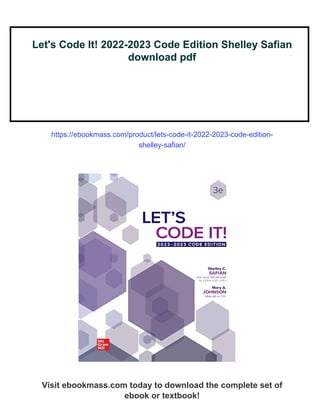
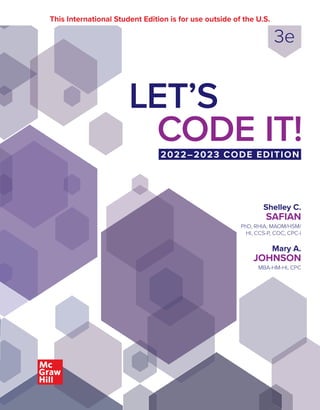
Let's Code It!2022-2023 Code Edition Shelley Safian
download pdf
https://ebookmass.com/product/lets-code-it-2022-2023-code-edition-
shelley-safian/
Visit ebookmass.com today to download the complete set of
ebook or textbook!
2.
Here are somerecommended products for you. Click the link to
download, or explore more at ebookmass.com
3-2-1 Code It! 7th Edition
https://ebookmass.com/product/3-2-1-code-it-7th-edition/
International Fire Code (International Code Council
Series) 2021 1st Edition International Code Council
https://ebookmass.com/product/international-fire-code-international-
code-council-series-2021-1st-edition-international-code-council/
International Zoning Code (international Code Council
Series) 2018 International Code Council
https://ebookmass.com/product/international-zoning-code-international-
code-council-series-2018-international-code-council/
IBC International Building Code (International Code
Council Series) 2018 1st Edition International Code
Council
https://ebookmass.com/product/ibc-international-building-code-
international-code-council-series-2018-1st-edition-international-code-
council/
3.
International Energy ConservationCode (International Code
Council Series) 2018 1st Edition International Code
Council
https://ebookmass.com/product/international-energy-conservation-code-
international-code-council-series-2018-1st-edition-international-code-
council/
IPMC International Property Maintenance Code
(International Code Council Series) 2018 1st Edition
International Code Council
https://ebookmass.com/product/ipmc-international-property-maintenance-
code-international-code-council-series-2018-1st-edition-international-
code-council/
2018 International Existing Building Code 1st Edition
International Code Council
https://ebookmass.com/product/2018-international-existing-building-
code-1st-edition-international-code-council/
2018 International Mechanical Code (IMC) 1st Edition
International Code Council
https://ebookmass.com/product/2018-international-mechanical-code-
imc-1st-edition-international-code-council/
International Residential Code for One- and Two-Family
Dwellings (International Code Council Series) 2018 1st
Edition International Code Council
https://ebookmass.com/product/international-residential-code-for-one-
and-two-family-dwellings-international-code-council-series-2018-1st-
edition-international-code-council/
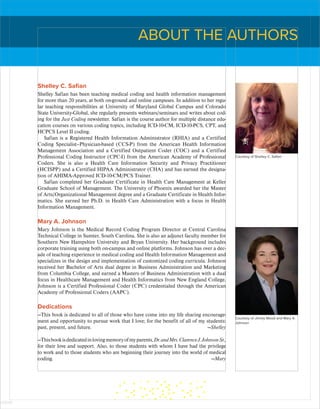
Shelley C. Safian
ShelleySafian has been teaching medical coding and health information management
for more than 20 years, at both on-ground and online campuses. In addition to her regu-
lar teaching responsibilities at University of Maryland Global Campus and Colorado
State University-Global, she regularly presents webinars/seminars and writes about cod-
ing for the Just Coding newsletter. Safian is the course author for multiple distance edu-
cation courses on various coding topics, including ICD-10-CM, ICD-10-PCS, CPT, and
HCPCS Level II coding.
Safian is a Registered Health Information Administrator (RHIA) and a Certified
Coding Specialist–Physician-based (CCS-P) from the American Health Information
Management Association and a Certified Outpatient Coder (COC) and a Certified
Professional Coding Instructor (CPC-I) from the American Academy of Professional
Coders. She is also a Health Care Information Security and Privacy Practitioner
(HCISPP) and a Certified HIPAA Administrator (CHA) and has earned the designa-
tion of AHIMA-Approved ICD-10-CM/PCS Trainer.
Safian completed her Graduate Certificate in Health Care Management at Keller
Graduate School of Management. The University of Phoenix awarded her the Master
of Arts/Organizational Management degree and a Graduate Certificate in Health Infor-
matics. She earned her Ph.D. in Health Care Administration with a focus in Health
Information Management.
Mary A. Johnson
Mary Johnson is the Medical Record Coding Program Director at Central Carolina
Technical College in Sumter, South Carolina. She is also an adjunct faculty member for
Southern New Hampshire University and Bryan University. Her background includes
corporate training using both on-campus and online platforms. Johnson has over a dec-
ade of teaching experience in medical coding and Health Information Management and
specializes in the design and implementation of customized coding curricula. Johnson
received her Bachelor of Arts dual degree in Business Administration and Marketing
from Columbia College, and earned a Masters of Business Administration with a dual
focus in Healthcare Management and Health Informatics from New England College.
Johnson is a Certified Professional Coder (CPC) credentialed through the American
Academy of Professional Coders (AAPC).
Dedications
—This book is dedicated to all of those who have come into my life sharing encourage-
ment and opportunity to pursue work that I love; for the benefit of all of my students:
past, present, and future. —Shelley
—Thisbookisdedicatedinlovingmemoryofmyparents,Dr.andMrs.ClarenceJ.JohnsonSr.,
for their love and support. Also, to those students with whom I have had the privilege
to work and to those students who are beginning their journey into the world of medical
coding. —Mary
ABOUT THE AUTHORS
Courtesy of Shelley C. Safian
Courtesy of Jimmy Wood and Mary A.
Johnson
ISTUDY
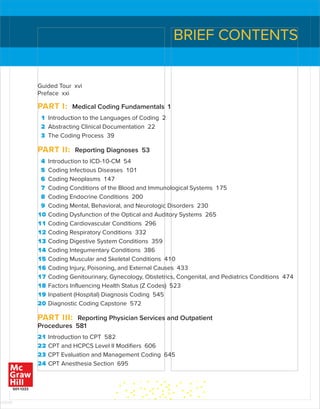
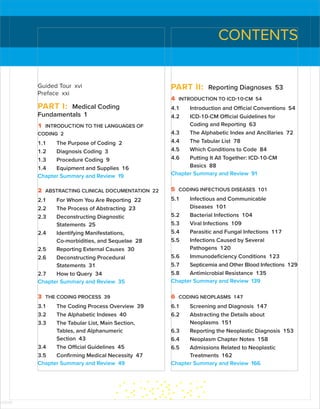
Guided Tour xvi
Prefacexxi
PART I: Medical Coding Fundamentals 1
1 Introduction to the Languages of Coding 2
2 Abstracting Clinical Documentation 22
3 The Coding Process 39
PART II: Reporting Diagnoses 53
4 Introduction to ICD-10-CM 54
5 Coding Infectious Diseases 101
6 Coding Neoplasms 147
7 Coding Conditions of the Blood and Immunological Systems 175
8 Coding Endocrine Conditions 200
9 Coding Mental, Behavioral, and Neurologic Disorders 230
10 Coding Dysfunction of the Optical and Auditory Systems 265
11 Coding Cardiovascular Conditions 296
12 Coding Respiratory Conditions 332
13 Coding Digestive System Conditions 359
14 Coding Integumentary Conditions 386
15 Coding Muscular and Skeletal Conditions 410
16 Coding Injury, Poisoning, and External Causes 433
17 Coding Genitourinary, Gynecology, Obstetrics, Congenital, and Pediatrics Conditions 474
18 Factors Influencing Health Status (Z Codes) 523
19 Inpatient (Hospital) Diagnosis Coding 545
20 Diagnostic Coding Capstone 572
PART III: Reporting Physician Services and Outpatient
Procedures 581
21 Introduction to CPT 582
22 CPT and HCPCS Level II Modifiers 606
23 CPT Evaluation and Management Coding 645
24 CPT Anesthesia Section 695
BRIEF CONTENTS
ISTUDY
13.
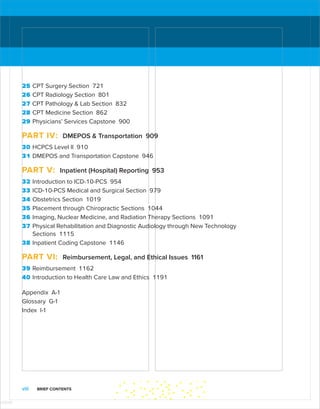
viii BRIEF CONTENTS
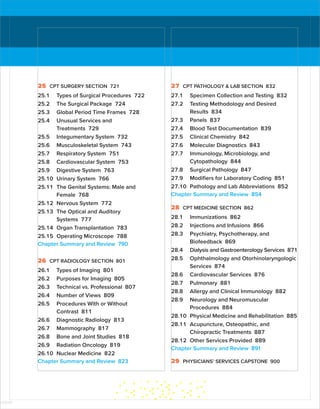
25CPT Surgery Section 721
26 CPT Radiology Section 801
27 CPT Pathology Lab Section 832
28 CPT Medicine Section 862
29 Physicians’ Services Capstone 900
PART IV: DMEPOS Transportation 909
30 HCPCS Level II 910
31 DMEPOS and Transportation Capstone 946
PART V: Inpatient (Hospital) Reporting 953
32 Introduction to ICD-10-PCS 954
33 ICD-10-PCS Medical and Surgical Section 979
34 Obstetrics Section 1019
35 Placement through Chiropractic Sections 1044
36 Imaging, Nuclear Medicine, and Radiation Therapy Sections 1091
37 Physical Rehabilitation and Diagnostic Audiology through New Technology
Sections 1115
38 Inpatient Coding Capstone 1146
PART VI: Reimbursement, Legal, and Ethical Issues 1161
39 Reimbursement 1162
40 Introduction to Health Care Law and Ethics 1191
Appendix A-1
Glossary G-1
Index I-1
ISTUDY
14.
CONTENTS
Guided Tour xvi
Prefacexxi
PART I: Medical Coding
Fundamentals 1
1 INTRODUCTION TO THE LANGUAGES OF
CODING 2
1.1 The Purpose of Coding 2
1.2 Diagnosis Coding 3
1.3 Procedure Coding 9
1.4 Equipment and Supplies 16
Chapter Summary and Review 19
2 ABSTRACTING CLINICAL DOCUMENTATION 22
2.1 For Whom You Are Reporting 22
2.2 The Process of Abstracting 23
2.3 Deconstructing Diagnostic
Statements 25
2.4 Identifying Manifestations,
Co-morbidities, and Sequelae 28
2.5 Reporting External Causes 30
2.6 Deconstructing Procedural
Statements 31
2.7 How to Query 34
Chapter Summary and Review 35
3 THE CODING PROCESS 39
3.1 The Coding Process Overview 39
3.2 The Alphabetic Indexes 40
3.3 The Tabular List, Main Section,
Tables, and Alphanumeric
Section 43
3.4 The Official Guidelines 45
3.5 Confirming Medical Necessity 47
Chapter Summary and Review 49
PART II: Reporting Diagnoses 53
4 INTRODUCTION TO ICD-10-CM 54
4.1 Introduction and Official Conventions 54
4.2 ICD-10-CM Official Guidelines for
Coding and Reporting 63
4.3 The Alphabetic Index and Ancillaries 72
4.4 The Tabular List 78
4.5 Which Conditions to Code 84
4.6 Putting It All Together: ICD-10-CM
Basics 88
Chapter Summary and Review 91
5 CODING INFECTIOUS DISEASES 101
5.1 Infectious and Communicable
Diseases 101
5.2 Bacterial Infections 104
5.3 Viral Infections 109
5.4 Parasitic and Fungal Infections 117
5.5 Infections Caused by Several
Pathogens 120
5.6 Immunodeficiency Conditions 123
5.7 Septicemia and Other Blood Infections 129
5.8 Antimicrobial Resistance 135
Chapter Summary and Review 139
6 CODING NEOPLASMS 147
6.1 Screening and Diagnosis 147
6.2 Abstracting the Details about
Neoplasms 151
6.3 Reporting the Neoplastic Diagnosis 153
6.4 Neoplasm Chapter Notes 158
6.5 Admissions Related to Neoplastic
Treatments 162
Chapter Summary and Review 166
ISTUDY
15.
Visit https://ebookmass.com todayto explore
a vast collection of ebooks across various
genres, available in popular formats like
PDF, EPUB, and MOBI, fully compatible with
all devices. Enjoy a seamless reading
experience and effortlessly download high-
quality materials in just a few simple steps.
Plus, don’t miss out on exciting offers that
let you access a wealth of knowledge at the
best prices!
16.
x CONTENTS
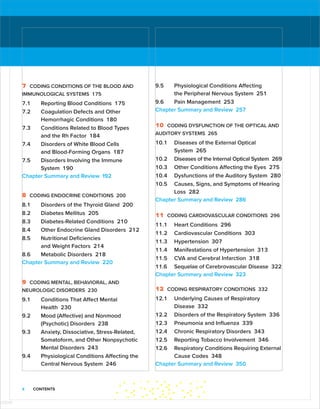
7 CODINGCONDITIONS OF THE BLOOD AND
IMMUNOLOGICAL SYSTEMS 175
7.1 Reporting Blood Conditions 175
7.2 Coagulation Defects and Other
Hemorrhagic Conditions 180
7.3 Conditions Related to Blood Types
and the Rh Factor 184
7.4 Disorders of White Blood Cells
and Blood-Forming Organs 187
7.5 Disorders Involving the Immune
System 190
Chapter Summary and Review 192
8 CODING ENDOCRINE CONDITIONS 200
8.1 Disorders of the Thyroid Gland 200
8.2 Diabetes Mellitus 205
8.3 Diabetes-Related Conditions 210
8.4 Other Endocrine Gland Disorders 212
8.5 Nutritional Deficiencies
and Weight Factors 214
8.6 Metabolic Disorders 218
Chapter Summary and Review 220
9 CODING MENTAL, BEHAVIORAL, AND
NEUROLOGIC DISORDERS 230
9.1 Conditions That Affect Mental
Health 230
9.2 Mood (Affective) and Nonmood
(Psychotic) Disorders 238
9.3 Anxiety, Dissociative, Stress-Related,
Somatoform, and Other Nonpsychotic
Mental Disorders 243
9.4 Physiological Conditions Affecting the
Central Nervous System 246
9.5 Physiological Conditions Affecting
the Peripheral Nervous System 251
9.6 Pain Management 253
Chapter Summary and Review 257
10 CODING DYSFUNCTION OF THE OPTICAL AND
AUDITORY SYSTEMS 265
10.1 Diseases of the External Optical
System 265
10.2 Diseases of the Internal Optical System 269
10.3 Other Conditions Affecting the Eyes 275
10.4 Dysfunctions of the Auditory System 280
10.5 Causes, Signs, and Symptoms of Hearing
Loss 282
Chapter Summary and Review 286
11 CODING CARDIOVASCULAR CONDITIONS 296
11.1 Heart Conditions 296
11.2 Cardiovascular Conditions 303
11.3 Hypertension 307
11.4 Manifestations of Hypertension 313
11.5 CVA and Cerebral Infarction 318
11.6 Sequelae of Cerebrovascular Disease 322
Chapter Summary and Review 323
12 CODING RESPIRATORY CONDITIONS 332
12.1
Underlying Causes of Respiratory
Disease 332
12.2 Disorders of the Respiratory System 336
12.3 Pneumonia and Influenza 339
12.4 Chronic Respiratory Disorders 343
12.5 Reporting Tobacco Involvement 346
12.6 Respiratory Conditions Requiring
External
Cause Codes 348
Chapter Summary and Review 350
ISTUDY
17.
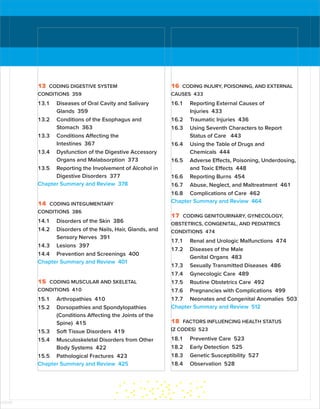
13 CODING DIGESTIVESYSTEM
CONDITIONS 359
13.1 Diseases of Oral Cavity and Salivary
Glands 359
13.2 Conditions of the Esophagus and
Stomach 363
13.3 Conditions Affecting the
Intestines 367
13.4 Dysfunction of the Digestive Accessory
Organs and Malabsorption 373
13.5 Reporting the Involvement of Alcohol in
Digestive Disorders 377
Chapter Summary and Review 378
14 CODING INTEGUMENTARY
CONDITIONS 386
14.1 Disorders of the Skin 386
14.2 Disorders of the Nails, Hair, Glands, and
Sensory Nerves 391
14.3 Lesions 397
14.4 Prevention and Screenings 400
Chapter Summary and Review 401
15 CODING MUSCULAR AND SKELETAL
CONDITIONS 410
15.1 Arthropathies 410
15.2 Dorsopathies and Spondylopathies
(Conditions Affecting the Joints of the
Spine) 415
15.3 Soft Tissue Disorders 419
15.4 Musculoskeletal Disorders from Other
Body Systems 422
15.5 Pathological Fractures 423
Chapter Summary and Review 425
16 CODING INJURY, POISONING, AND EXTERNAL
CAUSES 433
16.1 Reporting External Causes of
Injuries 433
16.2 Traumatic Injuries 436
16.3 Using Seventh Characters to Report
Status of Care 443
16.4 Using the Table of Drugs and
Chemicals 444
16.5 Adverse Effects, Poisoning, Underdosing,
and Toxic Effects 448
16.6 Reporting Burns 454
16.7 Abuse, Neglect, and Maltreatment 461
16.8 Complications of Care 462
Chapter Summary and Review 464
17 CODING GENITOURINARY, GYNECOLOGY,
OBSTETRICS, CONGENITAL, AND PEDIATRICS
CONDITIONS 474
17.1 Renal and Urologic Malfunctions 474
17.2 Diseases of the Male
Genital Organs 483
17.3 Sexually Transmitted Diseases 486
17.4 Gynecologic Care 489
17.5 Routine Obstetrics Care 492
17.6 Pregnancies with Complications 499
17.7 Neonates and Congenital Anomalies 503
Chapter Summary and Review 512
18 FACTORS INFLUENCING HEALTH STATUS
(Z CODES) 523
18.1 Preventive Care 523
18.2 Early Detection 525
18.3 Genetic Susceptibility 527
18.4 Observation 528
ISTUDY
18.
xii CONTENTS
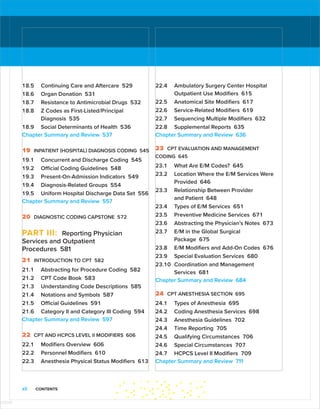
18.5 ContinuingCare and Aftercare 529
18.6 Organ Donation 531
18.7 Resistance to Antimicrobial Drugs 532
18.8 Z Codes as First-Listed/Principal
Diagnosis 535
18.9 Social Determinants of Health 536
Chapter Summary and Review 537
19 INPATIENT (HOSPITAL) DIAGNOSIS CODING 545
19.1 Concurrent and Discharge Coding 545
19.2 Official Coding Guidelines 548
19.3 Present-On-Admission Indicators 549
19.4 Diagnosis-Related Groups 554
19.5 Uniform Hospital Discharge Data Set 556
Chapter Summary and Review 557
20 DIAGNOSTIC CODING CAPSTONE 572
PART III: Reporting Physician
Services and Outpatient
Procedures 581
21 INTRODUCTION TO CPT 582
21.1 Abstracting for Procedure Coding 582
21.2 CPT Code Book 583
21.3 Understanding Code Descriptions 585
21.4 Notations and Symbols 587
21.5 Official Guidelines 591
21.6 Category II and Category III Coding 594
Chapter Summary and Review 597
22 CPT AND HCPCS LEVEL II MODIFIERS 606
22.1 Modifiers Overview 606
22.2 Personnel Modifiers 610
22.3 Anesthesia Physical Status Modifiers 613
22.4 Ambulatory Surgery Center Hospital
Outpatient Use Modifiers 615
22.5 Anatomical Site Modifiers 617
22.6 Service-Related Modifiers 619
22.7 Sequencing Multiple Modifiers 632
22.8 Supplemental Reports 635
Chapter Summary and Review 636
23 CPT EVALUATION AND MANAGEMENT
CODING 645
23.1 What Are E/M Codes? 645
23.2 Location Where the E/M Services Were
Provided 646
23.3 Relationship Between Provider
and Patient 648
23.4 Types of E/M Services 651
23.5 Preventive Medicine Services 671
23.6 Abstracting the Physician’s Notes 673
23.7 E/M in the Global Surgical
Package 675
23.8 E/M Modifiers and Add-On Codes 676
23.9 Special Evaluation Services 680
23.10 Coordination and Management
Services 681
Chapter Summary and Review 684
24 CPT ANESTHESIA SECTION 695
24.1 Types of Anesthesia 695
24.2 Coding Anesthesia Services 698
24.3 Anesthesia Guidelines 702
24.4 Time Reporting 705
24.5 Qualifying Circumstances 706
24.6 Special Circumstances 707
24.7 HCPCS Level II Modifiers 709
Chapter Summary and Review 711
ISTUDY
19.
25 CPT SURGERYSECTION 721
25.1 Types of Surgical Procedures 722
25.2 The Surgical Package 724
25.3 Global Period Time Frames 728
25.4 Unusual Services and
Treatments 729
25.5 Integumentary System 732
25.6 Musculoskeletal System 743
25.7 Respiratory System 751
25.8 Cardiovascular System 753
25.9 Digestive System 763
25.10 Urinary System 766
25.11 The Genital Systems: Male and
Female 768
25.12 Nervous System 772
25.13 The Optical and Auditory
Systems 777
25.14 Organ Transplantation 783
25.15 Operating Microscope 788
Chapter Summary and Review 790
26 CPT RADIOLOGY SECTION 801
26.1 Types of Imaging 801
26.2 Purposes for Imaging 805
26.3 Technical vs. Professional 807
26.4 Number of Views 809
26.5 Procedures With or Without
Contrast 811
26.6 Diagnostic Radiology 813
26.7 Mammography 817
26.8 Bone and Joint Studies 818
26.9 Radiation Oncology 819
26.10 Nuclear Medicine 822
Chapter Summary and Review 823
27 CPT PATHOLOGY LAB SECTION 832
27.1 Specimen Collection and Testing 832
27.2 Testing Methodology and Desired
Results 834
27.3 Panels 837
27.4 Blood Test Documentation 839
27.5 Clinical Chemistry 842
27.6 Molecular Diagnostics 843
27.7 Immunology, Microbiology, and
Cytopathology 844
27.8 Surgical Pathology 847
27.9 Modifiers for Laboratory Coding 851
27.10 Pathology and Lab Abbreviations 852
Chapter Summary and Review 854
28 CPT MEDICINE SECTION 862
28.1 Immunizations 862
28.2 Injections and Infusions 866
28.3 Psychiatry, Psychotherapy, and
Biofeedback 869
28.4 Dialysis and Gastroenterology Services 871
28.5 Ophthalmology and
Otorhinolaryngologic
Services 874
28.6 Cardiovascular Services 876
28.7 Pulmonary 881
28.8 Allergy and Clinical Immunology 882
28.9 Neurology and Neuromuscular
Procedures 884
28.10 Physical Medicine and Rehabilitation 885
28.11 Acupuncture, Osteopathic, and
Chiropractic Treatments 887
28.12 Other Services Provided 889
Chapter Summary and Review 891
29 PHYSICIANS’ SERVICES CAPSTONE 900
ISTUDY
20.
xiv CONTENTS
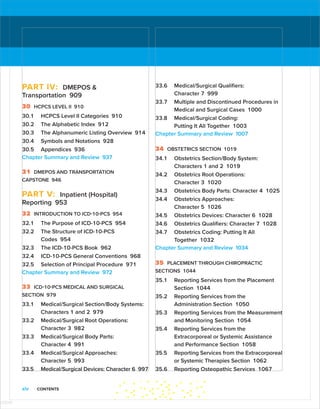
PART IV:DMEPOS
Transportation 909
30 HCPCS LEVEL II 910
30.1 HCPCS Level II Categories 910
30.2 The Alphabetic Index 912
30.3 The Alphanumeric Listing Overview 914
30.4 Symbols and Notations 928
30.5 Appendices 936
Chapter Summary and Review 937
31 DMEPOS AND TRANSPORTATION
CAPSTONE 946
PART V: Inpatient (Hospital)
Reporting 953
32 INTRODUCTION TO ICD-10-PCS 954
32.1 The Purpose of ICD-10-PCS 954
32.2 The Structure of ICD-10-PCS
Codes 954
32.3 The ICD-10-PCS Book 962
32.4 ICD-10-PCS General Conventions 968
32.5 Selection of Principal Procedure 971
Chapter Summary and Review 972
33 ICD-10-PCS MEDICAL AND SURGICAL
SECTION 979
33.1 Medical/Surgical Section/Body Systems:
Characters 1 and 2 979
33.2 Medical/Surgical Root Operations:
Character 3 982
33.3 Medical/Surgical Body Parts:
Character 4 991
33.4 Medical/Surgical Approaches:
Character 5 993
33.5 Medical/Surgical Devices: Character 6 997
33.6 Medical/Surgical Qualifiers:
Character 7 999
33.7 Multiple and Discontinued Procedures in
Medical and Surgical Cases 1000
33.8 Medical/Surgical Coding:
Putting It All Together 1003
Chapter Summary and Review 1007
34 OBSTETRICS SECTION 1019
34.1 Obstetrics Section/Body System:
Characters 1 and 2 1019
34.2 Obstetrics Root Operations:
Character 3 1020
34.3 Obstetrics Body Parts: Character 4 1025
34.4 Obstetrics Approaches:
Character 5 1026
34.5 Obstetrics Devices: Character 6 1028
34.6 Obstetrics Qualifiers: Character 7 1028
34.7 Obstetrics Coding: Putting It All
Together 1032
Chapter Summary and Review 1034
35 PLACEMENT THROUGH CHIROPRACTIC
SECTIONS 1044
35.1 Reporting Services from the Placement
Section 1044
35.2 Reporting Services from the
Administration Section 1050
35.3 Reporting Services from the
Measurement
and Monitoring Section 1054
35.4 Reporting Services from the
Extracorporeal or Systemic Assistance
and Performance Section 1058
35.5 Reporting Services from the Extracorporeal
or Systemic Therapies Section 1062
35.6 Reporting Osteopathic Services 1067
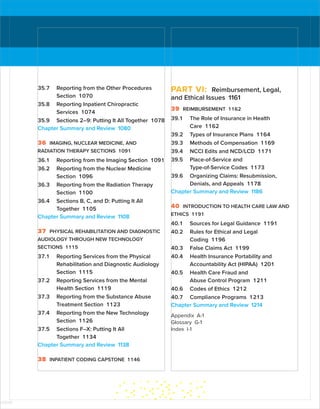
ISTUDY
21.
35.7 Reporting fromthe Other Procedures
Section 1070
35.8 Reporting Inpatient Chiropractic
Services 1074
35.9 Sections 2–9: Putting It All Together 1078
Chapter Summary and Review 1080
36 IMAGING, NUCLEAR MEDICINE, AND
RADIATION THERAPY SECTIONS 1091
36.1 Reporting from the Imaging Section 1091
36.2 Reporting from the Nuclear Medicine
Section 1096
36.3 Reporting from the Radiation Therapy
Section 1100
36.4 Sections B, C, and D: Putting It All
Together 1105
Chapter Summary and Review 1108
37 PHYSICAL REHABILITATION AND DIAGNOSTIC
AUDIOLOGY THROUGH NEW TECHNOLOGY
SECTIONS 1115
37.1 Reporting Services from the
Physical
Rehabilitation and Diagnostic
Audiology
Section 1115
37.2 Reporting Services from the Mental
Health Section 1119
37.3 Reporting from the Substance Abuse
Treatment Section 1123
37.4 Reporting from the New Technology
Section 1126
37.5 Sections F–X: Putting It All
Together 1134
Chapter Summary and Review 1138
38 INPATIENT CODING CAPSTONE 1146
PART VI: Reimbursement, Legal,
and Ethical Issues 1161
39 REIMBURSEMENT 1162
39.1 The Role of Insurance in Health
Care 1162
39.2 Types of Insurance Plans 1164
39.3 Methods of Compensation 1169
39.4 NCCI Edits and NCD/LCD 1171
39.5 Place-of-Service and
Type-of-Service Codes 1173
39.6 Organizing Claims: Resubmission,
Denials, and Appeals 1178
Chapter Summary and Review 1186
40 INTRODUCTION TO HEALTH CARE LAW AND
ETHICS 1191
40.1 Sources for Legal Guidance 1191
40.2 Rules for Ethical and Legal
Coding 1196
40.3 False Claims Act 1199
40.4 Health Insurance Portability and
Accountability Act (HIPAA) 1201
40.5 Health Care Fraud and
Abuse Control Program 1211
40.6 Codes of Ethics 1212
40.7 Compliance Programs 1213
Chapter Summary and Review 1214
Appendix A-1
Glossary G-1
Index I-1
ISTUDY
22.
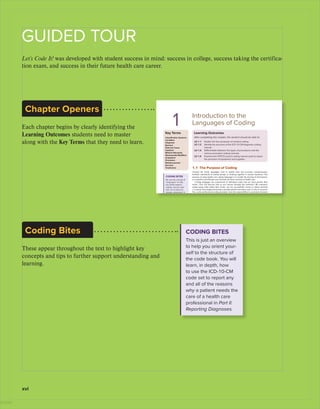
xvi
Let’s Code It!was developed with student success in mind: success in college, success taking the certifica-
tion exam, and success in their future health care career.
GUIDED TOUR
Chapter Openers
Each chapter begins by clearly identifying the
Learning Outcomes students need to master
along with the Key Terms that they need to learn.
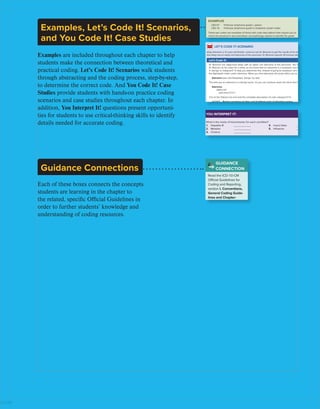
Coding Bites
These appear throughout the text to highlight key
concepts and tips to further support understanding and
learning.
or diagnostic statement, in the
seen and treated.
The physician’s notes explai
The notes may document a spec
unnamed problem, or another
As a coding specialist, it is your
(or codes) so that everyone inv
patient at a particular time.
The International Classifica
tion (ICD-10-CM) code book c
report the reason why the healt
cific encounter.
Overview of the Interna
Revision – Clinical Mod
Book Sections
The ICD-10-CM code book (w
tions. Here is an overview of its
sections to determine the most
encounter occurred.
Index to Diseases and In
The Alphabetic Index [Index t
terms used by the physician to
from a health care professional.
The Alphabetic Index lists al
their basic description alphabet
tions are listed by
• Condition (e.g., infection, fra
• Eponym (e.g., Epstein-Barr s
• Other descriptors (e.g., perso
So, whichever type of words you
them in the Alphabetic Index in
The Alphabetic Index can on
sis, and you will use this suggest
CODING BITES
This is just an overview
to help you orient your-
self to the structure of
the code book. You will
learn, in depth, how
to use the ICD-10-CM
code set to report any
and all of the reasons
why a patient needs the
care of a health care
professional in Part II:
Reporting Diagnoses.
Condition
The state of abnormality or
dysfunction.
Eponym
A disease or condition named
for a person. Abnormal, abnormality, abno
- acid-base balance (mixed) E
- albumin R77.0
- alphafetoprotein R77.2
- alveolar ridge K08.9
Confirming Pages
2
saf6657X_ch01_001-021.indd 2 04/19/19 04:37 PM
Introduction to the
Languages of Coding
1
Key Terms
Classification Systems
Condition
Diagnosis
Eponym
External Cause
Inpatient
Medical Necessity
Nonessential Modifiers
Outpatient
Procedure
Reimbursement
Services
Treatments
Learning Outcomes
After completing this chapter, the student should be able to:
LO 1.1 Explain the four purposes of medical coding.
LO 1.2 Identify the structure of the ICD-10-CM diagnosis coding
manual.
LO 1.3 Differentiate between the types of procedures and the
various procedure coding manuals.
LO 1.4 Examine the HCPCS Level II coding manual used to report
the provision of equipment and supplies.
1.1 The Purpose of Coding
Around the world, languages exist to enable clear and accurate communication
between individuals in similar groups or working together in similar functions. The
purpose of using health care coding languages is to enable the sharing of information,
in a specific and efficient way, between all those involved in health care.
Coding languages are constructed of individual codes that are more precise than
words. (You will discover this as you venture through this textbook.) By communi-
cating using codes rather than words, you can successfully convey to others involved
(1) exactly what happened during a provider-patient encounter and (2) why it occurred.
You, as the professional coding specialist, have the responsibility to accurately interpret
health care terms and definitions (medical terminology) into numbers or number-letter
combinations (alphanumeric codes) that specifically convey diagnoses and procedures.
Why is it so critical to code diagnoses and procedures accurately? The coding lan-
guages, known as classification systems, communicate information that is key to various
aspects of the health care system, including
• Medical necessity
• Statistical analyses
• Reimbursement
• Resource allocation
Medical Necessity
The diagnosis codes that you report explain the justification for the procedure, service,
or treatment provided to a patient during his or her encounter. Every time a health
care professional provides care to a patient, there must be a valid medical reason.
Patients certainly want to know that health care professionals performed procedures
or provided care for a specific, justified purpose, and so do third-party payers! This is
referred to as medical necessity. Requiring medical necessity ensures that health care
providers are not performing tests or giving injections without a good medical reason.
Diagnosis codes explain why the individual came to see the physician and support the
physician’s decision about what procedures to provide.
Medical necessity is one of the reasons why it is so very important to code the diag-
nosis accurately and with all the detail possible. If you are one number off in your code
CODING BITES
We use the concept of
“languages” to help
you relate medical
coding—and its code
sets—to an idea you
already understand. In
the health care industry,
however, the various
code sets, such as ICD-
10-CM or HCPCS Level
II, are referred to as
Classification Systems.
Classification Systems
The term used in health care
to identify ICD-10-CM, CPT,
ICD-10-PCS, and HCPCS Level
II code sets.
CODING BITES
A diagnosis explains
WHY the patient requires
the attention of a health
care provider and a
procedure explains
WHAT the physician or
health care provider did
for the patient.
ISTUDY
xviii
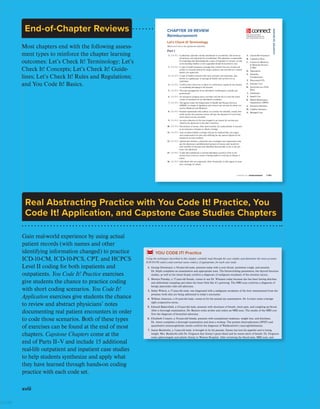
Gain real-world experienceby using actual
patient records (with names and other
identifying information changed) to practice
ICD-10-CM, ICD-10-PCS, CPT, and HCPCS
Level II coding for both inpatients and
outpatients. You Code It! Practice exercises
give students the chance to practice coding
with short coding scenarios. You Code It!
Application exercises give students the chance
to review and abstract physicians’ notes
documenting real patient encounters in order
to code those scenarios. Both of these types
of exercises can be found at the end of most
chapters. Capstone Chapters come at the
end of Parts II–V and include 15 additional
real-life outpatient and inpatient case studies
to help students synthesize and apply what
they have learned through hands-on coding
practice with each code set.
Real Abstracting Practice with You Code It! Practice, You
Code It! Application, and Capstone Case Studies Chapters
End-of-Chapter Reviews
Most chapters end with the following assess-
ment types to reinforce the chapter learning
outcomes: Let’s Check It! Terminology; Let’s
Check It! Concepts; Let’s Check It! Guide-
lines; Let’s Check It! Rules and Regulations;
and You Code It! Basics.
First Pages
saf6657X_ch39_1157-1186.indd 1183 06/27/19 06:18 PM
CHAPTER 39 | REIMBURSEMEnT 1183
CHAPTER
39
REVIEW
CHAPTER 39 REVIEW
Reimbursement
Let’s Check It! Terminology
Match each term to the appropriate definition.
Part I
Enhance your learning by
completing these exercises and
more at mcgrawhillconnect.com!
®
1. LO 39.2 A physician, typically a family practitioner or an internist, who serves as
the primary care physician for an individual. This physician is responsible
for evaluating and determining the course of treatment or services, as well
as for deciding whether or not a specialist should be involved in care.
2. LO 39.1 A type of health insurance coverage that controls the care of each sub-
scriber (or insured person) by using a primary care provider as a central
health care supervisor.
3. LO 39.2 A type of health insurance that uses a primary care physician, also
known as a gatekeeper, to manage all health care services for an
individual.
4. LO 39.2 A policy that covers loss or injury to a third party caused by the insured
or something belonging to the insured.
5. LO 39.1 The total management of an individual’s well-being by a health care
professional.
6. LO 39.3 An insurance company pays a provider one flat fee to cover the entire
course of treatment for an individual’s condition.
7. LO 39.2 The agency under the Department of Health and Human Services
(DHHS) in charge of regulation and control over services for those cov-
ered by Medicare and Medicaid.
8. LO 39.3 Payment agreements that outline, in a written fee schedule, exactly how
much money the insurance carrier will pay the physician for each treat-
ment and/or service provided.
9. LO 39.3 An extra reduction in the rate charged to an insurer for services pro-
vided by the physician to the plan’s members.
10. LO 39.1 The amount of money, often paid monthly, by a policyholder or insured,
to an insurance company to obtain coverage.
11. LO 39.2 Auto accident liability coverage will pay for medical bills, lost wages,
and compensation for pain and suffering for any person injured by the
insured in an auto accident.
12. LO 39.3 Agreements between a physician and a managed care organization that
pay the physician a predetermined amount of money each month for
each member of the plan who identifies that provider as his or her pri-
mary care physician.
13. LO 39.2 A plan that reimburses a covered individual a portion of his or her
income that is lost as a result of being unable to work due to illness or
injury.
14. LO 39.2 Individuals who are supported, either financially or with regard to insur-
ance coverage, by others.
A. Automobile Insurance
B. Capitation Plans
C. Centers for Medicare
Medicaid Services
(CMS)
D. Dependents
E. Disability
Compensation
F. Discounted FFS
G. Episodic Care
H. Fee-for-Service (FFS)
Plans
I. Gatekeeper
J. Health Care
K. Health Maintenance
Organization (HMO)
L. Insurance Premium
M. Liability Insurance
N. Managed Care
Confirming Pages
saf6657X_ch06_145-172.indd 168
CHAPTER
6
REVIEW
168 PART II | REPORTING DIAGNOSES
7. Follicular grade III lymphoma, lymph nodes of
inguinal region and lower limbs:
a. main term: _____ b. diagnosis: _____
8. Acral lentiginous, right heel melanoma:
a. main term: _____ b. diagnosis: _____
9. Lipoma of the kidney:
a. main term: _____ b. diagnosis: _____
10. Primary malignant neoplasm of right male breast,
upper-outer quadrant:
a. main term: _____ b. diagnosis: _____
11. Malignant odontogenic tumor, upper jaw bone:
a. main term: _____ b. diagnosis: _____
12. Secondary malignant neoplasm of vallecula:
a. main term: _____ b. diagnosis: _____
13. Carcinoma in situ neoplasm of left eyeball:
a. main term: _____ b. diagnosis: _____
14. Benign neoplasm of cerebrum peduncle:
a. main term: _____ b. diagnosis: _____
15. Myelofibrosis with myeloid metaplasia:
a. main term: _____ b. diagnosis: _____
YOU CODE IT! Practice
Using the techniques described in this chapter, carefully read through the case studies and determine the most accurate
ICD-10-CM code(s) and external cause code(s), if appropriate, for each case study.
1. George Donmoyer, a 58-year-old male, presents today with a sore throat, persistent cough, and earache.
Dr. Selph completes an examination and appropriate tests. The blood-clotting parameters, the thyroid function
studies, as well as the tissue biopsy confirm a diagnosis of malignant neoplasm of the extrinsic larynx.
2. Monica Pressley, a 37-year-old female, comes to see Dr. Wheaten today because she has been having diarrhea
and abdominal cramping and states her heart feels like it’s quivering. The MRI scan confirms a diagnosis of
benign pancreatic islet cell adenoma.
3. Suber Wilson, a 57-year-old male, was diagnosed with a malignant neoplasm of the liver metastasized from the
prostate; both sites are being addressed in today’s encounter.
4. William Amerson, a 41-year-old male, comes in for his annual eye examination. Dr. Leviner notes a benign
right conjunctiva nevus.
5. Edward Bakersfield, a 43-year-old male, presents with shortness of breath, chest pain, and coughing up blood.
After a thorough examination, Dr. Benson notes stridor and orders an MRI scan. The results of the MRI con-
firm the diagnosis of bronchial adenoma.
6. Elizabeth Conyers, a 56-year-old female, presents with unexplained weakness, weight loss, and dizziness.
Dr. Amos completes a thorough examination and does a workup. The protein electrophoresis (SPEP) and
quantitative immunoglobulin results confirm the diagnosis of Waldenström’s macroglobulinemia.
7. James Buckholtz, a 3-year-old male, is brought in by his parents. Jimmy has lost his appetite and is losing
weight. Mrs. Buckholtz tells Dr. Ferguson that Jimmy’s gums bleed and he seems short of breath. Dr. Ferguson
notes splenomegaly and admits Jimmy to Weston Hospital. After reviewing the blood tests, MRI scan, and
bone marrow aspiration results, Jimmy is diagnosed with acute lymphoblastic leukemia.
8. Kelley Young, a 39-year-old female, presents to Dr. Clerk with the complaints of sudden blurred vision, dizzi-
ness, and numbness in her face. Kelley states she feels very weak and has headaches. Dr. Clerk admits Kelley
to the hospital. After reviewing the MRI scan, her hormone levels from the blood workup, and urine tests, Kel-
ley is diagnosed with a primary malignant neoplasm of the pituitary gland.
9. Ralph Bradley, a 36-year-old male, comes to see Dr. Harper because he is weak, losing weight, and vomiting
and has diarrhea with some blood showing. Ralph was diagnosed with HIV 3 years ago. Dr. Harper completes
an examination noting paleness, tachycardia, and tachypnea. Ralph is admitted to the hospital. The biopsied
tissue from an endoscopy confirms a diagnosis of Kaposi’s sarcoma of gastrointestinal organ.
ICD-10-CM
ISTUDY
25.
In addition, allof the exercises in the
Chapter Review can be assigned through
Connect. Of particular note are the You
Code It! Practice exercises, which offer
our unique CodePath option. In Connect,
students are presented with a series of
questions to guide them through the
critical thinking process to determine the
correct code.
Confirming Pages
saf34625_ch04_053-100.indd 97 11/17/21 05:45 PM
CHAPTER
4
REVIEW
CHAPTER 4 | INTRODUCTION TO ICD-10-CM 97
YOU CODE IT! Application
The following exercises provide practice in abstracting physician documentation from our health care facility, Prader,
Bracker, Associates. These case studies are modeled on real patient encounters. Using the techniques described in this
chapter, carefully read through the case studies and determine the most accurate ICD-10-CM code(s) for each case study.
Remember to include external cause codes, if appropriate.
ICD-10-CM
PRADER, BRACKER, ASSOCIATES
A Complete Health Care Facility
159 Healthcare Way • SOMEWHERE, FL 32811 • 407-555-6789
PATIENT: Kassandra, Kelly
ACCOUNT/EHR #: KASSKE001
DATE: 09/16/22
Attending Physician: Oscar R. Prader, MD
S: Pt is a 19-year-old female who has had a sore throat and cough for the past week. She states that
she had a temperature of 101.5 F last night. She also admits that it is painful to swallow. No OTC medi-
cation has provided any significant relief.
O: Ht 5′5″ Wt. 148 lb. R 20. T 101 F. BP 125/82. Pharynx is inspected, tonsils enlarged. There is pus
noted in the posterior pharynx. Neck: supple, no nodes. Chest: clear. Heart: regular rate and rhythm
without murmur.
A: Acute pharyngitis
P: 1. Send pt for Strep test
2. Recommend patient gargle with warm salt water and use OTC lozenges to keep throat moist
3. Rx if needed once results of Strep test come back
4. Return in 2 weeks for follow-up
Determine the most accurate ICD-10-CM code(s).
WESTON HOSPITAL
629 Healthcare Way • SOMEWHERE, FL 32811 • 407-555-6541
PATIENT: DAVIS, HELEN
ACCOUNT/EHR #: DAVIHE001
DATE: 10/21/22
Attending Physician: Renee O. Bracker, MD
Patient, an 82-year-old that presents today to see Dr. Newson. Dr. Newson saw this patient 10 days ago
in office, where she was diagnosed with a UTI and prescribed nitrofurantoin PO. Today she presents
with the complaints of dysuria, low back pain, abdominal pain, nausea, and diarrhea. After a positive UA
she was admitted to Weston Hospital.
(continued)
ISTUDY
26.
Visit https://ebookmass.com todayto explore
a vast collection of ebooks across various
genres, available in popular formats like
PDF, EPUB, and MOBI, fully compatible with
all devices. Enjoy a seamless reading
experience and effortlessly download high-
quality materials in just a few simple steps.
Plus, don’t miss out on exciting offers that
let you access a wealth of knowledge at the
best prices!
to make oneman the property of another? Has God poured the tide
of life through the African’s breast, and animated it with a portion of
his own Divine spirit, and at the same time deprived him of all
natural affections, that he alone is to be struck off the list of rational
beings, and placed on a level with the brute? Is his flesh marble, and
his sinews iron, or his immortal spirit of a class condemned, without
hope, to penal suffering, that he is called upon to endure incessant
toil, and to be subjected to degradation, bodily and mental, such as
no other portion of the family of Adam have ever been destined to
endure, without the vengeance of Heaven being signally displayed
upon the oppressors? Does the African mother feel less love to her
offspring than the white woman? or the African husband regard with
less tenderness the wife of his bosom? Is his heart dead to the ties
of kindred,—his nature so brutalized, that the sacred associations of
home and country awaken no emotions in his breast?
History unanswerably demonstrates that the negro does feel, keenly
feel, the wrongs inflicted upon him by his unrighteous enslavers, and
that his mind, barren as it has been rendered by hard usage, and
desolated with misery, is not unwatered by the pure and gentle
streams of natural affection. Yet the lordly oppressors remain
unmoved by the sad condition of the negro, contemplate with
indifference his bodily and mental sufferings, and still dare to
postpone to an indefinite period the termination of his oppression
and of their own guilt.
But thanks be to God! there is some counteracting influence to this
feeling, and that it is on the advance. The night has been long and
dark,—already the horizon brightens; the day of freedom dawns.
Go on, then, my friend; I say, go on! in the good cause thou hast
espoused. Labor, and faint not. “Whatsoever thy hand findeth to do,
do it with all thy might.” My kind regards to Frederick Douglass; may
he, and all others also, be strengthened and encouraged to labor in
the great work of human freedom; that so, by gradual increase, like
the mighty surge, they may become strong enough to overpower
and drown the oppressor, and be enabled to devise and execute
29.
Wilson Armistead
measures ofmercy and justice, which may avert the judgments of
the Almighty from their guilty land. For surely some signal display of
Divine displeasure must await America, unless she repent, and undo
the heavy burdens of her THREE MILLION SLAVES.
Are not the signs of the times calculated to remind us forcibly of this
language of Isaiah, “Behold, the Lord cometh out of his place to
punish the inhabitants of the earth for their iniquity; the earth also
shall disclose her blood, and no more cover her slain.” Do we not
hear already
“——the wheels of an avenging God,
Groan heavily along the distant road?”
Assuredly, he comes to judge the earth. “Who shall abide the day of
his coming; who shall stand when he appeareth?”
Thy Friend, very truly,
30.
IMPROMPTU STANZAS,
SUGGESTED BYTHE WORKING OF THE FUGITIVE SLAVE ACT, AS
ILLUSTRATED IN THE CASE OF REV. DOCTOR PENNINGTON.
BY THE WORK-SHOP BARD.
31.
Bring out thehandcuffs, clank the rusted gyves;
Rain down your curses on the doomed race;
Hang out a terror that shall haunt their lives,
In every place.
Unloose the bloodhounds from oppression’s den;
Arm every brigand in the name of law,
And triple shield of pulpit, press, and pen,
Around them draw.
Ho! politicians, orators, divines!
Ho! cotton-mongers of the North and South!
Strike now for slavery, or our Union’s shrines
Are gone forsooth!
Down from their glory into chaos hurled,
Your thirty States in shivered fragments go,
Like the seared leaves by autumn tempests whirled
To depths below.
Closed be each ear, let every tongue be dumb;
Nor one sad pitying tear o’er man be shed,
Though fainting at your threshold he should come,
And ask for bread.
Though woman, fleeing from the cruel grip
Of foul oppression, scarred and stained with blood,
Where from the severed veins the driver’s whip
Hath drank its flood.
Though helpless childhood ask—O pitying Heaven!—
The merest crumb which falls upon the floor,
Tho’ faint and famished, bread must not be given,
Bolt fast the door.
And must it be, thou just and holy God!
Th t i id t th l d d t i k
32.
J. M. Eells.
Thatin our midst thy peeled and stricken poor
Shall kneel and plead amid their tears and blood,
For evermore?
Shall those whom thou hast sent baptized from heaven,
To preach the Gospel the wide world around,
To teach the erring they may be forgiven,
Be seized and bound?
Placed on the auction-block, with chattels sold,
Driven like beasts of burden day by day,
The flock be scattered from the shepherd’s fold,
The spoiler’s prey?
How long—thy people cry—O Lord, how long!
Shall not thine arm “shake down the bolted fire!”
Can deeds like these of God-defying wrongs,
Escape His ire?
Must judgments,—such as swept with fearful tread
O’er Egypt when she made thy people slaves,
Where thy hand strewed with their unburied dead
The Red Sea waves?
Must fire and hail from heaven upon us fall,
Our first-born perish ’neath the Avenger’s brand,
And sevenfold darkness, like a funeral pall
O’erspread the land?
We kneel before thy footstool, gracious God,
Spare thou our nation, in thy mercy spare;
We perish quickly ’neath thy lifted rod
And arm made bare.
JOHN MURRAY (OFGLASGOW).
About a year ago, the newspapers announced the death of Mr. John
Murray, for many years the secretary of the Glasgow Emancipation
Society, and I would do violence to truth and humanity whose
servant and soldier he was, should I neglect to pen a few
recollections of that most earnest and efficient man.
He was related to the ancient and honorable family of the Oswalds
of Sheildhall, and received that excellent educational and religious
training which is given to the children of the middle and higher
classes in Scotland. At the age of twenty-two or three, in
consequence of an attack of pulmonary hemorrhage, he sailed for
the West Indies and found employment at his trade, house-building,
in St. Kitts. Very soon, however, he found other matters to engage,
and almost engross his attention and labors; in conjunction with an
uncle of George Stephen of London, and a Dr. Hamilton, resident in
St. Kitts, he did manly and successful fight in behalf of the wronged
and bleeding slave.
After a residence in that island of some years, during which he
obtained a thorough knowledge of the workings of slavery, he
returned to Glasgow, poor in pocket, but rich in abolitionism. Soon
after his return, he was united in marriage to Miss Anna ——, a lady
whose perfect harmony in sentiment, softened by feminine delicacy,
made a happy anti-slavery home for the zealous and ardent
abolitionism of John Murray. It was a union of hearts attached in
early youth, and which had remained “leal” during a long separation.
Shortly after marriage, he commenced business as a spirit-dealer,
then and now a most reputable calling in the opinion of the good
citizens of Glasgow. Temperate himself, his calling gradually became
35.
unpleasant to him.At first he refused to sell spirits to any person
partly inebriated; then he reasoned himself into a total abandonment
of the death-dealing traffic. With no other business prospect before
him, prevented by his long difficulty from working at his trade, with
a young wife and child dependent on him, he suddenly locked up his
spirit-cellar and never more sold rum!
In 1828 or 1829, through the influence of his kinsman, James
Oswald, Esq., of Sheildhall, Mr. Murray was appointed surveyor on a
part of the Forth and Clyde canal, an office requiring much labor for
little pay. His prospects of promotion depended on Mr. Oswald and
other members of the Kirk of Scotland. Mr. Murray was a full
member of the Tron Church, Glasgow, when, according to law, a
minister was appointed there regardless of the choice, and contrary
to the wishes of the great majority of its members. In consequence
of this appointment, and again unmindful of personal advancement,
John Murray shook the dust from his sandals and quit at once and
forever the Tron Church and the Kirk of Scotland.
About the same time the Glasgow Emancipation Society was formed
or re-organized, on the doctrine of immediate emancipation so
splendidly announced by a secession minister of Edinburgh. The
secretaries of this association were John Murray the surveyor, and
William Smead, of the Gallowgate, grocer; the last a Friend. These
two were the head and front, the thinking and the locomotive power
of this well known association which did notable fight, if not the
principal labor, in effecting emancipation in the British West Indies,
and in assaulting American slavery.
And, twenty odd years ago, it was no trifling matter to do anti-
slavery work in Glasgow, the very names of whose stateliest streets
proclaimed that they were built by money wrung out of the blood
and sweat of the negroes of Jamaica, St. Vincents, etc. The whole of
the retired wealth, nearly all the active business influence, the
weight of the Established Church, the rank and fashion of Glasgow,
and though last not least, the keen wit of the poet Motherwell,[N]
and the great statistical learning and industry of M’Queen were
36.
arrayed on theside of the slave-holder. Sugar and cotton and rum
were lords of the ascendant! Yet the poor surveyor and the humble
grocer fought on; nor did they fight alone; the silvery voice and keen
acumen of Ralph Wardlaw, the earnest and powerful Hugh Heugh,
the inexorable logic and burning sarcasm of swarthy Wully Anderson,
and the princely munificence of James Johnston, combined to
awaken the people to the enormity of slavery. And the Voluntary
Church movement, and the fight for the Reform Bill aroused a varied
eloquence in the orators who plead for, and a kindling enthusiasm in
the people who were struggling on the liberal side of all these
questions; for the people, battling for their own rights, had heart
room to hear the prayer for the rights of others more deeply
oppressed. Thus ever will liberty be expansive and expanding in the
direction of human brotherhood.
Then Knibb came along with his fiery eloquence, which swept over
and warmed the hearts of the people with indignation at the
dishonor done religion in the martyrdom of the missionary Smith;
and then the grand scene in the British emancipation drama, the
overthrow of Bostwick by George Thompson, and the monster
petitions and the reluctant assent of the ministry and the passage of
the bill.
Those were stirring times in Glasgow, and it did one’s heart good to
see John Murray in their midst. The arrangements for nearly all
those movements originated with, and were carried out by him; he
never made a speech of one minute long, yet he most effectively
arranged all the speaking, drew up all the resolutions and reports
and addresses; and most of the movements in England, the pressure
upon the ministry, and the advocacy in Parliament were the result of
his wide and laborious correspondence. He used more than one
ream of paper for manuscripts upon the great cause which he
seemed born to carry out successfully. In addition to his other
correspondence, nearly every issue of two of the Glasgow tri-weekly
papers contained able articles from his pen in reply to the elaborate
defence of slavery carried on in the Glasgow Courier by Mr. M’Queen.
And yet this man, doing this mighty work, was so entirely
37.
James M’Cune Smith
unobtrusive,so quiet in his labors, that few beyond the committee
knew him other than the silent secretary of the Glasgow
Emancipation Society. And I shall not soon forget the perfect
consternation with which he heard a vote of thanks tendered him by
resolution at an annual meeting of the society.
In 1835 or 1836, Mr. Murray was promoted to the office of collector
at Bowling Bay, for the company he had so long and faithfully
served. And many an anti-slavery wayfarer can testify to the warm
welcome and genial hospitality of the snug little stone building so
beautifully packed on the Clyde entrance of the Forth and Clyde
canal. A charming family, consisting of a devoted wife, two most
promising boys, and a retiring, sweet tempered girl, made happy the
declining years of this great friend of the slave, and earnest pioneer
in many reforms. Freedom for Ireland, the Peace Question, Radical
Reform, a Free Church, and Total Abstinence, were questions to all
of which Mr. Murray devoted his pen and his purse. His soul received
and advocated whatever looked towards human progress.
In person, Mr. Murray was tall and gaunt, and would strongly remind
one of Henry Clay. About a mile from Bowling Bay, within the
enclosure that surrounds the Relief Church, in a sweet quiet spot,
the green turf now covers what remains of the once active frame of
John Murray; and as, with moistened cheek, I fling this pebble upon
his cairn, I cannot help thinking how much more has been done for
the cause of human progress by this faithful servant to his own
convictions of the truth, than by the nation-wept sage of Ashland.
New York, Sept. 25,
1852.
38.
POWER OF AMERICANEXAMPLE.
At the last anniversary of the American Home Missionary Society,
Rev. John P. Gulliver made an eloquent address on the duty of
bringing the American people under the full influence of Christian
principle, in an argument drawn from the bearings of our national
example on the people of other lands. Christianity, he said, alone
can make the nations free. We fully believe in this sentiment. In
answer to the question, How is Christianity to effect this result?—Mr.
Gulliver’s answer was: America is to be the agent.
Other nations, he thought, might do much in working out this great
result; but the chief hopes of the friends of freedom, he suggested,
are centered upon this country. The world needs an example; and
he pointed to what the example of this nation has already done,
imperfect as it is. “It is doing, at this moment, more to change the
political condition of man than all the armies and navies,—than all
the diplomacy and king-craft of the world.” If it be so, if, as the
speaker declared, “the battle of the world’s freedom is to be fought
on our own soil,” it would be interesting to look at the obstacles in
the way. The United States must present a very different example
from that exhibited the last twenty-five years, and now exhibited,
before this country will be the agent of Christianity in evangelizing
the world. Think of three millions of our countrymen in chains! Think
of the large numbers held by ministers of the gospel and members
of churches! Think of the countenance given to slave-holders by our
ecclesiastical assemblies, by Northern preachers, by Christian
lawyers, merchants, and mechanics! Think of the platforms, adopted
by the two leading political parties of the country, composed partly
of religious men! Think of the dumbness of those that minister at
the altar, in view of the great national iniquity, and then consider the
39.
effects of suchan example upon other nations, Christian and
Heathen!
Dr. Hawes is stated to have said at the last annual meeting of the A.
B. C. F. M., that Dr. John H. Rice said, in his hearing, more than
twenty years ago: “I do not believe the Lord will suffer the existing
type or character of the Christian world to be impressed on the
heathen.” We also heard the remark, and believe that Dr. Rice, in
alluding to the state of religion in this country, said, “it was so far
short of what Christianity required, that sanguine as many were that
the United States was speedily to be the agent of the world’s
conversion, he did not believe, for one, that God would suffer the
Christianity of this country, as it then was, to be impressed upon the
heathen world.” If the character of our religion was thus twenty
years ago, what is it now? As a religious people we have been
boastful. We have acted as if we thought God could not convert the
world without the instrumentality of this country. It is far more
probable that the converted heathen will send missionaries to the
United States to teach us the first rudiments of Christianity, than that
this country, at the present low ebb of religion, will be the agent of
converting heathen nations to God.
Dr. Hawes believed “that if the piety of the church were corrected
and raised to the standard of Paul, God would soon give to the Son
the heathen for his inheritance.” No doubt of it. Such piety would do
away with chattel slavery, with caste, with slavery platforms, with
ungodly rulers, with Indian oppression, with divorcing Christianity
from the ballot-box, with heathenism at home. Let us pray for such
piety; and that hundreds of such men as Rice and Hawes may lift up
their voices like a trumpet, and put forth corresponding action, until
the nation shall be regenerated and become fit to enlighten, and,
through the grace of God, save a dying world.
40.
“THE GOSPEL ASA REMEDY FOR
SLAVERY.”
In one of the leading Congregational papers, a writer, W. C. J., has
commenced a series of communications under the above heading. It
is well to discuss the subject. The writer says, “There are, it is true,
many among our three millions of slaves who are acquainted with
the rudiments of religious truth, and are leading lives of sincere
piety.” Dr. Nelson, a native of a slave State, stated, as the result of
experience for many years, that he had never known more than
three or four slaves who he had reason to believe were truly and
intelligently pious. The Synod of South Carolina and Georgia
published to the world, some years since, that the great mass of
slaves were heathen, as much so as the heathen of any portion of
the globe. What authority W. C. J. has for saying there are, among
the three millions of American slaves, “many” who are “leading lives
of sincere piety,” I do not know. It is probably the mere conjecture of
an ardent mind. He qualifies the expression by asking, “What is the
type of the religion that too generally appears among the slaves?”
And then replies to his own question, “It is sickly and weak, like a
plant growing in a cellar, or a cave; a compound of sincere piety with
much of superstition and fanaticism.” What sort of piety is that?
A sagacious observer has remarked, that there never can be, in our
day, intelligent piety where men are not possessed of property,
especially where they are mere serfs or slaves. How many American
slaves have the piety of “Uncle Tom,” we are unable to say. Probably
very few. And it must fill the heart of every one who loves the souls
of men, with anguish to contemplate the spiritual destitution of the
slaves in this country; kept in bondage by the religious and political
apathy or acts of professing Christians, of different denominations, in
41.
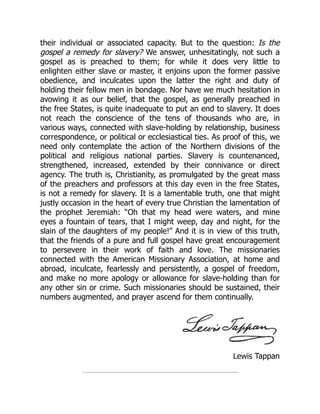
Lewis Tappan
their individualor associated capacity. But to the question: Is the
gospel a remedy for slavery? We answer, unhesitatingly, not such a
gospel as is preached to them; for while it does very little to
enlighten either slave or master, it enjoins upon the former passive
obedience, and inculcates upon the latter the right and duty of
holding their fellow men in bondage. Nor have we much hesitation in
avowing it as our belief, that the gospel, as generally preached in
the free States, is quite inadequate to put an end to slavery. It does
not reach the conscience of the tens of thousands who are, in
various ways, connected with slave-holding by relationship, business
correspondence, or political or ecclesiastical ties. As proof of this, we
need only contemplate the action of the Northern divisions of the
political and religious national parties. Slavery is countenanced,
strengthened, increased, extended by their connivance or direct
agency. The truth is, Christianity, as promulgated by the great mass
of the preachers and professors at this day even in the free States,
is not a remedy for slavery. It is a lamentable truth, one that might
justly occasion in the heart of every true Christian the lamentation of
the prophet Jeremiah: “Oh that my head were waters, and mine
eyes a fountain of tears, that I might weep, day and night, for the
slain of the daughters of my people!” And it is in view of this truth,
that the friends of a pure and full gospel have great encouragement
to persevere in their work of faith and love. The missionaries
connected with the American Missionary Association, at home and
abroad, inculcate, fearlessly and persistently, a gospel of freedom,
and make no more apology or allowance for slave-holding than for
any other sin or crime. Such missionaries should be sustained, their
numbers augmented, and prayer ascend for them continually.
42.
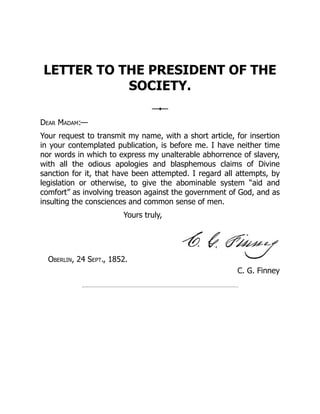
C. G. Finney
LETTERTO THE PRESIDENT OF THE
SOCIETY.
Dear Madam:—
Your request to transmit my name, with a short article, for insertion
in your contemplated publication, is before me. I have neither time
nor words in which to express my unalterable abhorrence of slavery,
with all the odious apologies and blasphemous claims of Divine
sanction for it, that have been attempted. I regard all attempts, by
legislation or otherwise, to give the abominable system “aid and
comfort” as involving treason against the government of God, and as
insulting the consciences and common sense of men.
Yours truly,
Oberlin, 24 Sept., 1852.
43.
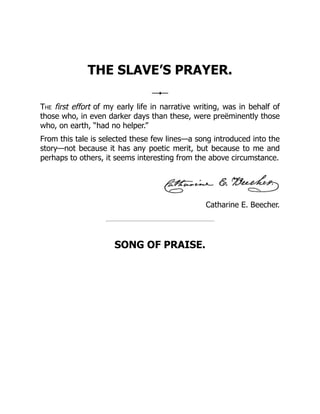
Catharine E. Beecher.
THESLAVE’S PRAYER.
The first effort of my early life in narrative writing, was in behalf of
those who, in even darker days than these, were preëminently those
who, on earth, “had no helper.”
From this tale is selected these few lines—a song introduced into the
story—not because it has any poetic merit, but because to me and
perhaps to others, it seems interesting from the above circumstance.
SONG OF PRAISE.
44.
Though man neglectsmy sighing,
And mocks the bitter tear,
Yet does not God my crying
With kindest pity hear?
And when with fierce heat panting
His hand can be my shade,
And when with weakness fainting
Support my aching head.
And when I felt my cares
For those his love can save,
Will he not hear the prayers
Of the poor negro slave?
Yes, for the poor and needy
He promises to save,
And who is poor and needy
Like the poor negro slave!
45.
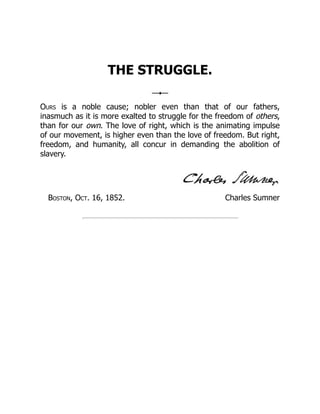
Charles Sumner
THE STRUGGLE.
Oursis a noble cause; nobler even than that of our fathers,
inasmuch as it is more exalted to struggle for the freedom of others,
than for our own. The love of right, which is the animating impulse
of our movement, is higher even than the love of freedom. But right,
freedom, and humanity, all concur in demanding the abolition of
slavery.
Boston, Oct. 16, 1852.
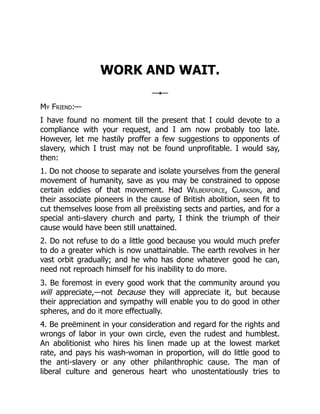
46.
WORK AND WAIT.
MyFriend:—
I have found no moment till the present that I could devote to a
compliance with your request, and I am now probably too late.
However, let me hastily proffer a few suggestions to opponents of
slavery, which I trust may not be found unprofitable. I would say,
then:
1. Do not choose to separate and isolate yourselves from the general
movement of humanity, save as you may be constrained to oppose
certain eddies of that movement. Had Wilberforce, Clarkson, and
their associate pioneers in the cause of British abolition, seen fit to
cut themselves loose from all preëxisting sects and parties, and for a
special anti-slavery church and party, I think the triumph of their
cause would have been still unattained.
2. Do not refuse to do a little good because you would much prefer
to do a greater which is now unattainable. The earth revolves in her
vast orbit gradually; and he who has done whatever good he can,
need not reproach himself for his inability to do more.
3. Be foremost in every good work that the community around you
will appreciate,—not because they will appreciate it, but because
their appreciation and sympathy will enable you to do good in other
spheres, and do it more effectually.
4. Be preëminent in your consideration and regard for the rights and
wrongs of labor in your own circle, even the rudest and humblest.
An abolitionist who hires his linen made up at the lowest market
rate, and pays his wash-woman in proportion, will do little good to
the anti-slavery or any other philanthrophic cause. The man of
liberal culture and generous heart who unostentatiously tries to
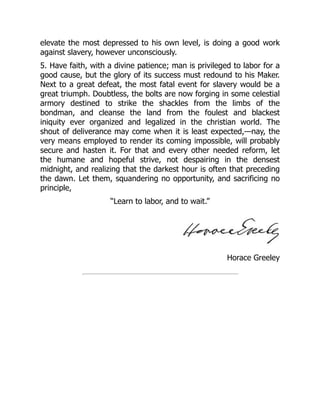
47.
Horace Greeley
elevate themost depressed to his own level, is doing a good work
against slavery, however unconsciously.
5. Have faith, with a divine patience; man is privileged to labor for a
good cause, but the glory of its success must redound to his Maker.
Next to a great defeat, the most fatal event for slavery would be a
great triumph. Doubtless, the bolts are now forging in some celestial
armory destined to strike the shackles from the limbs of the
bondman, and cleanse the land from the foulest and blackest
iniquity ever organized and legalized in the christian world. The
shout of deliverance may come when it is least expected,—nay, the
very means employed to render its coming impossible, will probably
secure and hasten it. For that and every other needed reform, let
the humane and hopeful strive, not despairing in the densest
midnight, and realizing that the darkest hour is often that preceding
the dawn. Let them, squandering no opportunity, and sacrificing no
principle,
“Learn to labor, and to wait.”
48.
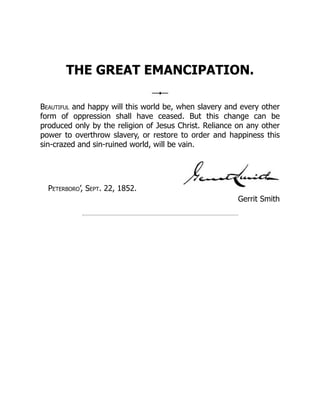
Gerrit Smith
THE GREATEMANCIPATION.
Beautiful and happy will this world be, when slavery and every other
form of oppression shall have ceased. But this change can be
produced only by the religion of Jesus Christ. Reliance on any other
power to overthrow slavery, or restore to order and happiness this
sin-crazed and sin-ruined world, will be vain.
Peterboro’, Sept. 22, 1852.
49.
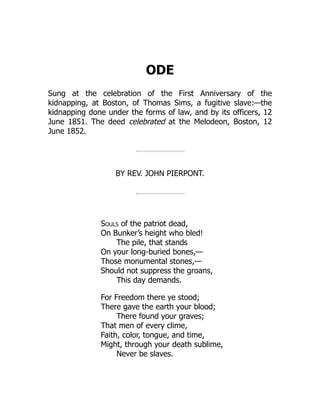
ODE
Sung at thecelebration of the First Anniversary of the
kidnapping, at Boston, of Thomas Sims, a fugitive slave:—the
kidnapping done under the forms of law, and by its officers, 12
June 1851. The deed celebrated at the Melodeon, Boston, 12
June 1852.
BY REV. JOHN PIERPONT.
Souls of the patriot dead,
On Bunker’s height who bled!
The pile, that stands
On your long-buried bones,—
Those monumental stones,—
Should not suppress the groans,
This day demands.
For Freedom there ye stood;
There gave the earth your blood;
There found your graves;
That men of every clime,
Faith, color, tongue, and time,
Might, through your death sublime,
Never be slaves.
Over your bed,so low,
Heard ye not, long ago,
A voice of power[O]
Proclaim to earth and sea,
That, where ye sleep, should be
A home for Liberty,
Till Time’s last hour?
Hear ye the chains of slaves,
Now clanking round your graves?
Hear ye the sound
Of that same voice, that calls
From out our Senate halls,[P]
“Hunt down those fleeing thralls,
With horse and hound!”
That voice your sons hath swayed!
’Tis heard, and is obeyed!
This gloomy day
Tells you of ermine stained,
Of Justice’ name profaned,
Of a poor bondman, chained
And borne away!
Over Virginia’s Springs,
Her eagles spread their wings,
Her Blue Ridge towers:—
That voice,[Q]—once heard with awe,—
Now asks,—“Who ever saw,
Up there, a higher law
Than this of ours?”
Must we obey that voice?
When God, or man’s the choice,
Must we postpone
H h f Si i k ?
52.
Welcome to ourwebsite – the perfect destination for book lovers and
knowledge seekers. We believe that every book holds a new world,
offering opportunities for learning, discovery, and personal growth.
That’s why we are dedicated to bringing you a diverse collection of
books, ranging from classic literature and specialized publications to
self-development guides and children's books.
More than just a book-buying platform, we strive to be a bridge
connecting you with timeless cultural and intellectual values. With an
elegant, user-friendly interface and a smart search system, you can
quickly find the books that best suit your interests. Additionally,
our special promotions and home delivery services help you save time
and fully enjoy the joy of reading.
Join us on a journey of knowledge exploration, passion nurturing, and
personal growth every day!
ebookmasss.com











![unpleasant to him. At first he refused to sell spirits to any person
partly inebriated; then he reasoned himself into a total abandonment
of the death-dealing traffic. With no other business prospect before
him, prevented by his long difficulty from working at his trade, with
a young wife and child dependent on him, he suddenly locked up his
spirit-cellar and never more sold rum!
In 1828 or 1829, through the influence of his kinsman, James
Oswald, Esq., of Sheildhall, Mr. Murray was appointed surveyor on a
part of the Forth and Clyde canal, an office requiring much labor for
little pay. His prospects of promotion depended on Mr. Oswald and
other members of the Kirk of Scotland. Mr. Murray was a full
member of the Tron Church, Glasgow, when, according to law, a
minister was appointed there regardless of the choice, and contrary
to the wishes of the great majority of its members. In consequence
of this appointment, and again unmindful of personal advancement,
John Murray shook the dust from his sandals and quit at once and
forever the Tron Church and the Kirk of Scotland.
About the same time the Glasgow Emancipation Society was formed
or re-organized, on the doctrine of immediate emancipation so
splendidly announced by a secession minister of Edinburgh. The
secretaries of this association were John Murray the surveyor, and
William Smead, of the Gallowgate, grocer; the last a Friend. These
two were the head and front, the thinking and the locomotive power
of this well known association which did notable fight, if not the
principal labor, in effecting emancipation in the British West Indies,
and in assaulting American slavery.
And, twenty odd years ago, it was no trifling matter to do anti-
slavery work in Glasgow, the very names of whose stateliest streets
proclaimed that they were built by money wrung out of the blood
and sweat of the negroes of Jamaica, St. Vincents, etc. The whole of
the retired wealth, nearly all the active business influence, the
weight of the Established Church, the rank and fashion of Glasgow,
and though last not least, the keen wit of the poet Motherwell,[N]
and the great statistical learning and industry of M’Queen were](https://image.slidesharecdn.com/50595-250615140426-a573a94a/85/Let-s-Code-It-2022-2023-Code-Edition-Shelley-Safian-35-320.jpg)

![Over your bed, so low,
Heard ye not, long ago,
A voice of power[O]
Proclaim to earth and sea,
That, where ye sleep, should be
A home for Liberty,
Till Time’s last hour?
Hear ye the chains of slaves,
Now clanking round your graves?
Hear ye the sound
Of that same voice, that calls
From out our Senate halls,[P]
“Hunt down those fleeing thralls,
With horse and hound!”
That voice your sons hath swayed!
’Tis heard, and is obeyed!
This gloomy day
Tells you of ermine stained,
Of Justice’ name profaned,
Of a poor bondman, chained
And borne away!
Over Virginia’s Springs,
Her eagles spread their wings,
Her Blue Ridge towers:—
That voice,[Q]—once heard with awe,—
Now asks,—“Who ever saw,
Up there, a higher law
Than this of ours?”
Must we obey that voice?
When God, or man’s the choice,
Must we postpone
H h f Si i k ?](https://image.slidesharecdn.com/50595-250615140426-a573a94a/85/Let-s-Code-It-2022-2023-Code-Edition-Shelley-Safian-51-320.jpg)