Copyright © 2014, 2013, 2012 by Saunders, an imprint of Elsevier Inc. All rights reserved.
Chapter 1
The Rationale for and History of
Coding
Copyright © 2014, 2013, 2012 by Saunders, an imprint of Elsevier Inc. All rights reserved.
2
Lesson 1.1: The Rationale for and
History of Coding
 Describe the application of coding.
 Define nomenclature and classification.
 Identify the historical timeline of coding.
 Explain the difference between ICD-9-CM and ICD-
10-CM.
 Delineate coder training needs for transitioning to
ICD-10-CM.
 Describe the different coding organizations and
credentials.
Copyright © 2014, 2013, 2012 by Saunders, an imprint of Elsevier Inc. All rights reserved.
3
Lesson 1.1: The Rationale for and
History of Coding
 Recognize the importance of the Standards of
Ethical Coding.
 Define compliance as it relates to coding.
 Explain confidentiality as it relates to coding.
Copyright © 2014, 2013, 2012 by Saunders, an imprint of Elsevier Inc. All rights reserved.
4
Background of Coding
 What is coding, and what are its applications?
 International Classification of Diseases, 10th
Revision, Clinical Modification (ICD-10-CM &
ICD-10-PCS)
 Medicare Severity Diagnosis-Related Groups
(MS-DRGs)
Copyright © 2014, 2013, 2012 by Saunders, an imprint of Elsevier Inc. All rights reserved.
5
Background of Coding
 Nomenclature
 Classification
 Types of
 History of
Copyright © 2014, 2013, 2012 by Saunders, an imprint of Elsevier Inc. All rights reserved.
6
History of Coding
 1893: Bertillon’s Classification of Causes of
Death
 1898: Adopted by the American Public Health
Association
 World Health Organization (WHO)
 International Classification of Causes of Death
 1977: Clinical Modifications (CMs) for U.S.
Copyright © 2014, 2013, 2012 by Saunders, an imprint of Elsevier Inc. All rights reserved.
7
History of Coding
 1993: ICD-10 published by the WHO
 In use in other countries
 Alphanumeric system
 Implementation in the U.S. slated for October
2014
Copyright © 2014, 2013, 2012 by Saunders, an imprint of Elsevier Inc. All rights reserved.
8
History of Coding
 ICD-9-CM updated twice a year
 Federal Register publication of updates
 See www.cms.gov
 Current coding tools are a must!
Copyright © 2014, 2013, 2012 by Saunders, an imprint of Elsevier Inc. All rights reserved.
9
History of Coding
 Development & maintenance of guidelines:
 National Center for Health Statistics (NCHS)
 Centers for Medicare and Medicaid Services
(CMS)
 American Hospital Association (AHA)
 American Health Information Management
Association (AHIMA)
Copyright © 2014, 2013, 2012 by Saunders, an imprint of Elsevier Inc. All rights reserved.
10
Preparation for Transition to ICD-10-
CM
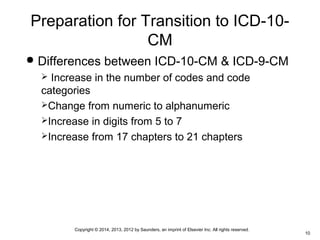
 Differences between ICD-10-CM & ICD-9-CM
 Increase in the number of codes and code
categories
Change from numeric to alphanumeric
Increase in digits from 5 to 7
Increase from 17 chapters to 21 chapters
Copyright © 2014, 2013, 2012 by Saunders, an imprint of Elsevier Inc. All rights reserved.
11
Preparation for Transition to ICD-10-CM
 Coders must have in-depth knowledge of
 Anatomy and physiology
 Medical terminology
 Operative reports
 ICD-10-PCS definitions
Copyright © 2014, 2013, 2012 by Saunders, an imprint of Elsevier Inc. All rights reserved.
12
Coding Organizations and
Credentials
 Where do coders work?
 Hospitals
 Physician offices
 Outpatient surgical centers
 Long-term care facilities
 Insurance companies
 Prisons
 Government agencies
Copyright © 2014, 2013, 2012 by Saunders, an imprint of Elsevier Inc. All rights reserved.
13
Coding Organizations and
Credentials
 American Health Information Management
Association (AHIMA) Credentials:
 CCA Certified Coding Associate
 CCS Certified Coding Specialist
 CCS-P Certified Coding Specialist–
Physician-Based
 RHIT Registered Health Information
Technician
 RHIA Registered Health Information
Administrator
Copyright © 2014, 2013, 2012 by Saunders, an imprint of Elsevier Inc. All rights reserved.
14
Coding Organizations and
Credentials
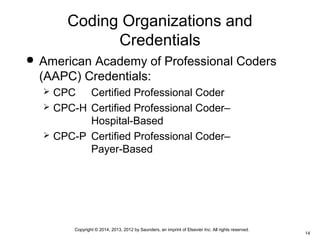
 American Academy of Professional Coders
(AAPC) Credentials:
 CPC Certified Professional Coder
 CPC-H Certified Professional Coder–
Hospital-Based
 CPC-P Certified Professional Coder–
Payer-Based
Copyright © 2014, 2013, 2012 by Saunders, an imprint of Elsevier Inc. All rights reserved.
15
Coding Organizations and
Credentials
 Certification examinations
 Keeping coding knowledge current
 Continuing education units (CEUs)
 Minimums are required to maintain certification
Copyright © 2014, 2013, 2012 by Saunders, an imprint of Elsevier Inc. All rights reserved.
16
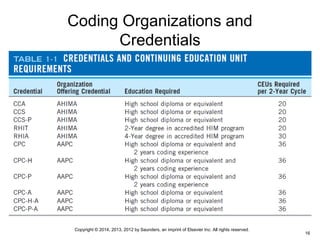
Coding Organizations and
Credentials
Copyright © 2014, 2013, 2012 by Saunders, an imprint of Elsevier Inc. All rights reserved.
17
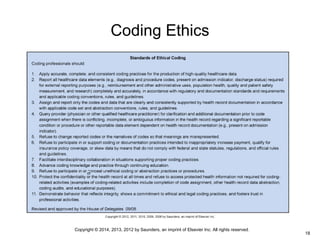
Coding Ethics
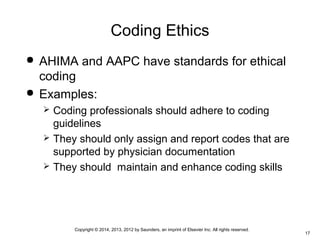
 AHIMA and AAPC have standards for ethical
coding
 Examples:
 Coding professionals should adhere to coding
guidelines
 They should only assign and report codes that are
supported by physician documentation
 They should maintain and enhance coding skills
Copyright © 2014, 2013, 2012 by Saunders, an imprint of Elsevier Inc. All rights reserved.
18
Coding Ethics
Copyright © 2014, 2013, 2012 by Saunders, an imprint of Elsevier Inc. All rights reserved.
19
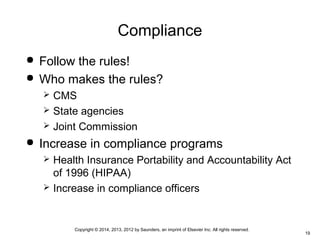
Compliance
 Follow the rules!
 Who makes the rules?
 CMS
 State agencies
 Joint Commission
 Increase in compliance programs
 Health Insurance Portability and Accountability Act
of 1996 (HIPAA)
 Increase in compliance officers
Copyright © 2014, 2013, 2012 by Saunders, an imprint of Elsevier Inc. All rights reserved.
20
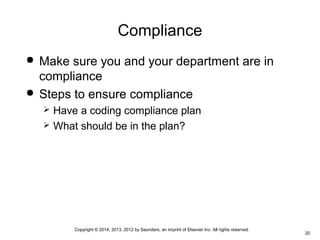
Compliance
 Make sure you and your department are in
compliance
 Steps to ensure compliance
 Have a coding compliance plan
 What should be in the plan?
Copyright © 2014, 2013, 2012 by Saunders, an imprint of Elsevier Inc. All rights reserved.
21
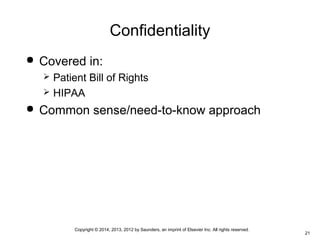
Confidentiality
 Covered in:
 Patient Bill of Rights
 HIPAA
 Common sense/need-to-know approach
Copyright © 2014, 2013, 2012 by Saunders, an imprint of Elsevier Inc. All rights reserved.
22
QUESTIONS

MO230 Chapter 001

  • 1.
    Copyright © 2014,2013, 2012 by Saunders, an imprint of Elsevier Inc. All rights reserved. Chapter 1 The Rationale for and History of Coding
  • 2.
    Copyright © 2014,2013, 2012 by Saunders, an imprint of Elsevier Inc. All rights reserved. 2 Lesson 1.1: The Rationale for and History of Coding  Describe the application of coding.  Define nomenclature and classification.  Identify the historical timeline of coding.  Explain the difference between ICD-9-CM and ICD- 10-CM.  Delineate coder training needs for transitioning to ICD-10-CM.  Describe the different coding organizations and credentials.
  • 3.
    Copyright © 2014,2013, 2012 by Saunders, an imprint of Elsevier Inc. All rights reserved. 3 Lesson 1.1: The Rationale for and History of Coding  Recognize the importance of the Standards of Ethical Coding.  Define compliance as it relates to coding.  Explain confidentiality as it relates to coding.
  • 4.
    Copyright © 2014,2013, 2012 by Saunders, an imprint of Elsevier Inc. All rights reserved. 4 Background of Coding  What is coding, and what are its applications?  International Classification of Diseases, 10th Revision, Clinical Modification (ICD-10-CM & ICD-10-PCS)  Medicare Severity Diagnosis-Related Groups (MS-DRGs)
  • 5.
    Copyright © 2014,2013, 2012 by Saunders, an imprint of Elsevier Inc. All rights reserved. 5 Background of Coding  Nomenclature  Classification  Types of  History of
  • 6.
    Copyright © 2014,2013, 2012 by Saunders, an imprint of Elsevier Inc. All rights reserved. 6 History of Coding  1893: Bertillon’s Classification of Causes of Death  1898: Adopted by the American Public Health Association  World Health Organization (WHO)  International Classification of Causes of Death  1977: Clinical Modifications (CMs) for U.S.
  • 7.
    Copyright © 2014,2013, 2012 by Saunders, an imprint of Elsevier Inc. All rights reserved. 7 History of Coding  1993: ICD-10 published by the WHO  In use in other countries  Alphanumeric system  Implementation in the U.S. slated for October 2014
  • 8.
    Copyright © 2014,2013, 2012 by Saunders, an imprint of Elsevier Inc. All rights reserved. 8 History of Coding  ICD-9-CM updated twice a year  Federal Register publication of updates  See www.cms.gov  Current coding tools are a must!
  • 9.
    Copyright © 2014,2013, 2012 by Saunders, an imprint of Elsevier Inc. All rights reserved. 9 History of Coding  Development & maintenance of guidelines:  National Center for Health Statistics (NCHS)  Centers for Medicare and Medicaid Services (CMS)  American Hospital Association (AHA)  American Health Information Management Association (AHIMA)
  • 10.
    Copyright © 2014,2013, 2012 by Saunders, an imprint of Elsevier Inc. All rights reserved. 10 Preparation for Transition to ICD-10- CM  Differences between ICD-10-CM & ICD-9-CM  Increase in the number of codes and code categories Change from numeric to alphanumeric Increase in digits from 5 to 7 Increase from 17 chapters to 21 chapters
  • 11.
    Copyright © 2014,2013, 2012 by Saunders, an imprint of Elsevier Inc. All rights reserved. 11 Preparation for Transition to ICD-10-CM  Coders must have in-depth knowledge of  Anatomy and physiology  Medical terminology  Operative reports  ICD-10-PCS definitions
  • 12.
    Copyright © 2014,2013, 2012 by Saunders, an imprint of Elsevier Inc. All rights reserved. 12 Coding Organizations and Credentials  Where do coders work?  Hospitals  Physician offices  Outpatient surgical centers  Long-term care facilities  Insurance companies  Prisons  Government agencies
  • 13.
    Copyright © 2014,2013, 2012 by Saunders, an imprint of Elsevier Inc. All rights reserved. 13 Coding Organizations and Credentials  American Health Information Management Association (AHIMA) Credentials:  CCA Certified Coding Associate  CCS Certified Coding Specialist  CCS-P Certified Coding Specialist– Physician-Based  RHIT Registered Health Information Technician  RHIA Registered Health Information Administrator
  • 14.
    Copyright © 2014,2013, 2012 by Saunders, an imprint of Elsevier Inc. All rights reserved. 14 Coding Organizations and Credentials  American Academy of Professional Coders (AAPC) Credentials:  CPC Certified Professional Coder  CPC-H Certified Professional Coder– Hospital-Based  CPC-P Certified Professional Coder– Payer-Based
  • 15.
    Copyright © 2014,2013, 2012 by Saunders, an imprint of Elsevier Inc. All rights reserved. 15 Coding Organizations and Credentials  Certification examinations  Keeping coding knowledge current  Continuing education units (CEUs)  Minimums are required to maintain certification
  • 16.
    Copyright © 2014,2013, 2012 by Saunders, an imprint of Elsevier Inc. All rights reserved. 16 Coding Organizations and Credentials
  • 17.
    Copyright © 2014,2013, 2012 by Saunders, an imprint of Elsevier Inc. All rights reserved. 17 Coding Ethics  AHIMA and AAPC have standards for ethical coding  Examples:  Coding professionals should adhere to coding guidelines  They should only assign and report codes that are supported by physician documentation  They should maintain and enhance coding skills
  • 18.
    Copyright © 2014,2013, 2012 by Saunders, an imprint of Elsevier Inc. All rights reserved. 18 Coding Ethics
  • 19.
    Copyright © 2014,2013, 2012 by Saunders, an imprint of Elsevier Inc. All rights reserved. 19 Compliance  Follow the rules!  Who makes the rules?  CMS  State agencies  Joint Commission  Increase in compliance programs  Health Insurance Portability and Accountability Act of 1996 (HIPAA)  Increase in compliance officers
  • 20.
    Copyright © 2014,2013, 2012 by Saunders, an imprint of Elsevier Inc. All rights reserved. 20 Compliance  Make sure you and your department are in compliance  Steps to ensure compliance  Have a coding compliance plan  What should be in the plan?
  • 21.
    Copyright © 2014,2013, 2012 by Saunders, an imprint of Elsevier Inc. All rights reserved. 21 Confidentiality  Covered in:  Patient Bill of Rights  HIPAA  Common sense/need-to-know approach
  • 22.
    Copyright © 2014,2013, 2012 by Saunders, an imprint of Elsevier Inc. All rights reserved. 22 QUESTIONS

Editor's Notes

  • #5 Medical coding consists of translating diagnoses and procedures into numbers for the purpose of statistically capturing data.
  • #6 A nomenclature is a system of names that are used as preferred terminology (in this case, for diseases and procedures). Classification systems group together similar items for easy storage and retrieval. The ICD-10-CM classification system is a closed system that comprises diseases, injuries, surgeries, and procedures. In a closed classification system a disease, condition, or procedure can only be classified in one place.
  • #7 ICD-9-CM, a publication of the U.S. Department of Health and Human Services, consists of 3 volumes.
  • #8 ICD-10-CM will replace ICD-9-CM, which has been in use for 30 years. The final rule for adoption of ICD-10-CM and ICD-10-PCS was released in January 2009. ICD-10 Tabular Volume was published in 1992. ICD-10 Instructional Volume was published in 1993. ICD-10 Alphabetic Index was published in 1994.
  • #9 ICD-9-CM Coordination and Maintenance Committee meets twice a year. Upon full implementation of ICD-10-CM/PCS this will become the ICD-10 Coordination and Maintenance Committee. 2 Federal agencies are responsible for maintenance of ICD-9-CM: NCHS – Classification of diagnoses CMS – Classification of procedures
  • #12 Along with above knowledge, also educate on the following: Structure change Disease classification Definitions Guidelines ICD-10-PCS
  • #13 Most coders take certification examinations to earn credentials and become members of a professional organization.
  • #16 See Table 1-2 in this chapter to see how many CEUs are required per year.
  • #18 Please see Figures 1-1 and 1-2.