


1. Cost of media products
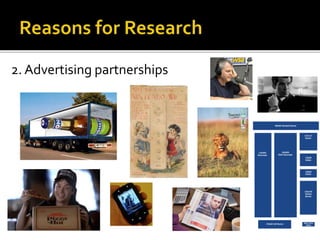
2. Advertising partnerships
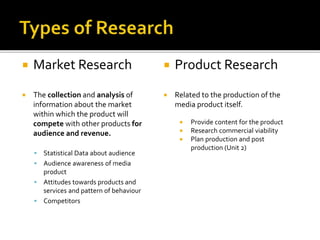
 Market Research
 The collection and analysis of
information about the market
within which the product will
compete with other products for
audience and revenue.
 Statistical Data about audience
 Audience awareness of media
product
 Attitudes towards products and
services and pattern of behaviour
 Competitors
 Product Research
 Related to the production of the
media product itself.
 Provide content for the product
 Research commercial viability
 Plan production and post
production (Unit 2)
 Media organisations will often commission
research from specialist agencies.
WHY?Advantages to Media Company
Hire “experts” Cheaper overall for business Control of project
Focus on core business No redundancy in business
 Age
 Gender
 Culture and ethnicity
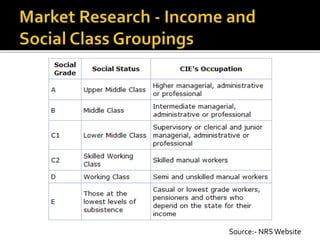
 Income and Social Class
Source:- NRSWebsite
“Time is
Money!!”
 Media products cost
so careful planning of
production and post
production is needed
to minimise this cost.
 Provide content for the product
 Research commercial viability
 Plan production and post
production (Unit 2)
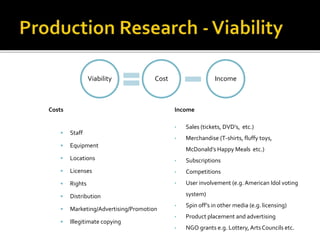
Costs
 Staff
 Equipment
 Locations
 Licenses
 Rights
 Distribution
 Marketing/Advertising/Promotion
 Illegitimate copying
Income
• Sales (tickets, DVD’s, etc.)
• Merchandise (T-shirts, fluffy toys,
McDonald’s Happy Meals etc.)
• Subscriptions
• Competitions
• User involvement (e.g. American Idol voting
system)
• Spin off’s in other media (e.g. licensing)
• Product placement and advertising
• NGO grants e.g. Lottery, Arts Councils etc.
Cost IncomeViability
TVB Pearl is going to produce aTV documentary program of
30 minutes long about the nature of household recycling in
Hong Kong.They want the program to show various sides
of recycling in Hong Kong for normal households. What
are some of the production research activities that might
take place to plan and produce this program?
HK Magazine is planning to write an article about the
Hong Kong Arts Festival . What research tasks do you
think they will need to undertake for this production?
The production researcher for Pearl has to complete a
recce for the program.
 What is a recce?
 What is it’s purpose?
 Fully explain with genuine examples the problems
that are attempting to be identified by doing a recce?
 Produce a checklist on word that could be used on a
recce.
Resources
Case Study and Activity Blog entry on a film recce
Health and Safety
Fully explain purposes of research in the media industries with supporting arguments and elucidated
examples expressing ideas fluently and using subject terminology correctly.
The report should include:-
▪ An introduction that states the aims of the report
▪ The role of the researcher.
▪ Explanation of main purposes of research – Market and Production
▪ A full explanation of the services of research organisations (such as RAJAR, NRS etc. as well as private companies such as
Nielsons).
▪ Market segmentation and how it is applies to media products.
▪ The importance of advertising to media production.
▪ Aspects of pre-production research and planning
▪ What copyright means and its connection to research for media production.
▪ A conclusion that summarises what you have learnt.
It is important for all students that in order to get access to higher marks that
student devised examples are used to explain the different aspects of the
report and justify points made. It is suggested that students use the bullet
points above to help structure their report. Use of technical language must be
consistently and accurately demonstrated throughout.

Media research techniques

  • 2.
    1. Cost ofmedia products
  • 3.
  • 4.
     Market Research The collection and analysis of information about the market within which the product will compete with other products for audience and revenue.  Statistical Data about audience  Audience awareness of media product  Attitudes towards products and services and pattern of behaviour  Competitors  Product Research  Related to the production of the media product itself.  Provide content for the product  Research commercial viability  Plan production and post production (Unit 2)
  • 5.
     Media organisationswill often commission research from specialist agencies. WHY?Advantages to Media Company Hire “experts” Cheaper overall for business Control of project Focus on core business No redundancy in business
  • 6.
     Age  Gender Culture and ethnicity  Income and Social Class
  • 7.
  • 8.
    “Time is Money!!”  Mediaproducts cost so careful planning of production and post production is needed to minimise this cost.  Provide content for the product  Research commercial viability  Plan production and post production (Unit 2)
  • 9.
    Costs  Staff  Equipment Locations  Licenses  Rights  Distribution  Marketing/Advertising/Promotion  Illegitimate copying Income • Sales (tickets, DVD’s, etc.) • Merchandise (T-shirts, fluffy toys, McDonald’s Happy Meals etc.) • Subscriptions • Competitions • User involvement (e.g. American Idol voting system) • Spin off’s in other media (e.g. licensing) • Product placement and advertising • NGO grants e.g. Lottery, Arts Councils etc. Cost IncomeViability
  • 10.
    TVB Pearl isgoing to produce aTV documentary program of 30 minutes long about the nature of household recycling in Hong Kong.They want the program to show various sides of recycling in Hong Kong for normal households. What are some of the production research activities that might take place to plan and produce this program? HK Magazine is planning to write an article about the Hong Kong Arts Festival . What research tasks do you think they will need to undertake for this production?
  • 11.
    The production researcherfor Pearl has to complete a recce for the program.  What is a recce?  What is it’s purpose?  Fully explain with genuine examples the problems that are attempting to be identified by doing a recce?  Produce a checklist on word that could be used on a recce. Resources Case Study and Activity Blog entry on a film recce Health and Safety
  • 12.
    Fully explain purposesof research in the media industries with supporting arguments and elucidated examples expressing ideas fluently and using subject terminology correctly. The report should include:- ▪ An introduction that states the aims of the report ▪ The role of the researcher. ▪ Explanation of main purposes of research – Market and Production ▪ A full explanation of the services of research organisations (such as RAJAR, NRS etc. as well as private companies such as Nielsons). ▪ Market segmentation and how it is applies to media products. ▪ The importance of advertising to media production. ▪ Aspects of pre-production research and planning ▪ What copyright means and its connection to research for media production. ▪ A conclusion that summarises what you have learnt. It is important for all students that in order to get access to higher marks that student devised examples are used to explain the different aspects of the report and justify points made. It is suggested that students use the bullet points above to help structure their report. Use of technical language must be consistently and accurately demonstrated throughout.

Editor's Notes

  • #2 Recap on what we learnt before
  • #3 Media products cost substantial amounts of money – Hollywood film are in the order of 10’s to 100’s of millions of $’s. TV programs can be anywhere from low budget (but still costing 10,000’s of $’s) to million dollar shows. Cost of producing a monthly magazine such as Cosmopolitan will be large Even a weekly “Celebrity/gossip magazine” has to make money To be successful a media product usually has to make money
  • #4  Adverts are a vital source of income to media products – commercial TV and Radio, Magazines. Students Activity Hand out some magazines and get student to count the number of pages of adverts – what proportion of this is advertising? Advertisers expect quality products that reach an intended audience They have to know that their money is being well spent. They want to be able to measure the effectiveness of their advertising campaign. Some of the technologies emerging over the Internet allow for a much more interactive relationship to exist between customer and advertiser. Advertisers have lots of choice about where to direct their money and through which media channels radio, tv, the Internet, Film, magazines, newspapers. They can also choose to sponsor programs rather than just create adverts. Advertisers are attracted to media products because of they deliver a ready made audience with a certain demographic. They will need to predict and then confirm that audience size and make-up align with their goals. Media research ties in very nicely to this. Therefore having up to date and accurate research about your audience serves both to ensure that the media product is successful and that the advertising opportunities associated with it are targeted.
  • #6 Effective successful media relies on understanding the audience and communicating with them effectively. Trend in the media industry to become more fragmented – why? Brief discussion point. Consider 1950’s and TV, number of channels available in UK in 70’s =3. Compare with now. Therefore knowing your specific audience has become more important – they are less homogenous CLICK Brief discussion of advantages to the Media company Some data is commercially available through agencies like neilsons. Other data maybe freely available. Students then carry out research on the UK NRS, ABC, BARB and RAJAR institutions. Student research these ideas in a Hong Kong context HW is to prepare a section of a report on these agencies and the services they provide. There are a number of institutions you have been introduced to that undertake market research activity for media products. Explain what services they offer and how they relate to producing successful media products.
  • #7  Gender Also a major categorisation and perhaps in some instances the most obvious divider between groups One of the most obvious media that shows this categorisation is the magazine market. Both genders will of course read magazines aimed at the opposite gender (which man hasn’t read cosmopolitain’s 100 ways to drive your man wild in bed top tips or sex surveys). However it is a question of principle audience. Age One of the most obvious and significant differentiators between groups of people is their age. What are common age groups in media research? 15 and younger 16-24 25-44 45-64 65 and older These are general – specific projects will be more targeted to one particular segment. E.g children below 15 would need further division if the effects of a product were to be fully understood. What other factors may affect this? e.g. legal for film classification Also advertisers will want to know what ages are watching, listening etc so that they can decide whether to place adverts at particular spots in a schedule. Culture and Ethnicity Today the media is global – not just the Internet. Consider news such as BBC World or Blooomberg. Newspapers such as the economist and FT, Vogue and Elle Immigration over the years has also created overseas markets e.g. Hong Kong In terms of research different cultures have different values and references. Some things will work in one culture but not others. Numbers – many UK and US hotels do not have room or floor 13’s Nippon Air doesn’t have seats numbered 4 or 9 Colours – Red lucky in Chinese, Green significant for Islam Women in bikini’s in adverts in Europe is OK – in Saudi Arabia not so good Language - Fiat Pinto did not sell in Brasil because it means “tiny mail genitals” Income and Social Class Involves looking at annual salary, job type and social class Disposable income is the key because that is what the advertiser is competing for. Also it is directly related to the product.
  • #8 CIE means Chief Income Earner Student task Students find a range of adverts from at least 3 different media that are clearly targeted at different groups. Gender Age Culture and ethnicity Income and social group They produce a presentation of their work and explain how the elements they see are aimed at target market using the 4 categories above.
  • #10 Student Task To brainstorm the possible costs and income generators for a media product
  • #11 Student Task Brainstorm in pairs what research activities might be necessary for these scenarios. Teacher creates a mind map HK Magazine Secondary research about the festival form newspapers and other magazines Secondary research exploring the Arts Festival website Trying to arrange interviews with Arts Festival Marketing people Getting and seeking permission to use Arts Festival pictures (perhaps from performers’ agents) Background on performances and performers. Permission needed from agents about these. Perhaps TVB Possibilities Try to meet old ladies that recycle and set up interviews. Go to recycling companies both large and small to see what they do and how they do it. Try to get permission to film. Do secondary research government legislation on recycling, background issues and future plans. Try to establish contacts in the government (Environmental Protection Agency) for interview and seek permission to film. Establish contacts in Green groups for background issues and plans for the future. Seek permission to interview a representative. Try to find a building management company that is renowned for recycling efforts and establish contacts. Get permission to recce location. Get permission to film location. Perhaps try to find families that do and don’t recycle. Why are they different? What would make them recycle more? Get permission to film them. Find archive footage that could be useful to the program and get permission to use it. Find appropriate music and investigate copyright costs Explore equipment needed and decide if all necessary equipment is available or need hiring? What are the costs? Are there any special locations that need to be hired in order to make the program? Seek sponsors?