The Role of Public Intellectuals in
Cooperative Extension
Jim Langcuster
Communications and Marketing Specialist,
Alabama Cooperative Extension System
@extensionguy
Anne Mims Adrian
Social Media Strategist
Military Families Learning Network-eXtension
@aafromaa
Galaxy IV
September 2013
#extG4
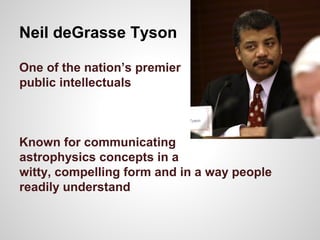
Neil deGrasse Tyson
One of the nation’s premier
public intellectuals
Known for communicating
astrophysics concepts in a
witty, compelling form and in a way people
readily understand
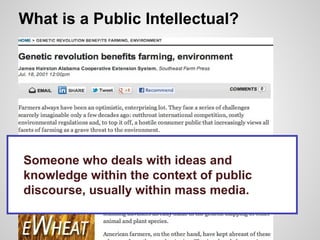
What is a Public Intellectual?
Someone who deals with ideas and
knowledge within the context of public
discourse, usually within mass media.
What is a Public Intellectual?
Op-ed pieces, magazine
columns, Sunday morning
network news interview
programs, interviewed on
public radio/TV.
Social media, an
important addition, may
be the front door to the
mass media presence.
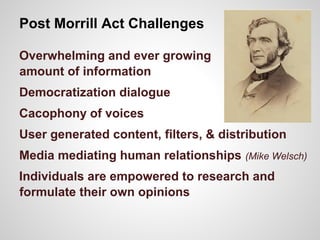
Post Morrill Act Challenges
Overwhelming and ever growing
amount of information
Democratization dialogue
Cacophony of voices
User generated content, filters, & distribution
Media mediating human relationships (Mike Welsch)
Individuals are empowered to research and
formulate their own opinions
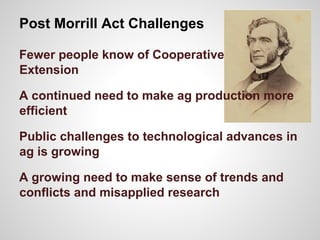
Post Morrill Act Challenges
Fewer people know of Cooperative
Extension
A continued need to make ag production more
efficient
Public challenges to technological advances in
ag is growing
A growing need to make sense of trends and
conflicts and misapplied research
Mark Bittman food and cooking writer author of Cooking at Home with a Four-
Star Chef, former The New York Times Columnist.
Charles Blow journalist and visual op-ed columnist for The New York Times.
David Brooks political and cultural commentator and author of The Social
Animal
Erik Brynjolfsson MIT Economics Professor and author of Race Against the
Machine and Wired for Innovation.
Gail Collins journalist, op-ed columnist, blogger, and author of When
Everything Changed: The Amazing Journey of American Women from 1960
to the Present
Maureen Dowd columnist for The New York Times and best-selling author of
Bushworld: Enter at Your Own Risk
Examples of Public Intellectuals
Thomas L. Friedman journalist, for The New York Times columnist, Pulitzer
Prize winner and author of The World Is Flat:
Paul Krugman Economics Professor at Princeton University, columnist, and
author of End This Depression Now!
Andrew McAfee MIT professor, author of Enterprise 2.0 and Race Against the
Machine
Andrew Sullivan columnist for The Sunday Times of London and a blogger
Neil deGrasse Tyson astrophysicist and science communicator Director
Frederick P. Rose Director of the Hayden Planetarium
George F . Will newspaper columnist, journalist, and author. He is a Pulitzer
Prize-winner
Examples of Public Intellectuals
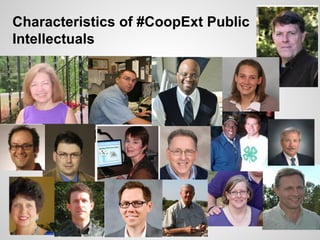
Characteristics of #CoopExt Public
Intellectuals
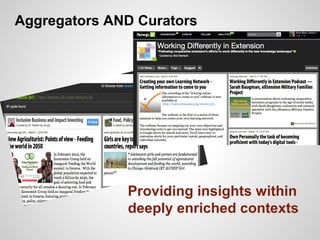
Aggregators AND Curators
Providing insights within
deeply enriched contexts
Public Intellectuals Bridge the Gap
Traditional Academics as Public Intellectuals?
In The Last Intellectuals: American Culture in
the Age of Academe, 1987, Jacoby reported
that no serious American thinker under the
age of 45 was writing for anyone other than
academics, or able to.
"Intellectuals who write with vigor and clarity
may be as scarce as low rents in New York."
Why Extension as Public Intellectuals?
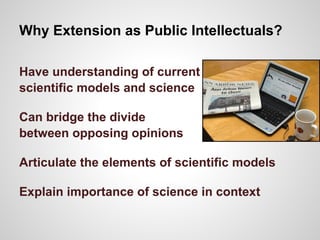
Have understanding of current
scientific models and science
Can bridge the divide
between opposing opinions
Articulate the elements of scientific models
Explain importance of science in context
Traits of Public Intellectuals
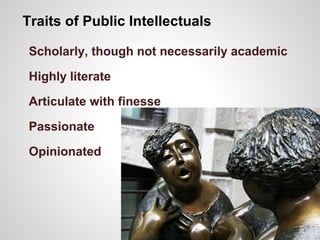
Scholarly, though not necessarily academic
Highly literate
Articulate with finesse
Passionate
Opinionated
Public Intellectuals
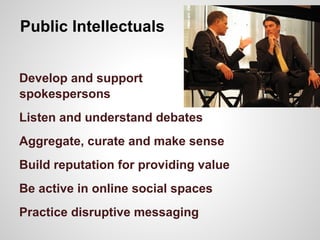
Develop and support
spokespersons
Listen and understand debates
Aggregate, curate and make sense
Build reputation for providing value
Be active in online social spaces
Practice disruptive messaging
A Cadre of Public Intellectuals
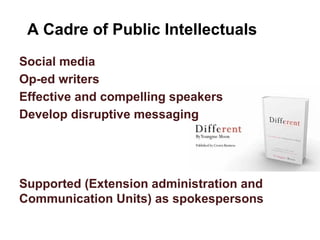
Social media
Op-ed writers
Effective and compelling speakers
Develop disruptive messaging
Supported (Extension administration and
Communication Units) as spokespersons
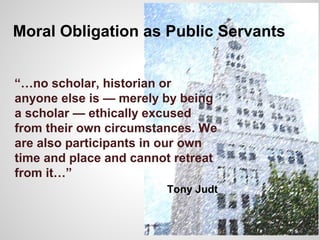
Moral Obligation as Public Servants
“…no scholar, historian or
anyone else is — merely by being
a scholar — ethically excused
from their own circumstances. We
are also participants in our own
time and place and cannot retreat
from it…”
Tony Judt
Photo Credits
http://en.wikipedia.org/wiki/File:Neil_deGrasse_Tyson_-_NAC_Nov_2005.jpg
http://www.loc.gov/rr/program/bib/ourdocs/Morrill.html
http://www.flickr.com/photos/jonnygoldstein/3650745193/
http://www.flickr.com/photos/donabelandewen/3584154214/
http://www.flickr.com/photos/quinnanya/3812878415/
http://www.flickr.com/photos/mfobrien/3382977725
http://www.flickr.com/photos/skewgee/6092105212/
http://www.flickr.com/photos/its_our_city/2659196522/
The Role of Public Intellectuals in Cooperative
Extension by Jim Langcuster and Anne Mims
Adrian, is licensed under a Creative
Commons Attribution 3.0 Unported License.
When using photos from this presentation, please note and
adhere to their CC license.

The Role of Public Intellectuals in Cooperative Extension 

  • 1.
    The Role ofPublic Intellectuals in Cooperative Extension Jim Langcuster Communications and Marketing Specialist, Alabama Cooperative Extension System @extensionguy Anne Mims Adrian Social Media Strategist Military Families Learning Network-eXtension @aafromaa Galaxy IV September 2013 #extG4
  • 2.
    Neil deGrasse Tyson Oneof the nation’s premier public intellectuals Known for communicating astrophysics concepts in a witty, compelling form and in a way people readily understand
  • 3.
    What is aPublic Intellectual? Someone who deals with ideas and knowledge within the context of public discourse, usually within mass media.
  • 4.
    What is aPublic Intellectual? Op-ed pieces, magazine columns, Sunday morning network news interview programs, interviewed on public radio/TV. Social media, an important addition, may be the front door to the mass media presence.
  • 5.
    Post Morrill ActChallenges Overwhelming and ever growing amount of information Democratization dialogue Cacophony of voices User generated content, filters, & distribution Media mediating human relationships (Mike Welsch) Individuals are empowered to research and formulate their own opinions
  • 6.
    Post Morrill ActChallenges Fewer people know of Cooperative Extension A continued need to make ag production more efficient Public challenges to technological advances in ag is growing A growing need to make sense of trends and conflicts and misapplied research
  • 7.
    Mark Bittman foodand cooking writer author of Cooking at Home with a Four- Star Chef, former The New York Times Columnist. Charles Blow journalist and visual op-ed columnist for The New York Times. David Brooks political and cultural commentator and author of The Social Animal Erik Brynjolfsson MIT Economics Professor and author of Race Against the Machine and Wired for Innovation. Gail Collins journalist, op-ed columnist, blogger, and author of When Everything Changed: The Amazing Journey of American Women from 1960 to the Present Maureen Dowd columnist for The New York Times and best-selling author of Bushworld: Enter at Your Own Risk Examples of Public Intellectuals
  • 8.
    Thomas L. Friedmanjournalist, for The New York Times columnist, Pulitzer Prize winner and author of The World Is Flat: Paul Krugman Economics Professor at Princeton University, columnist, and author of End This Depression Now! Andrew McAfee MIT professor, author of Enterprise 2.0 and Race Against the Machine Andrew Sullivan columnist for The Sunday Times of London and a blogger Neil deGrasse Tyson astrophysicist and science communicator Director Frederick P. Rose Director of the Hayden Planetarium George F . Will newspaper columnist, journalist, and author. He is a Pulitzer Prize-winner Examples of Public Intellectuals
  • 9.
    Characteristics of #CoopExtPublic Intellectuals
  • 10.
    Aggregators AND Curators Providinginsights within deeply enriched contexts
  • 11.
  • 12.
    Traditional Academics asPublic Intellectuals? In The Last Intellectuals: American Culture in the Age of Academe, 1987, Jacoby reported that no serious American thinker under the age of 45 was writing for anyone other than academics, or able to. "Intellectuals who write with vigor and clarity may be as scarce as low rents in New York."
  • 13.
    Why Extension asPublic Intellectuals? Have understanding of current scientific models and science Can bridge the divide between opposing opinions Articulate the elements of scientific models Explain importance of science in context
  • 14.
    Traits of PublicIntellectuals Scholarly, though not necessarily academic Highly literate Articulate with finesse Passionate Opinionated
  • 15.
    Public Intellectuals Develop andsupport spokespersons Listen and understand debates Aggregate, curate and make sense Build reputation for providing value Be active in online social spaces Practice disruptive messaging
  • 16.
    A Cadre ofPublic Intellectuals Social media Op-ed writers Effective and compelling speakers Develop disruptive messaging Supported (Extension administration and Communication Units) as spokespersons
  • 17.
    Moral Obligation asPublic Servants “…no scholar, historian or anyone else is — merely by being a scholar — ethically excused from their own circumstances. We are also participants in our own time and place and cannot retreat from it…” Tony Judt
  • 18.
  • 19.
    The Role ofPublic Intellectuals in Cooperative Extension by Jim Langcuster and Anne Mims Adrian, is licensed under a Creative Commons Attribution 3.0 Unported License. When using photos from this presentation, please note and adhere to their CC license.

Editor's Notes

  • #4 Broadly speaking, a public intellectual is someone who deals with ideas and knowledge within the context of public discourse, usually within a mass media context, though, following the advent of the Internet and Web 2.0, this role has evolved somewhat. Multi channels “ Public intellectual” is admittedly a rather grandiose term. Even so, we contend that an understanding of public intellectuals and the role they must serve in the future within our ranks is critical to our organizational survival. “ Public intellectual” is admittedly a rather grandiose term. Even so, we contend that an understanding of public intellectuals and the role they must serve in the future within our ranks is critical to our organizational survival. Public intellectuals often serve an indispensable role bridging the gap between the general public and the nation ’s leading thinkers, whether these happen to be formal academics or independent scholars. Public intellectuals typically are characterized as passionate, opinionated, highly literate and scholarly, though not necessarily academic. A good example of a scholarly, nonacademic public intellectual is David Brooks, who has used his columns and a recent book, “The Social Animal, ” to acquaint ordinary mericans with the immense insights researchers are gaining into the ways the human psyche works and is expressed in our everyday human interaction.
  • #6 http://www.loc.gov/rr/program/bib/ourdocs/Morrill.html
  • #7 http://www.loc.gov/rr/program/bib/ourdocs/Morrill.html
  • #12 http://www.flickr.com/photos/donabelandewen/3584154214/
  • #14 http://www.flickr.com/photos/mfobrien/3382977725
  • #15 http://www.flickr.com/photos/quinnanya/3812878415/
  • #16 http://www.flickr.com/photos/skewgee/6092105212/
  • #18 http://www.flickr.com/photos/its_our_city/2659196522/ As a Moral Obligation Extension educators at all levels have a moral obligation not only as scholars but as public servants to help put highly complicated, even controversial issues, into sharper perspective on behalf of their clients with the goal of improving their lives. “… no scholar, historian or anyone else is — merely by being a scholar — ethically excused from their own circumstances. We are also participants in our own time and place and cannot retreat from it…” Extension educators are now struggling to navigate their way across an increasingly steep, jagged divide between techno-skeptics, who harbor a deep mistrust of technology and its long-term implications, and techies, who, despite some misgivings, generally believe that each technological advance ultimately works to secure a better life for all of us. But why should we be surprised by this? Science, after all, is as much a process of refinement as it is of discovery. With this refinement has come a clearer understanding of the environmental costs associated with scientific and technological progress. Scientific farming methods have proven to be no exception. Back to Kevin Kelly ’s premise: A new farming model inevitably will be constructed that incorporates elements of scientific and sustainable farming practices. Building this model, though, will require people who possess the requisite training and insights to bridge the gap between the mutually hostile camps of techno-skeptics and techies. This inevitably will call for more technological conciliators. Who is better equipped to serve this role than Extension educators and particularly public intellectuals? This new role of technological conciliator will not only be confined to the farm sector. There will be an increasing need for public intellectuals from many different disciplines within Extension to explain how this new farming model will be expressed and how it ultimately will affect them. Herein lies an enormous opportunity for Extension — an opportunity for profound organizational transformation.