Introduction to
Media and Collective Identity
Representations of youth and youth
culture
Starter
Label your posit note side A and answer the
following question:
• Why is the representation of youth not
simple?
Task 1
Write down the first 5 words that you think of
when asked:
‘how is youth culture represented in the
media?’
Task 2
• 5 words describing:
‘How youth culture is represented in TV
programs?’
Task 3
• 5 words describing:
‘how is youth culture represented in the news?’
Task 4
• 5 words describing:
‘how youth culture is represented in films?’
Task 5
• 5 words describing:
‘How youth culture is represented in social
media?’
Task 6
• Do young people perceive representations of
youth in the same ways as parents and adults?
Explain your answer.
Aims
• To understand what the ‘Media and Collective
Identity’ module consists of and the areas you
must cover in your exam.
• To understand what ‘youth culture’ means and
over a number of weeks understand how
youth culture is represented in the media.
What will we be studying?
• Media and collective identity is one out of 2 questions that you
will be able to answer in your exam. When you enter your
exam you will see 6 different topic areas these include
• Contemporary Media regulation
• Global Media
• Media and Collective Identity – Me
• Media in the Online Age
• Postmodern Media- Tim
• ‘We Media’ and Democracy
You choose to answer ONE question. You are being taught Media
and Collective Identity and Post modern Media. You select the
topic you feel most comfortable with and answer ONE of the [50]
mark questions DO NOT ANSWER 2 QUESTIONS only one
question from one topic.
Over view
• The main area of focus will be:
• Representations of youth and youth culture in the media
• We will study relevant theorists and apply their theories to the
texts studied.
• It is vital we consider the following 4 areas:
• How do the contemporary media represent nations, regions and
ethnic / social / collective groups of people in different ways?
• How does contemporary representation compare to previous
time periods?
• What are the social implications of different media
representations of groups of people?
• To what extent is human identity increasingly ‘mediated’?
IMPORTANT EXAM RULE
You MUST refer to the following areas throughout
your essay
HISTORICAL representations
|
CONTEMPORARY (main focus area)
|
FUTURE representations
A contemporary media text is classified 5 years
from the exam date.
IMPORTANT EXAM RULE
• You MUST refer to AT LEAST 2 different media
texts/forms in your essay.
• Media texts we will look at include:
• Film – good for historical/contemporary reference
• TV
• Press
• TV news
• Social media – good for future/contemporary
reference
The more forms you refer to in your exam demonstrates
a wider knowledge and understanding of the topic area
you are discussing/debating/arguing.
Good for historical and
contemporary
Representations of youth in the media
• Our focus and argument:
‘The representation of youth in the media is
complex and repetitive, depending on who and
how the media is re-presented to the audience
depends on how consumers perceive youths of
society.’
How to validate our argument we
must consider the following
1) Who produces the representation
2) The media form used for the representation
(TV, film, social media, TV News, Press)
3) The target audience for the representation:
young, actual, parent, older non parent,
OAPs
Case studies you will refer to as
evidence in your essay
• Press: London riots 2011 (classed as
contemporary) Brighton beach riots Mods V
Rockers 1964 (historical)
• TV news: current affairs and Anne Maguire
murdered by Will Cornick stabbing in the
classroom.
• Films: Fish tank 2009, Quadrophenia (1979)
• TV Geordieshore, Inbetweeners, MIC
(contemporary)
• Social media: face book and blogs (future)
• Possibly a few more if we have time
IMPORTANT EXAM RULE
• You MUST refer to theory and theorists that
relate to and back up your points and argument.
• You are not only getting assessed on the strength
and validity of your argument but how you can
back it up with relevant theory.
• Some theory we have already covered when
looking are representation and audience theory
however we will cover more theorists that link
directly to the media texts we will be studying.
Previous exam questions
• Analyse the ways in which the media represent any one
group of people that you have studied.
• With reference to any one group of people that you have
studied, discuss how their identity has been ‘mediated’.
• Analyse the ways in which the media represent groups of
people.
• “The media do not construct collective identity; they
merely reflect it”. Discuss.
• “Media representations are complex, not simple and
straightforward”. How far do you agree with this
statement in relation to any one group of people that you
have studied?
• What is collective identity and how is it mediated?
How you will achieve marks in the
exam
• EAA- Explanation, analysis and argument [20]
• EG- Examples [20]
• Term- Terminology [10]
• Overall mark [50]
How to hit the criteria when writing an
essay
• EAA- Adapt learning to the specific requirements
of the chosen question in an excellent fashion.
The argument needs to have connections to the
question in hand to make it valid and believable.
The answer offers a clear fluent balance of media
theories and shows understanding of the theory
and how it applies to the argument. Knowledge
of industries and forms of media is shown with a
personal engagement with the issues and
debates discussed.
Hitting the criteria
• Use of examples: Examples of theories, texts
and industry knowledge are clearly connected
together in the answer. History and the future
are integrated into the discussion with
conviction and seamlessly back up the point
made by the individual. Showing that
development of a representation has
remained the same or adapted from a
historical representation. Theory is applied
while these points are made.
Hitting the criteria
• Use of terminology: Throughout the answer
material presented is informed by
contemporary media theory and the
command of the appropriate conceptual and
theoretical language is excellent. If theory is
not relevant to the question and referred to in
the incorrect manor it will illustrate the
individual is lacking in media understanding.
References to past, contemporary and future
are evident in the argument throughout.
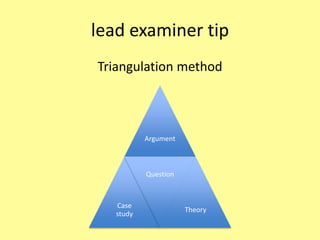
lead examiner tip
Triangulation method
Argument
Case
study
Question
Theory
Remember
• This exam is personal to you, it is your own argument you
construct it based on the media theory and texts we will
study in lesson, and your own experience of the media.
• There is no right or wrong answer.
• The examiner is looking for how well you construct an
argument based on the representation of youth in the
media and how the past, present and future media texts
have had an impact on this.
• You will show you understand that different audiences of
different ages perceive identity in different ways and how
historical references have influenced our opinions on
todays representations, and how the internet may change
future perceptions.
• You will also show you understand how the form of media
itself determines an opinion.
Task
Turn over your posit note and write side B
Answer the same question again:
Why is the representation of youth not simple?

L1 collective identity

  • 1.
    Introduction to Media andCollective Identity Representations of youth and youth culture
  • 2.
    Starter Label your positnote side A and answer the following question: • Why is the representation of youth not simple?
  • 3.
    Task 1 Write downthe first 5 words that you think of when asked: ‘how is youth culture represented in the media?’
  • 4.
    Task 2 • 5words describing: ‘How youth culture is represented in TV programs?’
  • 5.
    Task 3 • 5words describing: ‘how is youth culture represented in the news?’
  • 6.
    Task 4 • 5words describing: ‘how youth culture is represented in films?’
  • 7.
    Task 5 • 5words describing: ‘How youth culture is represented in social media?’
  • 8.
    Task 6 • Doyoung people perceive representations of youth in the same ways as parents and adults? Explain your answer.
  • 9.
    Aims • To understandwhat the ‘Media and Collective Identity’ module consists of and the areas you must cover in your exam. • To understand what ‘youth culture’ means and over a number of weeks understand how youth culture is represented in the media.
  • 10.
    What will webe studying? • Media and collective identity is one out of 2 questions that you will be able to answer in your exam. When you enter your exam you will see 6 different topic areas these include • Contemporary Media regulation • Global Media • Media and Collective Identity – Me • Media in the Online Age • Postmodern Media- Tim • ‘We Media’ and Democracy You choose to answer ONE question. You are being taught Media and Collective Identity and Post modern Media. You select the topic you feel most comfortable with and answer ONE of the [50] mark questions DO NOT ANSWER 2 QUESTIONS only one question from one topic.
  • 11.
    Over view • Themain area of focus will be: • Representations of youth and youth culture in the media • We will study relevant theorists and apply their theories to the texts studied. • It is vital we consider the following 4 areas: • How do the contemporary media represent nations, regions and ethnic / social / collective groups of people in different ways? • How does contemporary representation compare to previous time periods? • What are the social implications of different media representations of groups of people? • To what extent is human identity increasingly ‘mediated’?
  • 12.
    IMPORTANT EXAM RULE YouMUST refer to the following areas throughout your essay HISTORICAL representations | CONTEMPORARY (main focus area) | FUTURE representations A contemporary media text is classified 5 years from the exam date.
  • 13.
    IMPORTANT EXAM RULE •You MUST refer to AT LEAST 2 different media texts/forms in your essay. • Media texts we will look at include: • Film – good for historical/contemporary reference • TV • Press • TV news • Social media – good for future/contemporary reference The more forms you refer to in your exam demonstrates a wider knowledge and understanding of the topic area you are discussing/debating/arguing. Good for historical and contemporary
  • 14.
    Representations of youthin the media • Our focus and argument: ‘The representation of youth in the media is complex and repetitive, depending on who and how the media is re-presented to the audience depends on how consumers perceive youths of society.’
  • 15.
    How to validateour argument we must consider the following 1) Who produces the representation 2) The media form used for the representation (TV, film, social media, TV News, Press) 3) The target audience for the representation: young, actual, parent, older non parent, OAPs
  • 16.
    Case studies youwill refer to as evidence in your essay • Press: London riots 2011 (classed as contemporary) Brighton beach riots Mods V Rockers 1964 (historical) • TV news: current affairs and Anne Maguire murdered by Will Cornick stabbing in the classroom. • Films: Fish tank 2009, Quadrophenia (1979) • TV Geordieshore, Inbetweeners, MIC (contemporary) • Social media: face book and blogs (future) • Possibly a few more if we have time
  • 17.
    IMPORTANT EXAM RULE •You MUST refer to theory and theorists that relate to and back up your points and argument. • You are not only getting assessed on the strength and validity of your argument but how you can back it up with relevant theory. • Some theory we have already covered when looking are representation and audience theory however we will cover more theorists that link directly to the media texts we will be studying.
  • 18.
    Previous exam questions •Analyse the ways in which the media represent any one group of people that you have studied. • With reference to any one group of people that you have studied, discuss how their identity has been ‘mediated’. • Analyse the ways in which the media represent groups of people. • “The media do not construct collective identity; they merely reflect it”. Discuss. • “Media representations are complex, not simple and straightforward”. How far do you agree with this statement in relation to any one group of people that you have studied? • What is collective identity and how is it mediated?
  • 19.
    How you willachieve marks in the exam • EAA- Explanation, analysis and argument [20] • EG- Examples [20] • Term- Terminology [10] • Overall mark [50]
  • 20.
    How to hitthe criteria when writing an essay • EAA- Adapt learning to the specific requirements of the chosen question in an excellent fashion. The argument needs to have connections to the question in hand to make it valid and believable. The answer offers a clear fluent balance of media theories and shows understanding of the theory and how it applies to the argument. Knowledge of industries and forms of media is shown with a personal engagement with the issues and debates discussed.
  • 21.
    Hitting the criteria •Use of examples: Examples of theories, texts and industry knowledge are clearly connected together in the answer. History and the future are integrated into the discussion with conviction and seamlessly back up the point made by the individual. Showing that development of a representation has remained the same or adapted from a historical representation. Theory is applied while these points are made.
  • 22.
    Hitting the criteria •Use of terminology: Throughout the answer material presented is informed by contemporary media theory and the command of the appropriate conceptual and theoretical language is excellent. If theory is not relevant to the question and referred to in the incorrect manor it will illustrate the individual is lacking in media understanding. References to past, contemporary and future are evident in the argument throughout.
  • 23.
    lead examiner tip Triangulationmethod Argument Case study Question Theory
  • 24.
    Remember • This examis personal to you, it is your own argument you construct it based on the media theory and texts we will study in lesson, and your own experience of the media. • There is no right or wrong answer. • The examiner is looking for how well you construct an argument based on the representation of youth in the media and how the past, present and future media texts have had an impact on this. • You will show you understand that different audiences of different ages perceive identity in different ways and how historical references have influenced our opinions on todays representations, and how the internet may change future perceptions. • You will also show you understand how the form of media itself determines an opinion.
  • 25.
    Task Turn over yourposit note and write side B Answer the same question again: Why is the representation of youth not simple?