British Cinema
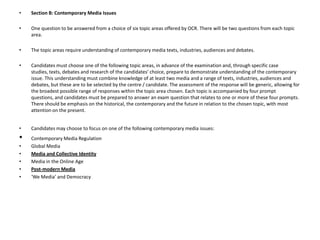
Section B: Contemporary Media Issues One question to be answered from a choice of six topic areas offered by OCR. There will be two questions from each topic area. The topic areas require understanding of contemporary media texts, industries, audiences and debates. Candidates must choose one of the following topic areas, in advance of the examination and, through specific case studies, texts, debates and research of the candidates’ choice, prepare to demonstrate understanding of the contemporary issue. This understanding must combine knowledge of at least two media and a range of texts, industries, audiences and debates, but these are to be selected by the centre / candidate. The assessment of the response will be generic, allowing for the broadest possible range of responses within the topic area chosen. Each topic is accompanied by four prompt questions, and candidates must be prepared to answer an exam question that relates to one or more of these four prompts. There should be emphasis on the historical, the contemporary and the future in relation to the chosen topic, with most attention on the present. Candidates may choose to focus on one of the following contemporary media issues:Contemporary Media Regulation Global Media Media and Collective IdentityMedia in the Online Age Post-modern Media‘We Media’ and Democracy
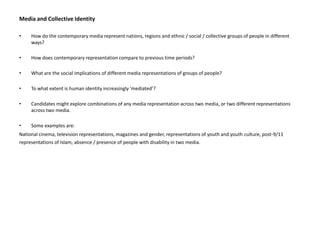
Media and Collective Identity How do the contemporary media represent nations, regions and ethnic / social / collective groups of people in different ways? How does contemporary representation compare to previous time periods? What are the social implications of different media representations of groups of people? To what extent is human identity increasingly ‘mediated’? Candidates might explore combinations of any media representation across two media, or two different representations across two media. Some examples are: National cinema, television representations, magazines and gender, representations of youth and youthculture, post-9/11representations of Islam, absence / presence of people with disability in two media.
What does it mean to be British?What things do we associate with Britain?Put things under the following headings:Food and DrinkSportsCulture (TV, Film, Music etc)Beliefs, Values and AttitudesLandmarksLanguage / Phrases
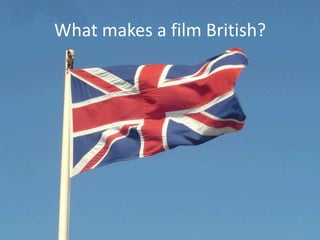
What makes a film British?
What do you expect from a British film?
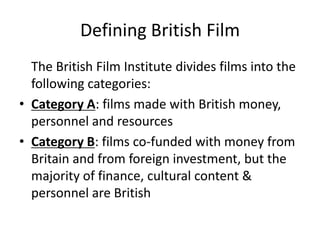
Defining British FilmThe British Film Institute divides films into the following categories:Category A: films made with British money, personnel and resourcesCategory B: films co-funded with money from Britain and from foreign investment, but the majority of finance, cultural content & personnel are British
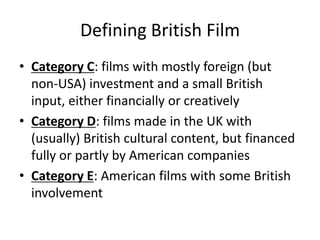
Defining British FilmCategory C: films with mostly foreign (but non-USA) investment and a small British input, either financially or creativelyCategory D: films made in the UK with (usually) British cultural content, but financed fully or partly by American companiesCategory E: American films with some British involvement
How many British films can you think of?
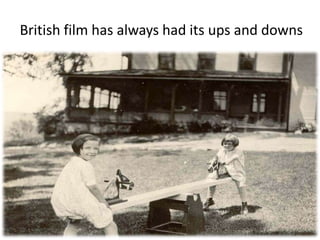
British film has always had its ups and downs
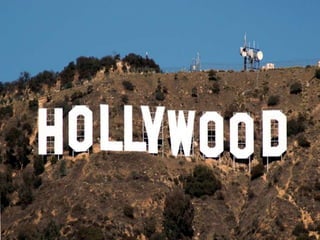
 Unfortunately, the British film industry has never been capable of generating worldwide commercial success on its own. This is partly down to the major power, success and control of…
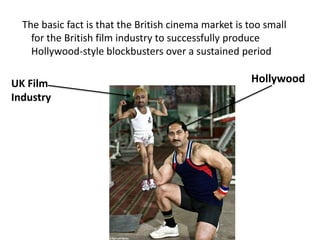
 The basic fact is that the British cinema market is too small for the British film industry to successfully produce Hollywood-style blockbusters over a sustained periodHollywoodUK Film Industry
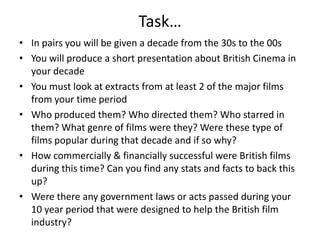
Task…In pairs you will be given a decade from the 30s to the 00sYou will produce a short presentation about British Cinema in your decadeYou must look at extracts from at least 2 of the major films from your time periodWho produced them? Who directed them? Who starred in them? What genre of films were they? Were these type of films popular during that decade and if so why?How commercially & financially successful were British films during this time? Can you find any stats and facts to back this up?Were there any government laws or acts passed during your 10 year period that were designed to help the British film industry?
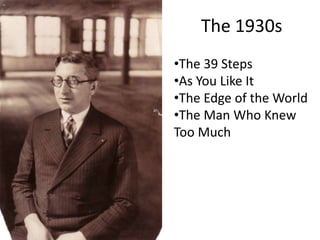
The 1930sThe 39 Steps
As You Like It
The Edge of the World
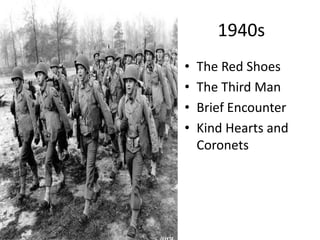
The Man Who Knew Too Much1940sThe Red ShoesThe Third ManBrief EncounterKind Hearts and Coronets
1950sThe Bridge Over The River KwaiThe Dam BustersThe Lady KillersRichard III
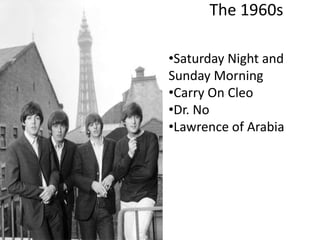
The 1960sSaturday Night and Sunday Morning
Carry On Cleo
Dr. No
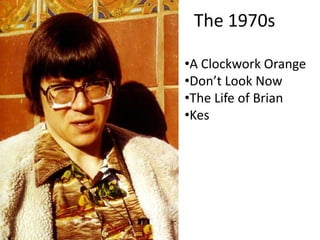
Lawrence of ArabiaThe 1970sA Clockwork Orange

Britishness and Collective Identity

  • 1.
  • 2.
    Section B: ContemporaryMedia Issues One question to be answered from a choice of six topic areas offered by OCR. There will be two questions from each topic area. The topic areas require understanding of contemporary media texts, industries, audiences and debates. Candidates must choose one of the following topic areas, in advance of the examination and, through specific case studies, texts, debates and research of the candidates’ choice, prepare to demonstrate understanding of the contemporary issue. This understanding must combine knowledge of at least two media and a range of texts, industries, audiences and debates, but these are to be selected by the centre / candidate. The assessment of the response will be generic, allowing for the broadest possible range of responses within the topic area chosen. Each topic is accompanied by four prompt questions, and candidates must be prepared to answer an exam question that relates to one or more of these four prompts. There should be emphasis on the historical, the contemporary and the future in relation to the chosen topic, with most attention on the present. Candidates may choose to focus on one of the following contemporary media issues:Contemporary Media Regulation Global Media Media and Collective IdentityMedia in the Online Age Post-modern Media‘We Media’ and Democracy
  • 3.
    Media and CollectiveIdentity How do the contemporary media represent nations, regions and ethnic / social / collective groups of people in different ways? How does contemporary representation compare to previous time periods? What are the social implications of different media representations of groups of people? To what extent is human identity increasingly ‘mediated’? Candidates might explore combinations of any media representation across two media, or two different representations across two media. Some examples are: National cinema, television representations, magazines and gender, representations of youth and youthculture, post-9/11representations of Islam, absence / presence of people with disability in two media.
  • 4.
    What does itmean to be British?What things do we associate with Britain?Put things under the following headings:Food and DrinkSportsCulture (TV, Film, Music etc)Beliefs, Values and AttitudesLandmarksLanguage / Phrases
  • 5.
    What makes afilm British?
  • 6.
    What do youexpect from a British film?
  • 7.
    Defining British FilmTheBritish Film Institute divides films into the following categories:Category A: films made with British money, personnel and resourcesCategory B: films co-funded with money from Britain and from foreign investment, but the majority of finance, cultural content & personnel are British
  • 8.
    Defining British FilmCategoryC: films with mostly foreign (but non-USA) investment and a small British input, either financially or creativelyCategory D: films made in the UK with (usually) British cultural content, but financed fully or partly by American companiesCategory E: American films with some British involvement
  • 9.
    How many Britishfilms can you think of?
  • 10.
    British film hasalways had its ups and downs
  • 11.
     Unfortunately, theBritish film industry has never been capable of generating worldwide commercial success on its own. This is partly down to the major power, success and control of…
  • 13.
     The basicfact is that the British cinema market is too small for the British film industry to successfully produce Hollywood-style blockbusters over a sustained periodHollywoodUK Film Industry
  • 14.
    Task…In pairs youwill be given a decade from the 30s to the 00sYou will produce a short presentation about British Cinema in your decadeYou must look at extracts from at least 2 of the major films from your time periodWho produced them? Who directed them? Who starred in them? What genre of films were they? Were these type of films popular during that decade and if so why?How commercially & financially successful were British films during this time? Can you find any stats and facts to back this up?Were there any government laws or acts passed during your 10 year period that were designed to help the British film industry?
  • 15.
  • 16.
  • 17.
    The Edge ofthe World
  • 18.
    The Man WhoKnew Too Much1940sThe Red ShoesThe Third ManBrief EncounterKind Hearts and Coronets
  • 19.
    1950sThe Bridge OverThe River KwaiThe Dam BustersThe Lady KillersRichard III
  • 20.
    The 1960sSaturday Nightand Sunday Morning
  • 21.
  • 22.
  • 23.
    Lawrence of ArabiaThe1970sA Clockwork Orange