McLuhan - 1960
• The rapidity of communication through electric media echoes the
  speed of the senses.
• Through media such as the telephone, television and more recently
  the personal computer and the 'Internet', we are increasingly linked
  together across the globe and this has enabled us to connect with
  people at the other side of the world as quickly as it takes us to
  contact and converse with those who inhabit the same physical
  space (i.e the people that live in the same village).
• We can now hear and see events that take place thousands of miles
  away in a matter of seconds, often quicker than we hear of events
  in our own villages or even families.
• McLuhan argues that it is the speed of these electronic media that
  allow us to act and react to global issues at the same speed as
  normal face to face verbal communication.
McLuhan 1960
• As he writes: ‘“Time” has ceased, 'space' has
  vanished. We now live in a global village... a
  simultaneous happening’ (1967: p.63).
• Globalization would be the product of society
  being ‘increasingly mediated’.
Essentially
• McLuhan argues that we can only consume
  media products like film, tv and music that
  isn’t produced nationally if we know they are
  there to watch, listen and buy.
• But globalisation cannot work without the
  media raising awareness of it.
• This means that due to media, we inhabit one
  big global village.
Your first research task
• Go to Fox News or bbc news and click on
  world.
• Find stories that support McLuhan’s ‘Global
  Village’ theory.
• Try to find the sources of the stories (Locals?
  Online? Reporters?)
• Note these down in your case study notes.
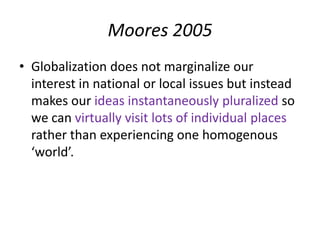
Moores 2005
• Globalization does not marginalize our
  interest in national or local issues but instead
  makes our ideas instantaneously pluralized so
  we can virtually visit lots of individual places
  rather than experiencing one homogenous
  ‘world’.
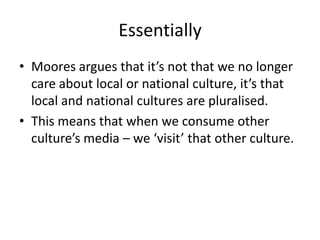
Essentially
• Moores argues that it’s not that we no longer
  care about local or national culture, it’s that
  local and national cultures are pluralised.
• This means that when we consume other
  culture’s media – we ‘visit’ that other culture.
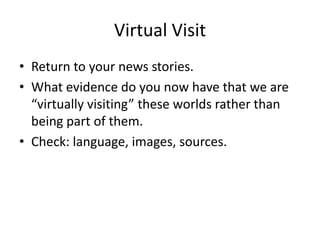
Virtual Visit
• Return to your news stories.
• What evidence do you now have that we are
  “virtually visiting” these worlds rather than
  being part of them.
• Check: language, images, sources.
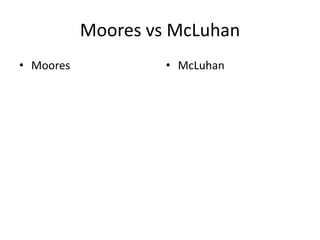
Moores vs McLuhan
• Moores            • McLuhan
Global media lesson 2

Global media lesson 2

  • 2.
    McLuhan - 1960 •The rapidity of communication through electric media echoes the speed of the senses. • Through media such as the telephone, television and more recently the personal computer and the 'Internet', we are increasingly linked together across the globe and this has enabled us to connect with people at the other side of the world as quickly as it takes us to contact and converse with those who inhabit the same physical space (i.e the people that live in the same village). • We can now hear and see events that take place thousands of miles away in a matter of seconds, often quicker than we hear of events in our own villages or even families. • McLuhan argues that it is the speed of these electronic media that allow us to act and react to global issues at the same speed as normal face to face verbal communication.
  • 3.
    McLuhan 1960 • Ashe writes: ‘“Time” has ceased, 'space' has vanished. We now live in a global village... a simultaneous happening’ (1967: p.63). • Globalization would be the product of society being ‘increasingly mediated’.
  • 4.
    Essentially • McLuhan arguesthat we can only consume media products like film, tv and music that isn’t produced nationally if we know they are there to watch, listen and buy. • But globalisation cannot work without the media raising awareness of it. • This means that due to media, we inhabit one big global village.
  • 5.
    Your first researchtask • Go to Fox News or bbc news and click on world. • Find stories that support McLuhan’s ‘Global Village’ theory. • Try to find the sources of the stories (Locals? Online? Reporters?) • Note these down in your case study notes.
  • 6.
    Moores 2005 • Globalizationdoes not marginalize our interest in national or local issues but instead makes our ideas instantaneously pluralized so we can virtually visit lots of individual places rather than experiencing one homogenous ‘world’.
  • 7.
    Essentially • Moores arguesthat it’s not that we no longer care about local or national culture, it’s that local and national cultures are pluralised. • This means that when we consume other culture’s media – we ‘visit’ that other culture.
  • 8.
    Virtual Visit • Returnto your news stories. • What evidence do you now have that we are “virtually visiting” these worlds rather than being part of them. • Check: language, images, sources.
  • 9.
    Moores vs McLuhan •Moores • McLuhan