Promoting media-based learning to organisations and practitioners through local training and networking events, 
online resources and knowledge sharing 
“Charting Media and Learning in Europe” Report 
Laura Orlescu, Activewatch (Romania) 
Sofia Papadimitriou, EduTV 
(Greece)
This project has been funded with support from the European Commission 
21 November 2014 
Report background 
The production of the report is a core activity of the MEDEAnet Project supported by the European Commission through the Lifelong Learning Programme 
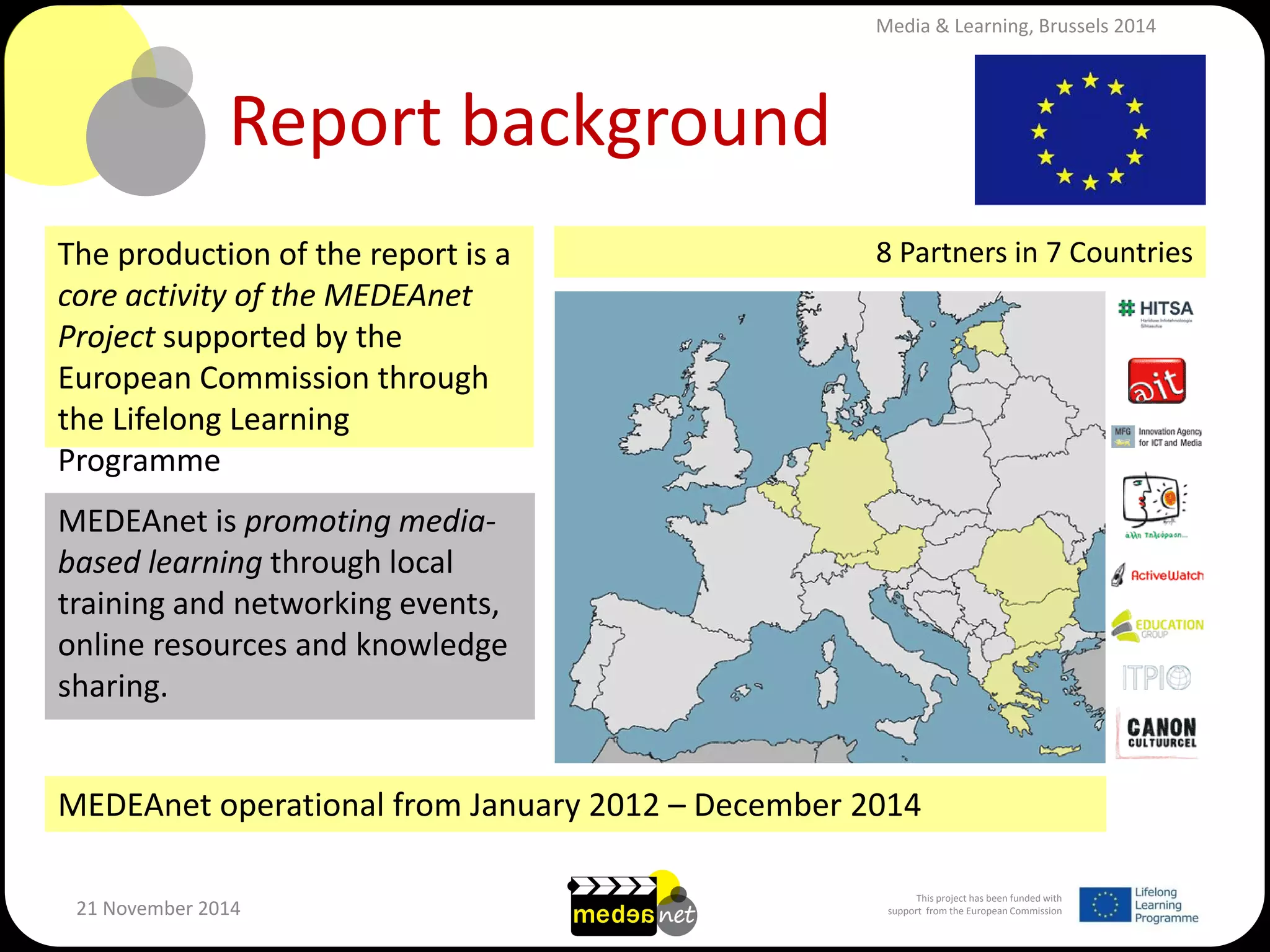
8 Partners in 7 Countries 
MEDEAnet is promoting media- based learning through local training and networking events, online resources and knowledge sharing. 
MEDEAnet operational from January 2012 – December 2014 
Media & Learning, Brussels 2014
This project has been funded with support from the European Commission 
21 November 2014 
Research question 
How is media used to support teaching and learning in different parts of Europe? 
The results of this investigation were published in a series of 3 annual reports – “Charting Media and Learning in Europe”. 
Each annual report had a different focus: 
2011: policies 
2012: school curriculum 
2013: teacher training 
Media & Learning, Brussels 2014
This project has been funded with support from the European Commission 
21 November 2014 
Report background 
Creating knowledge 
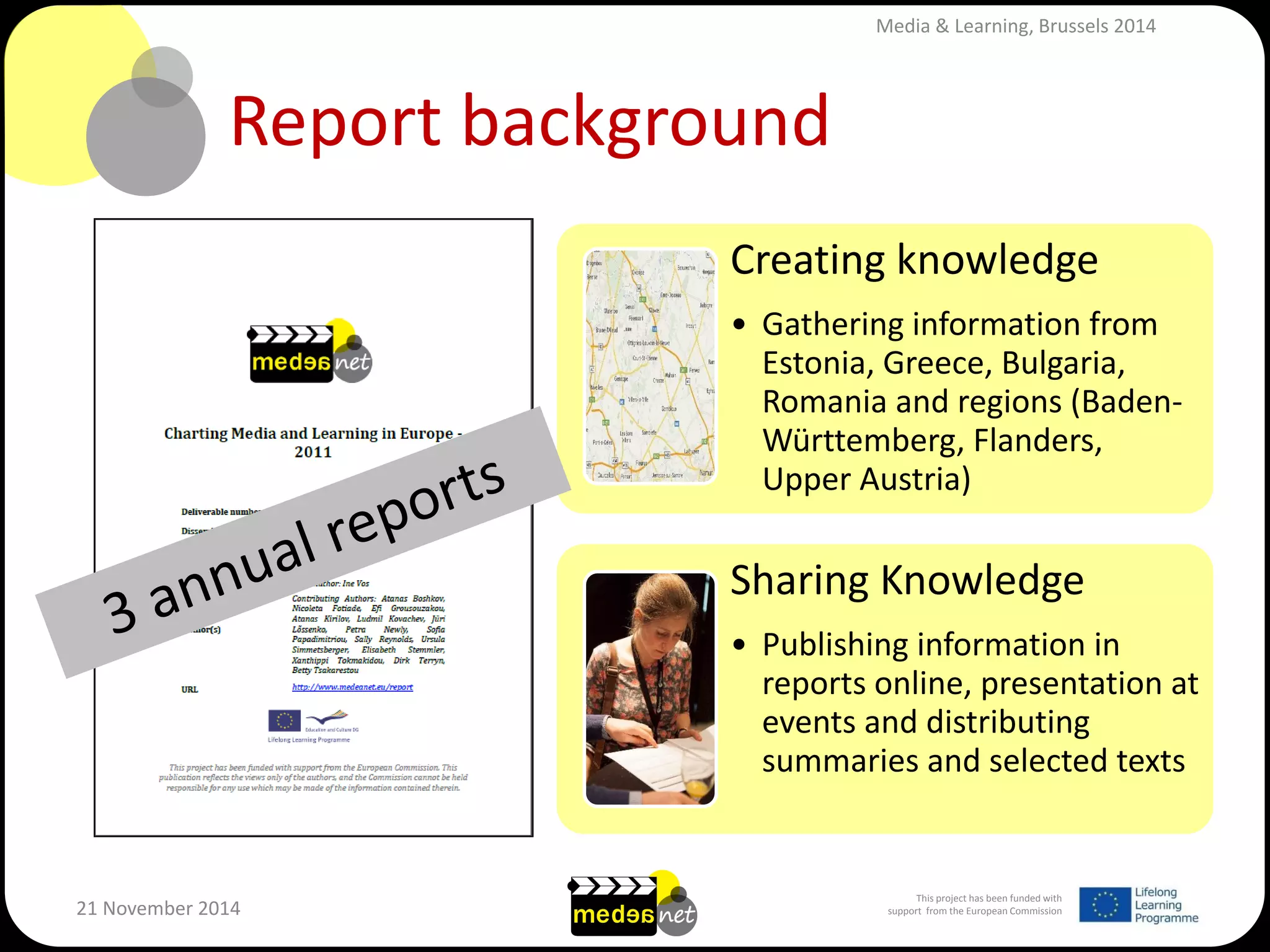
•Gathering information from Estonia, Greece, Bulgaria, Romania and regions (Baden- Württemberg, Flanders, Upper Austria) 
Sharing Knowledge 
•Publishing information in reports online, presentation at events and distributing summaries and selected texts 
Media & Learning, Brussels 2014
This project has been funded with support from the European Commission 
21 November 2014 
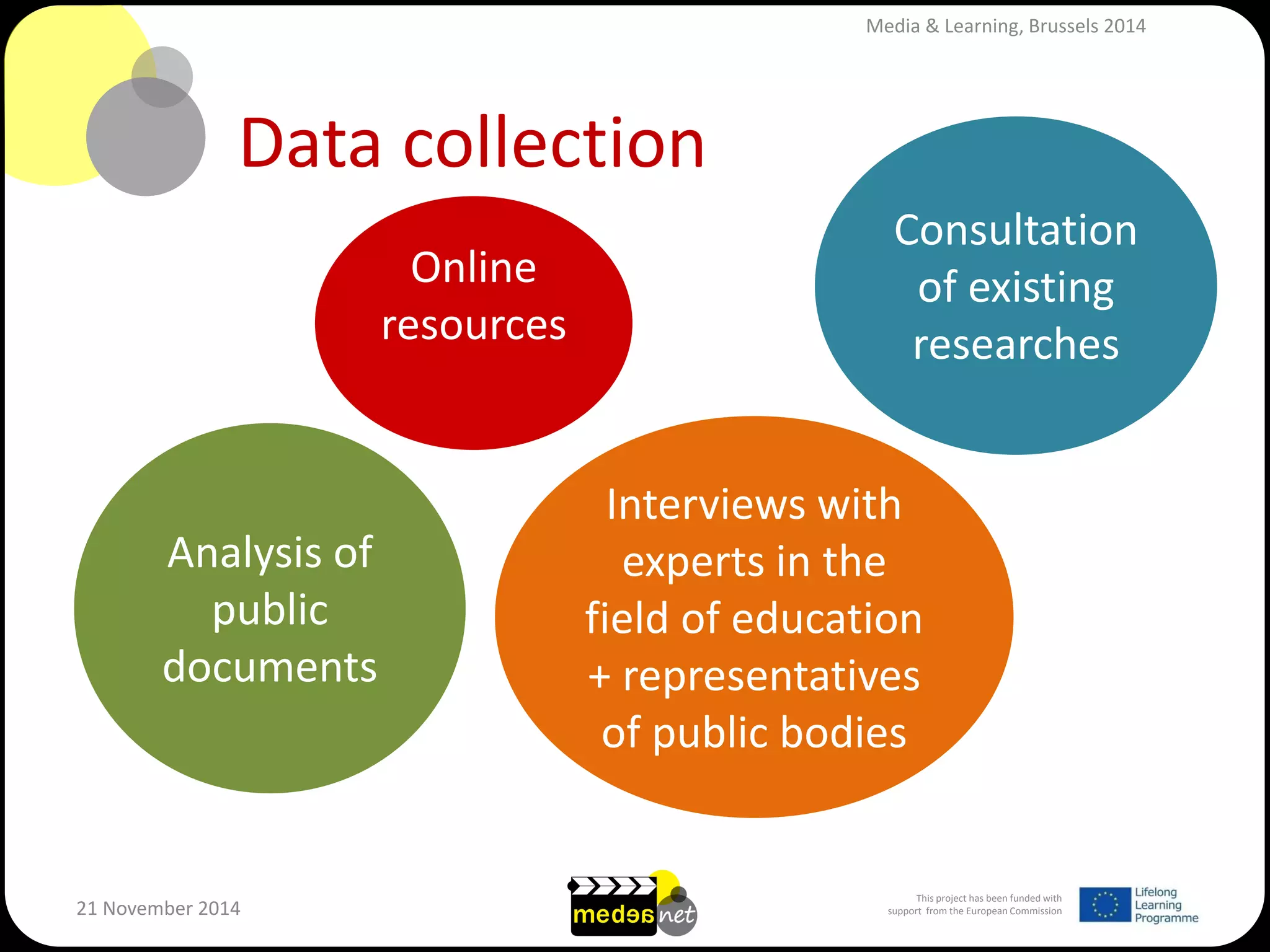
Data collection 
Analysis of public documents 
Consultation of existing researches 
Interviews with experts in the field of education + representatives of public bodies 
Online resources 
Media & Learning, Brussels 2014
This project has been funded with support from the European Commission 
21 November 2014 
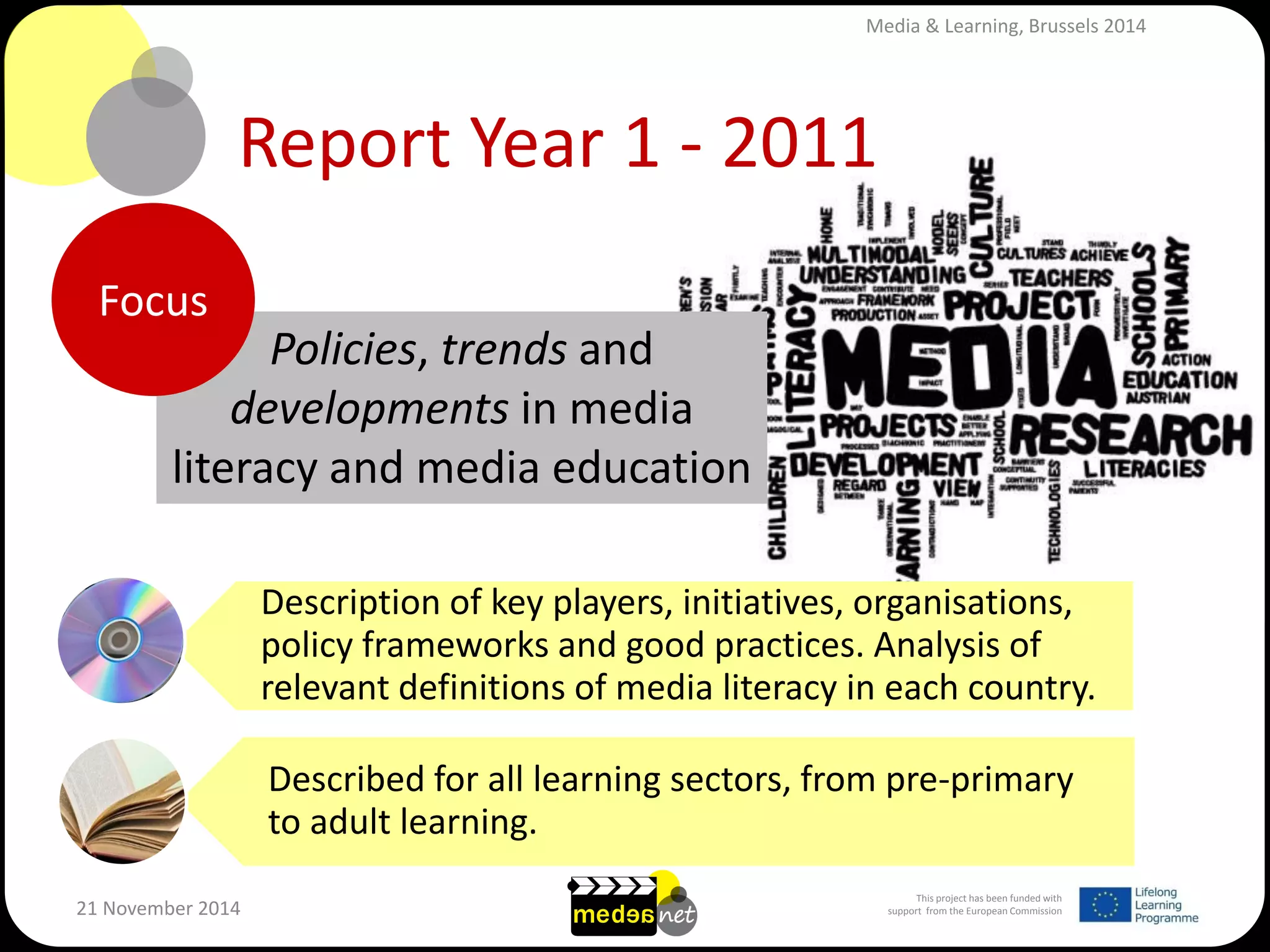
Report Year 1 - 2011 
Policies, trends and developments in media literacy and media education 
Description of key players, initiatives, organisations, policy frameworks and good practices. Analysis of relevant definitions of media literacy in each country. 
Described for all learning sectors, from pre-primary to adult learning. 
Focus 
Media & Learning, Brussels 2014
This project has been funded with support from the European Commission 
21 November 2014 
Key Findings 2011 
Media literacy is understood and defined very differently in the involved countries and it is a shared responsibility for several stakeholders. Some efforts are being made to measure the “level” of media literacy in different European countries (for example in the context of Eurydice) but this still has to improve. It was also noted that some countries or regions rather focus on the cultural component of media literacy whereas in others ICT is in the centre of attention. It is important to see both sides as complimentary, and therefore, both should be addressed simultaneously instead of in a separate way. 
Media & Learning, Brussels 2014
This project has been funded with support from the European Commission 
21 November 2014 
Key Findings 2011 
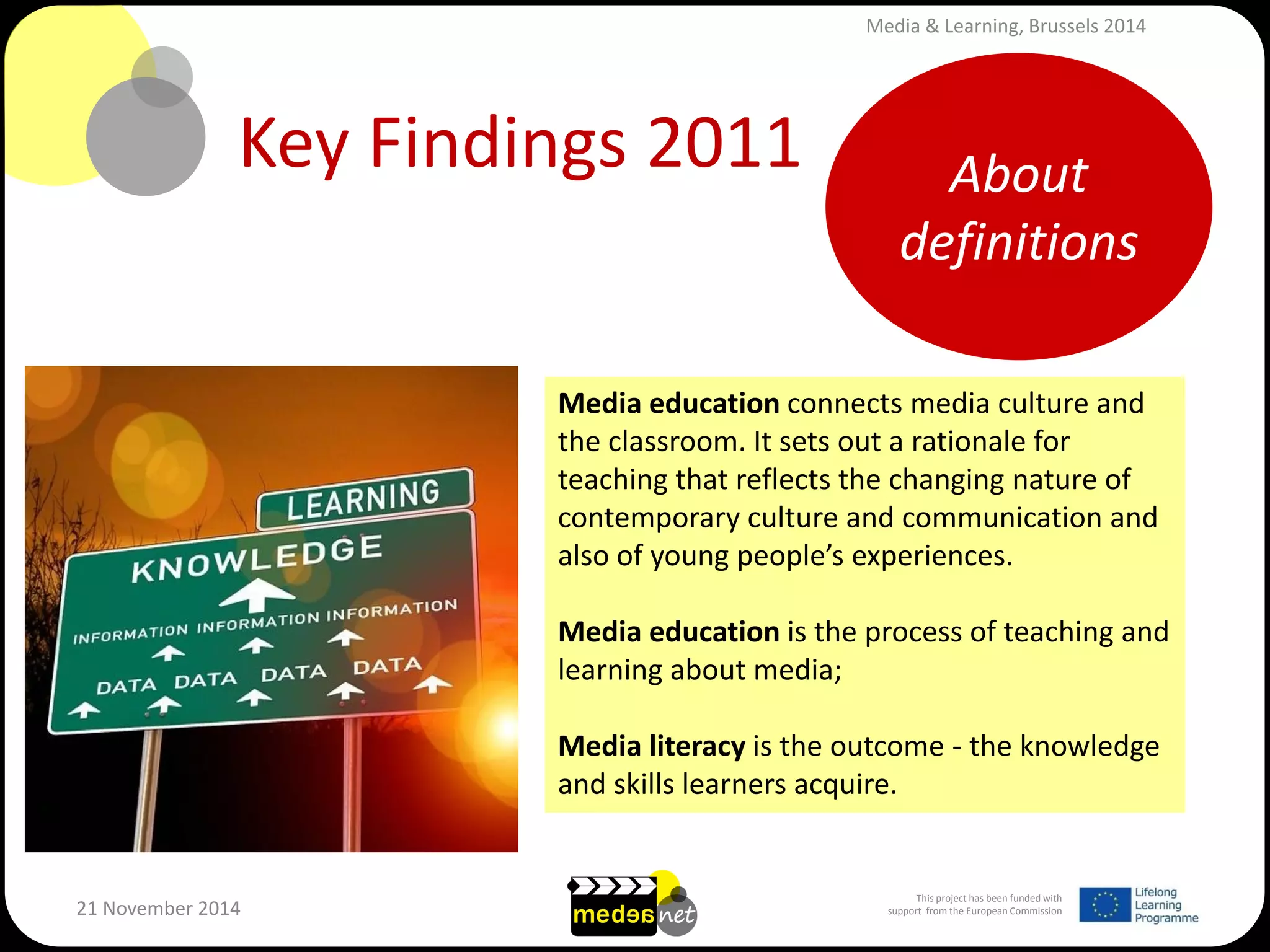
Media education connects media culture and the classroom. It sets out a rationale for teaching that reflects the changing nature of contemporary culture and communication and also of young people’s experiences. 
Media education is the process of teaching and learning about media; 
Media literacy is the outcome - the knowledge and skills learners acquire. 
About definitions 
Media & Learning, Brussels 2014
This project has been funded with support from the European Commission 
21 November 2014 
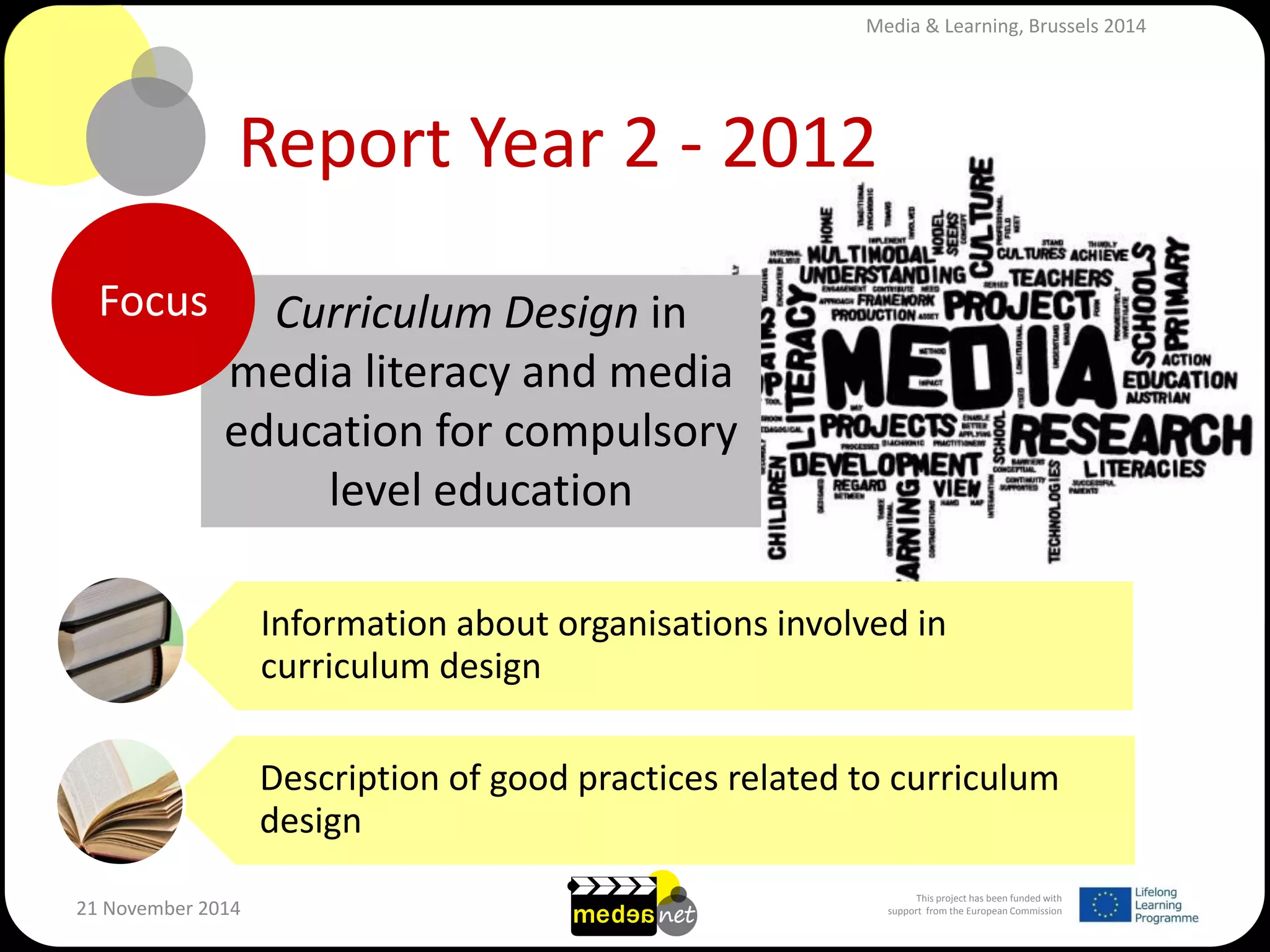
Report Year 2 - 2012 
Curriculum Design in media literacy and media education for compulsory level education 
Focus 
Information about organisations involved in curriculum design 
Description of good practices related to curriculum design 
Media & Learning, Brussels 2014
This project has been funded with support from the European Commission 
21 November 2014 
Key Findings 2012 
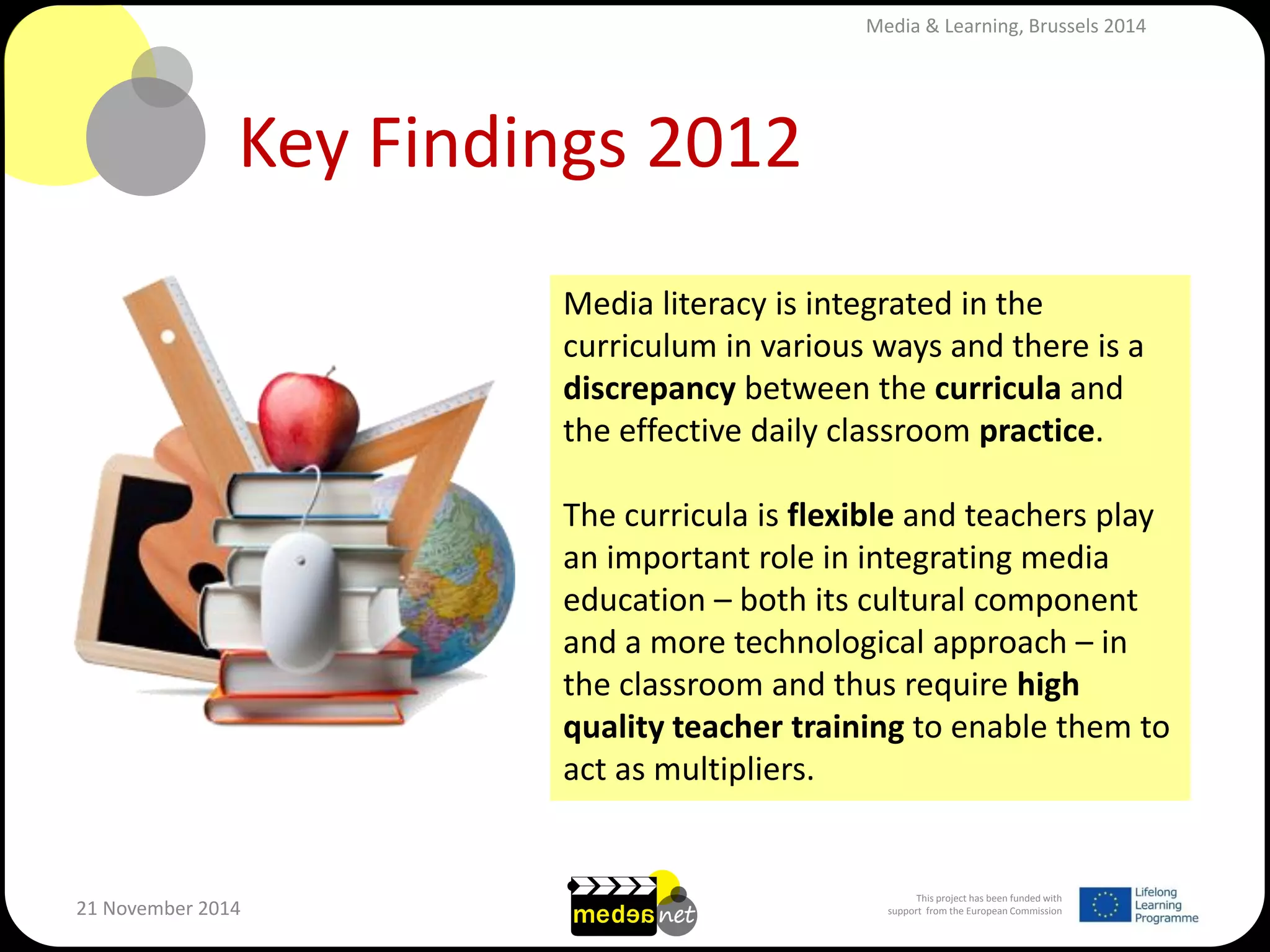
Media literacy is integrated in the curriculum in various ways and there is a discrepancy between the curricula and the effective daily classroom practice. 
The curricula is flexible and teachers play an important role in integrating media education – both its cultural component and a more technological approach – in the classroom and thus require high quality teacher training to enable them to act as multipliers. 
Media & Learning, Brussels 2014
This project has been funded with support from the European Commission 
21 November 2014 
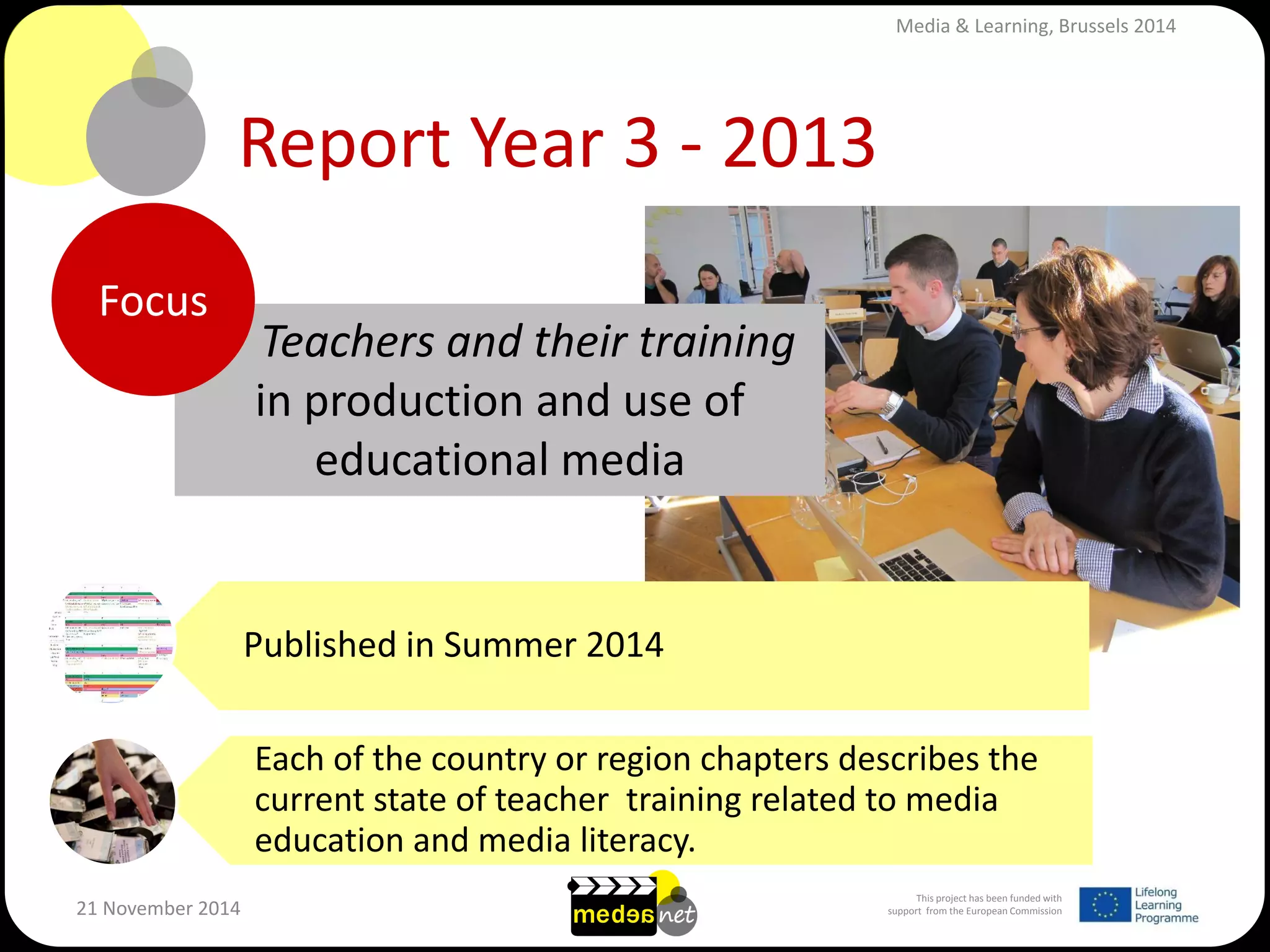
Report Year 3 - 2013 
Teachers and their training in production and use of educational media 
Published in Summer 2014 
Each of the country or region chapters describes the current state of teacher training related to media education and media literacy. 
Focus 
Media & Learning, Brussels 2014
This project has been funded with support from the European Commission 
21 November 2014 
Key Findings 2013 
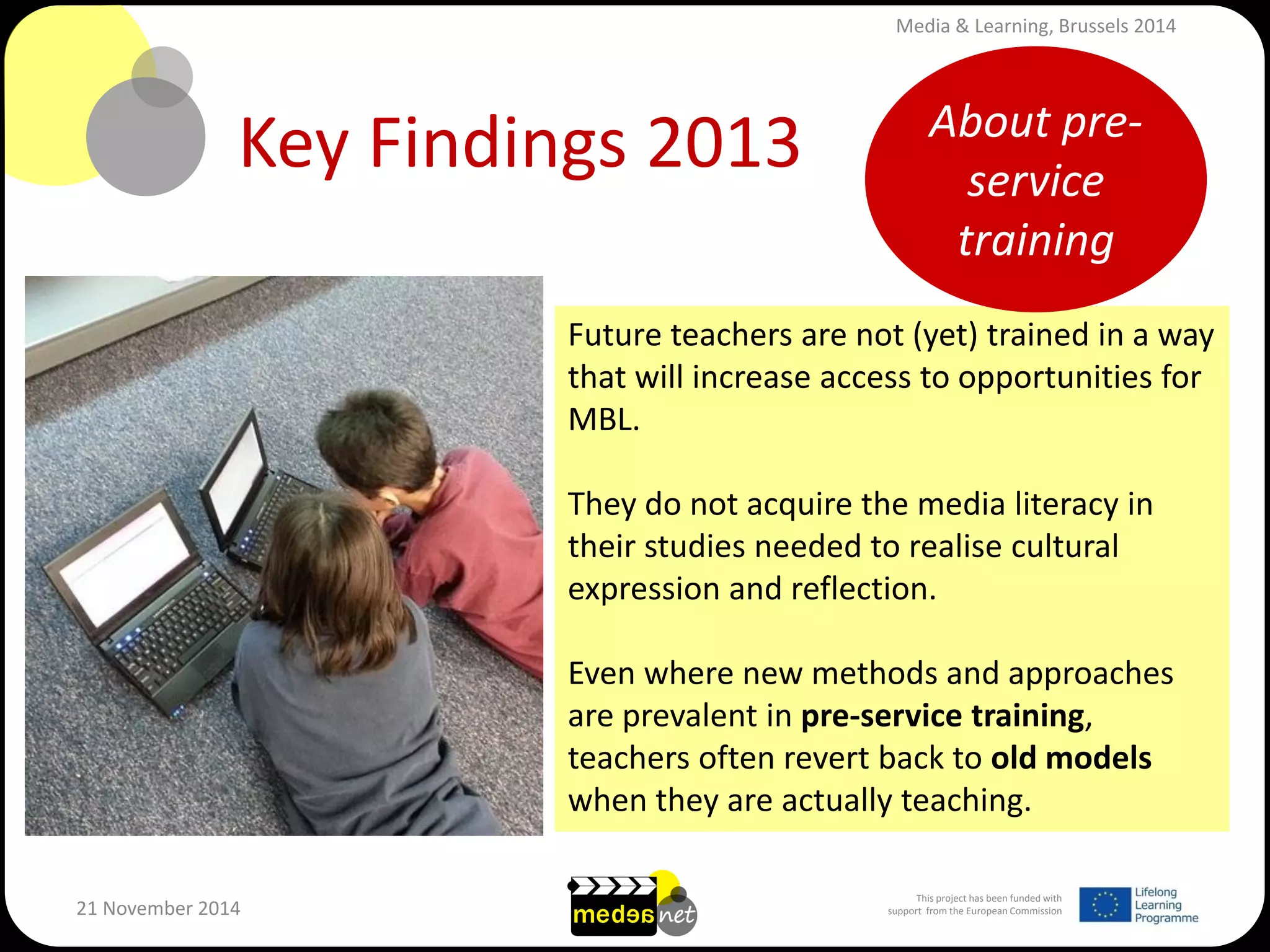
Future teachers are not (yet) trained in a way that will increase access to opportunities for MBL. 
They do not acquire the media literacy in their studies needed to realise cultural expression and reflection. 
Even where new methods and approaches are prevalent in pre-service training, teachers often revert back to old models when they are actually teaching. 
About pre- service training 
Media & Learning, Brussels 2014
This project has been funded with support from the European Commission 
21 November 2014 
Key Findings 2013 
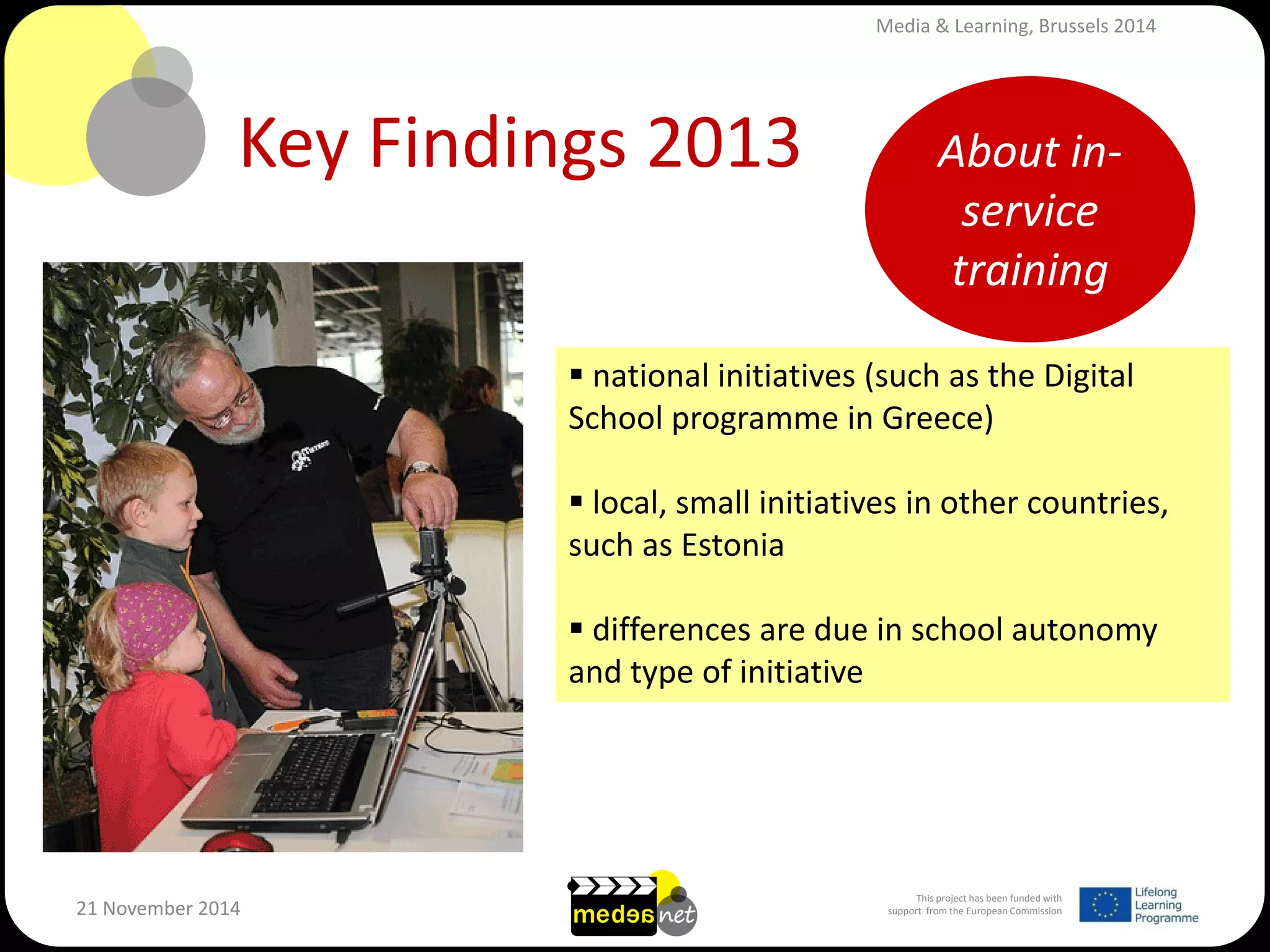
 national initiatives (such as the Digital School programme in Greece) 
 local, small initiatives in other countries, such as Estonia 
 differences are due in school autonomy and type of initiative 
About in- service training 
Media & Learning, Brussels 2014
This project has been funded with support from the European Commission 
21 November 2014 
Key Findings 2013 
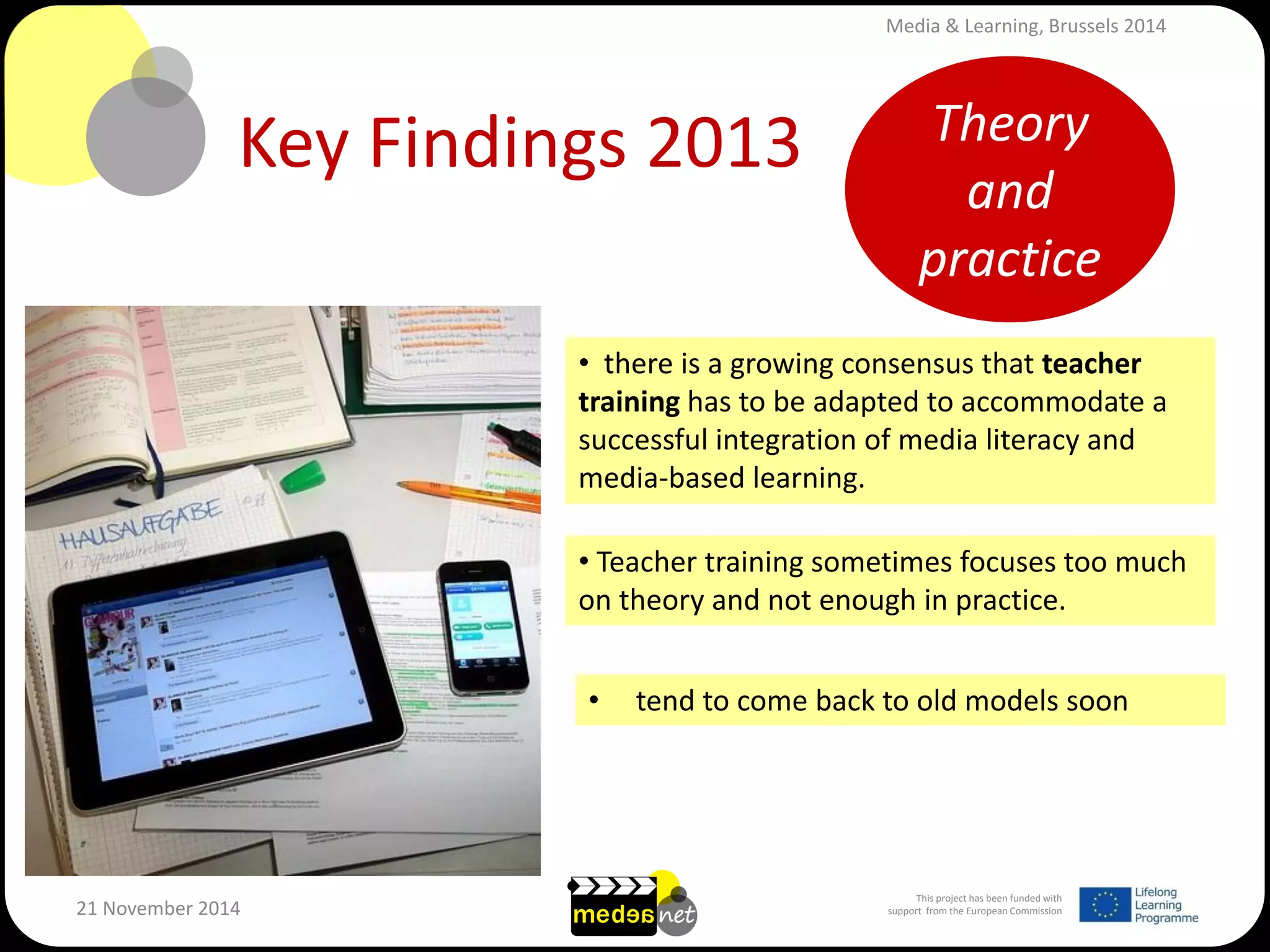
•tend to come back to old models soon 
• Teacher training sometimes focuses too much on theory and not enough in practice. 
Theory and practice 
• there is a growing consensus that teacher training has to be adapted to accommodate a successful integration of media literacy and media-based learning. 
Media & Learning, Brussels 2014
This project has been funded with support from the European Commission 
21 November 2014 
Key Findings 2013 
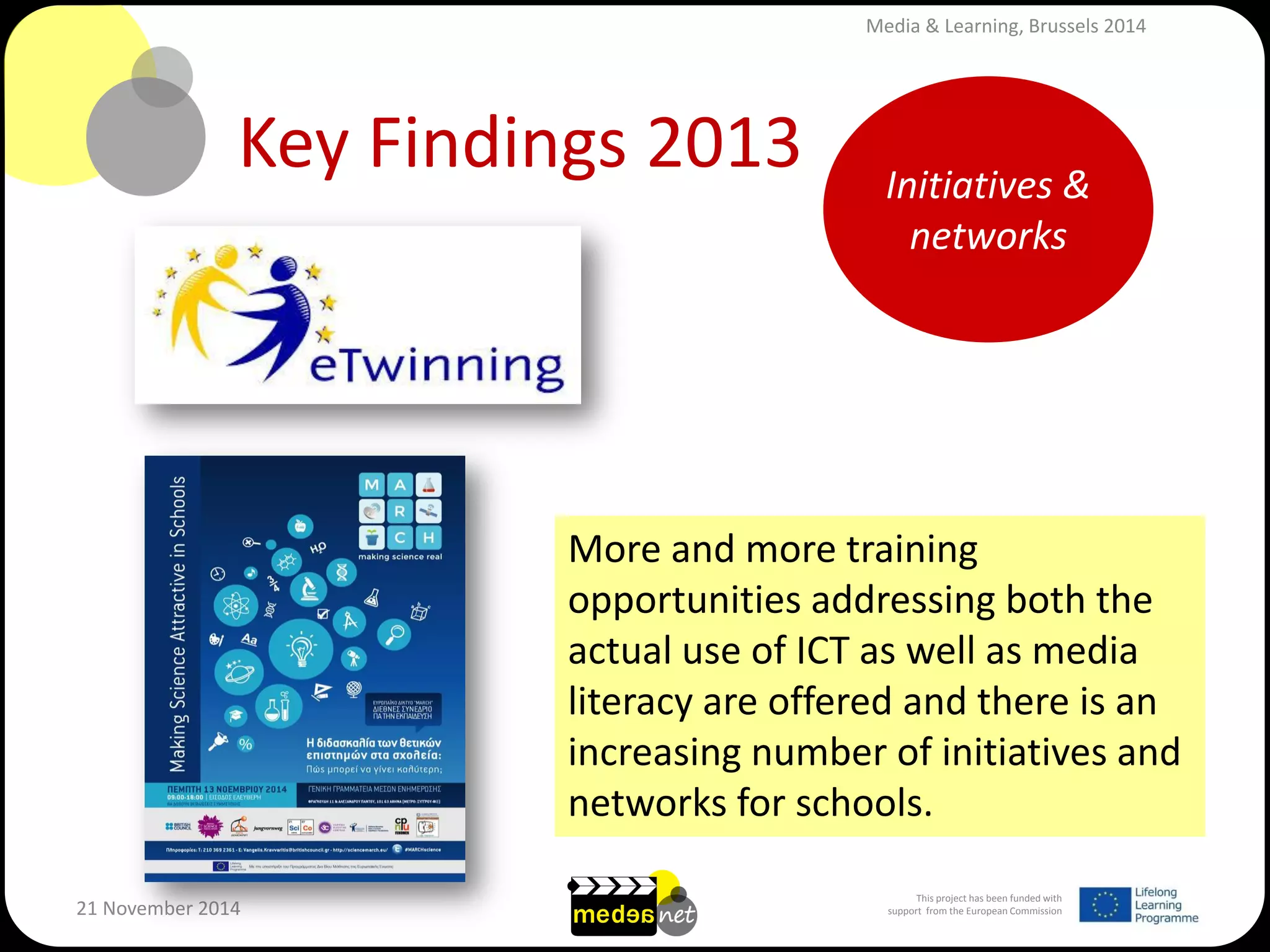
More and more training opportunities addressing both the actual use of ICT as well as media literacy are offered and there is an increasing number of initiatives and networks for schools. 
Initiatives & networks 
Media & Learning, Brussels 2014
This project has been funded with support from the European Commission 
21 November 2014 
Key Findings 2013 
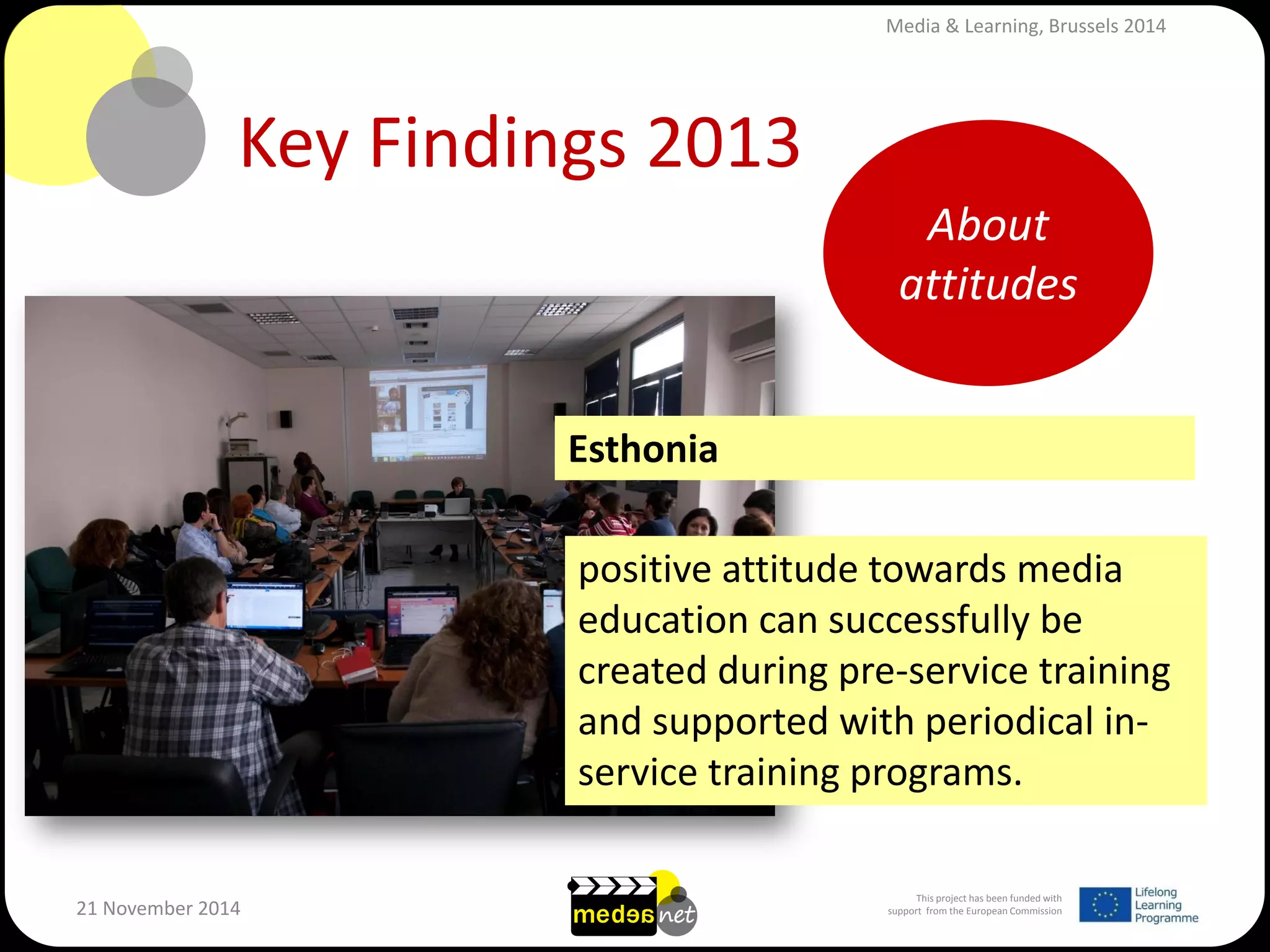
positive attitude towards media education can successfully be created during pre-service training and supported with periodical in- service training programs. 
Esthonia 
About attitudes 
Media & Learning, Brussels 2014
This project has been funded with support from the European Commission 
21 November 2014 
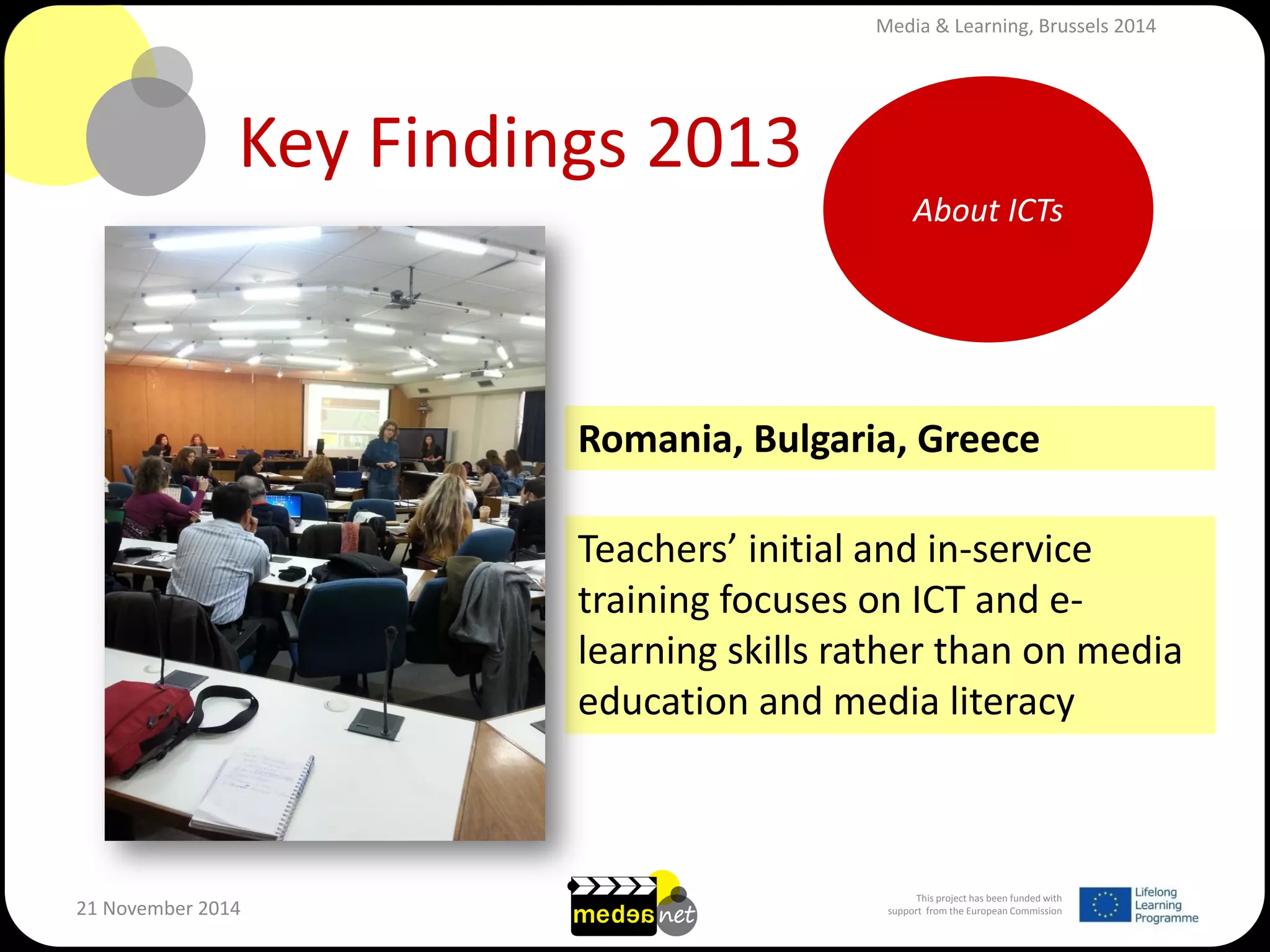
Key Findings 2013 
Teachers’ initial and in-service training focuses on ICT and e- learning skills rather than on media education and media literacy 
About ICTs 
Romania, Bulgaria, Greece 
Media & Learning, Brussels 2014
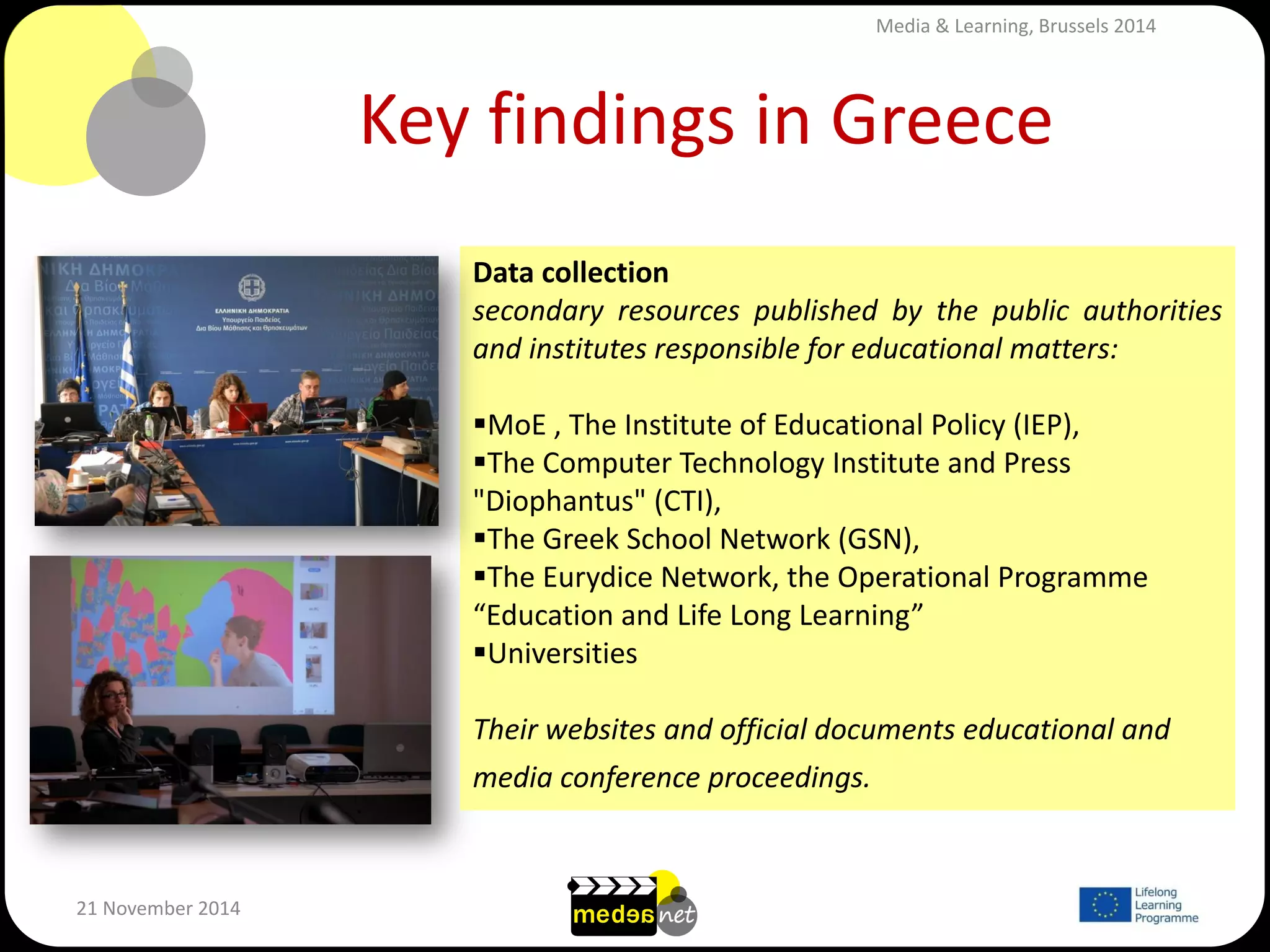
Key findings in Greece 
21 November 2014 
Data collection 
secondary resources published by the public authorities and institutes responsible for educational matters: 
MoE , The Institute of Educational Policy (IEP), 
The Computer Technology Institute and Press "Diophantus" (CTI), 
The Greek School Network (GSN), 
The Eurydice Network, the Operational Programme “Education and Life Long Learning” 
Universities 
Their websites and official documents educational and media conference proceedings. 
Media & Learning, Brussels 2014
Initial teacher education 
21 November 2014 
a pedagogical training certificate has been established in the curriculum from all University departments of Education Sciences. 
In-Service Training 
 The A and B level In-Service Training for the use and application of ICT in the teaching practice. 
 The B level distance training: Blended learning methods, combining distance learning and a limited number of f2f sessions. 
The major in-service teacher training Program. 
 Research Projects 
Media & Learning, Brussels 2014
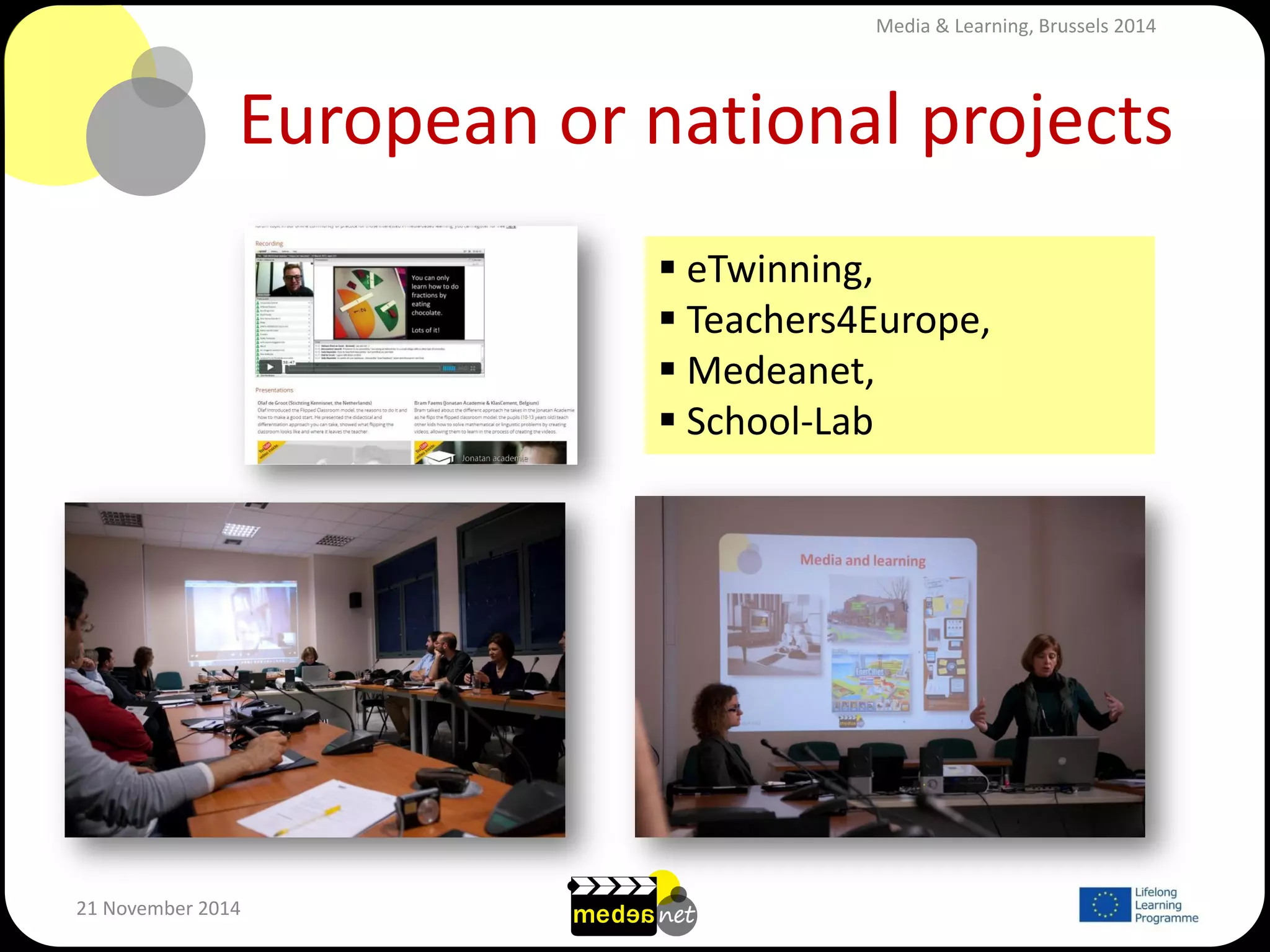
European or national projects 
21 November 2014 
 eTwinning, 
 Teachers4Europe, 
 Medeanet, 
 School-Lab 
Media & Learning, Brussels 2014
Communities of Practice, Professional Learning Networks 
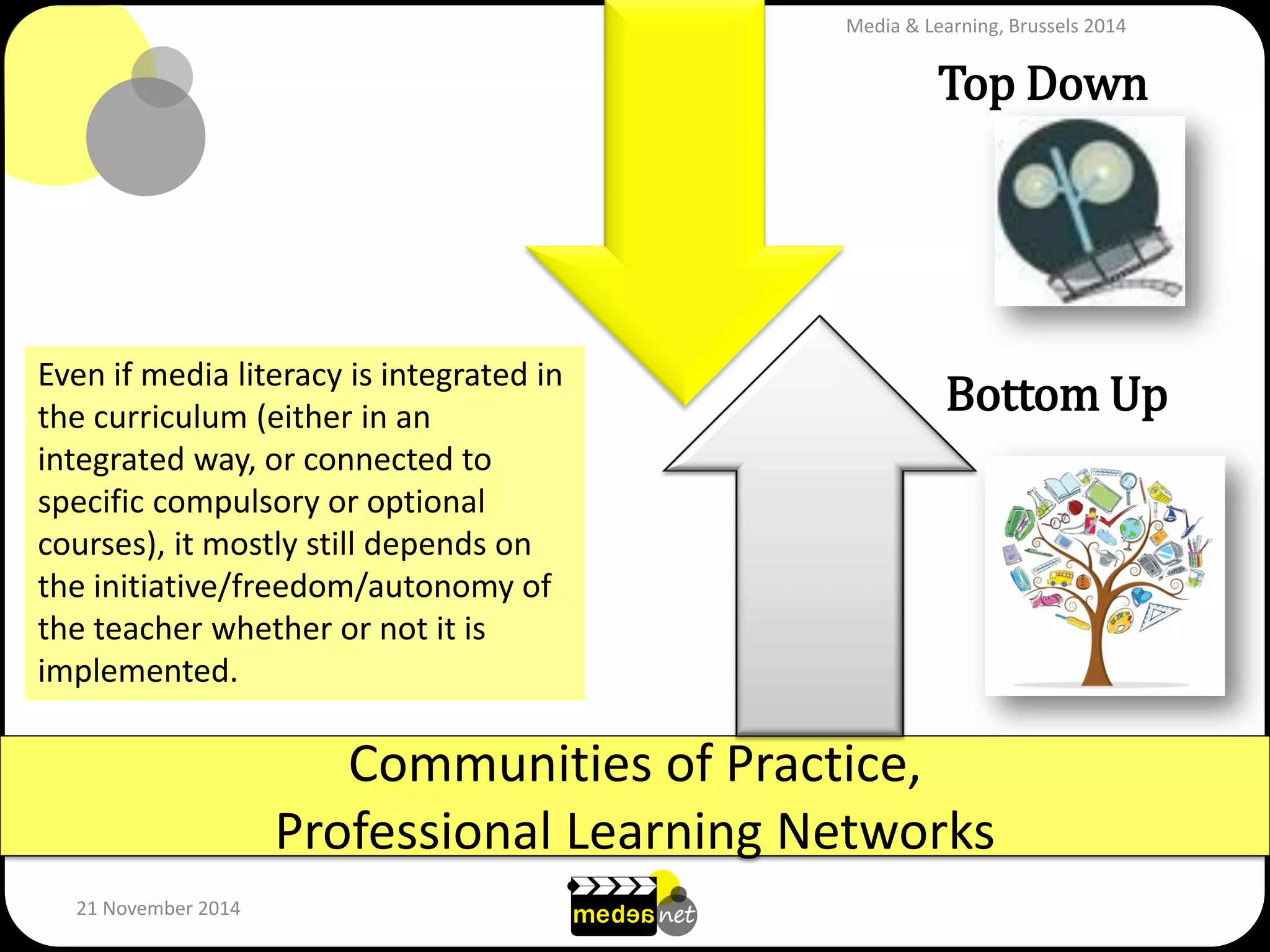
Top Down 
Bottom Up 
Even if media literacy is integrated in the curriculum (either in an integrated way, or connected to specific compulsory or optional courses), it mostly still depends on the initiative/freedom/autonomy of the teacher whether or not it is implemented. 
21 November 2014 
Media & Learning, Brussels 2014
Key findings in Romania definitions and policy 
21 November 2014 
In Romania no common definition for media literacy in its wider pedagogical and cultural understanding exists at national policy level. 
The only definition present in official education policy papers and relevant for media and learning refers to ICT skills. 
The media education definitions used in non-formal learning situations vary from the ones that embed the protectionist approach to the ones closer to the participatory model of media education. 
Media & Learning, Brussels 2014
Key findings in Romania curriculum design & teacher training 
21 November 2014 
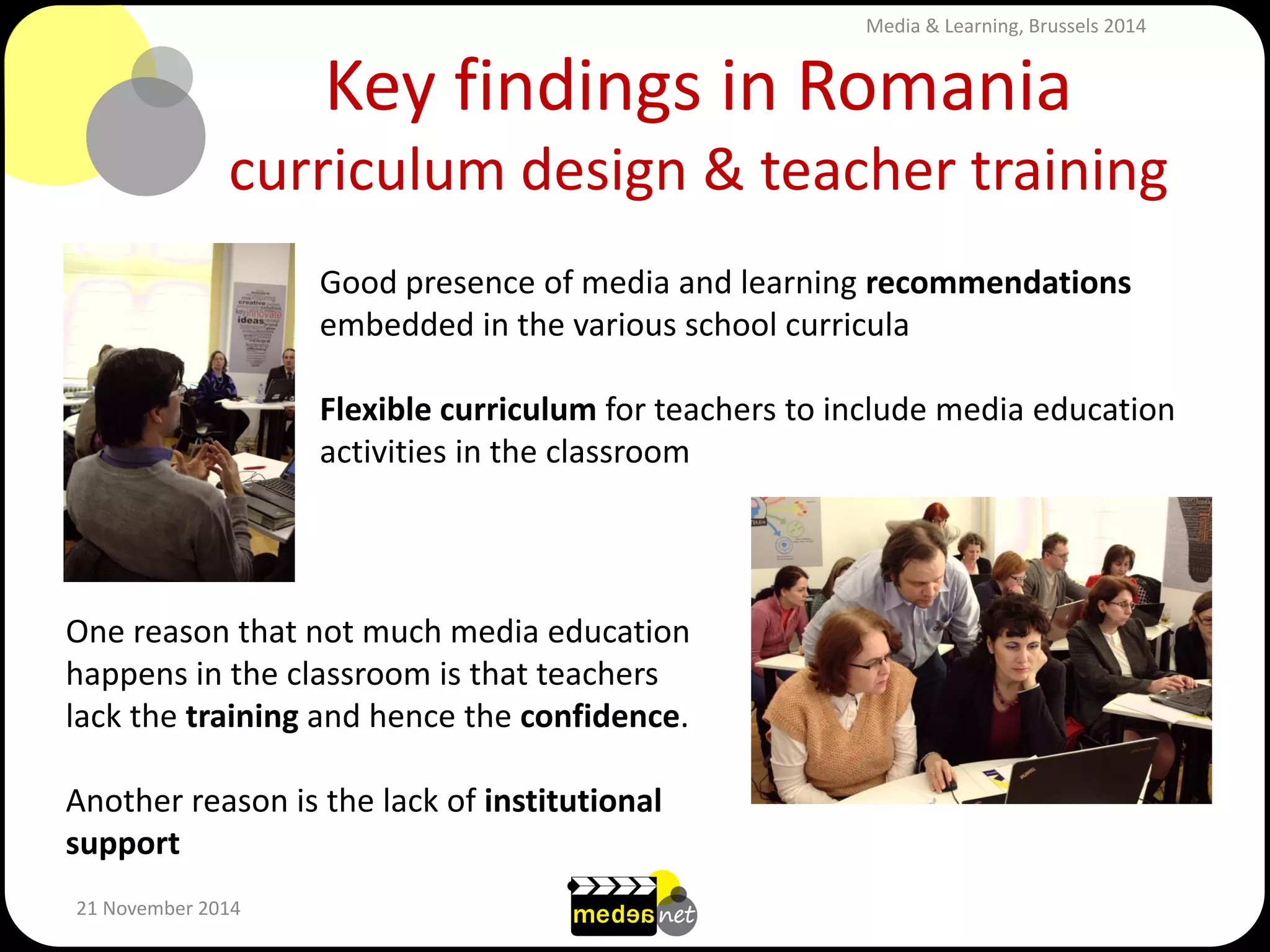
Good presence of media and learning recommendations embedded in the various school curricula Flexible curriculum for teachers to include media education activities in the classroom 
One reason that not much media education happens in the classroom is that teachers lack the training and hence the confidence. 
Another reason is the lack of institutional support 
Media & Learning, Brussels 2014
Key findings in Romania curriculum design & teacher training 
21 November 2014 
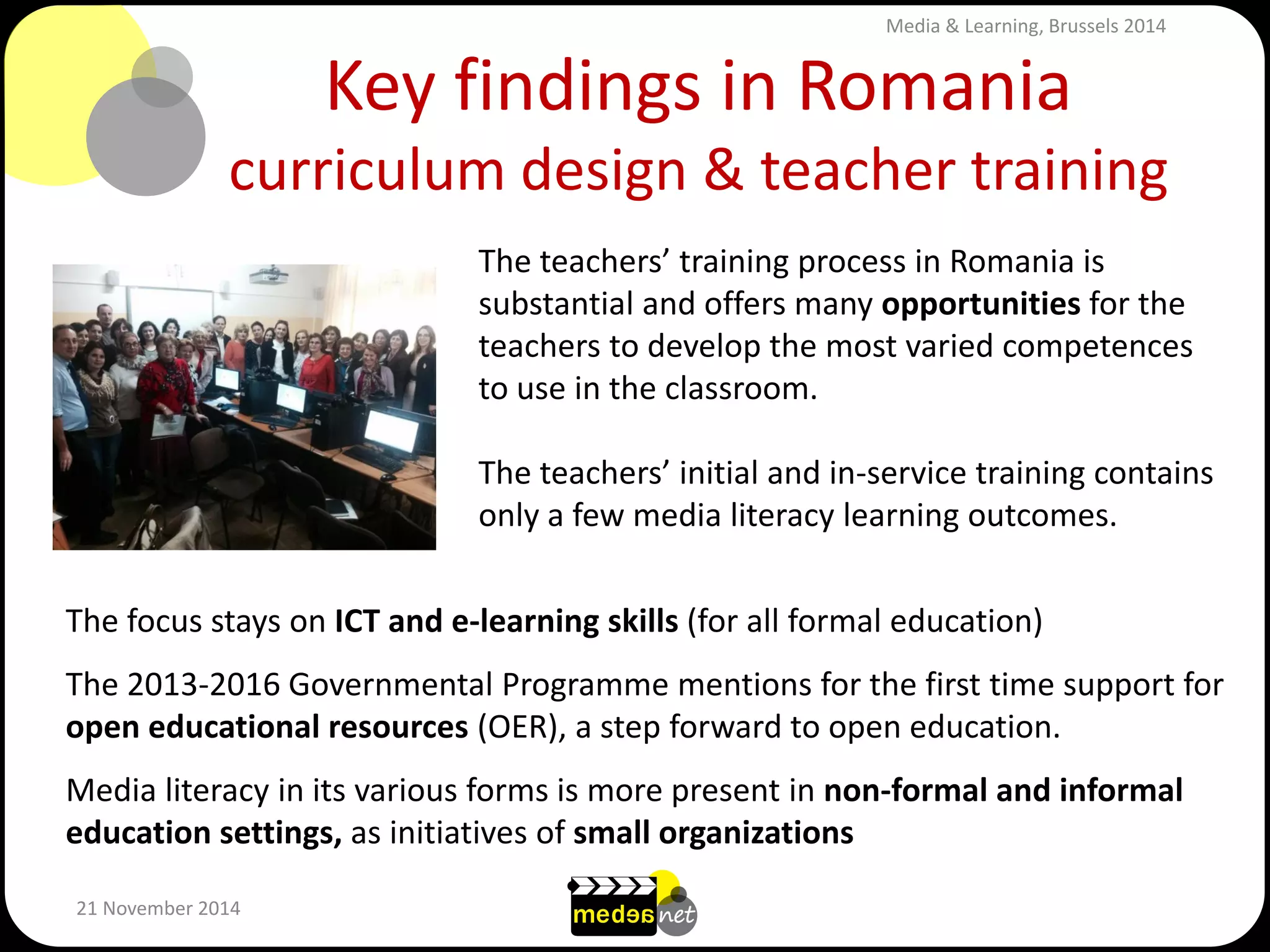
The teachers’ training process in Romania is substantial and offers many opportunities for the teachers to develop the most varied competences to use in the classroom. The teachers’ initial and in-service training contains only a few media literacy learning outcomes. 
The focus stays on ICT and e-learning skills (for all formal education) The 2013-2016 Governmental Programme mentions for the first time support for open educational resources (OER), a step forward to open education. Media literacy in its various forms is more present in non-formal and informal education settings, as initiatives of small organizations 
Media & Learning, Brussels 2014
Recommendations Romania 
21 November 2014 
The Ministry of Education should consider upgrading the teachers’ training in order to make it more relevant for the production and use of educational media in the classroom. The Ministry of Education should limit the hours of mandatory ICT classes and consider ways to integrate media literacy in all forms of formal education. Academia should develop training programmes for teachers and consider research in the field of media and education because they have a key role in curriculum development. Romanian policy makers should consider a wider cultural approach to media education and support its integration in all forms of education. 
Media & Learning, Brussels 2014
This project has been funded with support from the European Commission 
21 November 2014 
Main conclusion 
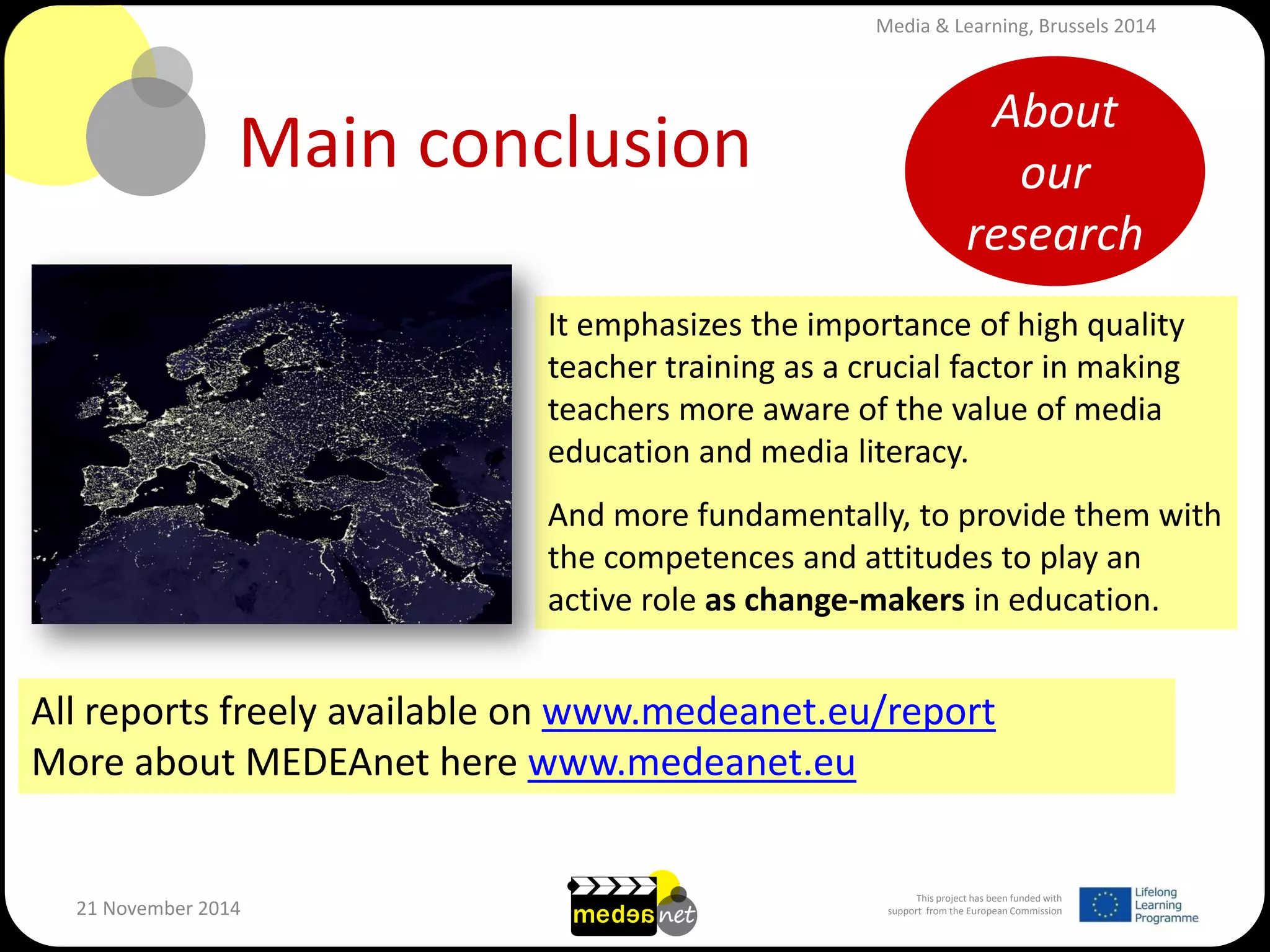
It emphasizes the importance of high quality teacher training as a crucial factor in making teachers more aware of the value of media education and media literacy. And more fundamentally, to provide them with the competences and attitudes to play an active role as change-makers in education. 
All reports freely available on www.medeanet.eu/report More about MEDEAnet here www.medeanet.eu 
About our research 
Media & Learning, Brussels 2014
THANK YOU FOR LISTENING! 
21 November 2014 
LAURA ORLESCU: laura@activewatch.ro SOFIA PAPADIMITRIOU: sofipapadi@gmail.com 
Media & Learning, Brussels 2014

Charting Media and Learning in Europe 2013

  • 1.
    Promoting media-based learningto organisations and practitioners through local training and networking events, online resources and knowledge sharing “Charting Media and Learning in Europe” Report Laura Orlescu, Activewatch (Romania) Sofia Papadimitriou, EduTV (Greece)
  • 2.
    This project hasbeen funded with support from the European Commission 21 November 2014 Report background The production of the report is a core activity of the MEDEAnet Project supported by the European Commission through the Lifelong Learning Programme 8 Partners in 7 Countries MEDEAnet is promoting media- based learning through local training and networking events, online resources and knowledge sharing. MEDEAnet operational from January 2012 – December 2014 Media & Learning, Brussels 2014
  • 3.
    This project hasbeen funded with support from the European Commission 21 November 2014 Research question How is media used to support teaching and learning in different parts of Europe? The results of this investigation were published in a series of 3 annual reports – “Charting Media and Learning in Europe”. Each annual report had a different focus: 2011: policies 2012: school curriculum 2013: teacher training Media & Learning, Brussels 2014
  • 4.
    This project hasbeen funded with support from the European Commission 21 November 2014 Report background Creating knowledge •Gathering information from Estonia, Greece, Bulgaria, Romania and regions (Baden- Württemberg, Flanders, Upper Austria) Sharing Knowledge •Publishing information in reports online, presentation at events and distributing summaries and selected texts Media & Learning, Brussels 2014
  • 5.
    This project hasbeen funded with support from the European Commission 21 November 2014 Data collection Analysis of public documents Consultation of existing researches Interviews with experts in the field of education + representatives of public bodies Online resources Media & Learning, Brussels 2014
  • 6.
    This project hasbeen funded with support from the European Commission 21 November 2014 Report Year 1 - 2011 Policies, trends and developments in media literacy and media education Description of key players, initiatives, organisations, policy frameworks and good practices. Analysis of relevant definitions of media literacy in each country. Described for all learning sectors, from pre-primary to adult learning. Focus Media & Learning, Brussels 2014
  • 7.
    This project hasbeen funded with support from the European Commission 21 November 2014 Key Findings 2011 Media literacy is understood and defined very differently in the involved countries and it is a shared responsibility for several stakeholders. Some efforts are being made to measure the “level” of media literacy in different European countries (for example in the context of Eurydice) but this still has to improve. It was also noted that some countries or regions rather focus on the cultural component of media literacy whereas in others ICT is in the centre of attention. It is important to see both sides as complimentary, and therefore, both should be addressed simultaneously instead of in a separate way. Media & Learning, Brussels 2014
  • 8.
    This project hasbeen funded with support from the European Commission 21 November 2014 Key Findings 2011 Media education connects media culture and the classroom. It sets out a rationale for teaching that reflects the changing nature of contemporary culture and communication and also of young people’s experiences. Media education is the process of teaching and learning about media; Media literacy is the outcome - the knowledge and skills learners acquire. About definitions Media & Learning, Brussels 2014
  • 9.
    This project hasbeen funded with support from the European Commission 21 November 2014 Report Year 2 - 2012 Curriculum Design in media literacy and media education for compulsory level education Focus Information about organisations involved in curriculum design Description of good practices related to curriculum design Media & Learning, Brussels 2014
  • 10.
    This project hasbeen funded with support from the European Commission 21 November 2014 Key Findings 2012 Media literacy is integrated in the curriculum in various ways and there is a discrepancy between the curricula and the effective daily classroom practice. The curricula is flexible and teachers play an important role in integrating media education – both its cultural component and a more technological approach – in the classroom and thus require high quality teacher training to enable them to act as multipliers. Media & Learning, Brussels 2014
  • 11.
    This project hasbeen funded with support from the European Commission 21 November 2014 Report Year 3 - 2013 Teachers and their training in production and use of educational media Published in Summer 2014 Each of the country or region chapters describes the current state of teacher training related to media education and media literacy. Focus Media & Learning, Brussels 2014
  • 12.
    This project hasbeen funded with support from the European Commission 21 November 2014 Key Findings 2013 Future teachers are not (yet) trained in a way that will increase access to opportunities for MBL. They do not acquire the media literacy in their studies needed to realise cultural expression and reflection. Even where new methods and approaches are prevalent in pre-service training, teachers often revert back to old models when they are actually teaching. About pre- service training Media & Learning, Brussels 2014
  • 13.
    This project hasbeen funded with support from the European Commission 21 November 2014 Key Findings 2013  national initiatives (such as the Digital School programme in Greece)  local, small initiatives in other countries, such as Estonia  differences are due in school autonomy and type of initiative About in- service training Media & Learning, Brussels 2014
  • 14.
    This project hasbeen funded with support from the European Commission 21 November 2014 Key Findings 2013 •tend to come back to old models soon • Teacher training sometimes focuses too much on theory and not enough in practice. Theory and practice • there is a growing consensus that teacher training has to be adapted to accommodate a successful integration of media literacy and media-based learning. Media & Learning, Brussels 2014
  • 15.
    This project hasbeen funded with support from the European Commission 21 November 2014 Key Findings 2013 More and more training opportunities addressing both the actual use of ICT as well as media literacy are offered and there is an increasing number of initiatives and networks for schools. Initiatives & networks Media & Learning, Brussels 2014
  • 16.
    This project hasbeen funded with support from the European Commission 21 November 2014 Key Findings 2013 positive attitude towards media education can successfully be created during pre-service training and supported with periodical in- service training programs. Esthonia About attitudes Media & Learning, Brussels 2014
  • 17.
    This project hasbeen funded with support from the European Commission 21 November 2014 Key Findings 2013 Teachers’ initial and in-service training focuses on ICT and e- learning skills rather than on media education and media literacy About ICTs Romania, Bulgaria, Greece Media & Learning, Brussels 2014
  • 18.
    Key findings inGreece 21 November 2014 Data collection secondary resources published by the public authorities and institutes responsible for educational matters: MoE , The Institute of Educational Policy (IEP), The Computer Technology Institute and Press "Diophantus" (CTI), The Greek School Network (GSN), The Eurydice Network, the Operational Programme “Education and Life Long Learning” Universities Their websites and official documents educational and media conference proceedings. Media & Learning, Brussels 2014
  • 19.
    Initial teacher education 21 November 2014 a pedagogical training certificate has been established in the curriculum from all University departments of Education Sciences. In-Service Training  The A and B level In-Service Training for the use and application of ICT in the teaching practice.  The B level distance training: Blended learning methods, combining distance learning and a limited number of f2f sessions. The major in-service teacher training Program.  Research Projects Media & Learning, Brussels 2014
  • 20.
    European or nationalprojects 21 November 2014  eTwinning,  Teachers4Europe,  Medeanet,  School-Lab Media & Learning, Brussels 2014
  • 21.
    Communities of Practice,Professional Learning Networks Top Down Bottom Up Even if media literacy is integrated in the curriculum (either in an integrated way, or connected to specific compulsory or optional courses), it mostly still depends on the initiative/freedom/autonomy of the teacher whether or not it is implemented. 21 November 2014 Media & Learning, Brussels 2014
  • 22.
    Key findings inRomania definitions and policy 21 November 2014 In Romania no common definition for media literacy in its wider pedagogical and cultural understanding exists at national policy level. The only definition present in official education policy papers and relevant for media and learning refers to ICT skills. The media education definitions used in non-formal learning situations vary from the ones that embed the protectionist approach to the ones closer to the participatory model of media education. Media & Learning, Brussels 2014
  • 23.
    Key findings inRomania curriculum design & teacher training 21 November 2014 Good presence of media and learning recommendations embedded in the various school curricula Flexible curriculum for teachers to include media education activities in the classroom One reason that not much media education happens in the classroom is that teachers lack the training and hence the confidence. Another reason is the lack of institutional support Media & Learning, Brussels 2014
  • 24.
    Key findings inRomania curriculum design & teacher training 21 November 2014 The teachers’ training process in Romania is substantial and offers many opportunities for the teachers to develop the most varied competences to use in the classroom. The teachers’ initial and in-service training contains only a few media literacy learning outcomes. The focus stays on ICT and e-learning skills (for all formal education) The 2013-2016 Governmental Programme mentions for the first time support for open educational resources (OER), a step forward to open education. Media literacy in its various forms is more present in non-formal and informal education settings, as initiatives of small organizations Media & Learning, Brussels 2014
  • 25.
    Recommendations Romania 21November 2014 The Ministry of Education should consider upgrading the teachers’ training in order to make it more relevant for the production and use of educational media in the classroom. The Ministry of Education should limit the hours of mandatory ICT classes and consider ways to integrate media literacy in all forms of formal education. Academia should develop training programmes for teachers and consider research in the field of media and education because they have a key role in curriculum development. Romanian policy makers should consider a wider cultural approach to media education and support its integration in all forms of education. Media & Learning, Brussels 2014
  • 26.
    This project hasbeen funded with support from the European Commission 21 November 2014 Main conclusion It emphasizes the importance of high quality teacher training as a crucial factor in making teachers more aware of the value of media education and media literacy. And more fundamentally, to provide them with the competences and attitudes to play an active role as change-makers in education. All reports freely available on www.medeanet.eu/report More about MEDEAnet here www.medeanet.eu About our research Media & Learning, Brussels 2014
  • 27.
    THANK YOU FORLISTENING! 21 November 2014 LAURA ORLESCU: laura@activewatch.ro SOFIA PAPADIMITRIOU: sofipapadi@gmail.com Media & Learning, Brussels 2014