ICT4IAL 
European Agency for Special Needs 
and Inclusive Education 
Marcella Turner-Cmuchal
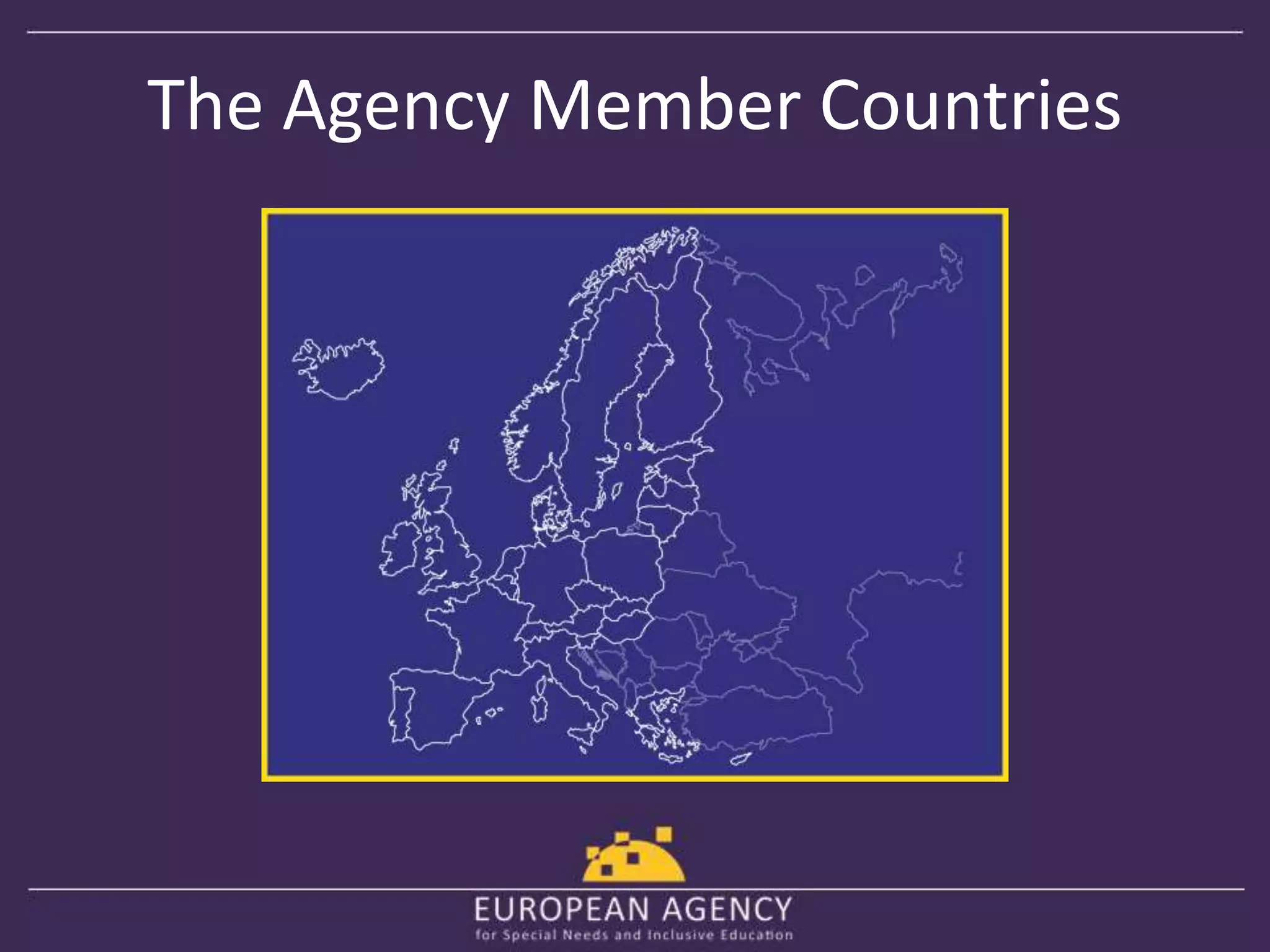
The Agency Member Countries
Currently 
• National networks in 28 European countries: Austria, 
Belgium (Flemish and French speaking communities), 
Cyprus, Czech Republic, Denmark, Estonia, Finland, France, 
Germany, Greece, Hungary, Iceland, Ireland, Italy, Latvia, 
Lithuania, Luxembourg, Malta, Netherlands, Norway, 
Poland, Portugal, Slovak Republic, Slovenia, Spain, 
Sweden, Switzerland, United Kingdom (England, Northern 
Ireland, Scotland and Wales) 
• Main secretariat in Odense, Denmark and European 
Liaison office in Brussels, Belgium 
• 18th year of operations
Funding 
The Agency is financed by: 
• The member countries’ Ministries of Education 
• European Commission as one of the 6 
organisations supported by the Jean Monnet, 
Erasmus+ Programme
Mission 
• The Agency is a permanent network of 
ministerial representatives acting as the member 
countries’ platform for collaboration regarding 
the promotion of quality and equity in education 
as a means to achieving social cohesion
Focus 
• The Agency’s main focus is upon inclusive education 
within its widest interpretation – that is dealing with 
learner difference and diversity in all educational 
settings as a quality issue. 
The Agency’s work is essentially concerned with how 
the achievement of all learners at all levels of 
inclusive lifelong learning can be improved in a 
meaningful way that enhances their life chances and 
opportunities for actively participating in society.
Defining terms 
Accessibility 
Information 
Special needs 
Inclusion 
Equity in education
ICT in education for learners with disabilities 
and SEN 
• UN figures – half a billion people with disabilities 
worldwide 
• 10% (a conservative estimate) of European 
population has some form of disability 
• 2% - 18% of the total school population 
(temporary or permanent educational needs) 
• ICT is increasingly seen as a major tool in 
meeting all learners’ individual learning needs 
• Knowledge Society for All is far from a reality for 
all European school pupils
Why is accessibility of 
information relevant for learning? 
Learners with disabilities and special 
needs must be able to access information 
relevant for learning in order to be present 
in a learning environment, participate in 
learning and to achieve. 
In meeting the specific needs of this 
learner group, a wider access for ALL 
learners is provided.
ICT as an opportunity... 
There are two strong arguments for providing 
accessible information for learning – 
1. Access to information is a human right 
2. Providing accessible information is more 
economic 
Accessible ICT has the potential to create 
synergies, which may equally benefit people with 
disabilities and special needs, the ageing 
population as well as all members of society.
Disability and the Digital Divide 
• People with disabilities are at risk of being 
doubly disadvantaged if their access to 
appropriate ICT is not supported 
• They risk becoming one of the main groups 
experiencing the growing digital divide 
• In addition, if some of their basic needs 
that could be addressed through the use of 
adaptive technology are not met, they risk 
further social exclusion
Relevance of ICT in Agency projects 
• ICT in Special Needs Education (1999 - 2001) 
• SEN-IST-network (2000-2003) 
• ICT in Education for People with Disabilities – Practice 
Review (in collaboration with IITE) 
• Model policy for inclusive ICTs in education (in 
collaboration with UNESCO and G3ict) 
• Accessible Information Provision for Learning (i-access) 
• ICT for Information Accessibility in Learning (ICT4IAL) 
• ICT for Inclusion
i-access: Guiding Principles for 
Accessibility 
• Rights Principle: Access to information is a fundamental right - it 
empowers learners and facilitates their participation in society. This 
access must be provided in the earliest phases of learning and 
accompany a learner throughout their lifetime. 
• Structural Principle: It is vital that any policy or recommendation does 
not regard technology as an end in itself. The systemic factors that 
determine the use of tools for lifelong learning must be recognised and 
considered. 
• All-Inclusive Principle: Accessible information provision needs to be 
considered in its widest interpretation to include people with all forms 
of disabilities and/or special educational needs. 
• Synergy Principle: Accessibility benefits users with disabilities and/or 
special educational needs and may often benefit all users.
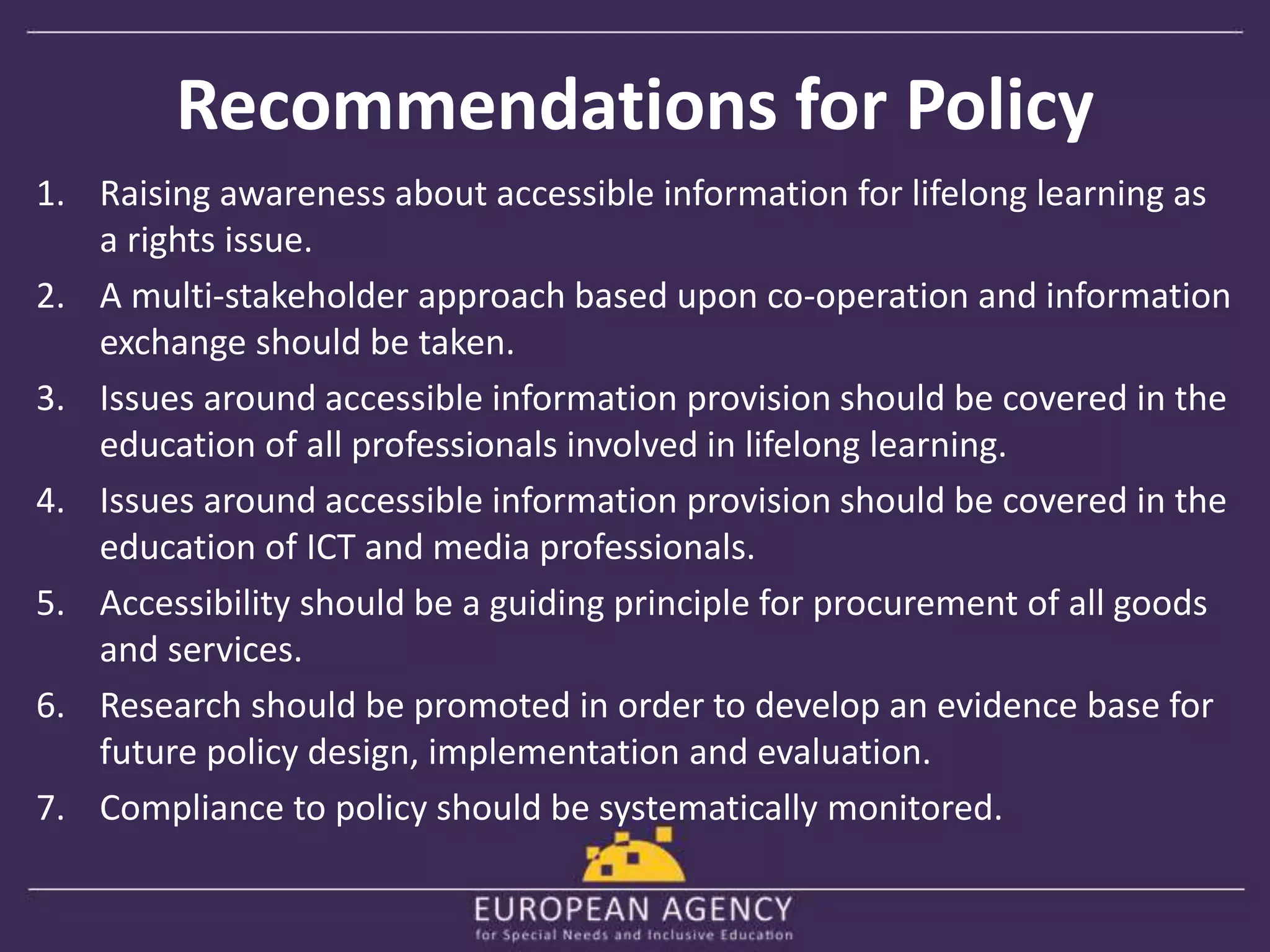
Recommendations for Policy 
1. Raising awareness about accessible information for lifelong learning as 
a rights issue. 
2. A multi-stakeholder approach based upon co-operation and information 
exchange should be taken. 
3. Issues around accessible information provision should be covered in the 
education of all professionals involved in lifelong learning. 
4. Issues around accessible information provision should be covered in the 
education of ICT and media professionals. 
5. Accessibility should be a guiding principle for procurement of all goods 
and services. 
6. Research should be promoted in order to develop an evidence base for 
future policy design, implementation and evaluation. 
7. Compliance to policy should be systematically monitored.
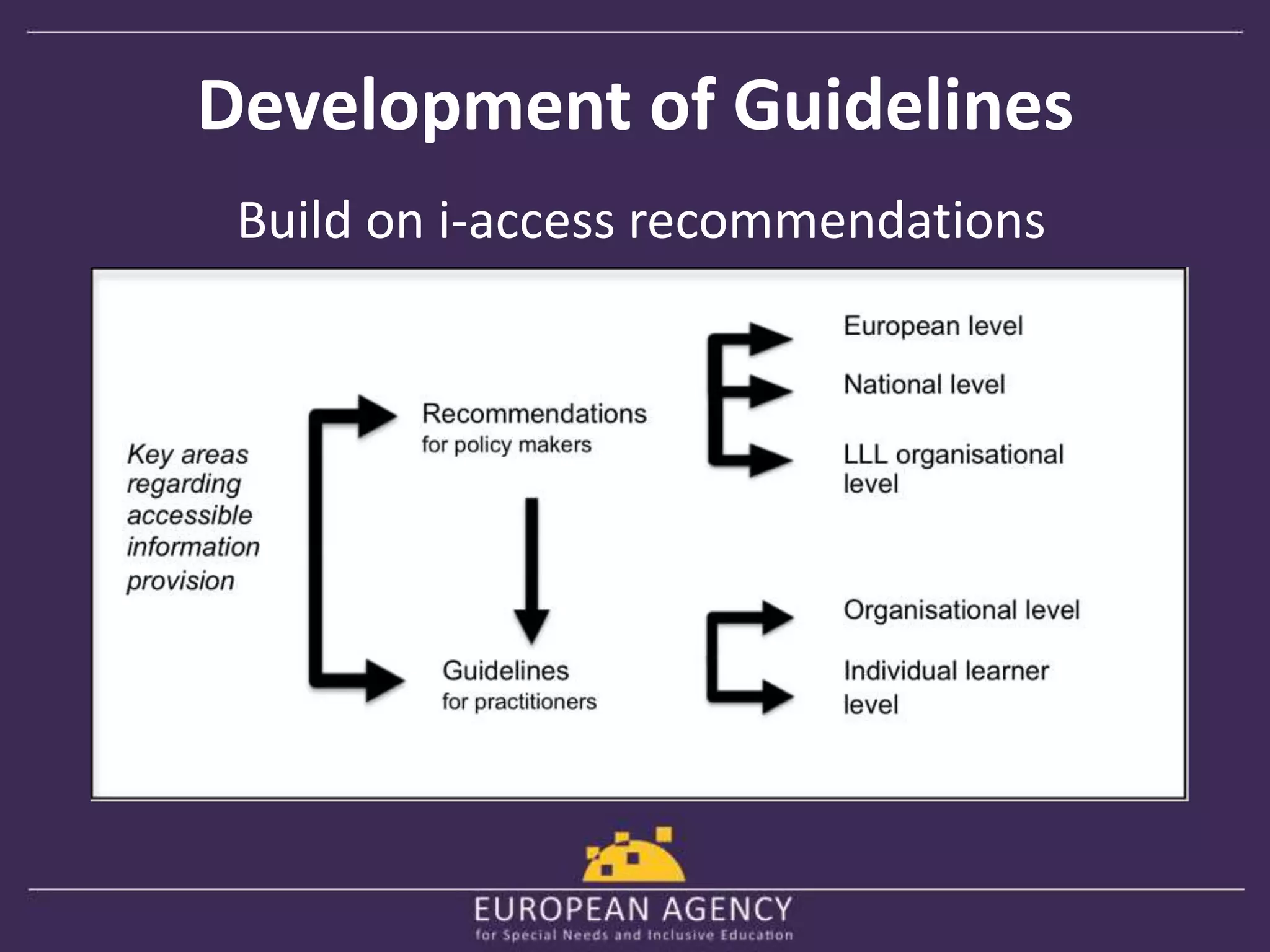
Development of Guidelines 
Build on i-access recommendations
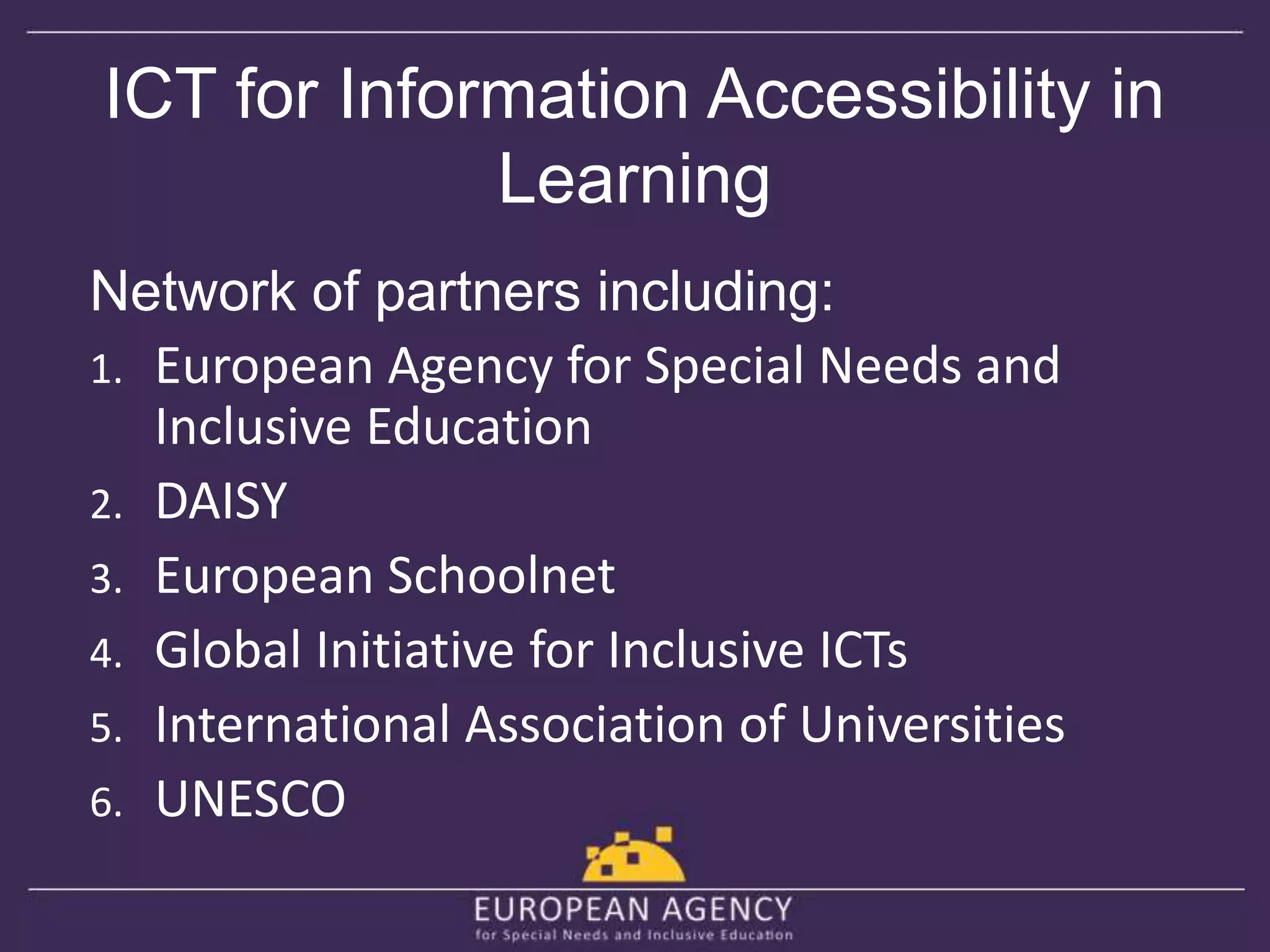
ICT for Information Accessibility in 
Learning 
Network of partners including: 
1. European Agency for Special Needs and 
Inclusive Education 
2. DAISY 
3. European Schoolnet 
4. Global Initiative for Inclusive ICTs 
5. International Association of Universities 
6. UNESCO
ICT4IAL Aims 
1. To raise awareness and increase the visibility 
of the issue of accessible information 
provision and its relevance for equitable 
lifelong learning opportunities,
ICT4IAL Aims 
2. Support accessible information provision 
within organisations through the: 
• Development of guidelines building on the 
recommendations for accessible information 
provision of the i-access project, 
• Trialing of the guidelines within 3 organisations 
(EUN, IAU and the Agency), 
• Evaluating these guidelines and their 
implementation.
ICT4IAL objectives 
1. Knowledge exchange and networking 
2. Developing and trialing of practical 
guidelines 
3. Reflection and evaluation upon 
implementation 
4. Validation of guidelines 
5. Dissemination and exploitation of results
Developing of Guidelines 
2 Phase approach: 
1. Drafting Guidelines based on exchange with experts 
and partners 
2. Redrafting Guidelines based on input from: 
• An International Survey including a document review and 
questionnaire 
• Implementation of the Guidelines within IAU, European 
Schoolnet and the Agency
A end-user’s perspective 
Inclusive education must become ‘normal’, but 
special skills must be learned by a lot of people to 
make that happen (Francesco, European Hearing, 
2011).
More information 
https://www.european-agency.org/agency-projects/ict4ial 
European Agency for Development in Special Needs Education 
Østre Stationsvej 33 
DK-5000 Odense C 
Denmark 
secretariat@european-agency.org 
Marcella Turner-Cmuchal marcella@european-agency.org 
Klára Somogyi klara@european-agency.org 
This project has been funded with support from the European 
Commission. This document reflects the views only of the author, 
and the Commission cannot be held responsible for any use which 
may be made of the information contained therein.

ICT4IAL Project

  • 1.
    ICT4IAL European Agencyfor Special Needs and Inclusive Education Marcella Turner-Cmuchal
  • 2.
  • 3.
    Currently • Nationalnetworks in 28 European countries: Austria, Belgium (Flemish and French speaking communities), Cyprus, Czech Republic, Denmark, Estonia, Finland, France, Germany, Greece, Hungary, Iceland, Ireland, Italy, Latvia, Lithuania, Luxembourg, Malta, Netherlands, Norway, Poland, Portugal, Slovak Republic, Slovenia, Spain, Sweden, Switzerland, United Kingdom (England, Northern Ireland, Scotland and Wales) • Main secretariat in Odense, Denmark and European Liaison office in Brussels, Belgium • 18th year of operations
  • 4.
    Funding The Agencyis financed by: • The member countries’ Ministries of Education • European Commission as one of the 6 organisations supported by the Jean Monnet, Erasmus+ Programme
  • 5.
    Mission • TheAgency is a permanent network of ministerial representatives acting as the member countries’ platform for collaboration regarding the promotion of quality and equity in education as a means to achieving social cohesion
  • 6.
    Focus • TheAgency’s main focus is upon inclusive education within its widest interpretation – that is dealing with learner difference and diversity in all educational settings as a quality issue. The Agency’s work is essentially concerned with how the achievement of all learners at all levels of inclusive lifelong learning can be improved in a meaningful way that enhances their life chances and opportunities for actively participating in society.
  • 7.
    Defining terms Accessibility Information Special needs Inclusion Equity in education
  • 8.
    ICT in educationfor learners with disabilities and SEN • UN figures – half a billion people with disabilities worldwide • 10% (a conservative estimate) of European population has some form of disability • 2% - 18% of the total school population (temporary or permanent educational needs) • ICT is increasingly seen as a major tool in meeting all learners’ individual learning needs • Knowledge Society for All is far from a reality for all European school pupils
  • 9.
    Why is accessibilityof information relevant for learning? Learners with disabilities and special needs must be able to access information relevant for learning in order to be present in a learning environment, participate in learning and to achieve. In meeting the specific needs of this learner group, a wider access for ALL learners is provided.
  • 10.
    ICT as anopportunity... There are two strong arguments for providing accessible information for learning – 1. Access to information is a human right 2. Providing accessible information is more economic Accessible ICT has the potential to create synergies, which may equally benefit people with disabilities and special needs, the ageing population as well as all members of society.
  • 11.
    Disability and theDigital Divide • People with disabilities are at risk of being doubly disadvantaged if their access to appropriate ICT is not supported • They risk becoming one of the main groups experiencing the growing digital divide • In addition, if some of their basic needs that could be addressed through the use of adaptive technology are not met, they risk further social exclusion
  • 12.
    Relevance of ICTin Agency projects • ICT in Special Needs Education (1999 - 2001) • SEN-IST-network (2000-2003) • ICT in Education for People with Disabilities – Practice Review (in collaboration with IITE) • Model policy for inclusive ICTs in education (in collaboration with UNESCO and G3ict) • Accessible Information Provision for Learning (i-access) • ICT for Information Accessibility in Learning (ICT4IAL) • ICT for Inclusion
  • 13.
    i-access: Guiding Principlesfor Accessibility • Rights Principle: Access to information is a fundamental right - it empowers learners and facilitates their participation in society. This access must be provided in the earliest phases of learning and accompany a learner throughout their lifetime. • Structural Principle: It is vital that any policy or recommendation does not regard technology as an end in itself. The systemic factors that determine the use of tools for lifelong learning must be recognised and considered. • All-Inclusive Principle: Accessible information provision needs to be considered in its widest interpretation to include people with all forms of disabilities and/or special educational needs. • Synergy Principle: Accessibility benefits users with disabilities and/or special educational needs and may often benefit all users.
  • 14.
    Recommendations for Policy 1. Raising awareness about accessible information for lifelong learning as a rights issue. 2. A multi-stakeholder approach based upon co-operation and information exchange should be taken. 3. Issues around accessible information provision should be covered in the education of all professionals involved in lifelong learning. 4. Issues around accessible information provision should be covered in the education of ICT and media professionals. 5. Accessibility should be a guiding principle for procurement of all goods and services. 6. Research should be promoted in order to develop an evidence base for future policy design, implementation and evaluation. 7. Compliance to policy should be systematically monitored.
  • 15.
    Development of Guidelines Build on i-access recommendations
  • 16.
    ICT for InformationAccessibility in Learning Network of partners including: 1. European Agency for Special Needs and Inclusive Education 2. DAISY 3. European Schoolnet 4. Global Initiative for Inclusive ICTs 5. International Association of Universities 6. UNESCO
  • 17.
    ICT4IAL Aims 1.To raise awareness and increase the visibility of the issue of accessible information provision and its relevance for equitable lifelong learning opportunities,
  • 18.
    ICT4IAL Aims 2.Support accessible information provision within organisations through the: • Development of guidelines building on the recommendations for accessible information provision of the i-access project, • Trialing of the guidelines within 3 organisations (EUN, IAU and the Agency), • Evaluating these guidelines and their implementation.
  • 19.
    ICT4IAL objectives 1.Knowledge exchange and networking 2. Developing and trialing of practical guidelines 3. Reflection and evaluation upon implementation 4. Validation of guidelines 5. Dissemination and exploitation of results
  • 20.
    Developing of Guidelines 2 Phase approach: 1. Drafting Guidelines based on exchange with experts and partners 2. Redrafting Guidelines based on input from: • An International Survey including a document review and questionnaire • Implementation of the Guidelines within IAU, European Schoolnet and the Agency
  • 21.
    A end-user’s perspective Inclusive education must become ‘normal’, but special skills must be learned by a lot of people to make that happen (Francesco, European Hearing, 2011).
  • 22.
    More information https://www.european-agency.org/agency-projects/ict4ial European Agency for Development in Special Needs Education Østre Stationsvej 33 DK-5000 Odense C Denmark secretariat@european-agency.org Marcella Turner-Cmuchal marcella@european-agency.org Klára Somogyi klara@european-agency.org This project has been funded with support from the European Commission. This document reflects the views only of the author, and the Commission cannot be held responsible for any use which may be made of the information contained therein.