The E- liosProject:
A school alliance for
Good Practices
Dr Chiotelis Ioannis
E- lios Coor dinator
E-Learning Interactive Open School
2015-1-EL01-KA201-014029
Collaboration for innovation and exchange of good
practice in the field of school education
EU: Digital dissemination
In March 2015, the Ministry of Economic Development – Department of
Communication – has published the Italian Digital Agenda (ADI). Italian Education
is now ruled by Law 107 “The Good School”, art 56 – 62.
Italian Agenda
 development of digital competences of students;
 strengthening of didactic and laboratory tools;
 adoption of organizational and technological tools in order to help
governance, transparency and data sharing;
 training of teachers for didactic innovation and development of digital
culture;
 training of administrative staff, in order to support digital innovation of
administration.
Tools Access
Venues (environments, Learning Plan, Innovative School Buildings
Digital Identity
Digital Administration
Competences, contents (Students, Innovation, Computing, Updated tech)
Digital, Entrepreneurship and Job
Digital Contents
Training (Teachers, Staff)
Tutoring and Support
Turkish Digital Agenda
Schools are fairly well-equipped with computer labs and classrooms with interactive
whiteboards.
Recently, within the context of strategic planning for the digital education several
training programs for teachers were organized with a view to drawing up the
integration of new technologies in everyday educational practice.
However, there is a dystocia in using new technologies in education mainly
because of a lack of teacher training in the use of new technologies. The
integration and the specific training procedures are lengthy at the risk of becoming
outdated technological equipment of schools
Great attention has been given to the extroversion of schools via the European
programs ERASMUS +. These programs introduced new educational techniques,
such as project based learning, mentoring, peer education and use of social media
in education.
The first results of the strategic plan of digital convergence in Turkish education
system expected in 2019.
The strategic plan in Turkey was established in 2015 and has a four-year prospective
The Turkish Ministry of Education supports distance education structures,
platforms supporting digital material, lifelong learning education and mobile
learning.
The Bulgarian Digital Era
In Bulgaria it has
become accepted that
modern societies are
becoming rapidly
technological.
In this context, the
strategic plan for the
digital convergence in
Bulgaria has the
following priorities:
 To raise students ' interest in ICT.
 To provide students with access to high-quality sources.
 To promote the creation of digital educational material.
 To promote interaction and critical thinking.
 To enhance the technological skills of the students.
 Introducing a modernized model educational administration.
The Bulgarian Digital Era
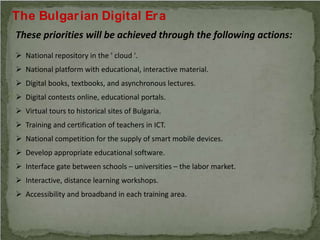
These priorities will be achieved through the following actions:
 National repository in the ' cloud '.
 National platform with educational, interactive material.
 Digital books, textbooks, and asynchronous lectures.
 Digital contests online, educational portals.
 Virtual tours to historical sites of Bulgaria.
 Training and certification of teachers in ICT.
 National competition for the supply of smart mobile devices.
 Develop appropriate educational software.
 Interface gate between schools – universities – the labor market.
 Interactive, distance learning workshops.
 Accessibility and broadband in each training area.
Romania: ICT in Education
Romania already prior its accession to the European Union invested in the introduction
of technology in education. In 2001 the Romanian Government introduced the
program SEI (Sistem Educational Informatizat).
This plan incorporated a large number of operations from equipping schools with
computers and train teachers, until creation of software with learner-centered
content.
The program was evaluated in 2004 and 2008, showing remarkable progress at all
levels of education.
After the positive review of the SEI program, was regarded as necessary to further
innovate, modernize and strengthen the Romanian education system by a second
project entitled RoEduNet (Romanian Educational Network) aimed mainly on
technological equipment for schools, universities and research centers.
The Romanian policy on new technologies in education emerged as a necessity of the
Romanian society for economic growth and prosperity. They were convinced that the
entrance of young people in the European labor market can only be done with the
right skills associated with the acquisition of technological skills.
Digital Era in Polish Education
In Poland the Informatics and the basic principles taught for the first time in
primary education.
In secondary Education there are addition courses of computing and
technology.
At the same time, in the course of project which is obligatory students are
invited to integrate knowledge of new technologies to their drafting and
research work.
In high school there is a study direction on informatics and students oriented
towards this direction are tested in the corresponding course subject.
At the Universities respectively there is a branch for computer science, where
students are specialized in new technologies.
In any case the Government has failed to develop a concrete plan for the
digital convergence of Polish education
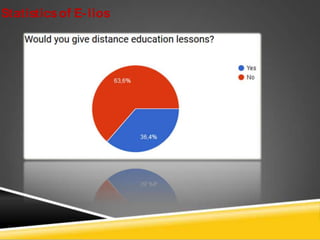
Statisticsof E- lios
The e lios project

The e lios project

  • 1.
    The E- liosProject: Aschool alliance for Good Practices Dr Chiotelis Ioannis E- lios Coor dinator
  • 2.
    E-Learning Interactive OpenSchool 2015-1-EL01-KA201-014029 Collaboration for innovation and exchange of good practice in the field of school education
  • 13.
  • 14.
    In March 2015,the Ministry of Economic Development – Department of Communication – has published the Italian Digital Agenda (ADI). Italian Education is now ruled by Law 107 “The Good School”, art 56 – 62. Italian Agenda  development of digital competences of students;  strengthening of didactic and laboratory tools;  adoption of organizational and technological tools in order to help governance, transparency and data sharing;  training of teachers for didactic innovation and development of digital culture;  training of administrative staff, in order to support digital innovation of administration. Tools Access Venues (environments, Learning Plan, Innovative School Buildings Digital Identity Digital Administration Competences, contents (Students, Innovation, Computing, Updated tech) Digital, Entrepreneurship and Job Digital Contents Training (Teachers, Staff) Tutoring and Support
  • 15.
    Turkish Digital Agenda Schoolsare fairly well-equipped with computer labs and classrooms with interactive whiteboards. Recently, within the context of strategic planning for the digital education several training programs for teachers were organized with a view to drawing up the integration of new technologies in everyday educational practice. However, there is a dystocia in using new technologies in education mainly because of a lack of teacher training in the use of new technologies. The integration and the specific training procedures are lengthy at the risk of becoming outdated technological equipment of schools Great attention has been given to the extroversion of schools via the European programs ERASMUS +. These programs introduced new educational techniques, such as project based learning, mentoring, peer education and use of social media in education. The first results of the strategic plan of digital convergence in Turkish education system expected in 2019. The strategic plan in Turkey was established in 2015 and has a four-year prospective The Turkish Ministry of Education supports distance education structures, platforms supporting digital material, lifelong learning education and mobile learning.
  • 16.
    The Bulgarian DigitalEra In Bulgaria it has become accepted that modern societies are becoming rapidly technological. In this context, the strategic plan for the digital convergence in Bulgaria has the following priorities:  To raise students ' interest in ICT.  To provide students with access to high-quality sources.  To promote the creation of digital educational material.  To promote interaction and critical thinking.  To enhance the technological skills of the students.  Introducing a modernized model educational administration.
  • 17.
    The Bulgarian DigitalEra These priorities will be achieved through the following actions:  National repository in the ' cloud '.  National platform with educational, interactive material.  Digital books, textbooks, and asynchronous lectures.  Digital contests online, educational portals.  Virtual tours to historical sites of Bulgaria.  Training and certification of teachers in ICT.  National competition for the supply of smart mobile devices.  Develop appropriate educational software.  Interface gate between schools – universities – the labor market.  Interactive, distance learning workshops.  Accessibility and broadband in each training area.
  • 18.
    Romania: ICT inEducation Romania already prior its accession to the European Union invested in the introduction of technology in education. In 2001 the Romanian Government introduced the program SEI (Sistem Educational Informatizat). This plan incorporated a large number of operations from equipping schools with computers and train teachers, until creation of software with learner-centered content. The program was evaluated in 2004 and 2008, showing remarkable progress at all levels of education. After the positive review of the SEI program, was regarded as necessary to further innovate, modernize and strengthen the Romanian education system by a second project entitled RoEduNet (Romanian Educational Network) aimed mainly on technological equipment for schools, universities and research centers. The Romanian policy on new technologies in education emerged as a necessity of the Romanian society for economic growth and prosperity. They were convinced that the entrance of young people in the European labor market can only be done with the right skills associated with the acquisition of technological skills.
  • 19.
    Digital Era inPolish Education In Poland the Informatics and the basic principles taught for the first time in primary education. In secondary Education there are addition courses of computing and technology. At the same time, in the course of project which is obligatory students are invited to integrate knowledge of new technologies to their drafting and research work. In high school there is a study direction on informatics and students oriented towards this direction are tested in the corresponding course subject. At the Universities respectively there is a branch for computer science, where students are specialized in new technologies. In any case the Government has failed to develop a concrete plan for the digital convergence of Polish education
  • 20.
  • 21.
  • 22.
  • 23.
  • 24.