Going Global? 
International Perspectives on Innovation 
in Media Literacy Education 
Renee Hobbs 
Media Education Summit, Prague 
November 20, 2014
Do We Really Need a 
Global Media Literacy Research 
Community?
TOO MANY 
DIFFERENCES?
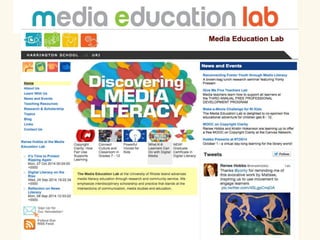
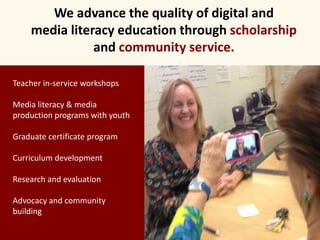
We advance the quality of digital and 
media literacy education through scholarship 
and community service. 
Teacher in-service workshops 
Media literacy & media 
production programs with youth 
Graduate certificate program 
Curriculum development 
Research and evaluation 
Advocacy and community 
building
PEER-TO-PEER FILE SHARING 
Theoretical Framework 
Communication & Education. Institutions of education and 
communication are interconnected in ways that may support democracy. 
Inquiry Learning. People develop intellectual curiosity by asking 
questions about what they experience in daily life. 
Critical Pedagogy. Awareness, analysis, and reflection enable people to 
take action to make society more just and equitable. 
Medium Theory. Media & technology are immersive cultural, political and 
economic environments; media structures re-shape human perception & 
values. 
Active Audience Theory. Meaning-making is variable; lived experience 
& social context shape practices of interpretation.
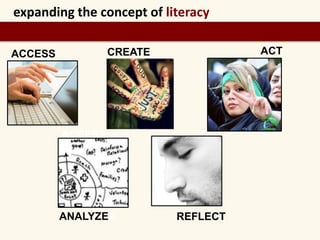
expanding the concept of literacy 
ACCESS 
CREATE ACT 
ANALYZEE 
REFLECT 
ACCESS
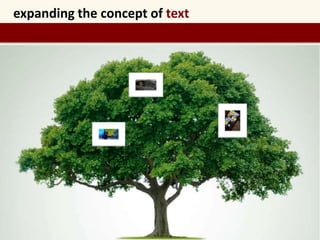
expanding the concept of text
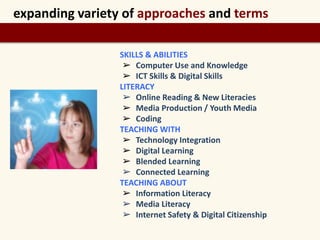
expanding variety of approaches and terms 
SKILLS & ABILITIES 
➢ Computer Use and Knowledge 
➢ ICT Skills & Digital Skills 
LITERACY 
➢ Online Reading & New Literacies 
➢ Media Production / Youth Media 
➢ Coding 
TEACHING WITH 
➢ Technology Integration 
➢ Digital Learning 
➢ Blended Learning 
➢ Connected Learning 
TEACHING ABOUT 
➢ Information Literacy 
➢ Media Literacy 
➢ Internet Safety & Digital Citizenship
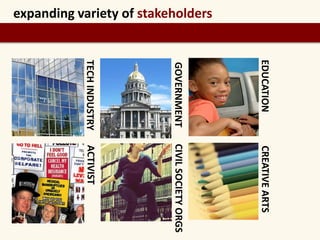
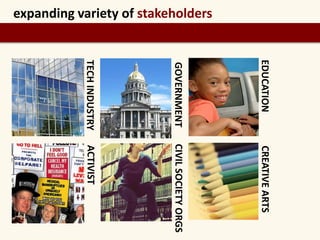
EDUCATION CREATIVE ARTS 
GOVERNMENT CIVIL SOCIETY ORGS 
TECH INDUSTRY ACTIVIST 
expanding variety of stakeholders
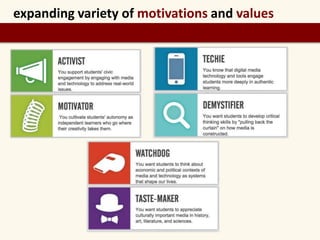
expanding variety of motivations and values
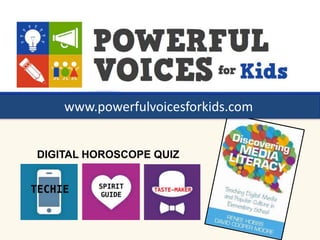
www.powerfulvoicesforkids.com 
DIGITAL HOROSCOPE QUIZ
Do We Really Need a 
Global Media Literacy Research 
Community?
Who? 
Where? 
What? 
How? 
Why? 
What are some 
of the most important 
differences? 
What are some 
of the most important 
similarities?
The Need For Global Innovation 
● Shifting definitions of digital & media literacy 
● New forms of media industry centralization 
● Global tensions & competition on the rise 
● Increased politicization of education 
● Growing gap between in-school and out-of-school 
learning 
● Uneven access to technology and competencies
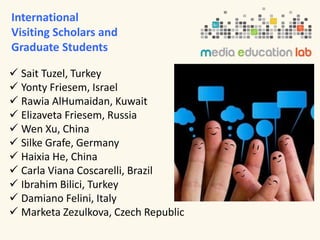
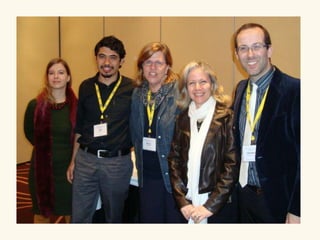
International 
Visiting Scholars and 
Graduate Students 
 Sait Tuzel, Turkey 
 Yonty Friesem, Israel 
 Rawia AlHumaidan, Kuwait 
 Elizaveta Friesem, Russia 
 Wen Xu, China 
 Silke Grafe, Germany 
 Haixia He, China 
 Carla Viana Coscarelli, Brazil 
 Ibrahim Bilici, Turkey 
 Damiano Felini, Italy 
 Marketa Zezulkova, Czech Republic
International 
Visiting Scholars and 
Graduate Students 
 Sait Tuzel, Turkey 
 Yonty Friesem, Israel 
 Rawia AlHumaidan, Kuwait 
 Elizaveta Friesem, Russia 
 Wen Xu, China 
 Silke Grafe, Germany 
 Haixia He, China 
 Carla Viana Coscarelli, Brazil 
 Ibrahim Bilici, Turkey 
 Damiano Felini, Italy 
 Marketa Zezulkova, Czech Republic
What Can be Learned Through 
Cross-National Comparison of 
Media Literacy Initiatives?
Russia 
Challenges 
● Media literacy is conceptualized as protection 
against bad [Western] media 
● Disparities in access to technology 
● National curriculum with strong lecture tradition 
and teacher-centered focus 
Opportunities 
● Active university research community 
● Film clubs and youth film production tradition is 
significant 
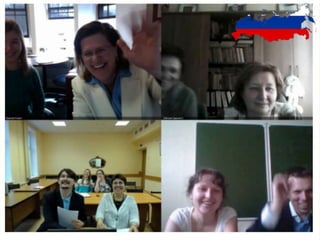
● Access to digital technology enables global 
conversations between educators & students
Innovation in Media Literacy Education 
is Deeply Situational & Contextual
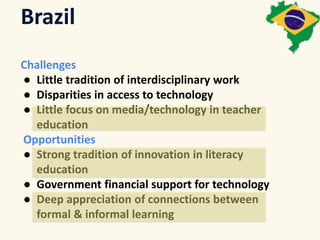
Brazil 
Challenges 
● Little tradition of interdisciplinary work 
● Disparities in access to technology 
● Little focus on media/technology in teacher 
education 
Opportunities 
● Strong tradition of innovation in literacy 
education 
● Government financial support for technology 
● Deep appreciation of connections between 
formal & informal learning
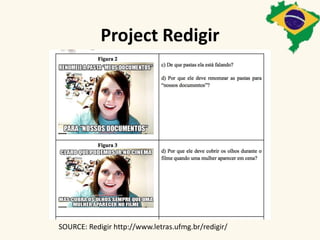
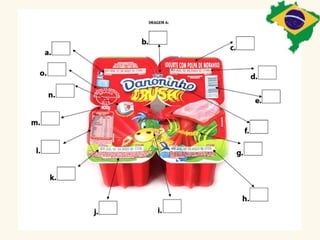
Project Redigir 
SOURCE: Redigir http://www.letras.ufmg.br/redigir/
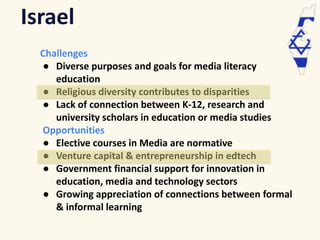
Israel 
Challenges 
● Diverse purposes and goals for media literacy 
education 
● Religious diversity contributes to disparities 
● Lack of connection between K-12, research and 
university scholars in education or media studies 
Opportunities 
● Elective courses in Media are normative 
● Venture capital & entrepreneurship in edtech 
● Government financial support for innovation in 
education, media and technology sectors 
● Growing appreciation of connections between formal 
& informal learning
Small Scale Programs Contribute to 
Innovation When Experience is Shared 
Authentically within the Knowledge 
Community
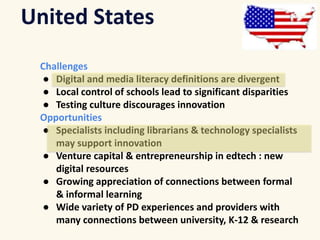
United States 
Challenges 
● Digital and media literacy definitions are divergent 
● Local control of schools lead to significant disparities 
● Testing culture discourages innovation 
Opportunities 
● Specialists including librarians & technology specialists 
may support innovation 
● Venture capital & entrepreneurship in edtech : new 
digital resources 
● Growing appreciation of connections between formal 
& informal learning 
● Wide variety of PD experiences and providers with 
many connections between university, K-12 & research
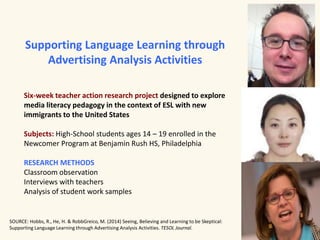
Supporting Language Learning through 
Advertising Analysis Activities 
Six-week teacher action research project designed to explore 
media literacy pedagogy in the context of ESL with new 
immigrants to the United States 
Subjects: High-School students ages 14 – 19 enrolled in the 
Newcomer Program at Benjamin Rush HS, Philadelphia 
RESEARCH METHODS 
Classroom observation 
Interviews with teachers 
Analysis of student work samples 
SOURCE: Hobbs, R., He, H. & RobbGreico, M. (2014) Seeing, Believing and Learning to be Skeptical: 
Supporting Language Learning through Advertising Analysis Activities. TESOL Journal.
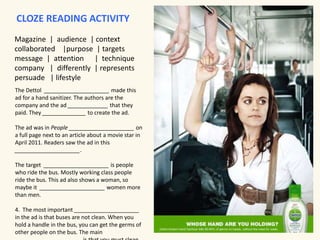
CLOZE READING ACTIVITY 
Magazine | audience | context 
collaborated |purpose | targets 
message | attention | technique 
company | differently | represents 
persuade | lifestyle 
The Dettol _____________________ made this 
ad for a hand sanitizer. The authors are the 
company and the ad _____________ that they 
paid. They ______________ to create the ad. 
The ad was in People _____________________ on 
a full page next to an article about a movie star in 
April 2011. Readers saw the ad in this 
_____________________. 
The target _____________________ is people 
who ride the bus. Mostly working class people 
ride the bus. This ad also shows a woman, so 
maybe it _____________________ women more 
than men. 
4. The most important _____________________ 
in the ad is that buses are not clean. When you 
hold a handle in the bus, you can get the germs of 
other people on the bus. The main 
_____________________ is that you must clean
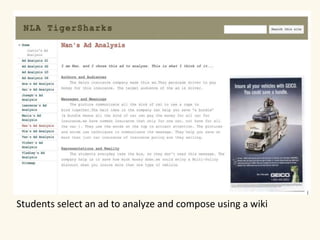
Students select an ad to analyze and compose using a wiki
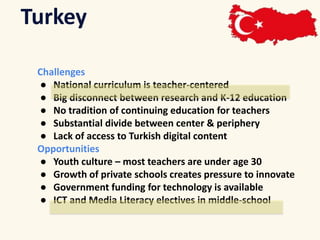
Turkey 
Challenges 
● National curriculum is teacher-centered 
● Big disconnect between research and K-12 education 
● No tradition of continuing education for teachers 
● Substantial divide between center & periphery 
● Lack of access to Turkish digital content 
Opportunities 
● Youth culture – most teachers are under age 30 
● Growth of private schools creates pressure to innovate 
● Government funding for technology is available 
● ICT and Media Literacy electives in middle-school
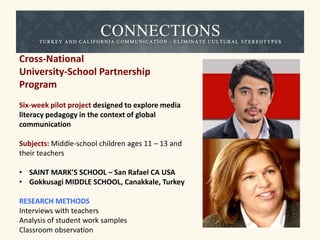
Cross-National 
University-School Partnership 
Program 
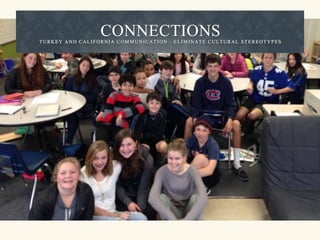
Six-week pilot project designed to explore media 
literacy pedagogy in the context of global 
communication 
Subjects: Middle-school children ages 11 – 13 and 
their teachers 
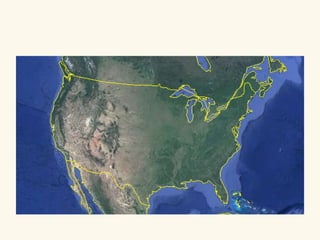
• SAINT MARK’S SCHOOL – San Rafael CA USA 
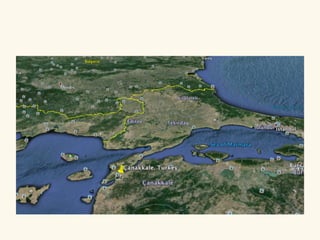
• Gokkusagi MIDDLE SCHOOL, Canakkale, Turkey 
RESEARCH METHODS 
Interviews with teachers 
Analysis of student work samples 
Classroom observation
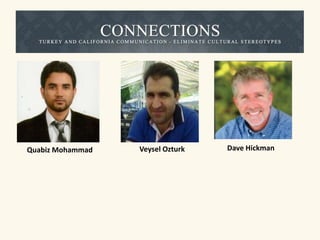
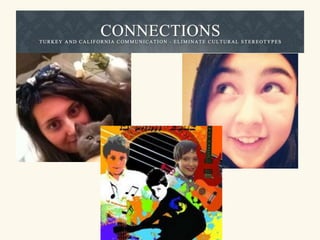
Quabiz Mohammad Veysel Ozturk Dave Hickman
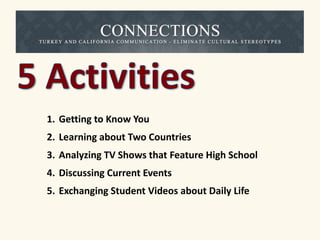
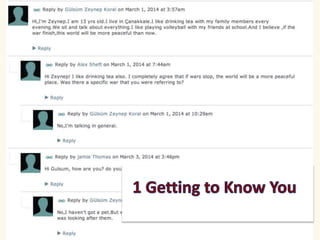
1. Getting to Know You 
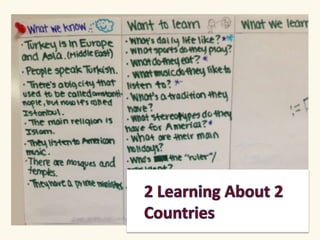
2. Learning about Two Countries 
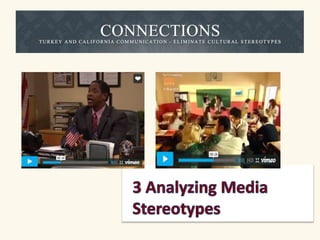
3. Analyzing TV Shows that Feature High School 
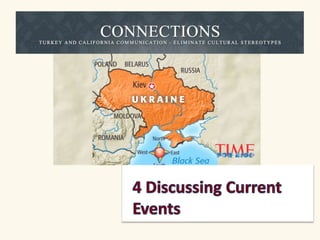
4. Discussing Current Events 
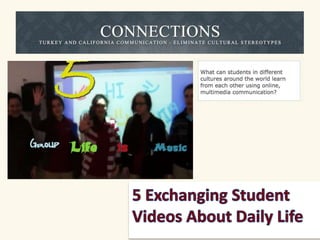
5. Exchanging Student Videos about Daily Life
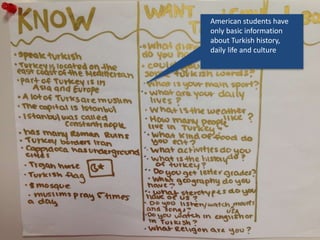
American students have 
only basic information 
about Turkish history, 
daily life and culture
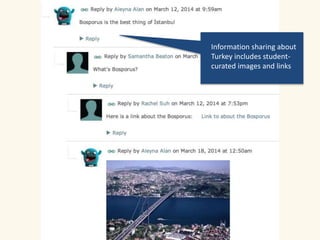
Information sharing about 
Turkey includes student-curated 
images and links
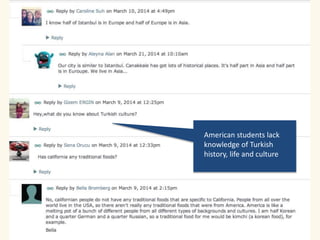
American students lack 
knowledge of Turkish 
history, life and culture
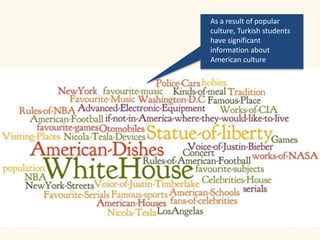
As a result of popular 
culture, Turkish students 
have significant 
information about 
American culture
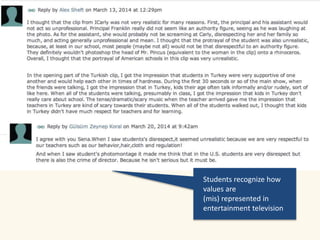
Students recognize how 
values are 
(mis) represented in 
entertainment television
Issues of Representation and Focus on 
Popular Culture Activate Critical Thinking 
about Personal & Social Identity 
in Relation to Culture & Values
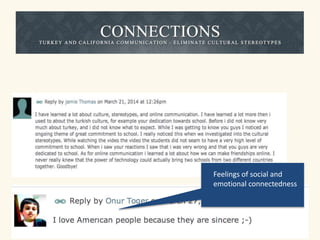
Feelings of social and 
emotional connectedness
Global Partnerships Promote Innovation 
to Advance New Knowledge in the Field
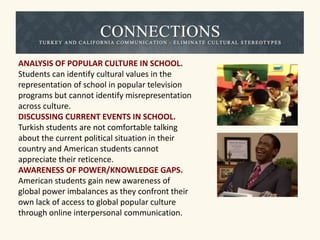
ANALYSIS OF POPULAR CULTURE IN SCHOOL. 
Students can identify cultural values in the 
representation of school in popular television 
programs but cannot identify misrepresentation 
across culture. 
DISCUSSING CURRENT EVENTS IN SCHOOL. 
Turkish students are not comfortable talking 
about the current political situation in their 
country and American students cannot 
appreciate their reticence. 
AWARENESS OF POWER/KNOWLEDGE GAPS. 
American students gain new awareness of 
global power imbalances as they confront their 
own lack of access to global popular culture 
through online interpersonal communication.
What Can be Learned Through 
Cross-National Comparison of 
Media Literacy Initiatives?
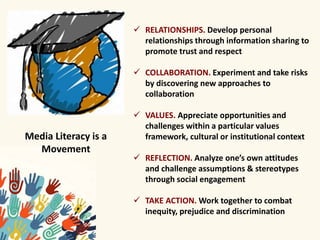
 RELATIONSHIPS. Develop personal 
relationships through information sharing to 
promote trust and respect 
 COLLABORATION. Experiment and take risks 
by discovering new approaches to 
collaboration 
 VALUES. Appreciate opportunities and 
challenges within a particular values 
framework, cultural or institutional context 
 REFLECTION. Analyze one’s own attitudes 
and challenge assumptions & stereotypes 
through social engagement 
 TAKE ACTION. Work together to combat 
inequity, prejudice and discrimination 
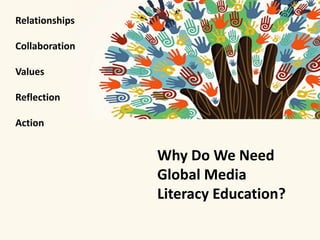
Media Literacy is a 
Movement
Why Do We Need 
Global Media 
Literacy Education? 
Relationships 
Collaboration 
Values 
Reflection 
Action
Conclusion 
 Innovation in media literacy education is deeply situational 
and contextual 
 Small scale programs contribute to innovation when 
experience is shared authentically within the knowledge 
community 
 Issues of representation and focus on popular culture 
activate critical thinking about personal and social identity 
in relation to culture and values 
 Global partnerships promote innovation to advance new 
knowledge in the field
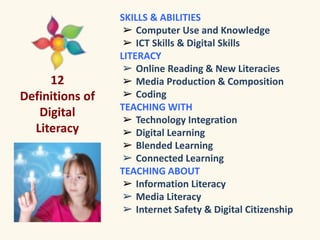
12 
Definitions of 
Digital 
Literacy 
SKILLS & ABILITIES 
➢ Computer Use and Knowledge 
➢ ICT Skills & Digital Skills 
LITERACY 
➢ Online Reading & New Literacies 
➢ Media Production & Composition 
➢ Coding 
TEACHING WITH 
➢ Technology Integration 
➢ Digital Learning 
➢ Blended Learning 
➢ Connected Learning 
TEACHING ABOUT 
➢ Information Literacy 
➢ Media Literacy 
➢ Internet Safety & Digital Citizenship
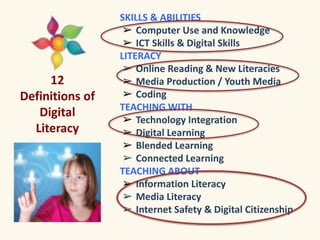
12 
Definitions of 
Digital 
Literacy 
SKILLS & ABILITIES 
➢ Computer Use and Knowledge 
➢ ICT Skills & Digital Skills 
LITERACY 
➢ Online Reading & New Literacies 
➢ Media Production / Youth Media 
➢ Coding 
TEACHING WITH 
➢ Technology Integration 
➢ Digital Learning 
➢ Blended Learning 
➢ Connected Learning 
TEACHING ABOUT 
➢ Information Literacy 
➢ Media Literacy 
➢ Internet Safety & Digital Citizenship
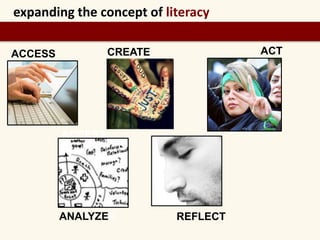
expanding the concept of literacy 
ACCESS 
CREATE ACT 
ANALYZEE 
REFLECT 
ACCESS
EDUCATION CREATIVE ARTS 
GOVERNMENT CIVIL SOCIETY ORGS 
TECH INDUSTRY ACTIVIST 
expanding variety of stakeholders
We must embrace new approaches and 
new stakeholders who help us expand the 
concept of literacy
A Proposed Unifying Principle 
We use the power of information and 
communication to make a difference in 
the world
Hobbs, R., He, H. & RobbGreico, M. (2014) Seeing, Believing and Learning to be Skeptical: Supporting 
Language Learning through Advertising Analysis Activities. TESOL Journal. 
Hobbs, R. & Tuzel, S. (2014). “The Use of Media Literacy Instructional Strategies for Promoting Intercultural 
Communication in U.S. & Turkish Middle Schools.” Paper presentation to the International Association for 
Intercultural Communication Studies (IAICS). Providence, RI. August 1. 
Hobbs, R. & Friesem, L. (2014). “Connecting Continents.” Online professional development program with 
Russian educators. Russian Academy of Education, March 25. 
Hobbs, R. (2014). “How Teachers Motivations Shape Digital Learning.” Workshop presentation at SXSW Edu. 
Austin, TX. March 24. 
Hobbs, R. (2013). “Global Developments in Media Literacy Education,” Media and Digital Literacy Lab 
(MDLAB). Keynote address at the American University of Beirut, Lebanon. August 18. 
Hobbs (2011). “How Digital and Media Literacy Supports Global Understanding,” Arab-US Association of 
Communication Educators (AUSACE), Beirut, Lebanon, October 30. 
Hobbs, R., Yoon, J., Al-Humaidan, R., Ebrahimi, A. & Cabral, N. (2011). Online digital media in elementary 
school. Journal of Middle East Media 7(1), 1 – 23. 
Hobbs, R., Ebrahimi, A., Cabral, N., Yoon, J., & Al-Humaidan, R. (2011). Field-based teacher education in 
elementary media literacy as a means to promote global understanding. Action for Teacher Education 33, 144 
– 156. 
www.mediaeducationlab.com
Renee Hobbs 
Professor of Communication Studies 
Director, Media Education Lab 
Harrington School of Communication and Media, 
University of Rhode Island USA 
Email: hobbs@uri.edu 
Twitter: @reneehobbs 
WEB: www.mediaeducationlab.com

Going Global?

  • 1.
    Going Global? InternationalPerspectives on Innovation in Media Literacy Education Renee Hobbs Media Education Summit, Prague November 20, 2014
  • 2.
    Do We ReallyNeed a Global Media Literacy Research Community?
  • 3.
  • 5.
    We advance thequality of digital and media literacy education through scholarship and community service. Teacher in-service workshops Media literacy & media production programs with youth Graduate certificate program Curriculum development Research and evaluation Advocacy and community building
  • 6.
    PEER-TO-PEER FILE SHARING Theoretical Framework Communication & Education. Institutions of education and communication are interconnected in ways that may support democracy. Inquiry Learning. People develop intellectual curiosity by asking questions about what they experience in daily life. Critical Pedagogy. Awareness, analysis, and reflection enable people to take action to make society more just and equitable. Medium Theory. Media & technology are immersive cultural, political and economic environments; media structures re-shape human perception & values. Active Audience Theory. Meaning-making is variable; lived experience & social context shape practices of interpretation.
  • 7.
    expanding the conceptof literacy ACCESS CREATE ACT ANALYZEE REFLECT ACCESS
  • 8.
  • 9.
    expanding variety ofapproaches and terms SKILLS & ABILITIES ➢ Computer Use and Knowledge ➢ ICT Skills & Digital Skills LITERACY ➢ Online Reading & New Literacies ➢ Media Production / Youth Media ➢ Coding TEACHING WITH ➢ Technology Integration ➢ Digital Learning ➢ Blended Learning ➢ Connected Learning TEACHING ABOUT ➢ Information Literacy ➢ Media Literacy ➢ Internet Safety & Digital Citizenship
  • 10.
    EDUCATION CREATIVE ARTS GOVERNMENT CIVIL SOCIETY ORGS TECH INDUSTRY ACTIVIST expanding variety of stakeholders
  • 11.
    expanding variety ofmotivations and values
  • 12.
  • 13.
    Do We ReallyNeed a Global Media Literacy Research Community?
  • 14.
    Who? Where? What? How? Why? What are some of the most important differences? What are some of the most important similarities?
  • 15.
    The Need ForGlobal Innovation ● Shifting definitions of digital & media literacy ● New forms of media industry centralization ● Global tensions & competition on the rise ● Increased politicization of education ● Growing gap between in-school and out-of-school learning ● Uneven access to technology and competencies
  • 16.
    International Visiting Scholarsand Graduate Students  Sait Tuzel, Turkey  Yonty Friesem, Israel  Rawia AlHumaidan, Kuwait  Elizaveta Friesem, Russia  Wen Xu, China  Silke Grafe, Germany  Haixia He, China  Carla Viana Coscarelli, Brazil  Ibrahim Bilici, Turkey  Damiano Felini, Italy  Marketa Zezulkova, Czech Republic
  • 17.
    International Visiting Scholarsand Graduate Students  Sait Tuzel, Turkey  Yonty Friesem, Israel  Rawia AlHumaidan, Kuwait  Elizaveta Friesem, Russia  Wen Xu, China  Silke Grafe, Germany  Haixia He, China  Carla Viana Coscarelli, Brazil  Ibrahim Bilici, Turkey  Damiano Felini, Italy  Marketa Zezulkova, Czech Republic
  • 18.
    What Can beLearned Through Cross-National Comparison of Media Literacy Initiatives?
  • 20.
    Russia Challenges ●Media literacy is conceptualized as protection against bad [Western] media ● Disparities in access to technology ● National curriculum with strong lecture tradition and teacher-centered focus Opportunities ● Active university research community ● Film clubs and youth film production tradition is significant ● Access to digital technology enables global conversations between educators & students
  • 22.
    Innovation in MediaLiteracy Education is Deeply Situational & Contextual
  • 23.
    Brazil Challenges ●Little tradition of interdisciplinary work ● Disparities in access to technology ● Little focus on media/technology in teacher education Opportunities ● Strong tradition of innovation in literacy education ● Government financial support for technology ● Deep appreciation of connections between formal & informal learning
  • 24.
    Project Redigir SOURCE:Redigir http://www.letras.ufmg.br/redigir/
  • 26.
    Israel Challenges ●Diverse purposes and goals for media literacy education ● Religious diversity contributes to disparities ● Lack of connection between K-12, research and university scholars in education or media studies Opportunities ● Elective courses in Media are normative ● Venture capital & entrepreneurship in edtech ● Government financial support for innovation in education, media and technology sectors ● Growing appreciation of connections between formal & informal learning
  • 28.
    Small Scale ProgramsContribute to Innovation When Experience is Shared Authentically within the Knowledge Community
  • 29.
    United States Challenges ● Digital and media literacy definitions are divergent ● Local control of schools lead to significant disparities ● Testing culture discourages innovation Opportunities ● Specialists including librarians & technology specialists may support innovation ● Venture capital & entrepreneurship in edtech : new digital resources ● Growing appreciation of connections between formal & informal learning ● Wide variety of PD experiences and providers with many connections between university, K-12 & research
  • 30.
    Supporting Language Learningthrough Advertising Analysis Activities Six-week teacher action research project designed to explore media literacy pedagogy in the context of ESL with new immigrants to the United States Subjects: High-School students ages 14 – 19 enrolled in the Newcomer Program at Benjamin Rush HS, Philadelphia RESEARCH METHODS Classroom observation Interviews with teachers Analysis of student work samples SOURCE: Hobbs, R., He, H. & RobbGreico, M. (2014) Seeing, Believing and Learning to be Skeptical: Supporting Language Learning through Advertising Analysis Activities. TESOL Journal.
  • 31.
    CLOZE READING ACTIVITY Magazine | audience | context collaborated |purpose | targets message | attention | technique company | differently | represents persuade | lifestyle The Dettol _____________________ made this ad for a hand sanitizer. The authors are the company and the ad _____________ that they paid. They ______________ to create the ad. The ad was in People _____________________ on a full page next to an article about a movie star in April 2011. Readers saw the ad in this _____________________. The target _____________________ is people who ride the bus. Mostly working class people ride the bus. This ad also shows a woman, so maybe it _____________________ women more than men. 4. The most important _____________________ in the ad is that buses are not clean. When you hold a handle in the bus, you can get the germs of other people on the bus. The main _____________________ is that you must clean
  • 32.
    Students select anad to analyze and compose using a wiki
  • 33.
    Turkey Challenges ●National curriculum is teacher-centered ● Big disconnect between research and K-12 education ● No tradition of continuing education for teachers ● Substantial divide between center & periphery ● Lack of access to Turkish digital content Opportunities ● Youth culture – most teachers are under age 30 ● Growth of private schools creates pressure to innovate ● Government funding for technology is available ● ICT and Media Literacy electives in middle-school
  • 34.
    Cross-National University-School Partnership Program Six-week pilot project designed to explore media literacy pedagogy in the context of global communication Subjects: Middle-school children ages 11 – 13 and their teachers • SAINT MARK’S SCHOOL – San Rafael CA USA • Gokkusagi MIDDLE SCHOOL, Canakkale, Turkey RESEARCH METHODS Interviews with teachers Analysis of student work samples Classroom observation
  • 37.
    Quabiz Mohammad VeyselOzturk Dave Hickman
  • 40.
    1. Getting toKnow You 2. Learning about Two Countries 3. Analyzing TV Shows that Feature High School 4. Discussing Current Events 5. Exchanging Student Videos about Daily Life
  • 43.
    American students have only basic information about Turkish history, daily life and culture
  • 44.
    Information sharing about Turkey includes student-curated images and links
  • 45.
    American students lack knowledge of Turkish history, life and culture
  • 46.
    As a resultof popular culture, Turkish students have significant information about American culture
  • 50.
    Students recognize how values are (mis) represented in entertainment television
  • 51.
    Issues of Representationand Focus on Popular Culture Activate Critical Thinking about Personal & Social Identity in Relation to Culture & Values
  • 54.
    Feelings of socialand emotional connectedness
  • 55.
    Global Partnerships PromoteInnovation to Advance New Knowledge in the Field
  • 56.
    ANALYSIS OF POPULARCULTURE IN SCHOOL. Students can identify cultural values in the representation of school in popular television programs but cannot identify misrepresentation across culture. DISCUSSING CURRENT EVENTS IN SCHOOL. Turkish students are not comfortable talking about the current political situation in their country and American students cannot appreciate their reticence. AWARENESS OF POWER/KNOWLEDGE GAPS. American students gain new awareness of global power imbalances as they confront their own lack of access to global popular culture through online interpersonal communication.
  • 57.
    What Can beLearned Through Cross-National Comparison of Media Literacy Initiatives?
  • 58.
     RELATIONSHIPS. Developpersonal relationships through information sharing to promote trust and respect  COLLABORATION. Experiment and take risks by discovering new approaches to collaboration  VALUES. Appreciate opportunities and challenges within a particular values framework, cultural or institutional context  REFLECTION. Analyze one’s own attitudes and challenge assumptions & stereotypes through social engagement  TAKE ACTION. Work together to combat inequity, prejudice and discrimination Media Literacy is a Movement
  • 59.
    Why Do WeNeed Global Media Literacy Education? Relationships Collaboration Values Reflection Action
  • 60.
    Conclusion  Innovationin media literacy education is deeply situational and contextual  Small scale programs contribute to innovation when experience is shared authentically within the knowledge community  Issues of representation and focus on popular culture activate critical thinking about personal and social identity in relation to culture and values  Global partnerships promote innovation to advance new knowledge in the field
  • 61.
    12 Definitions of Digital Literacy SKILLS & ABILITIES ➢ Computer Use and Knowledge ➢ ICT Skills & Digital Skills LITERACY ➢ Online Reading & New Literacies ➢ Media Production & Composition ➢ Coding TEACHING WITH ➢ Technology Integration ➢ Digital Learning ➢ Blended Learning ➢ Connected Learning TEACHING ABOUT ➢ Information Literacy ➢ Media Literacy ➢ Internet Safety & Digital Citizenship
  • 62.
    12 Definitions of Digital Literacy SKILLS & ABILITIES ➢ Computer Use and Knowledge ➢ ICT Skills & Digital Skills LITERACY ➢ Online Reading & New Literacies ➢ Media Production / Youth Media ➢ Coding TEACHING WITH ➢ Technology Integration ➢ Digital Learning ➢ Blended Learning ➢ Connected Learning TEACHING ABOUT ➢ Information Literacy ➢ Media Literacy ➢ Internet Safety & Digital Citizenship
  • 63.
    expanding the conceptof literacy ACCESS CREATE ACT ANALYZEE REFLECT ACCESS
  • 64.
    EDUCATION CREATIVE ARTS GOVERNMENT CIVIL SOCIETY ORGS TECH INDUSTRY ACTIVIST expanding variety of stakeholders
  • 65.
    We must embracenew approaches and new stakeholders who help us expand the concept of literacy
  • 66.
    A Proposed UnifyingPrinciple We use the power of information and communication to make a difference in the world
  • 67.
    Hobbs, R., He,H. & RobbGreico, M. (2014) Seeing, Believing and Learning to be Skeptical: Supporting Language Learning through Advertising Analysis Activities. TESOL Journal. Hobbs, R. & Tuzel, S. (2014). “The Use of Media Literacy Instructional Strategies for Promoting Intercultural Communication in U.S. & Turkish Middle Schools.” Paper presentation to the International Association for Intercultural Communication Studies (IAICS). Providence, RI. August 1. Hobbs, R. & Friesem, L. (2014). “Connecting Continents.” Online professional development program with Russian educators. Russian Academy of Education, March 25. Hobbs, R. (2014). “How Teachers Motivations Shape Digital Learning.” Workshop presentation at SXSW Edu. Austin, TX. March 24. Hobbs, R. (2013). “Global Developments in Media Literacy Education,” Media and Digital Literacy Lab (MDLAB). Keynote address at the American University of Beirut, Lebanon. August 18. Hobbs (2011). “How Digital and Media Literacy Supports Global Understanding,” Arab-US Association of Communication Educators (AUSACE), Beirut, Lebanon, October 30. Hobbs, R., Yoon, J., Al-Humaidan, R., Ebrahimi, A. & Cabral, N. (2011). Online digital media in elementary school. Journal of Middle East Media 7(1), 1 – 23. Hobbs, R., Ebrahimi, A., Cabral, N., Yoon, J., & Al-Humaidan, R. (2011). Field-based teacher education in elementary media literacy as a means to promote global understanding. Action for Teacher Education 33, 144 – 156. www.mediaeducationlab.com
  • 68.
    Renee Hobbs Professorof Communication Studies Director, Media Education Lab Harrington School of Communication and Media, University of Rhode Island USA Email: hobbs@uri.edu Twitter: @reneehobbs WEB: www.mediaeducationlab.com

Editor's Notes

  • #2 Jonathan
  • #5 Instructors – experience with