Museums and the
Internet of Things
Impacts of New Frontiers in Data on
Curators, Audiences, and Practice
Robert Weisberg, Senior Project Manager,
Publications and Editorial Department,
The Metropolitan Museum of Art
Robert Weisberg Museums and the Internet of Things
22 years in museum publishing (books, then digital projects, now labels) at
The Met. Four different job titles:
● Computer Specialist
● Desktop Publishing Manager
● Assistant Managing Editor
● Senior Project Manager
But in common: a search for patterns in the huge amount of editorial content
flowing through the Met: 20-25 art books, 5,000 object labels per year, and
digital hybrid projects.
About me
Robert Weisberg Museums and the Internet of Things
So what is the Internet of Things
to a museum?
Data about objects in the collection?
Data about visitors (physical or digital)?
Data about educational or other programs
undertaken by the museum?
Data about museum’s place in social media?
Data points within books and labels?
… but it all requires data!
Robert Weisberg Museums and the Internet of Things
Data at The Met: Objects in the Collection
1870
Ca. 1970
2015
Robert Weisberg Museums and the Internet of Things
Object data at The Met:
Also used for …
• Acquisition
• Storage and Inventory
• Research and Publications
• Exhibitions
• Loans
• Shipments
• Deaccessioning
Our Collection Management
System feeds into The Collection
Online, our online public-facing
database.
Robert Weisberg Museums and the Internet of Things
Object data: tracking artworks in Conservation
The Met used JIRA (from Atlassian) for IT and
Merchandising workflows. Now using for
artwork in Conservation.
Robert Weisberg Museums and the Internet of Things
How museums are gathering data: some examples
The Pen: Cooper Hewitt merges internal and external systems
Beacons: Guggenheim (Near Me feature), Brooklyn Museum (ASK app), Art Institute
of Chicago (300 beacons), Tech Museum of Innovation in San Jose (beacons to
capture tons of visitor data), and SFMOMA (new audio app)
GitHub: Natural history museums of U of Colorado and Florida State U using this
software-development sharing site to keep versions of their information stored.
Visitor data: Dallas Art Museum (Friends project), Australian Centre for the Moving
Image (“visitor journey mapping”)
Robert Weisberg Museums and the Internet of Things
Data and library practice in museums
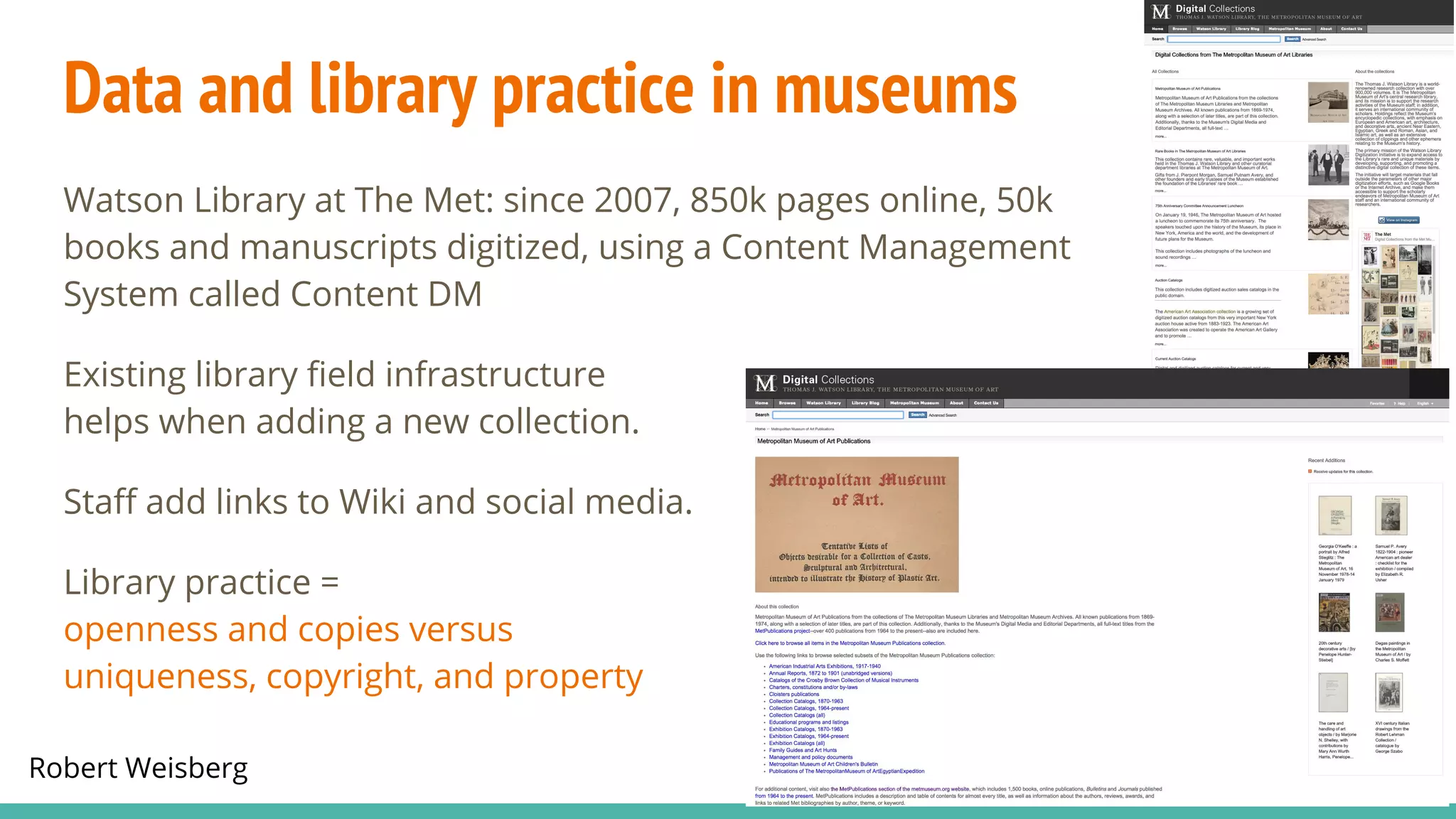
Watson Library at The Met: since 2007, 850k pages online, 50k
books and manuscripts digitized, using a Content Management
System called Content DM
Existing library field infrastructure
helps when adding a new collection.
Staff add links to Wiki and social media.
Library practice =
openness and copies versus
uniqueness, copyright, and property
Robert Weisberg Museums and the Internet of Things
Data and publishing practice in museums
Art book publishing is resource-intensive and may not have a lot of bandwidth
left over for data practice, including data inside of the print book’s digital files.
Print publishers are new to the idea of user (reader) data. Independent and
digital authors have been more aggressive about data and reader experience.
Robert Weisberg Museums and the Internet of Things
Digital
publishing
endeavors
(clockwise
from upper
left):
Met,
SFMOMA,
Getty,
MoMA,
Art Institute
of Chicago
Robert Weisberg Museums and the Internet of Things
Data and object labels
The Met has about 60,000 labels around the museum.
In the museum field, labels have different relationships to databases
depending on the institution (at MoMA, tightly tied into their CMS; at the Met,
not so much, but we’re trying).
Also has data that can be captured, and in some ways this is more useful
because labels are so tightly related to the collection. (“Low-hanging fruit.”)
Robert Weisberg Museums and the Internet of Things
Data and museum visitors
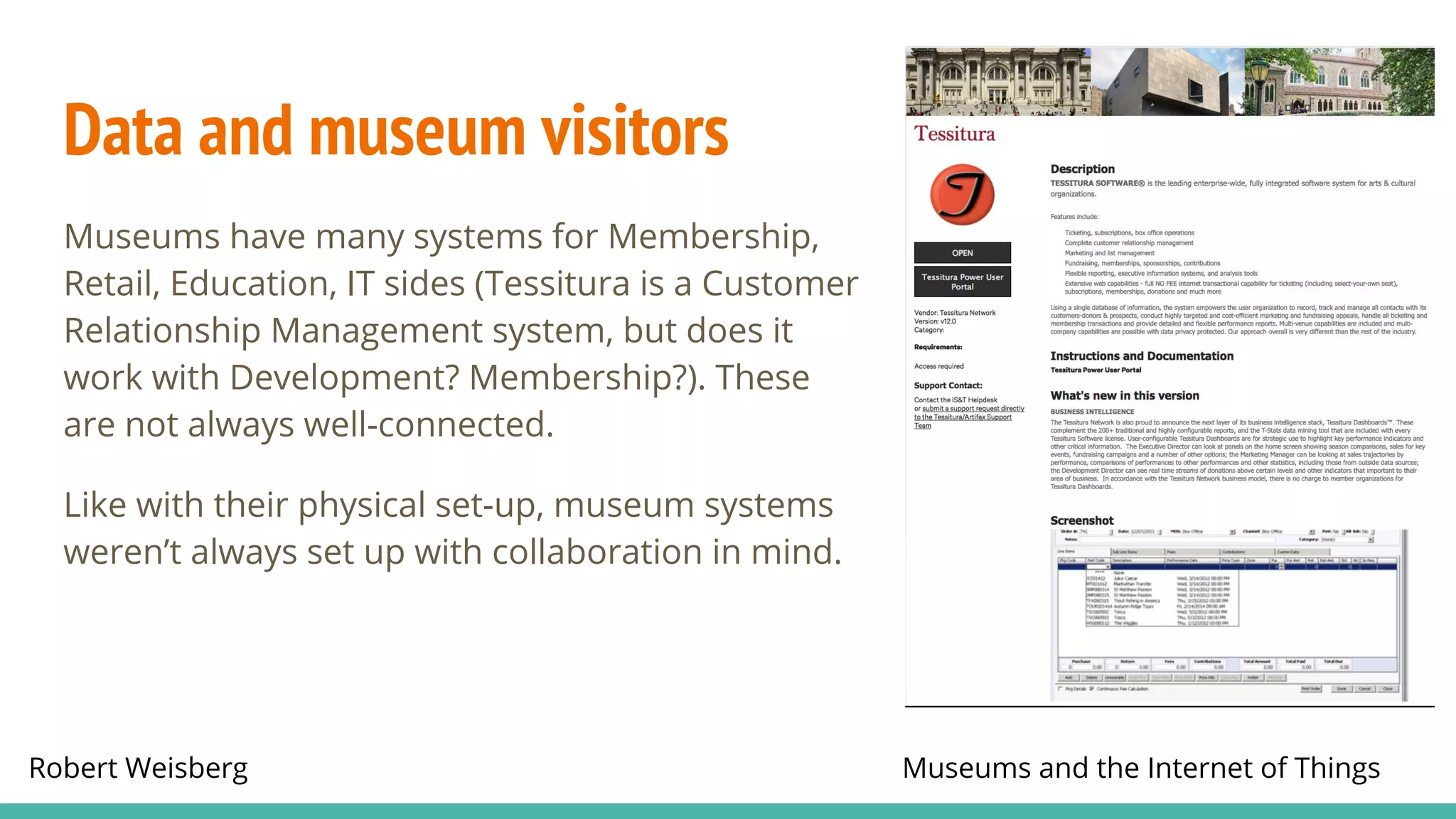
Museums have many systems for Membership,
Retail, Education, IT sides (Tessitura is a Customer
Relationship Management system, but does it
work with Development? Membership?). These
are not always well-connected.
Like with their physical set-up, museum systems
weren’t always set up with collaboration in mind.
Robert Weisberg Museums and the Internet of Things
Data and
museum
websites
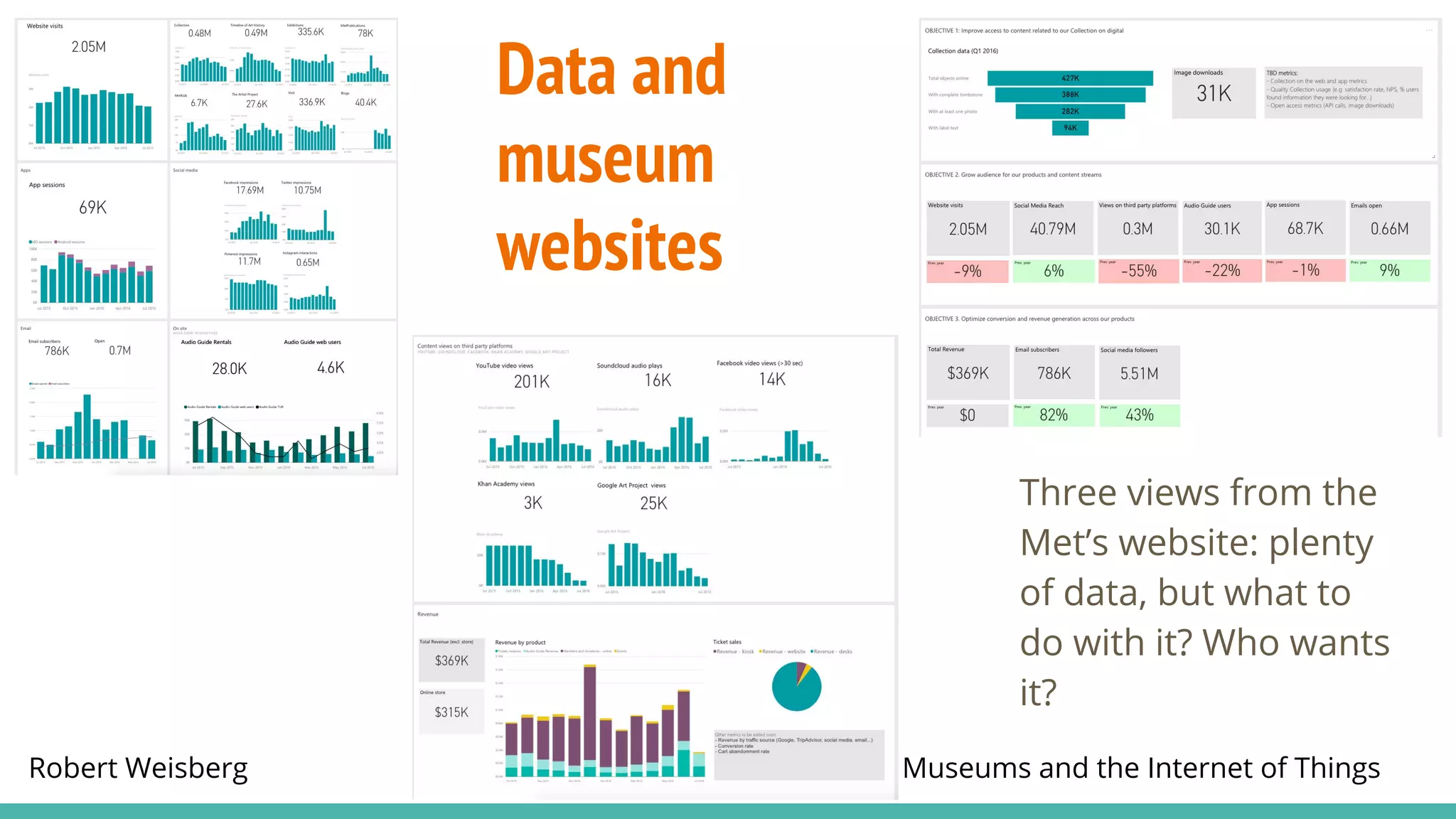
Three views from the
Met’s website: plenty
of data, but what to
do with it? Who wants
it?
Robert Weisberg Museums and the Internet of Things
Data and museums: a question of culture
Museum culture can be split between focus on collection and focus on visitor.
“Data” can be seen as a visitor concern.
Data, like dashboards regarding website visits, ends up in the Digital
department and doesn’t always get distributed.
Tracking visitor usage to improve visitor experience can involve many, many
departments. Culture is a big issue.
Museums have to decide to devote resources to data practice.
Robert Weisberg Museums and the Internet of Things
Data and museums: thinking of the visitor
“[W]e need to be careful because the editorial perspective of the Times is one of
the things that our subscribers value. They expect us to curate things they need to
know, not just the things that they want to know. We’re thinking about how can we
create a level of abstraction around the editorial judgment that we supply, so it can
be potentially worked into an algorithm.”
“What I see is an organization that really, really wants to change, but which has
deep-seated instincts that are different from what you would see in a data-driven
organization.”
— Nick Rockwell, Chief Technology Officer, The New York Times
Robert Weisberg Museums and the Internet of Things
So where to go from here? Some silver bullets:
Libraries: link library holdings with objects in the collection, improve
vocabularies and discovery layers, combine idea of reader/user/visitor
Publishers: link print and digital formats at time of production
Curatorial: end the transactional nature of digital information about
objects, decide how “open” research is going to be, build data into research
at the time of set-up
Visitor experience: provide multiple tracks of label information based on
preferences
Robert Weisberg Museums and the Internet of Things
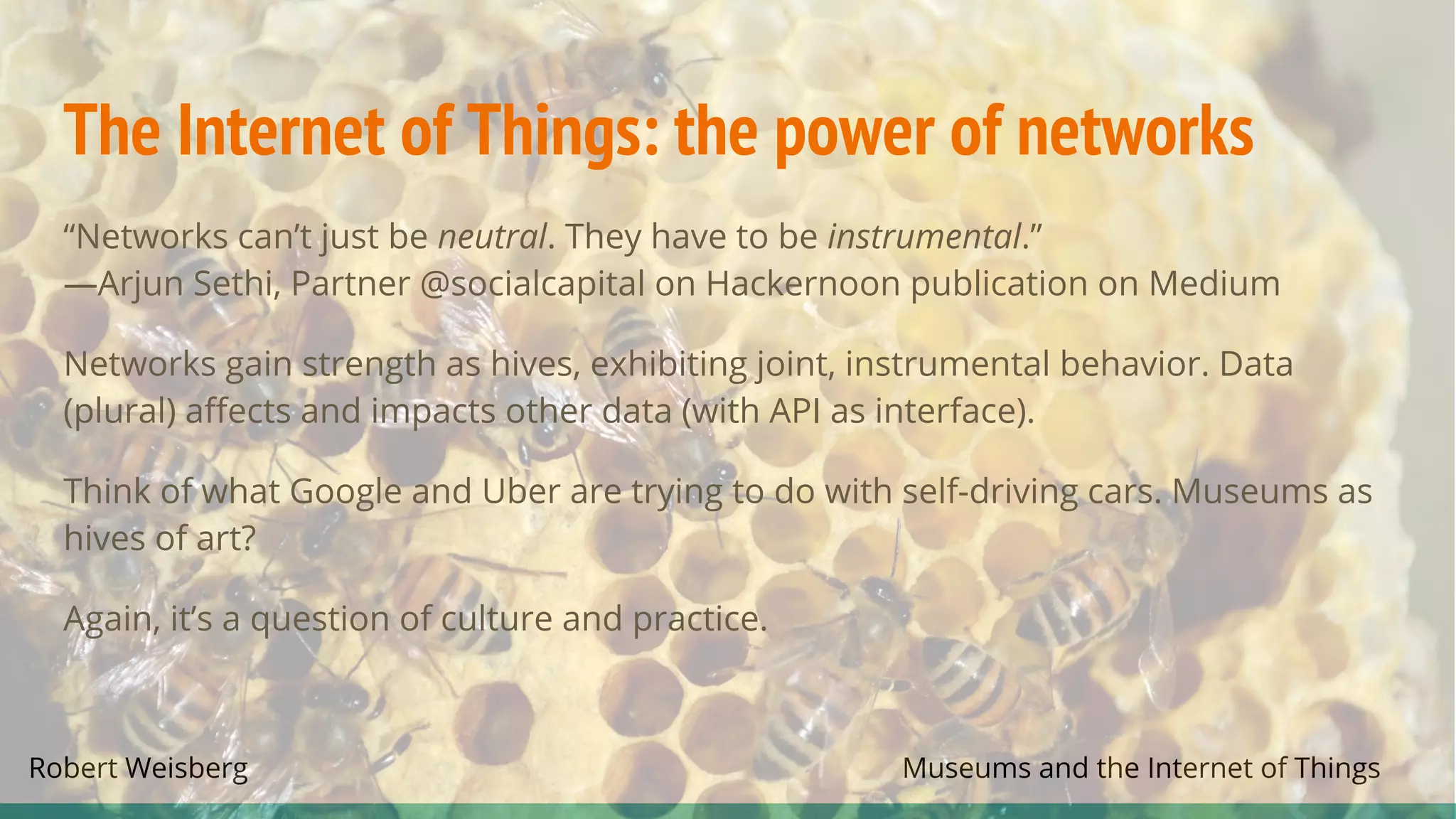
The Internet of Things: the power of networks
“Networks can’t just be neutral. They have to be instrumental.”
—Arjun Sethi, Partner @socialcapital on Hackernoon publication on Medium
Networks gain strength as hives, exhibiting joint, instrumental behavior. Data
(plural) affects and impacts other data (with API as interface).
Think of what Google and Uber are trying to do with self-driving cars. Museums as
hives of art?
Again, it’s a question of culture and practice.
Robert Weisberg Museums and the Internet of Things
The Museum of the Future (might look the same!)
Requires curators, educators,
conservators, publishers,
librarians, visitor specialists,
IT, all working together.
For the museum, the Internet
of Things is the physical and
digital intersection of data
and objects and visitors in all
spaces.
Robert Weisberg Museums and the Internet of Things
Sources to check out
● Center for the Future of Museums annual Trendswatch reports by Elizabeth Merritt
● New Media Consortium: http://www.nmc.org/publication/nmc-horizon-report-2016-museum-edition/
● Twitter hashtags: #musetech and #musedata
● Watson Library at The Met: http://libmma.contentdm.oclc.org/cdm
● My blog: http://www.robertjweisberg.com/tag-youre-it-museums-and-the-internet-of-stuff/
● CODE | WORDS on Medium:
○ https://medium.com/code-words-technology-and-theory-in-the-museum
○ https://medium.com/a-series-of-epistolary-romances
● Digital publications:
○ MetPublications
○ Getty online collection catalogues
○ OSCI: http://www.getty.edu/foundation/initiatives/current/osci/osci_browse_catalogues.html
○ MoMA, LACMA
Robert Weisberg Museums and the Internet of Things
Thank you!
My information:
robertjweisberg@gmail.com
Twitter: @robertjweisberg
Blog: http://www.robertjweisberg.com

Weisberg - Museums and the Internet of Things

  • 1.
    Museums and the Internetof Things Impacts of New Frontiers in Data on Curators, Audiences, and Practice Robert Weisberg, Senior Project Manager, Publications and Editorial Department, The Metropolitan Museum of Art
  • 2.
    Robert Weisberg Museumsand the Internet of Things 22 years in museum publishing (books, then digital projects, now labels) at The Met. Four different job titles: ● Computer Specialist ● Desktop Publishing Manager ● Assistant Managing Editor ● Senior Project Manager But in common: a search for patterns in the huge amount of editorial content flowing through the Met: 20-25 art books, 5,000 object labels per year, and digital hybrid projects. About me
  • 3.
    Robert Weisberg Museumsand the Internet of Things So what is the Internet of Things to a museum? Data about objects in the collection? Data about visitors (physical or digital)? Data about educational or other programs undertaken by the museum? Data about museum’s place in social media? Data points within books and labels? … but it all requires data!
  • 4.
    Robert Weisberg Museumsand the Internet of Things Data at The Met: Objects in the Collection 1870 Ca. 1970 2015
  • 5.
    Robert Weisberg Museumsand the Internet of Things Object data at The Met: Also used for … • Acquisition • Storage and Inventory • Research and Publications • Exhibitions • Loans • Shipments • Deaccessioning Our Collection Management System feeds into The Collection Online, our online public-facing database.
  • 6.
    Robert Weisberg Museumsand the Internet of Things Object data: tracking artworks in Conservation The Met used JIRA (from Atlassian) for IT and Merchandising workflows. Now using for artwork in Conservation.
  • 7.
    Robert Weisberg Museumsand the Internet of Things How museums are gathering data: some examples The Pen: Cooper Hewitt merges internal and external systems Beacons: Guggenheim (Near Me feature), Brooklyn Museum (ASK app), Art Institute of Chicago (300 beacons), Tech Museum of Innovation in San Jose (beacons to capture tons of visitor data), and SFMOMA (new audio app) GitHub: Natural history museums of U of Colorado and Florida State U using this software-development sharing site to keep versions of their information stored. Visitor data: Dallas Art Museum (Friends project), Australian Centre for the Moving Image (“visitor journey mapping”)
  • 8.
    Robert Weisberg Museumsand the Internet of Things Data and library practice in museums Watson Library at The Met: since 2007, 850k pages online, 50k books and manuscripts digitized, using a Content Management System called Content DM Existing library field infrastructure helps when adding a new collection. Staff add links to Wiki and social media. Library practice = openness and copies versus uniqueness, copyright, and property
  • 9.
    Robert Weisberg Museumsand the Internet of Things Data and publishing practice in museums Art book publishing is resource-intensive and may not have a lot of bandwidth left over for data practice, including data inside of the print book’s digital files. Print publishers are new to the idea of user (reader) data. Independent and digital authors have been more aggressive about data and reader experience.
  • 10.
    Robert Weisberg Museumsand the Internet of Things Digital publishing endeavors (clockwise from upper left): Met, SFMOMA, Getty, MoMA, Art Institute of Chicago
  • 11.
    Robert Weisberg Museumsand the Internet of Things Data and object labels The Met has about 60,000 labels around the museum. In the museum field, labels have different relationships to databases depending on the institution (at MoMA, tightly tied into their CMS; at the Met, not so much, but we’re trying). Also has data that can be captured, and in some ways this is more useful because labels are so tightly related to the collection. (“Low-hanging fruit.”)
  • 12.
    Robert Weisberg Museumsand the Internet of Things Data and museum visitors Museums have many systems for Membership, Retail, Education, IT sides (Tessitura is a Customer Relationship Management system, but does it work with Development? Membership?). These are not always well-connected. Like with their physical set-up, museum systems weren’t always set up with collaboration in mind.
  • 13.
    Robert Weisberg Museumsand the Internet of Things Data and museum websites Three views from the Met’s website: plenty of data, but what to do with it? Who wants it?
  • 14.
    Robert Weisberg Museumsand the Internet of Things Data and museums: a question of culture Museum culture can be split between focus on collection and focus on visitor. “Data” can be seen as a visitor concern. Data, like dashboards regarding website visits, ends up in the Digital department and doesn’t always get distributed. Tracking visitor usage to improve visitor experience can involve many, many departments. Culture is a big issue. Museums have to decide to devote resources to data practice.
  • 15.
    Robert Weisberg Museumsand the Internet of Things Data and museums: thinking of the visitor “[W]e need to be careful because the editorial perspective of the Times is one of the things that our subscribers value. They expect us to curate things they need to know, not just the things that they want to know. We’re thinking about how can we create a level of abstraction around the editorial judgment that we supply, so it can be potentially worked into an algorithm.” “What I see is an organization that really, really wants to change, but which has deep-seated instincts that are different from what you would see in a data-driven organization.” — Nick Rockwell, Chief Technology Officer, The New York Times
  • 16.
    Robert Weisberg Museumsand the Internet of Things So where to go from here? Some silver bullets: Libraries: link library holdings with objects in the collection, improve vocabularies and discovery layers, combine idea of reader/user/visitor Publishers: link print and digital formats at time of production Curatorial: end the transactional nature of digital information about objects, decide how “open” research is going to be, build data into research at the time of set-up Visitor experience: provide multiple tracks of label information based on preferences
  • 17.
    Robert Weisberg Museumsand the Internet of Things The Internet of Things: the power of networks “Networks can’t just be neutral. They have to be instrumental.” —Arjun Sethi, Partner @socialcapital on Hackernoon publication on Medium Networks gain strength as hives, exhibiting joint, instrumental behavior. Data (plural) affects and impacts other data (with API as interface). Think of what Google and Uber are trying to do with self-driving cars. Museums as hives of art? Again, it’s a question of culture and practice.
  • 18.
    Robert Weisberg Museumsand the Internet of Things The Museum of the Future (might look the same!) Requires curators, educators, conservators, publishers, librarians, visitor specialists, IT, all working together. For the museum, the Internet of Things is the physical and digital intersection of data and objects and visitors in all spaces.
  • 19.
    Robert Weisberg Museumsand the Internet of Things Sources to check out ● Center for the Future of Museums annual Trendswatch reports by Elizabeth Merritt ● New Media Consortium: http://www.nmc.org/publication/nmc-horizon-report-2016-museum-edition/ ● Twitter hashtags: #musetech and #musedata ● Watson Library at The Met: http://libmma.contentdm.oclc.org/cdm ● My blog: http://www.robertjweisberg.com/tag-youre-it-museums-and-the-internet-of-stuff/ ● CODE | WORDS on Medium: ○ https://medium.com/code-words-technology-and-theory-in-the-museum ○ https://medium.com/a-series-of-epistolary-romances ● Digital publications: ○ MetPublications ○ Getty online collection catalogues ○ OSCI: http://www.getty.edu/foundation/initiatives/current/osci/osci_browse_catalogues.html ○ MoMA, LACMA
  • 20.
    Robert Weisberg Museumsand the Internet of Things Thank you! My information: robertjweisberg@gmail.com Twitter: @robertjweisberg Blog: http://www.robertjweisberg.com