





Mechanical models of polymer behavior
Microstructure
Sedimentation
osmometry
Presented to :sir amrat
Presented by : Tayyaba khalid
Roll no:013 (B.s chem 15 )
CHEMISTRY DEPARTMENT SBBU SBA
Content
 Mechanical Models Of Polymer Behavior
 Modeling Techniques For Determination Of Mechanical
Properties Of Polymer Nanocomposites
 Micro Structure Of Polymer
 Sedimentation
 Types Of Sedimentation
 Osmometer
 Applications
 References
Mechanical models of polymer behavior
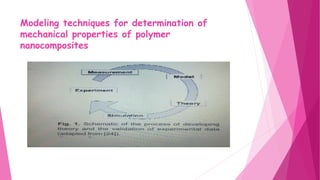
 The importance of modeling in understanding of the behavior of
matter .
 The earliest attempt to understanding material behavior is through
observation via experiments.
 Careful measurements of observed data are subsequently used for
the development of models that predict the observed behavior
under the corresponding conditions.
 The models are necessary to develop the theory. The theory is then
used to compare predicted behavior to experiments via simulation
Modeling techniques for determination of
mechanical properties of polymer
nanocomposites
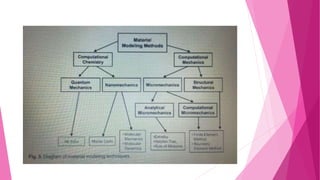
 The molecular modeling tools include molecular dynamics, Monte Carlo, and
Ab-initio techniques . Each of these continuum and molecular based
modeling methods are described below
 CONTINUUM METHODS These modeling methods assume the existence
of continuum for all calculations and generally do not include the chemical
interactions between the constituent phases of the composite. These
methods can be classified as either analytical or computational
 MOLECULAR MODELING In recent years molecular modeling has emerged as
an important tool in the prediction of physical material properties such as
elastic response, atomic structure, vibrational frequencies, heat of reaction,
electric permitivity, and binding energies .
 Continuum ( a range or series of things that are slightly different from
each other and that exit b/w two different possibilities.
Micro Structure Of Polymer
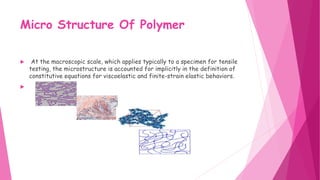
 At the macroscopic scale, which applies typically to a specimen for tensile
testing, the microstructure is accounted for implicitly in the definition of
constitutive equations for viscoelastic and finite-strain elastic behaviors.

 Identifying the elementary deformation mechanisms in polymers allows
defining relaxation times for viscoelasticity, and the role played by
adhesion between particles and a polymeric matrix helps describing the
Mullins effect that is observed in elastomers.
 At the microscopic scale, the volume fraction, shape, and orientation of
reinforcements affect the effective behavior of a composite strongly. The
homogenization techniques may then be employed to describe the relation
between microstructure and effective behavior.
 The anisotropic elastic and thermal expansion properties can be predicted,
which explain the shrinkage observed during the cooling of injection molded
short-fiber composites.
SEDIMENTATION
 Sedimentation is the process of depositing sediment. It is a treatment
process in which the velocity of the water is lowered below the suspension
velocity and the suspended particles settle out of the water due to gravity,
centrifugal acceleration or electromagnetism. Sedimentation has been used
to treat wastewater for millennia. Most water treatment plants include
sedimentation in their treatment processes.
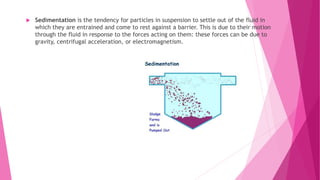
 Sedimentation is the tendency for particles in suspension to settle out of the fluid in
which they are entrained and come to rest against a barrier. This is due to their motion
through the fluid in response to the forces acting on them: these forces can be due to
gravity, centrifugal acceleration, or electromagnetism.
 A sedimentation tank is structure in which wastewater is filled and stored for
some time to remove the suspended particles present in the water. These
particles may settle at the bottom of the tank and are removed by using
scrapers. If the suspended particles have low specific gravity than water, they
settle at the top of the tank.
 Types of Sedimentation Tanks
 Depending upon various factors sedimentation tanks are classified as follows.
 1. Based on methods of operation
 a. Fill and draw type tank
 b. Continuous flow type tank
 2. Based on shape
 a. Circular tank
 b. Rectangular tank
 c. Hopper bottom tank
 3. Based on location
 a. Primary tank
 b. Secondary tank
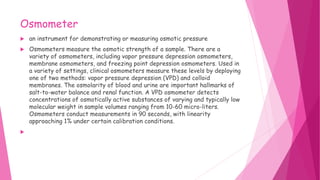
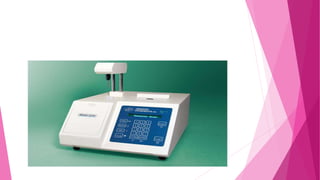
Osmometer
 an instrument for demonstrating or measuring osmotic pressure
 Osmometers measure the osmotic strength of a sample. There are a
variety of osmometers, including vapor pressure depression osmometers,
membrane osmometers, and freezing point depression osmometers. Used in
a variety of settings, clinical osmometers measure these levels by deploying
one of two methods: vapor pressure depression (VPD) and colloid
membranes. The osmolarity of blood and urine are important hallmarks of
salt-to-water balance and renal function. A VPD osmometer detects
concentrations of osmotically active substances of varying and typically low
molecular weight in sample volumes ranging from 10-60 micro-liters.
Osmometers conduct measurements in 90 seconds, with linearity
approaching 1% under certain calibration conditions.

Applications

Application in human- and veterinary medicine:
- Determination of osmolality from urine, blood or serum (kidney function
check)
Application in biological research:
- Determination of osmolality from nutrient solutions for cell culturing
- Determination of osmolality from fixing solutions for microscopic
specimen
- Determination of osmolality from haemolymph (bodyfluid of insects)
Application in botany:
- Determination of osmolality from plant saps
- Determination of osmolality from nutrient solutions
Continue
 Application in pharmaceutical industry:
- Osmolality of laboratory animals (as same as in veterinary medicine)
- Production check
Our end users:
- Private hospitals
- Sports Laboratories
- Pharmacology Departments
- Military Hospitals
- Contact Lens Manufacturers
- University Environmental Departments
- Therapeutic Antibody Centers
- Hospital Laboratories in general
- University Neuroscience Departments
- Biological Departments
References
 http://www.loeser-osmometer.de/anwend-eng.html
 https://onlinelibrary.wiley.com/doi/pdf/10.1111/j.1365-
2044.1978.tb08498.x
 https://www.researchgate.net/figure/Types-of-Sedimentation-271-
Classification-of-settling-behavior-Settling-particles-can_fig1_311985882
 https://www.tandfonline.com/doi/abs/10.1080/00372367508058996?jour
nalCode=lsst19
 https://www.google.com.pk/search?biw=1366&bih=672&tbm=isch&sa=1&ei=
aIbwWpvgFdCRkwX71b9w&q=sedimentation&oq=sedimentation&gs_l=img.3..
.6329068.6329068.0.6329422.1.1.0.0.0.0.0.0..0.0....0...1c.1.64.img..1.0.0....0.
OB9kTLl4hW0#imgrc=ALO_5G_tGqDLGM:
mechanical models of polymer behavior

mechanical models of polymer behavior

  • 1.
    Mechanical models ofpolymer behavior Microstructure Sedimentation osmometry Presented to :sir amrat Presented by : Tayyaba khalid Roll no:013 (B.s chem 15 ) CHEMISTRY DEPARTMENT SBBU SBA
  • 2.
    Content  Mechanical ModelsOf Polymer Behavior  Modeling Techniques For Determination Of Mechanical Properties Of Polymer Nanocomposites  Micro Structure Of Polymer  Sedimentation  Types Of Sedimentation  Osmometer  Applications  References
  • 3.
    Mechanical models ofpolymer behavior  The importance of modeling in understanding of the behavior of matter .  The earliest attempt to understanding material behavior is through observation via experiments.  Careful measurements of observed data are subsequently used for the development of models that predict the observed behavior under the corresponding conditions.  The models are necessary to develop the theory. The theory is then used to compare predicted behavior to experiments via simulation
  • 4.
    Modeling techniques fordetermination of mechanical properties of polymer nanocomposites
  • 5.
     The molecularmodeling tools include molecular dynamics, Monte Carlo, and Ab-initio techniques . Each of these continuum and molecular based modeling methods are described below  CONTINUUM METHODS These modeling methods assume the existence of continuum for all calculations and generally do not include the chemical interactions between the constituent phases of the composite. These methods can be classified as either analytical or computational  MOLECULAR MODELING In recent years molecular modeling has emerged as an important tool in the prediction of physical material properties such as elastic response, atomic structure, vibrational frequencies, heat of reaction, electric permitivity, and binding energies .  Continuum ( a range or series of things that are slightly different from each other and that exit b/w two different possibilities.
  • 7.
    Micro Structure OfPolymer  At the macroscopic scale, which applies typically to a specimen for tensile testing, the microstructure is accounted for implicitly in the definition of constitutive equations for viscoelastic and finite-strain elastic behaviors. 
  • 8.
     Identifying theelementary deformation mechanisms in polymers allows defining relaxation times for viscoelasticity, and the role played by adhesion between particles and a polymeric matrix helps describing the Mullins effect that is observed in elastomers.  At the microscopic scale, the volume fraction, shape, and orientation of reinforcements affect the effective behavior of a composite strongly. The homogenization techniques may then be employed to describe the relation between microstructure and effective behavior.  The anisotropic elastic and thermal expansion properties can be predicted, which explain the shrinkage observed during the cooling of injection molded short-fiber composites.
  • 9.
    SEDIMENTATION  Sedimentation isthe process of depositing sediment. It is a treatment process in which the velocity of the water is lowered below the suspension velocity and the suspended particles settle out of the water due to gravity, centrifugal acceleration or electromagnetism. Sedimentation has been used to treat wastewater for millennia. Most water treatment plants include sedimentation in their treatment processes.
  • 10.
     Sedimentation isthe tendency for particles in suspension to settle out of the fluid in which they are entrained and come to rest against a barrier. This is due to their motion through the fluid in response to the forces acting on them: these forces can be due to gravity, centrifugal acceleration, or electromagnetism.
  • 11.
     A sedimentationtank is structure in which wastewater is filled and stored for some time to remove the suspended particles present in the water. These particles may settle at the bottom of the tank and are removed by using scrapers. If the suspended particles have low specific gravity than water, they settle at the top of the tank.  Types of Sedimentation Tanks  Depending upon various factors sedimentation tanks are classified as follows.  1. Based on methods of operation  a. Fill and draw type tank  b. Continuous flow type tank  2. Based on shape  a. Circular tank  b. Rectangular tank  c. Hopper bottom tank  3. Based on location  a. Primary tank  b. Secondary tank
  • 12.
    Osmometer  an instrumentfor demonstrating or measuring osmotic pressure  Osmometers measure the osmotic strength of a sample. There are a variety of osmometers, including vapor pressure depression osmometers, membrane osmometers, and freezing point depression osmometers. Used in a variety of settings, clinical osmometers measure these levels by deploying one of two methods: vapor pressure depression (VPD) and colloid membranes. The osmolarity of blood and urine are important hallmarks of salt-to-water balance and renal function. A VPD osmometer detects concentrations of osmotically active substances of varying and typically low molecular weight in sample volumes ranging from 10-60 micro-liters. Osmometers conduct measurements in 90 seconds, with linearity approaching 1% under certain calibration conditions. 
  • 14.
    Applications  Application in human-and veterinary medicine: - Determination of osmolality from urine, blood or serum (kidney function check) Application in biological research: - Determination of osmolality from nutrient solutions for cell culturing - Determination of osmolality from fixing solutions for microscopic specimen - Determination of osmolality from haemolymph (bodyfluid of insects) Application in botany: - Determination of osmolality from plant saps - Determination of osmolality from nutrient solutions
  • 15.
    Continue  Application inpharmaceutical industry: - Osmolality of laboratory animals (as same as in veterinary medicine) - Production check Our end users: - Private hospitals - Sports Laboratories - Pharmacology Departments - Military Hospitals - Contact Lens Manufacturers - University Environmental Departments - Therapeutic Antibody Centers - Hospital Laboratories in general - University Neuroscience Departments - Biological Departments
  • 16.
    References  http://www.loeser-osmometer.de/anwend-eng.html  https://onlinelibrary.wiley.com/doi/pdf/10.1111/j.1365- 2044.1978.tb08498.x https://www.researchgate.net/figure/Types-of-Sedimentation-271- Classification-of-settling-behavior-Settling-particles-can_fig1_311985882  https://www.tandfonline.com/doi/abs/10.1080/00372367508058996?jour nalCode=lsst19  https://www.google.com.pk/search?biw=1366&bih=672&tbm=isch&sa=1&ei= aIbwWpvgFdCRkwX71b9w&q=sedimentation&oq=sedimentation&gs_l=img.3.. .6329068.6329068.0.6329422.1.1.0.0.0.0.0.0..0.0....0...1c.1.64.img..1.0.0....0. OB9kTLl4hW0#imgrc=ALO_5G_tGqDLGM:

Editor's Notes

  • #4 Simulation :something that is made a look ,feel or behave like something else specially so that it can studied or used to train people.
  • #6 Monte carlo: involving the use of random sampling techniques Dynamics: deals with forces and their relation primarily to the motion but sometimes also to the equilibrium of bidies.