An IntRoDucTion
TO
Concrete
by
RocKer AviNash
What is Concrete?
• Concrete is one of the most commonly used
building materials.
• Concrete is a composite material made from
several readily available constituents
(aggregates, sand, cement, water).
• Concrete is a versatile material that can
easily be mixed to meet a variety of special
needs and formed to virtually any shape.
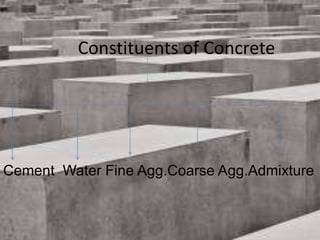
Constituents of Concrete
Cement Water Fine Agg.Coarse Agg.Admixture
PROPERTIES OF FRESH CONCRETE
Workability
Consistency
Segregation
Bleeding
Setting Time
Unit Weight
Uniformity
WORKABILITY
• Workability is the most important
property of freshly mixed concrete.
• There is no single test method that can
simultaneously measure all the properties
involved in workability.
• It is determined to a large extent by
measuring the “consistency” of the mix.
Factors Affecting Workability
• Method and duration of transportation
• Quantity and characteristics of cementing
materials
• Aggregate grading, shape and surface texture
• Quantity and characteristics of chemical
admixtures
• Amount of water
• Amount of entrained air
• Concrete & ambient air temperature
CONSISTENCY
 Consistency is the fluidity or degree of
wetness of concrete.
 It is generally dependent on the shear
resistance of the mass.
 It is a major factor in indicating the
workability of freshly mixed concrete.
SEGREGATION
• Segregation refers to a separation of the components of
fresh concrete, resulting in a non-uniform mix
Sp.Gr. Size
Cement 3-3.15 5-80 mm
C.Agg. 2.4-2.8 5-40 mm
F.Agg. 2.4-2.8 < 5 mm
 The primary causes of
segregation are differences
in specific gravity and size
of constituents of concrete.
Moreover, improper mixing,
improper placing and
improper consolidation also
lead to segregation.
SEGREGATION
Some of the factors affecting segregation:
–Larger maximum particle size (25mm) and
proportion of the larger particles.
–High specific gravity of coarse aggregate.
–Decrease in the amount of fine particles.
–Particle shape and texture.
–Water/cement ratio.
BLEEDING
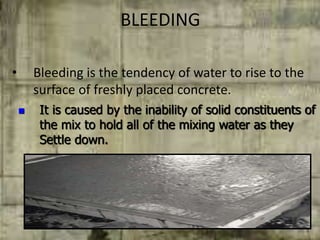
• Bleeding is the tendency of water to rise to the
surface of freshly placed concrete.
 It is caused by the inability of solid constituents of
the mix to hold all of the mixing water as they
Settle down.
BLEEDING
Undesirable effects of bleeding are:
• With the movement of water towards the top, the top portion
becomes weak & porous (high w/c). Thus the resistance of concrete

to freezing-thawing decreases.
• Water rising to the surface carry fine particles of cement which
weaken the top portion and form laitance. This portion is not
resistant to abrasion.
• Water may accumulate under the coarse agg. and reinforcement.
These large voids under the particles may lead to weak zones and
reduce the bond between paste and agg. or paste and
reinforcement.
MIXING OF CONCRETE
 The aim of mixing is to blend all of
the ingredients of the concrete to
form a uniform mass and to coat the
surface of aggregates with cement
paste.
MIXING OF CONCRETE
 Ready-Mix concrete: In this type ingredients
are introduced into a mixer truck and mixed
during transportation to the site.
• Wet – Water added before transportation
• Dry – Water added at site
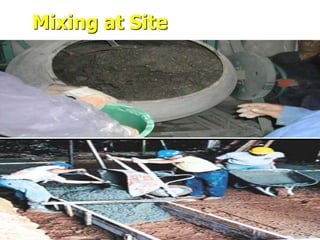
 Mixing at the site
• Hand mixed
• Mixer mixed
Ready Mix Concrete
Mixing at Site
MIXING OF CONCRETE
Mixing time should be sufficient to produce a
uniform concrete. The time of mixing depends
on the type of mixer and also to some
properties of fresh concrete.
 Undermixing → non-homogeneity
 Overmixing → danger of water loss,
brekage of aggregate particles
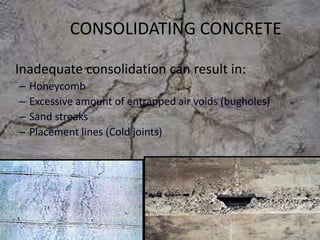
CONSOLIDATING CONCRETE
Inadequate consolidation can result in:
– Honeycomb
– Excessive amount of entrapped air voids (bugholes)
– Sand streaks
– Placement lines (Cold joints)
VIBRATION OF CONCRETE
 The process of compacting concrete
consists essentially of the elimination of
entrapped air. This can be achieved by:
– Tamping or rodding the concrete
– Use of vibrators
VIBRATORS
 Internal vibrator: The poker is immersed
into concrete to compact it. The poker is
easily removed from point to point.
 External vibrators: External vibrators
clamp direct to the formwork requiring
strong, rigid forms.
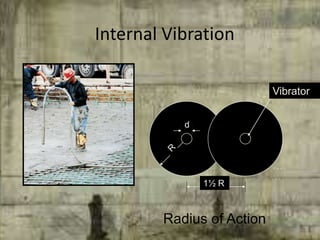
Internal Vibration
d
1½ R
Vibrator
Radius of Action
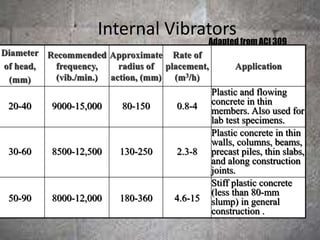
Internal Vibrators
Diameter
of head,
(mm)
Recommended
frequency,
(vib./min.)
Approximate
radius of
action, (mm)
Rate of
placement,
(m3/h)
Application
20-40 9000-15,000 80-150 0.8-4
Plastic and flowing
concrete in thin
members. Also used for
lab test specimens.
30-60 8500-12,500 130-250 2.3-8
Plastic concrete in thin
walls, columns, beams,
precast piles, thin slabs,
and along construction
joints.
50-90 8000-12,000 180-360 4.6-15
Stiff plastic concrete
(less than 80-mm
slump) in general
construction .
Adapted from ACI 309
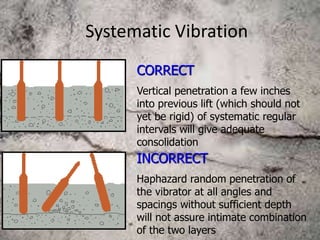
Systematic Vibration
CORRECT
Vertical penetration a few inches
into previous lift (which should not
yet be rigid) of systematic regular
intervals will give adequate
consolidation
INCORRECT
Haphazard random penetration of
the vibrator at all angles and
spacings without sufficient depth
will not assure intimate combination
of the two layers
External Vibrators
• Form vibrators
• Vibrating tables (Lab)
• Surface vibrators
– Vibratory screeds
– Plate vibrators
– Vibratory roller screeds
– Vibratory hand floats or
trowels
External Vibrators
 External vibrators are rigidly clamped to the formwork
so that both the form & concrete are subjected to
vibration.
 A considerable amount of work is needed to vibrate
forms.
 Forms must be strong and tied enough to prevent
distortion and leakage of the grout.
CURING OF CONCRETE
 Properties of concrete can improve with age as long
as conditions are favorable for the continued
hydration of cement. These improvements are rapid
at early ages and continues slowly for an indefinite
period of time.
 Curing is the procedures used for promoting the
hydration of cement and consists of a control of
temperature and the moisture movement from and
into the concrete.
CURING OF CONCRETE
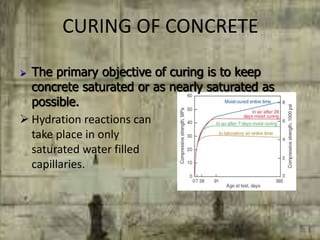
 Hydration reactions can
take place in only
saturated water filled
capillaries.
 The primary objective of curing is to keep
concrete saturated or as nearly saturated as
possible.
Curing Methods
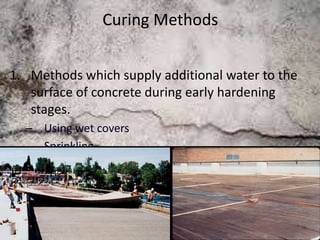
1. Methods which supply additional water to the
surface of concrete during early hardening
stages.
– Using wet covers
– Sprinkling
– Ponding
Curing Methods
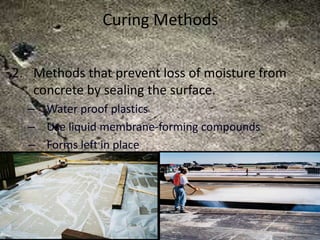
2. Methods that prevent loss of moisture from
concrete by sealing the surface.
– Water proof plastics
– Use liquid membrane-forming compounds
– Forms left in place
Curing Methods
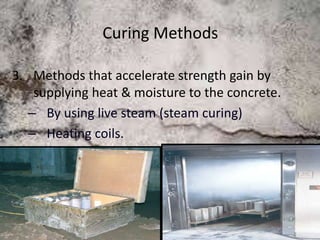
3. Methods that accelerate strength gain by
supplying heat & moisture to the concrete.
– By using live steam (steam curing)
– Heating coils.
Hot Weather Concrete
• Rapid hydration  early setting  rapid loss of
workability
• Extra problems due to
– Low humidity
– Wind, excessive evaporation
– Direct sunlight
Solutions
– Windbreaks
– Cooled Concrete Ingredients
– Water ponding (cooling due to evaporation)
– Reflective coatings/coverings
Cold Weather Concrete
• Keep concrete temperature above 5 °C to
minimize danger of freezing
Solutions
– Heated enclosures, insulation
– Rely on heat of hydration for larger sections
– Heated ingredients --- concrete hot when placed
– High early strength cement
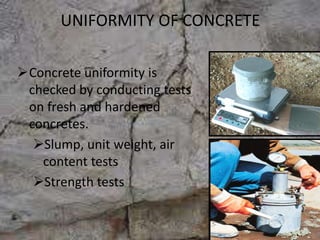
UNIFORMITY OF CONCRETE
Concrete uniformity is
checked by conducting tests
on fresh and hardened
concretes.
Slump, unit weight, air
content tests
Strength tests
UNIFORMITY OF CONCRETE
Due to heteregeneous nature of concrete, there
will always be some variations. These variations
are grouped as:
–Within-Batch Variations : inadequate mixing,
non-homogeneous nature
–Batch-to-Batch Variations : type of materials
used, changes in gradation of aggregates,
changes in moisture content of aggregates
Advantages of Concrete
• Ability to be cast
• Economical
• Durable
• Fire Resistant
• Energy efficient
• On site fabrication
Disadvantages Of Concrete
• Low tensile Strength.
• Low Ductility.
• Volume instability.
• Low Strength to Weight ratio.
Concrete

Concrete

  • 1.
  • 2.
    What is Concrete? •Concrete is one of the most commonly used building materials. • Concrete is a composite material made from several readily available constituents (aggregates, sand, cement, water). • Concrete is a versatile material that can easily be mixed to meet a variety of special needs and formed to virtually any shape.
  • 3.
    Constituents of Concrete CementWater Fine Agg.Coarse Agg.Admixture
  • 4.
    PROPERTIES OF FRESHCONCRETE Workability Consistency Segregation Bleeding Setting Time Unit Weight Uniformity
  • 5.
    WORKABILITY • Workability isthe most important property of freshly mixed concrete. • There is no single test method that can simultaneously measure all the properties involved in workability. • It is determined to a large extent by measuring the “consistency” of the mix.
  • 6.
    Factors Affecting Workability •Method and duration of transportation • Quantity and characteristics of cementing materials • Aggregate grading, shape and surface texture • Quantity and characteristics of chemical admixtures • Amount of water • Amount of entrained air • Concrete & ambient air temperature
  • 7.
    CONSISTENCY  Consistency isthe fluidity or degree of wetness of concrete.  It is generally dependent on the shear resistance of the mass.  It is a major factor in indicating the workability of freshly mixed concrete.
  • 8.
    SEGREGATION • Segregation refersto a separation of the components of fresh concrete, resulting in a non-uniform mix Sp.Gr. Size Cement 3-3.15 5-80 mm C.Agg. 2.4-2.8 5-40 mm F.Agg. 2.4-2.8 < 5 mm  The primary causes of segregation are differences in specific gravity and size of constituents of concrete. Moreover, improper mixing, improper placing and improper consolidation also lead to segregation.
  • 9.
    SEGREGATION Some of thefactors affecting segregation: –Larger maximum particle size (25mm) and proportion of the larger particles. –High specific gravity of coarse aggregate. –Decrease in the amount of fine particles. –Particle shape and texture. –Water/cement ratio.
  • 10.
    BLEEDING • Bleeding isthe tendency of water to rise to the surface of freshly placed concrete.  It is caused by the inability of solid constituents of the mix to hold all of the mixing water as they Settle down.
  • 11.
    BLEEDING Undesirable effects ofbleeding are: • With the movement of water towards the top, the top portion becomes weak & porous (high w/c). Thus the resistance of concrete to freezing-thawing decreases. • Water rising to the surface carry fine particles of cement which weaken the top portion and form laitance. This portion is not resistant to abrasion. • Water may accumulate under the coarse agg. and reinforcement. These large voids under the particles may lead to weak zones and reduce the bond between paste and agg. or paste and reinforcement.
  • 12.
    MIXING OF CONCRETE The aim of mixing is to blend all of the ingredients of the concrete to form a uniform mass and to coat the surface of aggregates with cement paste.
  • 13.
    MIXING OF CONCRETE Ready-Mix concrete: In this type ingredients are introduced into a mixer truck and mixed during transportation to the site. • Wet – Water added before transportation • Dry – Water added at site  Mixing at the site • Hand mixed • Mixer mixed
  • 14.
  • 15.
  • 16.
    MIXING OF CONCRETE Mixingtime should be sufficient to produce a uniform concrete. The time of mixing depends on the type of mixer and also to some properties of fresh concrete.  Undermixing → non-homogeneity  Overmixing → danger of water loss, brekage of aggregate particles
  • 17.
    CONSOLIDATING CONCRETE Inadequate consolidationcan result in: – Honeycomb – Excessive amount of entrapped air voids (bugholes) – Sand streaks – Placement lines (Cold joints)
  • 18.
    VIBRATION OF CONCRETE The process of compacting concrete consists essentially of the elimination of entrapped air. This can be achieved by: – Tamping or rodding the concrete – Use of vibrators
  • 19.
    VIBRATORS  Internal vibrator:The poker is immersed into concrete to compact it. The poker is easily removed from point to point.  External vibrators: External vibrators clamp direct to the formwork requiring strong, rigid forms.
  • 20.
  • 21.
    Internal Vibrators Diameter of head, (mm) Recommended frequency, (vib./min.) Approximate radiusof action, (mm) Rate of placement, (m3/h) Application 20-40 9000-15,000 80-150 0.8-4 Plastic and flowing concrete in thin members. Also used for lab test specimens. 30-60 8500-12,500 130-250 2.3-8 Plastic concrete in thin walls, columns, beams, precast piles, thin slabs, and along construction joints. 50-90 8000-12,000 180-360 4.6-15 Stiff plastic concrete (less than 80-mm slump) in general construction . Adapted from ACI 309
  • 22.
    Systematic Vibration CORRECT Vertical penetrationa few inches into previous lift (which should not yet be rigid) of systematic regular intervals will give adequate consolidation INCORRECT Haphazard random penetration of the vibrator at all angles and spacings without sufficient depth will not assure intimate combination of the two layers
  • 23.
    External Vibrators • Formvibrators • Vibrating tables (Lab) • Surface vibrators – Vibratory screeds – Plate vibrators – Vibratory roller screeds – Vibratory hand floats or trowels
  • 24.
    External Vibrators  Externalvibrators are rigidly clamped to the formwork so that both the form & concrete are subjected to vibration.  A considerable amount of work is needed to vibrate forms.  Forms must be strong and tied enough to prevent distortion and leakage of the grout.
  • 25.
    CURING OF CONCRETE Properties of concrete can improve with age as long as conditions are favorable for the continued hydration of cement. These improvements are rapid at early ages and continues slowly for an indefinite period of time.  Curing is the procedures used for promoting the hydration of cement and consists of a control of temperature and the moisture movement from and into the concrete.
  • 26.
    CURING OF CONCRETE Hydration reactions can take place in only saturated water filled capillaries.  The primary objective of curing is to keep concrete saturated or as nearly saturated as possible.
  • 27.
    Curing Methods 1. Methodswhich supply additional water to the surface of concrete during early hardening stages. – Using wet covers – Sprinkling – Ponding
  • 28.
    Curing Methods 2. Methodsthat prevent loss of moisture from concrete by sealing the surface. – Water proof plastics – Use liquid membrane-forming compounds – Forms left in place
  • 29.
    Curing Methods 3. Methodsthat accelerate strength gain by supplying heat & moisture to the concrete. – By using live steam (steam curing) – Heating coils.
  • 30.
    Hot Weather Concrete •Rapid hydration  early setting  rapid loss of workability • Extra problems due to – Low humidity – Wind, excessive evaporation – Direct sunlight Solutions – Windbreaks – Cooled Concrete Ingredients – Water ponding (cooling due to evaporation) – Reflective coatings/coverings
  • 31.
    Cold Weather Concrete •Keep concrete temperature above 5 °C to minimize danger of freezing Solutions – Heated enclosures, insulation – Rely on heat of hydration for larger sections – Heated ingredients --- concrete hot when placed – High early strength cement
  • 32.
    UNIFORMITY OF CONCRETE Concreteuniformity is checked by conducting tests on fresh and hardened concretes. Slump, unit weight, air content tests Strength tests
  • 33.
    UNIFORMITY OF CONCRETE Dueto heteregeneous nature of concrete, there will always be some variations. These variations are grouped as: –Within-Batch Variations : inadequate mixing, non-homogeneous nature –Batch-to-Batch Variations : type of materials used, changes in gradation of aggregates, changes in moisture content of aggregates
  • 34.
    Advantages of Concrete •Ability to be cast • Economical • Durable • Fire Resistant • Energy efficient • On site fabrication
  • 35.
    Disadvantages Of Concrete •Low tensile Strength. • Low Ductility. • Volume instability. • Low Strength to Weight ratio.