
MEARL OIL COMPANY : ENVIRONMENTAL
        IMPACT TARGETS (A)
     SIPUT BULLS EYE
                Sindikat Paling IMUT
                but Still EYESYiiiiiik !!!


                                             Yuliana Irmina
                                             Vanessa Fitri
                                             Ronaldo Bagus Putra
                                             Wisnumurti Raharjo
                                             Albertus Harvid
                                             Imam Mashari
Mearl Plant
• In Indonesia, many industrial facilities in the area
  were discharging wastewater into open ditches,
  which could present a serious environmental and
  health hazard

• Many Australian industrial plants had been accused
  of moving to Indonesia in order to take advantage of
  the lower environmental standards

• To ensure that its plans located in Indonesia weren’t
  accused of this, Mearl Oil Company issued a Water
  Effluent Management memo

• Mearl established a new policy in May 2003, called
  Mearl Environmental Impact Targets (EITs)
The Oil and Gas Industry
        •   The oil and gas industry was the largest in the
            world, valued between US$ 2 triilion and US$ 5
            trillion.

        •   The United Nations’ Environment Programme’s
            Intergovernmental Panel on Climate Change
            reported in 2001 that during the 20th century,
            the global average surface temperature
            increased by 0,6oC and the global average sea
            level rose between 0.1 and 0.2 meters.

        •   The substantial scientific evidence for global
            warming had oil and gas companies exploring
            new means to create green energy while
            carefully managing public opinion around their
            current fossil fuel operations.

        •   Oil and gas companies were increasingly
            cognizant of the need for a public license to
            operate and carefully managed their reputation
            to preserve an enhance this social license.
Environmental Impacts of the Oil and
          Gas Industry
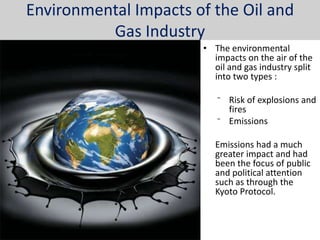
                       • The environmental
                         impacts on the air of the
                         oil and gas industry split
                         into two types :

                          ⁻ Risk of explosions and
                            fires
                          ⁻ Emissions

                          Emissions had a much
                          greater impact and had
                          been the focus of public
                          and political attention
                          such as through the
                          Kyoto Protocol.
• Air Emissions included :
  ‐ Sulfur Dioxide (SO2)
  ‐ Nitrous Oxides (NOx)
  ‐ Hydrogen Sulphide
  ‐ Hydrocarbons (HCs)
  ‐ Benzene
  ‐ Carbon Monoxide (CO)
  ‐ Carbon Dioxide (CO2)
  ‐ Mercaptans
  ‐ Toxic organic
    compounds
  ‐ Odors
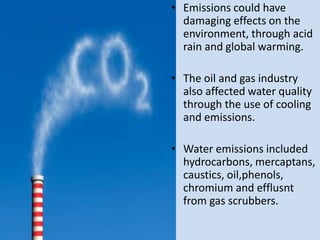
• Emissions could have
  damaging effects on the
  environment, through acid
  rain and global warming.

• The oil and gas industry
  also affected water quality
  through the use of cooling
  and emissions.

• Water emissions included
  hydrocarbons, mercaptans,
  caustics, oil,phenols,
  chromium and efflusnt
  from gas scrubbers.
• Two motivations for firms to reduce
             environmental impacts :
             ⁻ Managing risk
             ⁻ Creating opportunity through
                innovation

           • Risk management included complying
             with current regulations and foreseeing
             legislative changes.

           • Risk management motivated most
             companies to reduce impacts, many
Reducing     firm had gained a competitive
             advantage by finding innovative ways to
Impacts      reduce their environmental footprint.
• The most common way of achieving this
                   was through reduced resource consumption
                   and thus lower costs.

                 • A challenge for multinationals was that
                   different juridictions measured discharges
                   in different ways, which caused difficulties
                   conforming to a baseline global
                   environmental performance standard.


  Reducing
Impacts (cont)
MEARL OIL COMPANY CORPORATE
             PROFILE
• Founded in 1947
• 2003 revenue of $210 billion
• Had more than 200 major subsidiaries, joint
  ventures, and affiliates
• Employed more than 250.000
• Partnered with over 8.000 supplier companies
• Operations in 30 countries
Renewable Energy Division
          • Created in 1994

          • Explore the company’s various option for
            hedging against the end of the fossil fuel era

          • Started with a modest budget of $100 million

          • In 2003, the division budget was $1.4 billion
• 2002 ROACE proves that all Mearl team members
  are pushing together into a greener, more
  profitable future
MEARL’S ENVIRONMENTAL POLICY


• Environmental values were
  first developed in the late
  1970s and were refined in
  Mearl’s Environmental Policy
  in 1993

• Ore tightly defined standards
  needed to be imposed on
  Mearl operations worldwide
ENVIRONMENTAL IMPACT TARGETS
            • The Mearl Support System, Environmental,
              was formed in 1995

            • Built to provide direction, guidance, service
              and support to Mearl operations through
              implementation of the Mearl Environmental
              Policy

            • The Mearl EITs were established in 2003 to
              supplement legal requirements, and any
              other local or regional Mearl environmental
              requirements.
ENVIRONMENTAL IMPACT TARGETS
            • Mearl had an environmental management
              system in place and was moving its facilities
              to the ISO 14001 standard.


            • In May 2003, the EITs were finalized and
              communicated throughout Mearl
INTERNATIONAL ENVIRONMENT
                   GROUP
• Mearl International Environment
  Group (IEG) was established in
  January 2004

• The objective:
   – To address common facility
     environmental issues that affect
     Mearl operations worldwide
   – Develop common global
     strategies and recommendations
     consistent with Mearl’s
     Environmental Policy
   – The IEG consisted of
     representatives of Mearl
     operations from around the
     globe
MEARL CANADA LIMITED
            • Canada’s largest producer of
              crude oil and natural gas

            • Had 27 extracting facilities, as
              well as five refineries and
              many marketing offices

            • Mearlcan employed
              approximately 15.000 people

            • Had the capacity to extract 60
              million barrels of oil per year,
              which 75% was shipped to the
              United States
The Path Forward
           • Mearlcan specific concern was
             associated with one of its
             manufacturing operations that
             did not conform to the
             effluent requirements in the
             Water Effluent Management

           • The effluent quality of the
             process wastewater met all
             sewer use by law limits

           • The plant have to install its
             own biological treatment plant
             for sanitary waste
The Path Forward
           • Capital and operating costs
             associated with the biological
             sanitary treatment plant
             would make it difficult fot the
             plant to reach its business
             goals

           • Milne strongly supported the
             performance requirements in
             the water effluent
             management EIT and believed
             its applicability should include
             Mearlcan operations

           • Milne have to prepare the
             application of the uniform,
             global environmental impact
             targets in next meeting
Main Problem
• The Mearl Oil Company central had given its
  Mearl EITs for Water Effluent Management to
  Mearl’s global operations. . MearlCan said
  that EITs for Water Effluent Managment was
  only make sense to the operations in
  developing countries.
• MearlCan had met the high environmental
  standard in Canada. So EITs would affect in
  increasing the capital cost or administrative
  burden on its operation. It would only cause
  competitive disadvantage to MearlCan if the
  EITs was going to be an obligatory to global
  Mearl operations .
Main Problem
• The central Mearl Oil Company wanted
  to standardize the environmental policy
  for global operation of Mearl company,
  that was EITs, but MearlCan said that it
  was only make sense for Mearl
  operations in developing countries not
  in countries with extensive regulatory
  and legislative control for
  environmental standard
• The difference of point of view from the
  central Mearl company and MearlCan
  in executing the Mearl EIT for Water
  Effluent Management
LESSON LEARNED
• Companies should be proactive on processing
  their waste to avoid the negative impact for the
  environment
• Standard must be made for each companies, and
  the standard must meet the national’s standard
• Companies must consider their environment cost
  as their main cost to avoid the inability to pay for
  waste processing cost
Mearl Oil Company

Mearl Oil Company

  • 1.
    MEARL OIL COMPANY: ENVIRONMENTAL IMPACT TARGETS (A) SIPUT BULLS EYE Sindikat Paling IMUT but Still EYESYiiiiiik !!! Yuliana Irmina Vanessa Fitri Ronaldo Bagus Putra Wisnumurti Raharjo Albertus Harvid Imam Mashari
  • 2.
    Mearl Plant • InIndonesia, many industrial facilities in the area were discharging wastewater into open ditches, which could present a serious environmental and health hazard • Many Australian industrial plants had been accused of moving to Indonesia in order to take advantage of the lower environmental standards • To ensure that its plans located in Indonesia weren’t accused of this, Mearl Oil Company issued a Water Effluent Management memo • Mearl established a new policy in May 2003, called Mearl Environmental Impact Targets (EITs)
  • 3.
    The Oil andGas Industry • The oil and gas industry was the largest in the world, valued between US$ 2 triilion and US$ 5 trillion. • The United Nations’ Environment Programme’s Intergovernmental Panel on Climate Change reported in 2001 that during the 20th century, the global average surface temperature increased by 0,6oC and the global average sea level rose between 0.1 and 0.2 meters. • The substantial scientific evidence for global warming had oil and gas companies exploring new means to create green energy while carefully managing public opinion around their current fossil fuel operations. • Oil and gas companies were increasingly cognizant of the need for a public license to operate and carefully managed their reputation to preserve an enhance this social license.
  • 4.
    Environmental Impacts ofthe Oil and Gas Industry • The environmental impacts on the air of the oil and gas industry split into two types : ⁻ Risk of explosions and fires ⁻ Emissions Emissions had a much greater impact and had been the focus of public and political attention such as through the Kyoto Protocol.
  • 5.
    • Air Emissionsincluded : ‐ Sulfur Dioxide (SO2) ‐ Nitrous Oxides (NOx) ‐ Hydrogen Sulphide ‐ Hydrocarbons (HCs) ‐ Benzene ‐ Carbon Monoxide (CO) ‐ Carbon Dioxide (CO2) ‐ Mercaptans ‐ Toxic organic compounds ‐ Odors
  • 6.
    • Emissions couldhave damaging effects on the environment, through acid rain and global warming. • The oil and gas industry also affected water quality through the use of cooling and emissions. • Water emissions included hydrocarbons, mercaptans, caustics, oil,phenols, chromium and efflusnt from gas scrubbers.
  • 7.
    • Two motivationsfor firms to reduce environmental impacts : ⁻ Managing risk ⁻ Creating opportunity through innovation • Risk management included complying with current regulations and foreseeing legislative changes. • Risk management motivated most companies to reduce impacts, many Reducing firm had gained a competitive advantage by finding innovative ways to Impacts reduce their environmental footprint.
  • 8.
    • The mostcommon way of achieving this was through reduced resource consumption and thus lower costs. • A challenge for multinationals was that different juridictions measured discharges in different ways, which caused difficulties conforming to a baseline global environmental performance standard. Reducing Impacts (cont)
  • 9.
    MEARL OIL COMPANYCORPORATE PROFILE • Founded in 1947 • 2003 revenue of $210 billion • Had more than 200 major subsidiaries, joint ventures, and affiliates • Employed more than 250.000 • Partnered with over 8.000 supplier companies • Operations in 30 countries
  • 10.
    Renewable Energy Division • Created in 1994 • Explore the company’s various option for hedging against the end of the fossil fuel era • Started with a modest budget of $100 million • In 2003, the division budget was $1.4 billion
  • 11.
    • 2002 ROACEproves that all Mearl team members are pushing together into a greener, more profitable future
  • 12.
    MEARL’S ENVIRONMENTAL POLICY •Environmental values were first developed in the late 1970s and were refined in Mearl’s Environmental Policy in 1993 • Ore tightly defined standards needed to be imposed on Mearl operations worldwide
  • 13.
    ENVIRONMENTAL IMPACT TARGETS • The Mearl Support System, Environmental, was formed in 1995 • Built to provide direction, guidance, service and support to Mearl operations through implementation of the Mearl Environmental Policy • The Mearl EITs were established in 2003 to supplement legal requirements, and any other local or regional Mearl environmental requirements.
  • 14.
    ENVIRONMENTAL IMPACT TARGETS • Mearl had an environmental management system in place and was moving its facilities to the ISO 14001 standard. • In May 2003, the EITs were finalized and communicated throughout Mearl
  • 15.
    INTERNATIONAL ENVIRONMENT GROUP • Mearl International Environment Group (IEG) was established in January 2004 • The objective: – To address common facility environmental issues that affect Mearl operations worldwide – Develop common global strategies and recommendations consistent with Mearl’s Environmental Policy – The IEG consisted of representatives of Mearl operations from around the globe
  • 16.
    MEARL CANADA LIMITED • Canada’s largest producer of crude oil and natural gas • Had 27 extracting facilities, as well as five refineries and many marketing offices • Mearlcan employed approximately 15.000 people • Had the capacity to extract 60 million barrels of oil per year, which 75% was shipped to the United States
  • 17.
    The Path Forward • Mearlcan specific concern was associated with one of its manufacturing operations that did not conform to the effluent requirements in the Water Effluent Management • The effluent quality of the process wastewater met all sewer use by law limits • The plant have to install its own biological treatment plant for sanitary waste
  • 18.
    The Path Forward • Capital and operating costs associated with the biological sanitary treatment plant would make it difficult fot the plant to reach its business goals • Milne strongly supported the performance requirements in the water effluent management EIT and believed its applicability should include Mearlcan operations • Milne have to prepare the application of the uniform, global environmental impact targets in next meeting
  • 19.
    Main Problem • TheMearl Oil Company central had given its Mearl EITs for Water Effluent Management to Mearl’s global operations. . MearlCan said that EITs for Water Effluent Managment was only make sense to the operations in developing countries. • MearlCan had met the high environmental standard in Canada. So EITs would affect in increasing the capital cost or administrative burden on its operation. It would only cause competitive disadvantage to MearlCan if the EITs was going to be an obligatory to global Mearl operations .
  • 20.
    Main Problem • Thecentral Mearl Oil Company wanted to standardize the environmental policy for global operation of Mearl company, that was EITs, but MearlCan said that it was only make sense for Mearl operations in developing countries not in countries with extensive regulatory and legislative control for environmental standard • The difference of point of view from the central Mearl company and MearlCan in executing the Mearl EIT for Water Effluent Management
  • 21.
    LESSON LEARNED • Companiesshould be proactive on processing their waste to avoid the negative impact for the environment • Standard must be made for each companies, and the standard must meet the national’s standard • Companies must consider their environment cost as their main cost to avoid the inability to pay for waste processing cost